

Airport at a Glance
| Field | Detail |
|---|---|
| Airport | Roanoke-Blacksburg Regional Airport (Woodrum Field) |
| IATA Code | ROA |
| Country | United States |
| City | Roanoke, Virginia (serving the Roanoke Valley and New River Valley) |
| Annual Passengers | 756,000 total passengers in 2024, an all-time record, with 55,315 aircraft operations and 27 million pounds of cargo. Domestic only, no scheduled international service. |
| Primary Audience | University and research sector travellers, healthcare and biomedical professionals, corporate and manufacturing executives, affluent retirees and second-home owners |
| Peak Advertising Season | September to November, April to June |
| Audience Tier | Tier 2 by audience value, Tier 2 by passenger volume |
| Best Fit Categories | Healthcare and health systems, higher education and research, private aviation and wealth management, destination and retirement marketing |
A record-setting non-hub airport whose catchment contains a top-tier research university, a major academic health system, and one of the strongest recapture stories in American regional aviation.
Roanoke-Blacksburg posted an all-time record of 756,000 total passengers in 2024 alongside 55,315 aircraft operations, and the trajectory continued through 2025 as carriers added frequency, capacity, and routes. The airport sits three miles from downtown Roanoke on I-581, three miles from Interstate 81, and serves more than 1.6 million people within a two-hour drive spanning the Roanoke, Blacksburg-Christiansburg-Radford, and Lynchburg metropolitan areas plus much of southern West Virginia and northern North Carolina. American, Delta, and United fly daily to Atlanta, Charlotte, Washington Dulles, Chicago O'Hare, Philadelphia, and New York LaGuardia, with Allegiant serving three Florida markets.
The commercially important story is what has been happening beneath the headline number. For years this catchment leaked passengers to Greensboro, Charlotte, Raleigh-Durham, and Dulles. As service improved, that leakage fell and the recapture drove the record. That means the passenger base is not just growing, it is becoming more representative of the region's actual economic weight, which includes a major land-grant research university, a large academic health system and biomedical research institute, and an advanced manufacturing corridor. Advertisers who priced this airport on its old numbers are now buying a materially better audience than the historic data implies.
Advertising Value Snapshot
- Passenger scale: 756,000 total passengers in 2024, an all-time record, with 55,315 aircraft operations and 27 million pounds of cargo. Growth driven by route and frequency additions that recaptured leakage from surrounding hubs.
- Traveller type: University faculty, researchers and visiting academics, healthcare and biomedical professionals, corporate and advanced manufacturing executives, and affluent retirees and second-home owners.
- Airport classification: Tier 2 on both volume and audience value. FAA-categorised as a non-hub primary commercial service airport, but with a catchment quality well above what that classification suggests.
- Commercial positioning: The Blue Ridge gateway for southwestern Virginia, serving a research university, an academic medical centre, and a national outdoor recreation destination through one terminal.
- Wealth corridor signal: The airport sits on the Northeast and Mid-Atlantic to Blue Ridge corridor, carrying university and medical traffic outbound and retiree, second-home, and outdoor tourism capital inbound.
- Advertising opportunity: A single compact terminal with a highly-rated passenger experience means one brand can own the entire journey rather than compete for fragmented attention. Masscom Global secures placement across check-in, security, gate, and baggage claim touchpoints where the small footprint concentrates dwell. Notably, a substantial fractional and private aviation presence operates alongside scheduled service, adding a high-net-worth layer to the same environment.
Airport Advertising is Complex to Get Right
We help you execute faster, with proven results and local insight most planners lack starting now.
Talk to an Expert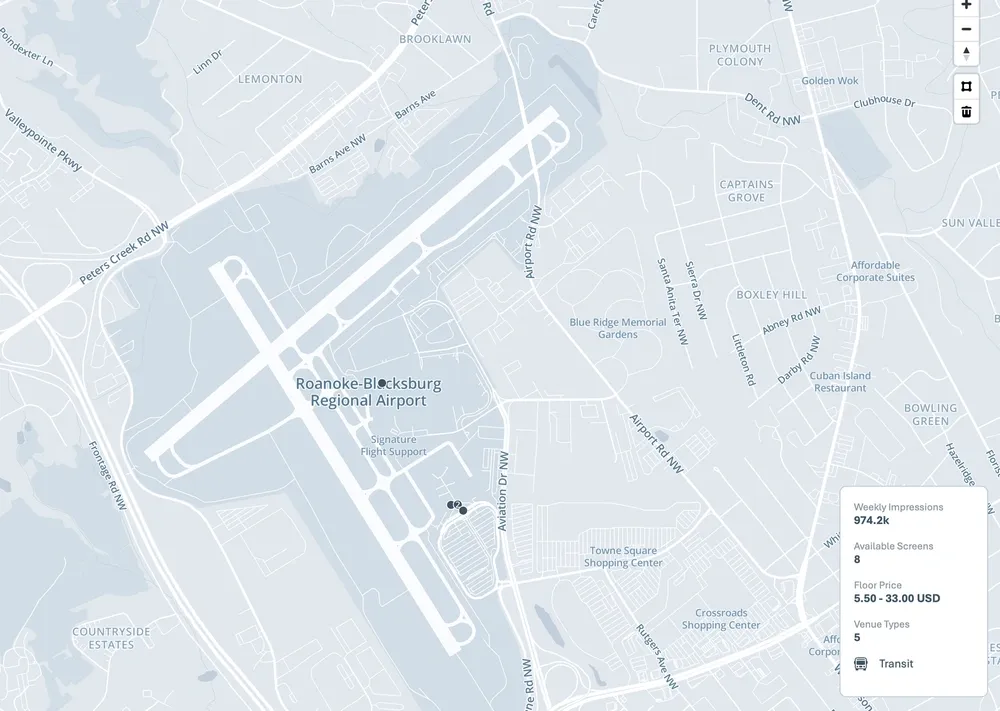
Catchment Area and Economic Drivers
Top 10 Cities within 150 km, Marketer Intelligence:
- Roanoke: The commercial and medical capital of southwestern Virginia. Concentrates a large academic health system, a biomedical research institute, professional services, and corporate headquarters activity. Produces the highest-income professional audience in the catchment.
- Blacksburg: Home to a major land-grant research university with roughly 38,000 students and substantial federal and corporate research funding. Produces faculty, researchers, visiting academics, and a very large parent and alumni travel base.
- Christiansburg: The retail and commercial anchor of the New River Valley, serving the university corridor. Produces suburban household consumers with strong retail and automotive spending.
- Salem: Manufacturing and light industrial base including significant tyre and industrial production, alongside a well-established sports events profile. Produces plant management and industrial procurement audiences.
- Radford: University town and industrial centre, with a major federal ammunition facility nearby. Produces academic, defence-linked, and government contracting audiences.
- Lynchburg: A large education and manufacturing market with one of the largest private universities in the United States by enrolment, plus nuclear and industrial engineering employers. Produces a substantial student, parent, and technical professional travel base.
- Bedford and Smith Mountain Lake: The catchment's second-home and retirement wealth corridor, drawing affluent buyers from the Northeast and Mid-Atlantic. Produces the strongest luxury consumer, wealth management, and premium services audience in the region.
- Dublin and Pulaski: Anchored by one of the world's largest heavy truck assembly operations and a growing autonomous vehicle technology presence. Produces manufacturing leadership and advanced mobility engineering audiences.
- Martinsville: Motorsport heritage and advanced materials manufacturing. Produces a distinct event-driven visitor flow alongside an industrial workforce.
- Lexington and the Rockbridge corridor: Two historic colleges plus heritage and equestrian tourism. Produces an affluent, education-linked visitor and alumni audience.
NRI and Diaspora Intelligence:
There is no large traditional diaspora community driving traffic here, but there is a commercially significant international academic population that advertisers routinely overlook. The research university in the catchment hosts a substantial international student and faculty body, weighted toward China, India, South Korea, and Iran, whose families travel internationally to visit and who represent genuine household wealth in their home markets. Alongside this, the Lynchburg institution draws students nationally and internationally at scale. The relevant insight is that this catchment carries a recurring international family travel flow tied to the academic calendar, and international banking, education, travel, and property brands can reach those families at predictable moments each year.
Economic Importance:
Four engines drive this catchment. Higher education and research is the largest by employment and by travel generation, anchored by a major land-grant university and several other institutions. Healthcare and biomedical research is the fastest-growing, centred on an academic health system, a medical school, and a biomedical research institute in Roanoke's innovation corridor. Advanced manufacturing forms the third engine, including heavy truck assembly, tyre production, and industrial materials. Outdoor recreation and second-home tourism is the fourth, built on the Blue Ridge Parkway, the Appalachian Trail, and a substantial lake community. Masscom Global maps creative to the engine an advertiser is selling into rather than treating the terminal as one audience.
Business and Industrial Ecosystem
- Higher education and university research: A major research university plus several additional institutions generate faculty, grant-funded researcher, conference, and recruiter travel year-round, alongside enormous parent and alumni movement in defined windows.
- Academic healthcare and biomedical research: A large regional health system, a medical school, and a biomedical research institute concentrate physicians, principal investigators, and life sciences executives in a single innovation district.
- Advanced manufacturing and heavy transport: Heavy truck assembly, tyre manufacturing, and industrial materials production across the New River Valley and Roanoke Valley produce plant leadership and procurement decision makers with capital budgets.
- Autonomous vehicle and mobility technology: A growing self-driving commercial vehicle development presence in the university corridor produces a young, highly compensated engineering audience and recurring corporate travel.
Passenger Intent, Business Segment:
Business travellers here are heavily weighted toward institutions rather than corporations, and that changes what works. They are physicians and principal investigators travelling to conferences, university administrators and recruiters, engineering leadership from the manufacturing corridor, and technology staff commuting to corporate parents elsewhere. They are educated, evidence-driven, and sceptical of unsupported claims. Medical devices and pharmaceutical services, research instrumentation, professional services and recruitment, commercial banking, business travel and accommodation, and technology B2B intercept them most effectively.
Strategic Insight:
The distinguishing commercial feature of this airport is the coexistence of a scheduled institutional audience and a genuine private aviation layer within the same small facility. Fractional and business aviation operators account for a meaningful share of the route activity, which means an advertiser buying this terminal reaches university and hospital leadership, manufacturing executives, and private aircraft passengers through the same placements. In most markets those audiences sit in entirely separate facilities at very different price points. Masscom Global builds campaigns that exploit that overlap rather than paying separately to reach each group.
Tourism and Premium Travel Drivers
- Blue Ridge Parkway and the Appalachian Trail: Nationally significant scenic and hiking infrastructure, including one of the most photographed viewpoints on the entire trail. Draws a well-funded outdoor recreation audience with high equipment and apparel spend.
- Smith Mountain Lake: The region's second-home and retirement wealth centre, attracting affluent buyers relocating from the Northeast and Mid-Atlantic. The strongest luxury consumer signal in the catchment.
- University sport and campus events: Home football weekends at a stadium seating around 65,000, plus graduation and parents' weekends, generate the sharpest and most predictable traffic peaks of the year.
- Mountain biking and adventure recreation: Roanoke has built a nationally recognised outdoor recreation identity with extensive trail infrastructure, drawing a young, active, and increasingly affluent visitor segment.
Passenger Intent, Tourism Segment:
Two very different leisure audiences move through here. The first is the university-linked visitor, principally parents, alumni, and prospective families, who arrive with a fixed emotional purpose and spend heavily on accommodation, dining, merchandise, and gifts across a compressed weekend. The second is the outdoor and second-home traveller, who has committed to equipment, property, or a lifestyle position before arriving and is receptive to categories that extend it. Hospitality, automotive, outdoor equipment, financial services, and retirement and property brands benefit most.
Travel Patterns and Seasonality
Peak seasons:
- September to November: The strongest window of the year by a clear margin. University home football weekends, autumn foliage on the Blue Ridge Parkway, the academic conference season, and Thanksgiving travel stack into a single sustained peak.
- April to June: The second peak, driven by graduation ceremonies across multiple institutions, admitted-student and campus visit season, spring outdoor recreation, and the start of the lake season.
- December to early January: A short, intense holiday peak combining student travel home, family visitation, and the start of Florida snowbird departures on the leisure routes.
- January to March: The softest business period, though Allegiant's Florida services run counter-seasonally as retirees and second-home owners head south, which keeps leisure volume from collapsing entirely.
Granular monthly passenger data is not published in current public form. Data not available.
Event-Driven Movement:
- University home football weekends (September to November): The most predictable and concentrated traffic surges of the year, filling hotels across the catchment and bringing alumni with substantial disposable income back to the region on a recurring schedule.
- Graduation season (May, with a smaller December cycle): Multiple institutions produce compressed, high-emotion, high-spend family travel windows with hotel and rental capacity fully absorbed.
- Autumn foliage season on the Blue Ridge Parkway (October): A sustained multi-week leisure driver that lifts hospitality, dining, and retail across the region.
- Spring campus visit and admitted-student season (March to April): Brings prospective families with active decisions to make about education spending, an unusually receptive audience for financial services and education-adjacent brands.
- Regional motorsport and outdoor festival calendar (spring and autumn): Adds discrete event-driven visitor flows that support hospitality, automotive, and outdoor equipment advertisers.
It’s Not Just Where You Advertise - It’s How Fast You Execute
We combine local insight with fast rollout to deliver results for you, now.
Talk to an ExpertAudience and Cultural Intelligence
Top 2 Languages:
- English: Dominant and the correct language for all primary creative. This is a domestic American audience with an unusually high concentration of graduate-level education, so creative can assume literacy, numeracy, and a low tolerance for vague claims.
- Spanish: The most significant second language across the catchment, concentrated in agriculture, food processing, construction, and hospitality employment. Commercially relevant for employer-facing, financial access, and remittance advertisers rather than for the core professional proposition.
Mandarin, Hindi, and Korean carry real relevance in the university corridor through the international student and faculty population and their visiting families. Masscom Global recommends deploying these selectively around the academic calendar rather than as standing translations.
Major Traveller Nationalities:
The traveller base is overwhelmingly American, drawn from the Roanoke and New River Valleys, Lynchburg, southern West Virginia, and northern North Carolina, with strong inbound flows from the Northeast, Mid-Atlantic, and Florida. The international layer is academic rather than touristic, principally Chinese, Indian, South Korean, and Iranian students, faculty, and their visiting families, moving on the university calendar. There is no scheduled international service, so all international travel connects through Atlanta, Charlotte, Dulles, Philadelphia, or O'Hare. Creative should be built for an educated domestic American audience with a deliberate academic-family layer at defined moments.
Religion, Advertiser Intelligence:
- Evangelical and mainline Protestantism (the dominant tradition across the catchment): Southwestern Virginia is notably more religiously observant than the American average, reinforced by one of the country's largest evangelical universities in Lynchburg. Anchors the Thanksgiving to Christmas family gathering block and Easter travel, and shapes a values-conscious purchasing culture that responds well to family framing, community involvement, and charitable positioning.
- Catholicism (a meaningful minority share, concentrated in Roanoke and the university towns): Reinforces the same seasonal calendar and adds a spring wedding and sacrament season aligned with graduation season, creating a compounded May peak for jewellery, hospitality, and travel advertisers.
- Jewish, Muslim, Hindu, and other communities (small but growing shares tied to the medical and university sectors): Concentrated among physicians, researchers, and international academics. Add Lunar New Year, Diwali, and Ramadan travel and spending patterns that are commercially relevant to travel, remittance, and food advertisers in defined windows.
Behavioral Insight:
This catchment combines two purchasing cultures that advertisers should not blend. The professional layer of physicians, researchers, engineers, and academics is analytical, credential-driven, and highly resistant to hype, responding to evidence, specification, and third-party validation. The broader regional consumer base is practical, value-conscious, and community-influenced, with strong brand loyalty once earned and considerable scepticism toward outsiders. Both share a pronounced regional pride around the Blue Ridge identity and the university, and creative that authentically reflects that place-based identity substantially outperforms generic national templates.
Outbound Wealth and Investment Intelligence
The outbound picture here is characteristically American professional wealth: substantial, conservatively managed, and directed more toward domestic lifestyle assets and tax efficiency than toward international speculation. What makes this catchment distinctive is the concentration of physician, academic, and engineering income alongside a genuine retirement and second-home wealth corridor at the lake, plus a fractional aviation user base that indicates real high-net-worth density. Advertisers should calibrate to a market of accumulated professional wealth rather than either mass consumer or ultra-high-net-worth extremes.
Outbound Real Estate Investment:
Domestic destinations dominate decisively. Florida leads, reinforced by the airport's direct leisure services to the Orlando, Tampa Bay, and Sarasota markets, which function as a second-home and retirement pipeline. The Carolina coast, the Virginia Tidewater, and the wider Blue Ridge follow, alongside continued in-catchment buying at Smith Mountain Lake. International purchases are a minority pursuit concentrated among physicians and business owners, with Costa Rica, Portugal, Italy, and the Caribbean the most common destinations. International developers should target the physician and business-owner segment specifically rather than the catchment as a whole.
Outbound Education Investment:
This is a catchment that produces education demand rather than exporting it, with several major institutions drawing students in from across the country and internationally. Local families overwhelmingly educate within Virginia's strong public university system. The genuine international education flow runs inbound, and the commercially relevant opportunity is the reverse: overseas study, semester-abroad, and international graduate programme providers reaching a large, mobile, academically ambitious student and parent population at a campus-linked airport. Study abroad programmes, international graduate schools, and student travel and insurance brands have an efficient audience here.
Outbound Wealth Migration and Residency:
Citizenship-by-investment and golden visa demand from the domestic population is limited and advertisers in that category should calibrate expectations. The relevant international mobility here is academic and professional: international faculty, researchers, and physicians managing visa status, cross-border tax exposure, and home-country assets, plus international student families planning long-term US presence. Immigration and cross-border tax advisory, international banking, and relocation services have a real and underserved audience tied to the university and medical sectors.
Strategic Implication for Advertisers:
Two propositions work here and they should not be combined. Domestic destination and retirement marketers, particularly Florida and coastal Carolina, should treat this as a priority origin market with a ready-made air link to their destination. Wealth management, private aviation, medical device and pharmaceutical, and premium automotive brands should target the physician, academic, and lake-community layer directly. Masscom Global can activate here and simultaneously in the Florida and coastal markets this audience travels to, closing the corridor at both ends.
Airport Infrastructure and Premium Indicators
Terminals:
- A single compact terminal three miles from downtown Roanoke, consistently rated by travellers for cleanliness, quick security, and easy navigation. Because every passenger follows an identical short path, placement coverage is effectively complete from a limited number of positions.
- Two runways, the primary 6/24 at 6,801 feet and a crosswind 16/34 at 5,810 feet, sized for the regional jet and narrowbody equipment operated by the mainline carriers' regional affiliates and by Allegiant.
Premium Indicators:
- A substantial fractional and business aviation presence operating alongside scheduled service, with private operators accounting for a significant share of route activity. This is a genuine high-net-worth signal and unusual at a non-hub airport of this size.
- 101 based aircraft and 55,315 annual aircraft operations, confirming a deep general and corporate aviation community beyond the scheduled schedule.
- 27 million pounds of annual cargo, reflecting the manufacturing and biomedical activity in the catchment rather than passenger-only demand.
- Free first thirty minutes of parking in all lots, accessible walking-distance parking, and a cell phone lot, all of which extend the arrival and greeting sequence and increase time spent in and around the terminal environment.
Forward-Looking Signal:
The direction of travel is clearly positive and documented. The 2024 record of 756,000 passengers was driven by carriers adding frequency, capacity, and routes, which recaptured passengers previously leaking to Greensboro, Charlotte, Raleigh-Durham, and Dulles, and the airport reported the trend continuing through 2025. Behind that, the Roanoke biomedical and health sciences corridor continues to expand, the university corridor is attracting autonomous mobility and technology investment, and the airport has acquired adjacent land for commercial development. Inventory in a single-terminal facility is finite by definition, and rates set against pre-record volumes will not survive continued recapture. Masscom Global is advising clients to secure position now, while pricing still reflects the leakage era rather than the recovery.
Airline and Route Intelligence
Top Airlines:
Three legacy carriers operate daily scheduled service through their regional affiliates, joined by a low-cost leisure carrier on Florida routes and by a substantial fractional and charter aviation presence. In total the airport records activity from a wide range of operators across roughly 32 daily movements to 29 nonstop destinations including private aviation.
Key International Routes:
There is no scheduled international service. International passengers connect through Atlanta, Charlotte, Washington Dulles, Philadelphia, or Chicago O'Hare, all of which are served daily and all of which offer extensive long-haul networks. Weekly frequency data for private international movement is not published. Data not available.
Domestic Connectivity:
Atlanta, Charlotte, Washington Dulles, Chicago O'Hare, Philadelphia, and New York LaGuardia are served daily by the three legacy carriers, with Charlotte the busiest single connection. Weekly leisure service reaches Orlando Sanford, St Petersburg-Clearwater, and Sarasota. This structure gives the catchment access to five major connecting hubs plus direct Florida leisure access, which is an unusually strong network for a non-hub airport.
Wealth Corridor Signal:
The route map divides into two corridors with two distinct audiences. The legacy hub routes to Atlanta, Charlotte, Dulles, O'Hare, Philadelphia, and LaGuardia carry the institutional and professional audience: physicians to conferences, academics to collaborations, executives to headquarters, and international academic families to long-haul connections. The Florida routes carry a retirement, second-home, and snowbird corridor that runs counter-seasonally to the business peaks. Advertisers should recognise that these two flows peak at opposite times of year, which allows a well-structured campaign to maintain relevance across the full calendar rather than going dark in the winter.
Media Environment at the Airport
- A single compact terminal with minimal existing visual competition, so a well-placed brand can own the entire arrival and departure journey rather than fight for share against dozens of adjacent messages.
- Dwell is concentrated rather than dispersed because the terminal is small, security is quick, and passengers consequently spend their waiting time in a limited number of gate and concourse spaces where placement visibility is high.
- The audience is exceptionally repetitive. University faculty, physicians, and manufacturing executives fly the same hub routes on recurring schedules, converting a 756,000 passenger base into deep frequency against a well-defined professional account list.
- Masscom Global holds the access and execution capability to secure precision placement across check-in, security, gate, and baggage claim touchpoints, and structures campaigns around the two counter-seasonal corridors rather than as a single averaged annual buy.
Strategic Advertising Fit
Best Fit:
- Healthcare systems, medical devices, and pharmaceutical services: Reaches physicians, principal investigators, and health system leadership in a catchment built around an academic medical centre and biomedical research institute.
- Higher education, graduate programmes, and study abroad: A catchment containing multiple major institutions with enormous parent, alumni, and prospective-student travel.
- Private aviation, fractional ownership, and aircraft services: A genuine fractional user base already operates here, making this a directly qualified audience.
- Wealth management and financial advisory: Accumulated physician, academic, engineering, and retirement wealth, concentrated further around the lake community.
- Florida and coastal destination and retirement marketing: Direct air service to three Florida markets from a proven origin catchment for second-home and retirement relocation.
- Premium automotive and outdoor recreation brands: An affluent professional base with strong outdoor identity, mountain biking infrastructure, and lake and trail lifestyle spending.
- Senior living, retirement communities, and long-term care: An ageing affluent population with high in-migration from the Northeast and Mid-Atlantic.
- Advanced manufacturing and technology recruitment: Heavy truck assembly, tyre production, and autonomous mobility development all compete for engineering talent in a tight regional market.
Brand Alignment at a Glance:
| Category | Fit |
|---|---|
| Healthcare, medical devices, and pharma services | Exceptional |
| Higher education and study abroad programmes | Exceptional |
| Wealth management and private aviation | Strong |
| Florida and coastal destination marketing | Strong |
| Senior living and retirement communities | Strong |
| Premium automotive and outdoor brands | Moderate |
| Advanced manufacturing recruitment | Moderate |