Airport at a Glance
| Field | Detail |
|---|---|
| Airport | Ranong Airport |
| IATA Code | UNN |
| Country | Thailand |
| City | Ranong, Southern Thailand |
| Annual Passengers | 131,104 (2025), down 7.9% year on year, with 889 aircraft movements |
| Primary Audience | Plantation, fishing and seafood processing owners, Myanmar border trade and migrant labour movement, domestic island and eco-tourism visitors |
| Peak Advertising Season | November to April, plus Songkran in April |
| Audience Tier | Tier 3 |
| Best Fit Categories | Myanmar corridor remittance and telecommunications, plantation and marine equipment, construction and heavy machinery, migrant financial services |
Ranong Airport handled 131,104 passengers in 2025 across 889 aircraft movements, served by a single airline on a single route to Bangkok Don Mueang at roughly one flight a day. Traffic declined 7.9 percent year on year and movements fell 13.7 percent. Masscom Global does not overstate airports, and the honest position is this: on current volumes UNN is a niche buy, not a reach buy, and any advertiser told otherwise is being sold something that does not exist.
What makes it worth a serious media planner's attention is what surrounds it. Ranong sits at the Isthmus of Kra, the narrowest point of the Malay Peninsula, directly across the Kraburi estuary from Myanmar, and it holds the only Andaman port managed by Thailand's national port authority. It is also the Andaman province closest to Bangkok. Thai government policy has now shifted from the full trillion-baht Chumphon to Ranong Land Bridge toward a prioritised modernisation of Ranong Port with a direct rail connection to the national network. If that proceeds, this airport serves the construction, logistics and commercial audience of Thailand's Indian Ocean gateway. Positioning ahead of that is a legitimate strategy. Pretending the volume is already there is not.
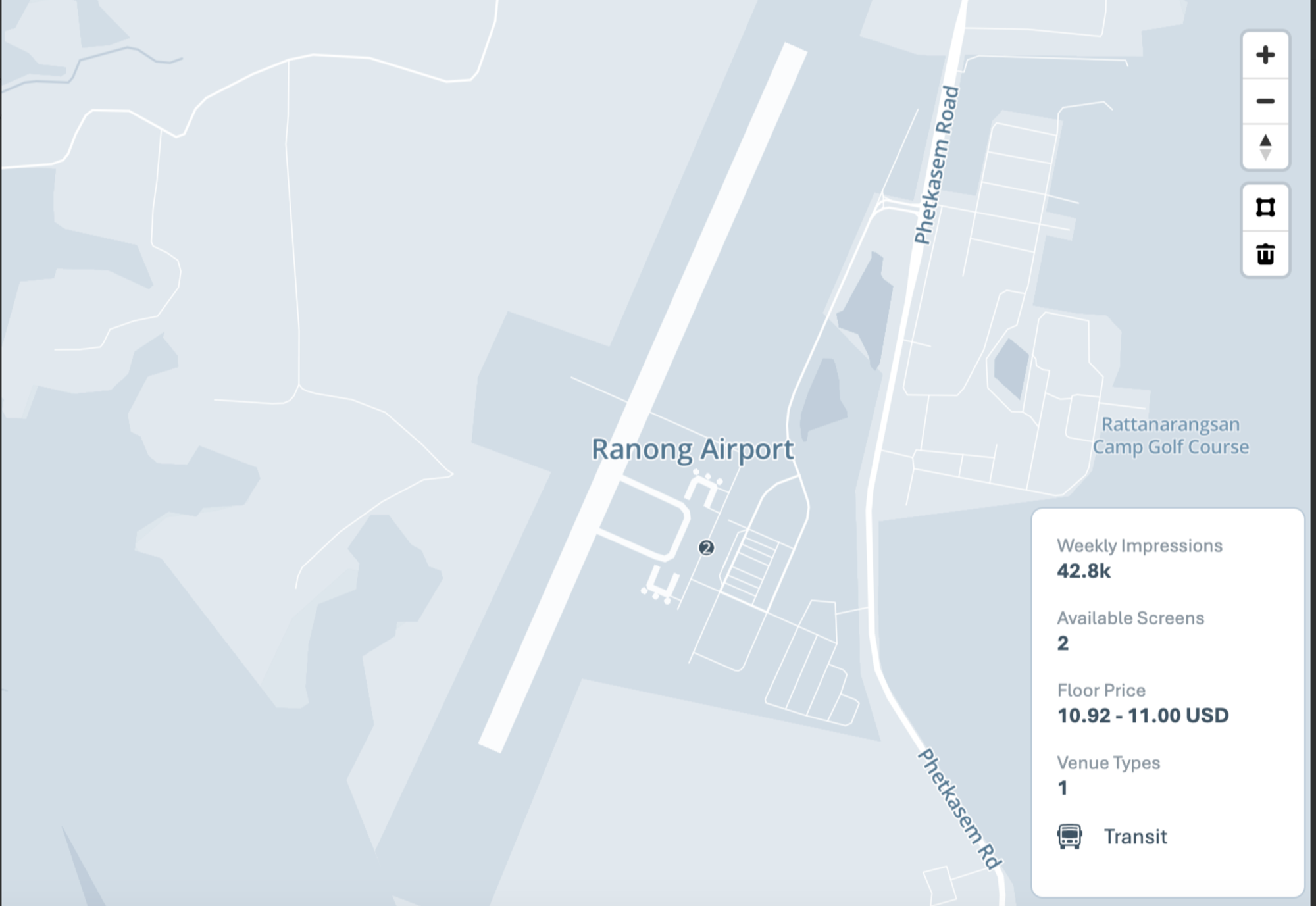
Advertising Value Snapshot
- Passenger scale: 131,104 passengers in 2025, down 7.9 percent, with 889 aircraft movements and no recorded freight. One carrier, one route, approximately seven weekly flights
- Traveller type: Plantation, fishing and seafood processing owners and managers, Myanmar border trade and migrant labour movement, domestic island and diving tourists, provincial government and healthcare travellers
- Airport classification: Tier 3. Low volume, narrow route structure, and a leisure demand window compressed by one of the longest monsoon seasons in Thailand
- Commercial positioning: The air gateway to Thailand's Andaman border province, the Myanmar crossing at Kawthaung, and the Surin Islands marine park
- Wealth corridor signal: Sits on the Thailand to Myanmar labour and remittance corridor, and on the prospective Andaman logistics corridor toward India, Bangladesh, Sri Lanka and the Middle East
- Advertising opportunity: Masscom Global positions UNN as a low-cost dominance and early-positioning buy. With one terminal, one route and effectively no competing advertisers, a minimal number of positions achieves complete and repeated coverage of a defined audience at a cost that is almost immaterial in a national plan. Masscom recommends this airport for advertisers with a specific Myanmar corridor, plantation, marine or infrastructure proposition, and advises against it for general brand reach.
Airport Advertising is Complex to Get Right
We help you execute faster, with proven results and local insight most planners lack starting now.
Talk to an ExpertCatchment Area and Economic Drivers
Top 10 Cities and Districts within 150 km, Marketer Intelligence:
- Ranong city: The provincial capital and commercial centre, home to the port, the seafood processing cluster and the administrative and healthcare functions for the province. Delivers the entire local business, government and professional audience.
- Kawthaung, Myanmar: Directly across the estuary and the busiest crossing on this stretch of border. Generates Myanmar trader, worker and medical travel, and is the origin point for much of the migrant labour that staffs Ranong's fishing and processing industries.
- Kraburi: The district at the narrowest point of the isthmus and the corridor through which any future rail and motorway link would run. Currently agricultural and increasingly the focus of land speculation tied to infrastructure expectation.
- La-un: Rubber and palm oil district with plantation-owning households and a strong agricultural input purchasing profile.
- Kapoe: Coastal district combining fishing, rubber and palm oil, producing small-scale plantation and marine business owners.
- Suksamran: Southern coastal district and the mainland access point toward the Ko Phayam and Ko Chang island tourism economy.
- Chumphon: Roughly 120 kilometres east on the Gulf coast, the other end of the prospective land corridor, with its own port, rail connection and substantial fruit and agricultural economy.
- Lang Suan: Chumphon province agricultural and trading town, contributing fruit, palm and rubber commerce to the wider catchment.
- Khura Buri, Phang Nga: The mainland gateway to the Surin and Similan marine parks, delivering a diving and eco-tourism operator and visitor audience.
- Takua Pa: Northern Phang Nga administrative and commercial town with tin mining heritage, plantation activity and tourism service employment.
Migrant, Border and Remittance Intelligence:
Ranong has one of the highest concentrations of Myanmar migrant workers of any Thai province, and this is the defining audience characteristic of the catchment. The fishing fleet, the seafood processing plants, the rubber and palm plantations and the construction sector all depend on Myanmar labour, much of it arriving and departing through the Kawthaung crossing rather than the airport. Remittances flow from Ranong into Myanmar continuously and at scale. Layered above this is an established Thai-Chinese business community with roots in the tin mining era, which owns much of the province's plantation, fishing, processing and property interests and represents the genuine local wealth. That community, not the migrant workforce, is the airport's paying business audience.
Economic Importance:
Four engines drive this catchment. Fishing and seafood processing centre on one of Thailand's principal Andaman ports. Plantation agriculture across rubber, palm oil and cashew underpins the rural districts. Cross-border trade with Myanmar through the Ranong and Kraburi crossings adds commercial movement and a border special economic zone designation. Tourism, low-key and eco-oriented rather than mass market, serves the islands, the hot springs and the marine parks. Prospective port and corridor investment sits above all four as the variable that could change the province's scale entirely.
Business and Industrial Ecosystem
- Fishing, aquaculture and seafood processing: The province's largest industry, producing fleet owners, processing plant operators and cold chain businesses with substantial equipment, vessel, refrigeration and compliance spending
- Rubber, palm oil and cashew plantations: Landholding families and estate operators across the inland districts, with purchasing cycles tied to commodity prices and harvest income
- Cross-border trade and the Ranong border special economic zone: Traders, customs brokers and logistics operators working the Myanmar corridor, with investment incentives attached to the zone designation
- Port, marine services and prospective infrastructure development: The Andaman port operated by the national port authority, plus the engineering, dredging, construction and logistics ecosystem that any port modernisation would activate
Passenger Intent, Business Segment:
Business travel at UNN is on the Bangkok corridor and is purposeful rather than routine, because with roughly one flight a day the option is limited and the trip must be worth it. Travellers are plantation and fishing business owners meeting buyers, financiers and regulators, seafood exporters handling certification and customs matters, provincial officials attending ministry meetings, and increasingly consultants, engineers and developers assessing port and corridor opportunities. Marine and plantation equipment, cold chain and refrigeration, heavy machinery, freight forwarding, business banking and insurance intercept this audience.
Strategic Insight:
The value here is specificity rather than scale. There is no competing advertiser presence at this terminal, which means a marine equipment supplier, a plantation input brand or a construction machinery manufacturer can own the entire environment for a fraction of what a single Bangkok position costs. The audience is small enough to be named, and in a province where the same families control fishing, plantations and processing, being visible at the only air gateway carries genuine commercial weight with the people who sign purchase orders.
Tourism and Premium Travel Drivers
- Mu Ko Surin Marine National Park: Internationally regarded diving and snorkelling, home to the Moken sea communities, and a genuine draw for specialist international divers. Critically, the park closes during the monsoon, roughly mid-May to mid-October, which compresses the entire high-value visitor season
- Ko Phayam and Ko Chang, Ranong: Low-density island destinations with an established independent and long-stay visitor culture, distinct from Thailand's mass resort model and attracting repeat European and domestic visitors
- Ranong hot springs and the Raksawarin area: The province's best-known mainland attraction, drawing domestic wellness and weekend visitation from Bangkok and the southern provinces
- The Kawthaung crossing: A functioning gateway into southern Myanmar and the Myeik archipelago, historically significant for border travel and still relevant for cross-border visitor movement
Passenger Intent, Tourism Segment:
The tourism passenger at UNN is a deliberate traveller, not an impulse one. Ranong is not on the mass resort circuit, and visitors who fly here have chosen it specifically for diving, islands, wellness or border travel, typically booking accommodation and dive packages in advance. That makes them committed but also relatively low in number and highly seasonal. Diving and marine equipment, outdoor apparel, travel insurance, telecommunications and hospitality reach a receptive audience during the November to April window, and almost nobody worth reaching during the monsoon.
Travel Patterns and Seasonality
Peak seasons:
- November to April, dry season: The entire viable tourism window. The marine national park is open, sea conditions permit island access, and domestic and international visitors arrive. This period should carry the overwhelming majority of any leisure-facing budget
- April, Songkran: The national holiday and homecoming period, delivering the year's highest domestic passenger volumes and family travel
- December to January: New Year holiday travel combining domestic tourism with returning family movement
- Chinese New Year, January or February: Meaningful in a province with deep Thai-Chinese heritage, driving family gathering and gifting spending
- May to October, monsoon: Ranong is among the wettest provinces in Thailand and the marine park closes. This is the weakest window of the year by a wide margin and should carry minimal weight
Event-Driven Movement:
- Songkran (mid April): Thailand's traditional new year and the principal homecoming period, drawing workers back from Bangkok and Phuket. The strongest domestic purchase-intent window for finance, telecommunications and durable goods advertisers.
- Marine park opening (mid October to November): The reopening of the Surin islands marks the start of the dive season and the arrival of operators, guides and specialist visitors. The correct trigger point for dive, outdoor and travel category flighting.
- Chinese New Year (January or February): Culturally significant given the province's Hokkien commercial heritage, driving family travel, gifting and business hospitality spending.
- Buddhist Lent and Ok Phansa (July and October): Religious observance driving temple giving and regional family movement, though falling within the monsoon trough for visitor traffic.
- Plantation harvest and commodity marketing cycles: Rubber and palm income realisation drives agricultural input and equipment purchasing at predictable points in the year.

It’s Not Just Where You Advertise - It’s How Fast You Execute
We combine local insight with fast rollout to deliver results for you, now.
Talk to an ExpertAudience and Cultural Intelligence
Top 2 Languages:
- Thai, Central and Southern: Central Thai is the language of government, formal business, banking and national media and the default for institutional categories. Southern Thai, or Pak Tai, is the everyday register across the catchment and carries strong regional identity. Consumer creative that uses southern register and reference lands with authenticity that standard Bangkok copy does not achieve.
- Burmese: Genuinely significant in this province rather than marginal, given the scale of the Myanmar workforce in fishing, processing, plantations and construction, and the volume of movement through the Kawthaung crossing. Burmese-language execution is a real requirement for remittance, telecommunications, insurance and essential services categories, and almost no advertiser is currently doing it here.
Major Traveller Nationalities:
The airport's passengers are overwhelmingly Thai domestic, travelling the Bangkok corridor. Myanmar nationals are a substantial presence in the province but move predominantly overland through the border crossing rather than by air. The international air segment is small and specialised, led by European divers and independent long-stay visitors from Germany, the United Kingdom, Scandinavia and France during the dry season. Campaign creative should be built for a Thai domestic audience as the default, with Burmese-language execution where the proposition targets the migrant population and English reserved for the dive season.
Religion, Advertiser Intelligence:
- Theravada Buddhism, approximately 85 to 90 percent: Dominant and actively practised, with the Buddhist lunar calendar shaping travel and household spending through Songkran, Khao Phansa, Ok Phansa and Loi Krathong. Merit-making is a genuine recurring financial commitment for local families, and remittance and household spending are frequently timed to it. Financial services, telecommunications, gifting and transport advertisers benefit from aligning to this calendar.
- Islam, approximately 5 to 10 percent: A meaningful minority, higher than in central Thailand and consistent with the wider southern provinces. Ramadan and Eid create distinct travel, gifting and food spending peaks, and halal provision is a real service consideration for food, hospitality and retail advertisers.
- Chinese folk and Mahayana practice, alongside Buddhism: Rooted in the province's Hokkien tin mining heritage and concentrated in the commercial families who own much of the local economy. Chinese New Year and the vegetarian festival period drive family gathering, business hospitality and gifting, and this community is the province's principal purchasing power.
- Burmese Buddhist observance among the migrant population: Follows its own festival calendar and community structures, creating remittance and travel patterns distinct from the Thai calendar and largely unaddressed by advertisers.
Behavioral Insight:
Two audiences here think in entirely different ways and a single campaign cannot serve both. The Thai-Chinese business community is conservative with capital, relationship-driven, and evaluates suppliers across decades and family generations, with purchase decisions made collectively and quietly. The migrant workforce operates on a short horizon with obligation abroad, judging services on cost, accessibility, trust and speed of transfer above all else. A brand attempting to speak to both with one message will land with neither. Masscom builds these as separate propositions within the same terminal.
Outbound Wealth and Investment Intelligence
Ranong is not a wealth-export airport and Masscom Global will not present it as one. There is no private banking audience, no business aviation, and no meaningful market for offshore residency or international luxury property. What does exist are two genuine and commercially addressable capital flows, one outbound and one inbound, and both are more valuable than a manufactured HNWI narrative.
Outbound Remittance to Myanmar:
This is the largest and most reliable outbound capital flow in the province. The Myanmar workforce staffing the fishing fleet, the processing plants, the plantations and the construction sector sends money home continuously, and Ranong functions as one of Thailand's principal remittance origination points toward southern Myanmar. Money transfer operators, mobile wallet providers, telecommunications companies and migrant-focused insurance and banking products have a clearly defined and largely unserved audience across this catchment. Burmese-language execution is the differentiator.
Domestic and Regional Property and Business Investment:
The Thai-Chinese commercial families of Ranong deploy capital domestically rather than offshore, into plantation land, fishing and processing capacity, local commercial property, and Bangkok and Phuket residential assets for the next generation. Cross-border business interest in Kawthaung and southern Myanmar exists but is constrained by conditions across the border. The genuinely notable movement is inbound: land acquisition and speculation across Kraburi and the Ranong coastal districts by investors positioning ahead of port and corridor development. Land services, legal and advisory firms, construction materials and property developers have a live audience here now.
Outbound Education Investment:
Plantation and processing families fund education substantially, sending children to Bangkok, Phuket and Hat Yai for secondary and tertiary study, with overseas study concentrated on China, Taiwan, Singapore and Australia, reflecting both the Thai-Chinese heritage and regional proximity. Vocational and marine qualifications carry particular local relevance. Universities, colleges, language schools and student finance products reach a committed parent audience with no competing airport messaging.
Strategic Implication for Advertisers:
Remittance operators, telecommunications providers and migrant financial services should treat Ranong as one of the most clearly defined and least contested Myanmar corridor audiences in Thailand. Construction materials, heavy equipment, logistics and land advisory firms should treat it as an early-positioning opportunity ahead of port investment. Every other category should be honest about whether the volume justifies the buy. Masscom Global activates Ranong alongside Bangkok Don Mueang, Phuket and the wider southern network so a small placement here sits inside a campaign with real reach.
Airport Infrastructure and Premium Indicators
Terminals:
- A single compact terminal serving one airline and one route, located roughly 23 kilometres south of Ranong city in Ratchakrut subdistrict, opened in May 1995 and operated by Thailand's Department of Airports
- Basic but functional facilities including a waiting area, food and beverage, retail, banking and ATM provision, and parking. The scale means a very small number of positions covers the entire passenger flow
Premium Indicators:
- The airport's genuine asset is not premium infrastructure but strategic position: it serves the only Andaman province whose port is managed by Thailand's national port authority, and it is the Andaman province closest to Bangkok
- Proximity to the Kawthaung crossing gives the terminal relevance to cross-border commercial and medical travel that a passenger count alone does not capture
- Access point for an internationally recognised marine national park and for a low-density island tourism economy that attracts repeat long-stay international visitors
- Situated within the Ranong border special economic zone framework, which carries investment incentives and marks the province as a designated development priority
Forward-Looking Signal:
This is the section that matters most at Ranong, and it requires accuracy rather than enthusiasm. The full Chumphon to Ranong Land Bridge, costed at roughly 997 billion baht with twin deep-sea ports and an 89 kilometre rail and motorway corridor, remains a live but contested proposal, with a Cabinet submission anticipated in mid 2026 and significant environmental and Senate scrutiny. As of the latest government statements, the Prime Minister has indicated the full project can wait, with priority shifting to modernising the existing Ranong Port and connecting it by rail to the national network through Chumphon. That downsized pathway is the more probable near-term outcome, and it would still position Ranong as Thailand's Indian Ocean logistics gateway toward India, Bangladesh, Sri Lanka and the Middle East. Masscom Global advises construction, logistics, equipment and advisory clients to establish presence now, while rates reflect a 131,000 passenger airport, because if port investment proceeds the audience and the cost base will both change materially.
Airline and Route Intelligence
Top Airlines:
One carrier serves Ranong. Thai AirAsia operates the sole scheduled route, with roughly seven weekly flights and 889 total aircraft movements across 2025. Advertisers should understand the concentration risk this represents: the airport's entire commercial passenger base depends on a single airline's continued commitment to a single route.
Key International Routes:
There are no international flights to or from Ranong. The nearest alternative airport across the border is Kawthaung in Myanmar. International travel from this catchment connects through Bangkok, or through Phuket for southern residents willing to drive. This means outbound international travellers, including the significant Myanmar workforce moving on longer journeys, are captured at UNN only in modest numbers, with most border movement occurring overland.
Domestic Connectivity:
Bangkok Don Mueang is the only scheduled destination, a 509 kilometre route taking approximately one hour and ten minutes at roughly one flight per day. Surat Thani and Phuket serve as the practical alternative gateways for parts of the catchment, and Chumphon has its own airport to the east, which means UNN competes for its own catchment rather than owning it outright.
Wealth Corridor Signal:
The route network reveals a small, functional airport serving necessity travel rather than volume demand. The Bangkok corridor carries business owners, officials and family travellers who need to be in the capital, plus a seasonal domestic and international tourism layer. The more significant corridor at Ranong is maritime and overland rather than aviation: the Andaman shipping route and the Myanmar border crossing. Advertisers targeting those flows should understand the airport as one touchpoint in a border and port strategy, not as the strategy itself.
Media Environment at the Airport
- Minimal terminal footprint with effectively no advertising clutter, meaning a handful of positions delivers complete and repeated coverage of the entire passenger base at very low absolute cost
- Dwell is proportionally long relative to airport size, because a single daily flight concentrates arrivals into narrow windows, family groups gather in numbers, and there is little to distract attention within a small terminal
- The environment is functional rather than premium, which suits practical categories such as equipment, finance, telecommunications and logistics, and works against aspirational or luxury positioning
- Masscom Global provides inventory access, position selection and dry-season flighting, and will advise candidly on whether this airport belongs in a given campaign rather than selling inventory that will not perform
Strategic Advertising Fit
Best Fit:
- Myanmar corridor remittance and money transfer: The clearest opportunity at this airport and across the wider province, addressing a large, defined and largely unserved audience
- Telecommunications, international calling and mobile data: Essential for a workforce maintaining family relationships across a border, with Burmese-language execution as the differentiator
- Marine equipment, vessel services, refrigeration and cold chain: Reaching fleet owners and processing operators in one of Thailand's principal Andaman fishing centres
- Plantation inputs, agricultural equipment and rubber and palm services: Serving landholding households across the inland districts with harvest-linked purchasing
- Construction materials, heavy machinery and civil engineering services: Early positioning ahead of port modernisation and corridor development, with land speculation already active
- Logistics, freight forwarding and customs brokerage: Relevant now through border trade and substantially more so if port investment proceeds
- Migrant-focused insurance, banking and health services: A population working in high-risk industries far from home, with genuine and unmet protection needs
- Diving, outdoor equipment and eco-tourism operators: Aligned to the marine park season and to a committed specialist visitor segment
Brand Alignment at a Glance:
| Category | Fit |
|---|---|
| Myanmar corridor remittance and telecoms | Exceptional |
| Marine equipment and cold chain | Strong |
| Plantation inputs and agricultural equipment | Strong |
| Construction materials and heavy machinery | Strong |
| Logistics and freight forwarding | Moderate |
| Migrant insurance and banking | Moderate |
| Diving and eco-tourism | Moderate |