

Airport at a Glance
| Field | Detail |
|---|---|
| Airport | Issyk-Kul International Airport |
| IATA Code | IKU |
| Country | Kyrgyzstan |
| City | Tamchy (serving Cholpon-Ata and the Issyk-Kul resort belt) |
| Annual Passengers | Data not available (seasonal operation, third-largest airport in Kyrgyzstan by scheduled activity) |
| Primary Audience | Regional leisure and resort travellers, CIS holiday families, government and delegation traffic |
| Peak Advertising Season | June to August, with a secondary window in December and January |
| Audience Tier | Tier 3 with Tier 1 seasonal audience concentration |
| Best Fit Categories | Hospitality and resorts, real estate and second homes, banking and remittance, travel retail and duty free |
The only airport in Central Asia where a national holiday economy compresses an entire year of premium audience into three months.
Issyk-Kul International Airport is not a volume airport, and advertisers should not evaluate it as one. It is a resort access point, positioned at Tamchy on the northern shore of Lake Issyk-Kul, roughly 35 km west of Cholpon-Ata. What arrives here is not commuter traffic but discretionary spend already committed: passengers who have booked accommodation, allocated a holiday budget, and travelled specifically to consume leisure. For advertisers, that is a rare condition. The audience is pre-qualified by the act of flying to a lake.
The commercial logic sits in the corridor, not the terminal. Lake Issyk-Kul is the recreational anchor for the entire post-Soviet space in Central Asia, drawing Kazakh, Russian, and Uzbek holiday traffic alongside the Kyrgyz upper-middle class and the Bishkek political and business establishment. Seasonal services connect the lake directly to Almaty, Astana, Tashkent, Novosibirsk, and Osh, which means the airport intercepts a cross-border wealth audience that would otherwise be dispersed across four national capitals. Masscom Global treats IKU as a precision seasonal buy rather than a reach buy, and that distinction is the whole strategy.
Advertising Value Snapshot
- Passenger scale: Data not available for verified annual throughput. Traffic is concentrated into the summer season, with scheduled activity currently spread across four carriers and five destinations in three countries.
- Traveller type: Domestic and CIS leisure families, high-spend resort and sanatorium guests, government and corporate delegation traffic.
- Airport classification: Tier 3 by scale, Tier 1 by audience quality during peak season. A small terminal footprint delivering a disproportionately affluent passenger mix.
- Commercial positioning: Kyrgyzstan's dedicated resort gateway and the primary air access point to the Issyk-Kul recreational economy.
- Wealth corridor signal: The airport sits on the Bishkek to Almaty to Issyk-Kul leisure and capital corridor, the route along which Central Asian discretionary wealth physically moves each summer.
- Advertising opportunity: Low terminal clutter means a single well-placed brand can achieve near-total share of visual attention, an outcome impossible at a major hub at any price. Masscom Global structures IKU as a seasonal dominance play, securing full-environment presence across the peak window rather than fragmented placements. Our access allows brands to own the arrival moment for an entire holiday season at a fraction of comparable hub investment.
Airport Advertising is Complex to Get Right
We help you execute faster, with proven results and local insight most planners lack starting now.
Talk to an ExpertCatchment Area and Economic Drivers
Top 10 Cities within 150 km, Marketer Intelligence:
- Cholpon-Ata: The premium resort core. Audience here is holiday-mode and price-insensitive within a fixed budget, making it the highest-conversion environment in the catchment for hospitality, jewellery, and premium beverage messaging.
- Bishkek: Supplies the wealth. The capital's business owners, senior officials, and professional class own or rent along the lake, and they arrive as decision-makers, not just holidaymakers. This is the B2B audience embedded inside a leisure environment.
- Balykchy: Logistics and rail terminus feeding the lake economy. Produces a working and trade audience relevant to financial services, telecoms, and fuel and automotive brands.
- Karakol: The adventure and winter tourism engine on the eastern shore. Delivers a younger, higher-frequency traveller and a foreign backpacker to mid-market crossover audience useful for outdoor, apparel, and payment brands.
- Tokmok: Industrial and agro-processing base with strong labour migration links to Russia. Remittance-receiving households make this a priority catchment for money transfer, banking, and consumer durables.
- Kant: Manufacturing and cement production centre with a longstanding Russian-linked community. Produces a stable salaried audience receptive to insurance, credit, and education messaging.
- Kemin: Energy and mining corridor town. Small population but generates technical and contractor audiences relevant to industrial equipment and B2B services.
- Bokonbayevo: Southern shore hub for community tourism and yurt-stay hospitality. Signals the growth edge of the lake economy and a rising small-business owner audience.
- Tup: Agricultural district feeding the resort belt's food supply chain. Relevant to agri-input, machinery, and cooperative finance advertisers.
- Naryn: High-altitude regional centre and the gateway toward the China trade route. Produces a trade and transport audience with cross-border commercial interests.
NRI and Diaspora Intelligence:
Kyrgyzstan's dominant diaspora movement runs to Russia and Kazakhstan, where a very large share of working-age citizens are employed, and remittances represent one of the highest shares of national income anywhere in the world. That flow matters at IKU in a specific way: returning migrants and their families holiday at Issyk-Kul as the visible marker of accumulated earnings, and the summer season is when repatriated capital is spent. The diaspora traveller arriving via Novosibirsk or Almaty is carrying seasonal liquidity, not just luggage. For remittance operators, banks, mobile wallets, and land and property developers, this is the single most efficient interception point in the country.
Economic Importance:
The Issyk-Kul region runs on three engines: resort tourism, gold mining, and agriculture, with the Kumtor operation historically anchoring a significant share of national output and generating a well-paid technical workforce. Tourism creates the seasonal high-spend audience, mining creates a year-round affluent professional segment, and agriculture creates the volume consumer base. Advertisers should read the region as two distinct audiences sharing one terminal: a June to August discretionary spender and a resident earner with stable income and low banking penetration.
Business and Industrial Ecosystem
- Resort and sanatorium hospitality: Produces owner-operators, hotel investors, and premium guest traffic. Directly relevant to hospitality tech, F&B supply, and luxury goods.
- Gold mining and extractives: Produces engineers, expatriate managers, and government stakeholders. High-income, low-availability audience that surfaces at this airport.
- Agriculture and agro-processing: Produces cooperative buyers and equipment purchasers, a durable B2B audience with real capital budgets.
- Renewable and hydropower development: Produces delegation and contractor traffic tied to state infrastructure programmes, valuable for engineering, finance, and industrial advertisers.
Passenger Intent, Business Segment:
Business travellers at IKU are overwhelmingly domestic and regional: Bishkek executives combining property and leisure interests, mining and energy personnel rotating in, and official delegations attending the summits and forums the lake regularly hosts. They travel with authority and short decision cycles. The categories that intercept them most effectively are banking and corporate finance, real estate and land development, telecoms, business travel services, and industrial B2B.
Strategic Insight:
The business audience here is unusually senior relative to airport size, because Issyk-Kul is where Kyrgyz decision-makers go rather than where they are sent. A regional forum or state visit routinely puts ministers, sovereign fund representatives, and cross-border investors through a terminal with almost no competing brand presence. For B2B advertisers, that ratio of audience seniority to media clutter is not available at any major Central Asian hub.
Tourism and Premium Travel Drivers
- Lake Issyk-Kul shoreline and resort belt: The second-largest alpine lake in the world and the region's defining holiday destination. Guests arrive with accommodation and activity spend already committed, ideal for upsell categories.
- Cholpon-Ata sanatorium and wellness cluster: A long-established health tourism economy attracting older, higher-net-worth CIS visitors on multi-week stays. Prime audience for private healthcare, insurance, and wealth management.
- Karakol and Jeti-Oguz mountain and ski corridor: Creates the secondary winter peak and a younger adventure segment relevant to apparel, equipment, and digital payment brands.
- Silk Road heritage and petroglyph sites around the northern shore: Draws international cultural tourists from Europe and East Asia, adding a foreign-currency spender to the mix.
Passenger Intent, Tourism Segment:
The tourist at IKU has already paid for the expensive part of the trip. Flights, resort stays, and sanatorium packages are prepaid, which shifts airport receptivity toward what is still undecided: duty free, jewellery and watches, currency and cards, mobile data, car rental, and property viewing. Departing passengers are in a reflective, high-recall state after a multi-day stay, which is when second-home and investment messaging performs best. Hospitality, financial services, travel retail, and real estate capture the most value from this segment.
Travel Patterns and Seasonality
- Peak seasons: June to late August is the dominant window, driven by the Central Asian school holiday and the short swimming season on the lake. A secondary peak runs late December to early January on New Year holiday travel and the Karakol ski season. Shoulder activity appears in May and September around conferences and cultural events.
- Verified monthly traffic volume data not available.
Event-Driven Movement:
- Summer holiday season opening (June): Not a single event but a national migration to the lake. The highest-value advertising window of the year and the moment brand presence must already be live.
- Nowruz (March): Regional new year celebration driving family travel and gifting spend. Useful early-year window for retail and financial promotions.
- Eid al-Fitr and Eid al-Adha (variable, spring and summer): Trigger family gathering travel and significant gifting and sacrifice-related expenditure across the Muslim majority catchment.
- Regional forums and summits hosted on the Issyk-Kul shore (May to September): Bring government, investor, and delegation audiences into a low-clutter terminal. Highest-quality B2B interception of the year.
- New Year and Orthodox Christmas period (late December to early January): Drives the winter resort and ski peak plus Russian-linked community travel, supporting a compact second campaign flight.

It’s Not Just Where You Advertise - It’s How Fast You Execute
We combine local insight with fast rollout to deliver results for you, now.
Talk to an ExpertAudience and Cultural Intelligence
Top 2 Languages:
- Kyrgyz: The state language and the primary language of the domestic resident and regional traveller audience. Essential for trust-building in financial, insurance, and government-adjacent categories where credibility drives conversion.
- Russian: The official language of commerce and the working language of the inbound Kazakh, Russian, and Uzbek holiday audience. Premium, aspirational, and cross-border creative should lead in Russian to capture the highest-spending segment.
Major Traveller Nationalities:
Kyrgyz nationals form the resident base, but the commercial weight sits with Kazakh, Russian, and Uzbek visitors travelling in on seasonal services from Almaty, Astana, Novosibirsk, and Tashkent, supported by a smaller European and East Asian cultural tourism flow. This mix means bilingual Russian and Kyrgyz creative is mandatory, and campaigns should be built for a cross-border audience whose banking, property, and retail decisions are made in a different country from the one they are advertised in. Brands with regional footprints across Kazakhstan, Uzbekistan, and Kyrgyzstan gain compounding value from a single IKU buy.
Religion, Advertiser Intelligence:
- Islam (approximately 85 to 90 percent): Predominantly Sunni and culturally moderate. Ramadan, Eid al-Fitr, and Eid al-Adha drive family reunion travel, livestock and gifting expenditure, and elevated remittance inflows. Halal-conscious F&B, family-oriented financial products, gold and jewellery, and travel packages all see clear seasonal lift.
- Russian Orthodox Christianity (approximately 7 to 10 percent): Concentrated in Bishkek, Tokmok, and Kant. New Year and Orthodox Christmas drive the winter travel peak and structured gifting behaviour, making late December the strongest retail and duty free window outside summer.
- Traditional and syncretic practice (smaller share, culturally widespread): Nowruz and seasonal observances remain broadly celebrated across religious lines, creating a spring spending trigger that advertisers consistently underuse.
Behavioral Insight:
This audience is cash-comfortable, credit-cautious, and family-anchored. Purchase decisions are made collectively, savings are often held in gold, land, or foreign currency rather than instruments, and trust is built through visible permanence rather than promotional urgency. Messaging that emphasises security, tangibility, and family benefit outperforms discount-led creative. In practical terms, a property, bank, or education brand that presents itself as established and regionally committed will convert here far better than one that leads with an offer.
Outbound Wealth and Investment Intelligence
The outbound passenger at Issyk-Kul is distinctive because wealth here is mobile by necessity. Kyrgyzstan's affluent households operate across borders by default, with capital, children, and residency spread between Central Asia, Russia, Turkey, and the Gulf. What passes through this terminal in summer is not simply holiday traffic but the annual moment when regional families are physically together and make their largest joint financial decisions.
Outbound Real Estate Investment:
Turkey, particularly Istanbul and Antalya, is the dominant offshore property destination for this audience, driven by affordability, cultural and linguistic comfort, and residency-linked purchase routes. Dubai has become the second pillar, attractive for zero personal income tax, freehold ownership, and rental yields materially above anything available domestically. Kazakhstan, especially Almaty and Astana, absorbs a large share of nearer-term buying as a regional wealth-parking market, while Russia remains relevant for diaspora-linked purchases. International developers marketing Turkish, UAE, or Kazakh inventory reach a genuinely qualified buyer here through Masscom placements timed to the summer family window.
Outbound Education Investment:
Russia remains the largest single destination for Kyrgyz students, supported by language compatibility and scholarship channels, followed by Kazakhstan, Turkey, and China, with the United Kingdom, Germany, and the United States serving the top wealth tier. Families typically fund education from combined household and remittance income and treat it as the primary vehicle for generational advancement, which makes them highly responsive to credibility signals and pathway clarity. Universities, foundation programmes, IELTS providers, and education consultancies advertising at IKU catch these families in the exact months when enrolment decisions are finalised.
Outbound Wealth Migration and Residency:
Turkey's property-linked citizenship route and the UAE Golden Visa are the two programmes with real traction among this audience, both aligned to the property purchases already underway. Kazakhstan residency serves as a practical regional mobility option, and interest in Caribbean citizenship-by-investment exists at the top of the market as a passport-diversification instrument. Immigration advisories and residency programme marketers should treat the summer peak as their concentrated selling season.
Strategic Implication for Advertisers:
International brands sitting on either side of this corridor should recognise that IKU delivers an audience whose capital is already leaving the country and looking for a destination. Turkish, UAE, and Kazakh developers, universities, and residency advisors reach decision-ready families here at a cost per qualified prospect no major hub can match. Masscom Global activates both ends of the corridor simultaneously, pairing IKU with Gulf, Turkish, and Central Asian airport inventory so the same household is reached at origin and destination.
Airport Infrastructure and Premium Indicators
Terminals:
- A single compact passenger terminal built alongside the current runway in 2003, handling both domestic and international traffic with customs and border control on site. Scale is modest, which concentrates all passenger flow through one uninterrupted media path.
- The facility operates as a class 4D airport with CAT I instrument landing and full runway and stand lighting for night operations, allowing it to absorb late seasonal charter arrivals from regional capitals.
Premium Indicators:
- Dedicated large-format lounge infrastructure is limited, which shifts premium audience contact into the main departures and arrivals flow rather than segregating it. Advertisers reach the top tier in the same environment as everyone else.
- Charter and delegation handling capability serves government and private group traffic connected to the resort belt and to summits hosted on the lake.
- The surrounding Cholpon-Ata and northern shore corridor carries the premium accommodation weight, including established resort and sanatorium properties serving multi-week high-spend guests.
- The airport's position as the only international air gateway to Kyrgyzstan's principal resort region is itself the premium signal: there is no alternative arrival point for this audience.
Forward-Looking Signal:
A new terminal complex has been in development to expand passenger handling and service quality, alongside longstanding plans to extend the runway and enable larger aircraft and longer-haul charter operations. Combined with Kyrgyzstan's visa-free access for a wide range of nationalities and active state promotion of Issyk-Kul tourism, the trajectory points toward higher capacity, longer seasons, and rising media value. Masscom Global advises clients to secure positions at current rate levels now, ahead of the terminal expansion, because inventory pricing at resort gateways resets sharply once capacity and international frequency increase.
Airline and Route Intelligence
Top Airlines:
TezJet, Centrum Air, FlyArystan, S7 Airlines, with additional seasonal and charter operators active during the summer peak.
Key International Routes:
Tashkent, Almaty, and Novosibirsk anchor the international network, with additional Kazakh connectivity and seasonal charter activity from Russian and regional cities. Verified weekly frequency data varies by season and is not consistently available.
Domestic Connectivity:
Osh is the primary domestic route and the single busiest service at the airport, linking the resort belt to Kyrgyzstan's southern population and trade centre.
Wealth Corridor Signal:
The route map tells advertisers exactly what to buy. Almaty and Astana are wealth corridors, moving Kazakhstan's affluent holiday and property-buying households in for the season. Novosibirsk is a diaspora and repatriated-income corridor. Tashkent is a regional trade and family corridor with growing middle-class leisure weight. Osh is a domestic connectivity corridor serving volume rather than premium. Brands targeting HNI audiences should weight creative and timing toward the Kazakh and Russian inbound flows, while volume categories align to the Osh service.
Media Environment at the Airport
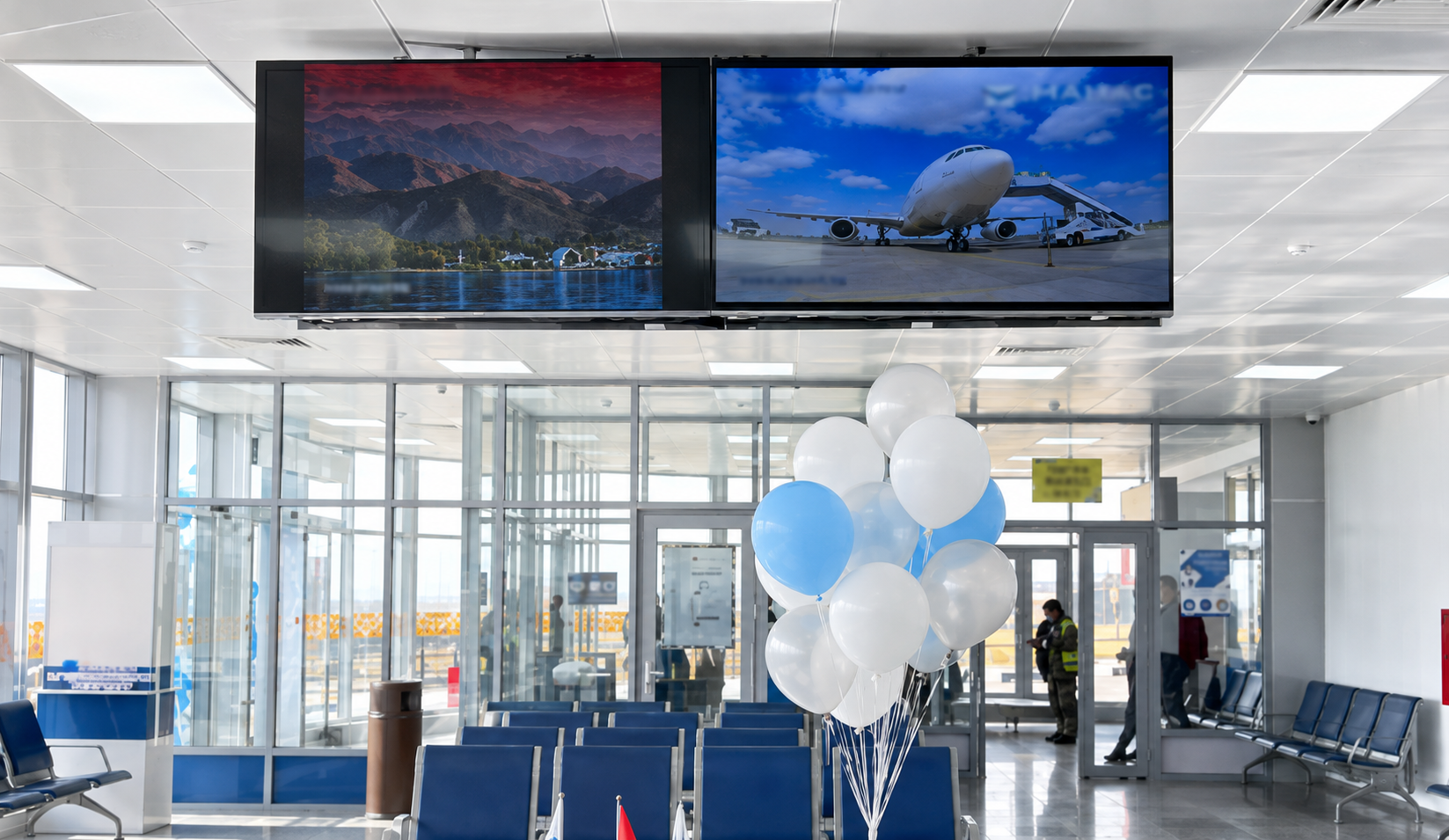
- Terminal scale is small and clutter levels are minimal compared with Bishkek or any regional hub, which means standout potential here is exceptional. A single dominant execution can effectively own the environment.
- Dwell time is extended by seasonal processing loads, border and customs formalities, and the group and family travel pattern typical of resort traffic. Passengers wait together, unhurried, in a confined space, which is the ideal condition for message absorption.
- The premium association is inherited from the destination itself. Arriving at a resort gateway places brands in a holiday and aspiration mindset rather than a transit and stress mindset, materially improving recall for luxury, property, and hospitality categories.
- Masscom Global provides direct inventory access, placement precision across the arrivals and departures flow, and rapid seasonal rollout, allowing brands to go live before the June surge and to secure full-environment dominance rather than fragmented panels.
Strategic Advertising Fit
Best Fit:
- International real estate developers: Turkish, UAE, and Kazakh residential inventory marketed to a family audience with confirmed offshore buying behaviour.
- Banks, remittance operators, and mobile wallets: A high-remittance economy with low banking penetration, reached at the moment seasonal liquidity is being spent.
- Hospitality, resorts, and wellness brands: Guests already in leisure spend mode, with sanatorium and multi-week stay behaviour supporting premium positioning.
- Education institutions and consultancies: Families making enrolment decisions during the summer window, with clear destination preferences in Russia, Turkey, and the UAE.
- Travel retail, duty free, jewellery, and watches: Gold-holding cultural preference plus departing-passenger discretionary spend.
- Airlines, tourism boards, and regional destination marketers: A captive audience already proven to fly for leisure.
- Telecoms, roaming, and digital payments: Cross-border travellers with immediate connectivity and currency needs on arrival.
- Residency and citizenship-by-investment advisors: Direct alignment with existing Turkish and UAE programme demand.
Brand Alignment at a Glance:
| Category | Fit |
|---|---|
| International real estate developers | Exceptional |
| Banking and remittance | Exceptional |
| Hospitality and wellness | Strong |
| Education and residency advisory | Strong |
| Travel retail, jewellery, and watches | Strong |
| Telecoms and digital payments | Moderate |
| Automotive | Moderate |
| Enterprise software and heavy B2B tech | Poor fit |
Who Should Not Advertise Here:
- Enterprise software and SaaS: The passenger mix does not contain the density of corporate IT decision-makers required to justify the buy.
- Ultra-luxury flagship goods requiring year-round presence: The audience exists in peak season only, so annual contracts waste the majority of their impressions.
- Mass-market FMCG and daily consumables: The audience is in travel mode, purchasing decisions are made at home or at the resort, and airport exposure does not intercept the buying moment.
Event and Seasonality Analysis
- Event Strength: Medium
- Seasonality Strength: High
- Traffic Pattern: Dual-Peak, heavily weighted to summer
Strategic Implication:
Budget should not be spread evenly across the year at IKU, and any planner who does so is wasting most of it. Allocate roughly seventy percent of spend to a live-by-late-May campaign running through August, and the balance to a compact December to early January flight covering New Year and ski traffic. Masscom Global structures IKU campaigns around exactly this rhythm, securing placements before the seasonal rate and availability squeeze so clients enter the peak already dominant rather than competing for what is left.

Poor Placement and Delays Affect Airport Campaigns
We help you move faster, access better inventory, and get it right now.
Talk to an ExpertFinal Strategic Verdict
Issyk-Kul International Airport is a specialist buy that rewards planners who understand concentration over scale. It is the sole air gateway to Kyrgyzstan's defining resort economy, and for three months each year it channels the Kyrgyz business establishment, Kazakh and Russian holiday wealth, and remittance-carrying diaspora families through a single low-clutter terminal where a well-placed brand can achieve share of attention that no Central Asian hub will ever offer at any price. The audience is pre-qualified by the act of travelling here, culturally predisposed toward tangible assets, and demonstrably deploying capital into Turkish and UAE property, foreign education, and residency programmes. Real estate developers, banks and remittance operators, hospitality brands, and education providers should treat the summer window at IKU as a priority regional buy, and with terminal expansion and runway extension on the horizon, current rate levels will not hold. Masscom Global has the access, the local intelligence, and the execution speed to place brands here before that window closes.
About Masscom Global
Masscom Global is a premium international airport advertising and media buying agency operating across 140 countries. With deep expertise in airport OOH, premium publications, and high-net-worth audience targeting, Masscom helps brands reach the world's most valuable travellers at the moments that matter most. For advertising packages, media rates, and campaign planning at Issyk-Kul International Airport and airports across the globe, contact Masscom Global today.
Frequently Asked Questions
How much does airport advertising cost at Issyk-Kul International Airport?
Cost at IKU depends on format, position within the passenger flow, campaign duration, and above all seasonal timing, since summer peak pricing behaves very differently from shoulder months. Because the terminal is compact, full-environment dominance packages are achievable at investment levels that would buy only a single panel at a major hub. Contact Masscom Global for current rates and seasonal availability.
Who are the passengers at Issyk-Kul International Airport?
Predominantly leisure travellers heading to the Lake Issyk-Kul resort belt: Kyrgyz families and Bishkek professionals, inbound Kazakh, Russian, and Uzbek holiday households, sanatorium and wellness guests on extended stays, returning diaspora workers, and a steady layer of government and delegation traffic tied to summits hosted on the lake shore. Domestic volume moves largely on the Osh route.
Is Issyk-Kul International Airport good for luxury brand advertising?
Selectively, yes. It is not a year-round luxury environment, but during the summer peak it delivers a concentrated affluent audience in a holiday mindset with almost no competing premium brand presence. Jewellery, watches, offshore property, private wellness, and residency advisory perform well. Ultra-luxury brands requiring continuous annual visibility should look elsewhere.
What is the best airport in Kyrgyzstan to reach HNWI audiences?
Manas in Bishkek delivers the volume and the year-round corporate base, but IKU delivers the concentration. During June to August, Kyrgyz and regional wealth physically relocates to the Issyk-Kul shore, meaning the resort gateway intercepts a denser affluent audience per impression than the capital does. The optimal strategy pairs both, and Masscom Global plans them as a single national buy.
What is the best time to advertise at Issyk-Kul International Airport?
Go live by late May and run through August to capture the full summer resort season. Add a second short flight from mid-December to early January for New Year travel and the Karakol ski audience. Nowruz in March and the Eid periods create additional spending triggers worth aligning creative to.
Can international real estate developers advertise at Issyk-Kul International Airport?
This is one of the strongest use cases for the airport. The catchment's affluent households are active buyers in Istanbul, Antalya, Dubai, Almaty, and Astana, motivated by yield, tax advantage, and residency-linked purchase routes. Summer is when these families travel together and make joint decisions, making IKU a highly efficient channel for Turkish, UAE, and Kazakh developers. Masscom Global can activate the same campaign at the destination airports simultaneously.
Which brands should not advertise at Issyk-Kul International Airport?
Enterprise software and heavy B2B technology lack the decision-maker density needed here. Mass-market FMCG and daily consumables miss the purchase moment entirely. Any brand requiring uniform year-round impressions will lose value, because the audience simply is not present outside the two peak windows.
How does Masscom Global help brands advertise at Issyk-Kul International Airport?
Masscom Global provides the full chain: audience and catchment intelligence, seasonal timing strategy, direct inventory access, placement precision across the arrivals and departures flow, fast rollout ahead of the June surge, and post-campaign performance reporting. We also connect IKU to the Gulf, Turkish, and Central Asian airports where this audience lands, so brands own both ends of the corridor. Book a fifteen minute planning call to start.