


Airport at a Glance
| Field | Detail |
|---|---|
| Airport | Atlantic City International Airport |
| IATA Code | ACY |
| Country | United States |
| City | Atlantic City, New Jersey (Egg Harbor Township) |
| Annual Passengers | 845,108 (2025) |
| Primary Audience | Leisure and casino visitors, Jersey Shore second-home owners, federal aviation and defence professionals, convention delegates |
| Peak Advertising Season | May to September, February to March |
| Audience Tier | Tier 3 by volume, Tier 2 by catchment wealth |
| Best Fit Categories | Coastal and second-home real estate, gaming and hospitality, financial services and wealth management, marine and outdoor lifestyle |
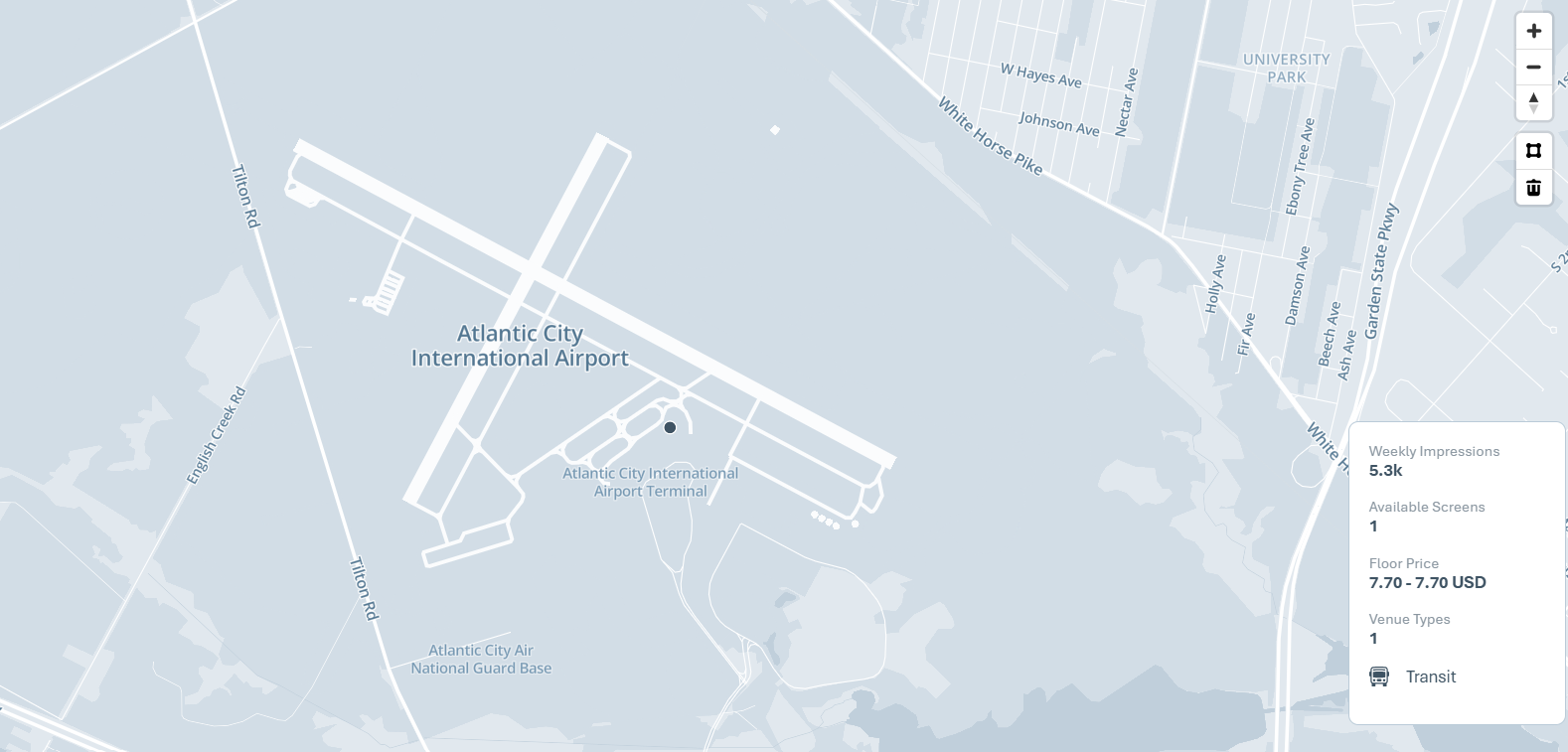
Atlantic City International Airport handled 845,108 passengers in 2025, and the number understates the commercial context entirely. ACY sits in Egg Harbor Township, minutes from a casino and convention economy that draws tens of millions of visitors annually by road, and within short reach of the Jersey Shore barrier island communities of Margate, Longport, Avalon, Stone Harbor, and Ocean City, where summer property values rank among the highest in the country. The airport also hosts a major federal aviation research complex and an Air National Guard fighter wing, adding a permanent, well-paid professional population that no leisure statistic captures.
The airport is currently in transition. The carrier that had operated roughly three quarters of its commercial flights ceased operations in May 2026, and replacement capacity is being rebuilt through low-cost and leisure operators across the second half of the year. For advertisers, disruption of this kind produces a specific and time-limited condition: a soft rate environment attached to a catchment whose underlying wealth has not changed at all. Brands that establish position during a rebuild secure terms that do not survive the recovery.
Advertising Value Snapshot
- Passenger scale: 845,108 passengers in 2025, down from prior years and below the one million threshold, with 56,612 aircraft operations recorded in 2024. Capacity is being actively rebuilt through 2026 with new leisure routes phasing in.
- Traveller type: Low-cost leisure and casino visitors, Jersey Shore second-home owners and their guests, federal aviation and defence professionals.
- Airport classification: Tier 3 by volume, Tier 2 by catchment wealth. The passenger mix is value-led, but the surrounding property and gaming economy is not.
- Commercial positioning: The air gateway to the Atlantic City casino and convention economy and to the southern New Jersey shore coastline.
- Wealth corridor signal: Philadelphia and New York money moves into the South Jersey shore each summer. ACY sits on that corridor, and the Florida and Carolina route network carries the same households out again each winter.
- Advertising opportunity: A single terminal with one screening point and a consolidated gate concourse means every commercial passenger follows the same physical path. Masscom Global structures ACY campaigns for saturation rather than share, and the current rebuild window offers entry pricing that will tighten as capacity returns.
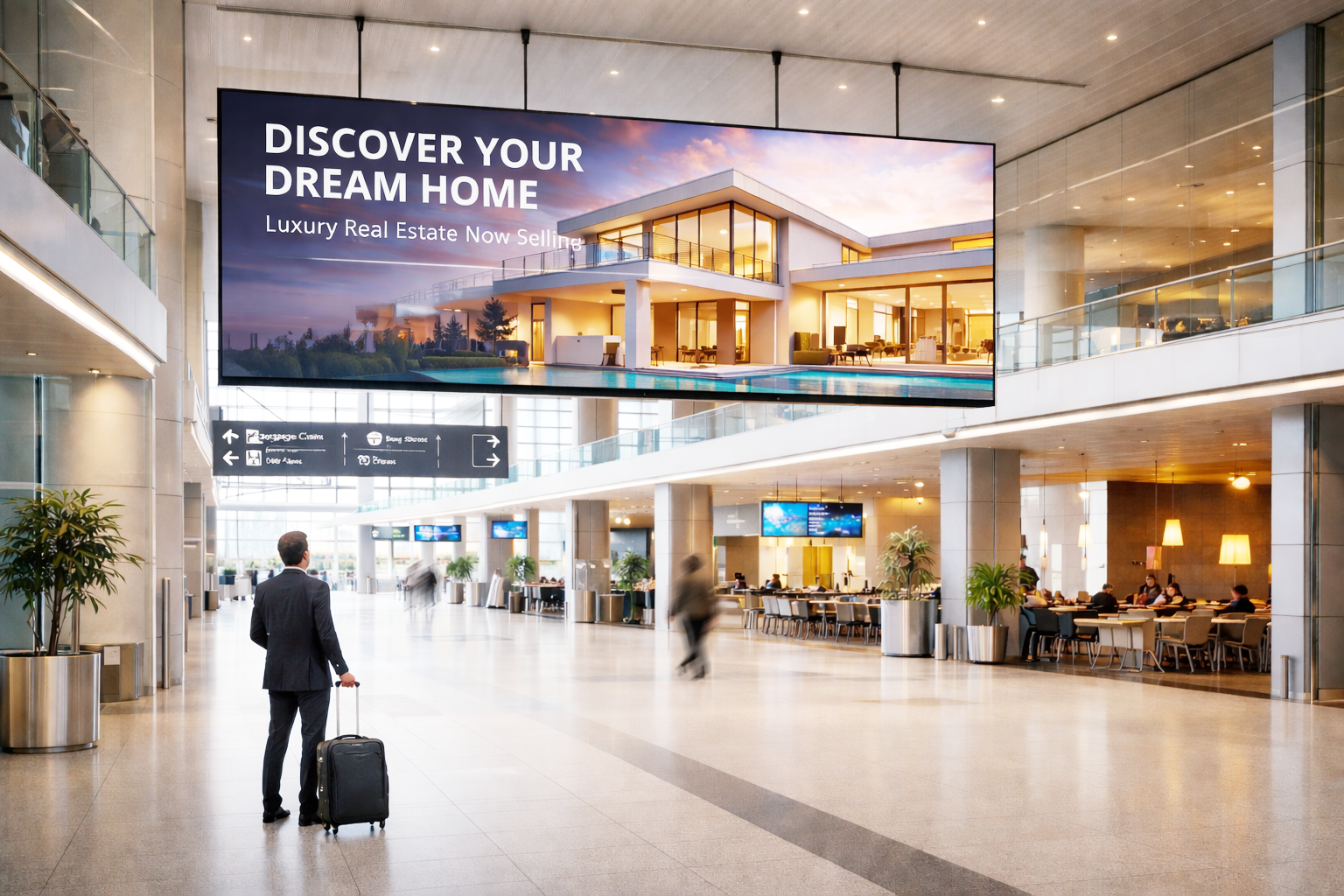
Airport Advertising is Complex to Get Right
We help you execute faster, with proven results and local insight most planners lack starting now.
Talk to an ExpertCatchment Area and Economic Drivers
Top 10 Cities within 150 km, Marketer Intelligence:
- Atlantic City, New Jersey: The commercial anchor. Casino, convention, and hospitality employment alongside a high-value visitor economy. Gaming, entertainment, hospitality, and financial advertisers all have direct relevance here.
- Egg Harbor Township and Galloway, New Jersey: The airport's immediate residential catchment, home to federal aviation staff, healthcare professionals, and university employees. Stable professional incomes with strong automotive and family financial services demand.
- Margate, Ventnor, and Longport, New Jersey: Barrier island second-home communities holding some of the highest property values in the state, owned predominantly by Philadelphia professional and business families. Prime audience for luxury property, wealth management, and marine advertisers.
- Avalon and Stone Harbor, New Jersey: The wealthiest stretch of the South Jersey coastline, with multi-million dollar summer homes and multi-generational family ownership. Genuine HNWI density, though much of it arrives by road rather than air.
- Ocean City, New Jersey: Large family-oriented resort community with high seasonal population turnover and strong rental property investment activity. Fit for property, insurance, and family retail advertisers.
- Cape May and Wildwood, New Jersey: Historic resort and commercial fishing centre with heavy summer visitation and a growing wine and hospitality economy. Relevant to tourism-adjacent and lifestyle advertisers.
- Vineland and Hammonton, New Jersey: Agricultural and food processing centre with a large Italian-American business ownership base and an established wine region. Produces closely held business wealth rarely targeted directly.
- Toms River and Long Beach Island, New Jersey (75 km): Northern shore corridor with substantial second-home and retirement property ownership. Overlaps with New York money rather than Philadelphia money.
- Philadelphia and Cherry Hill, Pennsylvania and New Jersey (100 km): The dominant source of South Jersey shore wealth. Most of this audience uses its own metropolitan airport, but ACY captures the price-sensitive leisure segment and shore-resident share.
- Wilmington and Dover, Delaware (110 to 135 km): Corporate services and defence-linked communities at the outer edge of the catchment. Modest but real contribution to leisure and convention traffic.
NRI and Diaspora Intelligence:
Atlantic City has an unusually diverse resident population for a small American city, shaped by casino and hospitality employment. The Vietnamese community is well established and commercially organised, with a visible business district and strong family remittance and homeland travel patterns. There are also significant Indian, Bangladeshi, Filipino, and Chinese populations tied to hospitality, retail, healthcare, and small business ownership, alongside large Puerto Rican, Dominican, and Mexican communities. This population travels internationally on a seasonal cycle and connects through Philadelphia or New York rather than flying nonstop, but it forms a consistent departure audience at ACY for the first leg. Remittance, telecom, money transfer, and international education advertisers reach a genuinely underserved segment here.
Economic Importance:
Four engines define this catchment. Casino gaming, hospitality, and convention business remain the largest employer and visitor driver, with New Jersey also operating the largest regulated online gaming market in the United States, which sustains a technology and compliance workforce. Coastal second-home property and seasonal rental represent an enormous concentration of private wealth held by non-resident owners. Federal aviation research and Air National Guard operations at the airport itself provide a permanent base of engineers, scientists, and defence personnel with secure high incomes. Agriculture, viticulture, and commercial fishing round out an inland and coastal economy with substantial family business ownership. Each engine produces a distinct addressable audience.
Business and Industrial Ecosystem
- Casino gaming, hospitality, and convention services: Produces executives, operators, suppliers, and delegates. High-value audience for gaming technology, hospitality supply, food and beverage, financial services, and business travel advertisers.
- Federal aviation research and air traffic technology: A major national research complex sits on the airport site, employing engineers, scientists, and contractors working on aviation systems and safety technology. Prime audience for aerospace, defence contracting, technology, and engineering recruitment advertisers.
- Air National Guard fighter operations: A permanent military flying wing based at the airport generates defence personnel, contractor, and visiting delegation traffic. Relevant to defence services, veteran financial products, and government contracting advertisers.
- Coastal property, construction, and marine services: Produces developers, contractors, marina operators, and property managers serving one of the most valuable coastlines in the northeast. Aligned to construction equipment, marine, insurance, and property finance advertisers.
Passenger Intent, Business Segment:
Business travel at ACY is smaller in share than leisure but higher in value per head. Federal aviation and defence personnel travel on scheduled institutional cycles to Washington and other technical centres. Casino and hospitality operators, gaming suppliers, and convention organisers travel to industry events and corporate headquarters. Coastal property developers and financial advisers move between the shore and Philadelphia and New York. These travellers use ACY when schedule and convenience beat the metropolitan alternatives, which means they are deliberate users rather than defaults. Categories that intercept them most effectively are aerospace and defence services, gaming and hospitality technology, commercial property finance, business insurance, and professional services.
Strategic Insight:
The B2B value here is specialised rather than broad. Very few airports in the United States place an advertiser directly in front of a concentrated federal aviation research and defence aviation workforce alongside a gaming and hospitality executive population. For advertisers selling into either of those verticals, ACY offers a targeting precision that a Philadelphia or Newark buy cannot replicate at any price, because in those environments the same audience is diluted into millions of unrelated passengers.
Tourism and Premium Travel Drivers
- Atlantic City casinos, Boardwalk, and Boardwalk Hall: Nine casino resorts plus a major arena and entertainment calendar drive year-round visitation, concerts, boxing and combat sports events, and a substantial high-limit gaming audience. Fit for hospitality, entertainment, financial, and luxury service advertisers.
- The Atlantic City Convention Center and resort meeting space: Anchors a large convention and trade show calendar that brings professional delegates into the region in concentrated blocks. Strong fit for B2B and professional services advertisers.
- The South Jersey barrier island beaches: Ocean City, Margate, Avalon, Stone Harbor, Sea Isle City, Wildwood, and Cape May form a continuous summer resort coastline with enormous seasonal population expansion and premium rental economics.
- The Outer Coastal Plain wine region and Hammonton agriculture: A growing food, wine, and agritourism corridor drawing weekend visitors from Philadelphia and New York with above-average discretionary spending.
- Sport fishing, boating, and marina economy: Cape May and the inlet communities support a substantial recreational and commercial marine sector, driving high-value equipment and vessel ownership across the catchment.
Passenger Intent, Tourism Segment:
Two flows matter. Inbound leisure visitors arrive having committed to hotel, casino, or rental accommodation spending, and are receptive to gaming promotion, dining, entertainment, rental vehicle, and local service messaging at the moment of arrival. Outbound leisure travellers are predominantly South Jersey residents and shore homeowners flying to Florida and the Carolinas, and this group has booked a holiday, skews older and property-owning, and includes a high proportion of active or approaching retirees. Florida and coastal real estate, retirement communities, cruise operators, travel banking, and cross-state tax advisory perform strongest against this second group.
Travel Patterns and Seasonality
- Peak seasons: May to September is the dominant window, driven by shore season, summer resort visitation, the August airshow, and family holiday travel. February to March forms a strong secondary peak driven by outbound winter escape traffic to Florida and the Carolinas alongside the winter convention and consumer show calendar. Late autumn carries the professional convention cycle.
- Traffic volume data: Monthly passenger breakdowns are not published in a consolidated public series. Data not available.
Event-Driven Movement:
- Atlantic City Airshow, Thunder Over the Boardwalk (August): One of the largest free airshows in the country, drawing enormous regional crowds and generating a concentrated visitor and aviation enthusiast window. Strong consumer advertising moment.
- Summer shore season (Memorial Day to Labor Day): The defining commercial period of the year, when the barrier island population multiplies and second-home owners, renters, and guests move in and out continuously.
- Winter escape season (February to March): Peak outbound leisure departure period to Florida and the Carolinas. Highest-intent window for property, retirement, and travel advertisers.
- Professional convention and trade show calendar (Autumn and Winter): Large statewide professional conventions and consumer shows fill the convention centre and casino meeting space in concentrated multi-day blocks with delegate arrivals.
- Boardwalk Hall entertainment and combat sports calendar (Year-round): Major concerts and championship events generate short, sharp inbound arrival spikes with a high-spend audience.
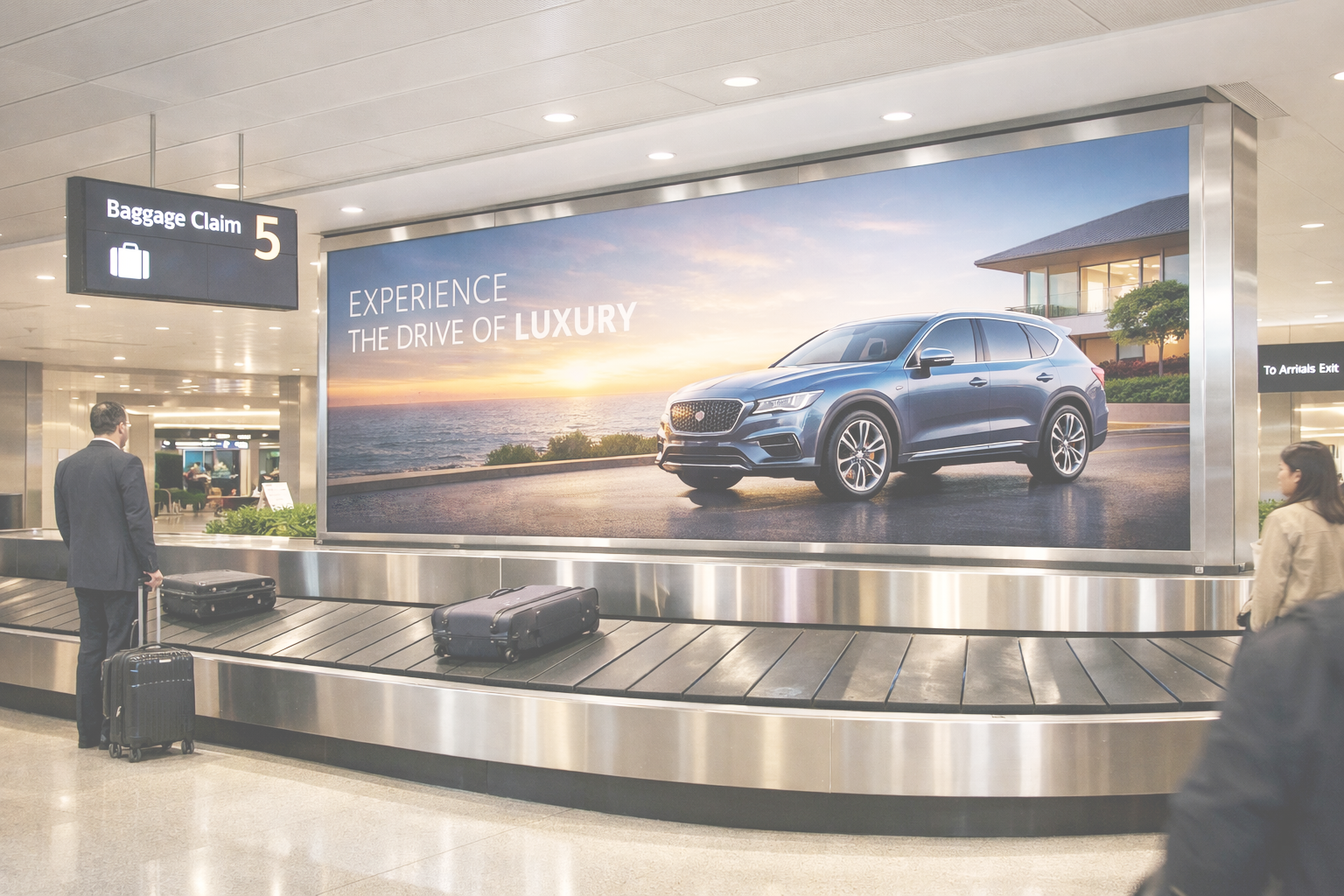
It’s Not Just Where You Advertise - It’s How Fast You Execute
We combine local insight with fast rollout to deliver results for you, now.
Talk to an ExpertAudience and Cultural Intelligence
Top 2 Languages:
- English: Dominant across every segment and the default for all commercial and B2B creative. The regional audience responds to direct, value-led, unpretentious messaging and reacts poorly to abstraction.
- Spanish: A substantial second language across Atlantic City's resident population, concentrated in hospitality, retail, healthcare, and construction employment. Spanish-language creative measurably improves reach for consumer financial, telecom, remittance, and retail advertisers targeting the local workforce rather than the visitor.
Major Traveller Nationalities:
The passenger base is overwhelmingly United States domestic, drawn from southern New Jersey, southeastern Pennsylvania, and Delaware. Foreign visitation to the region is real but arrives largely through the metropolitan airports and continues by road. The internationally relevant population at ACY is resident rather than visiting, consisting of Vietnamese, Indian, Bangladeshi, Filipino, Chinese, Puerto Rican, Dominican, and Mexican communities tied to the hospitality economy. Creative should be built primarily for an American regional audience, with targeted multilingual execution where the advertiser category specifically serves the resident workforce.
Religion, Advertiser Intelligence:
- Catholicism (approximately 35 to 40 percent): Strongly represented through the region's Italian, Irish, Polish, and Hispanic communities. Christmas and Easter are the primary family travel triggers, producing December and spring peaks with gifting, reunion, and multi-generational travel spending. Family financial products, jewellery, and travel align to these windows.
- Protestant Christianity (approximately 25 to 30 percent): Broadly distributed across the inland and southern counties. Thanksgiving and Christmas travel triggers dominate, with strong community-trust sensitivity in messaging.
- No religious affiliation and other faiths including Judaism, Islam, Hinduism, and Buddhism (approximately 30 percent): A large secular segment alongside an established Jewish community with historic shore-town presence and growing Asian faith communities tied to the hospitality workforce. Purchase triggers here are seasonal and life-stage driven. Eid, Diwali, and Lunar New Year generate outbound connecting travel relevant to remittance, telecom, and travel advertisers.
Behavioural Insight:
There are two distinct financial mindsets in one terminal and advertisers must choose which they are addressing. The passenger flying a low-cost leisure route is value-driven, price-comparing, and responsive to promotional clarity, discount structure, and guaranteed inclusions. The shore homeowner and casino-adjacent professional is asset-focused, tax-aware, and interested in property yield, succession, and retirement positioning, and responds to competence signals rather than price. Creative that tries to serve both simultaneously reaches neither. Masscom recommends segmenting ACY campaigns by daypart and route pattern rather than treating the terminal as one audience.
Outbound Wealth and Investment Intelligence
The outbound passenger at ACY is defined by a specific and unusually clear pattern. This catchment already understands second-home ownership better than almost any region in the United States, because a large share of the population either owns shore property, rents it out, or works within its economy. That familiarity translates directly into openness to further property acquisition elsewhere, particularly in warm-climate markets that solve the winter problem the Jersey Shore cannot. The airport's route network points exactly where that capital goes.
Outbound Real Estate Investment:
Capital from this catchment moves consistently into Florida, with the Gulf Coast around Fort Myers, Punta Gorda, and the Tampa and St. Petersburg corridor absorbing the largest share, reinforced by direct nonstop access from ACY. The Florida Atlantic coast, including the West Palm Beach and Fort Lauderdale corridors, attracts the higher-value buyer, particularly Philadelphia and shore families trading up. The Orlando and Sanford corridor draws investment property and vacation rental buyers who already understand rental yield from shore ownership. Coastal South Carolina around Myrtle Beach attracts the entry-level second-home and retirement buyer. Beyond the United States, the Caribbean and Mexico's Riviera Maya draw the more adventurous purchaser. Developers targeting northeastern second-home capital reach an unusually sophisticated and pre-educated buyer here at a cost far below Philadelphia or New York airports.
Outbound Education Investment:
Families in this catchment send students primarily to New Jersey and Pennsylvania institutions, with a strong secondary flow to nationally ranked private universities across the northeast and to specialist programmes in aviation, hospitality management, gaming administration, and health sciences. International study, where chosen, concentrates on the United Kingdom, Ireland, and Italy, often driven by heritage connection as much as academics. Professional and business-owning households support full tuition without financial aid dependence and decide a full academic year in advance, making September to January the decision window. A reverse flow exists through the regional university and the hospitality workforce, creating a dual-direction education audience for universities and advisory firms.
Outbound Wealth Migration and Residency:
United States passport holders here do not pursue residency for mobility, so demand is entirely tax and lifestyle driven, and in this specific region it is acute. New Jersey's state tax and estate environment makes Florida domicile relocation an actively discussed strategy among shore homeowners and business owners, and this is the single most commercially relevant wealth migration product for the ACY audience. Beyond that, Portugal and Greece residency by investment, Caribbean citizenship by investment in St Kitts and Nevis, Antigua, and Dominica, and Costa Rican and Panamanian retirement residency attract genuine interest. Domicile advisory, estate planning, and business succession services find a receptive and financially capable audience that is rarely addressed directly at the point of departure.
Strategic Implication for Advertisers:
Brands on both sides of this corridor should recognise that ACY intercepts a buyer who is already committed to the second-home concept and simply choosing the next market. That is a far shorter persuasion path than cold-selling the idea of coastal property ownership. Masscom Global activates both ends of the corridor simultaneously, placing property, domicile, and retirement messaging at ACY while running destination-market activity for the same client in Florida and the Carolinas, so one campaign captures the audience at departure and again at arrival.
Airport Infrastructure and Premium Indicators
Terminals:
- A single passenger terminal serving all commercial traffic, with one consolidated security checkpoint and a shared gate concourse. Every departing passenger follows an identical physical sequence, which guarantees audience capture for correctly positioned inventory.
- Federal inspection facilities are in place, giving the airport international arrival capability for charter and non-scheduled operations even though no scheduled international service currently operates.
Premium Indicators:
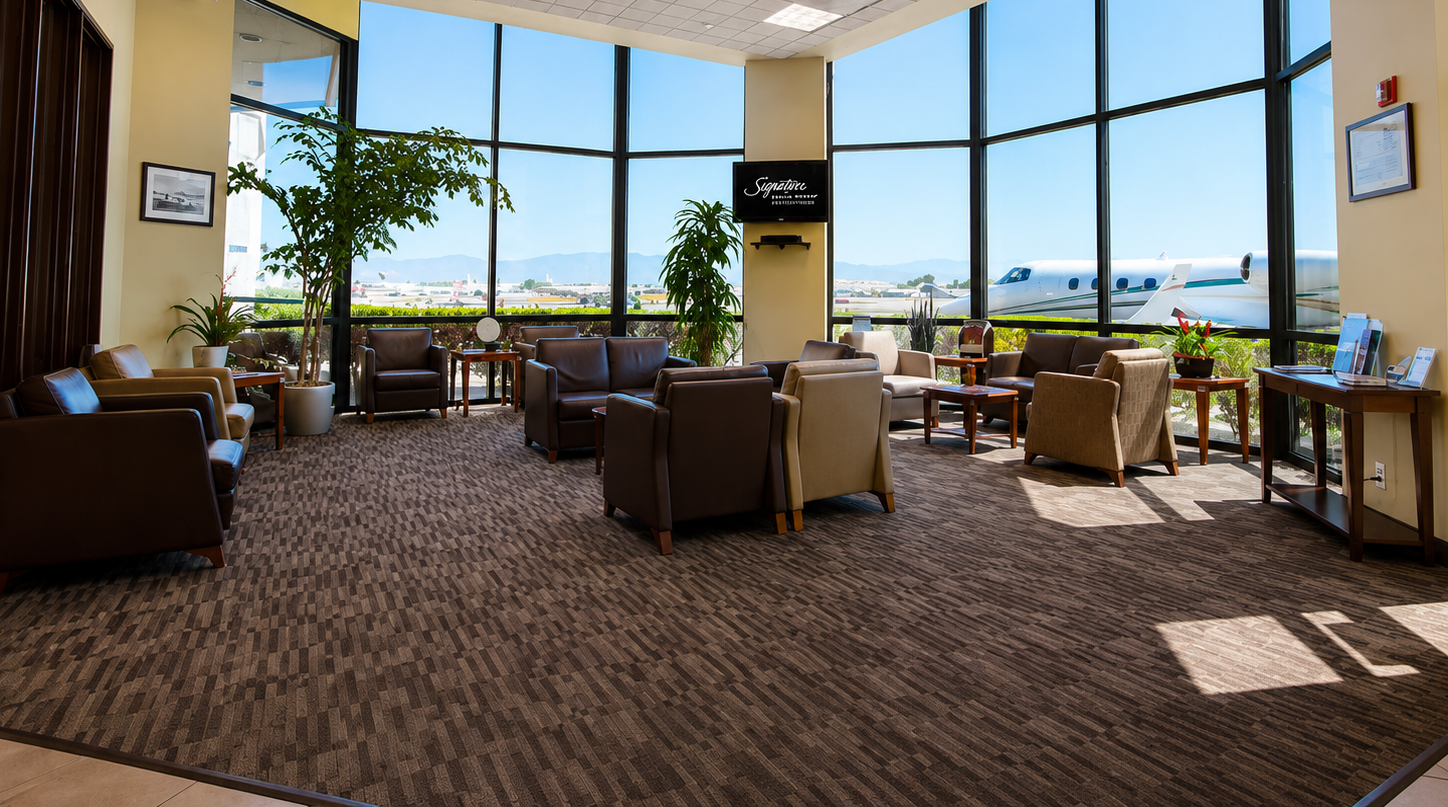
- No branded commercial lounge network operates at the airport. Premium audience contact occurs in the main concourse, at check-in, and in parking and arrivals, which materially raises the value of general terminal placements.
- Substantial general aviation and charter activity, with 56,612 aircraft operations recorded in 2024 against 845,108 commercial passengers. That ratio reflects the federal research complex, military flying, flight training, and business and casino-related private aviation using the field.
- The primary runway extends to 10,000 feet, capable of handling wide-body and long-range charter equipment, which underpins the airport's charter, cargo, and irregular-operations capability and gives it a physical capacity far beyond its current schedule.
- A major federal aviation research and technology complex and an Air National Guard fighter wing are co-located on the airfield, producing a permanent professional and defence population and a national aviation technology park presence.
- A passenger loyalty programme operated by the airport itself creates a direct-marketing relationship with repeat regional flyers, an unusual asset for an airport of this size.
- No on-airport luxury hotel. Casino resort accommodation is approximately 10 miles away in Atlantic City.
Forward-Looking Signal:
The airport is in an active rebuild. Following the loss of its dominant carrier in May 2026, replacement leisure capacity is being added through the second half of the year, with the airport director stating an expectation that lost service would be fully replaced by December 2026 and that the market has room to grow beyond its previous level. Officials have also noted that single-carrier dominance previously discouraged other airlines from entering, meaning the current reset opens the route map to broader competition and higher long-term volume. Advertisers who establish position during the rebuild secure rates that will not survive the recovery, and Masscom Global advises clients to lock multi-period placements now rather than after the schedule stabilises.
Airline and Route Intelligence
Top Airlines:
Allegiant Air, Breeze Airways, and American Airlines, the latter operating a connecting surface transfer product that moves ACY passengers directly to their departure gate at Philadelphia after check-in and security screening at Atlantic City. Charter and cargo operators also use the field.
Key International Routes:
Scheduled international service is not currently offered. Federal inspection facilities support international charter operations. All scheduled international travel is connecting. Weekly international frequency data is not applicable.
Domestic Connectivity:
Allegiant serves Florida and coastal leisure markets including Fort Lauderdale, St. Petersburg and Clearwater, Punta Gorda, the Orlando and Sanford corridor, and Myrtle Beach. Breeze Airways is expanding rapidly, with daily nonstop Orlando service and additional routes including Fort Myers, Myrtle Beach, and West Palm Beach phasing in. American Airlines provides access to its global network via the Philadelphia connecting product. Route composition is being actively rebuilt through 2026 and should be verified before campaign launch.
Wealth Corridor Signal:
The route map is unusually easy to read. Almost every scheduled destination is a warm-climate leisure and second-home market: Florida's Gulf and Atlantic coasts, central Florida, and coastal South Carolina. This is not a business network, it is a wealth relocation and vacation property network, carrying northeastern homeowners toward exactly the markets they are most likely to buy into. The Philadelphia connecting product is the separate corporate and international corridor, serving the smaller but higher-value business and diaspora segment. Advertisers should treat these as two distinct campaigns sharing one terminal.
Media Environment at the Airport
- Single terminal, single checkpoint, single concourse. Advertising clutter is minimal compared with Philadelphia or Newark, which means individual placements command a far higher share of voice than equivalent spend in either metropolitan market.
- Dwell time is extended and predictable. Low-cost leisure passengers arrive early by habit, the airport is widely used precisely because it is calmer than the metropolitan alternatives, and the connecting surface product to Philadelphia creates an unusually long and captive pre-departure period. Longer, unhurried dwell produces genuine reading time rather than glance exposure.
- The environment reads as relaxed and regional rather than transactional, which suits property, financial services, hospitality, insurance, and lifestyle advertisers seeking approachability and trust. The co-located federal research and defence presence adds a credibility dimension for aerospace and technology brands.
- Masscom Global provides inventory access, placement precision, and execution management at ACY alongside the wider United States regional airport network, allowing advertisers to build a northeastern coastal, mid-Atlantic, or national regional package from a single point of contact with unified reporting and consistent creative deployment.
Strategic Advertising Fit
Best Fit:
- Florida and coastal second-home real estate: The most aligned category by a wide margin. The route network flies this audience directly into the markets being sold.
- Retirement communities, domicile advisory, and estate planning: Addresses an acute and locally understood tax and relocation question among shore homeowners and business owners.
- Wealth management, private banking, and business succession: Targets closely held business wealth and property-derived capital across the shore and inland catchment.
- Gaming, hospitality, and entertainment: Direct relevance to inbound visitors arriving with committed spend and to the resident operator community.
- Marine, boating, and coastal lifestyle: Matches one of the strongest discretionary spending patterns in the entire catchment.
- Aerospace, defence services, and engineering recruitment: Reaches a concentrated federal aviation research and military aviation population found at almost no other commercial airport.
- Travel insurance, cruise, and vacation packaging: Intercepts a committed leisure audience at the point of departure with high conversion relevance.
- Automotive, particularly SUV and premium family vehicles: Aligned to a suburban, property-owning, multi-vehicle household profile.
Brand Alignment at a Glance:
| Category | Fit |
|---|---|
| Coastal and second-home real estate | Exceptional |
| Retirement, domicile, and estate advisory | Exceptional |
| Gaming, hospitality, and entertainment | Strong |
| Wealth management and private banking | Strong |
| Marine and coastal lifestyle | Strong |
| Aerospace, defence, and engineering | Strong |
| Automotive and travel insurance | Moderate |
| High-fashion luxury and designer retail | Poor fit |
Who Should Not Advertise Here:
- High-fashion, couture, and designer luxury retail: The genuine HNWI in this catchment overwhelmingly arrive at the shore by road from Philadelphia and New York or fly privately, and they do not pass through this terminal. The commercial passenger is a value-led leisure traveller, and status-led creative will not convert. Advertisers seeking that audience should buy the metropolitan airports instead.
- Premium business travel products, business class services, and corporate travel management: The scheduled network is almost entirely leisure. There is no meaningful corporate travel volume to intercept.
- Inbound destination tourism campaigns for competing global markets: Passenger volume is modest and the outbound audience travels on booked nonstop leisure service with the destination already fixed.
Event and Seasonality Analysis
- Event Strength: High
- Seasonality Strength: High
- Traffic Pattern: Dual-Peak
Strategic Implication:
Budget should be heavily concentrated rather than spread evenly. May to September is the dominant window, capturing shore season, summer visitation, and the August airshow, and it should carry the majority of consumer weight. February to March is the second window, capturing outbound Florida departure traffic at its highest purchase intent, and it is the correct moment for property, retirement, and domicile advertisers specifically. Masscom Global structures ACY campaigns around this rhythm, weighting inventory into the two peaks and using shoulder months for lower-cost brand maintenance, which typically improves effective cost per relevant impression across a twelve-month plan. Given the current schedule rebuild, we recommend contracting now and reviewing route mix in the first quarter of 2027.

Poor Placement and Delays Affect Airport Campaigns
We help you move faster, access better inventory, and get it right now.
Talk to an ExpertFinal Strategic Verdict
Atlantic City International Airport is a timing play, and the timing is right now. With 845,108 passengers in 2025, a schedule actively rebuilding after the loss of its dominant carrier, and a catchment containing some of the most valuable second-home real estate in the United States, ACY presents a soft rate environment attached to a wealth base that has not moved an inch. Coastal property developers, retirement and domicile advisers, wealth managers, gaming and hospitality brands, and marine lifestyle advertisers reach a buyer here who already understands second-home ownership and is flying directly into the markets they are being sold. Replacement capacity is phasing in through 2026, officials expect the route map to broaden beyond its previous single-carrier limits, and rates will follow volume upward. Advertisers who secure position during the rebuild lock terms that the recovery will erase, and Masscom Global has the inventory access, audience intelligence, and execution speed to place them correctly before that window closes.
About Masscom Global
Masscom Global is a premium international airport advertising and media buying agency operating across 140 countries. With deep expertise in airport OOH, premium publications, and high-net-worth audience targeting, Masscom helps brands reach the world's most valuable travellers at the moments that matter most. For advertising packages, media rates, and campaign planning at Atlantic City International Airport and airports across the globe, contact Masscom Global today.
Frequently Asked Questions
How much does airport advertising cost at Atlantic City International Airport? Cost varies by format, terminal position, campaign duration, and seasonal demand. Summer shore season and the winter Florida departure period carry premium pricing, while shoulder months offer lower entry points. The airport is currently rebuilding capacity following a major carrier departure, which has created a temporarily favourable rate environment. Contact Masscom Global for current rates and availability before that window closes.
Who are the passengers at Atlantic City International Airport? Predominantly American leisure travellers from southern New Jersey, southeastern Pennsylvania, and Delaware. The core segments are low-cost leisure and casino visitors, Jersey Shore second-home owners and their guests, federal aviation research and Air National Guard personnel based at the airfield, and convention delegates. There is also meaningful charter and general aviation activity beyond scheduled service.
Is Atlantic City International Airport good for luxury brand advertising? For fashion-led and designer luxury, no. The wealthiest households in this catchment reach the shore by road from Philadelphia and New York or fly privately, and they do not pass through the commercial terminal. Asset-based premium categories perform well, including coastal and second-home real estate, private banking and wealth management, marine and boating, and estate and domicile advisory. The wealth in this region is real, but it is expressed through property rather than display.
What is the best airport in New Jersey to reach HNWI audiences? Newark Liberty carries the greatest absolute volume of high-net-worth travellers in the state. Atlantic City International is the better choice for reaching Jersey Shore second-home wealth, coastal property buyers, and the gaming and hospitality economy specifically, because it is the only commercial airport embedded in that catchment. For full New Jersey coverage, the two work as complements rather than alternatives.
What is the best time to advertise at Atlantic City International Airport? May to September is the dominant window, capturing shore season, summer resort visitation, and the August airshow. February to March is the second window and the highest-intent period for property and retirement advertisers, because it captures outbound Florida departure traffic at the moment of decision. Advertisers with a single-season budget should choose based on whether the target is consumer volume or property intent.
Can international real estate developers advertise at Atlantic City International Airport? Yes, and the alignment is unusually strong, though the largest opportunity is domestic. This catchment sends consistent second-home and retirement capital into Florida's Gulf and Atlantic coasts, central Florida, and coastal South Carolina, with secondary interest in Mexico and the Caribbean. Because so many households here already own or rent shore property, the audience arrives pre-educated on yield, seasonality, and ownership economics, which shortens the persuasion path considerably.
Which brands should not advertise at Atlantic City International Airport? High-fashion and designer luxury retail, because that audience does not use the commercial terminal. Premium business travel and corporate travel management products, because the scheduled network is almost entirely leisure with negligible corporate volume. Inbound destination tourism campaigns for competing global markets, because passenger volume is modest and the outbound audience has already booked a fixed nonstop destination.
How does Masscom Global help brands advertise at Atlantic City International Airport? Masscom Global provides the full chain: audience intelligence specific to the Jersey Shore property, gaming, and federal aviation catchment, inventory access and placement recommendation, creative guidance segmented by route corridor rather than treating the terminal as one audience, campaign execution and installation management, and performance reporting. We also monitor the current schedule rebuild so campaign timing tracks returning capacity rather than lagging it. Book a fifteen-minute call to review availability and rates.