




Airport at a Glance
| Field | Detail |
|---|---|
| Airport | Incheon International Airport |
| IATA Code | ICN |
| Country | South Korea (Republic of Korea) |
| City | Incheon (48 km west of Seoul) |
| Annual Passengers | 71.2 million total (2024); 70.7 million international — a new all-time record |
| Primary Audience | Korean HNWI and corporate executives, inbound K-culture and Hallyu tourism, outbound Korean premium leisure travellers, Northeast Asian transit audience |
| Peak Advertising Season | Spring (March to May — cherry blossom, F1), summer (July to August), Korean Chuseok (September to October), Chinese New Year (January to February) |
| Audience Tier | Tier 1 |
| Best Fit Categories | K-beauty and premium cosmetics, luxury goods and duty-free, premium automotive, international education, luxury hospitality, financial services |
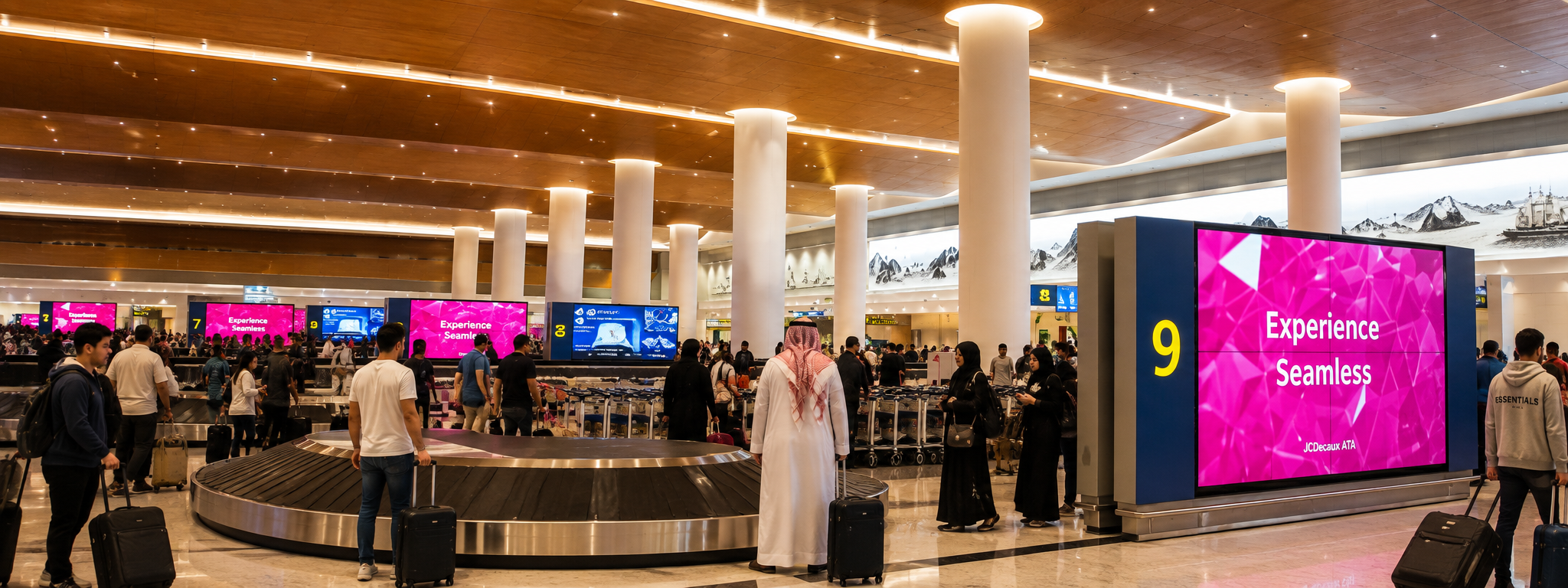
Airport Advertising in Incheon International Airport (ICN), South Korea
The world's third-busiest international airport — gateway to the global Korean Wave, home to the world's largest duty-free retail environment, and the sole aviation hub that simultaneously ranks in the world's top 3 for international passengers and top 6 for cargo.
Incheon International Airport entered 2025 having achieved a trifecta that no other airport in Asia had accomplished simultaneously: it ranked third globally in international passenger traffic, third globally in cargo operations, and third globally in infrastructure capacity after completing its Phase 4 expansion in December 2024. The 70.7 million international passengers it handled in 2024 surpassed its own previous record set in 2019 by 0.1% — an achievement that jumped ICN from 20th to 13th in the global airport rankings in a single year, fuelled by a 26.7% year-on-year surge driven by Japan (+31%), China (+93%), and Northeast Asia (+37%) route recovery. With Phase 4 completion, the airport can now handle 106 million annual passengers — nearly double its original capacity — making it the third-largest airport by infrastructure globally.
What makes Incheon commercially distinct from every other airport in Northeast Asia is the intersection of three uniquely Korean commercial forces that flow through its terminals daily. South Korea's outbound travellers — 29 million flew overseas in 2024, nearly 1.8 times the number of inbound tourists — are the most travel-active consumer population in Asia relative to the country's size, spending generously on duty-free goods, premium hospitality, and international experiences. Inbound Hallyu tourism brought 16.37 million foreign visitors to South Korea in 2024, a 48% increase that made the country the world's fastest-growing major tourism destination, with shopping accounting for 37.8% of visitor spending — led by K-beauty, luxury fashion, and Korean cultural products. And Incheon's transit ecosystem — rated the world's best international transit airport by Skytrax for multiple years — routes tens of millions of global passengers through its terminals on journeys between North America, Europe, and Southeast Asia. For advertisers, these three audiences share one terminal complex.
Advertising Value Snapshot
- Passenger scale: 71.2 million total, 70.7 million international in 2024, a new all-time record; third globally by international passenger traffic; 26.7% year-on-year growth — the strongest among all global top-5 airports; Phase 4 completion (December 2024) expanded capacity to 106 million annually; IIAC projects 73–76.6 million international passengers in 2025
- Traveller type: Korean HNWI and chaeebol family-owned enterprise executives, outbound Korean premium leisure travellers (29 million overseas trips in 2024), inbound K-culture and Hallyu tourists (16.37 million to South Korea in 2024 — world's fastest-growing major destination), and the global transit audience routing through Incheon between North America, Europe, and Asia
- Airport classification: Tier 1 — Skytrax 3rd best airport globally in 2024; world's best international transit airport (Skytrax, multiple years); 5-Star Airport rating; Phase 4 expansion completed December 2024 with new Terminal 2 wings, fourth runway, and 106 million annual capacity
- Commercial positioning: South Korea's economy anchored by Samsung, Hyundai, LG, and SK — the four chaebol groups whose global operations generate constant premium international travel; Seoul home to 82,500 millionaires and 20 billionaires; K-beauty exports hit a record $10.2 billion in 2024; Korean cultural exports — K-pop, K-dramas, K-film — generate $12+ billion annually in tourism-related downstream spending
- Wealth corridor signal: ICN anchors Seoul's most commercially productive outbound corridors to Los Angeles, New York, Tokyo, Singapore, London, and Frankfurt — the routes through which South Korea's chaebol leadership, technology executives, and HNWI families conduct global business and deploy capital
- Advertising opportunity: Masscom Global provides brands with the intelligence and access to reach Incheon's extraordinary three-audience convergence — the outbound Korean HNWI and professional, the inbound Hallyu and premium cultural tourist, and the global transit premium passenger — with creative and placement calibrated to the specific commercial intent of each segment

Airport Advertising is Complex to Get Right
We help you execute faster, with proven results and local insight most planners lack starting now.
Talk to an ExpertCatchment Area and Economic Drivers
Top 10 Cities within 150 km — Marketer Intelligence
- Seoul (Gangnam, Jongno, Yeongdeungpo): South Korea's capital and the commercial headquarters of every major Korean chaebol — Samsung, Hyundai, LG, SK, Lotte, and Hanwha — home to 82,500 millionaires and 20 billionaires; the senior executives of Samsung Electronics, Hyundai Motor, LG Electronics, and POSCO travel through ICN weekly on routes to Silicon Valley, Tokyo, Frankfurt, and Singapore; Seoul is also the world headquarters of K-pop's major labels — HYBE (BTS), SM Entertainment, YG Entertainment, and JYP — whose global operations generate premium international travel at ICN
- Incheon (Songdo International Business District): The city directly surrounding ICN, home to Songdo IBD — one of the world's most extensively planned smart cities and a growing hub for international organisations, biotech, and financial services; Songdo houses UN agencies, global pharmaceutical firms, and a rapidly expanding biotech cluster; the international professionals resident in Songdo generate consistent premium business travel through ICN
- Suwon (Gyeonggi Province): 30 km south of Seoul and headquarters of Samsung Electronics' global semiconductor and mobile division — the world's largest semiconductor company by revenue; the Samsung Electronics engineers and executives who make Suwon one of the world's most commercially consequential technology campuses travel through ICN on routes to San Jose, Austin, Tokyo, and Amsterdam
- Seongnam-Bundang (Gyeonggi Province): Home to the headquarters of Naver — South Korea's dominant internet and technology company (South Korea's answer to Google and Amazon) — along with Kakao and a growing ecosystem of Korean digital technology companies; the technology executives and developers of Korea's digital economy contribute a growing HNWI and premium professional travel audience at ICN
- Yongin (Gyeonggi Province): Home to Samsung Electronics' Giheung campus (DRAM and NAND flash memory manufacturing) and a major Samsung R&D hub; the thousands of advanced semiconductor engineers and their senior management who staff this facility are among the most globally mobile technical professionals in South Korea and travel frequently through ICN
- Ansan (Gyeonggi Province): A major industrial city with significant automotive component and electronics manufacturing; Ansan's professional business community contributes regular business travel through ICN on domestic connections and short-haul international routes
- Pyeongtaek (Gyeonggi Province): Home to Samsung Electronics' Pyeongtaek semiconductor mega-campus — the world's largest single semiconductor manufacturing facility, covering 289 hectares — whose continued expansion generates consistent senior executive and international technical specialist travel through ICN
- Uijeongbu (Gyeonggi Province): A northern Gyeonggi city with significant logistics and distribution sector development, contributing business travel through ICN from the supply chain and logistics executive community supporting Seoul's major consumer goods and technology companies
- Gwangmyeong (Gyeonggi Province): An industrial and transportation hub directly south of Seoul whose IKEA Gwangmyeong — the world's largest IKEA by floor space — reflects the city's scale as a retail and logistics centre; its business community accesses international connections through ICN
- Icheon (Gyeonggi Province): Home to SK Hynix's semiconductor manufacturing campus — South Korea's second-largest chipmaker and one of the world's most significant memory semiconductor producers; the Icheon executives and engineers contribute a consistent premium B2B technology travel audience at ICN alongside Suwon's Samsung community
NRI and Diaspora Intelligence
South Korea's diaspora dynamic at Incheon is commercially significant and growing. The Korean-American community — approximately 2.5 million in the US — generates substantial return visit travel through ICN, with a premium spending profile anchored in luxury goods purchasing, family visits, and real estate investment in Seoul's Gangnam and Seongsu districts. The Korean-American professional community includes disproportionate representation in Silicon Valley's technology sector, contributing a consistent premium B2B travel audience on the ICN-San Francisco and ICN-Los Angeles routes. Chinese tourists — 4.6 million in 2024 and recovering rapidly — are driving one of the strongest single-market inbound growth trends at ICN, with duty-free shopping accounting for a large share of their total South Korea expenditure. The global Hallyu diaspora — the tens of millions of K-pop, K-drama, and K-beauty fans who have developed deep cultural connections with South Korea through media — are converting into physical visitors at ICN at an accelerating pace.
Economic Importance
South Korea's economy operates at a scale and global integration that makes ICN commercially unique in Northeast Asia. The country is the world's 13th-largest economy by GDP, home to the world's most significant semiconductor cluster — Samsung and SK Hynix together control approximately 70% of the global DRAM market — and the world's most dominant shipbuilding, automotive, and consumer electronics exporting nations. The chaebol conglomerates — Samsung, Hyundai, LG, SK, Lotte, Hanwha, Hyundai Heavy Industries, and POSCO — collectively account for a significant share of South Korea's total exports and stock market capitalisation, and their global operations generate daily premium international business travel through ICN. K-beauty exports reached a record $10.2 billion in 2024, growing 21% year-on-year, making beauty the fastest-growing South Korean export category after semiconductors. For advertisers, the practical implication is that ICN's catchment produces both the most globally consequential semiconductor and technology executives in Asia and the most commercially potent cultural export ecosystem on earth — both flowing through the same terminals daily.
Business and Industrial Ecosystem
- Samsung Electronics and Samsung Group: South Korea's largest chaebol and the world's largest semiconductor company, headquartered in Suwon with manufacturing campuses in Pyeongtaek; Samsung's global semiconductor operations with TSMC, Apple, NVIDIA, Qualcomm, AMD, and Intel generate constant senior executive travel through ICN on routes to Silicon Valley, Austin, Amsterdam, and Tokyo; Samsung's device and consumer electronics leadership travels to MWC, CES, and regional retail meetings through ICN's European and North American corridors
- Hyundai Motor Group: South Korea's second-largest chaebol and the world's third-largest automotive group by volume, headquartered in Seoul's Yangjae district; Hyundai's global operations — including the Genesis luxury brand, IONIQ EV platform, and Kia Motors — generate substantial premium executive travel through ICN to Frankfurt (IAA), Los Angeles, and Singapore; Hyundai's growing electric vehicle and battery technology business drives a new wave of technology partnership travel
- LG Electronics, SK Group, and platform technology companies: LG Electronics' global display and home appliance operations, SK Hynix's semiconductor business, and the rapidly internationalising Korean technology platform companies — Naver, Kakao, Coupang — all generate premium B2B executive travel through ICN; the founders and investors of Korea's digital economy are an emerging UHNWI travel audience
- K-pop and entertainment industry: The global operations of HYBE (BTS), SM Entertainment (EXO, NCT, aespa), YG Entertainment (BLACKPINK), and JYP Entertainment (TWICE, Stray Kids) generate consistent premium travel through ICN as Korean artists and their management team travel for world tours, global media appearances, and international brand partnerships; the K-pop industry generated $12.4 billion in revenue in 2024, creating a global business executive class that travels internationally through ICN
Passenger Intent — Business Segment
The Korean corporate executive at ICN travels with a combination of institutional weight and global commercial urgency that is specific to South Korea's export-driven economy. The Samsung vice president flying to Austin is managing the most strategically consequential semiconductor relationship in global technology. The Hyundai executive connecting through ICN to Frankfurt is presenting the next generation of hydrogen fuel cell technology to the European automotive market. The HYBE senior manager flying to Los Angeles is managing the global marketing strategy of the world's most commercially valuable music group. These are not incidental business trips — they are the operational backbone of the industries that give South Korea its global economic significance.
Strategic Insight
ICN's strategic advertising advantage is its position at the centre of the global Korean export economy and the global Korean cultural wave simultaneously. No other airport in the world offers advertisers the ability to reach both the executives of the world's most consequential semiconductor companies and the operators of the most commercially powerful entertainment export machine in Asia in the same terminal. For B2B technology, premium automotive, and financial services brands, the Korean corporate executive audience at ICN is among the most technically informed and commercially consequential in Asian aviation. For luxury goods, K-beauty, premium hospitality, and international lifestyle brands, the Korean outbound traveller is among the highest per-capita spenders in global aviation. Masscom builds ICN campaigns that capture both audiences simultaneously.
Tourism and Premium Travel Drivers
- K-beauty and Hallyu tourism — Myeong-dong, Gangnam, Hongdae: South Korea's Hallyu-driven inbound tourism is the fastest-growing major destination trend in Asia; 16.37 million visitors in 2024, a 48% increase; shopping accounts for 37.8% of visitor spending with Myeong-dong, Dongdaemun, and Lotte and Hyundai duty-free stores being primary destinations; Chinese tourists (4.6 million in 2024) and Japanese tourists (3.22 million) are the largest inbound market groups, with Americans (1.32 million) growing the fastest; K-beauty's record $10.2 billion in exports in 2024 signals a consumer industry whose global demand is channelling directly into ICN's inbound tourism numbers
- Medical and cosmetic tourism: South Korea is the world's most prominent medical tourism destination for cosmetic surgery, dermatological treatments, and premium wellness; the Gangnam district's internationally recognised plastic surgery clinics and Korean dermatology procedures attract visitors from Southeast Asia, China, Japan, and the Middle East; this audience arrives through ICN with committed medical spending budgets and extends their stay for shopping and cultural experiences
- Inspire Entertainment Resort (adjacent to ICN): The integrated luxury resort directly on Yeongjong Island adjacent to ICN — featuring 1,275 hotel rooms across three five-star towers, a casino, arena entertainment, and theme park attractions — creates a destination that captures transit and inbound visitors within the airport ecosystem; the Inspire arena hosts international concerts, sporting events, and premium entertainment that generates both inbound and transit audiences from across Asia
- K-pop tourism — concerts and cultural sites: International K-pop fans travelling to attend concerts by BTS, BLACKPINK, EXO, and their generational successors represent one of the most dedicated and highest-spending niche tourism audiences in the world; these fans plan multi-day Seoul itineraries that include concert attendance, fan merchandise shopping, and visits to filming locations of favourite K-dramas; their average trip spend is above the Korean inbound tourism average
- Cherry blossom season and natural heritage: South Korea's spring season (late March to mid-April) generates a significant inbound premium tourism surge comparable to Japan's, with Gyeongju, Jeju Island, and Seoul's Bukchon Hanok Village among the most photographed destinations; this tourism window creates a concentrated inbound premium leisure audience at ICN every spring
Passenger Intent — Tourism Segment
The inbound visitor arriving at ICN via the world's best international transit airport has typically planned a multi-destination journey; they may have connected from Los Angeles via Incheon to Bangkok, or from London to Singapore via Seoul. Those stopping in South Korea as a primary destination arrive with specific high-spend intent — duty-free cosmetics purchasing, medical treatment, K-pop fan experience, or premium culinary and cultural itineraries. Incheon's extensive duty-free mall — one of the world's largest — captures both groups: the transit passenger spending during a layover and the primary destination tourist departing with premium Korean goods.
Travel Patterns and Seasonality
Peak seasons:
- Spring (late March to May — cherry blossom and cultural peak): South Korea's most commercially dynamic inbound tourism window; cherry blossom tourism, Golden Week visitor surge from Japan (late April to early May), and the concentrated cultural festival calendar create ICN's highest-quality inbound premium leisure audience of the year
- Summer (July to August — Lunar New Year aftermath and peak leisure): Korean domestic outbound travel peaks as families travel to Southeast Asia, Japan, and Europe; inbound tourism from China and Southeast Asia peaks simultaneously; ICN's busiest absolute passenger volume period
- Chuseok and autumn (September to October — Korea's harvest festival and cultural peak): One of Korea's two most important national holidays creates a surge in outbound leisure travel; the autumn foliage season in South Korea's national parks creates inbound premium tourism from Japanese and Chinese visitors; October is the highest inbound month of 2024 with 1.60 million visitors
- Chinese New Year / Lunar New Year (January to February): ICN's peak daily passenger concentration; the airport projects an average of 214,000 daily passengers over the 10-day Lunar New Year period; outbound Korean family travel and inbound Chinese tourism create simultaneous peak conditions
- Year-round for Korean corporate and chaebol travel: Samsung, Hyundai, LG, and SK executives generate year-round premium corporate travel that is structurally independent of seasonal patterns
Event-Driven Movement
- Lunar New Year / Seollal (January to February): ICN's highest peak daily passenger window; Korean families travel internationally and visiting Asian diaspora returns home; luxury gifting, premium duty-free, and family hospitality advertising performs most efficiently in this period
- Chuseok — Korean Thanksgiving (September to October): The second major national holiday travel surge; outbound Korean leisure travel to Japan, Southeast Asia, and Europe peaks; luxury goods and premium hospitality advertising benefits
- K-pop concert season (March to October): Major K-pop groups' world tour schedules are anchored by Seoul concerts that attract international fans through ICN; BTS, BLACKPINK, EXO, and their successor groups each generate tens of thousands of international visitor arrivals when they perform in Seoul; these concerts create concentrated premium inbound audiences during their weekend windows
- Busan International Film Festival (October): Korea's most prestigious cultural event, drawing international filmmakers, producers, and culture industry executives to Busan through ICN; BIFF is the primary Asian film market and a concentrated premium cultural audience window
- CES-related Samsung and LG executive travel (January): The annual Consumer Electronics Show in Las Vegas drives an exceptional concentration of Samsung, LG, and Korean technology executive outbound travel through ICN in the first week of January, representing the year's most concentrated premium technology B2B advertising window

It’s Not Just Where You Advertise - It’s How Fast You Execute
We combine local insight with fast rollout to deliver results for you, now.
Talk to an ExpertAudience and Cultural Intelligence
Top 2 Languages
- Korean (Hangul): The sole national language and the primary communication language of every Korean passenger at ICN, from the Samsung vice president to the first-time Hallyu fan; advertising in Korean at ICN is not optional for the domestic audience — it is the fundamental creative requirement; Korean consumer culture rewards brands that demonstrate cultural knowledge of Korean values: respect for family relationships, emphasis on quality and craftsmanship, and the complex blend of technological modernity with Confucian-rooted social values
- English: The international business language of Korea's chaebol export economy, the communication medium of the global Hallyu community, and the primary language of ICN's extensive inbound international audience from the US, Europe, and Oceania; ICN's status as the world's best international transit airport means that English-language advertising reaches a genuine pan-global audience in transit; bilingual Korean-English creative maximises reach across domestic premium passengers and the international audience simultaneously
Major Traveller Nationalities
ICN's passenger nationality profile reflects South Korea's position as Northeast Asia's foremost hub. Koreans dominate domestic and outbound traffic — 29 million overseas trips in 2024. Among inbound international passengers, Chinese visitors (4.6 million in 2024, recovering rapidly and up 93% versus 2023) lead volume; Japanese visitors (3.22 million) are the highest-frequency market given Incheon's proximity to Japan; Taiwanese (1.47 million), American (1.32 million), and Southeast Asian visitors complete the primary inbound nationality profile. The global Hallyu community — extending from Southeast Asia to South America, the Middle East, and sub-Saharan Africa — is generating new source markets for Korean inbound tourism at ICN that did not exist before 2015. The transit audience routing through ICN between North America and Southeast Asia adds a layer of global nationalities whose duration at the airport can range from two to 24 hours.
Religion — Advertiser Intelligence
- Christianity (approximately 30%): South Korea's largest organised religious group, with significant Protestant and Catholic communities whose influence on the cultural calendar is commercially relevant; Christmas is a major consumer spending event; the Korean Christian community is disproportionately represented in the educated professional and HNWI classes
- Buddhism (approximately 16%): The traditional spiritual foundation of Korean culture, expressed commercially through the Lunar New Year and Chuseok harvest festival; temple-stay tourism and Buddhist cultural tourism are growing inbound niche categories at ICN
- No religion (approximately 56%): The largest demographic; Korea's majority secular and pragmatic consumer base evaluates brands on product quality, innovation reputation, and cultural relevance rather than religious alignment; this audience is among Asia's most brand-sophisticated and research-oriented
Behavioral Insight
The Korean HNWI is Asia's most brand-loyal premium consumer and among the most globally travel-active. South Korea's 29 million outbound trips in 2024 — from a population of 51.6 million — represent the highest per-capita international travel intensity in Asia. The Korean outbound traveller carries a pre-planned duty-free shopping list: Swiss watches, French luxury goods, Japanese cosmetics, and increasingly premium Korean-origin brands. They research purchases before travelling, execute transactions at duty-free and international boutiques during travel, and return home as brand advocates. The inbound foreign tourist to Korea arrives specifically for Korean cultural experiences — and their 37.8% spending allocation to shopping reflects one of the highest duty-free and retail spending ratios of any inbound market in global aviation. Advertising at ICN that speaks to both audiences — the outbound Korean consumer and the inbound Korean-culture enthusiast — achieves dual commercial reach from a single placement.
Outbound Wealth and Investment Intelligence
Korea's outbound wealth dynamic at ICN is defined by the intersection of chaebol family wealth and the new generation of Korean tech billionaires whose global capital deployment is growing rapidly. Seoul's 82,500 millionaires — including 195 centi-millionaires and 20 billionaires — travel predominantly through ICN on outbound investment, education, and leisure journeys. The Korean chaeebol families — the Lees (Samsung), the Chungs (Hyundai), the Koos (LG), and the Cheys (SK) — represent the traditional HNWI outbound capital base, investing in US real estate, European luxury goods, and international financial assets. The new generation of Korean HNWI — founders of Coupang, Krafton, Kakao, and the K-beauty companies — adds a younger, more globally mobile wealth tier whose investment preferences extend to Southeast Asian technology, US venture capital, and Japanese real estate.
Outbound Real Estate Investment
Korean HNWI outbound real estate investment is concentrated in three geographies. The United States — specifically New York, Los Angeles, and Seattle — is the primary outbound market for Korean HNWI families whose children attend American universities; California and New York real estate near elite university campuses is a structural demand driver. Australia (Sydney and Melbourne) attracts Korean investors for lifestyle and education corridor properties. Japan — particularly Tokyo and Osaka — has emerged as a rapidly growing Korean real estate investment destination, driven by the weak yen and Seoul's geographical and cultural proximity; Koreans are now among Japan's top-5 foreign real estate buyers. European luxury real estate — London, Paris, and Swiss residential properties — is a smaller but growing category among Korea's ultra-HNWI tier.
Outbound Education Investment
South Korea's HNWI families invest in international education with the same intensity as Chinese and Singaporean families. The United States leads — the Ivy League, MIT, Stanford, and top US liberal arts universities attract a disproportionately high share of Korea's most academically competitive students; Korean-American university communities at Harvard, Columbia, MIT, and Johns Hopkins are among the largest Asian national groups. The UK (Oxford, Cambridge, LSE, and London boarding school circuit) is the second destination. Canada and Australia draw the families who prioritise lifestyle, safety, and value alongside academic quality. International school networks in Singapore and Hong Kong also attract Korean families whose parents are posted internationally. For international education advertisers, ICN's premium departure environment — particularly on the US, UK, and Canadian routes — is one of Asia's most commercially committed education investment audiences.
Outbound Wealth Migration and Residency
Korean HNWI interest in international residency has grown substantially since the pandemic. South Korea is on the Henley & Partners list of countries experiencing net HNWI outflows, driven primarily by concerns over high inheritance taxes (South Korea has a maximum inheritance tax rate of 50%), complex business regulatory environments, and geopolitical proximity to North Korea. The United States EB-5 investor visa, Canada's investor immigration programmes, Australia's Global Talent visa, and Portugal's Golden Visa have all marketed actively to the Korean HNWI community. Singapore and the UAE are also growing residency investment destinations for Korean entrepreneurs seeking international business bases. Investment migration advisory, international estate planning, and residency consultancy firms will find ICN's outbound HNWI departure environment commercially responsive.
Strategic Implication for Advertisers
Incheon Airport sits at the exact intersection of outbound Korean HNWI capital deployment and inbound global investment in the Korean economy and cultural ecosystem. International real estate developers targeting Korean buyers, wealth management platforms seeking Korean HNWI mandates, and international education brands targeting Korea's HNWI parent community should treat ICN as a tier-one global advertising channel. Simultaneously, international brands seeking access to the world's fastest-growing inbound cultural tourism audience — the global Hallyu community arriving in Seoul — should position their brand at ICN as the first touchpoint of the Korean cultural experience they have travelled to encounter. Masscom structures ICN campaigns to serve both flows with the cultural precision each requires.
Airport Infrastructure and Premium Indicators
Terminals
ICN operates Terminal 1 (opened 2001, 496,000 sqm — the largest terminal in South Korea, 1,060 metres long) and Terminal 2 (opened January 2018, 347,000 sqm, designed by Gensler; Phase 4 expansion of T2 completed December 2024 with new east and west wings featuring the "Eternal Sky" kinetic art installation — 980 louvers mimicking endangered species movements — and "garden tips" outdoor relaxation areas at wing ends). Asiana Airlines relocated from T1 to T2 in January 2026 following the Korean Air-Asiana merger, balancing passenger flows to approximately 51% T1 / 49% T2 and significantly alleviating T1's historical congestion. Terminal 3 is in long-term planning as a dedicated low-cost carrier facility. The Phase 4 expansion also delivered a fourth runway, bringing ICN's total to four, with capacity for 600,000 annual aircraft movements and 6.3 million tonnes of cargo.
Premium Indicators
- World's best international transit airport — Skytrax (multiple years): This classification is commercially significant because it confirms that ICN's dwell environment is specifically optimised for the transit passenger — the long-haul traveller from New York connecting to Singapore who spends 4–8 hours in the terminal; these passengers have high commercial receptivity and extended dwell time that makes ICN's advertising environment among the most effective for transit-targeting campaigns in Asia
- World's largest duty-free retail ecosystem — Lotte and Hyundai DF: ICN's duty-free retail complex is among the world's largest, operated since 2025 by Lotte Duty Free and Hyundai DF following a major operator transition; the combination of Korean beauty, global luxury goods, premium spirits, and electronics creates a retail environment whose scale and commercial productivity is exceptional; the adjacent transit hotel and spa ecosystem extend the commercial dwell environment
- Inspire Entertainment Resort (Yeongjong Island): The integrated luxury resort directly accessible from ICN — 1,275 hotel rooms across three five-star towers, a casino, arena entertainment, and theme park — creates a destination that transforms the airport island into a multi-day premium leisure destination; international visitors arriving at ICN can begin their Korean experience at Inspire before entering Seoul, and the resort's events draw premium audiences from across Asia
- Korean Air and Asiana — both now at Terminal 2 following merger consolidation: The consolidation of Korea's two flag carriers in Terminal 2 following the completed Korean Air-Asiana merger creates a single premium hub terminal where the combined fleets of both carriers operate, delivering an exceptional first and business class audience density to T2's commercial environment
- Skytrax 5-Star Airport, ranked 3rd globally 2024: ICN's consistently high Skytrax rating positions it alongside Singapore Changi and Tokyo Haneda as one of Asia's three most premium airport experiences; the ambient quality signal this creates for advertisers is commercially significant
Forward-Looking Signal
ICN's forward trajectory is defined by Vision 2040 — IIAC's strategic plan targeting 100 million annual passengers by approximately 2032, advanced through Phase 4's newly delivered 106 million capacity infrastructure. The Declaration of Digital Transformation in March 2024 and the Aviation AI Innovation Hub announced in March 2025 signal IIAC's commitment to becoming Asia's most technologically sophisticated airport, with digital twins, autonomous ground vehicles, biometric SmartPass, and AI-driven operations as competitive differentiators. The Korean Air-Asiana merger consolidation — now fully effective with Asiana's January 2026 T2 relocation — will create a more commercially concentrated premium hub, with both carriers operating coordinated networks from T2. Scandinavian Airlines' September 2025 inaugural service from ICN signals the continued expansion of European connectivity that strengthens ICN's premium B2B travel audience. Masscom advises brands to act on ICN advertising now — ahead of the 100 million passenger milestone and before the Digital Transformation programme's full implementation makes premium inventory increasingly competitive.
Airline and Route Intelligence
Top Airlines
Korean Air (primary hub, T2 — SkyTeam), Asiana Airlines (now T2 — Korean Air merger), Jeju Air, Jin Air, T'way Air, Air Busan, Air Seoul; major international carriers: Delta Air Lines (SkyTeam — T2), Air France (SkyTeam — T2), KLM (SkyTeam — T2), Japan Airlines, All Nippon Airways, Singapore Airlines, United Airlines, American Airlines, British Airways, Lufthansa, Cathay Pacific, Thai Airways, Malaysia Airlines, China Eastern, Vietnam Airlines, Scandinavian Airlines (new September 2025)
Key International Routes
- Los Angeles (Korean Air, Asiana, Delta — primary trans-Pacific corridor; largest inbound market by spend)
- New York JFK (Korean Air, Asiana)
- San Francisco (Korean Air — Silicon Valley technology corridor)
- Chicago (Korean Air, Asiana)
- Dallas Fort Worth (Korean Air)
- London Heathrow (Korean Air, Asiana, British Airways)
- Frankfurt (Korean Air, Asiana, Lufthansa)
- Paris Charles de Gaulle (Air France, Korean Air)
- Amsterdam Schiphol (KLM, Korean Air)
- Copenhagen (Scandinavian Airlines — new September 2025)
- Tokyo Narita and Haneda (Korean Air, Asiana, JAL, ANA — highest frequency international route)
- Osaka Kansai and Fukuoka (Korean Air — top 2 and 3 by passenger volume)
- Bangkok (Korean Air, Asiana, Thai Airways)
- Singapore (Korean Air, Asiana, Singapore Airlines)
- Hong Kong (Cathay Pacific, Korean Air)
- Vietnam (Hanoi and Ho Chi Minh — high frequency, growing)
- Sydney and Melbourne (Korean Air, Asiana)
Domestic Connectivity
ICN serves primarily as an international gateway. Seoul's domestic air traffic and regional shuttle services operate predominantly from Gimpo Airport (GMP), which serves domestic destinations and shuttle flights to Tokyo Haneda, Osaka Kansai, Shanghai Hongqiao, and Taipei Songshan. ICN's domestic flights are limited; the airport's strategic identity is entirely international — a structural characteristic that ensures almost every passenger at ICN is a cross-border traveller, making it one of the most internationally pure advertising environments in Northeast Asian aviation.
Wealth Corridor Signal
Korean Air's route network — now combined with Asiana's upon merger completion — is the largest Korean-operated international network ever assembled. The Los Angeles route is South Korea's primary Korean-American diaspora corridor and the semiconductor industry's Silicon Valley relationship management route. The Frankfurt and Munich routes carry the Korean automotive industry's European production and design relationships. The Tokyo routes carry the world's highest-frequency bilateral aviation relationship — Koreans are Japan's largest source of inbound visitors, and the proximity of the two economies makes this one of the world's most commercially active bilateral corridors. The Singapore route carries Samsung's Southeast Asian headquarters relationship and Korea's growing ASEAN investment corridor. Every route at ICN is a mirror of South Korea's global economic relationships.
Media Environment at the Airport
- ICN's dual-terminal system — with T1's long-established premium retail and T2's architecturally distinguished new environment following its Phase 4 expansion — creates two distinct commercial advertising zones serving slightly different airline and passenger segments; the newly completed T2 wings with the "Eternal Sky" kinetic installation and outdoor garden areas are among the most visually distinctive and commercially high-attention advertising environments of any airport in Asia
- ICN's world-best international transit reputation means that the terminal accommodates some of the most dwell-time-engaged international passengers in global aviation; the transit passenger who has budgeted 4–8 hours at ICN has specifically chosen the airport for its retail, dining, and transit amenity quality — and their commercial receptivity during that dwell period is among the highest of any aviation audience
- Lotte Duty Free and Hyundai DF's new operators of the DF1 and DF2 zones represent a fresh premium retail context that is attracting a new generation of luxury brand partnerships; advertising adjacent to or within the duty-free environment at ICN is commercially the most productive placement category at the airport, capturing both Korean outbound duty-free purchasers and the inbound Hallyu tourist who shops duty-free on departure
- Masscom Global provides end-to-end campaign execution at ICN, with Korean-language creative advisory, cultural alignment with South Korea's specific premium consumer expectations, terminal-specific placement strategy across T1 and T2, and seasonal campaign timing calibrated to Korea's holiday and cultural event calendar
Strategic Advertising Fit
Best Fit
- K-beauty, skincare, and premium cosmetics: ICN is the most commercially concentrated global platform for K-beauty advertising to both the outbound Korean consumer and the inbound global Hallyu beauty enthusiast; Korean beauty exports hit $10.2 billion in 2024; the duty-free retail zone is the world's most productive single distribution channel for premium Korean cosmetics; international and Korean beauty brands advertising at ICN reach the category's most commercially active audiences simultaneously in both directions
- Luxury goods and premium duty-free: ICN's position as one of the world's largest duty-free complexes, combined with the outbound Korean traveller's consistent pre-travel luxury goods shopping intent and the inbound Chinese and Japanese duty-free purchase orientation, makes this the most productive duty-free advertising environment in Northeast Asia outside of international hubs like Dubai and Singapore
- Premium automotive: Korean chaebol family wealth and senior Samsung, Hyundai, and LG executive community are active premium automotive consumers; Porsche, Mercedes-Benz, BMW, and the Hyundai Genesis flagship luxury brand are all commercially relevant; the electric vehicle transition is creating new premium EV advertising relevance with the Samsung and Hyundai technology executive audience
- International education — US, UK, Canada, Australia: Korea's exceptional HNWI families are among Asia's most active international education investors; ICN's outbound departure environment on the US, UK, and Australian routes is one of the most commercially committed education investment audiences in Asia
- Luxury hospitality and destination travel: The Korean outbound traveller — 29 million in 2024, travelling to Europe, Southeast Asia, Japan, and Oceania — is among the highest-spending leisure travellers in Asia per capita; luxury resorts, premium cruise operators, and ultra-premium destination experiences will find a commercially active and aspirationally engaged audience at ICN
- B2B technology and professional services: ICN's concentration of Samsung, SK Hynix, Hyundai, and LG executives generates consistent enterprise technology, management consulting, and financial advisory demand; the Korean technology executive's international travel provides a regular premium B2B advertising window for the global professional services community that serves Korea's chaebol economy
- Financial services and wealth management: Korea's HNWI community — with Seoul's 82,500 millionaires, 20 billionaires, and growing inheritance tax management demand — represents a commercially active wealth management audience; Swiss, Singapore, and Hong Kong private banks expanding into the Korean HNWI market should treat ICN as a tier-one advertising channel
Brand Alignment at a Glance
| Category | Fit |
|---|---|
| K-beauty and premium cosmetics | Exceptional |
| Luxury goods and duty-free | Exceptional |
| Luxury hospitality and destination travel | Exceptional |
| Premium automotive | Strong |
| International education | Strong |
| B2B technology and professional services | Strong |
| Financial services and wealth management | Strong |
| Mass-market consumer goods | Poor fit |
Who Should Not Advertise Here
- Brands with no Korea market presence or cultural intelligence: The Korean consumer evaluates brands against their domestic availability, after-service quality, and cultural alignment with Korean values; international brands without a meaningful Korea market investment will find that awareness created at ICN cannot be converted without supporting retail and service infrastructure in Seoul
- Mass-market consumer goods: ICN's audience is concentrated in the premium and HNWI tier domestically, and in the culturally motivated premium spending tier internationally; mass-market consumer goods advertising will achieve low conversion relative to the investment required for premium placements
- Brands insensitive to geopolitical dynamics: South Korea's complex geopolitical environment — relations with North Korea, periodic Japan-Korea historical tensions, and China-Korea trade sensitivities — means that brands whose advertising inadvertently intersects with these dynamics risk reputational damage; Masscom advises on geopolitical sensitivity before building ICN campaigns
Event and Seasonality Analysis
- Event Strength: Very High (K-pop concert season, Chuseok, Lunar New Year, BIFF, cherry blossom tourism surge)
- Seasonality Strength: Very High (Spring cherry blossom peak, summer leisure peak, Chuseok autumn peak, Lunar New Year peak)
- Traffic Pattern: Multi-Peak (Lunar New Year, spring, summer, Chuseok) with Strong Year-Round Chaebol Corporate Base
Strategic Implication
ICN's commercial calendar is defined by South Korea's cultural rhythm — a country whose population travels internationally at one of the world's highest per-capita rates and whose cultural exports generate inbound tourism demand that is growing faster than any major destination in Asia. Lunar New Year in January and February is the year's highest daily passenger concentration. Cherry blossom spring is the year's highest quality inbound premium tourist window. Summer is the year's highest absolute volume period. Chuseok is the year's most important domestic outbound leisure window. K-pop concert season creates concentrated premium inbound cultural tourism audiences on specific weekends throughout the year. Masscom structures ICN campaigns to harvest each seasonal peak with appropriate creative while maintaining continuous brand presence for the year-round chaebol corporate audience that provides ICN's structural commercial floor.

Poor Placement and Delays Affect Airport Campaigns
We help you move faster, access better inventory, and get it right now.
Talk to an ExpertFinal Strategic Verdict
Incheon International Airport is one of the most commercially extraordinary advertising environments in the world because it is simultaneously three airports in one. It is the gateway to the world's most powerful cultural export machine — Hallyu — whose global reach converts into 16.37 million inbound visitors and growing; it is the departure hub for South Korea's 29 million annual outbound travellers, who carry the world's highest per-capita international travel intensity and premium duty-free spending intent; and it is Asia's foremost transit platform, rated the world's best international transit airport, through which tens of millions of global passengers move between North America, Europe, and Southeast Asia every year. Phase 4's completion in December 2024 has expanded capacity to 106 million — nearly double the original — positioning ICN for a decade of growth toward 100 million passengers by 2032. The Korean Air-Asiana merger consolidation, the new Lotte and Hyundai DF retail operation, the Inspire Entertainment Resort, and the Digital Transformation strategy collectively signal an airport whose commercial ecosystem is accelerating, not plateauing. The brands that invest at ICN now — in K-beauty, luxury goods, premium automotive, international education, and financial services — are positioning themselves at the intersection of Asia's most consequential semiconductor economy and the world's most commercially potent cultural wave, in a terminal environment that grows more premium, more internationally diverse, and more commercially productive with every passing year. Masscom Global provides the cultural intelligence, Korean-market expertise, placement precision, and execution capability to ensure that investment at ICN converts into the commercial outcomes this extraordinary airport deserves.
About Masscom Global
Masscom Global is a premium international airport advertising and media buying agency operating across 140 countries. With deep expertise in airport OOH, premium publications, and high-net-worth audience targeting, Masscom helps brands reach the world's most valuable travellers at the moments that matter most. For advertising packages, media rates, and campaign planning at Incheon International Airport and airports across the globe, contact Masscom Global today.
Frequently Asked Questions
How much does airport advertising cost at Incheon International Airport?
Advertising costs at ICN vary by terminal, placement zone, format, campaign duration, and seasonal demand. The duty-free retail adjacency zones in both T1 and T2 command premium pricing for their exceptionally high commercial conversion environment. The Lunar New Year and Chuseok holiday windows reflect peak demand premiums consistent with the airport's highest passenger concentration. The newly expanded T2 wings following Phase 4 completion are creating new inventory in architecturally distinctive environments with high commercial attention value. Masscom Global provides current rate intelligence and placement recommendations. Contact Masscom for a tailored rate card.
Who are the passengers at Incheon International Airport?
ICN's passenger profile is defined by three commercially distinct groups. Korean outbound travellers — 29 million in 2024 — are Asia's most internationally active consumer population, with high premium spending intent across luxury goods, duty-free cosmetics, and premium hospitality. Inbound Hallyu and cultural tourists — 16.37 million visitors to South Korea in 2024 — arrive specifically motivated by K-beauty, K-drama, K-pop, and Korean cuisine, with shopping representing 37.8% of their total spend. The global transit audience — routing between North America, Europe, and Southeast Asia through the world's best international transit airport — adds a genuinely global consumer layer with extended dwell time and high retail receptivity.
Is Incheon International Airport good for luxury brand advertising?
ICN is one of the premier luxury brand advertising environments in Northeast Asia. The Korean HNWI and corporate executive community, combined with the high-spending inbound Chinese and Japanese duty-free purchasers, creates a consistently premium commercial audience for luxury goods advertising. The duty-free retail complex — one of the world's largest, now operated by Lotte and Hyundai DF — is the most commercially productive single luxury retail environment at the airport, and advertising adjacent to it achieves the highest luxury brand conversion rates available at any Northeast Asian airport.
What is the best airport in Northeast Asia for reaching the K-beauty and Hallyu audience?
ICN is the unambiguous choice. Every international arrival into South Korea — the origin of K-beauty, K-pop, and K-drama — passes through ICN's terminals. The airport is simultaneously the departure point for outbound Korean beauty consumers and the arrival point for the global Hallyu fans who have chosen Korea as their destination specifically for its beauty and cultural products. No other airport in the world concentrates both sides of this commercial dynamic in a single terminal system.
What is the best time to advertise at Incheon International Airport?
Lunar New Year (January to February) is the year's highest daily passenger concentration. Cherry blossom spring (late March to May) is the highest-quality inbound premium tourist window. Summer (July to August) is the year's highest absolute volume. Chuseok (September to October) is the largest Korean outbound leisure window and the highest inbound October volume. K-pop concert season creates premium inbound cultural windows on specific weekends throughout the year. Year-round B2B campaigns for technology, financial services, and premium automotive are viable given ICN's structural chaebol corporate travel base.
Can international real estate developers advertise at Incheon International Airport?
ICN is a commercially productive channel for international real estate developers. Korean HNWI families are active international property investors — particularly in the US (education corridor), Japan (weak yen and proximity), Australia (lifestyle and education), and London (established Korean community). Korea's 50% maximum inheritance tax rate is creating structural demand for international estate planning and offshore asset structuring that underlies sustained Korean HNWI property investment abroad. Developers in these markets should treat ICN's premium departure environment as a tier-one channel for reaching Korea's internationally active HNWI community.
Which brands should not advertise at Incheon International Airport?
Mass-market consumer goods brands, budget travel brands, and international brands without meaningful Korea market presence will find ICN's premium placement costs commercially inefficient. Brands whose creative relies on culturally generic Korean imagery without genuine Korean market knowledge will underperform with ICN's sophisticated domestic audience. Masscom advises on both category suitability and Korean cultural alignment before recommending ICN campaigns.
How does Masscom Global help brands advertise at Incheon International Airport?
Masscom Global provides complete campaign capability at ICN: Korean-language creative advisory and cultural compliance; audience segmentation across the Korean outbound HNWI and corporate tier, the inbound Hallyu cultural tourism audience, and the global transit passenger segment; terminal-specific placement strategy across T1 and T2 with duty-free adjacency expertise; seasonal campaign timing calibrated to Korea's holiday calendar, K-pop concert season, and cultural event windows; and performance reporting connecting media investment to commercial outcomes. Contact Masscom today to discuss a campaign at Incheon International Airport or across its global network spanning 140 countries.







