

Airport at a Glance
| Field | Detail |
|---|---|
| Airport | Gimpo International Airport |
| IATA Code | GMP |
| Country | South Korea |
| City | Seoul |
| Annual Passengers | 8.2 million (2023–24) |
| Primary Audience | Very High HNWI South Korean corporate and conglomerate executives, Seoul business class domestic commuters, Northeast Asian short-haul business community, Korean luxury consumer and K-culture industry principals |
| Peak Advertising Season | March to June, September to December |
| Audience Tier | Tier 1 — Very High |
| Best Fit Categories | Luxury goods and K-beauty brands, premium automotive, financial services and private banking, international real estate and premium travel |
Gimpo International Airport occupies a commercially distinctive position in South Korean aviation that passenger volume statistics alone consistently understate. Located in western Seoul — within the city's own administrative boundaries, 16 kilometres from Gwanghwamun, the heart of Korea's governmental and corporate district — GMP is the airport that the Seoul business community actually uses for the travel that matters most commercially: the Gimpo-Jeju route that is consistently one of the busiest domestic air corridors in the world, the Gimpo-Tokyo Haneda bilateral route that has historically served as the primary channel for the most senior-level Korean-Japanese bilateral corporate and governmental engagement, and the Beijing Capital and Shanghai Hongqiao bilateral routes that connect Seoul's most commercially active corporate community to China's equivalent tier of institutional commercial authority. These are not tourist routes. They are the commercial circulatory system of Northeast Asia's most commercially integrated regional economy — and GMP is where the Korean end of that system converges.
What makes GMP commercially distinctive is the specific quality of the audience its route network concentrates. The Gimpo-Haneda bilateral — whose passenger eligibility has historically been restricted to business travellers and whose premium cabin penetration rate is among the highest of any regularly scheduled short-haul route in Asia — carries the chairmen, CEOs, and managing directors of Korea's most commercially powerful conglomerates and Japan's equivalent corporate tier in weekly reciprocal bilateral engagement. The Gimpo-Jeju domestic route carries the Samsung Group, Hyundai Group, LG Electronics, and SK Group executive communities on their most frequent domestic commercial movement — Jeju Island being simultaneously Korea's most popular domestic leisure destination and the location of the annual Korea Business Conference that serves as the Korean corporate community's most commercially significant domestic gathering. For an advertiser targeting South Korea's most institutionally authoritative corporate community in their most commercially routine transit environment, GMP is without viable alternative.
Advertising Value Snapshot
- Passenger scale: 8.2 million passengers annually — a volume that is commercially misleading in isolation. GMP's premium cabin penetration rate, its Haneda bilateral route's institutional commercial authority, and the specific corporate community that the Seoul-Jeju domestic corridor concentrates make the commercial value per impression at GMP substantially higher than any equivalent volume airport in Korea's domestic aviation system
- Traveller type: Very High HNWI South Korean chaebol and conglomerate corporate executives, Seoul financial district banking and private equity principals, K-culture and entertainment industry commercial leaders, Korean luxury consumer market trendsetters, and the bilateral Northeast Asian corporate community whose Tokyo, Beijing, and Shanghai bilateral engagements route through GMP's specifically institutionally credentialed short-haul network
- Airport classification: Tier 1 — Very High. GMP's Very High HNWI classification reflects the extraordinary institutional commercial authority of its primary corporate audience — the chairmen, presidents, and managing directors of Korea's most commercially consequential companies whose GMP transit frequency defines the airport's character as South Korea's most commercially senior corporate aviation gateway
- Commercial positioning: South Korea's premium short-haul business aviation hub, serving the Korean corporate community's most institutionally significant domestic and bilateral Northeast Asian commercial movements and the specific luxury consumer and K-culture industry audience whose domestic Korean market authority makes GMP a commercially consequential luxury brand advertising environment
- Wealth corridor signal: GMP sits at the nexus of South Korea's most commercially concentrated corporate network — the Seoul-Jeju domestic corridor, the Tokyo bilateral, and the China short-haul bilateral routes collectively represent the most commercially senior institutional corporate community in South Korean aviation, with the Haneda bilateral specifically serving a passenger tier whose institutional authority over bilateral Korea-Japan corporate engagement is commercially irreplaceable
- Advertising opportunity: Masscom Global provides direct access to GMP's premium terminal inventory within South Korea's most institutionally commercially authoritative short-haul business aviation environment, enabling luxury goods, premium automotive, financial services, and premium lifestyle brands to reach the Korean corporate elite and the Northeast Asian business community at their most commercially routine and most institutionally engaged transit moment
Airport Advertising is Complex to Get Right
We help you execute faster, with proven results and local insight most planners lack starting now.
Talk to an ExpertCatchment Area and Economic Drivers
Top 10 Cities within 150 km — Marketer Intelligence
- Seoul (all districts — Gangnam, Jongno, Yeouido, and broader metropolitan area): South Korea's capital and the most commercially consequential single-city economy in Northeast Asia outside Tokyo — housing the group headquarters of Samsung, Hyundai, LG, SK, Lotte, Hanwha, GS, and the full spectrum of Korea's most commercially powerful conglomerate structures, the Korea Stock Exchange, the Financial Services Commission, and the headquarters concentration of every major Korean financial institution. Seoul's GDP exceeds USD 800 billion — comparable to the Netherlands as a national economy — and its concentration of corporate headquarters, financial market infrastructure, and the K-culture industry's commercial output makes it one of the most commercially dense single metropolitan economies in Asia. GMP is Seoul's city-centre airport, not its international hub — its commercial proximity to Yeouido's financial district, Gangnam's luxury commercial core, and the central business district's conglomerate headquarters creates the most functionally accessible airport for Seoul's corporate elite.
- Incheon (including Songdo International Business District): The commercial city west of Seoul whose Songdo International Business District — one of the most ambitious urban development projects in Asia — houses the headquarters of the International Telecommunication Union's Asia-Pacific office, numerous multinational corporate regional headquarters, and the growing financial services and biotech ecosystem whose professional community generates active GMP transit for domestic and short-haul regional travel. Incheon's Songdo development is progressively adding a commercially sophisticated professional community to GMP's broader Seoul metropolitan catchment.
- Suwon: Samsung Electronics' primary Korean manufacturing and R&D headquarters city — the most commercially significant single corporate campus in South Korea by technology output value, whose senior engineering, commercial, and management executives generate sustained GMP transit for domestic and short-haul international business travel whose commercial authority over Samsung's global technology operations is among the most commercially consequential of any single corporate community in Korean aviation.
- Seongnam and Bundang: The southern Seoul technology corridor housing Kakao, Naver, and Krafton's primary Korean operations alongside the broader Pangyo Techno Valley technology park whose tenant community includes the most commercially active Korean internet and gaming company executive community. The Kakao and Naver executives whose GMP transit connects Seoul's technology corridor to Jeju Island's annual business conference and to Tokyo's digital content bilateral relationship are among the most commercially sophisticated technology sector passengers at any Korean domestic airport.
- Yongin: The Samsung SDI and Hyundai Mobis manufacturing hub whose automotive battery and mobility technology executive community generates sustained GMP transit for the bilateral automotive technology corporate engagements with Japanese and Chinese counterparts that route through GMP's Tokyo and Beijing bilateral corridors.
- Anyang and Gwacheon: The immediate southern Seoul commercial corridor housing the Ministry of Strategy and Finance's Gwacheon Government Complex — the administrative centre of Korea's fiscal and economic policy management — alongside significant commercial and professional services operations whose government ministry and professional services executive community generates domestic and bilateral GMP transit with high institutional authority.
- Goyang and Ilsan: The northwestern Seoul satellite cities whose commercial character combines premium residential development for Seoul's HNWI corporate community with growing technology and media industry operations. Korea's major broadcasting companies' production facilities in the Ilsan corridor generate a commercially active K-culture industry professional audience at GMP whose creative and commercial authority in Korea's most internationally commercially impactful industry adds a culturally distinctive dimension to the airport's corporate advertising audience.
- Gimpo (airport municipality): The immediate airport community — whose commercial character is defined by its proximity to the airport and its role in supporting the logistics and service infrastructure of western Seoul's commercial economy — generates a commercially active professional audience whose purchasing behaviour reflects the premium consumption standards of Seoul's most commercially established suburban professional class.
- Bucheon: A significant industrial and technology manufacturing hub between Seoul and Incheon whose electronics, automotive components, and technology manufacturing industrial base generates a community of industrial executives with active domestic and regional bilateral business travel through GMP whose compensation structures reflect the mid-to-upper-HNWI tier of Korea's manufacturing professional community.
- Gwangmyeong: An emerging commercial and residential development corridor south of Seoul whose rapid growth as a premium residential destination for Seoul's upwardly mobile professional community is progressively expanding GMP's effective premium consumer catchment toward the most commercially ambitious tier of Korea's rising middle and upper-income professional class.
NRI and Diaspora Intelligence
GMP's diaspora profile is shaped by the specific bilateral community relationships of Korea's most commercially active short-haul aviation corridors. The Korean-Japanese community — Korean nationals resident in Japan and Japanese nationals resident in Korea — is the most commercially significant bilateral diaspora group at GMP, reflecting the deep historical, commercial, and cultural ties between the two countries whose bilateral corporate engagement defines the Haneda route's primary commercial character. The Korean-American diaspora's domestic Korean community engagement creates sustained bilateral travel whose commercial significance for Korea's luxury consumer market — returning Korean-Americans arriving for family connection and consuming at Korean luxury retail and hospitality benchmarks calibrated by American purchasing power — is commercially active on the GMP-to-domestic network. The Korean-Chinese community generates a commercially active bilateral short-haul travel flow on the Beijing and Shanghai routes whose commercial significance for Korean luxury goods, cosmetics, and K-culture consumption within the Chinese market creates a specific commercial advertising relevance for brands whose Chinese market engagement is advanced by Korean cultural authority.
Economic Importance
South Korea's economy — the fourth-largest in Asia and one of the twenty largest in the world — is structurally anchored by the chaebol conglomerate system whose commercial output in semiconductors, automobiles, shipbuilding, consumer electronics, and petrochemicals collectively represents the most commercially consequential single-country corporate community in Northeast Asia outside Japan. Samsung Electronics alone generates annual revenues exceeding USD 200 billion — equivalent to the GDP of a medium-sized European nation — and the Samsung Group's combined commercial operations across electronics, construction, life insurance, and financial services create a corporate ecosystem whose Seoul headquarters community is the single most commercially authoritative corporate concentration at any Korean domestic airport. Hyundai Motor Group, LG Electronics, SK Group, Lotte, and the full spectrum of Korea's major chaebol groups collectively sustain a corporate headquarters community whose GMP transit frequency and institutional commercial authority define the airport's primary commercial character as South Korea's most institutionally senior corporate aviation gateway.
Business and Industrial Ecosystem
- Samsung, Hyundai, LG, and the chaebol conglomerate leadership community: The concentrated group headquarters of Korea's most commercially powerful conglomerates in Seoul's central business district creates a corporate executive community whose GMP transit — for Jeju business conferences, Tokyo bilateral meetings, and Beijing commercial engagement — is the most institutionally commercially authoritative of any Korean airport's business audience. The Samsung Group's Lee family, the Hyundai Group's Chung family, and the LG Group's Koo family corporate leadership whose commercial authority over combined revenues exceeding USD 500 billion annually represent the most commercially consequential Korean corporate passengers at any domestic aviation gateway.
- Financial services, Korea Stock Exchange, and private equity: Yeouido's financial district — housing the Korea Exchange (KRX), the Financial Services Commission, Korea Investment Corporation, and the Korean headquarters of every major global investment bank and asset management firm — generates a financial sector community whose domestic bilateral and short-haul regional travel through GMP carries the institutional commercial authority of Korea's most consequential capital markets regulatory and investment management professionals.
- K-culture industry — entertainment, gaming, and content: The commercial leadership of Korea's globally dominant K-culture industry — the entertainment agencies whose BTS, Blackpink, and global K-pop content generates commercial revenues that rival the Korean automotive sector's contribution to national brand value, the gaming companies whose global digital content export exceeds Korea's semiconductor export by brand recognition metric, and the Korean drama and film production ecosystem whose Netflix and international streaming commercial relationships are among the most commercially consequential in Asian content — generates a commercially distinctive creative industry HNWI professional community at GMP whose cultural influence and commercial authority define one of Korea's most globally impactful export sectors.
- Technology sector — Kakao, Naver, and the digital economy: Korea's domestic technology giants — Kakao's messaging, fintech, and content ecosystem, Naver's search, webtoon, and e-commerce platform — generate a technology sector executive community whose domestic and bilateral short-haul travel through GMP carries the commercial authority of Korea's most commercially consequential digital economy operators, whose combined platform user bases exceed 50 million in a country of 52 million people.
Passenger Intent — Business Segment
The GMP business traveller is South Korea's most institutionally commercially authoritative corporate professional at their most commercially routine — the Samsung managing director whose weekly Gimpo-Jeju commute is as commercially consequential as any business class transatlantic flight at LHR, the LG Electronics chairman whose GMP-Haneda bilateral meeting is the most institutionally significant single bilateral corporate engagement in Korea's weekly commercial calendar, and the Korea Investment Corporation portfolio manager whose GMP-Shanghai flight precedes a meeting with the most commercially active Chinese institutional investors in Korea's capital market relationship ecosystem. They travel in Korean Air or Asiana business class as a corporate standard, carry the institutional commercial authority of Korea's most consequential enterprises, and make brand decisions with the specific combination of Korean quality consciousness, international brand sophistication, and conglomerate-scale purchasing authority that defines the Korean corporate HNWI's commercial profile.
Strategic Insight
The B2B advertising environment at GMP is the most institutionally senior in Korean domestic aviation — the chaebol executive community that transits this airport for domestic and short-haul bilateral travel is the same community that travels through Incheon for long-haul international, but the GMP context is specifically domestic and regional, which creates a commercially distinctive advertising dynamic. The executive arriving at GMP for a Jeju business conference is mentally preparing for the institutional commercial conversations of Korea's most commercially concentrated annual corporate social gathering. The executive departing GMP for Tokyo Haneda is mentally preparing for the most institutionally senior bilateral corporate exchange in Northeast Asia. Both of these commercial mindsets create advertising receptivity conditions whose depth and specificity for premium B2B brand communications are commercially distinctive from the broader international business travel audience at Incheon.
Tourism and Premium Travel Drivers
- Jeju Island as Korea's premium domestic leisure destination: The Gimpo-Jeju route is one of the most commercially significant domestic air corridors in the world — carrying not merely leisure tourists but the Korean corporate community's annual cycle of business conferences, premium resort stays, and the specific combination of professional social obligation and personal leisure that makes Jeju the most commercially concentrated domestic premium consumer spending destination in Korean aviation. Shilla Hotel Jeju, Lotte Hotel Jeju, and the broader Jeju premium hospitality circuit serve a domestic HNWI leisure audience whose per-night accommodation spending and premium F&B consumption rivals international luxury resort standards.
- Tokyo Haneda bilateral — the most institutionally senior short-haul route in Korean aviation: The GMP-Haneda bilateral is not a tourism route — it is the most commercially institutionally senior bilateral business route in Northeast Asian aviation, carrying the Korean and Japanese corporate leadership communities in weekly reciprocal commercial engagement whose aggregate bilateral commercial relationship value defines the most commercially consequential bilateral corporate relationship in Northeast Asia. The Haneda bilateral is the single most institutionally commercially authoritative route in GMP's international network, and its passengers are the most commercially senior institutional professionals at any Korean short-haul gateway.
- K-culture tourism and the Hallyu wave: Seoul's position as the global capital of the Korean Wave — K-pop, K-drama, K-beauty, and Korean food culture — generates significant inbound cultural tourism from Japanese, Chinese, Southeast Asian, and Western visitors whose Hallyu-motivated Seoul visits and premium K-culture consumption spending profiles are commercially relevant for premium lifestyle, beauty, and hospitality brands whose product serves the culturally motivated HNWI tourism of one of the world's most commercially dynamic cultural export phenomena.
Passenger Intent — Tourism Segment
The GMP departing leisure traveller is primarily the Korean domestic HNWI heading to Jeju Island — a traveller whose confirmed premium resort accommodation, premium dining at Jeju's most commercially sought-after restaurants, and the social obligation of the Korean corporate community's Jeju conference circuit creates an outbound leisure spending profile whose per-visit premium consumption is among the highest of any domestic aviation corridor in Asia. The inbound leisure traveller arriving at GMP has typically chosen Seoul's city-centre airport specifically for its proximity to Gangnam, Insadong, and the K-culture consumer districts whose premium retail, beauty, dining, and entertainment spending reflects the specific aspirational consumption that drives K-culture tourism from across Asia.
Travel Patterns and Seasonality
Peak seasons:
- March to June (spring business travel and Korea Business Conference season): The primary commercial window combining the spring corporate bilateral engagement acceleration, the Korea Business Conference at Jeju's spring session, and the general spring business travel recovery whose commercial intensity reflects the Korean corporate calendar's most commercially active deal-making and bilateral engagement period.
- September to December (autumn business season, Jeju autumn conference, and year-end corporate cycle):The secondary commercial peak combining the autumn Jeju business conference season, the year-end corporate bilateral engagement acceleration, and the December-January pre-Lunar New Year commercial cycle whose premium gifting culture and year-end hospitality spending create commercial advertising windows of significant consumer luxury brand relevance.
Event-Driven Movement
- Korea Business Conference at Jeju (biannual — spring and autumn): The most commercially concentrated single domestic business event in Korean corporate aviation — drawing the chairmen, CEOs, and top executives of Korea's most commercially powerful conglomerates to Jeju Island twice annually for a programme of bilateral business engagement, government-industry dialogue, and the specific Korean corporate social networking whose relationship capital is commercially consequential throughout the year. The Korea Business Conference's Jeju attendance creates GMP's most concentrated institutional commercial authority audience of any domestic event window in the annual calendar.
- Samsung, LG, SK, and Hyundai major product launches and shareholder meetings (April/May and September/October): Korea's most commercially significant corporate events — the annual general meetings and major product launches of Korea's most globally prominent conglomerates — generate concentrated executive travel through GMP whose institutional commercial authority is commercially distinctive for financial services, premium automotive, and luxury lifestyle brand advertising during these specific event windows.
- Chuseok (Korean Thanksgiving — September/October) and Lunar New Year (January/February): The two most commercially significant Korean national holidays — each generating domestic family travel surges through GMP's Jeju and domestic network, accompanied by the year's most commercially intense luxury gifting and premium food purchasing seasons. The pre-Chuseok and pre-Lunar New Year periods create the year's most commercially active Korean luxury goods advertising windows.
- BIFF — Busan International Film Festival (October, Busan): Korea's most commercially significant cultural industry event — drawing K-culture industry principals, international entertainment industry executives, and the global film and content distribution community to Busan — generates GMP transit for Seoul-based entertainment industry professionals whose attendance at BIFF combines with the broader autumn K-culture industry commercial calendar to create a concentrated creative industry HNWI audience at GMP.
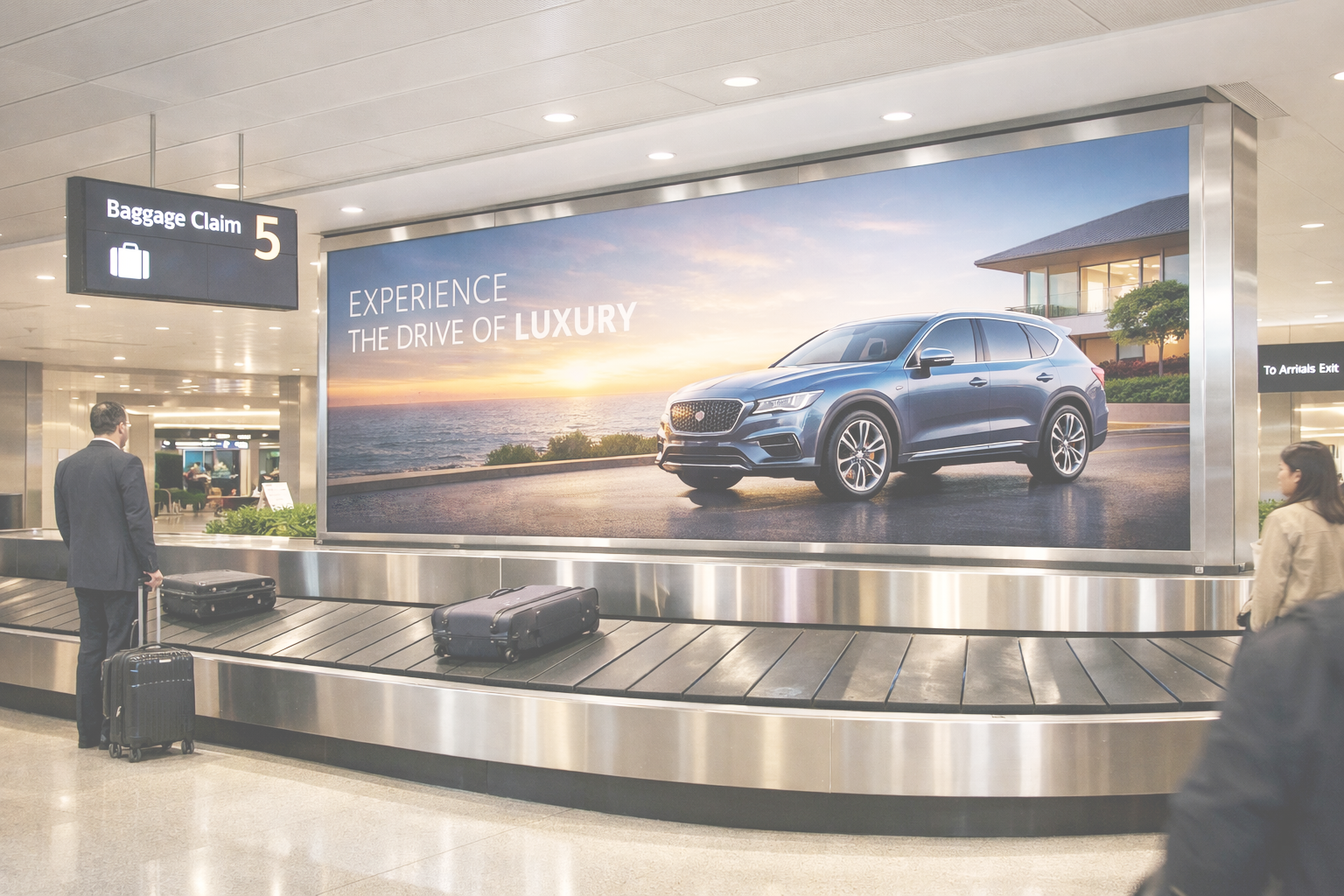
It’s Not Just Where You Advertise - It’s How Fast You Execute
We combine local insight with fast rollout to deliver results for you, now.
Talk to an ExpertAudience and Cultural Intelligence
Top 2 Languages
- Korean (Hangul): The national language of South Korea and the exclusive commercial, cultural, and social language of GMP's Korean passenger community. Korean-language advertising at GMP is not a translation option — it is the mandatory creative baseline for any brand seeking genuine resonance with the Korean HNWI audience whose cultural pride in the Korean language, the Hallyu cultural phenomenon, and the specific institutional respect for Korean commercial culture's own aesthetic and quality standards make Korean-language creative development a commercially essential investment rather than a production convenience. The specific politeness register of Korean business communication — whose honorific linguistic levels encode institutional hierarchy with commercial significance — requires genuine Korean cultural expertise rather than translation from English source material.
- Japanese: The most commercially relevant secondary language at GMP, reflecting the bilateral Japan-Korea commercial relationship whose Haneda route is GMP's most institutionally senior international corridor. Japanese-language advertising at GMP reaches the bilateral Japanese corporate community transiting through Korea's city-centre airport with the cultural authority that signals genuine bilateral commercial respect — a commercial signal of particular importance given the historically complex but commercially deeply interdependent Korea-Japan bilateral relationship.
Major Traveller Nationalities
GMP's passenger base is the most nationally homogeneous of any airport in this series — approximately 85 to 90 percent Korean nationals, reflecting the airport's primary domestic and short-haul bilateral character. Japanese nationals — the single largest international community, reflecting the Haneda bilateral's institutional commercial significance — form a commercially distinctive premium secondary audience whose bilateral corporate and tourism travel creates the most institutionally senior non-Korean passenger community at GMP. Chinese nationals — predominantly business travellers from Beijing and Shanghai on the bilateral short-haul routes — add a commercially active Northeast Asian corporate bilateral dimension. The international community is primarily Northeast Asian in character, reflecting GMP's specific short-haul bilateral focus on the most commercially integrated regional economy in Asia.
Religion — Advertiser Intelligence
- Christianity (approximately 30% of South Korea — predominantly Protestant, with significant Catholic community): South Korea has one of the highest Christian penetration rates of any predominantly East Asian society — a legacy of 19th-century missionary activity and the specific alignment between Korean Protestant Christianity and the achievement-oriented commercial culture that drove Korea's economic transformation. Christmas and Easter generate modest domestic leisure travel spikes whose premium consumer spending behaviour reflects the holiday gifting and family celebration culture of Korea's Christian community.
- Buddhism (approximately 20% of South Korea): The traditional Buddhist community's commercial calendar — particularly the Buddha's Birthday celebration in May (Seokga Tansin-il, a national holiday) — generates domestic travel and premium gifting behaviour whose commercial significance for the Korean luxury consumer market reflects the Buddhist community's historically commercial role in Korean civil society.
- Confucian cultural values (broader societal influence beyond formal religious practice): South Korea's most commercially significant cultural framework for advertising purposes is not a formal religion but the Confucian value system whose institutional hierarchy consciousness, educational achievement orientation, family obligation, and face-awareness collectively shape the Korean HNWI community's brand decision-making at every level. The Korean Confucian commercial culture's specific combination of institutional respect, generational hierarchy awareness, and the premium gifting culture of the major holiday periods — Chuseok and Lunar New Year — creates the most commercially structured advertising calendar of any East Asian airport audience in this series, with defined institutional gifting seasons, clearly hierarchical corporate gift-giving obligations, and a luxury goods purchasing culture whose Confucian social meaning is as commercially significant as the product quality of the items purchased.
Behavioral Insight
The GMP Very High HNWI audience is the most institutionally hierarchy-conscious of any commercial airport advertising audience in this series — and that hierarchy consciousness is simultaneously the most commercially important and the most commercially nuanced characteristic for international brands to navigate at this airport. The Korean chaebol executive's brand decisions are made within a framework that combines genuine product quality assessment with the specific Korean form of institutional status consciousness — where brand prestige must demonstrate both genuine quality authority and the specific social recognition that makes it appropriate for the gift-giving and corporate entertainment obligations that define the Korean executive's most commercially visible consumption moments. A premium whisky brand that is the right gift for a Samsung managing director to give to a Hyundai chairman must meet both quality standards — and both institutional prestige standards. The international brand that understands this dual qualification — quality plus Korean institutional recognition — is the brand that earns the Korean corporate community's most commercially loyal purchasing relationships. Additionally, the K-culture industry's commercial influence on the Korean domestic luxury consumer market means that the luxury brand whose ambassador relationship, product collaboration, or cultural creative association with K-culture has been successfully established is the luxury brand with the most commercially sustainable Korean HNWI brand authority.
Outbound Wealth and Investment Intelligence
GMP's outbound wealth intelligence reflects the specific investment behaviours of South Korea's most commercially established corporate and HNWI community — a community whose capital deployment combines the traditional Korean emphasis on real estate and quality education with the increasingly sophisticated international financial diversification of a HNWI class that has accumulated wealth across multiple decades of chaebol-led economic success.
Outbound Real Estate Investment
South Korea's HNWI community's outbound real estate investment reflects the specific bilateral relationships and cultural affinities of the Korean commercial elite. The United States — particularly Los Angeles, New York, and Hawaii — attracts Korean HNWI investment through the Korean-American diaspora infrastructure, the educational pathway logic of US university placements, and the lifestyle quality of West Coast luxury real estate that the Korean upper-income class has established as a standard international property ownership aspiration. Japan — particularly Tokyo premium residential and Kyoto second-home market — attracts Korean HNWI buyers whose cultural familiarity, aesthetic alignment, and the bilateral corporate relationship's proximity rationale create a specifically Korean-Japanese real estate investment logic. Australia — particularly Melbourne and Sydney — attracts Korean HNWI buyers through education pathway logic and lifestyle quality alignment. Vietnam's premium resort real estate — particularly Da Nang and Ho Chi Minh City's luxury residential developments — attracts Korean HNWI investment driven by the Korean corporate community's extensive bilateral Vietnamese manufacturing and commercial relationships. Portugal's Golden Visa programme attracts Korean HNWI families seeking EU mobility. International real estate developers in Los Angeles, Tokyo, Melbourne, Ho Chi Minh City, and Lisbon should treat GMP as a commercially productive Korean HNWI buyer acquisition channel.
Outbound Education Investment
South Korea's HNWI community's education investment in international institutions reflects the country's specific combination of the world's highest educational aspiration intensity — Korea's university entrance exam culture and its extraordinary per-capita education investment — with the international credential diversification of a HNWI class whose children's generation regards international academic experience as the natural complement to domestic Korean educational excellence. The United States — MIT, Stanford, Harvard, and the Ivy League — attracts Korea's most academically ambitious HNWI families whose international credential aspirations reflect both genuine intellectual ambition and the specific Korean understanding that American university credentials are the most commercially valuable single educational credential for global career mobility. The United Kingdom — Oxford, Cambridge, LSE, and Imperial — attracts Korean families whose European credential preference reflects the Korean corporate community's increasingly pan-European commercial engagement. Canada and Australia attract Korean HNWI families whose combination of academic quality and immigration pathway logic creates a combined education and residency investment rationale. Singapore's NUS and NTU attract Korean families whose regional hub proximity and academic quality create a specifically Northeast Asian educational investment option.
Outbound Wealth Migration and Residency
South Korea's HNWI community's residency diversification behaviour reflects the specific Korean cultural and commercial rationale for international residency — primarily driven by educational planning, family mobility, and the tax optimisation logic of internationally mobile corporate executives. The United States' EB-5 investor visa and O-1 talent visa programmes attract Korean HNWI families whose American commercial and educational engagement creates genuine dual-residency rationale. Australia's Significant Investor Visa attracts Korean HNWI families whose Australian education and lifestyle investment creates a natural complementary residency argument. Portugal's Golden Visa programme attracts Korean HNWI families seeking EU mobility with Spanish and Portuguese lifestyle alignment. Singapore's Permanent Residency and Global Investor Programme attracts Korean technology and finance sector executives whose Southeast Asian commercial hub rationale creates a business-anchored residency logic.
Strategic Implication for Advertisers
GMP's outbound wealth intelligence is commercially structured around the Korean HNWI community's specific combination of institutional hierarchy consciousness, educational achievement orientation, and the Confucian gift-giving culture whose commercial significance in Korean luxury goods consumption is commercially consequential across the full premium consumer calendar. For international real estate developers whose product can make a credible Korean cultural quality alignment argument, for education institutions whose Korean student community culture is actively cultivated, and for luxury goods brands whose Korean institutional prestige — including any K-culture adjacency or Korean celebrity brand relationship — creates the specific social recognition that Korean Confucian gift-giving culture requires, GMP provides direct access to the most institutionally commercially authoritative Korean domestic corporate advertising audience in Korean domestic aviation.
Airport Infrastructure and Premium Indicators
Terminals
- Main Terminal (Domestic and International): Gimpo's compact but commercially well-appointed terminal complex handles domestic Korean aviation and short-haul international operations through a unified facility whose proximity to Seoul's city centre — 16 kilometres from Gwanghwamun — makes it the most functionally accessible airport for Seoul's corporate elite relative to Incheon's 52-kilometre distance from the central business district. The terminal's commercial advertising estate — concentrated in check-in halls, departure concourses, and the domestic premium lounge adjacency zones — serves a passenger community whose average income and corporate seniority consistently benchmark above the Korean aviation norm for equivalent passenger volumes.
- Business Aviation and General Aviation Facilities: GMP's general aviation handling accommodates the private aircraft and charter operations of Korea's most senior chaebol family members and institutional commercial principals whose private aviation preference reflects both the operational efficiency of city-centre airport access and the specific preference for private departure privacy that Korea's most commercially visible corporate community values.
Premium Indicators
- Haneda bilateral route's institutional prestige: The GMP-Haneda bilateral agreement — which restricts the route to specific bilateral aviation arrangement conditions and whose passenger community has historically been characterised by unusually high premium cabin penetration and institutional corporate seniority — is the single most commercially significant premium indicator of GMP's advertising value. An airport whose most important international route specifically concentrates the most institutionally senior bilateral corporate community in Northeast Asia is, by definition, serving a premium business audience of extraordinary commercial authority.
- City-centre proximity advantage: GMP's 16-kilometre distance from Seoul's central business district — versus Incheon's 52-kilometre distance — creates a commercial proximity advantage that is the airport's most commercially distinctive physical characteristic. The Korean corporate executive who values their time commercially prefers GMP for domestic and short-haul regional travel precisely because the airport's city-centre proximity maximises the productive time between office and aircraft. This preference for GMP among Seoul's most commercially productive corporate community is the airport's most commercially self-selecting premium indicator.
- Korean Air and Asiana's premium domestic cabin community: Korean Air and Asiana's first and business class domestic products on the Gimpo-Jeju route are among the most commercially active premium domestic aviation products in Asia — their combined premium cabin passenger communities on this corridor represent the most concentrated Korean domestic premium cabin audience at any domestic airport.
- Hallyu cultural proximity: GMP's location within Seoul — the global capital of K-culture — creates a commercial proximity to the Korean Wave's most commercially impactful industry whose advertising adjacency effect for K-beauty, K-fashion, and K-culture-aligned luxury brands is commercially productive in a way available at no comparable airport outside Korea's capital city.
Forward-Looking Signal
GMP is implementing terminal improvement and capacity enhancement programmes that are progressively elevating the commercial quality of the airport's advertising estate. The progressive normalisation of Korea-Japan and Korea-China bilateral aviation relationships — whose diplomatic fluctuations have historically created commercial uncertainty in GMP's most institutionally senior bilateral route volumes — will progressively stabilise and deepen the bilateral corporate community's GMP transit as Northeast Asian commercial relationships resume their commercial maturity trajectory. The K-culture industry's continued global commercial expansion — whose commercial revenues are making Korean cultural exports an increasingly commercially consequential component of Korea's bilateral trade relationships — will progressively elevate the commercial authority of GMP's K-culture industry community and create growing international awareness of GMP as a culturally commercially significant advertising environment. Masscom advises brands to establish GMP advertising positions now — at a moment when the Haneda bilateral and China short-haul routes' full commercial potential is progressively being realised as Northeast Asian bilateral commercial normalisation advances — and to plan campaigns that capture both the established chaebol corporate authority audience and the K-culture industry community whose global commercial expansion is making Korean cultural authority an increasingly consequential advertising adjacency benefit.
Airline and Route Intelligence
Top Airlines
Korean Air, Asiana Airlines, Jin Air, Air Busan, T'way Air, Air Seoul, Japan Airlines (Haneda bilateral), ANA (Haneda bilateral), Air China, China Eastern Airlines
Key International Routes
- Tokyo Haneda (HND): Korean Air and JAL/ANA bilateral services — the most institutionally commercially senior bilateral route in GMP's international network, carrying the Korean-Japanese corporate leadership community's most commercially consequential weekly bilateral engagement. The Haneda bilateral's restricted nature — historically limited to specific bilateral aviation arrangement conditions — has created a passenger community whose institutional commercial authority is among the highest of any regularly scheduled short-haul route in Asia.
- Beijing Capital (PEK): Korean Air and Air China services — the Korea-China bilateral corporate corridor, carrying Seoul's most commercially active conglomerate executives' China market management travel and Beijing's equivalent corporate tier's Korea commercial engagement
- Shanghai Hongqiao (SHA): Korean Air and China Eastern services — the Korea-China bilateral corridor's commercial centre of gravity for the East China economic zone's most commercially active Korean corporate engagement community
- Osaka Itami (ITM) and select Japanese domestic connections: Korean Air services connecting Seoul's corporate community to Japan's western commercial centres
Domestic Connectivity
- Jeju (CJU): Multiple daily Korean Air, Asiana, and low-cost carrier services — the most commercially significant domestic route at GMP and one of the most commercially consequential domestic air corridors in all of Asian aviation. The Gimpo-Jeju route's combination of leisure tourism, business conference travel, and the Korean corporate community's most commercially important domestic social networking destination makes it simultaneously one of the world's busiest domestic air corridors by frequency and one of the most commercially senior by average passenger income and corporate authority.
- Busan (PUS): Daily services connecting Seoul's corporate community to Korea's second-largest commercial city and maritime trade capital.
- Gwangju, Yeosu, and other Korean domestic destinations: Regional connectivity serving the Korean domestic professional and consumer community's nationwide travel network.
Wealth Corridor Signal
GMP's route network is the most commercially institutionally concentrated of any Korean gateway airport — every significant route serves a specific dimension of South Korea's most commercially consequential bilateral and domestic corporate relationship. The Haneda bilateral is the most institutionally senior single bilateral corporate route in Korean aviation history — its weekly frequency sustains the Korea-Japan bilateral commercial relationship that has defined Northeast Asian economic cooperation for six decades. The Beijing and Shanghai bilaterals carry the Korea-China corporate relationship whose combined bilateral trade and investment value exceeds USD 300 billion annually. The Jeju domestic route carries Korea's most commercially concentrated annual corporate social gathering. Together, these routes reveal an airport whose entire commercial character is defined by institutional corporate authority rather than tourism volume — confirming that GMP's advertising environment is constituted by the decision-makers of Korea's most commercially consequential enterprises rather than by the consumers of its leisure economy.
Media Environment at the Airport
- GMP's compact terminal design — handling 8.2 million passengers through a single main terminal and a limited concourse network — creates advertising capture conditions of exceptional efficiency whose intimate scale delivers near-complete audience penetration for correctly positioned formats without the dispersal losses of Incheon's multi-concourse international terminal complex
- The specific institutional commercial character of GMP's primary Very High HNWI audience — chaebol executives, financial sector principals, K-culture industry leaders, and bilateral Northeast Asian corporate community members whose institutional authority defines the airport's commercial character — creates advertising receptivity conditions that reward Korean institutional prestige signals, genuine product quality authority, and the specific Korean corporate culture's hierarchy-conscious brand evaluation framework
- The Gimpo-Jeju domestic route's commercial concentration — whose premium cabin passengers represent Korea's most institutionally senior corporate community in their most commercially routine domestic transit — creates advertising dwell-time conditions in the domestic departure zone whose audience commercial authority per minute of exposure is among the highest of any domestic aviation departure environment in Asia
- Masscom Global provides comprehensive inventory access across GMP's terminal commercial estate, with full campaign management covering Korean-language and Japanese-language creative execution developed with genuine Korean commercial culture expertise, compliance with Korea Communications Commission and Fair Trade Commission advertising standards, optimal zone positioning for chaebol corporate, financial services, luxury goods, and K-culture brand audiences, Korea Business Conference and Chuseok/Lunar New Year holiday window campaign planning, and campaign performance reporting
Strategic Advertising Fit
Best Fit
- Luxury goods and premium gifting — Korean corporate gift-giving culture: GMP is South Korea's most commercially productive airport for luxury goods brands whose Korean institutional prestige makes them appropriate for the corporate gift-giving culture that defines the Korean HNWI community's most commercially consequential luxury purchasing occasions. The Chuseok and Lunar New Year holiday gifting seasons, the Korea Business Conference attendance, and the ongoing bilateral corporate relationship maintenance rituals collectively create a sustained luxury goods advertising audience at GMP whose institutional gift-giving obligation and personal premium consumption aspirations are commercially concentrated in a single domestic aviation facility.
- K-beauty and Korean premium lifestyle brands: GMP's city-centre Seoul proximity and the K-culture industry professional community's presence create a commercially distinctive advertising environment for K-beauty, Korean premium lifestyle, and Hallyu-adjacent luxury brands whose global commercial expansion and Korean domestic market authority are simultaneously commercially relevant for the domestic Korean HNWI audience and the bilateral Japanese and Chinese corporate community whose Korean cultural consumption aspirations are commercially significant.
- Premium automotive — Korean and international luxury brands: South Korea's premium automotive market — particularly the Korean conglomerate executive community's documented Genesis, Porsche, and Bentley purchasing culture and the bilateral Japanese and Chinese corporate community's Korean luxury automotive engagement — creates a commercially active premium automotive advertising audience at GMP whose institutional hierarchy consciousness and corporate status signalling through premium vehicle choice is commercially productive for both Korean premium automotive brands and international luxury automotive advertising.
- Financial services and private banking — Korean HNWI advisory: The concentration of Korea's most commercially established chaebol family wealth, financial sector principals, and technology sector equity wealth at GMP creates a commercially active private banking and wealth management advertising audience whose Korean-language advisory capability, estate planning expertise, and cross-border wealth management sophistication are commercially valued by the Korean HNWI community's most commercially established members.
- International real estate — United States, Japan, and Vietnam: The Korean HNWI community's established outbound real estate investment corridors — Los Angeles and Hawaii, Tokyo premium residential, and Vietnam luxury resort and residential — create directly addressable Korean buyer communities at GMP whose historical bilateral transaction data confirms active purchase intent. Korean-language creative with culturally specific investment logic is commercially essential.
- International education — US Ivy League, UK Russell Group, and Singapore: The Korean HNWI community's education investment in international universities creates a commercially active Korean student family advertising audience at GMP whose combined educational aspiration and premium institutional credential brand affinity makes TLV one of the most commercially institutionally oriented international education advertising environments in Korean aviation.
- Premium travel — Japan, Southeast Asia, and luxury domestic circuit: The bilateral Korea-Japan travel community, the Korean HNWI community's premium Southeast Asian leisure circuit, and the Gimpo-Jeju premium domestic leisure corridor collectively create a commercially active premium travel advertising audience whose confirmed premium accommodation and luxury F&B spending profiles reflect the Korean corporate community's documented preference for the highest-quality hospitality experiences available.
- Corporate advisory and legal services — bilateral Northeast Asian practice expertise: The chaebol executive community's ongoing cross-border deal-making, the bilateral Korea-Japan and Korea-China corporate advisory requirements, and the Korean private equity community's international transaction management needs create a commercially active professional advisory services advertising audience at GMP whose institutional authority over some of Korea's most commercially consequential corporate transactions makes this a commercially productive niche B2B advertising environment for international law firms, accounting practices, and advisory firms with genuine Korea market expertise.
Brand Alignment at a Glance
| Category | Fit |
|---|---|
| Luxury goods and premium gifting | Exceptional |
| K-beauty and Korean premium lifestyle | Exceptional |
| Premium automotive | Exceptional |
| Financial services and private banking | Exceptional |
| International real estate | Strong |
| International education | Strong |
| Premium travel | Strong |
| Corporate advisory services | Strong |
| Mass-market consumer brands | Poor fit |
Who Should Not Advertise Here
- Brands without genuine Korean cultural adaptation or Korean market investment: The single most commercially important requirement for effective advertising at GMP is genuine Korean cultural adaptation — the chaebol executive whose lifetime of commercial success has been built within the Korean corporate culture's institutional framework will not be persuaded by advertising that treats Korea as a generic East Asian luxury consumer market. Korean cultural specificity — the honorific register, the Confucian hierarchy consciousness, the specific Korean aesthetic standards, and the K-culture adjacency that signals genuine Korean market commitment — is the admission credential for commercial resonance with GMP's most commercially authoritative audience.
- Brands that conflict with Korean advertising regulatory standards: Korea Communications Commission and Fair Trade Commission advertising standards have specific content requirements regarding comparative claims, superlative assertions, and content standards whose non-compliance creates legal risk and commercial brand damage. Masscom Global's Korea market regulatory expertise provides the compliance advisory necessary for successful GMP campaign execution.
- Mass-market consumer brands without premium positioning: GMP's Very High HNWI chaebol and corporate executive audience has commercial consumption standards that are calibrated to the highest available product quality — mass-market brand positioning without genuine premium differentiation will find the Korean institutional hierarchy consciousness a persistent barrier to engagement, as brands that cannot credibly claim premium Korean quality standards are not commercially appropriate gifts for the corporate relationships that define the Korean executive's most commercially consequential consumption occasions.
Event and Seasonality Analysis
- Event Strength: High — particularly Korea Business Conference at Jeju, Chuseok and Lunar New Year gifting seasons, and Samsung/LG/Hyundai major corporate event calendar
- Seasonality Strength: High — strong March to June and September to December dual-season commercial windows
- Traffic Pattern: Dual-season with institutional corporate event peaks and Korean holiday gifting season amplification
Strategic Implication
GMP's commercial calendar combines the Korean corporate event calendar — whose Korea Business Conference at Jeju biannual sessions define the year's most commercially concentrated institutional corporate audience concentration — with the Korean national holiday gifting seasons whose Confucian gift-giving culture makes Chuseok and Lunar New Year the most commercially intense luxury goods advertising windows in Korean domestic aviation. The spring Korea Business Conference should anchor B2B financial services and premium corporate hospitality advertising investment. The autumn Chuseok period should anchor luxury goods and premium gifting advertising investment. The pre-Lunar New Year window should anchor the year's most commercially intense luxury goods consumer advertising. The bilateral Haneda route's weekly commercial concentration should anchor sustained B2B corporate advisory, premium automotive, and financial services advertising investment as a year-round baseline. Masscom structures GMP campaigns to activate these distinct commercial windows with Korean-language creative whose institutional hierarchy consciousness and Confucian cultural respect are commercially calibrated to the specific purchasing motivation of each audience moment — ensuring that the brand investment at GMP achieves the institutional prestige recognition and genuine Korean cultural respect that Korea's most commercially authoritative corporate community demands.

Poor Placement and Delays Affect Airport Campaigns
We help you move faster, access better inventory, and get it right now.
Talk to an ExpertFinal Strategic Verdict
Gimpo International Airport is South Korea's most institutionally commercially authoritative domestic and short-haul international aviation gateway — serving the chairmen and managing directors of the chaebol groups whose combined revenues define the Korean economy, the financial sector principals whose capital markets authority shapes Northeast Asian investment flows, the K-culture industry leaders whose commercial output is making Korean cultural authority one of the most commercially consequential bilateral trade relationships in Asian entertainment history, and the bilateral Japan-Korea corporate community whose Haneda route weekly commute sustains the most commercially senior bilateral corporate relationship in Northeast Asian aviation. The 8.2 million passengers who transit GMP annually are not a volume statistical curiosity — they are the specific institutional corporate community that makes South Korea's most commercially consequential commercial decisions, who express those decisions through the gift-giving rituals of Chuseok and Lunar New Year with the Korean luxury goods purchasing intensity that makes Korea's domestic luxury consumer market one of the most commercially consequential per-capita in Asia, and who sustain the bilateral Northeast Asian corporate relationships whose commercial value to Korea's economy exceeds the bilateral trade statistics that formally capture them. For luxury goods brands targeting the Korean corporate gift-giving culture's most commercially demanding occasion purchases, for premium automotive brands whose Korean institutional prestige and K-culture adjacency creates the specific social recognition that the chaebol community requires, for financial services and private banking brands targeting the accumulated wealth of Korea's most commercially established chaebol families, for international real estate and education brands targeting the Korean HNWI outbound investment market, and for corporate advisory firms targeting Korea's most commercially consequential bilateral transaction community — GMP is the most commercially institutionally authoritative domestic and short-haul international advertising environment in Korean aviation. Masscom Global provides the Korean cultural authority, the conglomerate commercial intelligence, and the full-service execution capability to ensure that every brand investing at GMP earns the institutional commercial respect of the most hierarchically conscious and the most commercially loyalty-productive premium corporate audience in Northeast Asian aviation.
About Masscom Global
Masscom Global is a premium international airport advertising and media buying agency operating across 140 countries. With deep expertise in airport OOH, premium publications, and high-net-worth audience targeting, Masscom helps brands reach the world's most valuable travellers at the moments that matter most. For advertising packages, media rates, and campaign planning at Gimpo International Airport and airports across the globe, contact Masscom Global today.
Frequently Asked Questions
How much does airport advertising cost at Gimpo International Airport? Advertising costs at GMP vary by terminal zone, format type, position within passenger flow, campaign duration, and seasonal demand. Domestic departure concourse positions serving the Gimpo-Jeju premium cabin community command the most commercially active sustained advertising positions. The Haneda bilateral international departure zone commands premium rates reflecting the institutional commercial authority of its passenger community. The Chuseok pre-holiday luxury gifting window and Lunar New Year gifting season command the year's highest consumer luxury goods advertising rate premiums. Korean-language cultural adaptation is commercially essential. Masscom Global provides current rate structures, Korean corporate calendar and holiday guidance, and full campaign proposals. Contact Masscom for a tailored GMP proposal.
Who are the passengers at Gimpo International Airport? GMP serves a Very High HNWI-rated audience anchored by Seoul's chaebol conglomerate corporate executive community — Samsung, Hyundai, LG, SK, and their group company leadership — alongside Korea's financial sector principals from Yeouido's financial district, K-culture and entertainment industry commercial leaders, Korean premium consumer market trendsetters, and the bilateral Japan-Korea and China-Korea corporate community whose Haneda, Beijing, and Shanghai bilateral routes carry the most institutionally senior short-haul corporate passenger community in Northeast Asian aviation. The domestic Gimpo-Jeju corridor specifically concentrates the Korean corporate community's most commercially consequential annual professional social gathering at the Korea Business Conference.
Is Gimpo International Airport good for luxury brand advertising? GMP is commercially exceptional for luxury brands whose Korean institutional prestige — including any K-culture adjacency, Korean celebrity brand relationship, or established Korean market retail presence — creates the specific social recognition that the Korean Confucian corporate gift-giving culture requires. The Korean HNWI community's luxury goods purchasing culture is among the most commercially active per capita in Asia, driven both by genuine product quality appreciation and the institutional gift-giving obligation that makes luxury goods advertising at GMP the most commercially directly conversion-linked consumer brand advertising environment in Korean domestic aviation.
What is the best airport in South Korea for HNWI corporate advertising? GMP is South Korea's most institutionally commercially authoritative airport for the Korean domestic and short-haul bilateral corporate community. Incheon serves a higher volume with a broader international HNWI audience including more diverse international source markets. For brands specifically targeting the Korean chaebol executive community, the Korea Business Conference bilateral, and the Haneda route's institutionally senior bilateral corporate passengers, GMP provides the most commercially concentrated and most institutionally authoritative Korean corporate audience in Korean domestic aviation. A joint GMP-Incheon campaign through Masscom Global delivers complete Korean corporate aviation coverage across both the domestic institutional and international gateway dimensions.
What is the best time to advertise at Gimpo International Airport? The biannual Korea Business Conference at Jeju — spring and autumn sessions — creates the year's most commercially concentrated institutional corporate authority audiences at GMP and should anchor corporate advisory, financial services, and premium lifestyle brand campaign investment. The pre-Chuseok luxury gifting window in September creates the year's most commercially active Korean luxury goods consumer advertising moment. The pre-Lunar New Year gifting season in January creates the complementary winter luxury goods commercial peak. The Haneda bilateral's sustained weekly commercial frequency creates a year-round baseline for bilateral corporate advisory, premium automotive, and financial services advertising. Sustained presence across the full commercial calendar with amplified bursts around these specific windows delivers maximum commercial return.
Can international real estate developers advertise at Gimpo International Airport? GMP is commercially productive for international real estate developers targeting the Korean HNWI community's established outbound investment corridors. Los Angeles and Hawaii residential developers with Korean community infrastructure and lifestyle alignment have a pre-qualified Korean buyer audience at GMP. Tokyo premium residential developers with Korean-language outreach and bilateral investment appeal have a growing Korean buyer audience. Vietnam luxury resort and residential developers targeting the Korean corporate community's extensive Vietnam commercial relationship can reach a specifically motivated buyer audience. Portuguese Golden Visa developers targeting EU mobility-seeking Korean HNWI families have an active Korean applicant audience. Korean-language creative with culturally adapted investment logic is commercially essential for real estate advertising effectiveness at GMP.
Which brands should not advertise at Gimpo International Airport? Brands without genuine Korean cultural adaptation, brands whose content conflicts with Korean advertising regulatory standards, and mass-market consumer brands without premium positioning are commercially misaligned with GMP's Very High HNWI chaebol and corporate executive audience. The Korean institutional hierarchy consciousness is the most commercially demanding brand evaluation framework in Northeast Asian domestic aviation — brands that cannot demonstrate genuine Korean market commitment and genuine product quality excellence will find the Korean corporate community's gift-giving culture's specific institutional prestige requirements a commercially insurmountable barrier to the loyalty that makes GMP advertising investment commercially rewarding.
How does Masscom Global help brands advertise at Gimpo International Airport? Masscom Global provides full-service airport advertising execution at GMP — covering Korean chaebol corporate community and K-culture industry audience intelligence, Korean-language and Japanese-language creative strategy developed with genuine Korean commercial culture and Confucian hierarchy expertise, Korea Communications Commission and Fair Trade Commission compliance management, optimal terminal zone positioning for luxury goods, corporate advisory, automotive, and financial services brand audiences, Korea Business Conference, Chuseok, and Lunar New Year holiday campaign planning, and live campaign performance reporting. With operations across 140 countries, Masscom provides both the Korean cultural commercial intelligence and the global network capability to activate GMP as part of a coordinated Korean HNWI and bilateral Northeast Asian corporate strategy — running concurrent campaigns across GMP, Incheon ICN, and bilateral destination airports in Tokyo Haneda, Beijing Capital, and Shanghai Hongqiao to intercept the Korean institutional corporate community at every stage of their most commercially consequential domestic and bilateral Northeast Asian engagement circuit.