




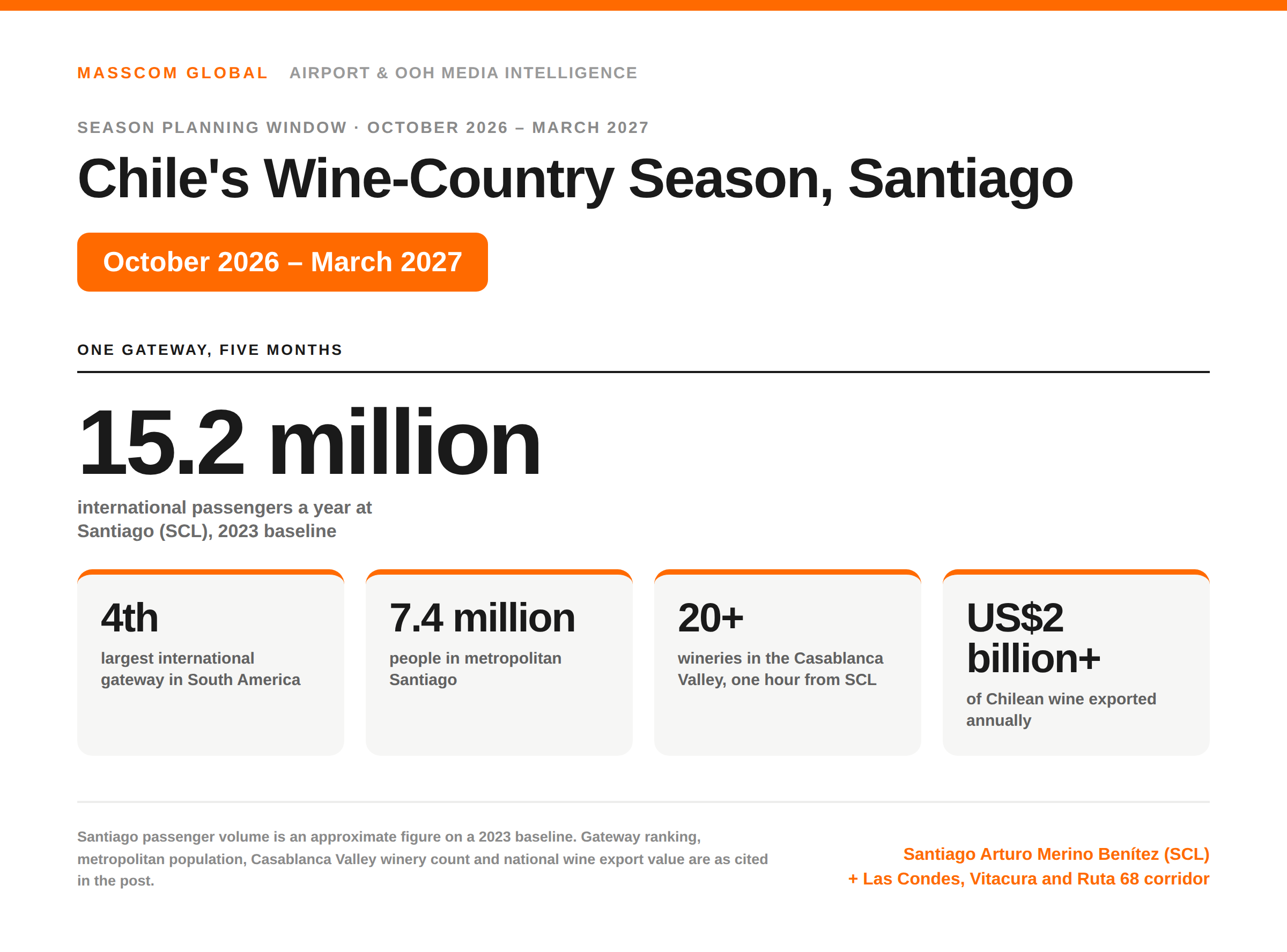
Chile's wine-country season is not a dated event; it is a five-month window. October to March is the southern hemisphere's spring and summer, and it is the recognised prime travel period for Chile: the months when the Central Valley is open, warm and fully staffed for visitors, and when Santiago itself runs at its peak. Temperatures in Santiago crest in January at around 28°C to 30°C. For the premium wine-tourism trade, the vineyards north and south of the capital are effectively closed to serious hosting in the June-to-August winter and wide open from October onward.
That makes this a planning window rather than a spike. Between October 2026 and March 2027, Santiago Arturo Merino Benítez International Airport (SCL) is the single funnel through which almost every international visitor to Chilean wine country passes, and it is the one place where a brand can reach that audience with certainty before they disperse into the valleys. The wine-harvest festivals themselves (the vendimia celebrations) run later in the season, between February and May, with the largest concentration in March, which places the festival peak at the closing end of this same window.
Why Advertise During Chile's Wine-Region Season?
Chile is a small economy that punches structurally above its weight, and its visitor profile reflects that. National GDP runs at approximately US$300 billion. Chile is the only South American member of the OECD and holds investment-grade credit ratings from Moody's, S&P and Fitch. It produces 27% of the world's copper and holds 40% of the world's identified lithium resources in the Salar de Atacama. Chilean producers export more than US$2 billion of wine annually, and the country is the world's second-largest salmon producer after Norway, with combined salmon exports exceeding US$5 billion a year.
Those figures matter to a media planner for one reason: they define who flies in. Chile's inbound traffic in this window is a blend of resource and commodity executives, institutional investors and mining-finance delegations, premium wine-trade buyers and sommeliers, and leisure UHNWI travellers combining Santiago with Patagonia, the Atacama or the Andean ski complexes. The Valle Nevado ski complex sits just 60 kilometres east of the airport, which means the same gateway serves a mountain-luxury audience as well as a wine one.
The wine audience specifically is high-value and geographically legible. The Casablanca Valley lies just an hour from Santiago along Ruta 68 and carries over 20 wineries, concentrated in Sauvignon Blanc and Chardonnay. The Colchagua Valley, centred on Santa Cruz, is around two hours from Santiago, also with more than 20 wineries and 13 historic estates on its established wine route. The Maule Valley sits two and a half hours south and hosts the Curicó festival (the oldest in Chile) linking 15 wineries. Every one of those itineraries begins at SCL.
Key Benefits of Advertising During the Chilean Wine Season
Reach a qualified, high-spend audience
Wine-country travellers self-select for disposable income. They arrive on long-haul premium cabins or private aviation, book estate lunches and cellar tastings weeks ahead, and buy at the top of the price ladder. Airport media reaches them at the one unavoidable moment in an otherwise dispersed itinerary: before they have chosen where to spend.
Elevate your brand positioning
Chilean wine tourism operates in a considered, quality-forward register. A brand present across SCL's arrival journey and in Santiago's premium districts is read as part of that environment rather than as an intrusion into it: particularly valuable for categories where provenance and craft are the sales argument.
Generate real business opportunity
This window is also Chile's commercial season. Mining and lithium investment delegations, agricultural and wine-trade buyers, and institutional investors all schedule Santiago visits between October and March. Sustained visibility across the season keeps a brand in front of decision-makers whose visits are short and whose calendars are full.
Get Free Expert Assistance from Our Global Media Planning Team
Receive strategic recommendations, media planning support, campaign monitoring and reporting to maximise your visibility throughout Santiago Wine Region UHNWI season.
Book Expert ConsultationSantiago Arturo Merino Benítez International Airport (SCL)
SCL is the fourth-largest international gateway in South America, handling approximately 15.2 million international passengers annually on a 2023 baseline. It operates two terminal buildings: the legacy Terminal 1 and the modernised Terminal 2, opened in 2022 and operated by VINCI Airports. The airport sits at Pudahuel in the Central Valley at an elevation of roughly 520 metres, west of the city centre, with the wine valleys and the Andean ski complexes on opposite sides of it. Its principal international connections run to Miami, New York, London, Madrid, Bogotá and São Paulo: a route map that maps almost exactly onto the origin markets of premium wine tourism and mining finance.
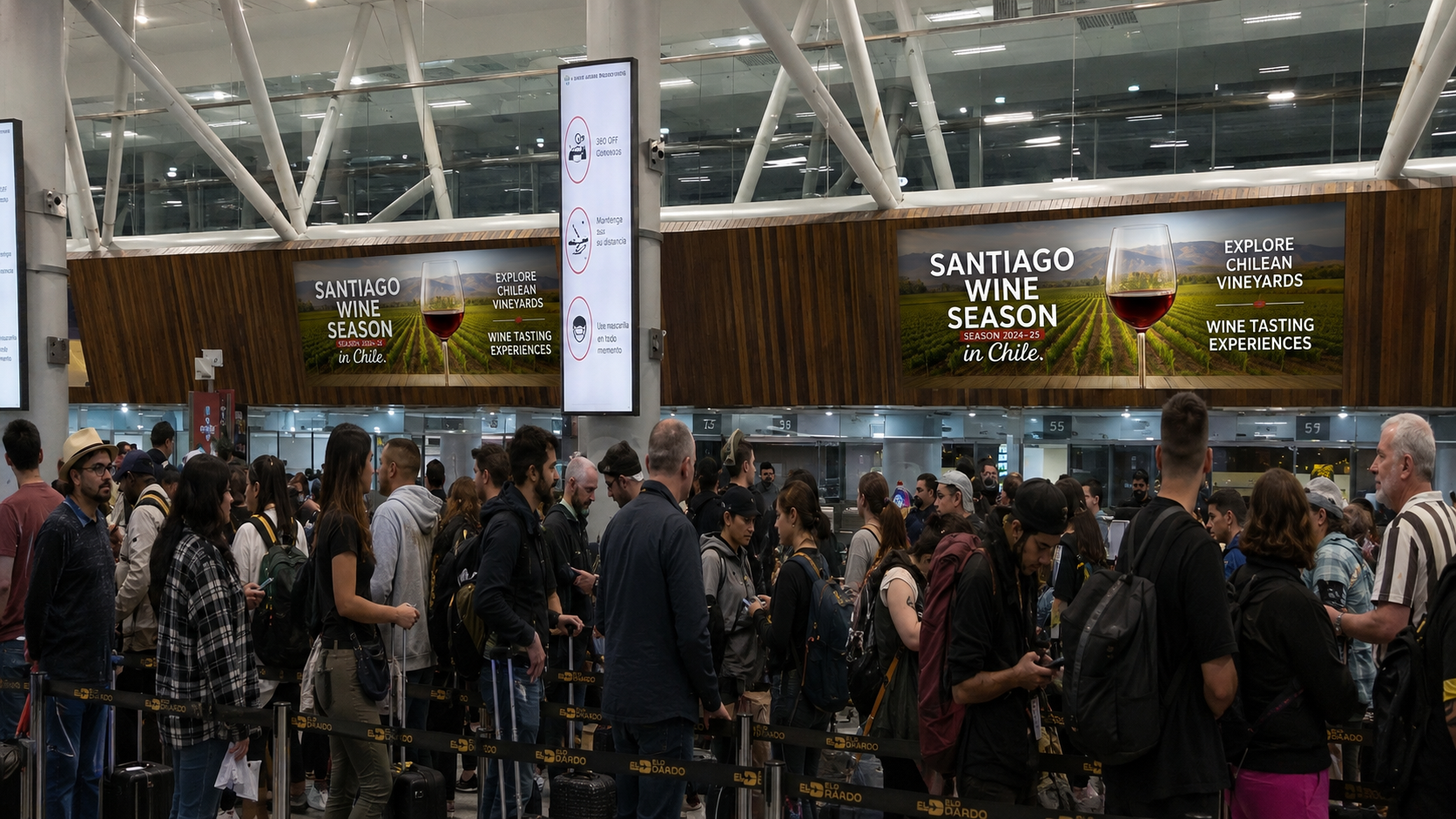
Inventory Highlights
- Arrivals and immigration approach positions: the first branded environment an inbound visitor sees, and the highest-dwell moment of the journey
- Baggage reclaim and arrivals hall placements, where long-haul passengers from Madrid, London, Miami and New York wait with nothing else to look at
- Terminal 2 environments: a recently modernised international terminal with contemporary digital-capable specification and a premium long-haul passenger mix
- Terminal 1 positions reaching domestic and regional feeder traffic, including onward Patagonia, Atacama and regional Chilean connections
- Departure concourse and premium check-in zones: the outbound moment when wine and luxury purchase intent is highest
- Landside, forecourt and car-hire environments capturing the transfer decision point for self-drive valley itineraries along Ruta 68 and Ruta 5
Advantages for Advertisers
- Single-gateway certainty: with no competing international hub serving central Chile, SCL reaches effectively the whole inbound wine and luxury-travel audience
- A five-month campaign window allows sustained presence at efficient rates rather than a premium-priced three-day event buy
- Dual-terminal buying separates the long-haul premium audience from regional and domestic traffic, so budget can be weighted precisely
- Audience quality is structurally high: OECD-market origin traffic, commodity and mining executives, and premium leisure travellers
- Long-haul arrival fatigue works in the advertiser's favour: dwell times in immigration and reclaim support detailed, considered creative
- Departure-side positions catch the buying moment: duty-free wine, jewellery, watch and luxury-goods purchase decisions are made in the concourse
 Wealth in motion intelligence.
Destination Santiago: Full Visitor Journey Coverage
Santiago is an unusually plannable city for a sequenced campaign because its affluent geography is concentrated. The metropolitan area holds around 7.4 million people, but the premium footprint that matters (Las Condes, Vitacura, Providencia, the Nueva Las Condes and Sanhattan business cluster, and the luxury retail and hotel corridor along Avenida Apoquindo and Isidora Goyenechea) occupies a narrow eastern band of the city. Wine-country visitors sleep, eat and shop inside that band, then leave it on Ruta 68 toward Casablanca or Ruta 5 toward Colchagua and Maule.
An Airport → City → Valley sequence follows that movement directly. Own the arrival at SCL. Sustain presence with digital and large-format OOH across the eastern premium districts, the financial cluster and the hotel corridor. Then convert on the departure corridors (the Ruta 68 approach toward Casablanca and Valparaíso, and the southbound Ruta 5 arterials toward Santa Cruz and Curicó) the roads every valley itinerary uses in both directions.
Because the season runs five months rather than three days, that sequence can be run as a sustained programme with rotating creative rather than a single burst. Three effects follow:
- Increased brand recall: repeated exposure at arrival, in the city and on the road to the valleys
- Consistent presence: the brand reads as part of the season's environment, not as an interruption to a holiday
- Enhanced campaign effectiveness: coordinated airport, city and corridor placements outperform equivalent spend fragmented across unconnected markets
Why Brands Choose Airport & City Advertising for Santiago Wine-Season
Exclusive audience access. A single gateway serves the entire international inbound flow to Chilean wine country, the Andean ski complexes and the Santiago financial district: a rare concentration of affluent, high-intent travellers behind one media door.
A prestigious environment. Chile's premium wine and gastronomy sector operates at an internationally respected level, and its visitor set expects that standard. Brands placed in this journey are judged in good company.
End-to-end campaign support. Masscom Global plans, negotiates and executes across SCL terminals and Santiago city inventory from a single brief, with one point of accountability.
Strategic planning assistance. Our planners advise on terminal weighting, format mix and seasonal phasing: front-loading October and November for early-season arrivals, or weighting February and March to the vendimia festival peak.
The Masscom Global Standard Behind Every Chilean wine season Placement
- Verified inventory and audience data: screen counts and terminal data for SCL come from live operator data at proposal stage, not published estimates.
- Transparent delivery reporting: campaign monitoring and reporting across SCL and Santiago city inventory, so you see exactly where your creative ran.
- Benchmarked recommendations: terminal weighting and seasonal phasing, front-loading October and November or building toward the vendimia festival peak, set against comparable campaigns across our network.
- We absorb the complexity: one point of accountability from negotiation through execution across the full October-to-March season.
Request Your Customised Santiago Wine Region UHNWI season Advertising Plan
Tell us your audience, category and budget. Our planners will return a costed plan across airport and prime city inventory, with availability confirmed.
Book NowFrequently Asked Questions
What exactly are the dates of the Chilean wine season?
This is a season rather than a single dated event. October to March is Chile's southern spring and summer and the recognised prime travel window; the vendimia harvest festivals themselves run February to May, concentrated in March. Any campaign should be planned against the window, not a fixed date.
Who travels to Chilean wine country in this window?
International premium leisure travellers, wine-trade buyers and sommeliers, mining, lithium and commodity executives visiting Santiago on business, institutional investors, and UHNWI travellers combining Santiago with Patagonia, the Atacama or Valle Nevado, 60 kilometres from the airport.
Can I reach visitors across their whole journey, not just at the airport?
Yes. A combined SCL and Santiago city campaign covers arrival, the Las Condes and Vitacura premium districts, the financial cluster and the hotel corridor, and the Ruta 68 and Ruta 5 departure corridors toward Casablanca, Colchagua and Maule.
How far in advance should a season campaign be booked?
Because the window is five months long, planning lead time matters more than urgency. We recommend confirming SCL availability well before the October opening, particularly for arrivals-hall and Terminal 2 positions, and locking city inventory for the January-to-March peak early.
Which brand categories perform best in this window?
Premium wine and spirits, luxury hospitality and boutique hotels, watches and jewellery, private aviation and yachting, wealth management and private banking, mining and industrial B2B, residential real estate and residency advisory, and luxury travel operators.
Related Airport Advertising Guides
Detailed inventory, audience and planning notes for the airports covered above:
Chilean wine season Won't Wait. Neither Should You.
- A five-month window, not a single date: planning lead time matters more than last-minute urgency here, and confirming SCL availability ahead of the October opening is what protects arrivals-hall and Terminal 2 positions.
- Competitors are already moving: every week without a plan is a week another wine, hospitality or wealth management brand locks the same eastern Santiago city sites for the January-to-March peak.
- The window is long, but the best positions still go early: SCL arrivals-hall and Terminal 2 positions, and prime eastern Santiago city sites, are booked across the full southern summer.
- The alternative reaches the wrong audience: generic domestic advertising can't isolate the international wine-trade buyers, mining executives and UHNWI travellers this single gateway concentrates.
Get Free Expert Assistance Now
Tell us your audience, category and budget, and our planners will return a costed Santiago and Central Valley media plan spanning the October-to-March season.
Request Availability
SCL arrivals and Terminal 2 positions, and prime eastern-Santiago city sites, are booked across the full southern summer. Ask us what is still open.
Chile's wine season is unusual among the occasions on this site because it is not a weekend: it is five months during which almost every international visitor to Casablanca, Colchagua or Maule passes through a single airport before dispersing. That gives a brand a rare planning luxury, room to run a sustained programme with rotating creative rather than a single burst, reaching mining executives, wine-trade buyers and UHNWI leisure travellers at the one point they all share. For premium wine, hospitality and wealth-tier categories, the opportunity runs as long as the season itself.







