

Samarkand is the destination the whole of Uzbekistan's inbound cultural market is travelling to see. Registan Square, the Gur-e-Amir mausoleum, Bibi-Khanym and Shah-i-Zinda are the reason a European, Japanese or American traveller books a two-week Central Asian itinerary at all, and October is when they come. Travel specialists identify September to early November as one of the two ideal periods to visit Uzbekistan, alongside late March to May, with October delivering temperatures of 15°C to 24°C: warm enough for long days on foot across the monument complexes, cool enough to be comfortable, and paired with the harvest when the bazaars are fullest.
What has changed commercially is access. Samarkand was for decades reached overland or by domestic connection from Tashkent. It now has a modern international airport of its own, growing faster than any other gateway in the country: Samarkand International Airport set a record with over 1.38 million passengers in 2024, up 37% on 2023. That is a fast-growing, high-value inbound audience arriving directly into one compact heritage city.
This post is about Samarkand as a heritage destination and direct-arrival gateway. For the capital's business-and-diplomatic role, see our companion piece on Tashkent's October cultural peak; for a national multi-airport programme, see our Uzbekistan autumn network post.

Why Airport & City Advertising Works During Samarkand's October Cultural Peak
The audience is pre-qualified by the itinerary. Nobody visits Samarkand casually. The trip requires a long-haul flight and is planned months in advance around a specific cultural interest. International cultural tourists on organised programmes spend USD 3,000 to 8,000 per tour package: a level that self-selects for professionals with meaningful discretionary income from Europe, East Asia and North America. The arriving population is therefore almost uniformly the audience a premium brand wants, without the wastage of a mass-market gateway.
The city is small and the routes are fixed. Samarkand's monument complexes sit within a few kilometres of one another, connected by a handful of boulevards and the Registan-to-Shah-i-Zinda pedestrian axis. Visitors stay and eat in a compact belt. Near-total visitor coverage is achievable with a modest number of well-chosen positions.
Growth is repricing the market. A 37% year-on-year increase means a campaign booked today delivers a larger audience than the same buy would have a year ago, and inventory is not yet contested at the levels of established heritage destinations. Brands entering now establish position before the market matures.
Key Benefits of Airport & City Advertising During Samarkand's October Peak
Reach a qualified audience
The October window in Samarkand concentrates long-haul cultural travellers, small-group and private luxury operator clients, and the higher-spend independent traveller into one compact city with one airport. Audience quality per impression is exceptionally high because the destination itself has already done the filtering.
Elevate your brand positioning
Samarkand is a UNESCO-recognised name with global cultural weight. A brand present in its arrival environment and around its monument districts is associated with heritage, craftsmanship and permanence: attributes that luxury, watch, jewellery, hospitality and financial brands invest heavily to claim elsewhere.
Generate business opportunity
Samarkand has become a venue for international summits and conferences as well as tourism, and the same autumn window governs both. Presence in the airport and city core reaches delegates and organisers alongside the cultural audience, supporting hospitality bookings, boutique footfall and partnership conversations.
Samarkand International Airport (SKD)
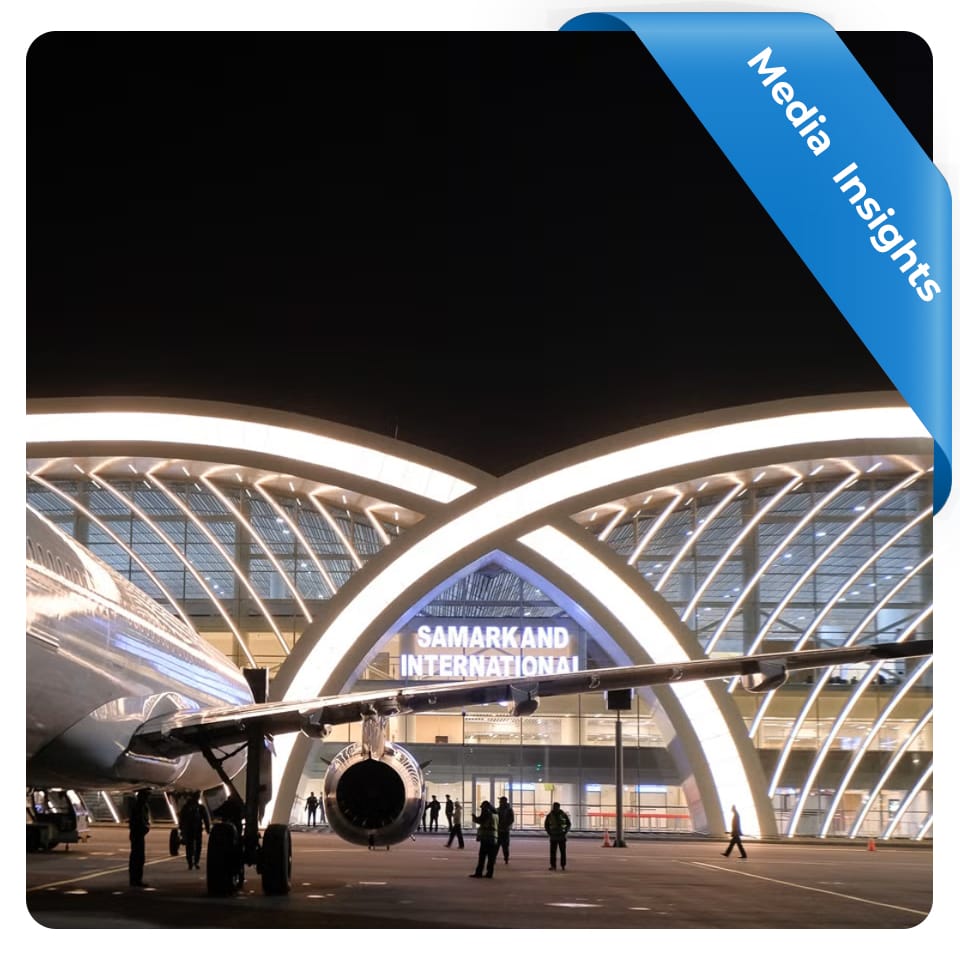
Samarkand International is the direct gateway to the heritage circuit and the country's fastest-growing airport, handling over 1.38 million passengers in 2024, a record, up 37% on 2023. Its terminal opened on 18 March 2022, designed in homage to the astronomer Ulugh Beg with a roof resembling a star chart: a distinctive environment a well-executed campaign can work with rather than against. The facility raised capacity from 300 to 1,000 passengers per hour and provides 24 aircraft parking stands and 8 gates. A single runway (09/27) of 3,100 by 60 metres accommodates all major types including the Boeing 737, 757 and 767. Carriers include Uzbekistan Airways, Turkish Airlines, Aeroflot and regional operators, with routes to Moscow, Istanbul, Tashkent, Baku, and newer services to Xi'an and Sharm El-Sheikh.
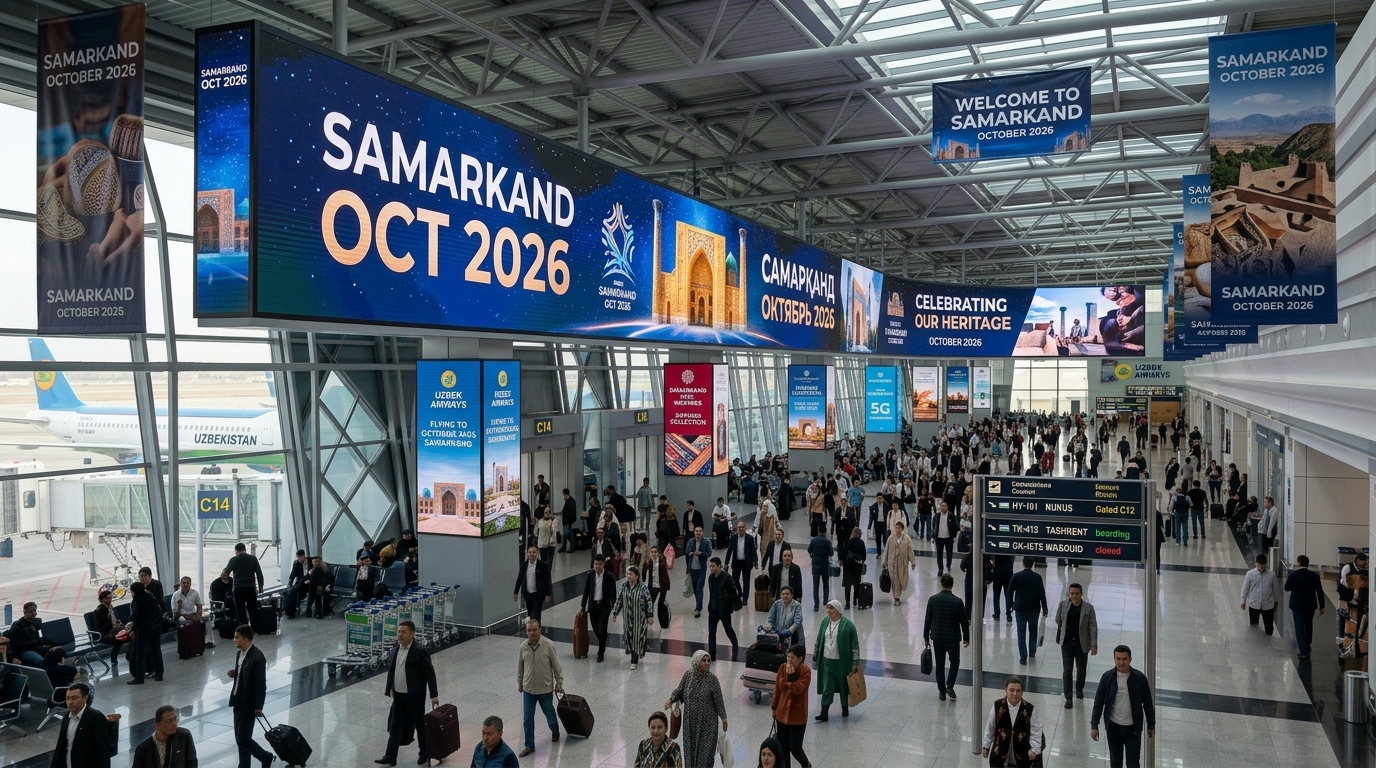
Inventory Highlights
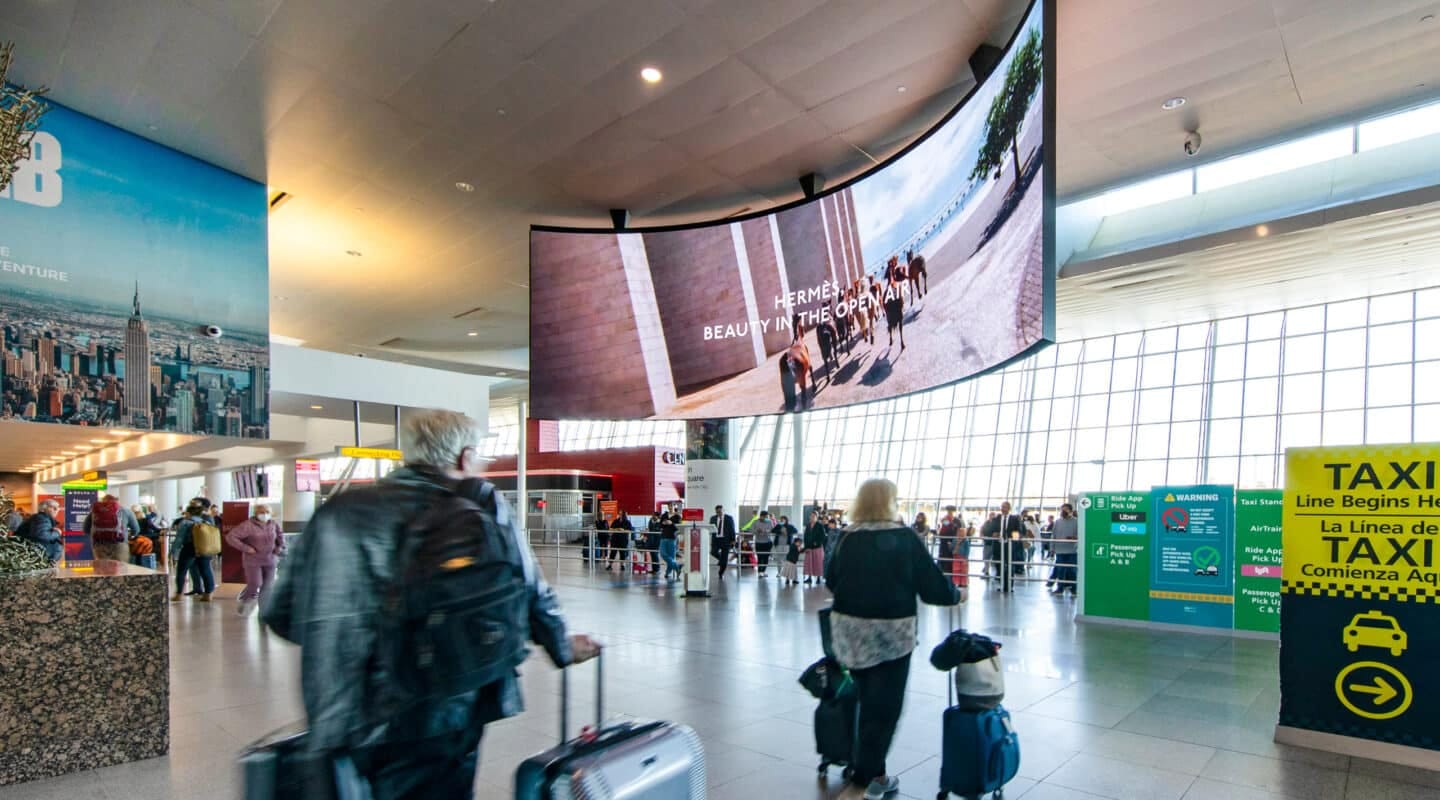
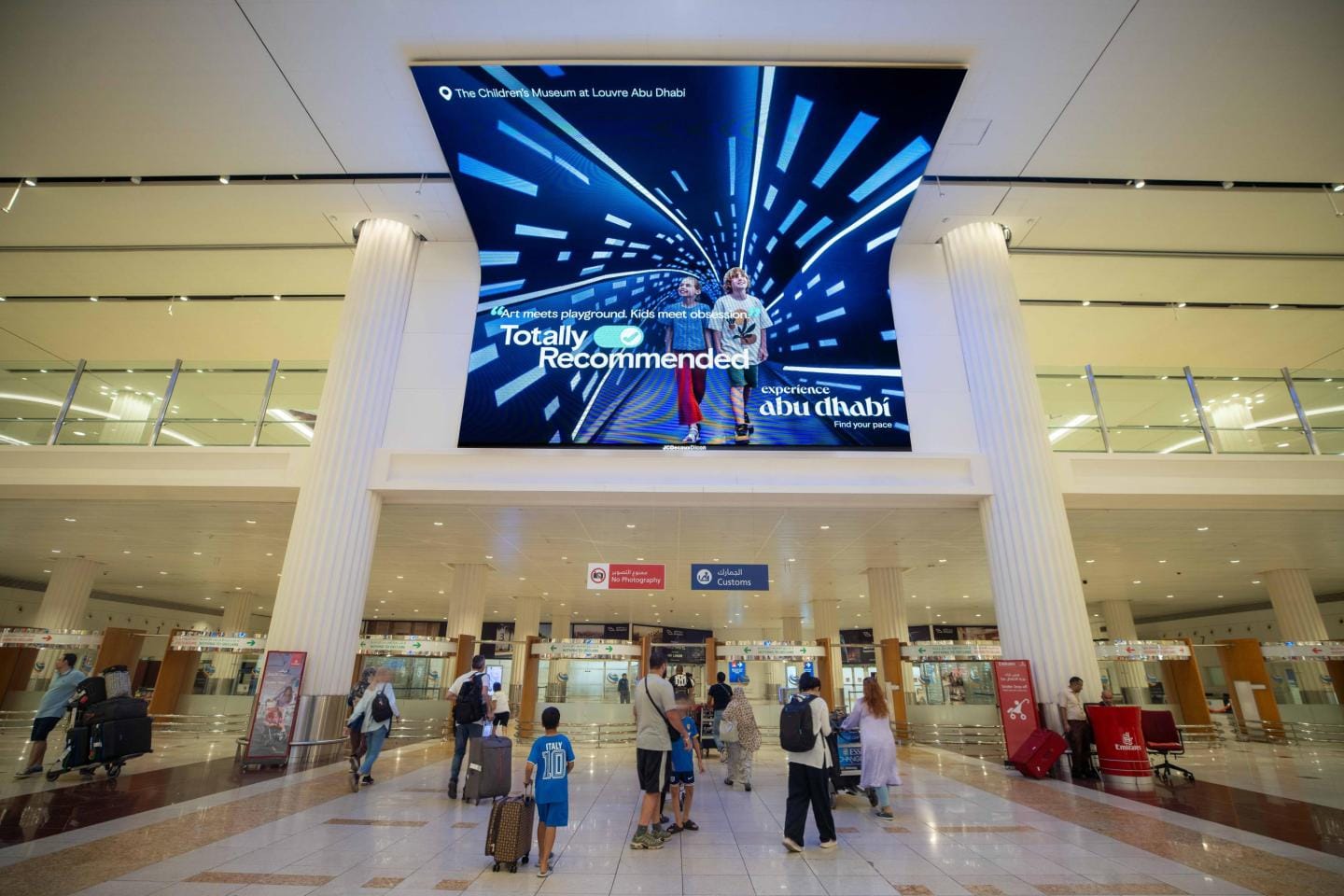
- International arrivals and immigration hall: the highest-dwell environment in the terminal, and the first branded impression for a traveller arriving directly into the heritage city.
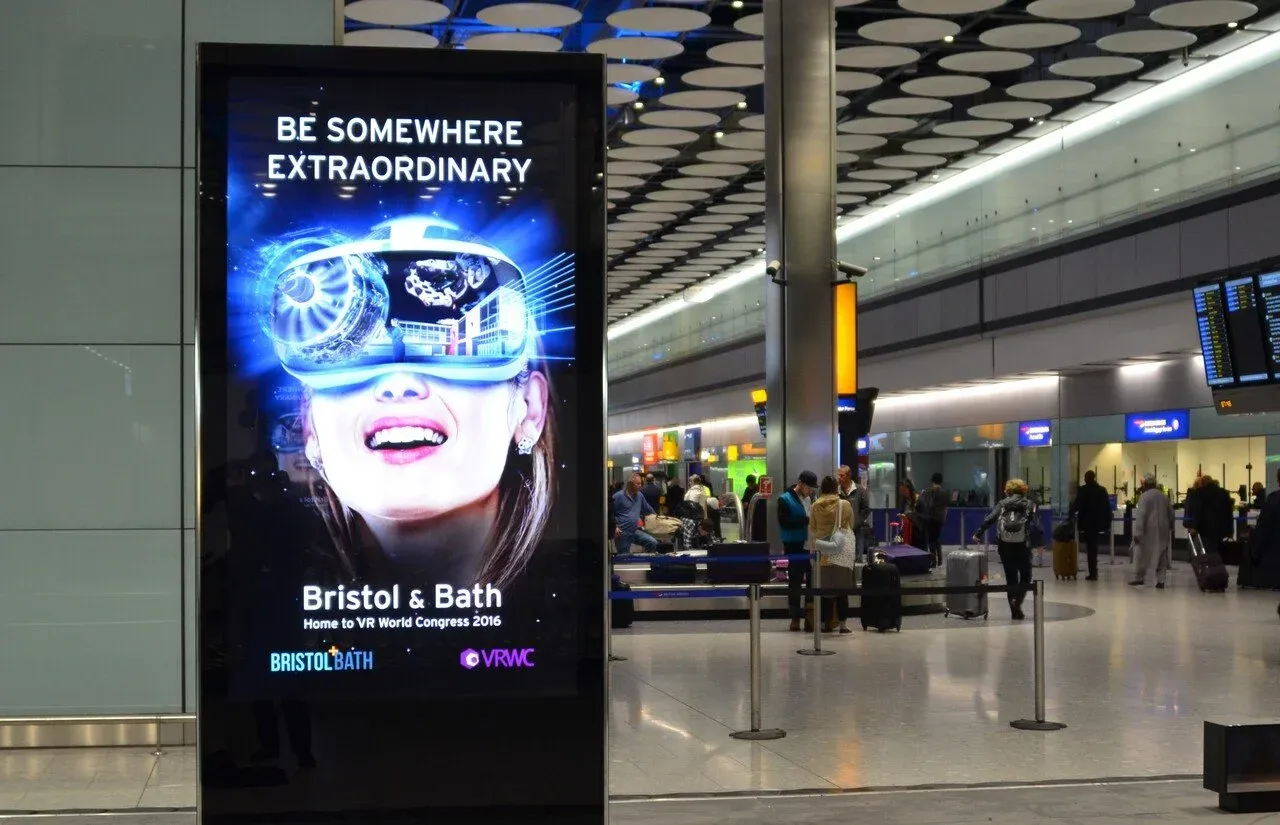
- Baggage reclaim and customs exit, where tour groups and private parties wait together before meeting guides.
- Meeter-greeter and forecourt positions, the interface with the tour operators, hotel transfers and private drivers that collect essentially every arriving cultural visitor.
- Departures, check-in and gate environments across the 8-gate terminal, reaching the same audience at the close of an itinerary, when post-trip purchase and next-destination decisions are made.
- Main concourse circulation in the 2022 terminal, whose single-building layout means all passengers pass the same positions.
- Apron and stand-adjacent visibility across the 24 parking stands, relevant for aviation and destination-brand messaging.
Advantages for Advertisers
- Direct-arrival capture. Passengers arriving at Samarkand have bypassed Tashkent entirely. Reaching them requires a Samarkand buy: a national capital-city campaign will miss them.
- Fastest growth in the country. A 37% year-on-year increase means audience delivery is expanding faster here than at any other Uzbek gateway.
- Single modern terminal. One building, one circulation path, eight gates: full inbound coverage from a small number of positions, with no terminal-split wastage.
- Purpose-built environment. The 2022 terminal is a contemporary, well-lit, design-led space in which premium creative presents properly: unlike ageing facilities where format quality constrains execution.
- Route mix aligned to the audience. Istanbul and Moscow feed European and CIS connecting traffic; the Xi'an service opens the Chinese cultural-travel market; Baku and Sharm El-Sheikh add regional volume.
- Capacity headroom. The step from 300 to 1,000 passengers per hour means the airport can absorb continued growth without the congestion that degrades media environments.
 Wealth in motion intelligence.
Destination Samarkand: Full Visitor Journey Coverage
Samarkand rewards a whole-journey approach more completely than almost any city of its size, because the visitor path is short, fixed and repeated daily. Travellers arrive at Samarkand International or by high-speed rail from Tashkent, transfer into the hotel belt near the Registan, and spend two to four days circulating between a handful of sites: Registan Square, Gur-e-Amir, Bibi-Khanym Mosque and the adjacent Siyob Bazaar, Shah-i-Zinda, the Ulugh Beg Observatory, and the Silk Road Samarkand resort complex. Evenings concentrate in the restaurant and craft-retail streets around the Registan.
The Airport → City → Venue sequence is therefore unusually literal. A campaign should open at Samarkand International arrivals, where dwell is longest and the traveller's spending pattern for the trip is still unformed. It should continue through Samarkand OOH and DOOH: large-format positions on the airport corridor and the main boulevards, digital screens across the hotel belt and the Silk Road Samarkand complex, and street-level formats along the pedestrian approaches to the monument complexes and the bazaar. It should close on the departure leg: the airport's compact departures hall and the rail terminal for travellers continuing to Bukhara or returning to Tashkent.
Built in that order, the programme produces three compounding effects. Increased brand recall, because the visitor meets the message at the airport, in the hotel district and again on the daily walk to the monuments. Consistent presence, because the brand is visible in every environment the traveller occupies, which in a city this compact reads as an established local presence rather than a seasonal buy. Enhanced campaign effectiveness, because frequency against a small, high-value, tightly bounded audience delivers far more per unit of spend than broad coverage of a diffuse market.
Why Brands Choose Airport & City Advertising for Samarkand October
Exclusive audience access. The October window brings the international heritage traveller, the luxury small-group client and the conference delegate into one compact city at once, arriving through a single modern terminal. There is no comparably efficient way to reach that combined audience in Central Asia.
A prestigious environment. Registan Square is among the most photographed architectural ensembles in Asia, and a brand present in its city carries that association. The 2022 airport terminal, designed around Ulugh Beg's star charts, extends the same register into the arrival journey.
End-to-end campaign support. Masscom Global plans, books, verifies and reports across Samarkand International and city inventory, so a single brief covers arrival, the hotel belt, the monument approaches and the departure leg.
Strategic planning assistance. Our planners advise on weighting airport against city formats in a destination this compact, phasing spend across the September build, the October peak and the early-November tail, and whether to pair Samarkand with Tashkent or Bukhara for fuller itinerary coverage.
The Masscom Global Standard Behind Every Samarkand October window Placement
- Verified inventory and audience data: screen counts and terminal data for Samarkand International come from live operator data at proposal stage, not published estimates.
- Transparent delivery reporting: campaign monitoring and reporting across the airport and city inventory, so you see exactly where your creative ran.
- Benchmarked recommendations: weighting airport against city formats and phasing spend across the September build, October peak and November tail set against comparable campaigns across our network.
- We absorb the complexity: one brief covers arrival, the hotel belt, the monument approaches and the departure leg.
Request Your Customised Samarkand October Advertising Plan
Tell us your audience, category and budget. Our planners will return a costed plan across airport and prime city inventory, with availability confirmed.
Book NowFrequently Asked Questions
What are the dates of Samarkand's October cultural peak in 2026?
There is no fixed date, because this is a seasonal window rather than an event. Uzbekistan's autumn high season runs from September to early November, and October is its peak month, with temperatures of 15°C to 24°C. Plan flighting across the month rather than around a specific day.
Who travels to Samarkand in this window?
Long-haul cultural and heritage travellers from Europe, East Asia and North America, small-group and private luxury operator clients, higher-spend independent travellers, and summit and conference delegations. Organised cultural tour packages typically run USD 3,000 to 8,000 per traveller.
Can a campaign reach the same audience beyond the airport?
Yes, and in Samarkand it should. A combined airport and city programme covers arrivals and departures at Samarkand International, the airport corridor, the hotel belt, the Silk Road Samarkand complex, and the pedestrian approaches to Registan, Gur-e-Amir and Shah-i-Zinda: several exposures across a two-to-four-day stay.
How far in advance should a campaign be booked?
Samarkand International grew 37% in 2024 and operates a single terminal with eight gates, so premium positions are genuinely finite and are being taken up. We recommend confirming availability several months ahead of a September start. Later requests can often still be served, but with reduced format choice.
Which brand categories perform best in this window?
Premium hospitality and resort groups, airlines and travel platforms, luxury retail, watches and jewellery, cards and payments, telecoms and roaming, photography and optics, heritage and cultural institutions, and premium tour and cruise operators.
Related Airport Advertising Guides
Detailed inventory, audience and planning notes for the airports covered above:
Wealth in motion intelligence.Samarkand October window Won't Wait. Neither Should You.
- A single terminal, genuinely finite: Samarkand International grew 37 percent in 2024 and operates a single terminal with eight gates, so premium positions are being taken up.
- Competitors are already moving: every week without a plan is a week a hospitality, luxury retail or tour operator brand gets closer to locking the same airport and city-centre positions.
- The window is exact, not approximate: confirming availability several months ahead of a September start keeps full format choice; later requests can often still be served, but with reduced choice.
- The alternative can't reach a short stay the same way: generic advertising can't deliver the several exposures a combined airport and city programme achieves across arrivals, the hotel belt and the pedestrian approaches to Registan.
Get Free Expert Assistance Now
Tell us your audience, category and budget, and our planners will return a costed Samarkand October media plan across airport and city inventory.
Request Availability
Samarkand International and city-centre positions for October 2026 are limited by the terminal's compact footprint. Ask us what is still open.
Samarkand no longer needs Tashkent to deliver its own audience: a record 1.38 million passengers arrived directly in 2024, up 37% on the year before, straight into the compact heritage core built around Registan, Gur-e-Amir and Shah-i-Zinda. A campaign covering Samarkand International arrivals and the short walk to those monuments reaches a long-haul, high-value cultural traveller several times inside a two-to-four-day stay, at a fraction of the reach a national buy would need to replicate one city at a time. October is the peak of that traffic, and the terminal's single-runway footprint means the good positions do not last.