




NYFW is the opening act of the global spring/summer show season, the week that sets the buying and editorial agenda before London, Milan and Paris. New York Fashion Week returns from 10 to 15 September 2026, opening on Thursday 10 September with Henry Zankov's debut collection for Diane von Furstenberg and closing on Tuesday 15 September with Thom Browne. The CFDA's official schedule carries 70 runway shows and designer presentations, with further collections shown by appointment and digitally across the same six days; out of respect for the 25th anniversary of 11 September, the Friday schedule begins at 10:00 am rather than the usual earlier start.
For media planners, that ordering matters commercially. New York is where the international fashion press, the department-store and multi-brand buying community, the luxury e-commerce merchandising teams and the brand-side marketing leadership all arrive at once, before their budgets and attention are committed elsewhere in the month.
The opportunity for advertisers is not the runway. It is the six-day window in which a compressed, extremely high-value audience arrives through two of the busiest international gateways in the Americas and then concentrates itself into a small number of Manhattan districts.
Why Airport & City Advertising Works During New York Fashion Week
The NYFW audience composition is unusually favourable for premium advertisers. It combines editors and creative directors from every major international title; wholesale buyers with real purchasing authority; brand founders, CEOs and marketing directors; celebrity and talent entourages with their agents and stylists; and a substantial layer of clients, investors and private-client customers flown in by the houses themselves. Most arrive by air, most travel in premium cabins or by private aircraft, and almost all pass through John F. Kennedy International or Newark Liberty International.
They arrive into one of the deepest consumer markets on earth. New York's metropolitan area supports a regional GDP exceeding two trillion dollars annually and a catchment of over 20 million people, with inbound tourism running at approximately 65 million visitors annually. A fashion-week campaign in this market therefore does double duty: it reaches the visiting industry cohort, and it reaches a resident affluent population that is already the primary customer base for luxury retail in North America.
It is also a rare week in which the industry's own decision-makers are demonstrably receptive to brand messaging. Buyers and editors spend the week actively looking at communication, positioning and creative execution. Media placed in their path is being consumed by an audience whose professional job that week is to notice.
Key Benefits of Airport & City Advertising During New York Fashion Week
Reach a qualified, high-spend audience
Show-week arrivals concentrate premium-cabin and private-aviation travellers into a six-day corridor. At JFK, international traffic accounts for approximately 60% of total volume, and international departing passengers consistently dwell 60 to 90 minutes before boarding. Airport and Manhattan media reach this audience during unavoidable, high-attention moments rather than competing for it in a crowded digital auction.
Elevate your brand positioning
NYFW is a prestige environment by definition, and the media environment around it is read accordingly. A brand visible across the arrival journey and the Manhattan luxury core is placed alongside the houses on the official schedule: without the cost or exclusivity constraints of official partnership.
Generate real business opportunity
The week functions as a wholesale and partnership calendar as much as a creative one. Showroom appointments, buying meetings, licensing conversations and investor introductions all cluster into the same days. Sustained visibility across arrival, city and district keeps a brand present through every one of those conversations.
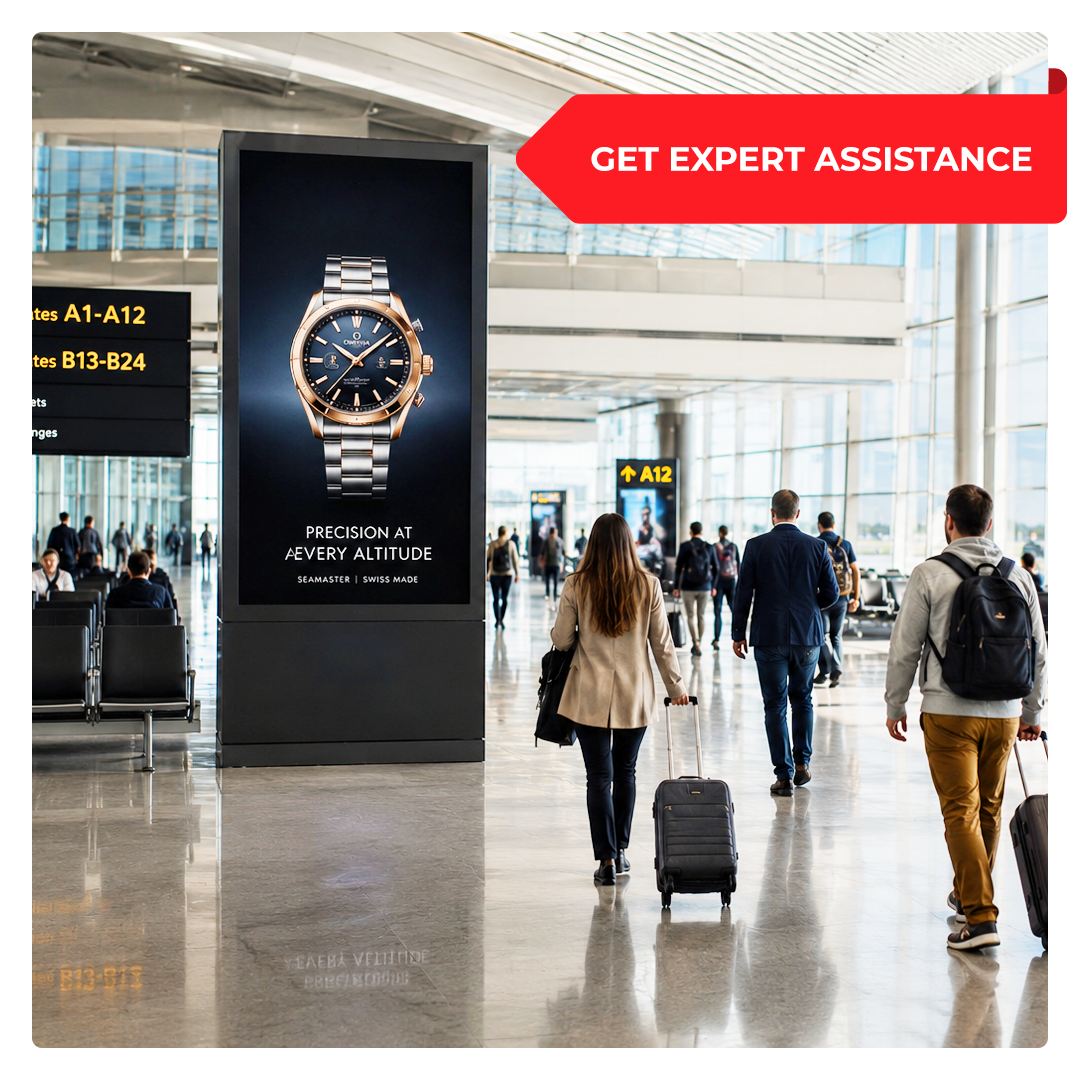
Get Free Expert Assistance from Our Global Media Planning Team
Receive strategic recommendations, media planning support, campaign monitoring and reporting to maximise your visibility throughout NY Fashion Week (Sept).
Book Expert ConsultationJohn F. Kennedy International Airport (JFK)
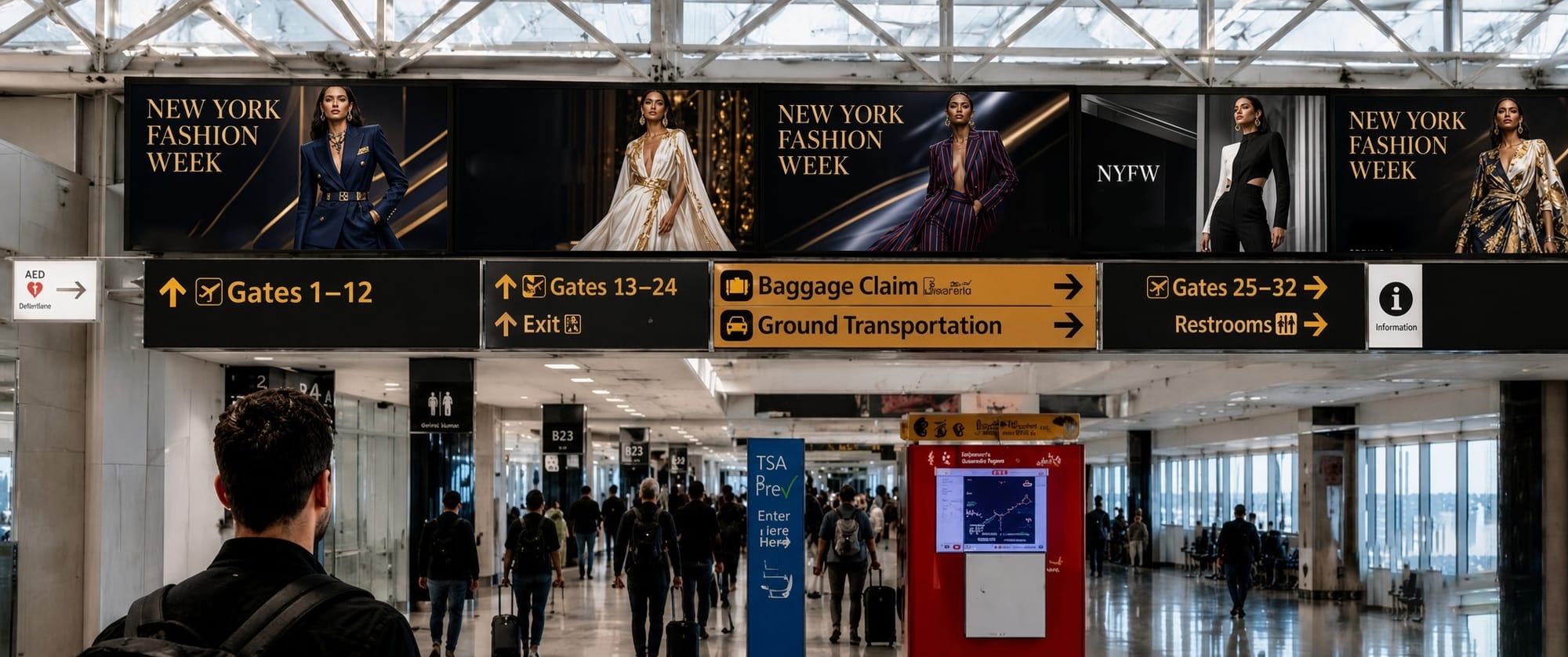
JFK is the principal international gateway for fashion-week arrivals, handling 62.5 million annual passengers (2023) across multiple terminal buildings, with international traffic at approximately 60% of total volume. Terminal 4 is the primary international hub, Terminal 5 is JetBlue's dedicated base, and Terminal 8 houses American Airlines operations. The airport is mid-way through a capital transformation exceeding fifteen billion dollars, including the US$9.5 billion New Terminal One and the US$4.2 billion Terminal 6 redevelopment, which means new-build, low-clutter digital environments are progressively coming into the inventory pool.
JFK's route network is what makes it the right buy for this week specifically: multiple daily services to London Heathrow, plus direct service to Singapore, Tokyo, Dubai, Doha, Hong Kong and other major centres. The international fashion cohort travelling in from Europe, the Gulf and Asia lands here.
Inventory Highlights
- Arrivals, immigration approach and baggage reclaim positions in the international terminals: the first branded surface a visiting editor or buyer encounters in the United States
- Digital networks along departure concourses and premium check-in zones, reaching business- and first-class travellers on the outbound leg
- Terminal 4 international environments carrying the long-haul European, Gulf and Asian arrivals central to show week
- Newly delivered terminal environments arising from the New Terminal One and Terminal 6 programmes, with contemporary digital specification
- Transit and connection zones serving onward domestic distribution to the rest of the North American market
Advantages for Advertisers
- Unavoidable exposure: every inbound international arrival passes through a sequence a brand can own end to end
- Confirmed 60–90 minute international departure dwell supports considered creative, not glance-only messaging
- Sixty per cent international mix means budget is not diluted across domestic short-haul audiences
- Multi-terminal buys allow separate treatment of long-haul premium arrivals and domestic feeder traffic
- Reaches the resident affluent population of a 20-million catchment in addition to the visiting cohort
 Wealth in motion intelligence.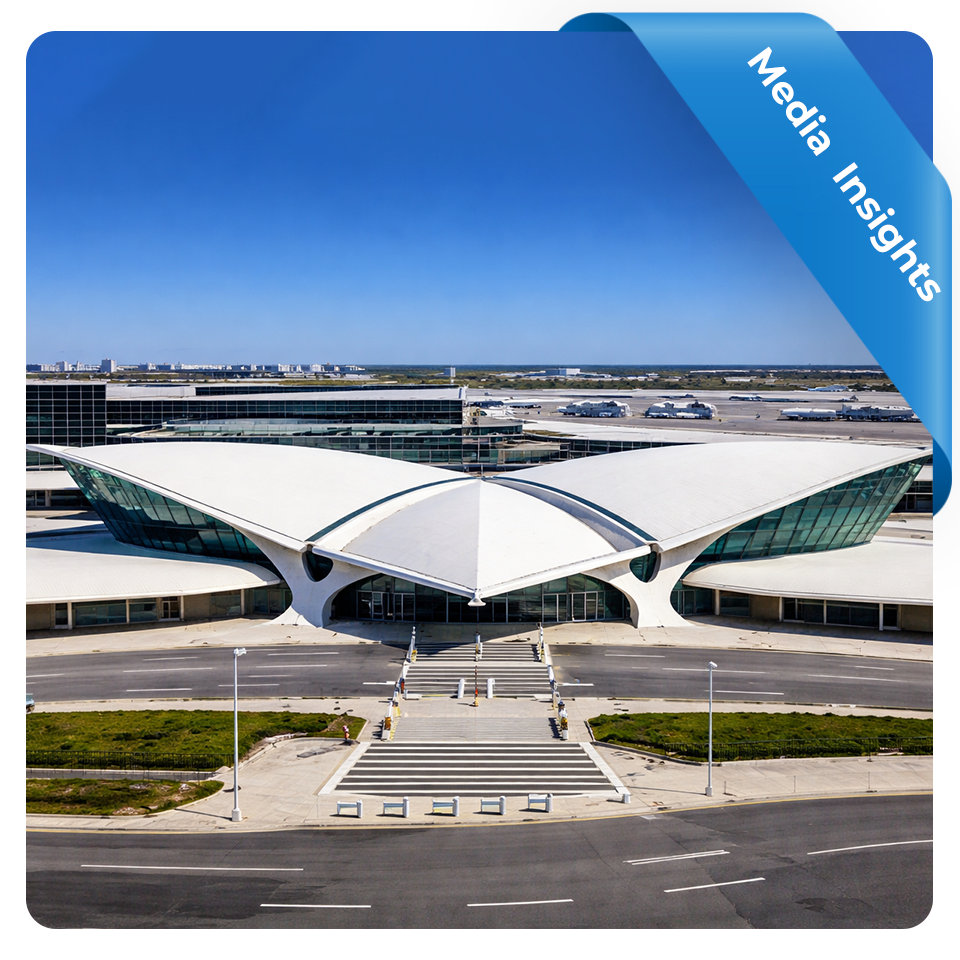
Newark Liberty International Airport (EWR)
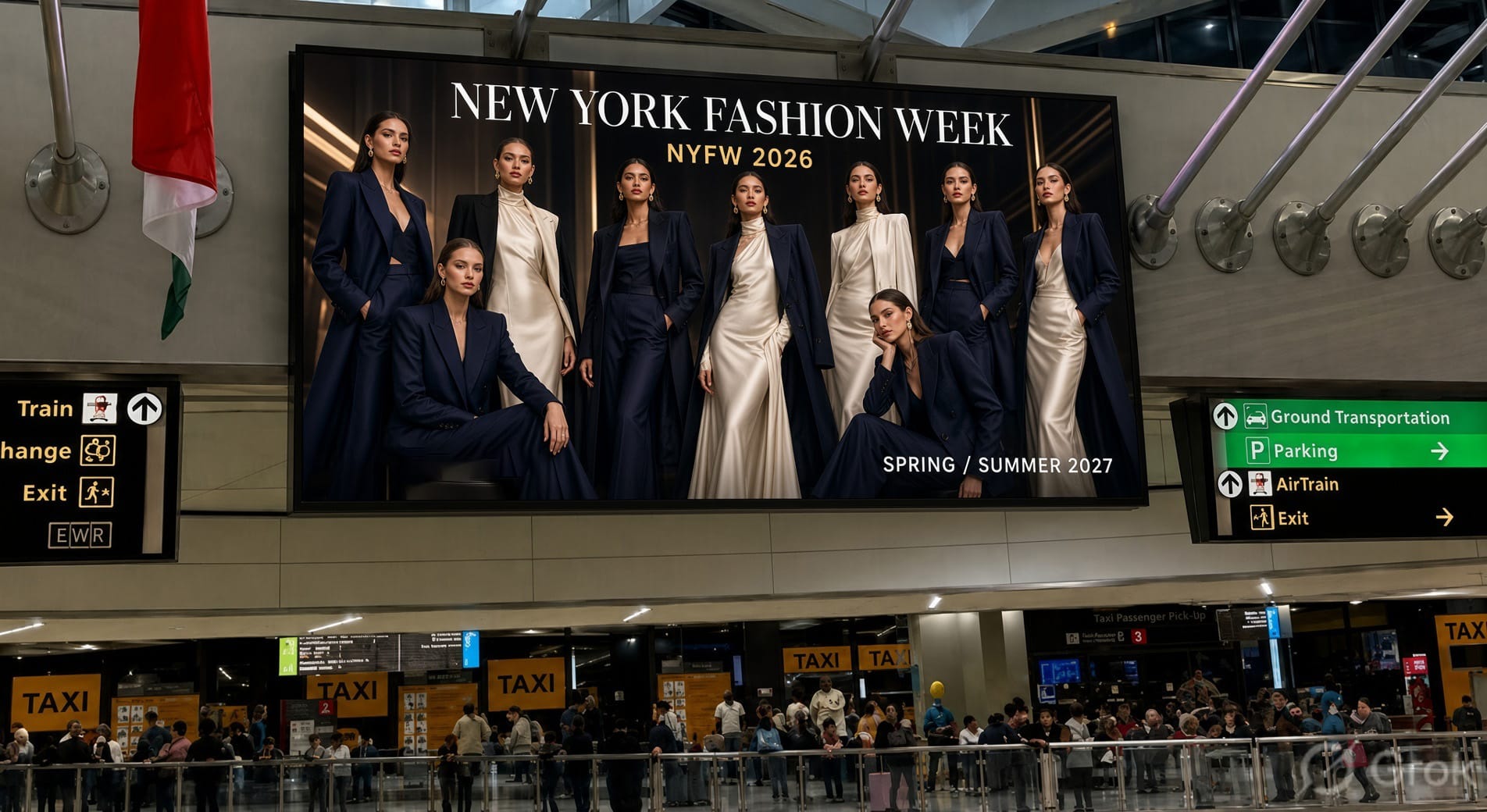
Newark Liberty is the second major gateway into the New York market and carries a materially different traffic profile from JFK: a heavier corporate and transatlantic business mix, strong hub connectivity, and convenient access to Midtown and Downtown Manhattan. For fashion week it matters because a significant share of brand-side executives, agency teams and corporate travellers route through Newark rather than JFK, often on itineraries booked by company travel programmes rather than by the houses.
Inventory Highlights
- Arrivals hall and baggage reclaim environments across the international terminal operation
- Departure concourse digital positions reaching transatlantic business travellers
- Premium check-in, lounge approach and security queue positions with structured dwell
- Ground-transport interchange and rail link environments used by Manhattan-bound arrivals
Advantages for Advertisers
- Captures the corporate and brand-side executive segment that JFK alone will miss
- Pairing EWR with JFK produces near-complete coverage of air arrivals into the New York market for the week
- Business-heavy composition suits B2B and trade-facing messaging aimed at buyers and wholesale partners
- Manhattan-bound ground transport creates a natural handover into city media
 Wealth in motion intelligence.
Destination New York: Full Visitor Journey Coverage
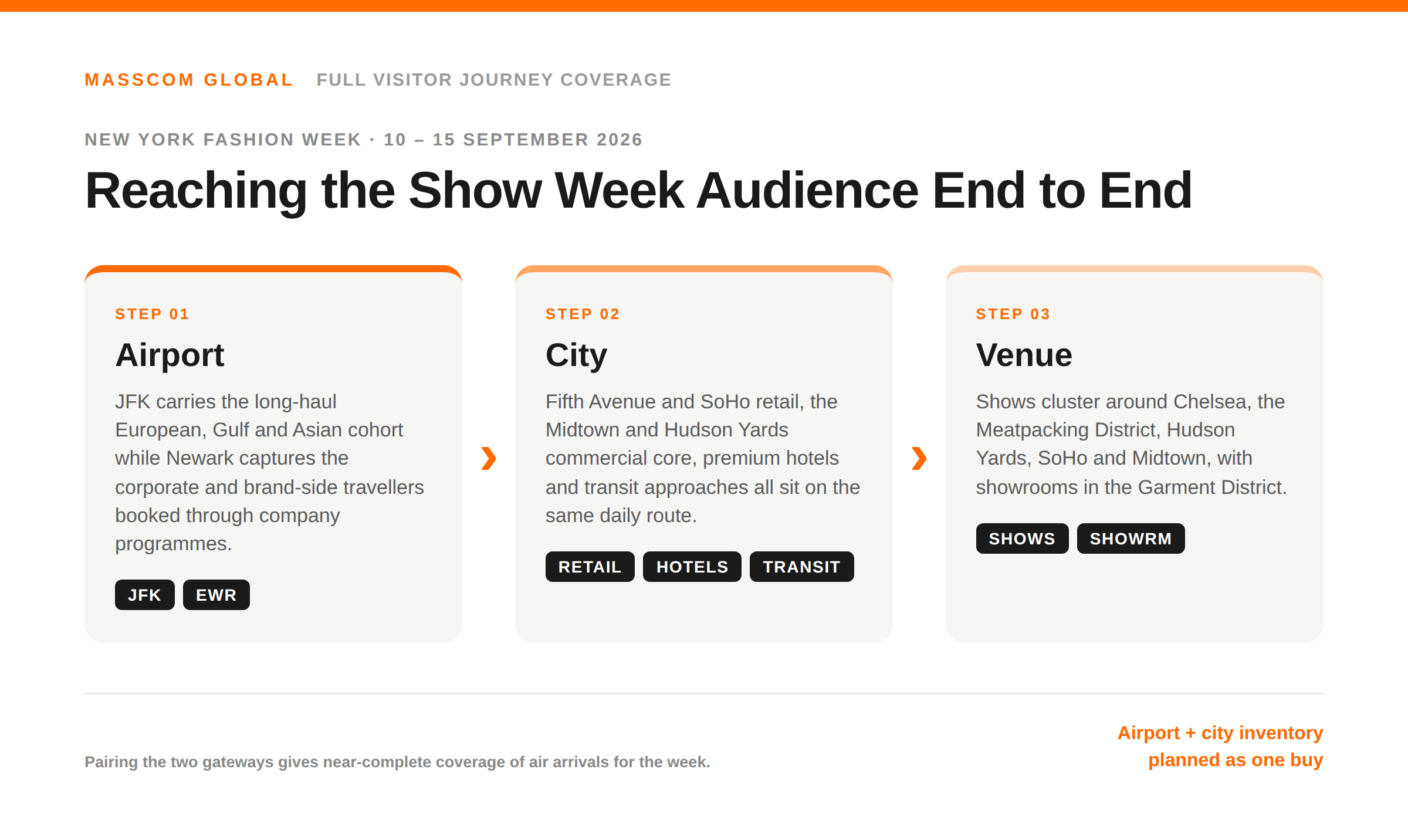
New York's show week is geographically disciplined. Venues cluster around Chelsea, the Meatpacking District, Hudson Yards, SoHo and Midtown; showrooms sit in the Garment District and Lower Manhattan; the hotels, restaurants and after-show venues that absorb the same audience sit inside the same handful of neighbourhoods. A visitor's entire week happens along a narrow north-south spine of Manhattan.
That geography makes an Airport → City → Venue media sequence unusually efficient. A campaign can meet an arriving buyer at JFK or Newark immigration, appear again on large-format and digital OOH along the Fifth Avenue and SoHo luxury retail corridors, in the Midtown and Hudson Yards commercial core, across premium hotel environments and transit approaches, and then a third time within walking distance of the show venues themselves: all without buying impressions in geographies the audience never enters.
Three effects follow from sequencing rather than scattering:
- Increased brand recall: repeated exposure at arrival, in the city and near the venue compounds within a single week
- Consistent presence: the brand becomes part of the week's visual environment rather than an interruption to it
- Enhanced campaign effectiveness: coordinated placements across one audience journey outperform the same spend split across disconnected markets
Why Brands Choose Airport & City Advertising for New York Fashion Week
Exclusive audience access. Few six-day windows anywhere concentrate this density of international editors, buyers, brand principals and private clients into two airports and a few square miles of city.
A prestigious environment. NYFW opens the global season and is covered accordingly. Brands visible in that environment are read within it.
End-to-end campaign support. Masscom Global plans, negotiates and executes across JFK, Newark and Manhattan city inventory from a single brief, with one point of accountability.
Strategic planning assistance. Our planners advise on terminal selection, format mix and flight-timing alignment so that spend lands where the fashion-week audience actually moves, not where inventory happens to be available.
The Masscom Global Standard Behind Every New York Fashion Week Placement
- Verified inventory and audience data: screen counts and passenger figures across JFK and Newark come from live operator data at proposal stage, not published estimates.
- Transparent delivery reporting: campaign monitoring and reporting across both airports and Manhattan city inventory.
- Benchmarked recommendations: terminal selection and format mix set against comparable campaigns across our network.
- We absorb the complexity: one point of accountability across gateways and city inventory.
Request Your Customised NY Fashion Week (Sept) Advertising Plan
Tell us your audience, category and budget. Our planners will return a costed plan across airport and prime city inventory, with availability confirmed.
Book NowFrequently Asked Questions
When exactly is New York Fashion Week in September 2026?
The official CFDA schedule runs 10 to 15 September 2026, opening Thursday 10 September with Henry Zankov's debut for Diane von Furstenberg and closing Tuesday 15 September with Thom Browne. The Friday schedule starts at 10:00 am out of respect for the 25th anniversary of 11 September.
Who attends New York Fashion Week?
International fashion press and editors, wholesale and department-store buyers, luxury e-commerce merchandising teams, brand founders and marketing leadership, talent and their representatives, and private clients and investors hosted by the houses. The official schedule alone comprises 70 runway shows and designer presentations, and New York's own resident affluent population, drawn from a metro area with a regional GDP exceeding two trillion dollars, adds further weight to the audience beyond the visiting industry cohort.
Can I reach visitors across their whole journey, not just at the shows?
Yes. A combined JFK, Newark and Manhattan campaign covers international arrival, the luxury retail and commercial core, hotel and transit environments, and the districts containing the show venues, so the same audience encounters the brand several times across the six days.
How far in advance should a fashion-week campaign be booked?
Premium JFK and Manhattan positions for the September window are among the most contested inventory in North America, and demand is compounded by the wider autumn business calendar. We recommend confirming availability several months ahead; later requests can often still be served, but with reduced format and location choice.
Which brand categories perform best in this window?
Luxury fashion and accessories, watches and jewellery, beauty and fragrance, premium hospitality and hotels, private aviation, wealth management and private banking, real estate and residency advisory, and premium spirits.
Related Airport Advertising Guides
Detailed inventory, audience and planning notes for the airports covered above:
Wealth in motion intelligence.Wealth in motion intelligence.New York Fashion Week Won't Wait. Neither Should You.
- Once a year, then gone: premium JFK and Manhattan positions for the September window are already among the most contested inventory in North America.
- Competitors are already moving: every week without a plan is a week a fashion, jewellery or beauty brand gets closer to locking the same positions.
- The window is exact, not approximate: a campaign that isn't live for the six-day season misses the buyers and press actually in the city.
- The alternative reaches the wrong tier: broadcast and programmatic can't isolate the senior buyers and press who control season budgets the way JFK arrival and Manhattan city media can.
Get Free Expert Assistance Now
Tell us your audience, your category and your budget, and our planners will return a costed New York Fashion Week media plan across JFK, Newark and Manhattan inventory.
Request Availability
JFK and Manhattan positions for the 10–15 September 2026 window move quickly. Ask us what is still open.
New York Fashion Week opens the global show season and compresses the industry's editors, buyers and brand leadership into six days, arriving through JFK and Newark into a metro area worth more than two trillion dollars in regional GDP. An Airport → City → Venue plan reaches that audience at international arrival, again across the Fifth Avenue and SoHo retail corridors, and a third time near the show venues themselves. Premium JFK and Manhattan positions for the September window are already among the most contested inventory in North America.







