

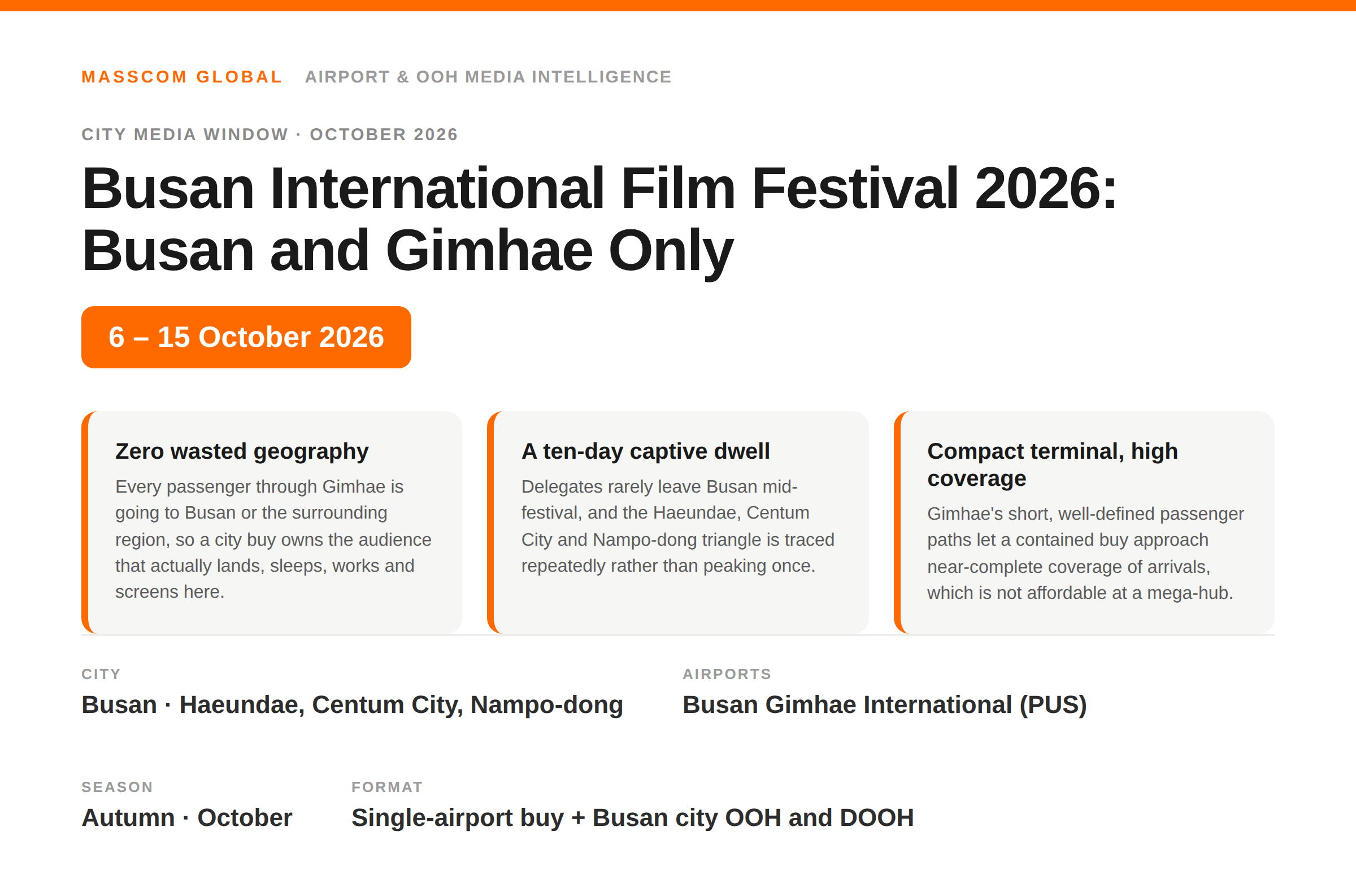
BIFF is Asia's most consequential film festival, and for ten days it converts Busan from Korea's second city into the region's entertainment-industry capital. The 31st Busan International Film Festival runs from Tuesday 6 October to Thursday 15 October 2026: ten days, anchored at the Busan Cinema Center in Centum City, with screenings and industry activity extending across the Haeundae and Nampo-dong districts of the city.
This post is deliberately about Busan alone: the city and its own airport gateway, Gimhae International Airport (PUS). That single-city framing matters commercially. A national Korean campaign spreads budget across eight airports and seven cities in the hope of intercepting festival traffic somewhere. A Busan campaign owns the one city where the audience actually lands, sleeps, works and screens, for the whole ten days.
Why Airport & City Advertising Works During the Busan International Film Festival
The BIFF audience is not a general leisure crowd. It comprises international film buyers, distributors and sales agents; streaming and studio executives from Seoul, Tokyo, Hong Kong, Los Angeles and Europe; producers and financiers seeking co-production deals; festival programmers; press and critics; talent and their representatives; and the sponsor and brand delegations that follow all of them. Behind that sits a domestic audience of considerable purchasing power, since Busan draws heavily from Seoul and the wider Korean metropolitan corridor during festival week.
Three characteristics make this window unusually attractive to a premium brief. First, the audience is captive in one city for a long dwell: ten days is far longer than the two or three days a sporting event provides, and delegates rarely leave Busan mid-festival. Second, the geography is tightly concentrated: Centum City, Haeundae's beachfront hotel strip and Nampo-dong's cinema district are a small number of well-defined districts connected by predictable transit and road corridors. Third, the audience is professionally receptive to brand messaging: these are people whose working lives revolve around media, positioning and production value, and who read an environment's advertising as a signal about the market they are visiting.
South Korea's major airports process millions of passengers annually, and Incheon is globally renowned, but Incheon is a Seoul gateway. For a festival campaign, Gimhae is the gateway that matters, because it is where the Busan-bound share of that traffic actually arrives.
Key Benefits of Airport & City Advertising During the Busan International Film Festival
Reach a qualified audience
Festival week concentrates decision-makers from the entertainment, media, streaming and advertising industries into one city. For brands selling to that sector (technology, production services, aviation, hospitality, financial services) the qualification rate of a Busan buy in this window is far higher than any equivalent general-market placement.
Elevate your brand positioning
BIFF carries genuine cultural authority across Asia, and the Busan Cinema Center is one of the most photographed pieces of contemporary architecture in Korea. A brand present in the festival's visual environment (at the airport, along the Haeundae corridor, in Centum City) is read as culturally fluent rather than merely visible.
Generate real business opportunity
BIFF is a market as much as a festival. Rights are traded, co-productions are agreed and distribution deals are signed across the ten days. Sustained visibility keeps a brand in front of an audience that is actively transacting, in a week when their attention is professionally tuned to who is present and who is not.
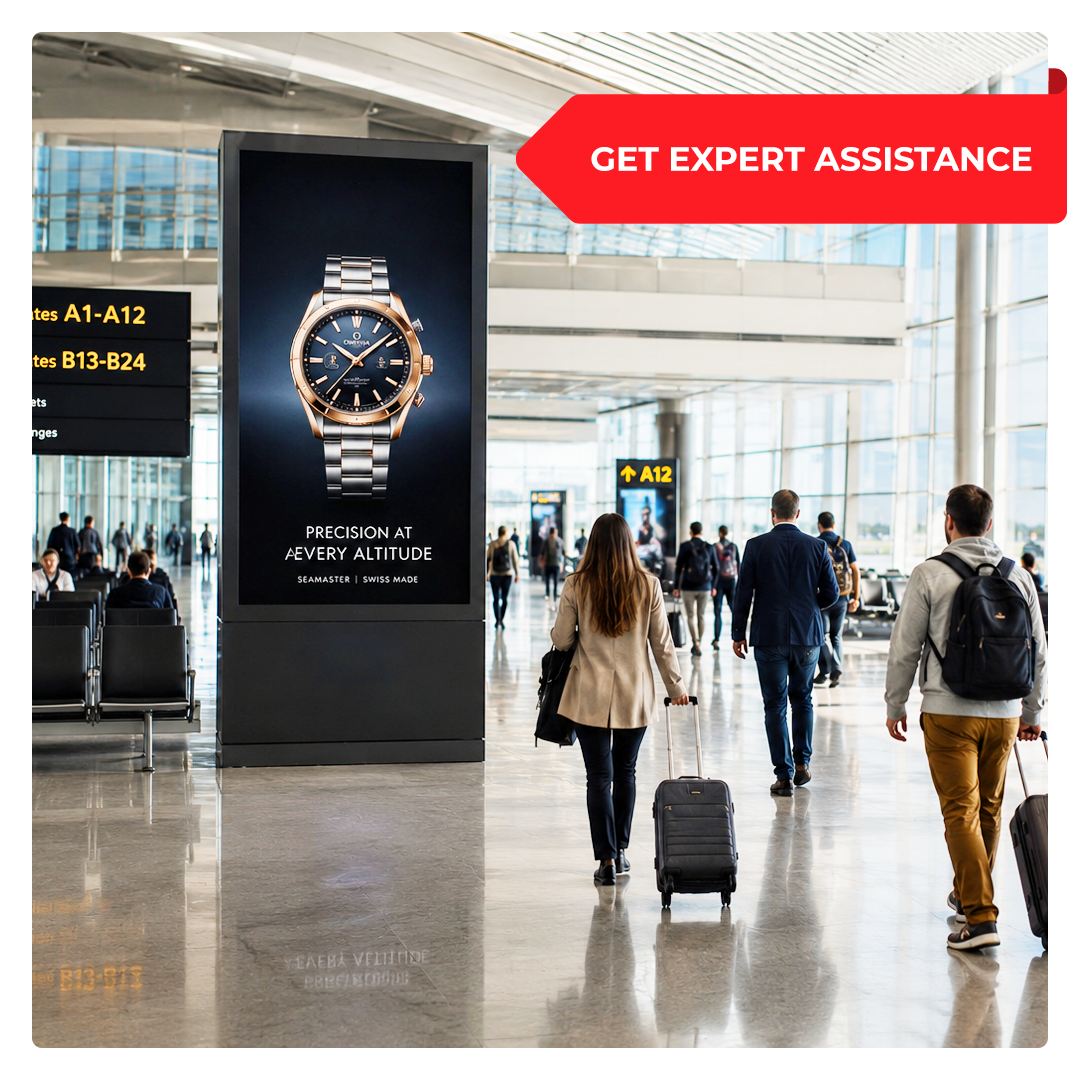
Get Free Expert Assistance from Our Global Media Planning Team
Receive strategic recommendations, media planning support, campaign monitoring and reporting to maximise your visibility throughout Busan International Film Festival.
Book Expert ConsultationBusan Gimhae International Airport (PUS): The City's Own Gateway
Gimhae is the gateway to Busan and to the wider Gyeongsang region, serving both international routes (principally across East and Southeast Asia) and heavy domestic traffic from Seoul Gimpo and Jeju. During festival week its passenger mix shifts noticeably toward international industry delegates and domestic film-industry travellers, which is precisely the moment a campaign should be live.
Gimhae's structure works in an advertiser's favour. It is a compact two-terminal airport (international and domestic under one operational roof) with short, well-defined passenger paths and none of the sprawl that dilutes coverage at mega-hubs. A relatively contained buy can achieve near-complete coverage of the arriving audience, which is rarely possible at Incheon at any sensible cost.
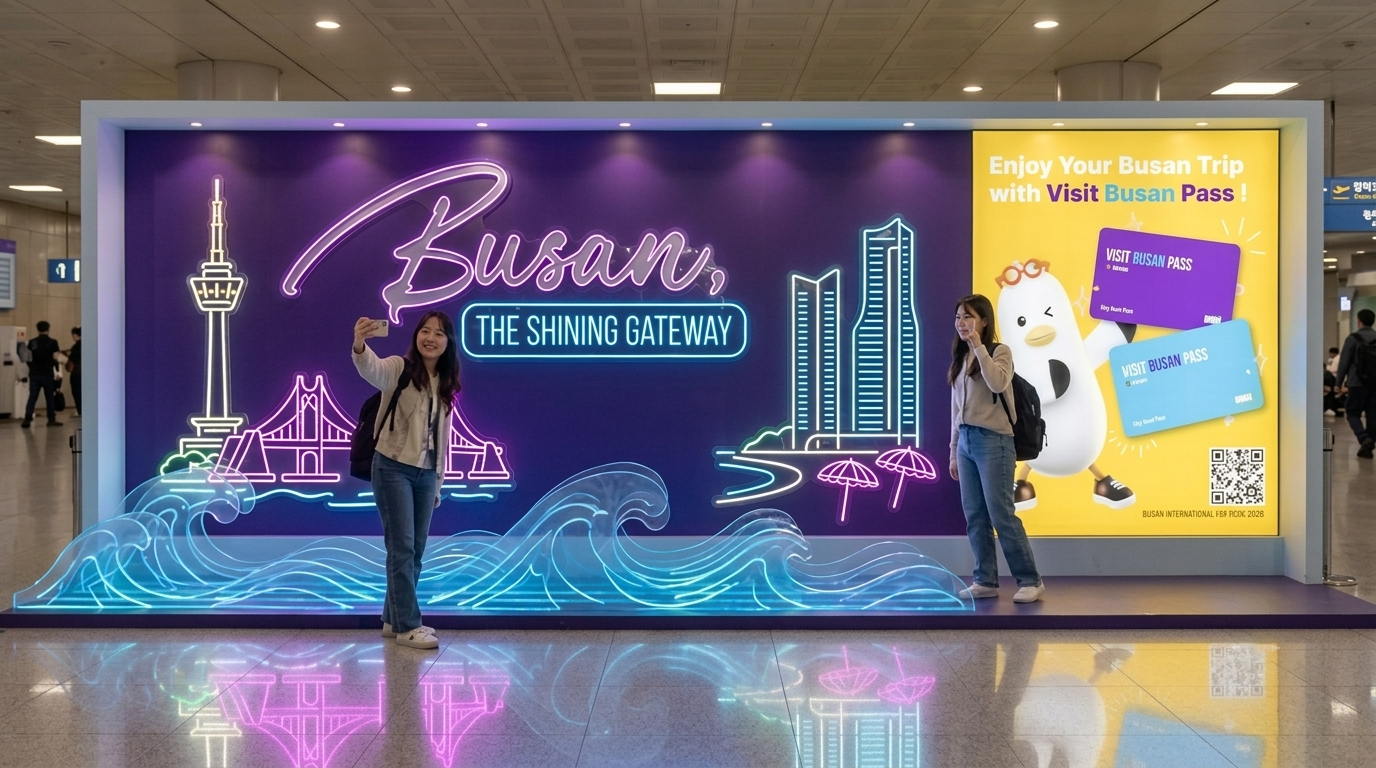
Inventory Highlights
- International arrivals and immigration approach positions: the first branded surface an inbound festival delegate encounters in Korea's second city
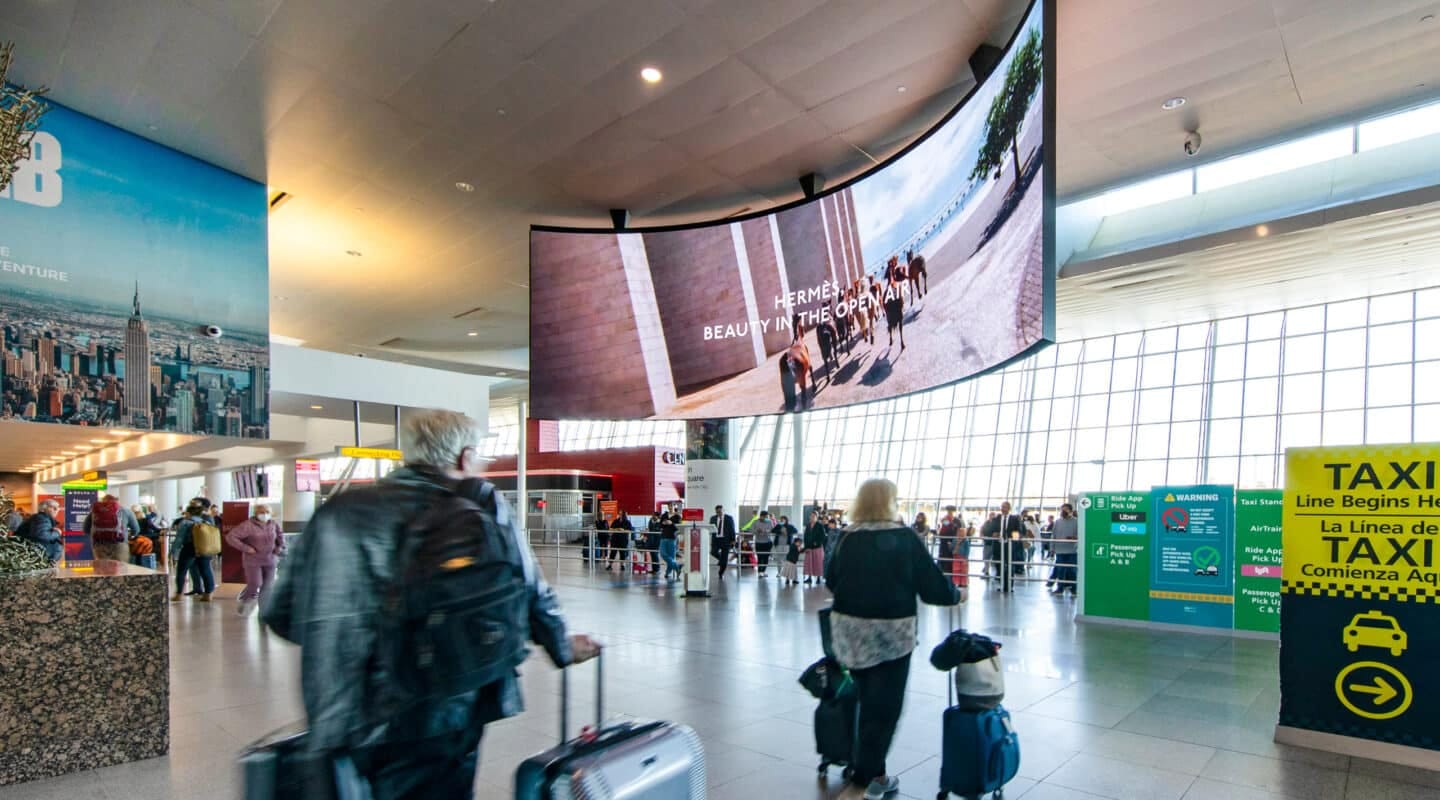
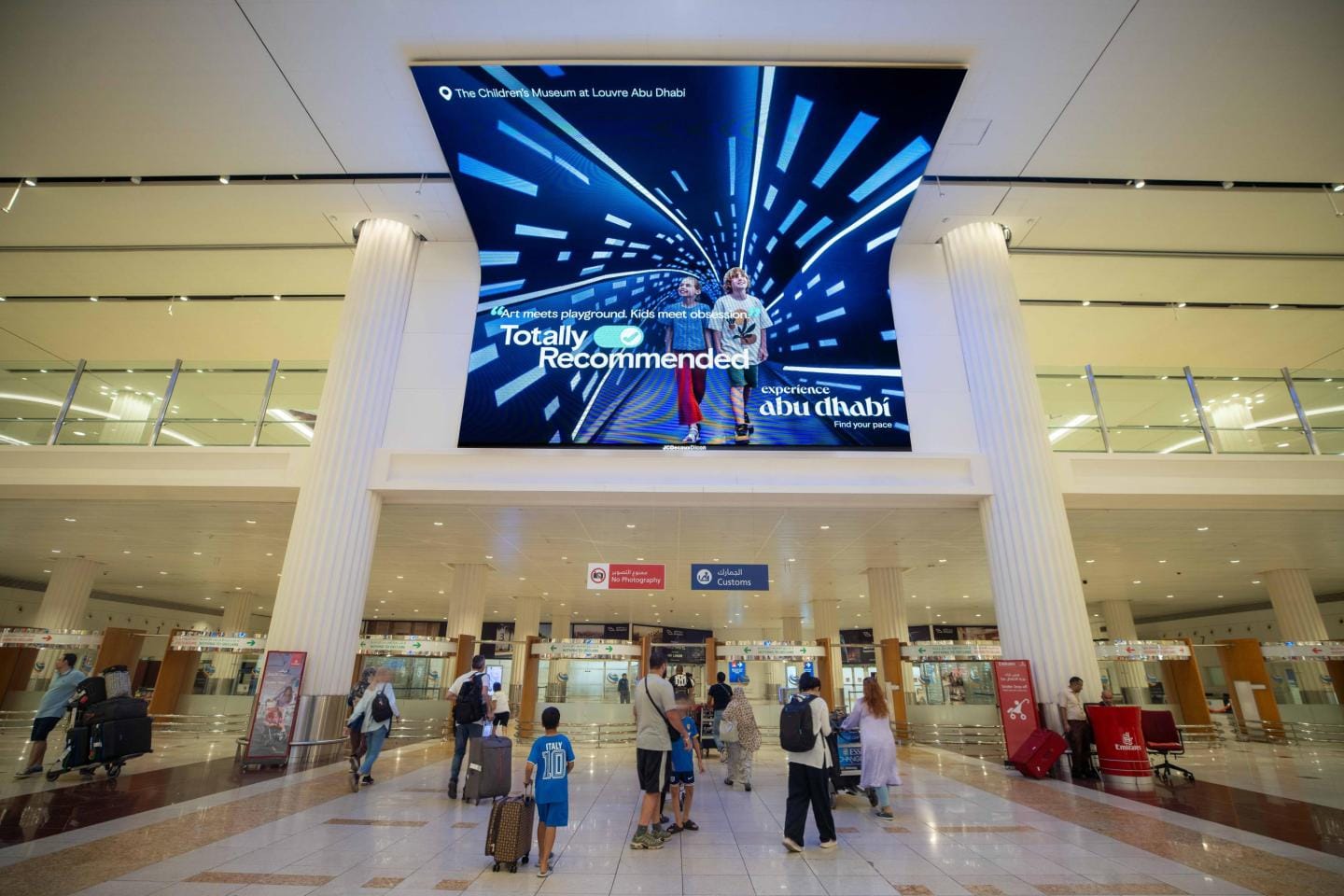
- Baggage reclaim and arrivals hall environments, with the long, effectively captive dwell that long-haul and regional arrivals produce
- Departure concourse, security approach and gate-hold positions reaching delegates on the outbound leg, when the festival experience is freshest
- Domestic terminal placements capturing the substantial Seoul Gimpo and Jeju feeder traffic that carries Korean industry and media attendees
- Premium check-in and lounge-adjacent environments serving business-cabin travellers
- Landside, forecourt, taxi rank and car-hire positions catching the transfer decision point on the drive into Haeundae and Centum City
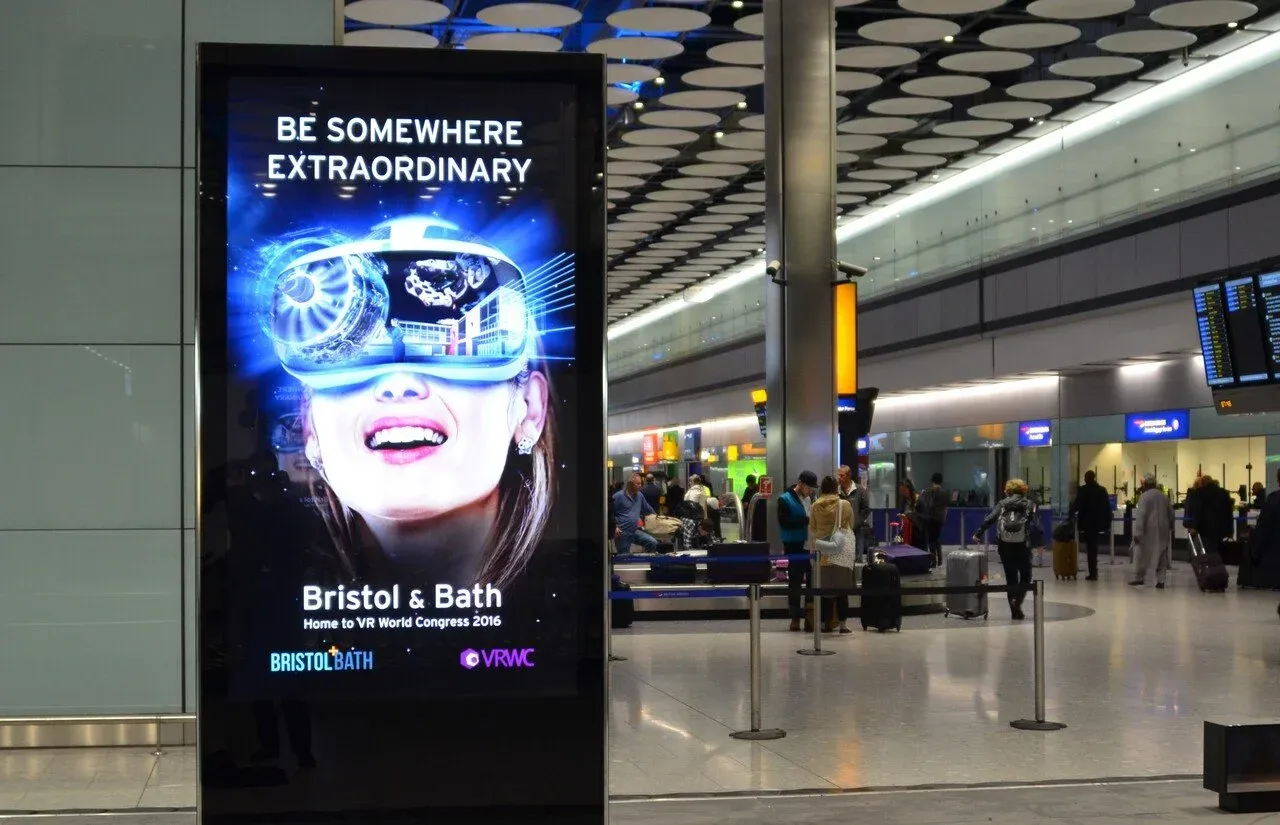
- Digital and static formats across concourse and circulation zones, allowing dated festival-week creative to run alongside a longer brand message
Advantages for Advertisers
- City-level precision: every passenger through Gimhae is going to Busan or the surrounding region, so there is no wasted geographic reach
- Compact footprint means high coverage of the arriving audience for a fraction of a national multi-airport budget
- Lower media clutter than Incheon, so individual executions retain share of voice
- Dual international and domestic reach in one airport: the overseas delegate and the Seoul-based executive arrive through the same building
- Ten-day festival window justifies a full month-long booking cycle, improving rate efficiency against a short-burst event buy
- Short drive into the festival districts allows an airport buy to be sequenced directly into city OOH along the same corridor
 Wealth in motion intelligence.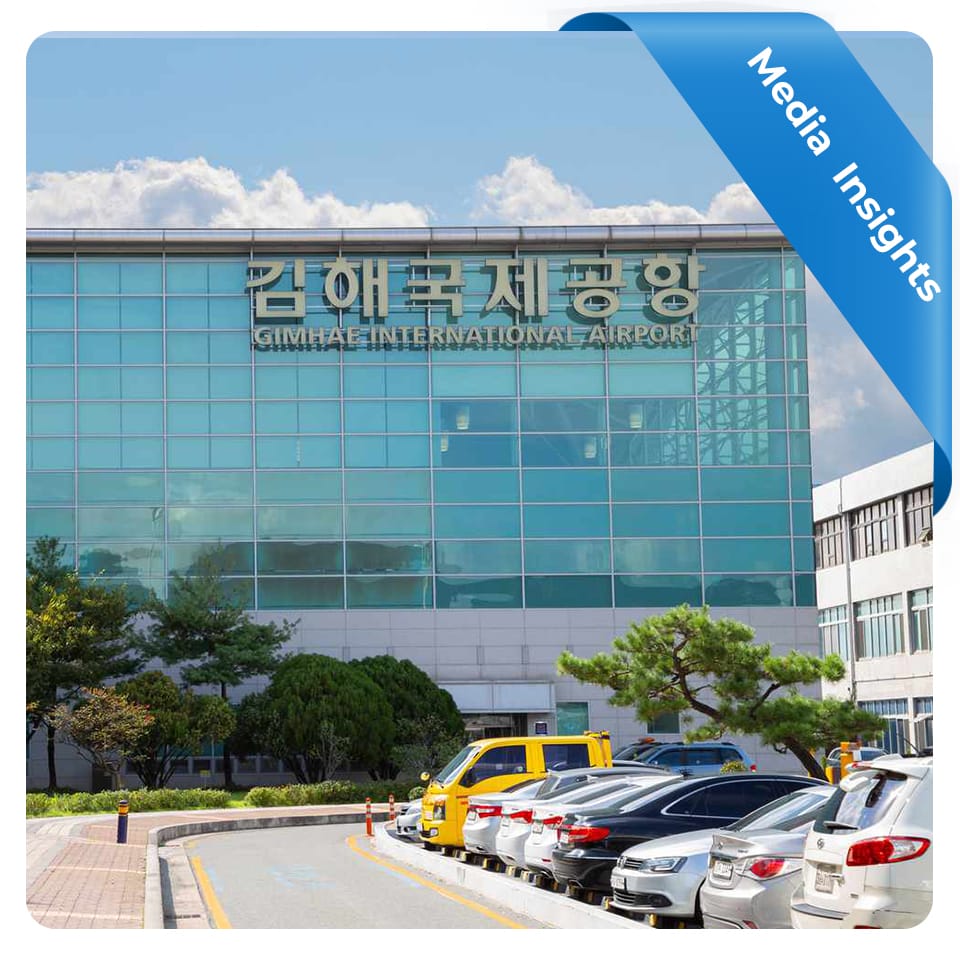
Destination Busan: Full Visitor Journey Coverage
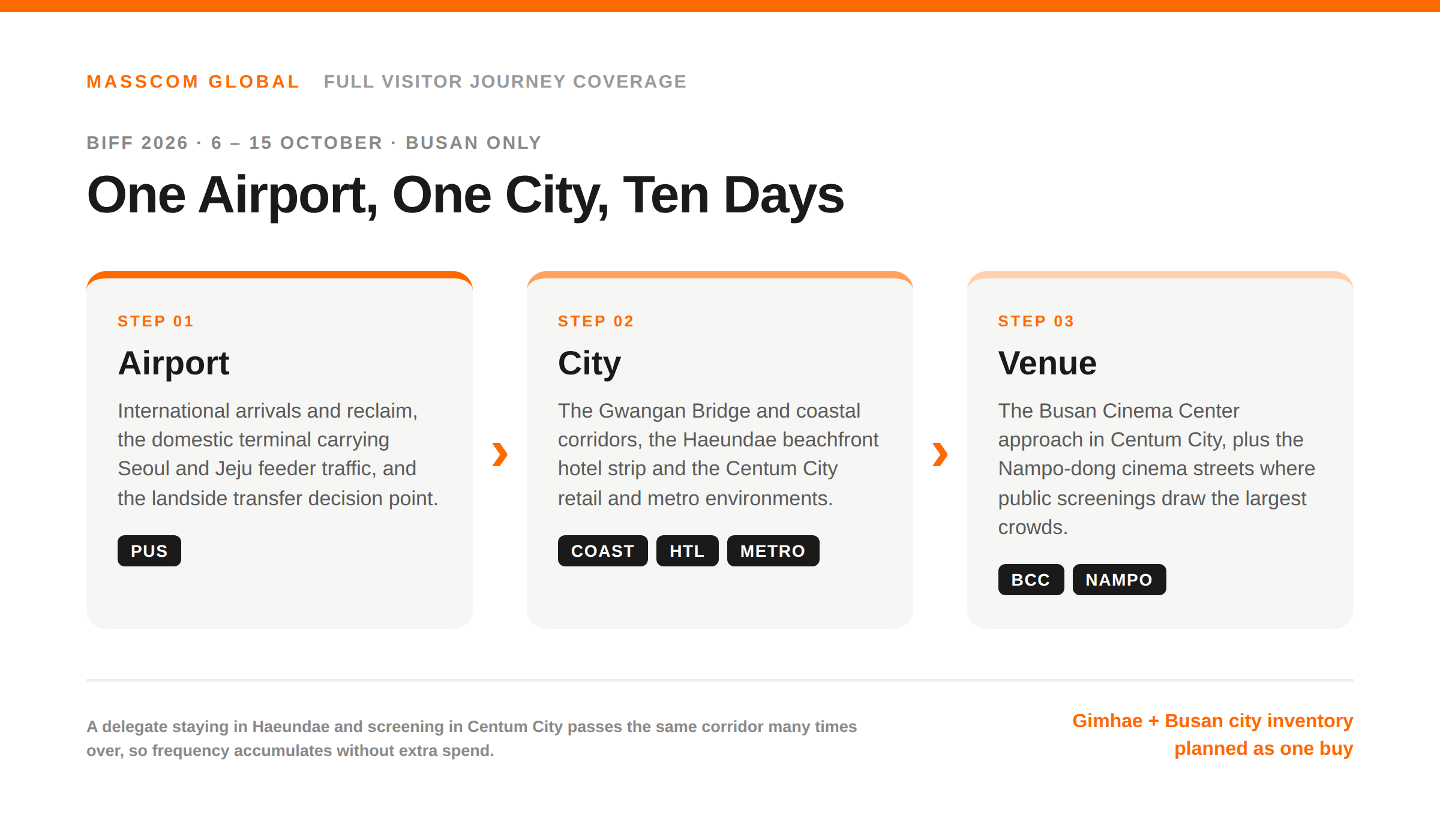
Busan's festival geography is one of the most plannable in Asia. Delegates arrive at Gimhae, transfer east along the Gwangan Bridge and coastal corridors, and settle into the Haeundae beachfront hotel strip. Screenings and industry sessions run at the Busan Cinema Center in Centum City, minutes from Haeundae by metro or road, with a secondary cluster of activity in the older Nampo-dong cinema district near the port. Delegates trace that triangle repeatedly for ten consecutive days.
An Airport → City → Venue sequence maps directly onto it. Own arrivals at Gimhae. Sustain presence through digital and large-format OOH along the Haeundae hotel and beachfront strip, the Centum City commercial and retail district, the Gwangan Bridge and coastal approach corridors, and the metro environments connecting them. Then convert in the immediate venue vicinity: the Busan Cinema Center approach, and the Nampo-dong cinema streets where public screenings draw the largest domestic crowds.
Because festival attendance repeats daily rather than peaking once, frequency accumulates naturally. A delegate staying in Haeundae and screening in Centum City passes the same corridor twenty times across the festival. Three effects follow from sequencing rather than scattering:
- Increased brand recall: repeated exposure at arrival, in the hotel district and at the venue itself, over ten days rather than a weekend
- Consistent presence: the brand becomes part of the festival's visual environment rather than an interruption to it
- Enhanced campaign effectiveness: a coordinated single-city buy delivers depth against the actual delegate population, where a dispersed national buy delivers breadth against a diluted one
Why Brands Choose Airport & City Advertising for Busan International Film Festival
Exclusive audience access. Ten days of concentrated access to Asia's entertainment-industry decision-making community, in a single city with a single airport gateway and a small number of well-defined districts.
A prestigious environment. BIFF is the most established film festival in Asia and the Busan Cinema Center is a landmark in its own right. Brands visible in that setting are judged in culturally credible company.
End-to-end campaign support. Masscom Global plans, negotiates and executes across Gimhae airport inventory and Busan city OOH and DOOH from a single brief, with one point of accountability from availability check through to proof of posting.
Strategic planning assistance. Our planners advise on terminal weighting, format mix and flighting: whether to lead on international arrivals for overseas delegates, on the domestic terminal for the Seoul industry contingent, or to balance both across the ten days.
The Masscom Global Standard Behind Every Busan International Film Festival Placement
- Verified inventory and audience data: screen counts and terminal data for Gimhae come from live operator data at proposal stage, not published estimates.
- Transparent delivery reporting: campaign monitoring and reporting across Gimhae and Busan city inventory, so you see exactly where your creative ran.
- Benchmarked recommendations: terminal weighting between international arrivals and the domestic Seoul contingent set against comparable festival campaigns across our network.
- We absorb the complexity: one point of accountability from availability check through to proof of posting across the ten-day festival.
Request Your Customised Busan International Film Festival Advertising Plan
Tell us your audience, category and budget. Our planners will return a costed plan across airport and prime city inventory, with availability confirmed.
Book NowFrequently Asked Questions
When exactly is the 2026 Busan International Film Festival?
The 31st edition runs from Tuesday 6 October to Thursday 15 October 2026, centred on the Busan Cinema Center in Centum City, with screenings and industry activity across the Haeundae and Nampo-dong districts of Busan.
Who attends BIFF?
International film buyers, distributors and sales agents, streaming and studio executives, producers and financiers, festival programmers, press and critics, talent and their representatives, sponsor and brand delegations, and a large domestic audience travelling to Busan for the public screening programme.
Can I reach delegates across their whole journey, not just at the venue?
Yes. A combined Gimhae and Busan city campaign covers arrival and departure at the airport, the Haeundae hotel and beachfront strip, the Centum City district around the Busan Cinema Center, the coastal and Gwangan Bridge transfer corridors, and the Nampo-dong cinema streets, so the same delegate meets the brand many times across ten days.
How far in advance should a festival campaign be booked?
Gimhae's premium arrivals inventory is finite and Haeundae's high-impact city sites are contested through the autumn. We recommend confirming availability several months ahead of the October window; later requests can often still be served, but with reduced format and location choice.
Which brand categories perform best in this window?
Luxury hospitality and resorts, premium consumer electronics and camera technology, airlines and private aviation, watches and jewellery, premium spirits and beauty, media technology and production services, financial services, and city and regional tourism promotion.
Related Airport Advertising Guides
Detailed inventory, audience and planning notes for the airports covered above:
Wealth in motion intelligence.Busan International Film Festival Won't Wait. Neither Should You.
- Ten days, once a year: Gimhae's premium arrivals inventory is finite and Haeundae's high-impact city sites are contested through the autumn.
- Competitors are already moving: every week without a plan is a week a hospitality, electronics or spirits brand gets closer to locking the same Haeundae and Centum City positions.
- The window is exact, not approximate: confirming availability several months ahead of the 6 to 15 October window keeps full format and location choice; later requests can often still be served, but with reduced choice.
- The alternative can't isolate the delegate: broadcast and programmatic can't separate film buyers, distributors and industry delegates from Busan's general public the way airport and city media across Haeundae and Centum City can.
Get Free Expert Assistance Now
Tell us your audience, category and budget, and our planners will return a costed Busan festival media plan across Gimhae airport and city inventory.
Request Availability
Gimhae arrivals positions and prime Haeundae and Centum City sites for the 6 – 15 October 2026 window move quickly. Ask us what is still open.
For ten days, BIFF turns Busan into the one city where Asia's film buyers, distributors, streaming executives and financiers all land, sleep and work in the same few districts, reached through a single airport gateway. A city-only campaign built around that pattern owns the audience a national buy would only intercept by chance, at every point from Gimhae arrivals through Haeundae and Centum City to Nampo-dong. The festival runs once a year; the positions that reach it need to be booked before Haeundae's contested autumn inventory clears.