

Airport at a Glance
| Field | Detail |
|---|---|
| Airport | Taipei Songshan Airport |
| IATA Code | TSA |
| Country | Taiwan |
| City | Taipei |
| Annual Passengers | 5.43 million (2024), up 7.16% year on year |
| Primary Audience | Senior corporate travellers, semiconductor and electronics executives, high-frequency North Asia commuters |
| Peak Advertising Season | January to February, April, July to August, October |
| Audience Tier | Tier 1 |
| Best Fit Categories | Private banking and wealth management, luxury watches, international real estate, premium automotive |
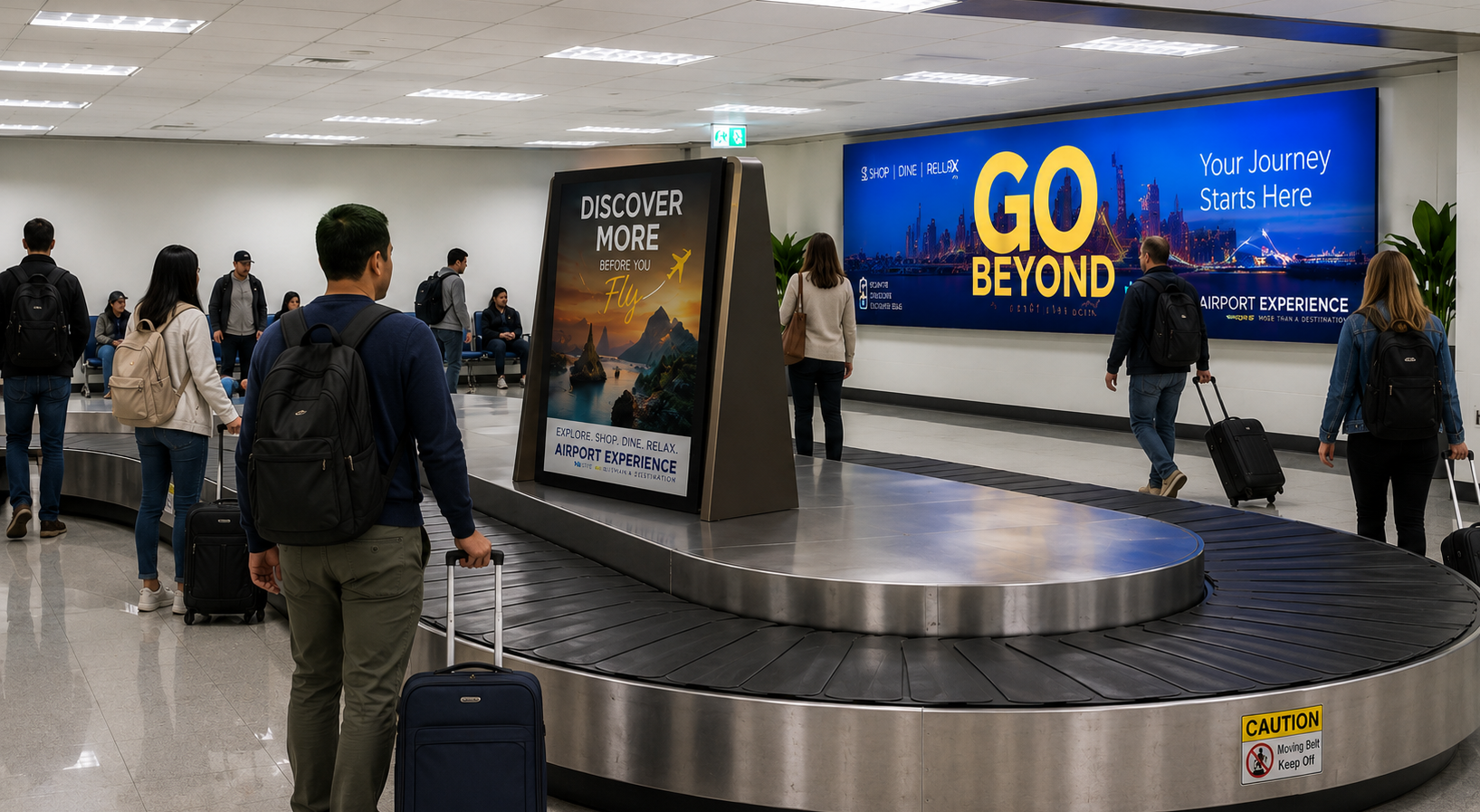
The only airport in Taiwan that puts your brand three kilometres from the boardroom.
Taipei Songshan is not a volume airport and advertisers should not evaluate it as one. It sits inside Taipei city, roughly three kilometres from the central business district, and its route map has been deliberately built around city-centre to city-centre business shuttles: Tokyo Haneda, Seoul Gimpo, Shanghai Hongqiao. That single design decision filters the passenger base. People who fly TSA are paying a premium for time, which means the terminal concentrates decision-makers at a density Taiwan's larger gateway cannot replicate.
Taipei is the command centre of the global semiconductor supply chain, and the wealth that sits in the Songshan and Nangang districts surrounding this airport is corporate, liquid and internationally deployed. Add the government and diplomatic function of the airport, the presidential air fleet, and the business aviation apron, and TSA becomes a rare environment where a brand can reach Taiwanese ultra high net worth individuals, Japanese and Korean executives, and mainland business travellers in a single terminal footprint. Masscom Global treats TSA as a precision buy rather than a reach buy.
Advertising Value Snapshot
- Passenger scale: 5.43 million passengers in 2024, growing 7.16% year on year, with monthly throughput through late 2025 and early 2026 running above 400,000 and pointing to continued recovery of the North Asia shuttle routes.
- Traveller type: Repeat corporate travellers, technology and manufacturing executives, domestic island and offshore island commuters.
- Airport classification: Tier 1. Volume is modest but audience quality, income concentration and repeat frequency place it in the top bracket for premium advertising.
- Commercial positioning: Asia's business shuttle airport, known for shortest total door-to-door journey times between the region's financial districts.
- Wealth corridor signal: TSA sits on the Taipei to Tokyo to Seoul to Shanghai technology and capital corridor, the densest concentration of electronics wealth on earth.
- Advertising opportunity: Because the terminal is compact, the same passenger passes the same media positions repeatedly across dozens of trips per year, producing frequency without additional spend. Masscom Global secures placement in the highest-yield zones of the domestic and international terminals and structures campaigns so brands own the corridor rather than share it.
Airport Advertising is Complex to Get Right
We help you execute faster, with proven results and local insight most planners lack starting now.
Talk to an ExpertCatchment Area and Economic Drivers
Top 10 Cities within 150 km, Marketer Intelligence:
- Taipei City: Highest household income and highest luxury retail spend in Taiwan. Xinyi district concentrates flagship boutiques and private banking clients who fly TSA weekly.
- New Taipei City: Taiwan's largest population base and the manufacturing owner class. Family wealth here is business-owner wealth, receptive to succession planning, insurance and offshore property messaging.
- Keelung: Port and logistics economy plus cruise terminal traffic. Produces shipping and trade executives with recurring regional travel needs.
- Taoyuan: Taiwan's industrial park capital and headquarters belt for electronics contract manufacturers. Generates a dense stream of senior operations and procurement travellers.
- Hsinchu: Home of Taiwan's science park and the highest concentration of engineering millionaires in Asia. This is the single most valuable audience segment for wealth management and luxury automotive.
- Zhubei: Fast-growing high-income satellite city of Hsinchu, dominated by dual-income technology households and premium residential upgraders.
- Yilan: Resort and wellness destination for Taipei's affluent weekenders. Signals discretionary leisure spend rather than business intent.
- Miaoli: Precision machinery and materials manufacturing base. B2B industrial audience with export market exposure.
- Taichung: Machine tools, bicycles and hand tools export cluster with a strong self-made entrepreneur class and notable appetite for private banking products.
- Hsinchu County industrial belt: Supplier ecosystem to the semiconductor majors, producing mid-to-senior management travellers who cluster on the Japan and Korea routes.
NRI and Diaspora Intelligence:
The dominant cross-border movement at TSA is not a labour diaspora but a corporate one. A large population of Taiwanese business families maintains dual residency across Shanghai, Tokyo and increasingly Southeast Asia, running operations abroad while holding assets and family in Taipei. This group travels monthly, moves capital across jurisdictions routinely, and makes financial decisions with international tax structures in mind. For advertisers, this is a rare audience that is simultaneously domestic and offshore in its purchasing behaviour.
Economic Importance:
The Taipei to Hsinchu axis is the global centre of advanced semiconductor design and fabrication, and its supply chain radiates through Taoyuan, New Taipei and Taichung. That single industrial reality generates three distinct advertising audiences: highly compensated engineers with rapid wealth accumulation, senior executives with international mobility, and business owners managing intergenerational transfer. Each responds to different messaging, and all three pass through TSA.
Business and Industrial Ecosystem
- Semiconductor design and fabrication: Produces the highest-income salaried audience in Asia, primed for private wealth, premium property and luxury goods messaging.
- Electronics contract manufacturing and ICT hardware: Produces high-frequency operations executives moving between Taipei, Tokyo and mainland plants.
- Financial services and insurance: Taipei's Xinyi financial district produces institutional and private banking travellers with regional mandates.
- Machine tools and precision engineering: Produces owner-operator entrepreneurs with strong export exposure and appetite for offshore asset diversification.
Passenger Intent, Business Segment:
The business traveller at TSA is choosing this airport specifically to compress the working day, flying out in the morning and returning the same evening. They arrive with time to spare because the airport is small, they are travelling alone, and they are in an information-receptive state. Financial services, business aviation, enterprise technology, luxury watches and premium hospitality intercept this passenger more effectively here than at any other Taiwanese airport.
Strategic Insight:
The commercial value of the TSA business audience lies in seniority and repetition. A single quarter of exposure reaches the same executive many times, which allows brands to run considered, multi-message campaigns rather than one-hit awareness. That is the environment in which high-consideration categories such as wealth management and international real estate actually convert, and Masscom Global builds TSA schedules around that repetition logic.
Tourism and Premium Travel Drivers
- Taipei 101 and the Xinyi luxury retail district: Anchors inbound premium leisure spend and validates the airport's luxury brand adjacency.
- Penghu, Kinmen and Matsu island routes: Drive heavy domestic leisure peaks in summer and around festivals, delivering family and group audiences.
- Northern Taiwan hot spring and mountain resorts in Beitou, Yilan and Jiufen: Attract Japanese and Korean repeat visitors with high per-trip spend.
- Cultural and museum circuit including the National Palace Museum: Draws older, affluent regional visitors with strong preference for premium travel and organised itineraries.
Passenger Intent, Tourism Segment:
Inbound leisure passengers at TSA are predominantly Japanese and Korean repeat visitors who chose a city-centre arrival to maximise time in Taipei. They have already committed to the trip and are actively deciding where to spend once inside the city, which makes them highly receptive to retail, hospitality, duty free, dining and financial card offers at the terminal. Domestic leisure travellers on the offshore island routes deliver volume for telecom, FMCG, insurance and consumer finance categories.
Travel Patterns and Seasonality
- Peak seasons: Lunar New Year in January or February, when domestic and cross-strait travel surges and gifting spend peaks. Early April around the Tomb Sweeping holiday. July and August summer leisure peak on the island and offshore routes. Early October around the National Day holiday period, which also aligns with Japanese and Korean travel windows.
- Business travel maintains a steady Monday morning and Friday evening rhythm across the entire year, creating a reliable weekday premium audience independent of leisure seasonality.
Event-Driven Movement:
- Lunar New Year (January or February): Largest annual travel and gifting window. Ideal for luxury, jewellery, spirits and financial product campaigns.
- Taipei International Cycle Show and industrial trade season (March): Brings global buyers and export executives. Strong window for B2B and hospitality advertisers.
- Computex Taipei (May or June): Global technology buyers and press converge on Taipei. Premium timing for enterprise technology, telecom and business hospitality brands.
- Summer offshore island season (July to August): Family and group leisure volume. Best fit for consumer, telecom and travel insurance categories.
- Mid-Autumn Festival and National Day period (September to October): Combined gifting and short-haul regional travel surge, ideal for retail and duty free activations.
It’s Not Just Where You Advertise - It’s How Fast You Execute
We combine local insight with fast rollout to deliver results for you, now.
Talk to an ExpertAudience and Cultural Intelligence
Top 2 Languages:
- Mandarin Chinese (traditional script): The primary commercial language of the catchment. Traditional characters are essential; simplified script signals a foreign brand and weakens trust with Taiwanese audiences.
- Taiwanese Hokkien: Widely spoken among the business-owner and older affluent generation, particularly in New Taipei, Taichung and Yilan. Its use signals cultural familiarity and works well for family wealth and legacy messaging.
Major Traveller Nationalities:
The passenger mix is led by Taiwanese nationals, followed by Japanese, South Korean and mainland Chinese travellers, with a smaller stream of Hong Kong and Southeast Asian business visitors. Japanese and Korean passengers are largely repeat corporate or premium leisure visitors who value precision, understatement and quality signalling in creative. Mainland business travellers on the Hongqiao route skew senior and commercially focused. Effective campaigns here run bilingual traditional Chinese and English, with Japanese layered in on the Haneda corridor.
Religion, Advertiser Intelligence:
- Folk religion, Taoism and Buddhism combined (approximately 75 to 80%): Lunar New Year, Qingming, Ghost Month and Mid-Autumn Festival drive the strongest travel and gifting cycles of the year. Ghost Month in the seventh lunar month suppresses major purchases and travel bookings, a critical scheduling consideration. Jewellery, gold, spirits, gifting retail and insurance benefit most around the festival peaks.
- Christianity (approximately 4 to 5%): Concentrated in urban professional and internationally educated segments. Christmas and Easter periods lift premium retail and outbound travel to Western markets, favouring luxury retail and international education advertisers.
- Other and non-religious (approximately 15 to 20%): A large secular urban professional cohort that responds to product substance, data and specification rather than cultural or seasonal framing. Financial products, technology and automotive perform strongly with this group.
Behavioral Insight:
This audience is analytical, comparison-driven and unusually well informed. Taiwanese affluent consumers research heavily before purchase, distrust exaggerated claims, and reward brands that lead with specification, provenance and long-term value. Wealth here is largely first or second generation and self-made, so messaging built around discretion, capital preservation and family continuity outperforms status-led messaging. Airport creative should be quiet, precise and credible rather than loud.
Outbound Wealth and Investment Intelligence
The outbound passenger at TSA is unusual because they are typically deploying capital as a matter of ongoing business rather than as a one-off decision. This is an audience with existing offshore holdings, cross-border corporate structures and active currency diversification. They are travelling to manage operations, review assets and meet advisors, which means an airport message about international property, residency or wealth structuring reaches them at a moment when those decisions are already on the agenda.
Outbound Real Estate Investment:
Taiwanese high net worth capital has been consistently active in Japanese property, particularly Tokyo and Osaka residential and hospitality assets, where the weak yen and stable yields have made entry attractive. Beyond Japan, the strongest destinations are Australia, Canada, the United States west coast, Singapore and Malaysia, with Vietnam and Thailand drawing yield-focused buyers. International developers targeting Japanese, Australian and North American inventory will find no more concentrated Taiwanese buyer pool than the TSA departure environment, and Masscom Global places developer campaigns directly against that flow.
Outbound Education Investment:
Taiwanese families send students overwhelmingly to the United States, Japan, Australia, the United Kingdom and Canada, with a rising stream into Singapore and continental Europe for postgraduate technology and business programmes. Education is treated as a multi-year, high-commitment family investment, often funded from business profits rather than salary. International universities, boarding schools, test preparation providers and education consultancies reach both the decision-making parent and the departing student at this airport.
Outbound Wealth Migration and Residency:
Second-residency demand from this catchment focuses on Japan's business manager and highly skilled professional routes, Australian and Canadian investor and skilled migration pathways, Singapore residency, and European golden visa or residency-by-investment programmes in Portugal, Greece and Spain. Caribbean citizenship-by-investment programmes attract a smaller but active mobility-focused segment. Advisory firms, immigration consultancies and residency programme operators have a clearly defined audience here.
Strategic Implication for Advertisers:
Brands on both ends of this corridor should treat TSA as a priority buy because the same passenger is the buyer in Taipei and the investor in Tokyo, Sydney or Lisbon. Reaching them once at the point of departure is more efficient than pursuing them across two separate markets. Masscom Global activates both sides of the corridor simultaneously, pairing TSA placements with the destination airports that matter to this audience.
Airport Infrastructure and Premium Indicators
Terminals:
- Terminal 1 handles international and cross-strait services to Tokyo Haneda, Seoul Gimpo, Shanghai Hongqiao and selected mainland cities. This terminal carries the highest-value passenger concentration at the airport, dominated by senior business travellers.
- Terminal 2 handles domestic services to Taiwan's east coast, southern cities and the offshore islands of Penghu, Kinmen and Matsu. Volume-heavy, family and commuter oriented, with strong seasonal spikes.
Premium Indicators:
- Airline and card-network lounge facilities serve the international terminal, signalling a premium cabin and frequent flyer concentration disproportionate to the airport's overall size.
- The airport hosts business and general aviation operations alongside Taiwan's presidential and government air fleet, placing diplomatic, state and ultra high net worth private aviation traffic on the same site.
- Multiple international-standard hotels sit within a short drive in the Songshan, Nangang and Zhongshan districts, and the airport is directly connected to Taipei Metro and the city's main arterial roads.
- The surrounding district contains Taipei's design, exhibition and creative economy cluster, giving the airport an urban premium adjacency that out-of-town airports lack.
Forward-Looking Signal:
Terminal renovation and modernisation work, self-service processing upgrades, cargo facility expansion and continuing restoration of North Asian shuttle frequencies all point toward rising passenger quality and dwell value at TSA. Alongside this, redevelopment interest in the airport district continues to lift the commercial profile of the surrounding area. Advertisers who secure positions before frequency and demand fully normalise will hold the strongest inventory at current rates, and Masscom Global advises clients to move now rather than compete for the same positions later.
Airline and Route Intelligence
Top Airlines:
China Airlines, EVA Air, Mandarin Airlines, UNI Air, Japan Airlines, All Nippon Airways, Eastar Jet and mainland Chinese carriers including China Eastern, Shanghai Airlines and Xiamen Airlines.
Key International Routes:
Tokyo Haneda, Seoul Gimpo, Shanghai Hongqiao, Fuzhou, Xiamen, Chengdu, Chongqing and Wuhan. The Haneda and Gimpo services are among the most commercially valuable short-haul pairings in Asia because both connect city centre to city centre.
Domestic Connectivity:
Kinmen, Magong in Penghu, Taitung, Hualien, Nangan in Matsu and Kaohsiung, with Kinmen and Magong carrying the heaviest domestic volumes.
Wealth Corridor Signal:
The route map separates cleanly into two commercial stories. The Haneda, Gimpo and Hongqiao services are pure wealth transfer corridors carrying executives, capital and corporate decision-making, and they justify premium and luxury category investment. The offshore island and east coast routes are leisure and commuter corridors that deliver reach and frequency for mass consumer categories. Masscom Global builds split schedules so each budget lands on the corridor it belongs to.
Media Environment at the Airport
- The terminals are compact by international standards, which means far lower advertising clutter than large hub gateways and a much higher probability that a single well-placed execution becomes the dominant visual in the passenger journey.
- Dwell time is driven by the business rhythm rather than long connection waits, but passengers arrive early precisely because processing is fast, producing attentive, unhurried, screen-and-signage-receptive dwell in a calm environment.
- The presence of government, diplomatic and private aviation traffic alongside premium cabin passengers gives the airport an institutional gravity that elevates brand association well beyond its passenger count.
- Masscom Global provides access to the highest-yield positions across both terminals, with placement precision that lets brands separate the international business corridor from the domestic leisure flow and buy only the audience they need.
Strategic Advertising Fit
Best Fit:
- Private banking and wealth management: The highest concentration of self-made, internationally exposed capital in Taiwan passes through here weekly.
- International real estate developers: Active Taiwanese buyer demand in Japan, Australia, North America and Southeast Asia, reached at the point of departure.
- Luxury watches and fine jewellery: Understated status signalling is deeply established in this audience, and gifting peaks are calendar-predictable.
- Premium and electric automotive: Engineering-literate, specification-driven affluent buyers with high new-vehicle turnover.
- Business aviation and premium travel services: The airport already hosts private and government aviation, making this the natural audience.
- Residency, citizenship and immigration advisory: Clear and continuing second-residency demand across Japan, Oceania and Europe.
- International education and universities: High family spend on overseas education with the United States, Japan and Australia dominating.
- Enterprise technology and B2B industrial brands: Direct line to semiconductor, electronics and precision manufacturing decision-makers.
Brand Alignment at a Glance:
| Category | Fit |
|---|---|
| Private banking and wealth management | Exceptional |
| International real estate | Exceptional |
| Luxury watches and jewellery | Strong |
| Premium automotive | Strong |
| International education | Strong |
| Business aviation | Strong |
| Consumer telecom and FMCG | Moderate |
| Discount retail and budget services | Poor fit |
Who Should Not Advertise Here:
- Discount retail, value fashion and price-led promotions: The audience density here is premium, and mass discount messaging wastes an expensive environment while damaging brand perception.
- Long-haul transit and connection-dependent services: TSA is not a transfer hub, so there is no meaningful connecting audience to intercept.
- Mass tourism packages and budget tour operators: Inbound leisure at this airport is repeat, independent and premium, not first-time group travel.
Event and Seasonality Analysis
- Event Strength: High
- Seasonality Strength: Medium
- Traffic Pattern: Dual-Peak
Strategic Implication:
Budget should be split between the sustained weekday business layer, which runs at consistent value all year, and the sharp festival and trade show peaks that deliver volume and purchase intent. The strongest return windows are Lunar New Year for gifting and luxury, March through June for B2B and trade audiences, and the September to October festival and regional travel period. Masscom Global structures campaigns around this rhythm so premium categories hold continuous presence while surge budget lands only on the windows that convert.
Poor Placement and Delays Affect Airport Campaigns
We help you move faster, access better inventory, and get it right now.
Talk to an ExpertFinal Strategic Verdict
Taipei Songshan is the highest audience-quality-per-passenger airport in Taiwan, and advertisers who judge it by its 5.43 million annual passengers will misprice it badly. Its route design deliberately concentrates the executives of the world's most important semiconductor and electronics economy into a compact, low-clutter terminal three kilometres from Taipei's financial district, and its private and government aviation function layers ultra high net worth and diplomatic traffic on top. Private banks, international property developers, luxury houses, premium automotive brands, residency advisors and B2B technology companies will find no more efficient interception point for Taiwanese capital anywhere on the island. Masscom Global holds the inventory access, corridor intelligence and execution speed to convert that concentration into measurable outcomes, and the brands that commit before North Asian frequencies fully normalise will hold the best positions at the best rates.
About Masscom Global
Masscom Global is a premium international airport advertising and media buying agency operating across 140 countries. With deep expertise in airport OOH, premium publications, and high-net-worth audience targeting, Masscom helps brands reach the world's most valuable travellers at the moments that matter most. For advertising packages, media rates, and campaign planning at Taipei Songshan Airport and airports across the globe, contact Masscom Global today.
Frequently Asked Questions
How much does airport advertising cost at Taipei Songshan Airport? Cost at TSA varies by format, terminal, position within the passenger journey, campaign duration and seasonal demand. International terminal positions on the Tokyo, Seoul and Shanghai corridors command a premium over domestic terminal inventory because of audience quality, and rates move sharply around Lunar New Year and the spring trade show season. Contact Masscom Global for current rates and availability across both terminals.
Who are the passengers at Taipei Songshan Airport? The core audience is senior Taiwanese business travellers flying city centre to city centre to Tokyo Haneda, Seoul Gimpo and Shanghai Hongqiao, drawn heavily from the semiconductor, electronics, precision manufacturing and financial services sectors across the Taipei to Hsinchu corridor. This is supplemented by Japanese and Korean repeat premium leisure visitors, and by a large domestic flow to Kinmen, Penghu, Matsu and Taiwan's east coast that skews family and commuter.
Is Taipei Songshan Airport good for luxury brand advertising? Yes, and it is arguably better than its passenger count suggests. The international terminal concentrates the highest-income salaried and business-owner population in Taiwan, the airport hosts private and government aviation, and the low clutter environment gives luxury creative unusual standout. Creative should lean on craftsmanship, provenance and discretion rather than overt status, which is what this audience actually responds to.
What is the best airport in Taiwan to reach HNWI audiences? For scale and international breadth, Taiwan's main gateway carries more passengers. For pure high net worth density, weekday executive concentration and proximity to Taipei's financial and technology wealth, Taipei Songshan is the sharper buy. Most premium advertisers achieve the strongest result by anchoring at TSA for audience quality and extending reach at the larger gateway.
What is the best time to advertise at Taipei Songshan Airport? The strongest windows are Lunar New Year in January or February for gifting and luxury spend, March through June for B2B and trade audiences around the industrial and technology exhibition season, July and August for domestic leisure volume, and the September to October festival and National Day period. Advertisers should avoid launching major purchase-led campaigns during Ghost Month in the seventh lunar month, when big-ticket buying slows.
Can international real estate developers advertise at Taipei Songshan Airport? Yes, and it is one of the most effective real estate advertising environments in Asia. Taiwanese high net worth buyers are actively acquiring in Japan, Australia, North America, Singapore and Southeast Asia, and TSA departure passengers are frequently travelling for exactly these business and asset purposes. Masscom Global places developer campaigns against that outbound flow and can extend the same campaign into the destination airport.
Which brands should not advertise at Taipei Songshan Airport? Discount retail, value fashion, price-led promotional campaigns, budget group tour operators and any service dependent on long-haul transit passengers. TSA is a premium, non-transfer, business-led airport, and these categories pay a premium rate for an audience that does not match their proposition.
How does Masscom Global help brands advertise at Taipei Songshan Airport? Masscom Global delivers the full chain: catchment and audience intelligence specific to the Taipei and Hsinchu wealth corridor, access to high-yield inventory across both terminals, creative and language guidance for traditional Chinese, Japanese and English audiences, fast execution, and post-campaign performance review. We also activate the destination side of the corridor so your brand meets the same passenger twice.