

Airport at a Glance
| Field | Detail |
|---|---|
| Airport | Mt. Fuji Shizuoka Airport |
| IATA Code | FSZ |
| Country | Japan |
| City | Shizuoka |
| Annual Passengers | Data not available |
| Primary Audience | Japanese corporate executives, manufacturing sector professionals, inbound Asian leisure tourists, premium domestic travelers |
| Peak Advertising Season | March to May (spring/cherry blossom), October to December (autumn), Golden Week, inbound Chinese New Year |
| Audience Tier | Tier 2 |
| Best Fit Categories | Premium automotive, luxury travel, international real estate, electronics and technology, premium food and beverage, financial services, inbound tourism brands |
Mt. Fuji Shizuoka Airport sits at the commercial and cultural intersection of two of Japan's most powerful identity assets: the world's most recognised mountain and the prefecture that quietly powers some of the most significant industrial brands in global manufacturing. Shizuoka Prefecture is the production backbone of Yamaha, a major node in Toyota's supply chain, home to Honda's research and development operations, and the source of Japan's most prized green tea. For advertisers, this means an airport whose passenger base combines the engineering and executive elite of Japan's most industrially dense regional economy with a high-spending inbound Asian tourism audience drawn specifically by Mt. Fuji's extraordinary global brand recognition.
The airport's strategic value for advertisers extends beyond its passenger volume. It is a quality-over-quantity media environment where the combination of corporate manufacturing executives, international inbound tourists with strong Japanese brand loyalty, and domestic premium travelers creates a commercially layered audience within a compact, low-clutter terminal. Brands seeking precision access to Japan's industrial corporate tier and its internationally mobile Asian leisure segment simultaneously will find Mt. Fuji Shizuoka Airport one of the most commercially efficient access points in the Japanese regional aviation market.
Advertising Value Snapshot
- Passenger scale: Data not available for current audited annual figures; airport serves a prefecture of 3.6 million people with a GDP among the highest of any Japanese prefecture outside Tokyo and Osaka
- Traveller type: Japanese manufacturing and corporate executives, Shizuoka industrial sector professionals, inbound Chinese and Korean leisure tourists targeting Mt. Fuji, domestic premium leisure travelers
- Airport classification: Tier 2 — regional airport whose catchment economic output, corporate density, and Mt. Fuji inbound tourism premium deliver a commercially elite audience profile that significantly outperforms standard Tier 2 classification expectations
- Commercial positioning: Japan's premium industrial corridor gateway and the primary aviation entry point for the world's most iconic mountain destination, serving an audience defined by manufacturing excellence, cultural prestige, and above-average disposable income
- Wealth corridor signal: Shizuoka sits within Japan's Pacific coastal industrial belt connecting Tokyo and Nagoya, routing executive talent and institutional capital from two of Asia's most powerful economic centres through a single, focused media environment
- Advertising opportunity: Masscom Global provides precision inventory access at Mt. Fuji Shizuoka Airport structured to intercept Japan's industrial executive audience and the premium Mt. Fuji inbound tourism stream at their highest-intent travel moments within a low-competition regional terminal environment
Airport Advertising is Complex to Get Right
We help you execute faster, with proven results and local insight most planners lack starting now.
Talk to an ExpertCatchment Area and Economic Drivers
Top 10 Cities within 150 km — Marketer Intelligence:
- Shizuoka City: The prefectural capital and administrative hub, home to a dense cluster of manufacturing headquarters, financial services branches, and government institutions whose professional class represents the anchor of the airport's domestic business travel base. Executives from Shizuoka-based divisions of national and international manufacturing companies travel through this airport regularly, producing a corporate audience with above-average income and strong premium brand receptivity.
- Hamamatsu (~60 km west): Japan's most industrially significant regional city outside the major metropolitan zones, and the global headquarters of Yamaha Corporation (musical instruments and motorcycles), Yamaha Motor, Suzuki Motor, and a deep cluster of precision manufacturing suppliers whose collective executive workforce represents one of the highest-concentration corporate B2B advertising audiences accessible through any Japanese regional airport. Brands targeting senior Japanese manufacturing decision-makers will find Hamamatsu-connected travelers among the most commercially valuable in the entire airport's passenger base.
- Fujinomiya (~40 km northeast): Gateway city to Mt. Fuji's southern face and the Fujinomiya climbing trail, one of the most popular ascent routes in Japan. Travelers connected to Fujinomiya carry a tourism-economy spending profile concentrated in outdoor, lifestyle, and premium hospitality categories, and inbound visitors arriving for Mt. Fuji access pass through this corridor in concentrated peaks aligned with the climbing season and cherry blossom windows.
- Numazu (~50 km northeast): A coastal city at the gateway to the Izu Peninsula, home to seafood processing industries, marina lifestyle tourism, and a growing creative economy. Its upper-middle-class professional and leisure audience uses Shizuoka Airport for domestic travel, contributing a lifestyle-oriented, premium consumer segment with strong receptivity to travel, automotive, and food and beverage advertising.
- Mishima (~60 km northeast): A historically significant city adjacent to the Hakone resort corridor, whose affluent residential base, corporate satellite offices, and proximity to premium leisure destinations produce a high-income domestic traveler with consistent premium brand engagement across automotive, hospitality, and financial services categories.
- Fuji City (~45 km northeast): Home to Japan's largest concentration of paper and pulp manufacturing, Fuji City contributes a senior industrial executive and professional workforce audience to the airport's catchment. Business travelers from Fuji City carry the professional travel pattern and premium spending profile of Japan's manufacturing corporate class, making them receptive to business travel, financial services, and premium lifestyle brand advertising.
- Kakegawa (~55 km west): A heritage city known for its castle, green tea production zones, and proximity to the Kanaya tea belt. Kakegawa's business community spans agricultural enterprise, light manufacturing, and regional commerce, contributing a commercially active SME-owner audience with strong domestic travel patterns and responsiveness to premium food, financial, and lifestyle brand messaging.
- Shimizu (~15 km east): A port city merged with Shizuoka City whose deep-water port handles significant freight and whose proximity to the airport makes it a natural business travel origin for logistics executives, import-export professionals, and marine trade operators with above-average commercial activity and B2B financial services advertising receptivity.
- Yaizu (~20 km west): Japan's largest bonito and tuna fishing port, generating a seafood processing and maritime trade business community with national supply chain connections and a domestic business travel pattern through Shizuoka Airport. Premium food, agricultural finance, and marine industry brands will find a precisely relevant and commercially active audience from this catchment segment.
- Atami (~70 km northeast): Japan's premier hot spring resort city on the Izu coast, historically synonymous with luxury ryokan stays, premium seafood dining, and high-end Japanese lifestyle tourism. Atami's affluent leisure and hospitality economy contributes a premium domestic tourism audience to the airport's catchment whose spending profile in hospitality, gifts, and luxury wellness categories makes them highly receptive to premium brand advertising at both arrival and departure.
NRI and Diaspora Intelligence: Shizuoka Prefecture's manufacturing ecosystem has historically attracted a significant Brazilian-Japanese (Nikkei) community — one of the largest concentrations in Japan — primarily in Hamamatsu and surrounding industrial cities where they work across automotive and precision manufacturing supply chains. This community maintains strong family and cultural connections to Brazil, generating a Brazil-Japan travel corridor with distinct remittance, gifting, and consumer brand spending patterns that financial services, telecommunications, and consumer goods brands can intercept effectively at Shizuoka Airport. Chinese and Korean residents in the prefecture — connected to the manufacturing sector and university institutions — also contribute an internationally mobile Asian professional audience whose home visit travel generates consistent inbound and outbound spending across consumer electronics, premium fashion, and financial product categories.
Economic Importance: Shizuoka Prefecture's economy is anchored by a manufacturing sector of extraordinary global consequence. Yamaha's headquarters in Hamamatsu generates a corporate ecosystem spanning musical instruments, motorcycles, marine engines, and industrial robotics whose combined executive workforce produces a consistently senior and financially capable business travel audience. Honda's research and development centre in Hamamatsu, Suzuki Motor's global headquarters, and a dense supply chain network serving Toyota's Tokai manufacturing belt collectively make Shizuoka one of Japan's most institutionally concentrated industrial prefectures outside Aichi. The prefecture's agricultural sector — producing 40 percent of Japan's green tea, premium wasabi, and distinctive seafood products from its Pacific coastline — adds a premium food economy that generates both agri-business travel and a powerful regional identity asset for brands seeking alignment with Japanese quality and authenticity signals. For advertisers, this economic foundation produces a catchment audience whose income distribution, corporate seniority, and brand sophistication are among the highest of any Japanese regional airport catchment outside the three metropolitan zones.
Business and Industrial Ecosystem
- Yamaha Corporation and Yamaha Motor: Global headquarters in Hamamatsu generates the region's most recognisable corporate executive audience — an internationally mobile, brand-sophisticated management tier operating across music technology, precision mechanics, and marine engineering whose travel through Shizuoka Airport represents a premium B2B advertising target for financial services, corporate travel, and premium lifestyle categories.
- Suzuki Motor Corporation: A global automotive and motorcycle manufacturer headquartered in Hamamatsu whose executive and engineering workforce contributes a professionally senior, technically elite travel segment with strong premium automotive, technology, and corporate banking advertising receptivity.
- Honda R&D operations: Research and development professionals from Honda's Shizuoka facilities represent one of Japan's most intellectually distinguished industrial workforce segments, with premium technology, precision goods, and innovation-category brand advertising resonating strongly with their professional identity and spending behaviour.
- Pharmaceutical and medical device manufacturing: Shizuoka hosts a significant pharmaceutical and medical device production cluster, generating healthcare executive and specialist travel with strong receptivity to healthcare technology, insurance, wealth management, and premium travel brand advertising aligned with the professional lifestyle of Japan's senior medical industry workforce.
Passenger Intent — Business Segment: The business traveler at Mt. Fuji Shizuoka Airport is overwhelmingly a Japanese corporate professional in manufacturing, engineering, or associated business services, traveling domestically between Shizuoka and Japan's major commercial centres for project meetings, supplier engagements, and institutional business events. This audience has above-average disposable income relative to national benchmarks, carries strong brand loyalty once trust is established, and responds most powerfully to advertising that signals quality, precision, and long-term value rather than promotional pricing or short-term offers. Inbound business travelers attending manufacturing partnership visits and supplier audits add an internationally mobile, professionally senior dimension to the airport's business audience, particularly on routes from China, South Korea, and Taiwan where manufacturing sector ties with Shizuoka companies are most active.
Strategic Insight: What makes Shizuoka's business audience commercially exceptional for advertisers is the combination of institutional seniority and brand sophistication that Japan's manufacturing elite consistently demonstrates. These are executives from companies whose global brand equity — Yamaha, Suzuki, Honda — is built on the same principles of precision, quality, and cultural authenticity that resonate most deeply with the Japanese premium consumer mindset. Brands that signal equivalent commitment to quality and craftsmanship in their airport advertising creative at Shizuoka will achieve a level of audience alignment and brand credibility with this segment that generically positioned corporate travel campaigns cannot generate in this specific cultural and professional context.
Tourism and Premium Travel Drivers
- Mt. Fuji: The world's most recognised mountain and Japan's single most powerful cultural icon is directly accessible from Shizuoka Prefecture's northern corridor, making Shizuoka Airport one of only two aviation gateways to the Mt. Fuji climbing and viewing experience. The mountain's extraordinary global brand recognition ensures a consistent year-round inbound tourism stream from China, South Korea, Taiwan, Hong Kong, and Southeast Asia whose participants have already committed to premium travel expenditure and arrive in Japan with high brand receptivity and above-average per-trip spending intent.
- Izu Peninsula Resort and Onsen Corridor: The Izu Peninsula, extending south from the airport's eastern catchment, is Japan's premier hot spring and coastal resort corridor, drawing affluent domestic tourists and high-spending inbound Asian visitors to its luxury ryokan, private onsen resorts, and premium seafood restaurants. This audience carries one of the highest hospitality spending profiles of any leisure tourist segment in Japan, making premium hospitality, wellness, and gifting brand advertising at the airport exceptionally well-targeted.
- Nihondaira and Miho no Matsubara: Two of Japan's most celebrated scenic viewpoints — Nihondaira's panoramic Mt. Fuji views and Miho no Matsubara's UNESCO-listed pine grove — draw culturally motivated domestic and international visitors whose aesthetic sensibility and premium leisure spending align strongly with Japanese craft, premium food, and luxury lifestyle brand advertising.
- Shizuoka Green Tea Tourism: Japan's most iconic tea production landscape, centered on the Makinohara plateau and the Kanaya tea belt, generates a growing premium agri-tourism and food culture travel segment whose visitors are among the most predisposed audiences in Japan to premium food, artisanal beverage, and wellness lifestyle brand engagement at the airport.
Passenger Intent — Tourism Segment: The tourist arriving at Mt. Fuji Shizuoka Airport has made a deliberate choice to engage with Japan's most symbolically and visually powerful natural and cultural landscape. This intentionality translates into an elevated emotional state at arrival — anticipatory, culturally engaged, and highly brand-receptive — that is difficult to replicate at airports serving generic leisure destinations. At departure, spending intent concentrates on Shizuoka's premium agricultural identity: first-flush green tea, handcrafted wasabi products, premium bonito flakes, and Mt. Fuji-branded artisanal souvenirs that carry the cultural prestige of a Shizuoka visit back to markets across Asia and beyond. For premium food, wellness, hospitality, and Japanese cultural brand advertisers, the departing tourist at Shizuoka Airport is among the most emotionally positive and commercially receptive audiences in the Japanese airport advertising market.
Travel Patterns and Seasonality
Peak seasons:
- March to May (Cherry Blossom and Spring Season): Japan's most powerful leisure travel peak. Cherry blossom viewing at locations across Shizuoka Prefecture — particularly Mt. Fuji's iconic cherry blossom foreground views — generates the airport's highest annual inbound tourism footfall. Domestic and international leisure spending is at its peak intensity during this window across hospitality, gifting, food, and premium retail categories.
- July to August (Mt. Fuji Climbing Season): The official Mt. Fuji climbing window generates concentrated inbound tourism from across Asia, with Chinese, Korean, Taiwanese, and Southeast Asian visitors arriving specifically for the climbing experience. This audience has committed significant pre-trip expenditure and carries active on-trip spending intent across outdoor equipment, premium food, and Mt. Fuji-branded goods categories.
- October to November (Autumn Foliage Season): Japan's second major leisure tourism peak, driven by autumn foliage viewing across Shizuoka's highland and Izu Peninsula landscapes. Domestic premium travelers and inbound Asian tourists converge on this window, generating strong hospitality, food, and premium lifestyle brand advertising opportunities.
- Golden Week (Late April to Early May): Japan's most concentrated domestic travel window, with the highest annual domestic passenger volumes at regional airports across the country. Shizuoka's combination of Mt. Fuji access, Izu resort proximity, and premium agricultural tourism makes it a highly sought domestic leisure destination during this peak.
- Chinese New Year Window (January to February): A major inbound tourism peak driven by Chinese and Taiwanese holiday travelers whose per-trip spending in Japan is consistently among the highest of any inbound national group, making this a premium window for luxury retail, hospitality, and Japanese brand advertising at the airport.
Event-Driven Movement:
- Mt. Fuji Climbing Season Opening (Early July): The official opening of Mt. Fuji's climbing trails marks the beginning of the airport's highest-volume inbound Asian tourism window. Brands aligned with outdoor adventure, Japanese cultural experience, premium food, and mountain destination hospitality achieve maximum audience concentration and spending intent conversion during this period.
- Cherry Blossom Peak (Late March to Mid-April): Japan's most nationally and internationally celebrated seasonal phenomenon generates the year's most emotionally elevated leisure travel window. Airport advertising during this period intercepts an audience in peak positive emotional state with high brand receptivity and active spending across hospitality, gifting, photography, and premium consumer categories.
- Shizuoka Tea Festival (May): An annual celebration of the prefecture's tea culture drawing domestic and international visitors with strong food culture, artisanal product, and premium beverage brand alignment. This window is optimal for premium food, wellness, and Japanese craft brand campaigns targeting culturally engaged, above-average-income domestic and inbound tourists.
- Golden Week National Travel Peak (Late April to Early May): Japan's highest-volume domestic travel window concentrates the country's premium leisure travel spending into a compact period where airport advertising achieves maximum footfall and consumer spending intent simultaneously.
- Autumn Illumination and Foliage Events (October to November): Premium resort and tourist facilities across Shizuoka's Izu Peninsula and highland zones host illumination and foliage viewing events whose audiences represent Japan's most premium domestic leisure travel segment, generating above-average hospitality and retail spending windows at the airport.
It’s Not Just Where You Advertise - It’s How Fast You Execute
We combine local insight with fast rollout to deliver results for you, now.
Talk to an ExpertAudience and Cultural Intelligence
Top 2 Languages:
- Japanese: The universal language of the airport's domestic audience — manufacturing executives, government officials, leisure travelers, and premium tourists from across Japan — and the essential creative language for any brand seeking authentic engagement with the Japanese consumer psyche. Japanese-language advertising at Shizuoka must reflect the prefecture's dual identity as an industrial powerhouse and a culturally refined natural destination; generic pan-Japan creative that fails to acknowledge Shizuoka's specific identity will consistently underperform against campaigns that demonstrate genuine prefectural knowledge and cultural fluency.
- Chinese (Simplified and Traditional): The primary language of the airport's largest inbound international tourism segment, covering mainland Chinese, Taiwanese, and Hong Kong visitors for whom Mt. Fuji is the single most powerful symbol of Japan travel and whose per-trip spending in Japanese premium categories is among the highest of any inbound nationality in the country. Chinese-language creative at Shizuoka that references Mt. Fuji's cultural resonance explicitly will achieve exceptional engagement and conversion with this high-spending audience in both the pre-departure and arrival advertising contexts.
Major Traveller Nationalities: Japanese nationals dominate the passenger base at Mt. Fuji Shizuoka Airport across all seasons and all travel categories, from manufacturing executives and business travelers to domestic leisure and cultural tourists. Chinese nationals — both mainland Chinese and Taiwanese — form the most commercially significant inbound international segment, drawn primarily by Mt. Fuji and the premium Japanese cultural experience, with above-average per-trip spending in luxury goods, premium food, and hospitality categories. South Korean tourists represent the second significant inbound international group, traveling for Japanese cultural immersion, premium hospitality, and Mt. Fuji access. Southeast Asian visitors from Thailand, Singapore, Malaysia, and Vietnam contribute a growing premium tourism audience whose Japanese travel is motivated by cultural prestige, premium food discovery, and aspirational lifestyle experiences aligned with Japan's global brand identity.
Religion — Advertiser Intelligence:
- Shinto and Buddhism (Japanese domestic majority): Japan's syncretic religious practice shapes the seasonal rhythm of the domestic travel calendar with precision that informed media planners can leverage to maximum commercial effect. New Year's (Oshogatsu) generates Japan's highest-volume domestic travel event as families visit Shinto shrines and Buddhist temples, with significant gifting, food, and premium hospitality spending concentrated into the first week of January. Obon (mid-August) produces a second major domestic travel peak as families return to ancestral hometowns, generating strong hospitality and premium food advertising windows. The cherry blossom and autumn foliage seasons carry deep Shinto-influenced aesthetic and spiritual significance for the Japanese traveler that elevates brand receptivity for campaigns aligned with natural beauty, seasonal transience, and cultural authenticity.
- No dominant religion among inbound Asian tourists: The inbound Chinese, Korean, and Southeast Asian tourist audience at Shizuoka does not follow a single religious calendar, but their spending behaviour during Japanese cultural seasons — particularly cherry blossom, Mt. Fuji climbing season, and New Year — is consistently elevated by Japan's own seasonal prestige, making cultural calendar alignment more commercially relevant than religious calendar alignment for campaigns targeting this segment specifically.
Behavioral Insight: The Japanese corporate traveler at Mt. Fuji Shizuoka Airport brings the behavioral profile that defines Japan's premium consumer market globally: meticulous quality evaluation, strong brand loyalty once trust is established, deep skepticism of promotional framing, and exceptional responsiveness to craftsmanship, precision, and authenticity signals in advertising creative. This is an audience that interprets advertising quality as a direct proxy for brand quality, making the format, finish, and cultural intelligence of an airport campaign as commercially significant as the message itself. Inbound Asian tourists, particularly Chinese visitors, bring a contrasting behavioral profile of aspirational Japanese brand acquisition, gift purchasing as social obligation, and strong alignment between Japan's premium cultural identity and elevated personal spending behavior — an audience that arrives at the airport already primed for premium brand engagement and already committed to spending at Japanese quality standards.
Outbound Wealth and Investment Intelligence
The outbound passenger at Mt. Fuji Shizuoka Airport represents a segment of Japan's corporate and upper-middle-class wealth that is commercially underestimated by media plans anchored to Tokyo and Osaka. Shizuoka's manufacturing executive community — drawing compensation from some of Japan's most globally successful industrial corporations — carries above-average investable income and a growing appetite for international asset diversification, international education investment, and premium lifestyle asset acquisition that reflects Japan's broader affluent class trend toward global financial engagement. The prefecture's high GDP per capita and concentration of institutional corporate employment produce an outbound wealth profile whose depth is not reflected in Shizuoka Airport's regional classification.
Outbound Real Estate Investment: Japanese HNWI buyers from Shizuoka's industrial and professional community demonstrate growing interest in Hawaii and Southeast Asian real estate markets as lifestyle and investment assets, with Bali, Thailand, and Hawaii's Big Island emerging as primary acquisition targets for premium holiday property among Japan's upper-middle-class industrial professionals. Australian residential property, particularly in Melbourne and Sydney, attracts Japanese education-linked property buyers whose children are entering English-medium international university environments. Southeast Asian condominium markets in Bangkok, Kuala Lumpur, and Da Nang have gained traction among younger Shizuoka executives as rental yield and lifestyle diversification investments accessible at Japanese-familiar quality standards.
Outbound Education Investment: Shizuoka's industrially wealthy and academically ambitious professional families are active investors in international English-medium education, with the United States, United Kingdom, Australia, and Canada the primary target markets for both university study and secondary boarding school placement. The prefecture's manufacturing corporate culture places exceptional value on English language proficiency and international work experience, making education abroad investment a commercially rational priority for Shizuoka's corporate management class whose children represent the next generation of Japan's global industrial leadership. International universities, language school networks, and education consultancies advertising at Mt. Fuji Shizuoka Airport reach a financially qualified, academically motivated Japanese family audience whose education investment decisions are both active and long-term in commitment.
Outbound Wealth Migration and Residency: Interest in international residency and long-stay programmes among Shizuoka's affluent professional class tracks Japan's growing national trend toward global lifestyle diversification, particularly in Southeast Asia's retirement and long-stay visa markets. Malaysia's MM2H programme, Thailand's Elite Visa, and Portuguese residency pathways attract Japanese upper-middle-class professionals seeking lifestyle assets, global mobility, and international investment diversification. Wealth management and international financial advisory firms will find a receptive and financially qualified audience at Shizuoka Airport among the corporate executive segment whose compensation levels and investment sophistication make them viable clients for premium international wealth migration services.
Strategic Implication for Advertisers: International brands targeting Japanese premium capital outflows and the inbound Asian tourism spending corridor into Shizuoka have a dual-access opportunity at Mt. Fuji Shizuoka Airport that the airport's regional classification alone would cause most media planners to miss. The outbound Japanese corporate executive audience carries institutional compensation-level wealth and growing international investment appetite. The inbound Chinese and Asian tourist audience carries the highest per-trip Japan spending profile of any inbound nationality group in the country. Masscom Global structures campaigns at Shizuoka that activate both directions of this commercial corridor simultaneously, capturing outbound Japanese investment intent and inbound Asian premium consumer spending within a single, coordinated, and cost-efficient airport media investment.
Airport Infrastructure and Premium Indicators
Terminals:
- Mt. Fuji Shizuoka Airport operates a modern, single-terminal facility developed under Japan's national airports infrastructure programme, with domestic and international processing capacity calibrated to the prefecture's corporate and leisure travel profile, including dedicated premium check-in processing and pre-departure lounge facilities serving the corporate and premium leisure traveler tiers.
- The terminal's Mt. Fuji branding and visual identity — integrating Japan's most globally recognised natural icon into the airport's architectural and communication design — creates a premium arrival and departure experience whose emotional resonance for inbound Asian tourists is extraordinary, translating directly into elevated brand receptivity for advertising placements within this aspirationally charged environment.
Premium Indicators:
- Dedicated business and premium class lounge facilities concentrate the corporate executive audience in an extended-dwell, premium-context environment that delivers above-average advertising recall depth for campaigns positioned within or adjacent to lounge access zones.
- The airport's dual identity as both an industrial prefecture gateway and a Mt. Fuji tourism portal creates a rare premium environment signal that simultaneously validates quality brand associations for corporate B2B advertisers and aspirational brand associations for premium consumer and lifestyle advertisers.
- Ground transportation connectivity to premium destinations — direct bus services to Shizuoka City, Hamamatsu, and the Izu Peninsula resort corridor — reinforces the airport's positioning as a premium access point for both the corporate travel market and the high-spending leisure tourism segment.
- Japan's consistently high airport operational and passenger experience standards ensure a premium, well-maintained physical environment where brand advertising placements benefit from the quality association of the surrounding airport infrastructure.
Forward-Looking Signal: Japan's national tourism recovery strategy and the ongoing international marketing of Mt. Fuji as a UNESCO World Heritage site anchor are accelerating inbound international visitor growth through Shizuoka's aviation corridors. New international route development targeting expanded Chinese, Korean, and Southeast Asian leisure connectivity is under active planning, and Shizuoka Prefecture's Vision-equivalent economic development programme continues to invest in the airport's capacity, passenger experience quality, and commercial infrastructure. Masscom Global is advising clients to establish advertising presence at Mt. Fuji Shizuoka Airport now, during the current growth phase, when inventory pricing reflects the airport's present scale and brand share of voice can be secured at its most competitive rates ahead of the international route expansion and inbound tourism volume growth that the Mt. Fuji corridor's global brand power is steadily delivering.
Airline and Route Intelligence
Top Airlines:
- All Nippon Airways (ANA): Primary domestic carrier serving the core Japanese corporate and premium leisure audience on high-frequency domestic routes
- Japan Airlines (JAL): Secondary domestic carrier with Shizuoka connections serving the premium domestic traveler and corporate business segment
- Fuji Dream Airlines (FDA): Regional carrier operating key domestic routes from Shizuoka with strong local market knowledge and route precision for the prefecture's specific business travel demand
- China Eastern Airlines: Primary international carrier serving the Shanghai and Chinese leisure tourism corridor
- Asiana Airlines and Korean Air: Korean international connectivity serving the Shizuoka-Seoul corridor for both leisure and Korean-Japanese manufacturing business relationships
- Tigerair Taiwan: Taiwan connectivity serving Taiwanese leisure and cultural tourism to the Mt. Fuji corridor
Key International Routes:
- Shizuoka to Shanghai (China): Primary international route serving the largest inbound tourism and bilateral business connectivity corridor
- Shizuoka to Seoul (South Korea): Key leisure and business route serving South Korea's strong Japan travel market and bilateral manufacturing sector connections
- Shizuoka to Taipei (Taiwan): Taiwan corridor serving Taiwanese leisure tourism with the Mt. Fuji destination as a primary travel motivator
- Seasonal charter and additional Asian routes operate during peak cherry blossom and climbing season windows
Domestic Connectivity:
- Shizuoka to Sapporo: Northern Japan connectivity popular with domestic leisure travelers and corporate travelers with Hokkaido business connections
- Shizuoka to Fukuoka: Western Japan connectivity serving the Kyushu business and leisure corridor
- Shizuoka to Naha (Okinawa): Southern Japan resort connectivity generating strong domestic premium leisure travel peaks aligned with Japan's holiday calendar
- Shizuoka to Komatsu and Izumo: Regional domestic connectivity serving specific corporate and leisure demand segments within the Japanese domestic network
Wealth Corridor Signal: The route network at Mt. Fuji Shizuoka Airport reveals a commercially precise story about its audience composition. The Shanghai and Seoul international corridors confirm that Shizuoka's inbound audience is drawn from two of Asia's most active and highest-spending Japanese tourism markets, with Chinese visitors carrying Japan's highest per-trip international tourism spending profile and Korean visitors maintaining one of Japan's most consistent and culturally engaged inbound travel relationships. The domestic network — particularly Sapporo and Naha — maps the premium leisure preferences of Shizuoka's corporate executive and affluent family base, confirming an audience whose domestic travel choices reflect the premium resorts and cultural destinations that align with above-average disposable income and sophisticated leisure spending behaviour.
Media Environment at the Airport
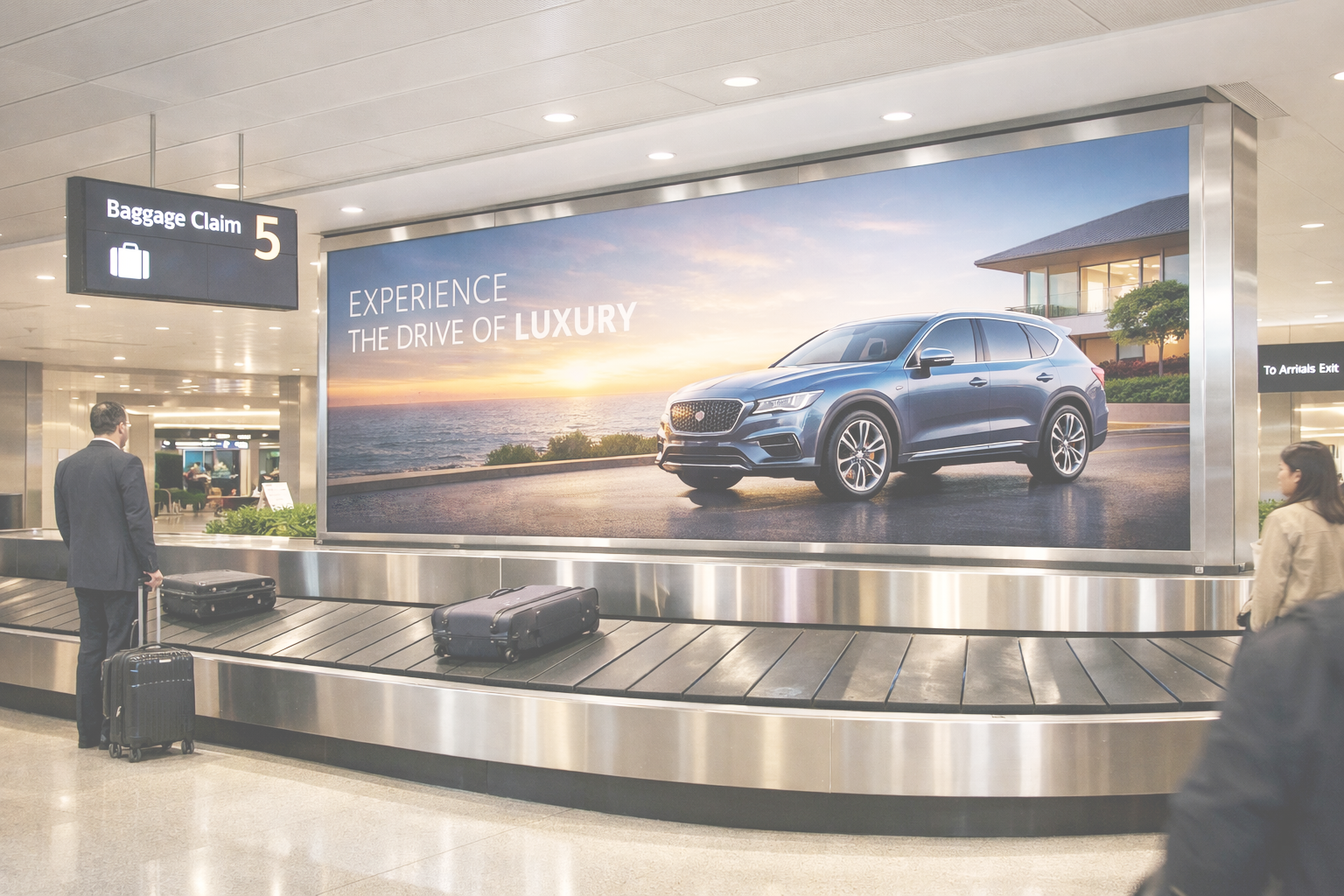
- Mt. Fuji Shizuoka Airport operates as a single-terminal environment with structurally lower advertising clutter than Japan's major hub airports at Haneda, Narita, or Kansai. A premium campaign here achieves a disproportionate share of the passenger's visual attention and extended brand exposure relative to equivalent investment in the major hub markets, making standout and recall structurally superior at a fraction of the media cost.
- Japan's cultural emphasis on quality environment and aesthetic precision means that the physical standard of advertising placements — finish quality, format selection, creative execution — is evaluated by the Japanese traveler as a direct indicator of brand quality. Airports in Japan are among the most quality-conscious brand advertising environments in the world, and a well-executed campaign at Shizuoka will achieve brand credibility transfer that generic placements in lower-quality environments cannot produce.
- The Mt. Fuji branding context of the terminal creates an elevated emotional environment for inbound Asian tourists whose engagement with Japan's most aspirationally charged cultural symbol is at its peak at the moment of airport arrival, making advertising placements in the arrival corridor particularly high-impact for brands targeting this audience's peak emotional engagement window.
- Masscom Global holds precise inventory knowledge and execution capability at Mt. Fuji Shizuoka Airport, delivering campaign placements in the terminal's highest-traffic zones with timing precision, format selection, and creative placement strategy structured to maximise commercial return for every client category within this uniquely dual-register corporate and cultural tourism advertising environment.
Strategic Advertising Fit
Best Fit:
- Premium and luxury automotive brands: Japan's manufacturing executive class is among the world's most sophisticated premium vehicle buyers, with Shizuoka's industrial corporate community combining above-average income with a professional identity deeply aligned with engineering precision and automotive performance. Premium automotive advertising at Shizuoka reaches an audience for whom vehicle quality is both a personal passion and a professional signal.
- International real estate and lifestyle investment: Japanese corporate professionals with above-average investable income and growing international lifestyle diversification appetite, reachable at precise travel moments when international investment awareness is heightened by the cross-border professional context of their business travel.
- Premium Japanese food, beverage, and artisanal brands: Shizuoka's identity as the source of Japan's finest green tea, premium wasabi, and Pacific seafood products creates a uniquely authentic platform for premium Japanese food brands whose association with the prefecture's agricultural excellence amplifies quality signals for both domestic and inbound international audiences simultaneously.
- International universities and education consultancies: Japanese corporate families with active international education investment and the English-language preparatory school and university market for inbound Chinese and Korean student travelers whose Japan-connected educational pathways include Shizuoka-corridor academic institutions.
- Premium travel and destination hospitality: Both domestic premium leisure travelers and high-spending inbound Asian tourists are in active hospitality spending mode at this airport, making destination resort, luxury ryokan, and premium travel service advertising highly relevant to both audience segments simultaneously.
- Financial services and wealth management: Shizuoka's industrial corporate executive audience carries above-average investable income and growing international portfolio diversification intent that rewards premium financial services advertising with strong audience alignment and above-average conversion probability relative to equivalent investment at more competitive hub-airport environments.
- Consumer electronics and precision technology: An audience of engineering professionals and technology-literate corporate executives with high brand awareness and strong purchase intent for premium electronics, precision instruments, and technology products that align with their professional identity and lifestyle.
- Premium inbound tourism and Japanese cultural experience brands: Chinese, Korean, and Taiwanese visitors arriving with Mt. Fuji as their primary destination motivation are highly receptive to premium Japanese experience, gifting, and cultural brand advertising that connects their aspirational Japan visit with premium product discovery at the airport's arrival points.
Brand Alignment at a Glance:
| Category | Fit |
|---|---|
| Premium automotive | Exceptional |
| Premium Japanese food and beverage | Exceptional |
| International real estate and lifestyle investment | Strong |
| International education | Strong |
| Premium travel and hospitality | Strong |
| Financial services and wealth management | Strong |
| Consumer electronics and technology | Strong |
| Inbound tourism and Japanese cultural brands | Strong |
| Mass-market FMCG (unpositioned) | Moderate |
| Budget travel and value retail | Poor fit |
Who Should Not Advertise Here:
- Budget and value-positioned brands: Japan's corporate manufacturing executive and premium tourism audiences evaluate brand quality through advertising quality itself. Price-led, discount-oriented, or value-positioned brand messaging is culturally counterproductive in this environment and will generate brand association damage rather than commercial return at an airport whose audience defines itself by quality rather than price.
- Mass entertainment and fast-fashion brands without premium positioning: Brands whose identity depends on youth mass culture, fast fashion cycles, or entertainment spectacle will find the Shizuoka corporate and cultural tourism audience poorly matched to their messaging, with low engagement and poor return on premium airport media investment.
- Brands without Japanese cultural fluency in their creative: Perhaps uniquely among the airports covered in this blog series, Mt. Fuji Shizuoka Airport penalises culturally uninformed advertising more severely than most markets. Japanese audiences will disengage from creative that demonstrates ignorance of Japanese aesthetic standards, seasonal significance, or cultural context, making cultural intelligence in campaign execution not merely desirable but commercially essential at this airport.
Event and Seasonality Analysis
- Event Strength: High
- Seasonality Strength: High
- Traffic Pattern: Multi-Peak (Cherry blossom spring peak, Mt. Fuji climbing summer peak, autumn foliage peak, Golden Week domestic peak, Chinese New Year inbound peak)
Strategic Implication: Advertisers at Mt. Fuji Shizuoka Airport benefit from one of the most commercially productive multi-peak seasonal structures in the Japanese regional airport market. Brands targeting the inbound Asian tourism audience should commit to cherry blossom season, Mt. Fuji climbing season, and Chinese New Year windows as their three primary investment periods, when inbound footfall and spending intent are simultaneously at their highest. Brands targeting the Japanese corporate and domestic premium audience should weight investment toward Golden Week, the autumn season, and the year-round business travel calendar. Masscom Global structures campaign calendars for Shizuoka clients that allocate budget across all commercially productive peaks while avoiding the shoulder-season inefficiencies that generically timed campaigns consistently incur in Japan's strongly seasonal airport traffic environment.

Poor Placement and Delays Affect Airport Campaigns
We help you move faster, access better inventory, and get it right now.
Talk to an ExpertFinal Strategic Verdict
Mt. Fuji Shizuoka Airport is Japan's most commercially underestimated regional advertising environment and one of Asia's most compelling dual-audience airport media opportunities. It is the only airport in Japan that simultaneously serves the executive elite of the world's most consequential industrial manufacturing cluster — Yamaha, Suzuki, Honda — and functions as a primary aviation gateway to the planet's single most globally recognised mountain, generating a passenger profile that layers Japanese corporate wealth with the highest-spending inbound Asian tourism segment in the country within a low-clutter, single-terminal environment whose advertising standout potential is structurally superior to any equivalent investment at Japan's saturated major hub airports. The manufacturing executive audience here is systematically overlooked by national media plans anchored to Tokyo and Osaka, yet it represents a concentration of premium automotive buyers, international real estate investors, and financial services prospects whose disposable income and brand sophistication are fully comparable to those hub-airport audiences at a fraction of the competitive advertising cost. Masscom Global is the partner who understands this airport's dual commercial identity, holds the inventory access, and delivers campaigns with the cultural precision, seasonal timing accuracy, and execution speed that Japan's most exacting advertising environment demands.
About Masscom Global
Masscom Global is a premium international airport advertising and media buying agency operating across 140 countries. With deep expertise in airport OOH, premium publications, and high-net-worth audience targeting, Masscom helps brands reach the world's most valuable travellers at the moments that matter most. For advertising packages, media rates, and campaign planning at Mt. Fuji Shizuoka Airport and airports across the globe, contact Masscom Global today.
Frequently Asked Questions
How much does airport advertising cost at Mt. Fuji Shizuoka Airport? Advertising costs at Mt. Fuji Shizuoka Airport vary based on format type, placement zone, campaign duration, and seasonal demand intensity. Cherry blossom season, Golden Week, and Mt. Fuji climbing season windows attract premium pricing due to peak inbound and domestic tourism footfall. Shoulder-season placements offer competitive entry rates for brands building continuous corporate business travel audience presence. Masscom Global structures packages across digital and static formats for all campaign objectives and budget levels. Contact Masscom for current rates, format availability, and placement recommendations specific to your brand and target audience at Shizuoka.
Who are the passengers at Mt. Fuji Shizuoka Airport? Mt. Fuji Shizuoka Airport's passenger base spans two primary commercial profiles. The domestic core is a Japanese corporate manufacturing executive audience drawn from the global headquarters of Yamaha, Suzuki Motor, Honda R&D, and their extensive supply chain networks, combined with government administrators and premium domestic leisure travelers. The international segment is anchored by Chinese, Taiwanese, and South Korean leisure tourists whose primary motivation is Mt. Fuji and Japan's premium cultural and natural experience, with per-trip spending profiles among the highest of any inbound nationality group in Japan. The combined profile reflects an airport whose commercial value is built on audience quality, corporate seniority, and inbound tourism spending power rather than raw passenger volume.
Is Mt. Fuji Shizuoka Airport good for luxury brand advertising? Mt. Fuji Shizuoka Airport delivers a strong luxury brand advertising environment for Japanese regional airport standards. The combination of Shizuoka's industrial corporate executive audience — drawn from Japan's most globally recognised manufacturing brands — with a high-spending inbound Chinese and Asian tourism audience whose aspirational relationship with Japanese premium quality is among the strongest in global consumer research creates an advertising context where luxury brands achieve both quality association and purchase intent conversion simultaneously. For premium automotive, high-end Japanese artisanal brands, luxury hospitality, and international real estate developers, Shizuoka Airport offers access to a financially qualified audience in a low-clutter environment at significantly more competitive media rates than equivalent premium audiences at Haneda or Narita.
What is the best airport in Japan to reach manufacturing sector audiences? Mt. Fuji Shizuoka Airport is the single most precisely positioned airport in Japan for brands targeting the manufacturing corporate executive tier outside the three major metropolitan zones. The Hamamatsu-Shizuoka corridor concentrates the global headquarters of Yamaha, Suzuki Motor, Honda R&D, and a dense supply chain network serving Toyota's Tokai manufacturing belt in a catchment area served exclusively by this airport. No other Japanese regional airport offers comparable access density to this specific corporate sector within a focused, low-competition terminal environment. Masscom Global manages Shizuoka campaigns alongside its broader Japanese airport network to deliver precision reach across both the manufacturing corridor and Japan's primary aviation hubs for clients requiring full national corporate coverage.
What is the best time to advertise at Mt. Fuji Shizuoka Airport? The three primary advertising windows at Shizuoka are cherry blossom season from late March to mid-April, which delivers the year's highest inbound Asian tourism concentration; Golden Week from late April to early May, which produces the year's highest domestic premium leisure footfall; and the Mt. Fuji climbing season from July to August, which generates a consistent inbound Asian tourism peak with strong brand spending intent. The autumn foliage window from October to November is a secondary but commercially productive domestic leisure peak. For corporate business travel campaigns, the year-round corporate travel base provides a stable audience foundation that Masscom Global supplements with seasonal peak amplification to maximise full-year return on investment.
Can international real estate developers advertise at Mt. Fuji Shizuoka Airport? Mt. Fuji Shizuoka Airport is a commercially viable channel for international real estate developers targeting Japanese outbound investment capital, particularly for Southeast Asian lifestyle property, Hawaii residential, and Australian education-linked property markets where Shizuoka's industrial professional community has demonstrated growing purchase interest. For inbound-focused real estate developers — particularly those marketing Japanese property to Chinese, Taiwanese, and Korean buyers — the airport's strong inbound Asian tourism corridor makes it a viable advertising channel for Japan property investment brands reaching Asia-Pacific buyers at their moment of highest Japanese market engagement. Masscom Global structures real estate campaigns at Shizuoka with format and timing aligned to the peak inbound tourism windows when investment intent is most active.
Which brands should not advertise at Mt. Fuji Shizuoka Airport? Budget and value-positioned consumer brands are fundamentally misaligned with the Japanese corporate executive and premium Asian tourism audience at Shizuoka and will generate brand association damage rather than commercial return in an environment where audience quality evaluation of advertising is among the most discerning in Asia. Brands without Japanese cultural fluency in their creative execution will find the domestic Japanese audience unreceptive to messaging that fails to acknowledge Japanese aesthetic standards. Mass entertainment and nightlife brands without premium positioning will find both the corporate domestic and culturally motivated inbound tourism audiences poorly matched to their messaging.
How does Masscom Global help brands advertise at Mt. Fuji Shizuoka Airport? Masscom Global delivers end-to-end airport advertising services at Mt. Fuji Shizuoka Airport covering audience intelligence, inventory access, format selection, creative placement strategy, campaign execution, and performance measurement. With established relationships across Japan's airport advertising ecosystem, deep knowledge of Shizuoka's manufacturing executive audience, inbound Asian tourism seasonal patterns, and terminal media environment, and the regional expertise to structure campaigns that deliver measurable return on investment for every client category, Masscom brings brands the cultural intelligence, placement precision, and execution speed that Japan's uniquely demanding airport advertising market requires.