

Airport at a Glance
| Field | Detail |
|---|---|
| Airport | Osaka Itami Airport (Osaka International Airport) |
| IATA Code | ITM |
| Country | Japan |
| City | Osaka |
| Annual Passengers | 7.1 million (2023) |
| Primary Audience | Japanese domestic corporate executives, Kansai business professionals, high-income domestic travellers |
| Peak Advertising Season | April to May (Golden Week), July to August (summer), December to January (year-end and New Year) |
| Audience Tier | Tier 1 |
| Best Fit Categories | Premium B2B, corporate financial services, luxury goods, premium automotive |
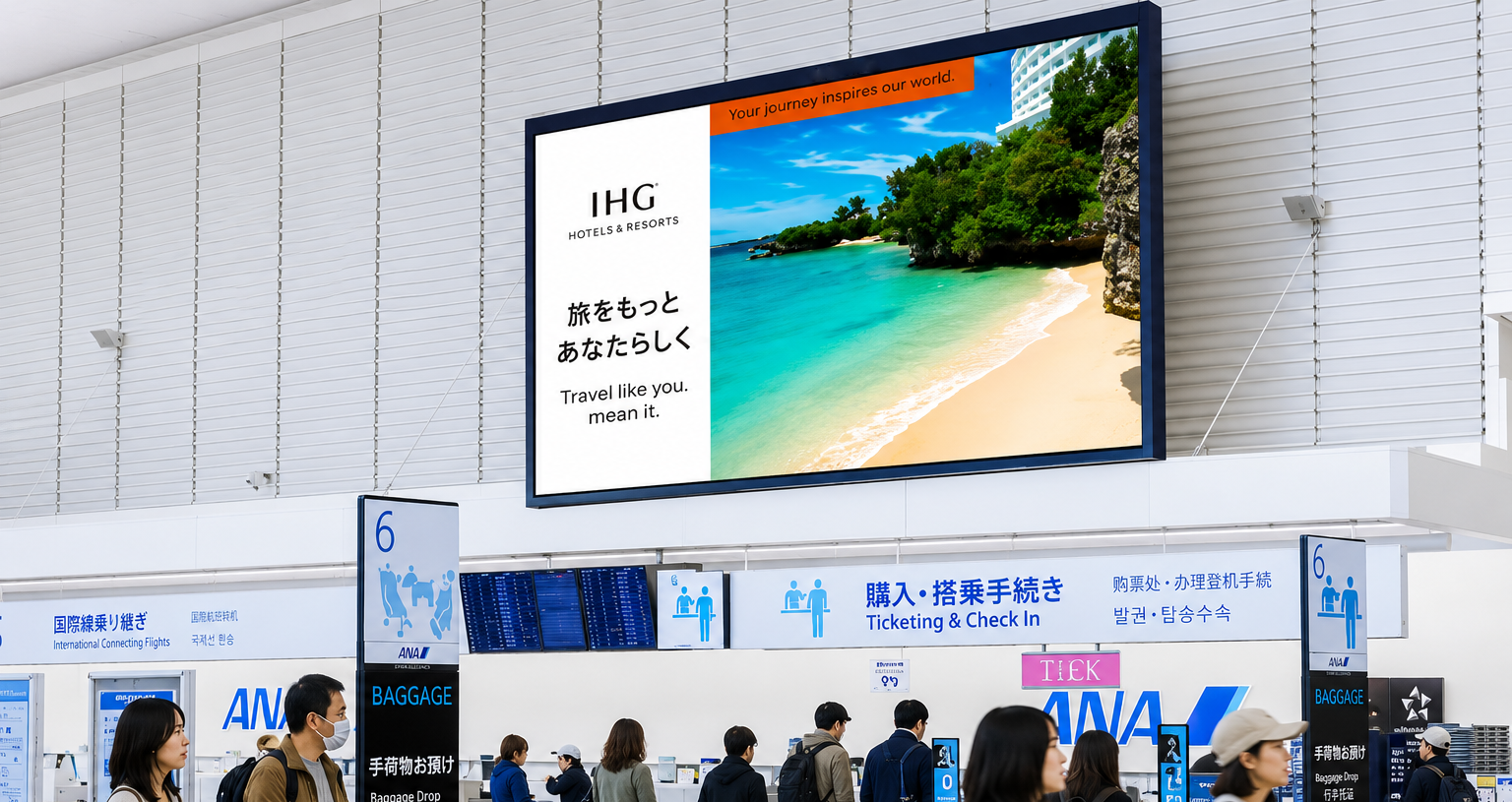
Osaka Itami Airport occupies a commercial position that is entirely misunderstood by advertisers who evaluate it as simply a domestic Japanese airport. With 7.1 million passengers annually and a HNWI Score of High, ITM is the primary airport for the Kansai region's corporate elite — the executives of Panasonic, Daikin, Suntory, Takeda Pharmaceutical, Nintendo, Kyocera, and hundreds of other global companies whose headquarters sit within 50 kilometres of the terminal. Unlike Kansai International Airport, which serves international tourists, ITM serves almost exclusively Japanese business and premium domestic travellers on routes that connect the nation's two most commercially powerful cities. The audience at this airport is not diverse, aspirational, or mixed. It is concentrated, affluent, and commercially active in a way that few domestic airport audiences anywhere in the world can match.
The Tokyo-Osaka route served through ITM is one of the world's highest-frequency and most commercially productive domestic air corridors. The executives flying this route are the decision-making senior management of Japan's largest manufacturing, pharmaceutical, financial, and technology companies, traveling between the two cities that together generate more than half of Japan's entire GDP. They fly multiple times per week, they carry significant purchasing authority, and they arrive at the terminal in precisely the active commercial mindset that makes B2B and premium consumer advertising most effective. For brands targeting corporate Japan at its highest concentration, ITM is the single most efficient media environment in western Japan.
Advertising Value Snapshot
- Passenger scale: 7.1 million passengers (2023), predominantly domestic business travellers on Japan's most commercially productive route network, with a recovery trajectory aligned to the full restoration of Japan's corporate travel economy post-COVID
- Traveller type: Japanese domestic corporate executives, Kansai manufacturing and technology professionals, high-income domestic leisure travellers
- Airport classification: Tier 1 within Japan's domestic network — the business-class preferred airport for Osaka's corporate community, chosen over Kansai International for its 15-minute proximity to central Osaka
- Commercial positioning: Japan's premier domestic corporate aviation hub, serving the Keihanshin metropolitan region whose economy of approximately 900 billion USD makes it the second-largest metropolitan economy in Japan and among the top ten globally
- Wealth corridor signal: ITM sits at the western anchor of Japan's domestic wealth corridor, connecting Osaka's manufacturing and trading capital to Tokyo's financial and government complex through a route that carries more concentrated corporate purchasing authority than any other domestic aviation link in Asia
- Advertising opportunity: Masscom Global provides inventory access and campaign execution capability at Osaka Itami Airport, enabling brands to reach Japan's most commercially concentrated domestic HNWI and corporate audience within a compact, high-dwell-time terminal environment where repeat brand exposure is structurally guaranteed by the high travel frequency of the business passenger base.
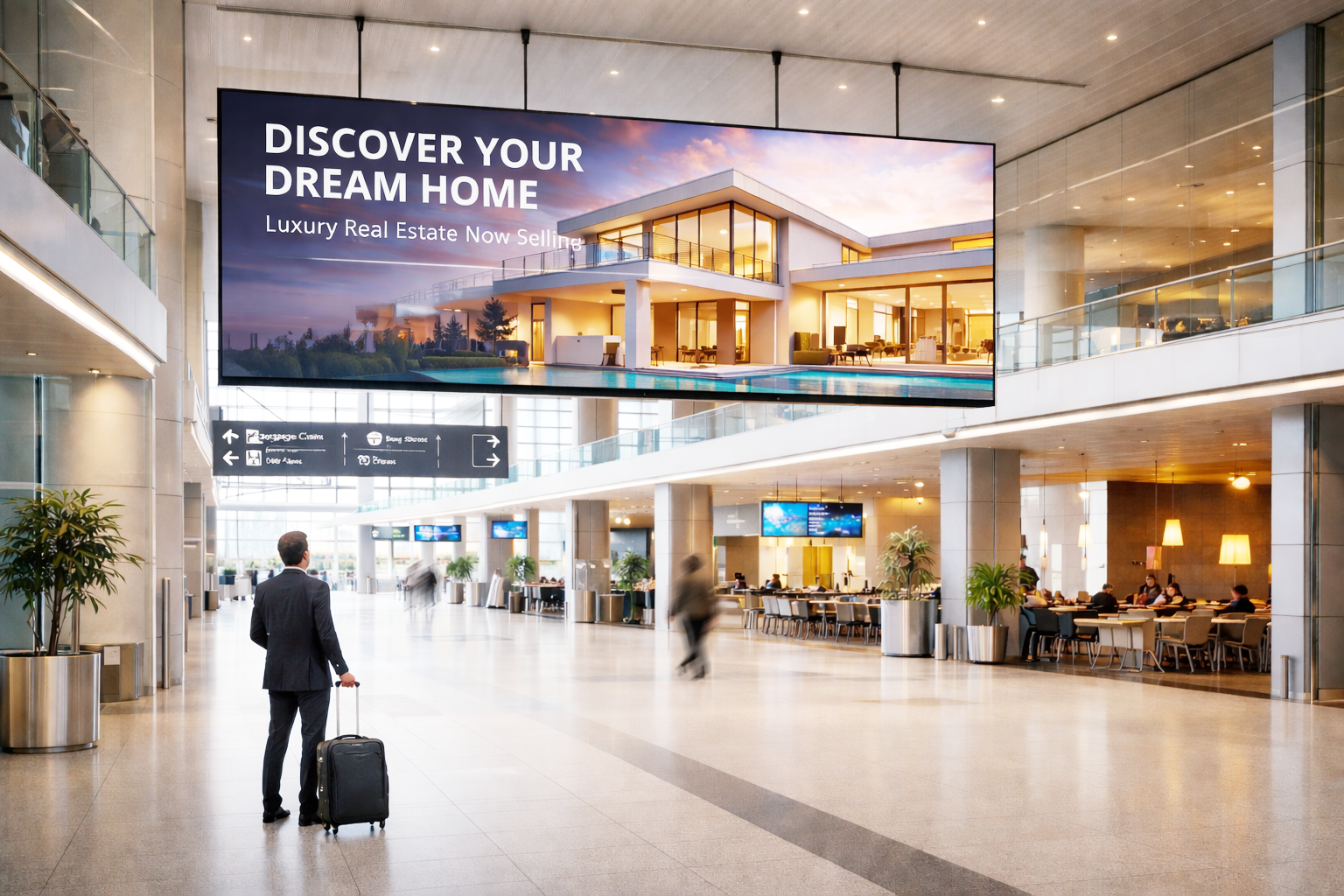
Airport Advertising is Complex to Get Right
We help you execute faster, with proven results and local insight most planners lack starting now.
Talk to an ExpertCatchment Area and Economic Drivers
Top 10 Cities within 150 km — Marketer Intelligence
- Osaka: Japan's commercial capital and the nation's wholesale trading heart, whose merchant tradition of "Osaka shonin" has created one of the world's highest concentrations of small and medium business owners with strong liquidity and aggressive commercial instinct; Osaka's corporate headquarters belt houses global brands including Panasonic, Daikin, Suntory, and Sumitomo Group subsidiaries, producing a B2B decision-making professional audience with both the purchasing authority and the premium personal consumption standards that make the city ITM's dominant commercial driver.
- Kobe: Japan's most cosmopolitan port city and the regional anchor for luxury goods consumption, fashion, and premium food culture; Kobe's professional class carries a distinct Western-brand fluency built on 150 years of international port trade, making it one of the most naturally receptive markets in Japan for premium international brand advertising; luxury automotive, fashion, and private banking find a commercially sophisticated audience here whose aspirations are globally calibrated rather than domestically bounded.
- Kyoto: Japan's cultural capital and home to Nintendo, Kyocera, Omron, and Murata Manufacturing among dozens of technology and precision instrument companies; Kyoto's corporate base uniquely combines deep traditional craft values with cutting-edge innovation identity, creating a B2B audience that responds to heritage positioning and engineering excellence in equal measure; the city's luxury tourism infrastructure, driven by its UNESCO heritage concentration, also generates premium hospitality and retail commercial activity.
- Nara: Japan's first imperial capital and a major inbound heritage tourism gateway, with a premium accommodation and traditional crafts sector growing rapidly in response to the post-Expo surge in Kansai tourism; Nara's emerging boutique hospitality and regional sake sectors are generating a new cohort of affluent entrepreneur-operators whose commercial decisions create growing demand for premium business services, insurance, and B2B supply chain brands.
- Nishinomiya: One of Japan's most consistently affluent residential cities, home to the Nada district producing Japan's finest sake, Koshien Stadium, and the premium residential corridors of the Hanshin commuter belt; Nishinomiya's executive commuter population represents one of the highest per-capita household income concentrations in western Japan, making it a premium consumer catchment for luxury goods, financial planning services, and premium FMCG with extremely high brand loyalty and above-average purchase frequency.
- Amagasaki: A rapidly transforming industrial city directly adjacent to Osaka's western boundary, transitioning from heavy industry to a commercial and technology hub with major corporate facilities relocating from central Osaka; the growing professional class brought in by this transformation carries above-average salaries and aspirational consumption behaviour, creating a fast-rising catchment for premium consumer and B2B brands whose presence in the region is expanding in proportion to Amagasaki's commercial upgrade.
- Himeji: Home of UNESCO World Heritage Himeji Castle and a significant steel, chemicals, and precision manufacturing economy; the corporate professional workforce of companies like Kaneka Corporation and Nippon Steel regional subsidiaries represents a stable, high-income B2B and premium consumer audience; Himeji's growing premium tourism infrastructure is generating new hospitality investment and luxury retail demand as the city positions itself as a high-end cultural destination within the Kansai corridor.
- Sakai: Japan's historic manufacturing and precision craftsmanship city, renowned globally for premium kitchen knives, traditional tools, and industrial production; Sakai's artisan-commercial identity creates a consumer audience that evaluates brands entirely on craft quality and heritage rather than marketing volume, making it one of Japan's most naturally receptive markets for premium product advertising; the city's export-oriented manufacturing class has strong international B2B relationships across Asia, Europe, and North America.
- Wakayama: A regional commercial capital with a significant chemical industry base, a premium Kii Peninsula tourism corridor, and the Kumano Kodo pilgrimage route driving high-income eco and heritage tourism; Wakayama's business and hospitality class is increasingly connected to premium wellness, outdoor lifestyle, and luxury travel brand categories; the city's premium agricultural products including Kishu ume and mandarin oranges represent a globally recognised heritage food category with strong B2C brand potential.
- Otsu: The capital of Shiga Prefecture and gateway to Lake Biwa, Japan's largest lake, anchoring a growing corporate campus and business park cluster that is establishing Otsu as the eastern extension of Kyoto's technology corridor; corporate relocations from Osaka and Kyoto attracted by Otsu's quality of life and cost efficiency are creating a growing professional class with above-average incomes, strong technology sector credentials, and premium brand orientation calibrated to Kansai's broader executive consumer standard.
Japanese Corporate HNWI Intelligence
Osaka Itami Airport does not serve a diaspora or NRI audience in the conventional sense. Instead, ITM's commercial significance is defined by the concentration of Japan's domestic corporate HNWI class passing through a single terminal in high-frequency repeat patterns. The Kansai region's business elite, including executives of Japan's largest manufacturers, pharmaceutical companies, and technology groups, use ITM as their primary domestic gateway because of its 15-minute proximity to central Osaka, a decisive advantage over the 75-minute transfer to Kansai International. This proximity advantage means ITM captures the highest-frequency, most commercially active business travellers in western Japan before Kansai International captures the international outbound audience. For advertisers, the repeat exposure opportunity at ITM is structurally guaranteed: the Osaka executive flying the Tokyo-Osaka route four or more times per month encounters brand advertising dozens of times per year within the same compact terminal, creating a brand recall environment that no one-time campaign placement can replicate.
Economic Importance
The Keihanshin metropolitan region anchored by Osaka, Kobe, and Kyoto generates an economy of approximately 900 billion USD, making it the second-largest metropolitan economy in Japan and among the ten largest in the world by output. This economy is driven by precision manufacturing, pharmaceuticals, electronics, chemicals, heavy industry, and a wholesale trading sector that distributes goods across Japan and Asia. The corporate headquarters density within 50 kilometres of ITM is among the highest of any city outside Tokyo, creating a concentration of B2B decision-makers whose procurement authority and personal income levels define the commercial character of the airport's passenger base. Japan's post-COVID corporate travel recovery, combined with the commercial momentum generated by the 2025 Osaka World Expo, has reinforced ITM's position as the most commercially productive domestic airport in western Japan by audience quality per passenger.
Business and Industrial Ecosystem
- Precision manufacturing and electronics: Panasonic, Daikin, Sharp, and Kubota anchor Osaka's manufacturing economy, along with dozens of precision parts suppliers whose executives travel the Tokyo-Osaka corridor regularly for corporate management, procurement, and client meetings; the engineering and technical management class of this sector is Japan's most commercially productive B2B advertiser audience
- Pharmaceuticals and life sciences: Osaka is Japan's pharmaceutical capital, home to Takeda Pharmaceutical, Shionogi, Otsuka, and dozens of generics and biotech companies; the pharma executive audience at ITM represents a high-income, globally connected, B2B-sophisticated professional class whose procurement and investment decisions span billions of yen annually
- Financial services and trading houses: Osaka historically anchored Japan's commodity futures and financial trading industry and remains a major banking and insurance centre; the Sumitomo Group, Daiwa Securities, and major regional banks are headquartered here, creating a financial services professional audience whose advisory, insurance, and investment product receptiveness is among the highest of any Japanese city
- Technology and innovation: Kyoto's corridor of technology companies including Nintendo, Kyocera, Omron, and Murata Manufacturing produces a scientifically rigorous, precision-oriented professional class whose consumer and B2B purchasing decisions are driven by performance evidence and engineering heritage; this audience responds to brand messaging that demonstrates genuine technical capability rather than lifestyle association
- Wholesale and distribution: Osaka's Dotonbori and Semba wholesale districts are among Japan's most active commercial trading areas, with import merchants and distribution executives whose procurement activity connects Kansai's retail market to global supply chains; this class travels to Tokyo, Nagoya, and beyond through ITM with active purchasing decisions in progress at the point of airport advertising exposure
Passenger Intent — Business Segment
The business traveller at ITM is not merely Japan's most frequent domestic flyer. They are Japan's most commercially powerful audience compressed into a departure terminal they visit multiple times per month. The executive flying the Osaka-Tokyo route is the procurement director of a global manufacturer, the investment banker of Osaka's financial district, the pharmaceutical company managing director traveling between research facilities and regulatory meetings, or the technology founder connecting Kyoto's innovation campus with Tokyo's investor community. Their decision-making authority spans billions of yen in annual commercial value, and they arrive at the terminal in the specific active commercial mindset — thinking about deals in progress, meetings ahead, decisions pending — that gives B2B and premium consumer brand advertising its deepest and most durable impression.
Strategic Insight
ITM's business audience is commercially valuable in a way that is unique within Japan's domestic aviation network. The Tokyo-Osaka corridor is functionally the boardroom corridor of the Japanese economy, and the executives who fly it regularly form a commercially cohesive audience with identical professional contexts, similar income profiles, and shared brand familiarity signals. A brand that establishes consistent presence at ITM becomes part of the visual vocabulary of Japan's Kansai executive class, who encounters it before every significant business trip in a state of heightened commercial attention. Masscom's intelligence on the Kansai corporate audience and the seasonal and event-driven patterns of their travel is structured to ensure that brand placement at ITM works at the frequency and precision that this audience rewards.
Tourism and Premium Travel Drivers
- Kyoto's UNESCO Heritage Circuit: Japan's most internationally recognised cultural destination, drawing domestic and international visitors to its 1,600 Buddhist temples, Shinto shrines, and traditional tea ceremony, geisha, and craft culture; the premium domestic tourist using ITM to reach Kyoto is a high-income, culturally engaged traveller whose airport spending on specialty food, premium sake, and traditional craft products represents one of the highest per-departure retail values in Japan's domestic network
- Universal Studios Japan and Osaka's Entertainment Economy: Japan's largest and most commercially productive theme park destination anchors Osaka's domestic tourism market, drawing families and young adults from across Japan through ITM; the entertainment and experience economy built around USJ has elevated the premium hospitality and F&B spend of Osaka's domestic visitor market significantly
- Kobe's Luxury Lifestyle and Gastronomy Tourism: Kobe's cosmopolitan identity, world-famous beef, premium sake, and high-end fashion district attract a domestic tourist audience with above-average incomes and luxury consumption habits; the Kobe visitor arriving through ITM is a premium lifestyle consumer whose airport retail behaviour reflects the highest-end domestic leisure spending bracket
- Nara and the Kansai Ancient Capital Circuit: The ancient capital circuit connecting Nara, Asuka, and Yoshino to Kyoto's heritage tourism is driving growing premium accommodation and cultural experience investment in the region; domestic tourists completing this circuit are highly educated, culturally sophisticated, and oriented toward traditional Japanese luxury goods, ceramics, lacquerware, and premium food products whose brand presence at ITM creates strong pre-departure purchase intent
Passenger Intent — Tourism Segment
The premium domestic tourist departing through ITM has already committed to a Kansai leisure experience at the higher end of Japan's domestic hospitality market. Their airport behaviour reflects the conclusion of a culturally and experientially rich visit, with strong omiyage (souvenir) gift-purchasing intent, premium food and drink purchases for family back home, and receptiveness to luxury lifestyle and travel brand advertising that speaks to their next premium domestic or international holiday. Japan's omiyage culture is commercially significant at ITM: the departure gift-buying ritual is deeply embedded in Japanese social behaviour, and the premium food and craft brands that position themselves within the airport's retail and advertising environment intercept this intent at its most active and deliberate point in the travel journey.
Travel Patterns and Seasonality
Peak seasons:
- Golden Week (late April to early May): Japan's most concentrated national holiday period generates the year's highest single departure surge; families and business travellers combining holidays with domestic leisure trips create peak traffic volumes; consumer spending on premium food, gifts, and travel accessories reaches its highest non-year-end peak during this window
- Obon (mid-August): Japan's traditional ancestral homecoming period drives the year's largest domestic travel surge as Japanese families return to their home regions; the inbound Kansai passenger arriving through ITM during Obon is often a high-income professional returning from Tokyo or other commercial centres, carrying premium omiyage purchasing intent and strong family-oriented consumer spending motivation
- Year-end and Shogatsu New Year (December to January): The most commercially intense combined period in the Japanese retail and travel calendar; year-end bonus spending, New Year gift-giving (oseibo and otoshidama cultures), and the prestige associated with first-of-year purchases create the highest per-passenger luxury goods, fine food, and premium brand spending of the annual cycle; ITM's passenger volume during this window is among the most commercially productive of any domestic Japanese airport period
- Cherry Blossom Season (late March to early April): Kansai's concentration of premium hanami venues drives significant domestic tourism inflow through ITM, with a culturally engaged, premium-spending audience arriving for Japan's most celebrated seasonal experience
Event-Driven Movement
- Golden Week (late April to early May): Japan's annual commercial intensity peak; business travel transitions to premium domestic leisure as Japan's corporate class accesses a rare extended holiday window; premium food, luxury goods, and travel brand advertising achieves maximum reach and premium audience receptiveness simultaneously during this period
- Osaka World Expo Legacy Events (ongoing post-October 2025): The 2025 Osaka World Expo on Yumeshima Island drove an accelerated cycle of international business engagement, infrastructure investment, and commercial confidence in the Kansai region that continues to attract corporate delegations, investment roadshows, and international business summits through ITM as the region's preferred domestic arrival point
- Obon Season (mid-August): Japan's highest domestic travel volume window; ITM processes returning Kansai families from across Japan alongside outbound Osaka professionals visiting home regions; the dual high-volume movement creates a mixed premium and aspiration audience with concentrated gift and premium food purchasing intent at both departure and arrival
- Oshogatsu New Year Period (January 1 to 7): Japan's most commercially reverential period, when first-purchase tradition and premium gift-giving culture create the highest per-passenger luxury goods expenditure of the year; brands positioned at ITM during Oshogatsu intercept an audience in a state of maximum prestige purchasing motivation
- Corporate Annual Planning Season (October to November): Japan's fiscal year planning cycle creates a surge in Tokyo-Osaka business travel as Kansai corporations consolidate annual strategies, approve budgets, and brief Tokyo headquarters on commercial plans; the B2B decision-maker density at ITM during this window is the highest of any non-holiday period in the calendar year

It’s Not Just Where You Advertise - It’s How Fast You Execute
We combine local insight with fast rollout to deliver results for you, now.
Talk to an ExpertAudience and Cultural Intelligence
Top 2 Languages
- Japanese: The sole language of commercial, social, and institutional life for virtually the entire ITM passenger base; Japanese-language advertising at this airport is not merely preferred but culturally expected, and campaigns that use authentic Kansai dialect registers (Kansai-ben) achieve a warmth, familiarity, and community-belonging signal that Standard Japanese alone cannot generate; for B2B brands, formal keigo (honorific Japanese) in advertising creates the respect-signalling that corporate Japanese audiences interpret as the baseline of serious brand credibility
- English: Functional for the subset of internationally oriented executives, multinational corporate professionals, and bilingual Japanese business travellers whose commercial life involves regular international engagement; English-language elements within Japanese-primary campaigns can signal international brand credibility and global scale, which the Kansai business class treats as a quality signal for B2B products in particular; pure English-language campaigns without Japanese adaptation will underperform significantly in this environment
Major Traveller Nationalities
Osaka Itami Airport's passenger base is effectively 100% Japanese nationals, making it one of the most commercially homogeneous audiences of any major airport in the world. The absence of significant international or expatriate passenger volume is not a limitation for advertisers but a commercial precision advantage: every creative decision, every language choice, and every cultural reference can be calibrated entirely to the Japanese premium consumer and corporate professional without compromise. Origin cities within Japan include Tokyo (dominant on the Haneda route), Sapporo, Fukuoka, Okinawa, and the Tohoku and Chubu regions, whose corporate and leisure travellers arrive in Osaka with regionally specific commercial behaviours that sophisticated Kansai advertisers understand and target accordingly.
Religion — Advertiser Intelligence
- Shinto and Buddhism (approximately 80 to 90% cultural practice): Japan's deeply syncretic religious tradition creates commercially significant seasonal patterns rather than doctrinally driven purchasing behaviour; Oshogatsu (New Year) is Japan's most commercially intense event, generating the largest single retail and premium gift-buying period of the year, with luxury goods, premium sake, food gifts, and fine stationery representing the core purchase categories; Obon (August) drives Japan's largest domestic travel surge and creates strong omiyage purchasing at both departure and arrival; the extensive Shinto matsuri (festival) calendar through spring and summer creates ongoing seasonal consumer spending moments across premium food, traditional craft, and lifestyle categories; for advertisers, the Japanese religious calendar is a seasonal commercial rhythm rather than a faith-driven purchasing trigger, and timing campaigns to these moments is structurally identical to timing around the Islamic Eid or Christian Christmas in other markets
- Christianity (approximately 1 to 2%): Japan's small Christian community skews disproportionately toward the internationally educated professional and academic class; Christmas has been fully adopted as a secular commercial event in Japan and generates strong premium gift, dining, and luxury goods spending across the entire population regardless of faith; Western-brand associations with Christmas aesthetics resonate strongly with Japanese premium consumers in the November to December commercial window
Behavioral Insight
The Kansai business professional is one of the world's most demanding, most brand-loyal, and most quality-conscious consumer audiences. The "Osaka shonin" merchant tradition prizes commercial directness, product authenticity, and long-term relationship value above aspirational lifestyle signalling. Unlike Tokyo's corporate culture, which responds to institutional prestige and hierarchical brand positioning, Osaka's business class evaluates brands primarily on demonstrated product excellence and commercial reliability — a distinction that has profound implications for advertising creative strategy. Premium pricing in this market is interpreted as a quality indicator rather than a barrier, meaning that brands which lead with quality heritage and craft credentials consistently outperform those leading with price accessibility. Japan's broader culture of "monozukuri" (the art of making things well) has created a consumer base at ITM that is constitutionally inclined to reward brands that take the same pride in their product that Japanese manufacturers take in theirs. Advertising that respects this standard earns exceptional loyalty returns.
Outbound Wealth and Investment Intelligence
The departing HNWI passenger at Osaka Itami Airport is a Japanese corporate executive or business owner whose outbound investment behaviour reflects the combination of Japan's domestic economic maturity, historically low domestic interest rates, and the sophisticated international asset diversification strategy that Japan's wealthiest families have pursued for decades. While ITM serves exclusively domestic routes, the outbound international investment intentions and decisions of Kansai's HNWI class are formed and finalised in exactly the commercial mindset that the airport advertising environment intercepts: between meetings, in a state of strategic planning, and with the international connectivity that their Tokyo connection will shortly provide.
Outbound Real Estate Investment
Hawaii is the single most important international real estate market for Kansai's HNWI class, with decades of Japanese property ownership on Oahu and Maui creating a deeply familiar investment corridor that combines lifestyle appeal with USD-denominated asset stability. Australia, particularly the Gold Coast, Sydney, and Melbourne, represents the primary alternative real estate market for Osaka's affluent families, offering golf course properties, premium residential real estate, and lifestyle investment at price points accessible to Japan's upper-middle HNWI tier. Singapore has grown significantly as a wealth management and property investment hub for Japanese HNWIs seeking a Southeast Asian financial centre with political stability, English-language commercial infrastructure, and high-yield rental markets. Thailand, particularly Bangkok and Phuket, is the fastest-growing second-home destination for Japan's younger HNWI generation, driven by dramatic price appreciation, direct flight accessibility, and a growing community of Japanese expatriates. International real estate brands advertising at ITM intercept Kansai HNWI investors at the precise moment they are planning their next international trip and considering their next asset acquisition.
Outbound Education Investment
The United States remains Japan's dominant international education destination, with elite universities in California, New York, and New England receiving the largest volume of Kansai students from high-income families. The United Kingdom represents the primary European alternative, particularly for business, law, and postgraduate study among Osaka's corporate professional families. Australia has become Japan's most popular English-language education destination for high school and university foundation year programmes, driven by proximity, safety reputation, and the quality of Australian university credentials in Japanese employer markets. Singapore's international school system attracts Japanese families pursuing trilingual education for children of internationally mobile professionals. International schools, university admissions consultancies, and study-abroad facilitators advertising at ITM reach the precise family audience that makes these investment decisions — the Kansai corporate professional whose high income and international business exposure motivates significant education investment.
Outbound Wealth Migration and Residency
Japan's HNWI class is not a traditional second-citizenship or Golden Visa market in the way that MENA or South Asian HNWIs pursue these programmes, given the strength of Japanese passport mobility and the deep cultural identification with Japan. However, the growing category of Japanese investment visa programmes in Australia, the United States (EB-5), and Singapore are increasingly relevant to the small but commercially significant segment of Kansai business owners who are establishing international operational bases for their companies and requiring residency infrastructure to support that presence. The more commercially active outbound wealth category for Japan's HNWI class is premium private banking, international portfolio diversification, and offshore fund investment — categories where Singapore's private banking sector, Swiss wealth management firms, and London-based investment platforms find a commercially sophisticated and high-net-worth audience at ITM whose asset volumes justify the premium targeting cost.
Strategic Implication for Advertisers
International brands serving Kansai's HNWI investment and wealth management market should treat ITM as a precision B2B channel rather than a mass awareness vehicle. The airport's concentrated, repeat-exposure, corporate-professional audience creates an environment where frequency of brand contact with a commercially sophisticated audience delivers compounding recall and trust-building effects that broad media platforms cannot achieve. Masscom Global structures ITM campaigns to exploit the repeat travel frequency of Kansai's corporate class, using sequential creative strategies that build the full brand story across multiple airport visits rather than relying on a single-impression conversion model, delivering the brand-trust outcomes that premium Japanese financial and real estate audiences require before committing.
Airport Infrastructure and Premium Indicators
Terminals
- Osaka Itami Airport operates two primary terminals: Terminal 1 serving Japan Airlines group and affiliated carriers, and Terminal 2 serving All Nippon Airways group and affiliated carriers; the compact two-terminal structure concentrates passenger flow through defined sequential zones with high dwell-time engagement potential and strong repeat-exposure geometry for brand campaigns
- The terminal complex is located 15 kilometres from central Osaka and is directly accessible by monorail and Osaka Airport Bus services, making it the preferred choice for Osaka's business community over the 75-minute Nankai Railway journey required to reach Kansai International; this proximity advantage structurally guarantees that ITM serves the highest-frequency business travellers in the region
Premium Indicators
- Comprehensive airline lounge infrastructure across both terminals, including JAL's Sakura Lounge and ANA's ANA Lounge, provides dedicated premium passenger environments that confirm a consistent business class and HNWI passenger concentration well above Japan's domestic economy average
- A well-developed airside retail zone anchored by premium Japanese confectionery brands, specialty regional food products, and craft sake selections reflects the airport management's calibration of retail to an affluent, gift-motivated, quality-conscious domestic audience whose omiyage purchasing behaviour generates strong per-passenger retail values
- The airport's compact scale creates an intimate media environment with lower advertising clutter relative to Japan's international airports, allowing brand campaigns to achieve stronger visual dominance and recall within a terminal whose passenger population is defined by frequency and familiarity rather than one-time visits
- ITM was designated as part of the integrated Kansai Airports management structure, alongside Kansai International and Kobe Airport, ensuring coordinated investment in terminal quality and commercial infrastructure that is progressively elevating the airport's media environment standard
Forward-Looking Signal
Osaka's commercial trajectory has been fundamentally upgraded by the 2025 World Expo, which catalysed the most significant infrastructure investment in the Kansai region in a generation, including the new Namba-Yumeshima metro line, major international hotel openings in Osaka city, and a wave of corporate headquarters relocations and foreign direct investment commitments that are embedding a new international business community in the city. ITM is the domestic arrival and departure point for this expanded corporate ecosystem, and its passenger quality and commercial value are growing in direct proportion to Osaka's elevated global business profile. Planned expansion of ITM's domestic route network, investment in terminal modernisation, and the airport's integration into the Kansai Airports concession structure provide a clear infrastructure improvement trajectory. Masscom advises clients to secure advertising positions at ITM now, as the competitive pressure on premium inventory positions in this terminal will intensify in line with Osaka's sustained commercial ascent.
Airline and Route Intelligence
Top Airlines
Japan Airlines (JAL), All Nippon Airways (ANA), Skymark Airlines, Japan Air Commuter (JAC), StarFlyer, Fuji Dream Airlines, AIRDO, SolaseedAir, Amakusa Airlines
Key Domestic Routes
- Tokyo Haneda (HND): Multiple daily departures throughout the day, the single most commercially important domestic route in Japan by passenger value and the primary commercial justification for ITM's position as a premier business airport
- Sapporo Chitose (CTS): Multiple daily services connecting Osaka to Hokkaido's commercial, agricultural, and leisure economy
- Fukuoka (FUK): Multiple daily services serving Kyushu's commercial gateway and a major business travel corridor for Kansai companies with western Japan operations
- Okinawa Naha (OKA): Daily services connecting Osaka to Japan's southern island chain and primary domestic resort destination
- Kagoshima (KOJ): Regular services connecting to Kyushu's southernmost major commercial city
- Sendai (SDJ): Regular services connecting the Kansai region to Tohoku's commercial and academic centres
- Hiroshima (HIJ): Regular services serving the Chugoku region's industrial and commercial economy
Domestic Connectivity as Commercial Intelligence
ITM's route network is not merely a domestic timetable. It is the map of Kansai's commercial relationships with the rest of Japan. The Haneda route carries the corporate decisions of Japan's two largest economies. The Fukuoka and Kagoshima routes carry the agricultural procurement, manufacturing, and logistics relationships between Osaka's wholesale trading class and western Japan's production centres. The Sapporo route carries the food and dairy supply chain connections between Hokkaido's agricultural economy and Kansai's food industry. For advertisers, this means that ITM's passenger base is not a single commercial profile but a layered cross-section of Japan's inter-regional business economy, concentrated into a single terminal where the connecting factor is not nationality, industry, or income alone but the commercial seriousness of domestic Japanese business travel at its highest frequency.
Wealth Corridor Signal
The Tokyo-Osaka domestic air corridor is Japan's most commercially productive bilateral route and one of the world's highest-value domestic aviation corridors by total passenger economic output. The route carries the corporate management of Japan's largest manufacturers, bankers, and pharmaceutical companies between the country's two dominant economic centres with a frequency that rivals commuter rail patterns. For advertisers, this route is not simply a high-volume connection. It is a guaranteed, repeat-exposure conduit to Japan's most commercially active executive audience, whose purchasing decisions — both B2B and premium personal — are made in the commercial mindset of active professional engagement that ITM's departure environment captures every working day.
Media Environment at the Airport
- ITM's compact two-terminal structure concentrates all domestic passenger flow through clearly defined and commercially navigable media zones, creating high-frequency sequential exposure from check-in through retail to departure gates that a larger, more dispersed airport cannot replicate at equivalent impact
- Average dwell times at ITM are structurally extended for business travellers who arrive early, use lounge facilities, and engage with terminal retail before boarding, providing sustained passive and active media engagement across the full passenger journey rather than a brief gate-area impression
- The absence of international tourist traffic at ITM creates a uniquely homogeneous and commercially focused audience environment; every advertising placement reaches a Japanese professional or premium domestic traveller whose consumption profile is well-defined, predictable, and highly receptive to premium brand messaging without the audience dilution of mass-market international airport environments
- Masscom Global has established inventory access and campaign execution capability at Osaka Itami Airport, with the local market knowledge of terminal flow patterns, Kansai corporate audience behaviour, and seasonal intensity variations that allow campaigns to be placed with the precision and cultural alignment that the Japanese advertising environment demands
Strategic Advertising Fit
Best Fit
- Premium B2B technology, enterprise software, and business services: The concentration of manufacturing, pharmaceutical, and technology corporate executives flying the Osaka-Tokyo corridor makes ITM the single most efficient B2B advertising channel in western Japan; procurement directors, CFOs, and senior management encounter B2B brand advertising at ITM in the exact mindset of active commercial decision-making
- Corporate financial services, private banking, and asset management: Osaka's wealth concentration, built on manufacturing profits, pharmaceutical revenues, and trading house margins, creates a high-income professional and HNWI audience whose financial services needs span corporate treasury, private wealth management, and international investment portfolio management; trust-building financial brand advertising at ITM reaches this audience with exceptional frequency and recall
- Luxury goods, premium watches, and fine jewelry: Japan is one of the world's three largest luxury goods markets, and Kansai's corporate class, motivated by year-end bonus spending and gift-giving culture, is among the country's most active luxury purchasers; the airport's gift-purchasing context amplifies luxury brand conversion significantly above general media rates
- Premium automotive: Japan's domestic luxury vehicle market is dominated by German, British, and domestic premium brands whose corporate executive audience is concentrated precisely at ITM; premium automotive campaigns at this airport reach repeat travellers who encounter the brand multiple times per month, creating the frequency exposure that high-consideration automotive decisions require
- Premium sake, whisky, and fine food brands: Japan's extraordinary premium food culture, gift-giving tradition, and the prominence of Kansai's food and beverage heritage make ITM one of the most commercially productive domestic airports for premium FMCG advertising; the omiyage purchasing ritual creates a built-in retail conversion moment that branded advertising at the airport reinforces directly
- International real estate in Hawaii, Australia, and Singapore: Kansai's HNWI outbound investor is actively considering international property acquisition and finds advertising for Hawaii, Gold Coast, and Singapore real estate at ITM both aspirationally resonant and practically relevant to their international travel planning
- Premium insurance and financial planning services: Japan's ageing HNWI demographic, combined with the legacy wealth of Osaka's business families, creates strong demand for estate planning, premium life insurance, and wealth succession services whose brand messaging at ITM reaches the precise decision-making professional audience at a high engagement frequency
- Premium business travel brands and executive hospitality: The Tokyo-Osaka business traveller is one of Japan's most consistent users of premium hotel, club lounge, and business service brands; executive hospitality brands, premium business card and stationery services, and corporate membership programmes find a naturally aligned audience at this airport
Brand Alignment at a Glance
| Category | Fit |
|---|---|
| Premium B2B and Enterprise Technology | Exceptional |
| Corporate Financial Services | Exceptional |
| Luxury Goods and Watches | Exceptional |
| Premium Automotive | Exceptional |
| Premium Sake and Fine Food | Strong |
| International Real Estate | Strong |
| Premium Insurance and Wealth Planning | Strong |
| Budget Consumer Retail | Poor fit |
Who Should Not Advertise Here
- Inbound international tourism promotion: ITM serves almost exclusively domestic Japanese routes; advertising aimed at bringing international tourists to Japan, or promoting inbound tourism services in English, reaches an audience for whom the message has no personal relevance and creates contextual dissonance in a terminal populated entirely by domestic Japanese travellers
- Budget and value-led consumer brands: The Japanese HNWI and corporate professional audience at ITM interprets price-led messaging as a quality-inferiority signal; discounting, limited-time offers, and value positioning undermine brand credibility with an audience whose cultural conditioning equates premium pricing with superior quality and whose purchase decisions are driven by brand trust rather than cost minimisation
- Non-Japan-relevant services and products: Services designed for non-Japanese commercial contexts, including international legal structures, foreign-market consumer products without Japan distribution, and B2B offerings with no Japanese market entry — will find no viable conversion audience at an airport whose passenger base is entirely Japanese-market-oriented
Event and Seasonality Analysis
| Factor | Rating |
|---|---|
| Event Strength | High |
| Seasonality Strength | High |
| Traffic Pattern | Multi-Peak Seasonal with Year-Round Business Baseline |
Strategic Implication
Advertisers at ITM should treat the airport as a two-layer opportunity: a year-round B2B corporate baseline driven by the Osaka-Tokyo business travel rhythm, and a series of high-intensity consumer peaks aligned with Japan's commercial and cultural calendar. The Golden Week, Obon, and Shogatsu windows deliver the year's highest consumer spending intent and should be prioritised for luxury goods, premium food, and gift-category campaigns. The October to November corporate planning season delivers the year's highest B2B decision-maker density and should be aligned with enterprise technology, financial services, and corporate hospitality brand activations. Masscom structures ITM campaigns to maintain consistent year-round B2B brand presence while layering consumer-focused tactical activations precisely into the three to four weeks before each major Japanese commercial holiday, capturing both the sustained brand recall of a frequent corporate audience and the conversion-ready purchasing intent of Japan's most commercially ritualised seasonal moments.

Poor Placement and Delays Affect Airport Campaigns
We help you move faster, access better inventory, and get it right now.
Talk to an ExpertFinal Strategic Verdict
Osaka Itami Airport is the most commercially concentrated domestic business airport in western Japan, serving an audience of Kansai corporate executives, premium professional travellers, and Japanese HNWI consumers whose combined purchasing authority and brand receptiveness define the standard for domestic airport advertising quality in Asia. The Tokyo-Osaka corridor it serves is the boardroom corridor of the Japanese economy, and the brands that establish consistent presence at ITM become part of the commercial vocabulary of Japan's second-largest metropolitan economy through a repeat-exposure mechanism that no other single domestic media placement can replicate. The airport's compact structure, business-class lounge concentration, and premium retail calibration confirm an audience whose spending standards are internationally benchmarked and whose loyalty, once earned, is among the most durable in global brand marketing. Combined with Osaka's post-Expo commercial acceleration and the sustained growth of Kansai's corporate investment profile, ITM is not merely a media placement. It is a strategic relationship-building channel with the executives who run Japan's most productive manufacturing, pharmaceutical, and technology economy. Masscom Global provides the local intelligence, inventory access, and Japanese market execution expertise to build that relationship for your brand, starting now.
About Masscom Global
Masscom Global is a premium international airport advertising and media buying agency operating across 140 countries. With deep expertise in airport OOH, premium publications, and high-net-worth audience targeting, Masscom helps brands reach the world's most valuable travellers at the moments that matter most. For advertising packages, media rates, and campaign planning at Osaka Itami Airport and airports across the globe, contact Masscom Global today.
Frequently Asked Questions
How much does airport advertising cost at Osaka Itami Airport?
Advertising costs at Osaka Itami Airport vary based on format type, terminal placement, campaign duration, and seasonal demand. Digital large-format placements in the primary check-in hall and airside departure zones, static premium formats in high-frequency business passenger corridors, and lounge-adjacent placements each carry distinct rate structures. Peak windows around Golden Week, Obon, and the Shogatsu New Year period attract the highest demand from domestic Japanese advertisers and premium international brands with Japan market programmes. Contact Masscom Global for current rate cards, available inventory, and campaign packages calibrated to your budget and the specific Kansai corporate audience objectives your brand requires.
Who are the passengers at Osaka Itami Airport?
ITM's 7.1 million annual passengers are almost entirely Japanese nationals, with the passenger base dominated by corporate executives, business professionals, and premium domestic leisure travellers flying the Osaka-Tokyo corridor and other key domestic routes. The dominant segment is the Kansai corporate professional, including executives of major manufacturers, pharmaceutical companies, financial institutions, and technology firms headquartered in the Osaka, Kobe, and Kyoto metropolitan area. High-frequency business travellers flying four or more times monthly on the Tokyo route represent the most commercially concentrated single audience at the airport.
Is Osaka Itami Airport good for luxury brand advertising?
Yes, and specifically for Japanese-market luxury positioning. Japan is one of the world's three largest luxury goods markets, and Kansai's corporate executive class is among the country's most active luxury purchasers, driven by year-end bonus spending culture, the gift-giving obligations of Japanese business and social life, and a deeply embedded appreciation for premium craftsmanship and heritage brand values. Luxury goods, watches, fine food, premium sake, and experiential brand campaigns achieve strong performance at ITM because the audience is both culturally predisposed to luxury purchasing and structurally in a gift-buying mindset at the point of departure. The key requirement is Japanese-market cultural alignment in creative execution.
What is the best domestic airport in Japan to reach HNWI corporate audiences?
For the Kansai region's corporate and HNWI class, Osaka Itami Airport has no domestic equivalent in western Japan. Tokyo Haneda Airport serves a larger total passenger volume and represents a complementary national buy, but ITM uniquely captures the Kansai business elite, whose corporate concentration in manufacturing, pharmaceuticals, and technology is distinct from Tokyo's financial and government-heavy economy. A combined Itami-plus-Haneda placement is the most effective national corporate Japan advertising strategy, while ITM alone delivers the most precise access to the Osaka, Kobe, and Kyoto executive class within a single terminal environment.
What is the best time to advertise at Osaka Itami Airport?
The highest-return consumer advertising windows at ITM are the three to four weeks before Golden Week (April), the three to four weeks before Obon (August), and the full six-week period from mid-November through Shogatsu New Year in early January, when Japan's luxury gift-giving, premium food purchasing, and year-end bonus spending cycle generates the most concentrated consumer purchase intent of the calendar year. For B2B campaigns, the October to November corporate planning season delivers the year's highest density of active procurement decision-makers. Masscom recommends a year-round presence strategy for B2B brands supplemented by consumer-facing tactical bursts precisely timed to these seasonal commercial peaks.
Can international real estate developers advertise at Osaka Itami Airport?
International real estate advertising at ITM performs most strongly for markets with established Japanese investor familiarity and cultural affinity. Hawaii, Australia (Gold Coast and Sydney), and Singapore are the markets with the highest established investor awareness among Kansai's HNWI class, and creative campaigns positioning property in these markets find an audience whose familiarity with the destination reduces the education barrier significantly. For emerging investment markets such as Thailand and Southeast Asian residential developments, ITM provides a high-quality platform for building awareness among a commercially sophisticated audience whose investment aperture is expanding. Contact Masscom Global for guidance on creative strategy and campaign timing for international real estate advertising at ITM.
Which brands should not advertise at Osaka Itami Airport?
Inbound international tourism promotion campaigns targeting foreign visitors to Japan have no viable audience at ITM, whose passenger base is entirely domestic Japanese. Budget and value-led consumer brands face fundamental audience misalignment with a corporate professional and HNWI audience whose cultural conditioning associates low-price positioning with inferior quality. Services designed exclusively for non-Japanese market contexts, including foreign legal structures, non-Japan-distributed consumer goods, and B2B offerings without Japanese market distribution or service delivery capability, will find no conversion audience in this environment.
How does Masscom Global help brands advertise at Osaka Itami Airport?
Masscom Global provides the Japanese market intelligence, cultural understanding, inventory access, and campaign execution capability that brands require to perform effectively in one of the world's most demanding and rewarding premium domestic advertising environments. We understand the seasonal intensity patterns of the Japanese commercial calendar, the cultural sensitivities that determine whether advertising creates trust or indifference with the Kansai corporate audience, and the specific terminal flow dynamics at ITM that determine optimal placement strategy for both B2B and premium consumer objectives. We execute campaigns with the speed and local precision that the Japanese advertising market requires and deliver the frequency-built brand recall that ITM's high-repeat-travel audience uniquely enables. Contact Masscom Global today to begin planning your campaign at Osaka Itami Airport.