

Airport at a Glance
| Field | Detail |
|---|---|
| Airport | Los Angeles International Airport |
| IATA Code | LAX |
| Country | United States |
| City | Los Angeles |
| Annual Passengers | 75.6 million (2023) |
| Primary Audience | Ultra-HNWI entertainment and technology executives, affluent Asia-Pacific transpacific travellers, high-income Latino diaspora and Latin American business travellers |
| Peak Advertising Season | June to August, November to January |
| Audience Tier | Tier 1 |
| Best Fit Categories | Luxury goods, international real estate, premium automotive, private banking, international education |
Los Angeles International Airport is the primary gateway to one of the most commercially distinctive metropolitan economies on earth — a city that simultaneously leads the global entertainment industry, anchors a thriving technology and venture capital ecosystem, and serves as the dominant financial crossroads between North America and the Asia-Pacific region. LAX is not simply a large airport; it is the physical manifestation of Los Angeles' identity as a city where creative wealth, technology wealth, and inherited wealth coexist in exceptional concentration. For advertisers seeking access to a premium audience that is culturally influential, internationally mobile, and commercially active across multiple high-value categories simultaneously, LAX occupies a unique position that no other North American airport can replicate. The transpacific route dominance, the entertainment industry's global reach, and Southern California's extraordinary leisure economy collectively produce a passenger base defined by aspiration, influence, and purchasing power.
What separates LAX from other tier-one North American airports is the specific character of its HNWI audience. A New York HNWI is primarily a financial services professional. An LAX HNWI is equally likely to be a studio executive, a venture-backed technology founder, a Korean or Chinese-American real estate developer, or a Latin American family office principal with investments across multiple continents. This diversity of wealth sources creates an advertising environment where premium categories from luxury lifestyle to international investment to technology services all find genuine audience alignment within the same terminal environment. The combination of exceptional catchment wealth concentration and a transpacific route network that connects directly to Asia's fastest-growing HNWI populations makes LAX one of the most commercially sophisticated airport advertising markets in the world.
Advertising Value Snapshot
- Passenger scale: 75.6 million annual passengers (2023), recovering strongly from post-pandemic lows toward its 2019 peak of 88 million, with year-on-year growth driven primarily by recovering transpacific and transatlantic international routes
- Traveller type: Ultra-HNWI entertainment and technology industry executives, affluent Asia-Pacific transpacific travellers, high-income Latino diaspora and Latin American business and leisure travellers
- Airport classification: Tier 1 — the primary international gateway to Southern California, the world's entertainment capital, and the dominant North American hub for transpacific wealth movement
- Commercial positioning: The global creative and cultural economy's home airport, where entertainment, technology, and real estate wealth converge with Asia-Pacific investment flows in a single premium terminal environment
- Wealth corridor signal: LAX sits at the intersection of the world's most commercially productive transpacific wealth corridor, connecting Southern California's entertainment and technology economy directly to Tokyo, Seoul, Shanghai, Beijing, Hong Kong, and Sydney
- Advertising opportunity: Masscom Global provides strategic access to LAX's full advertising estate, enabling brands to intercept Southern California's ultra-HNWI audience and Asia-Pacific's wealthiest inbound travellers with precision placement across international departures, arrivals, and premium transit environments. With a 140-country global network and deep expertise in transpacific and transatlantic audience targeting, Masscom structures LAX campaigns that deliver measurable brand impact among the world's most commercially active consumer segment.
Airport Advertising is Complex to Get Right
We help you execute faster, with proven results and local insight most planners lack starting now.
Talk to an ExpertCatchment Area and Economic Drivers
Top 10 Cities within 150 km — Marketer Intelligence:
- Los Angeles: The global headquarters of the entertainment industry and an accelerating technology and venture capital hub, Los Angeles produces one of the most diversified ultra-HNWI consumer bases on earth — studio executives, talent agency partners, streaming platform founders, and real estate dynasties whose spending behaviour is aspirational in character, brand-visible by design, and exceptionally high in absolute terms across luxury, travel, and investment categories.
- Beverly Hills: The single most concentrated HNWI residential and luxury retail corridor in the United States west of Manhattan, Beverly Hills produces a traveller base whose per-capita luxury spend profile is exceptional even by global airport advertising standards, making it one of the most commercially precise feeder communities for premium brand campaigns at LAX.
- Santa Monica: Home to Silicon Beach, Southern California's technology and digital media cluster housing major operations for Google, Snapchat, and hundreds of venture-backed startups, Santa Monica generates a high-density professional and entrepreneurial audience whose income profiles, international connectivity, and brand sophistication make them an ideal audience for premium technology, financial, and lifestyle advertising categories.
- Long Beach: Operating as one of the largest container port complexes in the Western Hemisphere, Long Beach feeds LAX with senior logistics, trade finance, and global supply chain executives whose international travel frequency and professional purchasing authority create strong alignment for B2B technology, financial services, and premium travel advertising.
- Burbank and Glendale: The operational heartland of Hollywood's studio infrastructure, housing Warner Bros., Disney, and Universal operations alongside dozens of production and post-production companies, Burbank and Glendale contribute a continuous flow of creative industry executives, talent, and high-earning production professionals whose brand engagement is driven by cultural currency as much as functional need.
- Pasadena: Home to Caltech and NASA's Jet Propulsion Laboratory, Pasadena produces a concentration of high-earning research scientists, aerospace engineers, and deep technology professionals whose travel patterns are internationally oriented and whose household income profiles consistently exceed national professional benchmarks.
- Irvine: One of Southern California's most rapidly growing professional communities, Irvine has become the commercial anchor of Orange County's biotech, financial services, and Asian-American entrepreneurial economy, contributing a highly educated, high-income, and internationally connected traveller base with strong transpacific ties to Taiwan, South Korea, and mainland China.
- Anaheim: The home of Disneyland and a major convention and hospitality market, Anaheim contributes substantial premium leisure and MICE travel to LAX's passenger volume, with convention delegates, theme park resort executives, and major hotel operators generating a consistent stream of business and leisure travellers whose profile spans both mass premium and ultra-HNWI segments.
- Torrance: The North American operational headquarters for Honda and Toyota, Torrance contributes a significant Japanese corporate executive community to LAX's passenger base, producing a high-frequency business traveller segment with strong brand loyalty across premium automotive, luxury hospitality, and high-end electronics categories.
- San Diego: Southern California's second major metropolitan economy anchored by defence contracting, biotech research, and cross-border commercial activity with Tijuana and the broader Baja California region, San Diego contributes senior defence and government executives, biotech founders, and cross-border business professionals to LAX's premium catchment volume.
NRI and Diaspora Intelligence:
Los Angeles hosts the most ethnically diverse and commercially significant diaspora communities in North America, and LAX is the primary physical channel through which these communities maintain their bilateral financial, cultural, and investment ties to origin markets. The Korean-American community concentrated in Los Angeles is one of the most entrepreneurially active diaspora populations in the United States, with business ownership rates, household income profiles, and transpacific investment activity that produce a consistently premium advertising audience for Korean and international brands alike. The Chinese-American community across greater Los Angeles, particularly in the San Gabriel Valley, represents one of the most significant forces in Southern California's residential real estate market, with active cross-border investment flows to mainland China, Taiwan, and increasingly Southeast Asia generating continuous premium travel through LAX. The Japanese-American corporate community, anchored by the presence of major Japanese automotive and electronics manufacturers, produces a high-frequency, high-income transpacific business traveller cohort with strong brand loyalty in premium categories. The Latin American diaspora across greater Los Angeles, particularly affluent Mexican, Colombian, and Guatemalan communities, generates substantial bilateral travel and remittance flows — with a commercially significant upper segment of Latin American family office principals and entrepreneurs whose financial profiles align with premium investment and real estate advertising.
Economic Importance:
The greater Los Angeles metropolitan area generates an annual GDP exceeding one trillion dollars, placing it among the ten largest economies on earth when measured independently. The entertainment industry alone generates hundreds of billions of dollars in annual economic activity globally, and the executives, talent, and financial infrastructure that drives this industry are concentrated within direct commuting distance of LAX. The emergence of Silicon Beach as a top-five technology cluster nationally has added a second layer of high-income professional concentration to Los Angeles' economic identity, while the city's role as the dominant gateway between the United States and Asia-Pacific trade and investment flows has created a financial services and logistics infrastructure that generates its own substantial HNWI professional community. For advertisers, this means that the individual standing in LAX's departure terminal is drawing on wealth that was created through fundamentally different means than the equivalent passenger at a finance-dominated gateway like JFK, producing a more culturally expressive, lifestyle-oriented, and brand-visible consumer with strong spending commitment across luxury, entertainment, wellness, and experience categories.
Business and Industrial Ecosystem
- Entertainment, media, and streaming: Hollywood's studio system and the streaming economy's global operational headquarters generate a constant flow of creative executives, talent management professionals, and production finance leaders whose brand relationship with luxury, premium travel, and high-value lifestyle products is both personal and professionally expressed at a scale unique to Los Angeles.
- Technology and venture capital: Silicon Beach's growing cluster of technology companies, digital media platforms, and venture-backed startups has added a generation of founders, product leaders, and investors whose wealth creation trajectory and international connectivity produce a commercially active premium consumer audience with strong appetite for financial services, international real estate, and premium experiential categories.
- Aerospace and defence: Southern California's aerospace heritage, anchored by major Lockheed Martin, Northrop Grumman, Boeing, and SpaceX operations in the Los Angeles basin, generates a high-income senior engineering and executive community whose travel profiles include frequent international defence and aerospace conference travel as well as significant leisure travel in premium cabin segments.
- International trade and logistics: The combined ports of Los Angeles and Long Beach handle over forty percent of all containerised imports entering the United States, generating a substantial commercial ecosystem of trade finance professionals, logistics executives, and international freight operators whose travel frequency and financial sophistication create strong alignment for B2B financial services, technology, and premium corporate services advertising.
Passenger Intent — Business Segment:
LAX's business traveller is not a monotype. The entertainment executive travelling to London or Cannes for a deal or a festival is in a fundamentally different purchasing mindset than the Korean-American biotech founder flying to Seoul for investor meetings or the Japanese automotive executive returning to Tokyo for a quarterly review. What these travellers share is a high-value, globally connected commercial identity and extended international dwell time in a premium terminal environment. Categories that intercept these passengers with messaging that speaks specifically to their professional and lifestyle identity — rather than generic business travel positioning — consistently outperform across brand recall, intent generation, and direct commercial response metrics. LAX's business traveller base responds to advertising that respects their cultural sophistication, acknowledges their international fluency, and delivers a proposition that genuinely adds value to their specific life profile.
Strategic Insight:
The creative and technology wealth concentrated in LAX's catchment produces a B2B advertising environment unlike any other airport in the United States. Brands selling enterprise technology, production services, premium corporate events, international co-production financing, or startup ecosystem services will find LAX the most commercially efficient entry point to the global entertainment and digital economy's decision-maker class. The airport functions simultaneously as a creative industry conference, a technology investor corridor, and an international trade gateway — producing a B2B audience density that requires a single physical advertising presence to achieve what would otherwise demand multiple separate digital and event-based campaigns.
Tourism and Premium Travel Drivers
- Greater Los Angeles premium tourism: Los Angeles draws approximately fifty million domestic and international visitors annually, with a premium leisure segment drawn by the combination of Hollywood celebrity culture, Rodeo Drive luxury retail, Malibu's coastal lifestyle, and the city's growing reputation as a world-class culinary and arts destination generating a consistently high-value inbound tourism audience through LAX.
- Napa Valley and California wine country: Wealthy domestic and international leisure travellers using LAX as their California gateway frequently extend itineraries northward toward Napa and Sonoma, contributing a high-income food and wine tourism segment particularly relevant for premium hospitality, private aviation, and ultra-luxury vehicle rental advertising.
- Palm Springs and the desert resort corridor: The Coachella Valley's luxury resort and spa ecosystem, including the Coachella and Stagecoach music festivals and the Palm Springs International Film Festival, draws a premium leisure audience through LAX whose spending patterns across hospitality, fashion, and experience categories are well above the national average.
- Disneyland and Orange County family premium leisure: Anaheim's Disneyland Resort draws international premium family travellers through LAX from Asia, Australia, Latin America, and Europe — a high-commitment, family-unit spending audience with strong receptivity to luxury family hospitality, children's premium education services, and family-oriented real estate advertising.
Passenger Intent — Tourism Segment:
International premium tourists arriving through LAX have already committed substantial travel budgets that position them for high-value discretionary spending throughout their Southern California visit. Asian inbound tourists, particularly from Japan, South Korea, and mainland China, represent some of the highest per-trip spend profiles of any inbound tourism market globally and are specifically drawn to Los Angeles for its luxury retail, entertainment experiences, and cultural proximity to American media culture. Latin American premium tourists, particularly from Mexico, Colombia, and Brazil, use LAX as their primary North American gateway for luxury shopping, premium hospitality, and entertainment industry access. Outbound premium leisure travellers departing through LAX are in a high-receptivity mindset for luxury goods, travel accessories, digital entertainment subscriptions, and premium wellness products, with extended dwell times in LAX's premium terminal environments delivering advertising exposure of sufficient duration to build genuine brand preference.
Travel Patterns and Seasonality
Peak seasons:
- June to August (Summer Peak): The dominant volume period driven by domestic family travel, international leisure arrivals from Europe and Latin America, and the entertainment industry's Cannes, Venice, and European festival circuit generating consistent premium passenger movement. This window also captures the peak of Korean and Japanese summer travel from LAX's transpacific routes.
- November to January (Holiday Peak): Thanksgiving, Christmas, and New Year travel generate LAX's second major volume surge, with particularly high HNWI concentration driven by Beverly Hills and Malibu's seasonal travel patterns, Latin American family holiday movement, and Asian diaspora visits to origin countries for Lunar New Year preparation travel beginning in January.
- February to March (Awards Season and Spring): The Academy Awards, Grammy Awards, and broader Hollywood awards season creates a globally unique HNWI travel environment at LAX in late January through early March, with entertainment industry executives, talent, and media representatives arriving from across Europe and Asia in concentrated premium travel bursts.
- April (Coachella and Spring Break): The Coachella Valley Music and Arts Festival draws an internationally significant premium youth and young affluent audience through LAX, alongside Spring Break leisure travel that captures both family premium and young HNWI traveller segments at high volume.
Event-Driven Movement:
- Academy Awards Season (January to March): The concentration of global entertainment industry leadership in Los Angeles during awards season produces a genuinely unique ultra-HNWI travel event that delivers studio executives, international distributors, talent representatives, and media executives through LAX in concentrated premium travel bursts with no equivalent in the North American airport advertising calendar.
- Coachella Valley Music and Arts Festival (April): Two consecutive weekends at the Empire Polo Club in Indio draw a high-income, culturally influential, and brand-engaged audience of approximately 125,000 attendees per weekend from across North America and internationally, generating a premium LAX traffic surge with strong alignment for luxury lifestyle, fashion, and experiential brand categories.
- Los Angeles Film Festival and AFI Fest (June and November): Los Angeles' major film festivals draw international film industry executives, distributors, and cultural leaders through LAX in concentrated windows that deliver a commercially sophisticated entertainment professional audience alongside premium cultural tourists.
- E3 / Technology and Gaming Events (June): Los Angeles' status as the North American epicentre of the gaming and interactive entertainment industry generates concentrated technology executive and creative industry travel through LAX in June, delivering a digitally native, premium-income professional audience with strong alignment for technology advertising categories.
- Lunar New Year (January to February): The single most commercially significant event for LAX's Asian-American and transpacific traveller base, Lunar New Year travel drives a substantial surge in premium transpacific movement with concentrated South Korean, Chinese, and Vietnamese community travel creating heightened receptivity for luxury goods, jewellery, and high-value gifting advertising.
- Art Los Angeles Contemporary and Frieze Los Angeles (February): Los Angeles' expanding position as a global contemporary art market hub generates significant ultra-HNWI collector and art market professional travel through LAX, delivering a concentrated audience of individuals whose financial profiles and spending behaviour represent the premium end of the advertising opportunity spectrum.
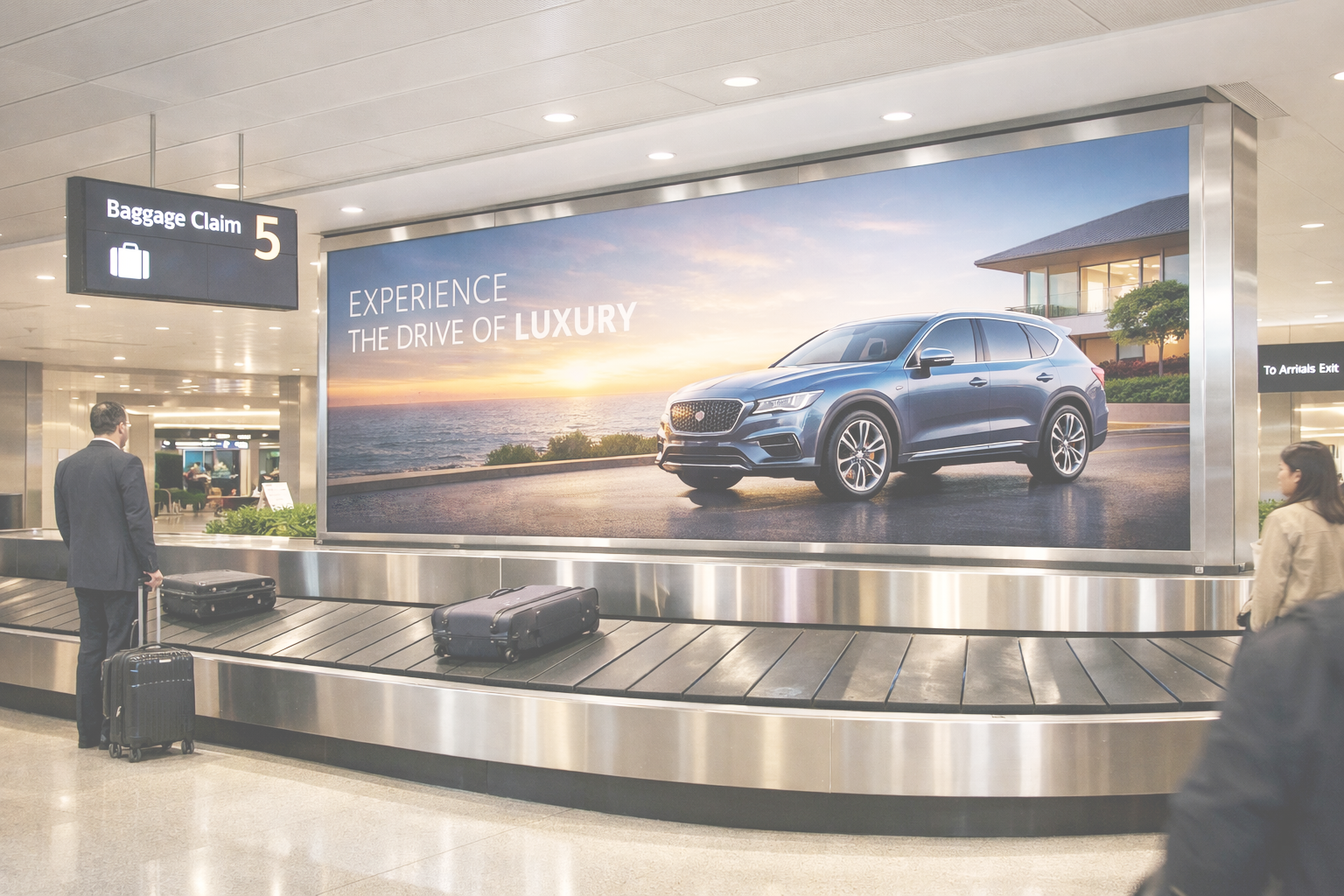
It’s Not Just Where You Advertise - It’s How Fast You Execute
We combine local insight with fast rollout to deliver results for you, now.
Talk to an ExpertAudience and Cultural Intelligence
Top 2 Languages:
- English: The dominant commercial and cultural language of LAX's catchment and passenger base, English-language advertising operates at maximum reach across the airport's broad traveller spectrum, with particular effectiveness among the entertainment and technology professional segments whose media consumption, brand literacy, and commercial sophistication make them exceptionally receptive to high-quality creative messaging.
- Spanish: The second language of Los Angeles by a wide margin, Spanish reflects both the city's deep Latin American cultural identity and the substantial affluent Mexican, Colombian, and Guatemalan traveller base that uses LAX as its primary North American gateway. Spanish-language creative dramatically increases advertising relevance and purchase intent generation among LAX's Hispanic premium traveller segment — a commercially underserved audience that responds powerfully to culturally fluent brand communication.
Major Traveller Nationalities:
LAX's international traveller mix is defined above all by its transpacific orientation and Latin American connectivity. Japanese travellers represent one of the longest-established and most commercially significant international segments at LAX, with a long-standing cultural affinity for Los Angeles as a lifestyle and cultural destination combined with strong corporate travel from Japan's automotive and electronics operations in Southern California. Korean travellers represent the fastest-growing premium transpacific segment at LAX, driven by the Korean-American community's exceptional bilateral ties, the popularity of Los Angeles among South Korean leisure travellers, and the rapid expansion of Korean Air and Asiana Airlines' LAX service. Chinese travellers — both mainland and overseas Chinese diaspora — generate substantial inbound real estate tourism, luxury retail spending, and education-related travel through LAX, with per-trip spend profiles among the highest of any international nationality. Australian travellers represent the dominant transpacific leisure segment from the Southern Hemisphere, with Los Angeles functioning as their primary North American transit and destination point. Mexican and Latin American premium travellers, particularly from Mexico City, Guadalajara, Bogota, and Lima, use LAX extensively for North American luxury retail, business travel, and international connections, contributing a high-income bilateral travel segment with strong brand awareness and premium purchasing activity.
Religion — Advertiser Intelligence:
- Christianity (approximately 60%): The dominant religious tradition across greater Los Angeles' diverse population, Christian holiday periods drive the two largest consumer spending and travel surges in the American calendar. The December and Easter windows deliver exceptional concentrations of premium leisure travellers with active luxury gifting, experiential travel, and family hospitality spending in progress.
- Judaism (approximately 6%): Los Angeles has one of the largest and most affluent Jewish communities in the United States outside New York, concentrated in Beverly Hills, Bel Air, Brentwood, and the West Side generally. This community's high-income professional and entertainment industry profile, combined with strong Israel travel ties and high-frequency international leisure travel, makes it a commercially significant advertising segment — particularly for luxury goods, international real estate, premium travel, and High Holiday and Passover travel windows.
- Buddhism (approximately 8%): Los Angeles' large East and Southeast Asian communities sustain a substantial Buddhist population whose commercial significance lies primarily in the Lunar New Year travel window and the broader transpacific travel pattern that this community drives through LAX. Korean, Chinese, Japanese, Vietnamese, and Thai Buddhist community members collectively represent a significant portion of LAX's highest-spending transpacific traveller segment.
- Islam (approximately 4%): Los Angeles' Muslim community, drawn from Iranian, Arab, South Asian, and Indonesian backgrounds, generates Ramadan and Eid travel surges through LAX with strong alignment for premium fashion, luxury hospitality, and international family travel advertising. Inbound Gulf state visitors also contribute a premium-spending Muslim traveller segment during major leisure travel windows.
- Hinduism (approximately 3%): Southern California's South Asian professional community, concentrated in technology, medicine, and finance across the greater LA basin and adjacent Orange County, drives Diwali travel and year-round transpacific movement through LAX, contributing a high-income, internationally connected audience with active investment interests in both the United States and India.
Behavioral Insight:
The LAX audience is defined by a purchase psychology that prizes visible authenticity, cultural currency, and experiential richness over conventional status signalling. Unlike the finance-dominated premium audience of a New York or London gateway, Los Angeles' HNWI consumer base has built wealth through creative industries, technology entrepreneurship, and real estate — sectors where personal brand and lifestyle expression are professional assets, not simply personal preferences. This produces an advertising environment where brands that communicate through genuine cultural engagement, aesthetic quality, and experiential differentiation significantly outperform those relying on conventional luxury heritage positioning. The LAX audience is sophisticated, internationally fluent, and exceptionally alert to inauthenticity — making campaign creative quality and cultural relevance as commercially critical as placement precision.
Outbound Wealth and Investment Intelligence
The outbound passenger at LAX deploys capital with a range and cultural diversity unmatched at any other North American airport. Southern California's HNWI community includes entertainment wealth families with multi-generational real estate portfolios, technology founders managing liquid wealth events from recent exits, Korean and Chinese entrepreneurs with active bilateral investment strategies, and Latin American family offices managing cross-border business and real estate interests. These are not simply wealthy consumers — they are internationally oriented capital allocators whose investment decisions span real estate, education, and residency across multiple continents simultaneously. LAX's route network maps almost precisely onto the destinations where these individuals are deploying capital, making it one of the most commercially precise environments in North America for international investment-oriented advertising.
Outbound Real Estate Investment:
LAX's HNWI outbound passenger base invests internationally across a diverse range of markets shaped by the specific cultural and financial profiles of each community segment. The Korean-American community maintains exceptionally active real estate investment ties to Seoul and Jeju Island, with LAX functioning as the primary departure point for property inspection and investment trips to South Korea's premium residential and commercial markets. The Chinese-American community from the San Gabriel Valley and broader Los Angeles directs substantial real estate capital toward Sydney, Vancouver, and increasingly Melbourne and Auckland, where lifestyle assets with residency pathway credentials command premium prices. Japanese corporate families and executives represent a steady demand segment for Hawaiian real estate and Pacific Northwest properties accessible through LAX's transpacific network. Latin American family office principals, particularly from Mexico and Colombia, are significant buyers of premium Florida, New York, and European real estate with LAX serving as their primary North American departure point. The broader ultra-HNWI entertainment and technology wealth community across Beverly Hills and the West Side is an active acquirer of London, Paris, and Mediterranean luxury property, making transatlantic real estate developers a strong fit for LAX advertising inventory targeting international departures.
Outbound Education Investment:
Southern California's affluent families, particularly across the Korean-American, Chinese-American, and entertainment industry wealth segments, allocate substantial budgets to international education at every level. The United Kingdom, anchored by Oxford, Cambridge, LSE, and UCL, remains the premier international higher education destination for LAX-catchment families seeking global brand credential for their children. Canada — particularly the University of British Columbia and the University of Toronto — attracts a growing cohort of West Coast families who value proximity alongside academic excellence. Australia's Group of Eight universities draw substantial student flows from LAX's East Asian diaspora communities, with the cultural proximity and lifestyle quality of Sydney and Melbourne competing effectively with more traditional European destinations. International boarding schools across the United Kingdom and Switzerland generate substantial parental travel through LAX, with parents visiting campuses for admissions processes, open days, and term events contributing a concentrated HNWI family education travel segment. Education consultancies, international universities, and language programme operators targeting household incomes above $400,000 will find LAX's terminal advertising environment among the most commercially productive channels in North America.
Outbound Wealth Migration and Residency:
Second residency and citizenship-by-investment demand among LAX's HNWI community is growing robustly, driven both by California's elevated tax environment — which makes offshore domicile planning a financially material conversation for individuals earning above $1 million annually — and by a generational shift toward internationally diversified lifestyle structures among technology and entertainment wealth holders. Portugal's Golden Visa investment fund pathway has attracted substantial interest from LAX-catchment technology and entertainment wealth, offering EU residency combined with lifestyle access to one of Europe's most highly regarded quality-of-life destinations. Greece's Golden Visa programme has particular appeal among the broader affluent community interested in Mediterranean lifestyle real estate at relatively accessible investment thresholds. The UAE's long-term residency and offshore domicile options attract technology founders and financial professionals from Los Angeles seeking to diversify their tax exposure while maintaining access to a globally connected commercial hub. Malta's EU citizenship programme serves LAX's ultra-HNWI segment seeking genuine EU citizenship with the broadest access and estate planning benefits. Residency advisory firms, international legal practices, and citizenship-by-investment programme operators will find LAX one of the most commercially productive North American airports for outbound wealth migration advertising.
Strategic Implication for Advertisers:
LAX's outbound passenger base represents a simultaneous multi-corridor investment audience that spans the transpacific, transatlantic, and Latin American wealth routes in a single physical advertising environment. A premium real estate developer with inventory in London, Sydney, and Seoul can reach the relevant investor community from all three target markets through a single LAX campaign, at a cost per qualified impression that would require substantial separate digital investment to approach through channel-specific targeting. Masscom Global's capacity to coordinate campaigns at LAX and across the destination airports on the same outbound routes — London Heathrow, Sydney International, Incheon International, and Lisbon Airport — enables brands to deploy end-to-end wealth corridor campaigns through a single expert partner with proven access on every leg of the investment and lifestyle journey.
Airport Infrastructure and Premium Indicators
Terminals:
- LAX operates nine terminals arranged in a distinctive horseshoe layout, with the Tom Bradley International Terminal (TBIT) serving as the flagship international hub handling the majority of long-haul transpacific and transatlantic premium traffic from carriers including Singapore Airlines, Cathay Pacific, Qantas, Japan Airlines, Korean Air, Air China, British Airways, and Lufthansa — creating a concentrated international premium passenger environment of exceptional advertising value.
- The domestic terminal complex serves Delta, American Airlines, United, Alaska Airlines, and Southwest across Terminals 1 through 7, with Delta's Terminal 3 operation and American Airlines' Terminal 4 housing the domestic business travel audiences most relevant for premium category advertising at accessible cost points relative to the TBIT international environment.
Premium Indicators:
- LAX's premium lounge infrastructure signals a consistently HNWI transit population, encompassing the United Polaris Business Class Lounge, Delta One Lounge, British Airways First Class Lounge, Cathay Pacific The Pier Business Lounge, Qantas Business Lounge, and the American Express Centurion Lounge — collectively creating a premium dwell-time environment across multiple international terminals where advertising is consumed by passengers with confirmed high-value consumer profiles.
- Signature Flight Support and Atlantic Aviation both operate Fixed Base Operations at LAX's private aviation facilities, handling a significant volume of private jet movements representing the ultra-high end of the Southern California wealth spectrum and extending the airport's premium audience footprint well beyond the main terminal complex.
- The InterContinental Los Angeles Downtown and numerous premium hotel properties within ten minutes of the airport provide luxury transit accommodation infrastructure that reinforces LAX's identity as a world-class international gateway rather than simply a high-volume domestic hub.
- LAX has received international recognition for its ongoing transformation investment, which at over fourteen billion dollars in committed capital represents one of the largest airport modernisation programmes currently underway in the world, signalling a trajectory toward premium global gateway status that aligns with the quality expectations of its catchment audience.
Forward-Looking Signal:
LAX's fourteen-billion-dollar modernisation programme, which includes the fully operational Automated People Mover connecting the airport to the regional rail network, the new Consolidated Rent-A-Car facility, and significant terminal renovation across multiple buildings, is structurally transforming the airport's physical quality, passenger experience, and advertising environment simultaneously. The 2028 Los Angeles Olympic and Paralympic Games represent perhaps the single most significant commercial event ever to focus on a North American airport advertising market, with LAX expected to handle extraordinary volumes of global ultra-HNWI visitors — heads of state, international Olympic Committee leadership, global brand partners, and the world's media — over a concentrated multi-week window. Brands that build awareness and positioning at LAX before the 2028 Games secure not only current premium inventory access at existing rates but also the brand recognition equity that will be activated during the most commercially intense period in the airport's history. Masscom Global strongly advises clients to establish LAX campaign presence now to maximise both current audience reach and the extraordinary 2028 Olympic advertising opportunity before competitive demand compresses available inventory and drives significant rate increases.
Airline and Route Intelligence
Top Airlines: Delta Air Lines, American Airlines, United Airlines, Alaska Airlines, Southwest Airlines, British Airways, Lufthansa, Air France, Japanese Airlines, Korean Air, Asiana Airlines, Cathay Pacific, Qantas, Air New Zealand, Singapore Airlines, Air China, China Eastern, China Southern, LATAM Airlines, Aeromexico, Virgin Atlantic, Turkish Airlines, Philippine Airlines, EVA Air
Key International Routes:
- Tokyo Narita and Haneda: Multiple daily flights via Japan Airlines, All Nippon Airways, and Delta
- Seoul Incheon: Daily Korean Air and Asiana Airlines service with multiple departures
- Sydney: Daily Qantas and United service with strong leisure and business demand
- London Heathrow: Daily British Airways, Virgin Atlantic, and American Airlines service
- Paris Charles de Gaulle: Daily Air France and Delta service
- Frankfurt: Daily Lufthansa service
- Hong Kong: Daily Cathay Pacific service
- Shanghai and Beijing: Multiple daily services by Air China, China Eastern, and China Southern
- Singapore: Singapore Airlines direct service
- Auckland: Air New Zealand direct service
- Mexico City: Daily Aeromexico and American Airlines service
- Santiago and Lima: LATAM Airlines service via gateway connections
- Taipei: EVA Air and China Airlines service
- Manila: Philippine Airlines direct service
Domestic Connectivity: Extensive domestic network covering New York (JFK and Newark), Chicago, Dallas, Seattle, San Francisco, Denver, Miami, Atlanta, Boston, Washington D.C., Honolulu, and Las Vegas — with the San Francisco, Seattle, and New York routes functioning as premium business travel corridors generating high-frequency HNWI commuter traffic relevant for financial services, technology, and premium B2B advertising categories.
Wealth Corridor Signal:
LAX's route network is a commercial map of the transpacific wealth corridors that are reshaping the global distribution of premium consumer and investment capital. The Tokyo, Seoul, Shanghai, Beijing, and Hong Kong routes carry not only the diaspora communities whose investment flows define Southern California's real estate and business landscape, but also the senior executives and entrepreneurs of Asia's most commercially dynamic economies who enter the North American market through LAX as their primary gateway. The Sydney and Auckland routes bring Australia and New Zealand's increasingly affluent leisure traveller base into the Southern California premium consumption ecosystem. The London, Paris, and Frankfurt routes carry the transatlantic business and creative industry flow that connects Hollywood's entertainment economy to its European financing, distribution, and cultural partners. Advertisers whose brand proposition spans the Pacific — whether in luxury goods, real estate, education, or financial services — will find that LAX's route network delivers the most commercially productive combination of outbound investor and inbound premium consumer audiences simultaneously available at any single North American advertising location.
Media Environment at the Airport
- The Tom Bradley International Terminal's scale, architectural quality, and concentration of long-haul international premium passengers creates a flagship advertising environment where brand messages are encountered by travellers whose dwell times consistently exceed ninety minutes and whose attention is not segmented across domestic short-haul volume — producing a qualitatively distinct advertising context that delivers genuine brand recall among a premium international audience.
- LAX's internationally travelling passenger base experiences some of the highest dwell times in North American aviation, driven by international security processing requirements, long-haul boarding procedures, and premium lounge culture that encourages extended pre-departure engagement — creating advertising exposure windows of sufficient duration to build brand preference, not simply awareness.
- The airport's ongoing modernisation is continuously elevating the quality of the physical advertising environment, with new digital display infrastructure, improved terminal lighting, and enhanced passenger circulation creating progressively better brand visibility conditions that reward early placement with premium positioning ahead of increasing demand competition.
- Masscom Global provides strategic access to LAX's full advertising estate — including Tom Bradley International Terminal, domestic terminal premium environments, and arrivals corridor placements — with the planning intelligence to select formats, positions, and timing windows that maximise brand impact for each specific client objective, backed by proven execution capability across North America and a global 140-country network.
Strategic Advertising Fit
Best Fit:
- Ultra-luxury goods and watches: LAX's Beverly Hills and West Side HNWI catchment, combined with high-spending Asian transpacific inbound visitors, produces an audience that purchases premium timepieces, jewellery, and luxury fashion with exceptional frequency — making LAX one of the highest-return luxury goods advertising environments in North America.
- International real estate: Developers with premium inventory in London, Sydney, Seoul, Tokyo, Dubai, Lisbon, and Miami will find LAX's outbound Asian-American, Latin American, and entertainment wealth passenger base a highly qualified investor audience at a cost per qualified impression that significantly undercuts equivalent digital channel investment.
- Premium and ultra-luxury automotive: Southern California's automotive culture and its HNWI catchment's demonstrated appetite for premium vehicle ownership — extending to performance imports, SUV flagships, and emerging premium EV categories — makes LAX an exceptionally productive environment for brands at the top of the automotive market.
- Private banking and wealth management: The extraordinary diversity of wealth sources in LAX's catchment — entertainment, technology, real estate, family business, and diaspora entrepreneurship — produces a wealth management advertising audience with diverse portfolio management needs and strong motivation to engage with premium financial advisory services.
- International education: The Korean-American, Chinese-American, and entertainment industry family segments that define LAX's HNWI catchment allocate premium education budgets at every level from boarding schools through MBA programmes — making LAX a high-productivity channel for international universities, elite secondary schools, and education consultancies.
- Luxury hospitality and travel: Premium hotel groups, private members clubs, ultra-luxury cruise lines, and bespoke travel operators will find LAX's outbound HNWI leisure traveller base — particularly during the summer peak and awards season windows — exceptionally well aligned with high-value experiential hospitality advertising.
- Technology and enterprise B2B: The concentration of Silicon Beach technology founders, entertainment technology executives, and Asia-Pacific corporate travellers at LAX creates a premium B2B technology advertising environment where enterprise software, cloud infrastructure, and professional services brands can reach decision-makers during extended dwell periods that deliver genuine engagement.
- Residency and investment advisory: Golden Visa programmes, second-citizenship advisory services, and international tax planning firms targeting California's high-income professional community — whose state income tax motivation for offshore planning is among the strongest in the United States — will find LAX's departing international passenger base actively receptive to residency advisory advertising.
Brand Alignment at a Glance:
| Category | Fit |
|---|---|
| Ultra-luxury goods and watches | Exceptional |
| International real estate | Exceptional |
| Premium and ultra-luxury automotive | Exceptional |
| Private banking and wealth management | Exceptional |
| International education | Strong |
| Luxury hospitality and travel | Strong |
| Technology and enterprise B2B | Strong |
| Residency and investment advisory | Strong |
| Mass market FMCG | Poor fit |
| Budget travel and accommodation | Poor fit |
Who Should Not Advertise Here:
- Mass market FMCG brands: The premium cost structure of LAX's advertising inventory is not justified for brands whose commercial success depends on volume reach among price-sensitive consumers — the audience profile misalignment produces structural underperformance relative to broadcast and digital alternatives that deliver mass-market reach at lower cost.
- Budget travel and accommodation platforms: Price-led travel brands targeting frugal bookers find no audience alignment in an airport where the majority of premium inventory is encountered by business class and first class passengers whose booking behaviour is driven by quality and programme loyalty rather than price comparison.
- Entry-level consumer electronics: Volume consumer electronics brands targeting first-time device buyers or price-sensitive upgraders are misaligned with an audience that defines itself partly through access to premium technology as a personal and professional expression, making entry-level positioning commercially counterproductive in this environment.
Event and Seasonality Analysis
- Event Strength: High
- Seasonality Strength: High
- Traffic Pattern: Dual-Peak with Event Overlay
Strategic Implication:
LAX operates on a robust dual-peak seasonal calendar anchored by the summer leisure peak (June to August) and the holiday travel surge (November to January), enriched by a series of commercially distinctive event-driven windows — awards season in January through March, Coachella in April, and Lunar New Year in late January to February — that concentrate ultra-HNWI audience segments in unusually high proportions relative to total passenger volume. Advertisers should weight annual LAX budgets toward these high-concentration windows while maintaining year-round baseline presence to capture LAX's consistent transpacific and transcontinental business traveller base, which travels at high frequency across all twelve months. Masscom Global structures LAX campaigns around this event and seasonal rhythm, ensuring clients are positioned at maximum impact during the periods when premium audience density and purchase intent combine to deliver the highest advertising return. The approach to 2028 means campaign presence established now will compound in commercial value over consecutive award seasons and transpacific travel cycles.

Poor Placement and Delays Affect Airport Campaigns
We help you move faster, access better inventory, and get it right now.
Talk to an ExpertFinal Strategic Verdict
Los Angeles International Airport is the only advertising environment in North America where entertainment wealth, technology wealth, transpacific investment capital, and Latin American family office money converge at scale within a single premium terminal complex — and where the 2028 Olympic Games will shortly transform that already exceptional commercial environment into the most concentrated global ultra-HNWI audience event in airport advertising history. For luxury brands, international real estate developers, private banks, premium automotive manufacturers, and any brand whose commercial success depends on reaching individuals who define global cultural and consumption trends, LAX is not one option among several North American airports — it is a structurally distinct opportunity with a specific audience, a unique cultural authority, and a forward-looking trajectory that makes current investment positions increasingly valuable as 2028 approaches. Masscom Global brings the intelligence, access, and execution capability to position brands at LAX with the precision and speed that this market demands, on every route corridor and at every scale of campaign ambition.
About Masscom Global
Masscom Global is a premium international airport advertising and media buying agency operating across 140 countries. With deep expertise in airport OOH, premium publications, and high-net-worth audience targeting, Masscom helps brands reach the world's most valuable travellers at the moments that matter most. For advertising packages, media rates, and campaign planning at Los Angeles International Airport and airports across the globe, contact Masscom Global today.
Frequently Asked Questions
How much does airport advertising cost at LAX Airport?
Airport advertising costs at Los Angeles International Airport vary based on format type, terminal placement, campaign duration, seasonal demand, and whether the campaign targets the Tom Bradley International Terminal's premium long-haul environment or the domestic terminal network. Premium large-format digital placements in international departures represent the highest cost tier, while standard formats in domestic terminals offer more accessible entry points for brands building LAX presence incrementally. With the 2028 Olympic Games now within the medium-term planning horizon, premium LAX inventory is expected to attract substantially increased competitive demand in the coming years, making current rate structures advantageous for brands that establish positions now. Contact Masscom Global for current rate cards and available inventory specific to your campaign objectives and budget parameters.
Who are the passengers at LAX Airport?
LAX's passenger base spans one of the most diverse and commercially valuable audience profiles of any airport in the world. At the premium end, it includes entertainment industry executives, technology founders, venture capital investors, and senior corporate professionals from Southern California's technology and aerospace sectors. The transpacific traveller base adds Korean, Japanese, Chinese, and Southeast Asian high-income business and leisure passengers whose per-trip spend profiles are among the highest in commercial aviation. Latin American premium travellers from Mexico, Colombia, and Brazil contribute a high-income bilateral travel segment with strong brand awareness and premium purchasing activity. The combination of these segments produces an advertising audience defined by cultural diversity, international financial fluency, and exceptional purchasing power.
Is LAX Airport good for luxury brand advertising?
LAX is one of the premier luxury brand advertising environments in the world. The combination of Southern California's extraordinary HNWI catchment, high-spending transpacific inbound visitors from Japan, South Korea, and China, extended international dwell times in Tom Bradley International Terminal, and a cultural context in which premium brand association is actively sought by a celebrity and entertainment-adjacent consumer base produces advertising conditions where luxury brands consistently achieve strong recall and purchase intent metrics. For any luxury brand seeking a West Coast North American flagship advertising position, LAX is the definitive choice.
What is the best airport in the western United States to reach HNWI audiences?
LAX stands alone as the premier HNWI airport advertising market in the western United States, combining the highest passenger volume on the West Coast with the most commercially concentrated HNWI catchment, the deepest transpacific premium route network, and a cultural and economic identity that aligns uniquely with luxury, entertainment, technology, and investment brand categories. San Francisco International Airport serves its own valuable Silicon Valley and finance audience, but LAX's combination of entertainment industry wealth, transpacific investor flows, and Latin American premium traveller volume produces a broader and higher aggregate commercial advertising opportunity.
What is the best time to advertise at LAX Airport?
The highest-value windows for LAX campaigns are June to August (summer peak for international leisure, entertainment industry travel, and transpacific tourism), November to January (holiday season, Thanksgiving, Christmas, and Lunar New Year preparation travel), and January through March (Hollywood awards season, which uniquely concentrates ultra-HNWI entertainment industry audience at LAX). The Coachella window in April delivers a concentrated premium youth and young affluent audience. Masscom Global recommends year-round LAX presence for brands targeting the airport's consistent transpacific business traveller base, with budget weighted toward these high-value windows for maximum commercial return.
Can international real estate developers advertise at LAX Airport?
LAX is one of the most commercially productive airports in the world for international real estate advertising. The airport's outbound HNWI passenger base actively invests across London, Sydney, Seoul, Tokyo, Dubai, Lisbon, and Miami, with investment decisions frequently triggered or reinforced by high-impact airport advertising encountered during international departure dwell time. The Korean-American and Chinese-American communities using LAX have particularly well-documented international real estate investment patterns that make LAX a high-precision targeting environment for developers with inventory in Asia-Pacific, European, and Middle Eastern markets. Contact Masscom Global to structure a campaign targeting the specific investor nationality and route corridor most relevant to your development's profile and pricing tier.
Which brands should not advertise at LAX Airport?
Mass market FMCG brands targeting price-sensitive consumers, budget travel and accommodation platforms, and entry-level consumer electronics manufacturers are misaligned with LAX's premium audience profile and cost environment. The airport's commercial value derives from its concentration of high-income, internationally mobile, and brand-sophisticated travellers — a profile that structurally underperforms for campaigns designed around price-led messaging or broad demographic volume reach.
How does Masscom Global help brands advertise at LAX Airport?
Masscom Global provides end-to-end airport advertising capability at LAX covering campaign intelligence, inventory access, creative placement strategy, execution management, and performance reporting. With a global network spanning 140 countries and deep expertise in HNWI audience targeting across transpacific, transatlantic, and Latin American corridors, Masscom identifies the precise terminal environments, formats, and timing windows that deliver maximum impact for each client's specific campaign objectives. For international brands coordinating campaigns across LAX and the destination airports on the same outbound routes — London Heathrow, Sydney International, Incheon International, and beyond — Masscom provides unified campaign planning and execution across all markets through a single expert partner with proven access on every leg of the journey. Contact Masscom Global today to begin planning your LAX campaign.