




Airport at a Glance
| Field | Detail |
|---|---|
| Airport | London Stansted Airport |
| IATA Code | STN |
| Country | United Kingdom |
| City | London (Stansted Mountfitchet, Essex) |
| Annual Passengers | Approximately 28 million (2023) |
| Primary Audience | Eastern European diaspora, London-Cambridge technology corridor professionals, Gulf-bound British South Asian travelers, European leisure and business travelers |
| Peak Advertising Season | June to September, December to January |
| Audience Tier | Tier 1 — London |
| Best Fit Categories | International real estate, financial services, remittance and digital banking, international education, premium travel and hospitality |
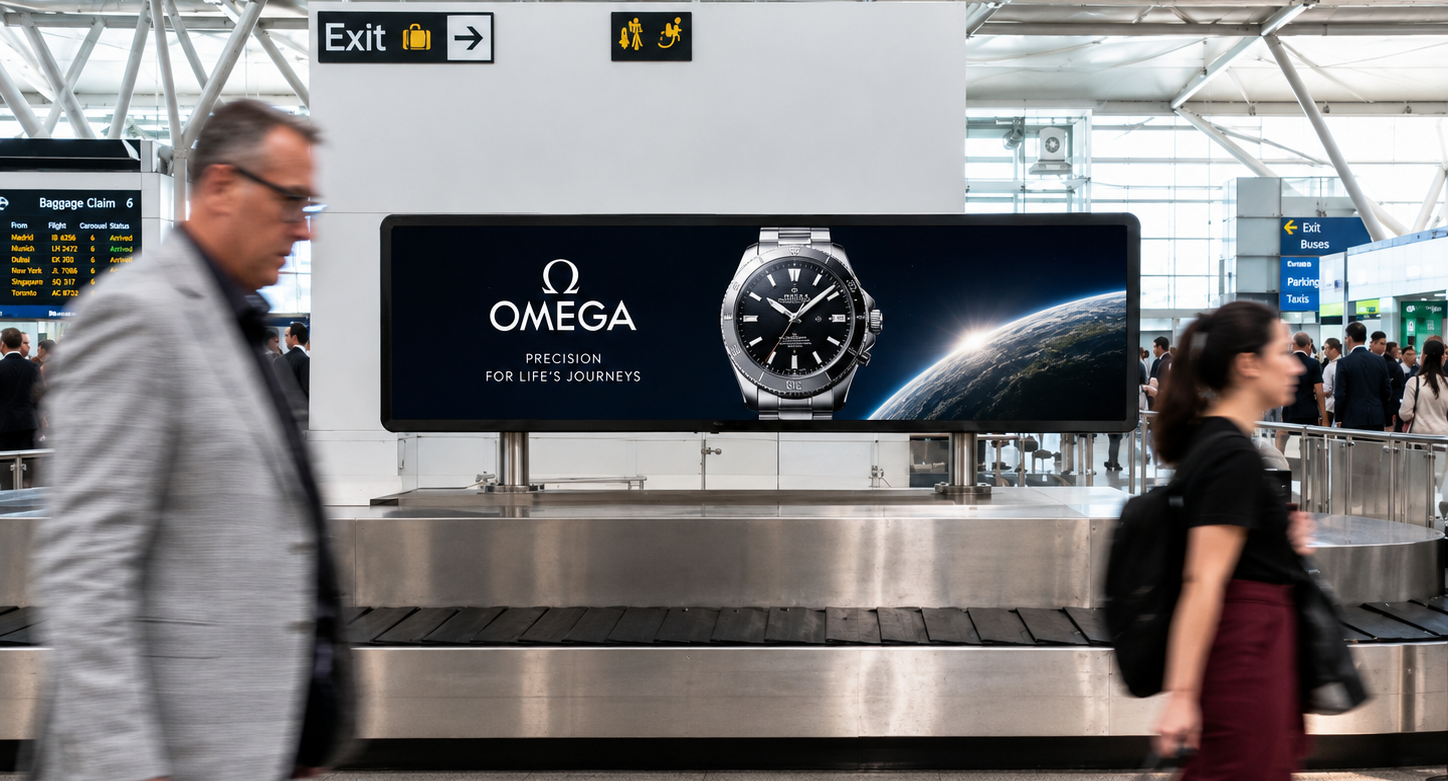
London Stansted Airport is the United Kingdom's third-busiest aviation gateway and one of Europe's most commercially distinctive airports by audience composition rather than premium positioning alone. STN is the primary hub of Ryanair's European network and a major base for easyJet, which means the airport handles one of the world's highest concentrations of Eastern European diaspora travel — Poles, Romanians, Lithuanians, Latvians, Estonians, and Bulgarians who live and work in the United Kingdom and return home through Stansted in volumes that make it the single most important physical interface between Britain's Eastern European community and the countries they came from. For advertisers, this audience is not the budget traveler its airline association might suggest — it is a working and professional class that has spent years accumulating sterling-denominated savings, building UK credit histories, purchasing UK property, and deploying capital back into Eastern European real estate, business investments, and family financial support at a scale that makes the Stansted corridor one of the most commercially significant remittance and diaspora investment channels in Europe.
But STN's commercial identity extends well beyond the Eastern European diaspora. The airport sits at the southern end of the London-Cambridge technology and life sciences corridor — one of the United Kingdom's most economically productive innovation belts, housing ARM Holdings, AstraZeneca, Frontier Developments, Marshall Aerospace, and hundreds of deep-tech startups and scale-ups whose executives, engineers, and investors travel through Stansted as their most proximate London airport gateway. The catchment also encompasses a significant British South Asian population — concentrated in East London boroughs including Newham, Tower Hamlets, Waltham Forest, Redbridge, and Barking and Dagenham — whose Gulf route connections through Stansted for family visits, business management in Pakistan and Bangladesh, and investment activity in Dubai and beyond represent a high-value, commercially motivated travel flow that low-cost airline pricing makes economically accessible without reducing the underlying spending power of the traveler. For international advertisers seeking simultaneous access to Eastern European diaspora capital, British technology sector wealth, and British South Asian Gulf corridor investment behaviour, STN is the only European airport that delivers all three within a single terminal dwell environment.


Advertising Value Snapshot
- Passenger scale: Approximately 28 million annually (2023), making STN the United Kingdom's third-busiest airport and one of Europe's highest-volume single-runway aviation gateways, with consistent growth driven by low-cost carrier expansion, Eastern European route frequency, and new long-haul and Gulf route additions
- Traveller type: Eastern European diaspora returnees, London-Cambridge technology and life sciences professionals, British South Asian Gulf and South Asia corridor travelers, European leisure and city-break travelers, domestic UK travelers connecting to Stansted's broad European network
- Airport classification: Tier 1 London — one of four London designated airports, serving the capital's eastern and northeastern catchment with Europe's most commercially significant Eastern European diaspora travel concentration and the technology wealth belt of the Cambridge arc
- Commercial positioning: The gateway for Europe's most commercially active Eastern European diaspora network, the technology corridor airport for the London-Cambridge innovation belt, and the low-cost carrier hub whose volume and route diversity make it one of Europe's most commercially viable airport advertising environments despite its non-premium airline positioning
- Wealth corridor signal: Positioned at the intersection of the UK-Eastern Europe remittance and investment corridor, the London-Cambridge technology wealth arc, and the UK-Gulf British South Asian family and investment travel channel
- Advertising opportunity: Masscom Global activates across STN's full inventory environment with the Eastern European diaspora market intelligence, British South Asian community cultural expertise, and UK airport advertising execution capability that international advertisers need to reach one of Europe's most commercially consequential and commercially underserved diaspora airport audiences
Airport Advertising is Complex to Get Right
We help you execute faster, with proven results and local insight most planners lack starting now.
Talk to an ExpertCatchment Area and Economic Drivers
Top 10 Cities within 150 km — Marketer Intelligence:
- East London (Newham, Tower Hamlets, Waltham Forest, Redbridge, Barking and Dagenham): The most commercially consequential component of STN's urban catchment, housing the United Kingdom's highest concentration of British Bangladeshi and British Pakistani communities, a large and growing Eastern European professional population, and one of London's most rapidly regenerating post-industrial economies anchored by the Queen Elizabeth Olympic Park, the Westfield Stratford retail complex, and the financial services and technology companies relocating from central London to east London's more affordable commercial districts — a commercially diverse and increasingly affluent audience with strong Gulf corridor travel behaviour and active remittance and cross-border investment activity.
- Cambridge: The anchor of the United Kingdom's most commercially productive innovation corridor and home to one of the world's most celebrated university research ecosystems, producing a concentration of deep-technology entrepreneurs, life sciences executives, venture capital investors, and academic commercialisation professionals whose international travel through STN connects them to European research partners, US investor meetings, and Gulf commercial engagements — an audience with above-average personal net worth, strong international commercial connections, and premium consumer spending behaviour calibrated to the global technology sector's compensation benchmarks.
- Chelmsford: Essex's county town and a rapidly growing professional commuter city whose proximity to London via the Liverpool Street rail corridor has attracted a significant population of financial services, insurance, and corporate professional households whose spending patterns reflect London employment income combined with Essex homeownership equity — a commercially established professional audience with consistent demand for premium automotive, international travel, financial services, and property investment products.
- Harlow: A planned town with significant pharmaceutical and technology sector employment anchored by the GlaxoSmithKline and Gilead Sciences research campuses, whose management and professional workforce travels frequently through STN for European and international engagements — a science and technology professional audience with institutional incomes and strong receptiveness to premium professional services, international real estate, and executive lifestyle brands.
- Luton: A town whose commercial identity is shaped by its own airport but whose eastern catchment population includes a significant British South Asian community — particularly British Pakistani and British Indian households — with active Gulf corridor travel behaviour, remittance financial activity, and community-structured purchasing patterns for gold, jewellery, and premium goods that make STN a viable advertising channel for brands targeting this segment when route options favour Stansted.
- Stevenage: A technology-intensive new town anchored by MBDA, Airbus Defence and Space, and a significant aerospace and defence manufacturing cluster whose engineering and management professionals travel through STN for European supplier meetings and international project engagements — a technically skilled, institutionally employed professional audience with above-average incomes and consistent demand for premium financial services, automotive, and business travel products.
- Bishop's Stortford: The most proximate affluent market town to STN itself, housing a high concentration of airport industry professionals, logistics and freight executives, Essex rural professional households, and the senior management class of Stansted's surrounding commercial and business park ecosystem — a locally concentrated but commercially capable audience with premium lifestyle aspirations and above-average homeownership equity relative to national averages.
- Bury St Edmunds: A prosperous Suffolk market town whose agricultural landowner class, professional service firms, and premium residential market produce an above-average income catchment with strong demand for luxury goods, premium automotive, financial services, and international travel products — a commercially established rural-professional audience that travels through STN as the most accessible London airport from Suffolk's western edge.
- Southend-on-Sea: A Thames Estuary coastal town with its own regional airport but a significant commuter population working in London's financial services sector, combining City of London income benchmarks with Essex coastal property wealth — an audience whose sterling-denominated savings and investment behaviour are shaped by financial sector employment exposure and whose travel through STN reflects the airport's competitive pricing and route diversity advantages for leisure and international business travel.
- Peterborough: A city positioned at the northern edge of STN's effective catchment, serving as the commercial hub of the Fenland agricultural economy and a growing manufacturing and logistics centre whose diverse population includes significant Eastern European communities — particularly Polish, Lithuanian, and Romanian workers in agricultural, food processing, and logistics sectors — who travel through STN as their primary return route to Central and Eastern Europe, making Peterborough an important feeder catchment for the Eastern European diaspora travel flow that defines STN's commercial identity.
NRI and Diaspora Intelligence:
The Eastern European diaspora in the United Kingdom is one of the most commercially significant migration communities in contemporary European economic history, with an estimated 1 million Polish-born residents alone, alongside large Lithuanian, Romanian, Bulgarian, Latvian, and Estonian populations concentrated heavily in East London, the East Midlands, and East Anglia. A disproportionate share of this community uses STN as their primary aviation gateway — Ryanair and Wizz Air's extensive Central and Eastern European route networks from Stansted make it the most cost-effective and frequency-accessible airport for Polish, Romanian, and Baltic connections. This audience has accumulated sterling savings over years and in many cases decades of UK employment, has developed UK-standard financial literacy through exposure to British banking, mortgage, and investment products, and is actively deploying capital back into Eastern European real estate, business investment, and family financial support at a scale that makes the STN corridor one of Europe's most commercially significant diaspora investment channels. The British South Asian community in STN's East London catchment — predominantly British Bangladeshi, British Pakistani, and British Indian — contributes a second high-value diaspora travel flow, using STN's Gulf connections for family visits to Bangladesh, Pakistan, and India via Dubai, Doha, and other Gulf hubs, and managing active remittance and cross-border investment activity whose scale reflects both the community's UK income accumulation and its family financial obligations in South Asia. For international real estate developers, digital banking platforms, remittance technology companies, and financial services brands targeting diaspora investment behaviour, the STN corridor represents one of the highest-concentration diaspora capital access points in the European airport network.
Economic Importance:
The London-Cambridge technology and life sciences corridor represents one of the United Kingdom's most economically productive innovation geographies, contributing disproportionately to UK patent filings, venture capital deployment, pharmaceutical R&D, and technology export revenue relative to its geographic footprint. STN sits at the southern gateway of this corridor, with Cambridge 35 minutes north by road and the M11 technology company cluster connecting the two cities through a continuous belt of science parks, research campuses, and technology business parks. The East London catchment economy is in the most rapid regeneration phase of any major UK urban area, with Canary Wharf's financial services cluster, the Stratford technology and media district, and the Royal Docks development zone collectively adding significant professional employment and consumer spending capacity to STN's immediate eastern catchment. The Essex commercial economy — anchored by financial services professionals commuting to London, logistics and distribution companies serving the M25 corridor, and a significant retail and commercial property development market — adds a further layer of middle-to-upper-income professional spending capacity to the airport's domestic audience. For advertisers, these overlapping economic geographies produce an STN audience that is commercially more capable and more diverse than the low-cost carrier association alone suggests.
Business and Industrial Ecosystem
- The London-Cambridge technology and life sciences cluster — encompassing ARM Holdings, AstraZeneca, Autonomy, Frontier Developments, Marshall Aerospace, and hundreds of venture-backed startups at the Cambridge Science Park, Babraham Research Campus, and Wellcome Genome Campus — generates a concentration of technology executives, life sciences researchers, venture capital investors, and intellectual property commercialisation professionals whose international travel through STN connects them to Silicon Valley investors, European research partners, and pharmaceutical manufacturing partners across the globe
- East London's financial services and professional services sector, anchored by Canary Wharf's international banking cluster and the Lloyd's of London insurance market, produces a professional class whose City of London income benchmarks combined with East London property equity position them among the UK's most commercially capable consumer households — this audience travels through STN because its East London residential geography makes Stansted the most practically accessible London airport for both leisure and international business travel
- The Essex and Hertfordshire logistics, distribution, and commercial property sector, serving the M25 orbital corridor's warehousing, distribution, and last-mile delivery economy, generates a business owner and senior management class whose institutional income levels and active commercial real estate investment behaviour create strong demand for business banking, investment platforms, and premium lifestyle products
- The Cambridge University and Anglia Ruskin University academic and research community, combined with the international student population that these institutions attract from across the world, generates a high-education, internationally mobile, and income-diverse audience that uses STN for both outbound student travel and inbound international academic and research visitor flows whose spending profiles reflect the institutions' global research network
Passenger Intent — Business Segment:
Business travelers at STN are drawn from the Cambridge technology and life sciences sector, East London financial services firms, Essex commercial and logistics businesses, the defence and aerospace manufacturing cluster in Stevenage and surrounding areas, and the pharmaceutical research campuses at Harlow and Cambridge. They travel to European technology hubs — Berlin, Amsterdam, Stockholm, Helsinki — for investor meetings, research partnerships, and commercial engagements, to Dubai and Gulf cities for regional business development and investment management, to Warsaw, Bucharest, and Vilnius for CEE business management, and to North American cities via connecting hubs. Advertiser categories that intercept them most effectively include premium business travel and hotel brands, international real estate investment platforms, financial services and wealth management, technology and professional services B2B brands, and international education programs targeting career advancement in the technology and life sciences sectors.
Strategic Insight:
The business audience at STN carries a commercially distinctive characteristic that is consistently underestimated by national advertisers who evaluate airport audiences through passenger volume and carrier prestige rather than catchment economic analysis: the London-Cambridge technology corridor has produced more globally significant technology companies, more venture capital return, and more intellectual property value per square kilometre than almost any comparable geography in the world, and the executives, founders, and investors who have built this ecosystem travel through STN as their most practically accessible London airport gateway. For premium financial services, international real estate, luxury goods, and B2B technology brands, the STN departure hall on a weekday morning contains a concentration of technology sector net worth that is systematically underestimated by media planners who have not conducted the catchment economic analysis that Masscom Global brings to every airport advertising engagement.
Tourism and Premium Travel Drivers
- The Cambridge University historic city — one of the world's most visited heritage and academic destinations, drawing over eight million visitors annually from North America, East Asia, the Gulf, and across Europe — generates a significant inbound premium tourism flow through STN whose visitors have pre-committed to premium accommodation in Cambridge's limited luxury hotel supply and whose trip profiles include high-end cultural experiences, academic institution tours, and premium retail engagement in Cambridge's Trumpington Street and King's Parade commercial zones
- The Essex coast, Norfolk Broads, and Suffolk Heritage Coast together constitute the United Kingdom's most accessible rural and coastal leisure corridor from London, drawing domestic premium leisure travelers through STN for weekend and holiday escapes to Mersea Island oyster restaurants, Constable Country countryside retreats, and the Norfolk and Suffolk premium coastal communities whose second-home property market attracts significant London professional investment
- The Blenheim Palace, Audley End House, and the wider east of England stately home and heritage tourism corridor draws inbound American, Gulf, and European heritage tourists through STN whose trip profiles emphasise premium country house hotel accommodation, historic garden visits, and luxury rural dining — a high-spending cultural tourism audience with established premium brand familiarity from their home markets
- Newmarket — the global headquarters of thoroughbred horse racing training and the home of the Jockey Club — draws an international horse racing and bloodstock industry audience through STN, including Gulf royal family members, Irish and French racing industry principals, and global bloodstock investors whose engagement with Newmarket's racing ecosystem represents some of the highest per-capita spending in the United Kingdom's entire rural leisure economy
Passenger Intent — Tourism Segment:
Tourism travelers at STN split between inbound international visitors using the airport as a London gateway — for whom the capital's cultural and commercial appeal justifies the airport's distance from central London — and outbound UK leisure travelers using Ryanair and easyJet's extensive European network for city breaks, beach holidays, and cultural travel across 40-plus European destinations accessible from a single terminal. The inbound premium segment — American heritage tourists, Gulf visitors, and high-spending East Asian tourists using STN as an entry point — is commercially accessible in the arrival hall with premium hospitality, cultural destination, and luxury retail advertising that intercepts a high-spending audience at the point of UK entry. The outbound leisure segment, while travelling on low-cost carriers, includes a significant proportion of above-average-income households whose choice of low-cost travel reflects price awareness rather than price constraint and whose pre-departure dwell spending on food, retail, and premium goods at the terminal is commercially significant in aggregate.
Travel Patterns and Seasonality
Peak seasons:
- June to September: STN's primary peak season driven by European summer holiday travel through Ryanair and easyJet's leisure route network, combined with the Eastern European diaspora's summer return migration and the Cambridge technology sector's conference and networking season — this period concentrates the year's highest passenger volumes across leisure, diaspora return, and business travel simultaneously
- December to January: The Christmas and New Year window drives STN's second-highest passenger concentration as Eastern European diaspora members return home for the holiday period, British South Asian families travel to Bangladesh, Pakistan, and India via Gulf connections, and outbound UK leisure travelers use Stansted's European network for Christmas city breaks — the period's consumer spending intensity makes it the most commercially valuable advertising window of the year for premium goods and financial services brands
- March to April (Easter): A compressed but commercially active European leisure travel peak as the UK school Easter holiday drives city break and beach destination departures, combined with a secondary Eastern European diaspora return for Easter celebrations in Catholic and Orthodox Christian communities across Poland, Lithuania, Romania, and Bulgaria
- October to November: A quieter volume period that nonetheless delivers a commercially significant business traveler concentration as the Cambridge technology sector's autumn conference and investment cycle intensifies and Eastern European diaspora members make pre-Christmas return visits home to manage property, family finances, and year-end commercial obligations
Event-Driven Movement:
- Christmas and New Year (December to January): STN's most commercially intense advertising window, combining the Eastern European diaspora's highest-volume annual return migration with British South Asian Gulf connection Christmas travel, the UK's peak domestic consumer spending period, and outbound European city break leisure travel — the convergence of these four audience streams in a four to five week window makes December the highest value-per-impression period of the year for financial services, remittance, real estate, and premium consumer brands at STN
- Eid ul Fitr (date varies annually — Lunar calendar): STN's significant British South Asian Muslim population generates a concentrated pre-Eid travel surge as East London's Bangladeshi and Pakistani communities travel via Gulf connections for family gatherings, combined with elevated consumer spending on apparel, gifting, gold, and food in the pre-departure terminal environment — a commercially distinct and community-concentrated spending window that makes the weeks before Eid ul Fitr a high-value advertising window for Islamic banking, halal premium goods, and Gulf destination brands
- Eid ul Adha and Hajj Season (date varies annually — Lunar calendar): A significant Hajj pilgrim departure flow from STN's British South Asian Muslim community, generating a pre-departure audience of deeply engaged Muslim consumers at peak religious motivation with strong receptiveness to Islamic financial products, premium prayer goods, and Saudi Arabian destination brands in the terminal's international departure environment
- Cheltenham Festival and Newmarket Race Meetings (March and throughout the racing season): The United Kingdom's most commercially significant horse racing events draw an international audience of bloodstock investors, racing industry professionals, and high-net-worth leisure racing enthusiasts through STN whose spending profiles reflect the extraordinary per-capita leisure expenditure of the global horse racing community
- Cambridge Science Festival and European Technology Conference Season (Multiple dates, predominantly September to November): The Cambridge technology corridor's annual conference and festival calendar generates concentrated peaks of globally mobile technology executives, researchers, and investors traveling through STN for Cambridge engagements, delivering a high-net-worth, intellectually sophisticated audience with premium travel and financial services receptiveness during specific autumn windows

It’s Not Just Where You Advertise - It’s How Fast You Execute
We combine local insight with fast rollout to deliver results for you, now.
Talk to an ExpertAudience and Cultural Intelligence
Top 2 Languages:
- English: The universal commercial and communication language across STN's entire catchment, essential for all campaigns targeting the London-Cambridge technology and professional class, the East London financial services community, the inbound international tourism audience, and the broad European leisure traveler segment — the non-negotiable primary language for any brand seeking comprehensive reach across Stansted's commercially capable domestic and international audience
- Polish: The single most widely spoken non-English language in the United Kingdom and the dominant community language of STN's largest diaspora segment, with an estimated one million Polish-born residents in the UK and a disproportionate concentration in STN's East London, East Midlands, and East Anglia catchment — campaigns incorporating Polish-language elements build authentic community trust and commercial engagement with the diaspora's most commercially active and financially capable segment, signalling that a brand understands and values this community rather than treating it as a generic European consumer demographic
Major Traveller Nationalities:
British nationals form the majority of STN's outbound passenger base, subdivided into the East London professional and South Asian community class, the Essex and Hertfordshire suburban professional household segment, the Cambridge technology and academic community, and a broad domestic leisure traveler population using Stansted's European network for affordable city breaks and beach holidays. Inbound international traveler nationalities at STN reflect the airport's dominant route network: Polish, Romanian, Lithuanian, Latvian, and Bulgarian arrivals from Eastern Europe constitute the largest inbound nationality groups by volume, followed by Irish travelers on the Dublin shuttle services, Spanish, Italian, and Portuguese leisure visitors, and a growing Gulf and Middle Eastern visitor segment using STN as a London entry point via Emirates, flydubai, and Ryanair's Abu Dhabi and Dubai connections. The American heritage tourism and business visitor segment uses STN as a Cambridge-entry point for educational institution visits, technology sector engagements, and east-of-England heritage tourism itineraries. The British South Asian community's Gulf corridor travel makes Bangladeshi, Pakistani, and Indian nationals among the most commercially significant inbound passenger nationalities relative to their numerical share of total passengers.
Religion — Advertiser Intelligence:
- Islam (approximately 35 to 40% of East London catchment, primarily British Bangladeshi and British Pakistani communities): The United Kingdom's largest concentration of British Muslims outside Birmingham is located in STN's East London catchment, creating a commercially significant Islamic festival and consumer calendar at the airport — Eid ul Fitr generates the single largest Muslim consumer spending event of the year for apparel, gold, gifting, and premium food products within the East London community; Ramadan creates a 30-day sustained window of elevated Islamic banking, charitable giving, and halal product engagement; Hajj and Umrah seasons produce a pre-departure pilgrim audience at STN whose religious motivation and spending receptiveness makes the terminal an active channel for Saudi Arabian destination brands, Islamic finance products, and premium prayer goods; the British Muslim community's Gulf travel behaviour through STN makes it one of the most commercially concentrated Islamic finance and halal premium goods audiences in the European airport network
- Christianity (majority across Essex, Hertfordshire, and Cambridge catchment, with significant Catholic Eastern European community): The dominant faith across STN's non-South-Asian domestic catchment, with the Eastern European Catholic community's Christmas and Easter travel cycles creating the airport's two most significant diaspora return peaks — Christmas creates STN's single highest-volume passenger window as Polish, Romanian, and Lithuanian communities return home for Catholic Christmas celebrations; Easter creates a secondary but commercially distinct return peak for the Eastern European Catholic and Romanian Orthodox community whose religious calendar structures their UK annual leave patterns
- Hinduism (approximately 10 to 15% of East London catchment, primarily British Indian and British Sri Lankan Tamil communities): A commercially active Hindu minority concentrated in Waltham Forest, Redbridge, and Harrow whose Diwali celebrations create a jewellery, gold, and premium gifting spending window at STN that is commercially significant for luxury goods, jewellery, and financial services brands active in the pre-Diwali weeks — the British Indian community's Gulf travel behaviour through STN adds a premium consumer spending layer to the broader South Asian diaspora audience at the airport
Behavioral Insight:
The Eastern European diaspora audience at STN makes financial decisions through a combination of pragmatic capital accumulation logic and strong family obligation frameworks — UK earnings are systematically deployed across three channels simultaneously: UK cost of living, UK savings and property investment, and Eastern European family financial support and property investment back home. This audience is financially literate beyond its income level, having navigated dual-country banking systems, currency conversion management, and cross-border mortgage products as standard life administration rather than specialist financial activity. For financial services, remittance technology, and international real estate brands, this audience's financial sophistication means messaging that leads with product transparency, fee efficiency, and operational reliability converts significantly better than aspirational or lifestyle-oriented creative. The British South Asian community makes purchasing decisions through family consensus, community peer comparison, and Islamic or Hindu cultural frameworks that structure both the timing and the category of major expenditure — airport advertising that acknowledges these cultural frameworks achieves authenticity and trust signals that generic multicultural UK creative cannot replicate at the same speed.
Outbound Wealth and Investment Intelligence
The outbound passenger at London Stansted Airport represents one of Europe's most commercially consequential diaspora investment profiles — not because individual passengers carry extraordinary personal wealth, but because the aggregate capital deployed by the Eastern European and British South Asian diaspora communities using STN as their primary aviation gateway represents one of the largest sustained cross-border investment flows in the European airport network. The Eastern European community's UK-earned capital has been flowing back into Polish, Romanian, Lithuanian, and Bulgarian real estate, business investment, and family financial support for two decades, creating a diaspora investor class whose collective cross-border property investment rivals or exceeds the individual transaction values of higher-net-worth airport audiences at premium-positioned competing airports.
Outbound Real Estate Investment:
Poland is the dominant outbound real estate investment market for STN's Polish diaspora audience, with Warsaw, Kraków, Gdańsk, Wrocław, and Poznań all receiving significant UK-sourced investment from Polish nationals who have accumulated sterling savings and are deploying them into the Polish residential property market as both personal investment and family provision vehicles. The Polish residential property market's sustained growth over the past decade, combined with the cultural comfort and family network support that domestic property investment provides, makes Polish real estate the primary cross-border investment category for the UK's largest Eastern European diaspora community. Romania's rapidly developing Bucharest and Cluj-Napoca residential markets are receiving growing British Romanian diaspora investment, driven by Romania's EU membership stability, improving infrastructure, and the strong rental yield profile of its developing urban property markets. The Baltic states — Vilnius, Riga, and Tallinn — are active real estate investment destinations for the UK's Lithuanian, Latvian, and Estonian diaspora communities, with the combination of EU membership, euro-denominated investment stability, and strong urban property appreciation making the Baltic capitals commercially compelling second-home and rental investment markets. Dubai has emerged as a growing secondary real estate market for the British South Asian community traveling through STN, driven by the UAE's dollar-linked stability, the tax-free investment environment, and the deep commercial familiarity of the British Pakistani and Bangladeshi communities with Gulf markets through family and business networks. International real estate developers advertising at STN — whether focused on Eastern European residential markets, Dubai, or UK domestic property — are reaching an audience whose cross-border investment motivation is structural, funded, and sustained across annual property transaction cycles.
Outbound Education Investment:
The United Kingdom's university system is the primary education investment for the British South Asian community using STN, but the outbound education story at this airport is defined by the Eastern European diaspora's investment in children's British education — Polish, Romanian, and Lithuanian families living in the UK invest significantly in UK private secondary and further education for children, using STN for school holiday travel home. The British South Asian community's outbound education investment targets the United Kingdom's own premier universities for the first generation of British-born graduates, but also Canada, the United States, and Australia for postgraduate programs whose immigration pathway value adds a residency dimension to the education investment calculation. International universities and foundation program providers targeting South Asian and Eastern European communities in the UK will find STN's pre-departure environment commercially accessible for family education investment conversations, particularly in the late summer August-September window when school and university enrollment travel concentrates through the terminal.
Outbound Wealth Migration and Residency:
STN's Eastern European diaspora audience occupies a structurally distinct position in the residency and wealth migration landscape — as EU nationals, Polish, Romanian, and Baltic travelers have existing European mobility rights and are not seeking new residency programmes in the same way as non-EU diaspora communities. Their migration behaviour is characterised by reverse migration planning — managing the transition back to Eastern European countries of origin once UK savings targets are met — rather than third-country residency acquisition. The British South Asian community using STN for Gulf corridor travel has demonstrated growing demand for UAE long-term residency options, driven by the Emirates' tax-free environment and the community's existing Gulf commercial relationships. The British technology professional class in the Cambridge corridor is increasingly exploring US O-1 and EB-1 visa pathways and EU digital nomad residency options as part of international career mobility planning, creating a residency advisory audience at the upper end of the income distribution that travels through STN for international business engagements.
Strategic Implication for Advertisers:
International brands on both sides of STN's wealth corridor — those entering the UK market via diaspora community channels and those offering real estate, remittance, and financial products to the airport's outbound capital class — should treat STN as a simultaneous dual-directional channel. The terminal handles inbound brands seeking UK Eastern European and British South Asian community market penetration and outbound diaspora capital seeking Eastern European, UAE, and South Asian investment opportunities within the same dwell window. Masscom Global activates campaigns targeting both flows with precision, delivering the Eastern European cultural intelligence, British South Asian community expertise, and UK airport execution capability that this commercially complex, diaspora-driven gateway demands.
Airport Infrastructure and Premium Indicators
Terminals:
- London Stansted Airport operates through a single, architecturally celebrated terminal designed by Sir Norman Foster and opened in 1991, with the terminal's signature satellite pier structure and distinctive roof design creating a well-configured commercial dwell environment that has been extensively upgraded with expanded retail, food and beverage, and digital advertising infrastructure over the subsequent three decades
- The terminal's single-building structure concentrates STN's complete passenger audience within a defined sequential dwell corridor — check-in, security, the underground transit connection to the satellite pier, and the pier's boarding gate commercial zone — creating a multi-touchpoint advertising environment where brands can build sequential impression frequency within a single passenger journey and achieve near-complete audience penetration with a focused placement strategy
Premium Indicators:
- Business class lounge infrastructure at STN includes the No1 Lounge and Aspire Lounge, accessible to premium class passengers and Priority Pass holders, concentrating the airport's highest-income technology sector, financial services, and business traveler segments in a controlled premium dwell environment with extended commercial receptivity for lounge-adjacent advertising placements
- The Norman Foster terminal architecture gives STN a brand prestige association significantly above its low-cost carrier positioning — the building is one of the most architecturally celebrated airport terminal designs in Europe, and brand adjacency to its iconic roof structure and light-filled atrium creates a premium environment that luxury and aspirational brands can leverage credibly despite the airport's non-premium airline roster
- Stansted's direct rail connection to London Liverpool Street — 47 minutes on the Stansted Express — positions the airport within the premium London commuter infrastructure network, making it practically accessible for City of London professionals, East London financial services workers, and Cambridge tech corridor executives without the road congestion challenges of Heathrow or Gatwick
- The airport's position within the M11 growth corridor — one of the United Kingdom's most economically productive highway development axes, connecting London to Cambridge through a continuous belt of business parks, science campuses, and logistics centres — gives STN a commercial ecosystem adjacency that reinforces its premium B2B audience credentials beyond the terminal environment itself
Forward-Looking Signal:
Manchester Airports Group, which owns STN, has committed to a significant long-term capital investment programme at Stansted including a major terminal expansion and upgrade project to accommodate passenger growth from the current 28 million toward a planned 43 million annual capacity. This expansion will substantially enlarge the retail, food and beverage, and commercial advertising inventory available within the terminal, increase dwell time quality through improved passenger processing, and attract new airline routes and passenger categories as the airport's physical infrastructure more credibly supports the premium positioning that its catchment geography and audience quality already justify. New long-haul route additions and expanded Gulf carrier services will diversify STN's international audience and introduce new high-spending passenger nationalities to the terminal environment. Masscom Global advises brands planning UK and European diaspora campaigns to establish STN advertising positions now, ahead of the terminal expansion that will significantly increase inventory competition and rates as the airport's commercial profile is formally repositioned to match its already-exceptional audience quality.
Airline and Route Intelligence
Top Airlines:
Ryanair, easyJet, Wizz Air, Jet2, TUI Airways, Ryanair UK, Flybe (regional routes), Emirates (Stansted seasonal or codeshare connection), flydubai, Ryanair (Abu Dhabi), Norse Atlantic Airways, Sun-Air
Key International Routes:
- Dublin (Ryanair) — multiple daily, highest-frequency route at STN encoding the deep Ireland-UK commercial and personal connectivity
- Warsaw and Kraków (Ryanair, Wizz Air, LOT Polish Airlines) — multiple daily, the Eastern European corridor's highest commercial value diaspora route pairing
- Bucharest and Cluj-Napoca (Ryanair, Wizz Air, Blue Air) — multiple daily, the highest-volume Romanian diaspora corridor in the UK airport network
- Vilnius, Riga, and Tallinn (Ryanair, Wizz Air) — multiple weekly to daily, the Baltic diaspora's primary UK aviation gateway
- Sofia and Varna (Ryanair, Wizz Air) — multiple weekly, Bulgarian diaspora corridor
- Dubai (flydubai, Emirates connections) — multiple weekly, the British South Asian and Gulf corridor primary connection
- Alicante, Malaga, Palma, Faro, and Lanzarote (Ryanair, easyJet, Jet2) — multiple daily across the Spanish and Portuguese coastal leisure network, high-volume British leisure traveler routes
- Amsterdam (Ryanair) — multiple daily, European business hub connectivity
- Barcelona, Madrid, Rome, Milan (Ryanair, easyJet) — multiple daily, European leisure and city break network
- New York JFK and Newark (Norse Atlantic Airways, seasonal) — several times weekly, transatlantic connection for the Cambridge technology sector and East London professional class
- Oslo, Stockholm, Copenhagen (Ryanair) — multiple weekly, Scandinavian business and leisure connectivity
Domestic Connectivity:
Edinburgh, Glasgow, Belfast, Newquay, Inverness, Knock (Ireland West) — domestic and near-international routes serving UK regional connectivity through Stansted's national network
Wealth Corridor Signal:
The STN route network is one of the most commercially instructive in the European airport system precisely because its commercial signals are encoded in diaspora movement rather than corporate travel. The Warsaw and Kraków corridors are not leisure routes — they are the arterial channels through which one million Polish-origin UK residents manage families, properties, and businesses across two countries simultaneously. The Bucharest and Cluj-Napoca routes carry Romanian diaspora members who are among the most active property investors in their origin cities' residential markets. The Vilnius, Riga, and Tallinn services move Baltic diaspora capital between UK earnings and Baltic home country investment in a weekly cycle that makes these routes among the most commercially important aviation connections in the Eastern European remittance economy. The Dubai routes carry the British South Asian community's Gulf corridor investment and family management travel. For advertisers, every major STN route is simultaneously a diaspora wealth signal and a targeting intelligence asset whose commercial value significantly exceeds what its low-cost carrier context initially suggests.
Media Environment at the Airport
- STN's single Norman Foster terminal creates a highly defined advertising environment where the complete passenger audience moves through a sequential commercial corridor from check-in through security to the satellite pier transit and the pier's gate zone — a multi-touchpoint journey that gives brands the opportunity to build sequential impression frequency within a single passenger journey, achieving recall reinforcement that single-placement campaigns at comparable airports cannot replicate
- Dwell times at STN are extended by the airport's security processing model and the satellite pier transit journey, regularly producing 90 to 120 minutes of active terminal dwell for international departure passengers — and the budget traveler demographic's tendency to arrive early and spend extended time in the retail and food and beverage concourse produces commercially valuable dwell engagement that exceeds the premium-airport assumption
- The pier's gate zone environment at STN creates a particularly high-receptivity advertising dwell space, with passengers settled at departure gates for extended periods after completing retail and dining purchases — a post-purchase dwell state that research consistently identifies as one of the most brand recall-productive advertising environments in airport systems globally
- Masscom Global provides comprehensive STN inventory access, campaign strategy, Eastern European and British South Asian community cultural execution guidance, campaign implementation management, and performance intelligence, giving international brands the full-service capability to plan and activate at one of Europe's most commercially consequential diaspora airport environments with the cultural precision, execution speed, and audience intelligence that this uniquely layered gateway demands
Strategic Advertising Fit
Best Fit:
- Remittance technology and digital banking platforms: STN's Eastern European and British South Asian diaspora communities represent one of the highest-concentration remittance sender audiences in the European airport network — digital remittance platforms, multi-currency banking apps, and cross-border payment services will find the STN departure hall one of Europe's most commercially productive advertising environments for customer acquisition among high-frequency cross-border money transfer users
- Eastern European real estate developers (Poland, Romania, Baltic states): The Polish, Romanian, Lithuanian, and Latvian diaspora audience is among the most active cross-border real estate investor communities in the European airport network, with established buying behaviour in their origin country residential markets and active property management cycles that make STN's departure hall a direct channel to motivated investors at maximum purchase intent before home country visits
- International real estate (UAE, UK domestic, Mauritius, Portugal): The British South Asian community's Gulf investment behaviour and the Cambridge technology class's international property diversification interest create additional real estate investment audience layers beyond the Eastern European corridor, making STN commercially viable for UAE, UK domestic, and European Golden Visa property advertising simultaneously
- Islamic banking and halal financial products: The East London British South Asian Muslim community's Gulf travel behaviour through STN creates one of the United Kingdom's most concentrated Islamic finance advertising audiences at a single airport outside Heathrow — Ramadan and Eid windows deliver peak engagement for Islamic banking, takaful, and halal investment products
- International education (UK universities for international students, overseas programs for British South Asian families): STN's international student inbound travel and the British South Asian community's university education investment behaviour create a commercially viable education advertising audience, particularly during the August to September enrollment travel period
- Premium business travel and technology sector services: The Cambridge technology corridor's frequent-traveler class represents a commercially underserved premium audience at STN — executive travel management, premium hotel brands, and professional services firms with technology sector specialisation find an above-average-income, high-travel-frequency audience whose STN usage reflects geographic convenience rather than preference for low-cost travel
- Automotive (value and mid-premium segment, Eastern European market-oriented): The Eastern European diaspora's return visit property management and consumer goods purchasing behaviour includes significant automotive interest — both UK used car purchases for export to Eastern Europe and new vehicle consideration for UK households — making STN a viable channel for value and mid-premium automotive brands with Eastern European market positions
- Premium FMCG and British lifestyle brands targeting Eastern European community: The Eastern European diaspora's pride in British quality products and its gifting behaviour toward family members at home creates a commercially productive audience for British premium food, personal care, and lifestyle brands whose Eastern European market aspiration is expressed through airport retail and gifting purchase cycles
Brand Alignment at a Glance:
| Category | Fit |
|---|---|
| Remittance and digital banking | Exceptional |
| Eastern European real estate | Exceptional |
| Islamic banking and halal financial products | Strong |
| International real estate (UAE, Portugal) | Strong |
| International education | Strong |
| Premium business travel and technology services | Strong |
| Automotive (value to mid-premium) | Strong |
| Ultra-luxury goods | Moderate |
Who Should Not Advertise Here:
- Ultra-luxury goods brands (seven-figure price points): STN's audience, while commercially capable and increasingly affluent, does not contain the concentration of ultra-HNWI travelers that Heathrow Terminal 5 or Gatwick South Terminal deliver — brands requiring an exclusively ultra-luxury brand environment will find STN's audience profile better suited to premium and aspirational luxury positioning than to the very highest price point categories
- Premium brands with no cultural adaptation for Eastern European or South Asian audiences: Campaigns that deploy generic premium British consumer creative without acknowledging the specific cultural identity, community values, and purchasing frameworks of STN's dominant diaspora audience segments will achieve significantly below-average engagement — the STN audience rewards cultural specificity and penalises cultural generic positioning more sharply than audiences at airports with homogeneous catchment demographics
- Brands with no digital or cross-border capability: STN's Eastern European and South Asian diaspora audience is digitally sophisticated, comparison-focused, and cross-border-oriented in its commercial behaviour — brands that cannot offer digital-first customer journeys, multi-currency pricing, and cross-border service delivery will find the audience's commercial engagement difficult to convert into sustained commercial relationships
Event and Seasonality Analysis
Event Strength: High Seasonality Strength: High Traffic Pattern: Summer-Peak Dominant with Diaspora-Driven Winter Secondary and Islamic Calendar Overlay
Strategic Implication:
Advertisers at STN should structure annual media investment around two primary peaks — the June to September summer peak, which delivers STN's highest passenger volume through the combination of European leisure travel, Eastern European diaspora summer returns, and the Cambridge technology sector's conference season — and the December to January Christmas and New Year window, which concentrates the Eastern European diaspora's most emotionally motivated and commercially active annual return migration alongside the British South Asian community's Gulf connection Christmas travel and the UK's peak consumer spending period. The Eid windows — particularly the Eid ul Fitr pre-departure period — provide a culturally specific and community-concentrated peak with specific Islamic banking, gifting, and Gulf destination advertising relevance for the East London Muslim community. Masscom Global builds STN campaigns calibrated to this dual-peak, diaspora-driven, culturally layered rhythm, ensuring brands are present with the culturally appropriate creative register during the moments when the airport's Eastern European investment capital and British South Asian Gulf corridor commercial activity are at maximum concentration and commercial convertibility.

Poor Placement and Delays Affect Airport Campaigns
We help you move faster, access better inventory, and get it right now.
Talk to an ExpertFinal Strategic Verdict
London Stansted Airport is one of Europe's most commercially underestimated aviation gateways — a terminal whose low-cost carrier association has caused international advertisers to systematically overlook an audience whose cumulative commercial capability, diaspora investment behaviour, and technology sector wealth arguably makes it the most commercially consequential underserved airport advertising environment in the United Kingdom. The terminal simultaneously concentrates the entirety of Britain's Polish, Romanian, and Baltic diaspora investment capital — communities that have spent two decades accumulating sterling savings and deploying them into Eastern European real estate, family business investment, and cross-border financial products at a scale that dwarfs the individual transaction values of many premium-airport HNWI audiences — alongside a Cambridge technology corridor professional class whose net worth, international commercial connectivity, and premium consumption profile is systematically invisible to media planners who read the Ryanair name on the departure board and stop their analysis there. The British South Asian Muslim community's Gulf corridor travel through STN adds a third commercially capable audience layer whose Islamic banking, halal luxury goods, and Gulf real estate investment behaviour makes the East London catchment one of the United Kingdom's most commercially concentrated non-Heathrow diaspora advertising audiences. For brands in remittance technology, Eastern European real estate, Islamic banking, digital financial services, international education, and premium travel targeting diaspora communities, STN is not a secondary London buy — it is the primary access point to the United Kingdom's most commercially active diaspora investment communities at the only airport that concentrates all of them within a single, architecturally celebrated, high-dwell terminal environment. Masscom Global brings the Eastern European cultural intelligence, British South Asian community expertise, and UK airport execution capability that international advertisers need to activate at STN with the precision, speed, and commercial credibility that this extraordinary diaspora gateway demands.
About Masscom Global
Masscom Global is a premium international airport advertising and media buying agency operating across 140 countries. With deep expertise in airport OOH, premium publications, and high-net-worth audience targeting, Masscom helps brands reach the world's most valuable travellers at the moments that matter most. For advertising packages, media rates, and campaign planning at London Stansted Airport and airports across the globe, contact Masscom Global today.
Frequently Asked Questions
How much does airport advertising cost at London Stansted Airport? Advertising costs at STN vary based on format (digital screens, static lightboxes, branded corridors, pier gate zone placements), position within the terminal and satellite pier, campaign duration, and seasonal demand. The June to September summer peak and the December to January Christmas and New Year window attract the highest inventory demand and rate premiums, reflecting the extraordinary concentration of Eastern European diaspora returnees, British South Asian Gulf connection travelers, and European leisure passengers that these periods deliver. Masscom Global provides current rate cards, culturally calibrated placement strategy, and campaign package options tailored to your objectives and budget. Contact Masscom for a detailed, market-specific proposal.
Who are the passengers at London Stansted Airport? STN serves a commercially rich and culturally layered passenger base combining Eastern European diaspora returnees — predominantly Polish, Romanian, Lithuanian, Latvian, and Bulgarian — East London British South Asian families and professionals traveling on Gulf corridor connections, Cambridge technology and life sciences sector executives and entrepreneurs, Essex and Hertfordshire suburban professional households, inbound European leisure visitors, North American academic and heritage tourists using STN as a Cambridge entry point, and a growing Gulf-origin visitor segment. It is one of Europe's most concentrated Eastern European diaspora investment community airport audiences and the primary British South Asian Gulf corridor gateway outside Heathrow.
Is London Stansted Airport good for luxury brand advertising? Yes, with appropriate product positioning calibration. STN is not Heathrow Terminal 5, and ultra-luxury brands at seven-figure price points will find a smaller concentration of their specific buyer profile than at Heathrow or Gatwick. However, premium and aspirational luxury goods — particularly within the jewellery, watches, premium fashion, and gifting categories — find a commercially receptive audience at STN in the British South Asian community's Diwali and Eid gifting cycles, the Eastern European diaspora's premium goods purchasing behaviour for home visits, and the Cambridge technology sector's professional achievement-oriented consumption patterns. Brands positioned at the premium rather than ultra-luxury end of the market find STN a commercially viable and underserved UK airport environment.
What is the best airport in London to reach Eastern European diaspora audiences? London Stansted Airport is the United Kingdom's primary Eastern European diaspora aviation gateway by a significant margin, driven by Ryanair and Wizz Air's dominant Central and Eastern European route networks from STN. Heathrow and Gatwick carry some Eastern European traffic on their full-service and low-cost European routes respectively, but neither concentrates the Polish, Romanian, Baltic, and Bulgarian diaspora audience with the same frequency, volume, and route diversity that STN's carrier network provides. For brands specifically targeting the UK's Eastern European diaspora communities — whether in remittance technology, real estate investment, automotive, digital banking, or premium FMCG — STN is the primary UK airport access point. Masscom Global advises on multi-airport UK strategies combining STN with LHR and LGW for comprehensive national diaspora and premium audience reach.
What is the best time to advertise at London Stansted Airport? The highest-value advertising windows at STN are the December to January Christmas and New Year period — which delivers the Eastern European diaspora's most emotionally motivated annual return migration alongside British South Asian Gulf connection Christmas travel and the UK's peak consumer spending period — and the June to September summer peak, which combines European leisure travel with the Eastern European diaspora's summer return wave and the Cambridge technology sector's conference season. The pre-Eid ul Fitr window provides a culturally concentrated Islamic banking, gifting, and Gulf destination advertising period for the East London Muslim community. Masscom structures STN campaigns around these dual-peak, culturally layered windows to maximise commercial return for every brand category.
Can international real estate developers advertise at London Stansted Airport? STN is one of Europe's most commercially productive airports for Eastern European real estate advertising specifically, and a commercially viable channel for UAE, UK domestic, and Portuguese real estate advertising targeting the British South Asian and technology professional audience segments. The Polish, Romanian, and Baltic diaspora's systematic UK-earnings reinvestment into origin country real estate makes STN's Eastern European corridor routes the most commercially motivated property investment audience in the European airport network. Dubai real estate advertising finds a receptive audience among the British South Asian community's Gulf corridor travelers. UK domestic property investment advertising finds a receptive audience among the Cambridge technology professional class and Essex professional household segment with active UK property wealth accumulation behaviour.
Which brands should not advertise at London Stansted Airport? Ultra-luxury goods brands requiring an exclusively HNWI audience environment will find STN's passenger mix less concentrated at the very highest income levels than Heathrow Terminal 5 or Gatwick's premium zones. Brands with no cultural adaptation for Eastern European or South Asian audience segments will underperform against their placement budget, as STN's dominant audience communities reward cultural specificity and engage poorly with generic British consumer creative that does not acknowledge their diaspora identity and values. Brands with no digital or cross-border service capability will struggle to convert STN's digitally sophisticated, comparison-oriented diaspora audience into commercial relationships without the multi-currency, cross-border service architecture that this audience's purchasing behaviour requires.
How does Masscom Global help brands advertise at London Stansted Airport? Masscom Global delivers end-to-end airport advertising capability at STN — spanning audience intelligence, Eastern European and British South Asian diaspora community-calibrated campaign strategy, inventory access and placement negotiation, culturally specific creative execution guidance across the airport's principal audience segments, implementation oversight, and post-campaign performance reporting. With operations across 140 countries and specific UK diaspora community market expertise, Masscom provides the cultural knowledge, language sensitivity, and execution speed that international advertisers need to operate effectively in the United Kingdom's most commercially significant diaspora airport environment. For brands entering the UK diaspora market for the first time or expanding existing European and South Asian community campaigns, Masscom eliminates the complexity of navigating a multi-community, culturally layered advertising environment and ensures placement precision that maximises commercial return at one of Europe's most commercially consequential and commercially underserved airport gateways. Contact Masscom Global today.







