




Airport at a Glance
| Field | Detail |
|---|---|
| Airport | Sundsvall Timrå Airport (Midlanda) |
| IATA Code | SDL |
| Country | Sweden |
| City | Timrå, serving Sundsvall and Härnösand |
| Annual Passengers | 273,527 (2018, last widely verified full-year figure). Current-year total: Data not available |
| Primary Audience | Industrial and corporate business travellers, public-sector and financial services professionals, affluent Nordic outbound leisure households |
| Peak Advertising Season | February, June to August, late October, December |
| Audience Tier | Tier 3 |
| Best Fit Categories | Industrial and B2B technology, banking and wealth management, Mediterranean and Southeast Asian real estate, premium automotive |

Sundsvall Timrå Airport, known locally as Midlanda, is not a scale buy and should never be sold as one. Its commercial value sits entirely in audience composition rather than impression count. The airport funnels the executive, engineering, and administrative population of Västernorrland through a single compact terminal where dwell time is unavoidable and competing brand messaging is minimal. For advertisers, that produces a rare condition: near-total share of attention within a defined, high-earning regional audience. Masscom Global positions SDL as a precision instrument, not a volume instrument.
The Sundsvall corridor matters because it concentrates three separate wealth engines within a 60 km radius: heavy forest-products industry, primary aluminium production, and one of Sweden's largest clusters of financial and government administrative employment. This produces a passenger who is salaried at above-national-average levels, travels on corporate account to Stockholm, and converts that income into Mediterranean property, second-home purchases, and long-horizon private wealth products. The airport sits directly on that capital corridor.
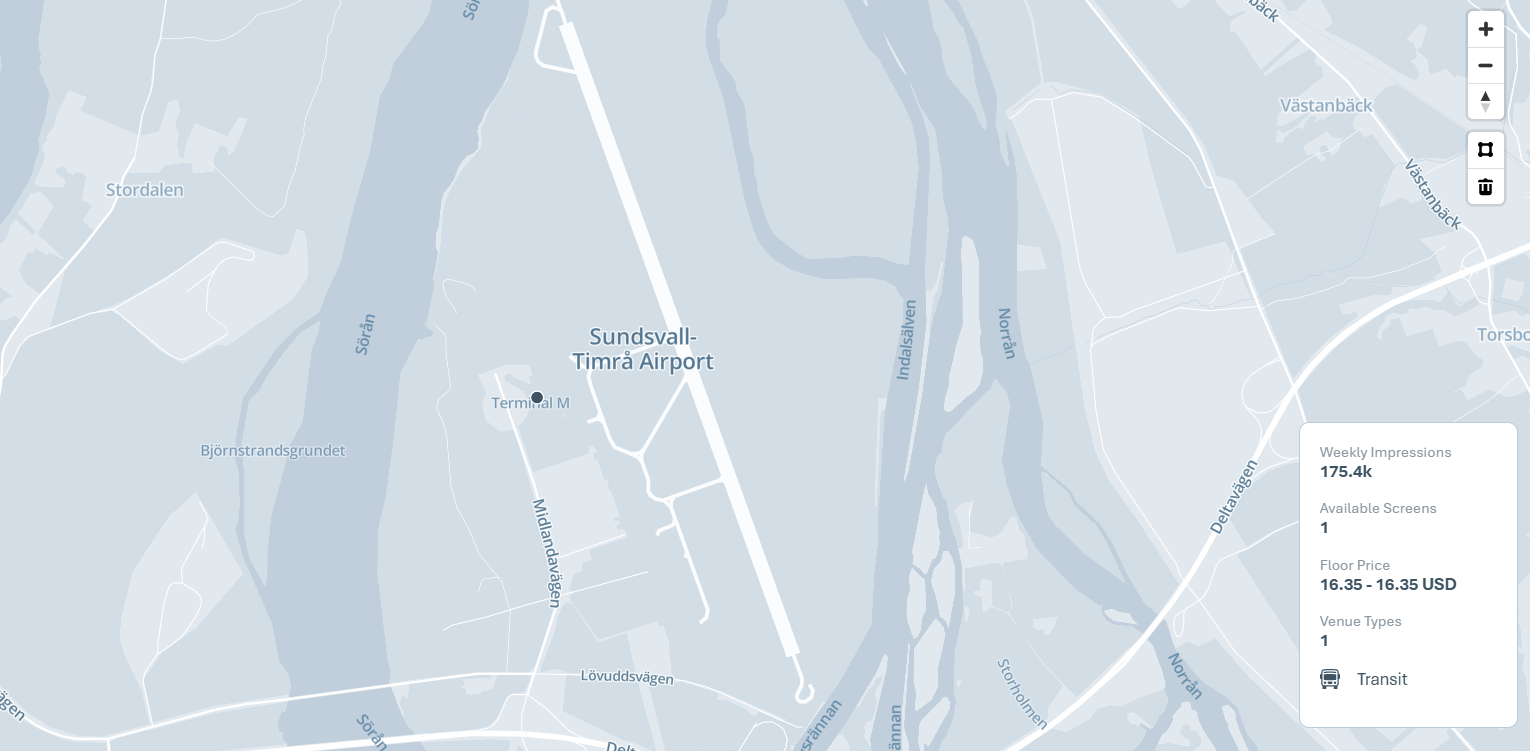
Advertising Value Snapshot
- Passenger scale: 273,527 passengers in 2018, of which 243,046 domestic and 30,481 international. Traffic contracted sharply in the most recent reporting period, with one industry source indicating a 47.1% year-on-year decline across 2024 to 2025. Verified current-year totals: Data not available.
- Traveller type: Corporate and industrial business travellers, public-sector and financial administration professionals, family charter leisure passengers.
- Airport classification: Tier 3. Low absolute volume with a high-income, low-clutter domestic audience and negligible transit dilution.
- Commercial positioning: Sweden's mid-coast industrial and administrative gateway, and the aviation access point for the High Coast UNESCO region.
- Wealth corridor signal: The Norrland industrial corridor into Stockholm, carrying corporate decision-makers northbound and household investment capital southbound and outbound.
Advertising opportunity: Masscom Global secures placement across the full passenger journey in a terminal where a single well-positioned execution owns the environment outright. Because the airport operates a compact single-terminal footprint, cost per qualified industrial decision-maker is materially lower than at Stockholm gateways. Masscom builds SDL into Nordic regional packages where audience quality, not reach, is the buying criterion.
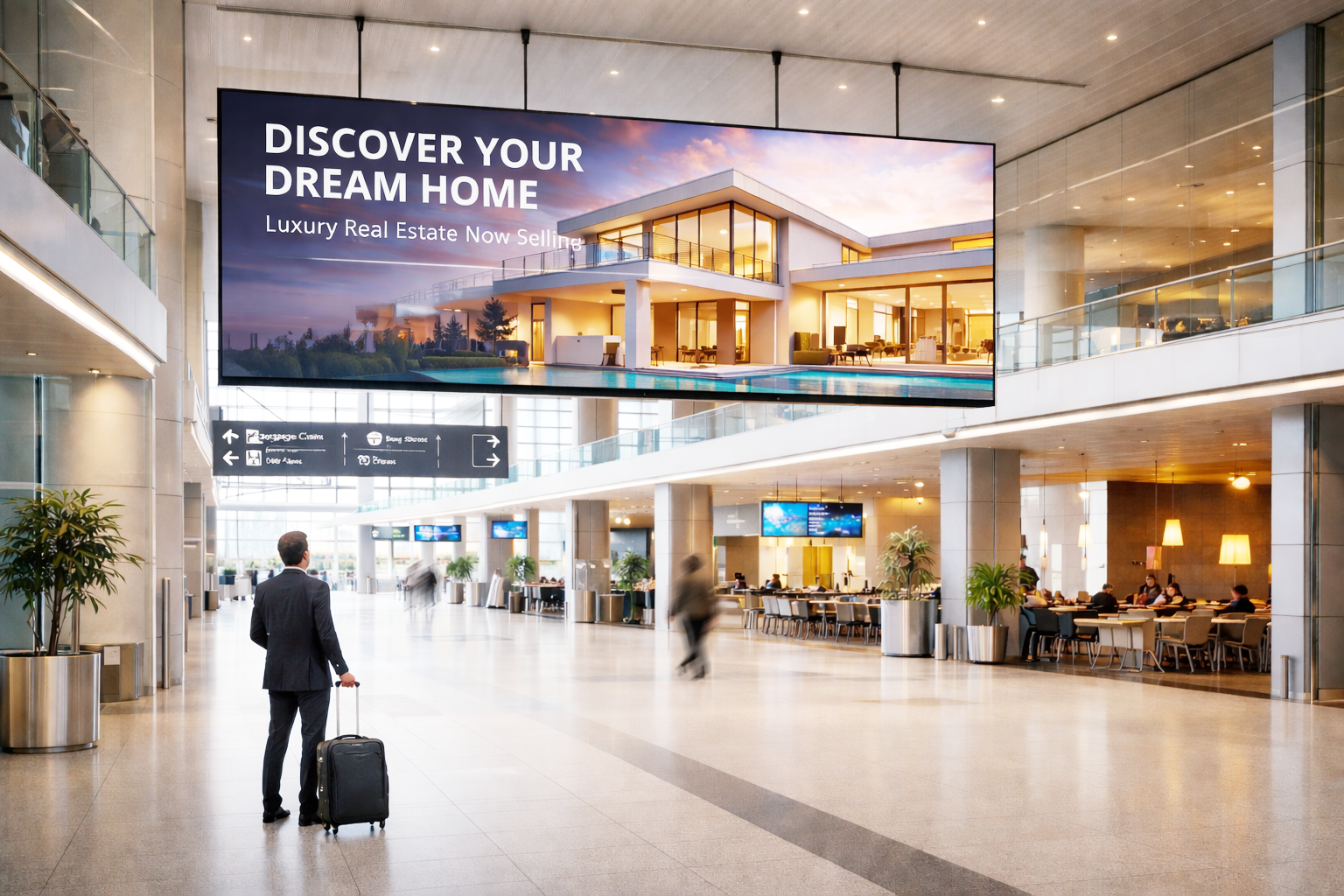
Airport Advertising is Complex to Get Right
We help you execute faster, with proven results and local insight most planners lack starting now.
Talk to an ExpertCatchment Area and Economic Drivers
Top 10 Cities within 150 km: Marketer Intelligence
- Sundsvall: The commercial core. Concentrates banking, insurance, and pension administration headcount alongside industrial management. Produces salaried professionals with high disposable income and strong appetite for financial and investment messaging.
- Timrå: Home to one of Europe's largest pulp operations. Delivers engineering and technical management audiences on corporate travel accounts, ideal for industrial B2B and premium automotive intercept.
- Härnösand: Regional administrative and county seat. Public-sector senior employment with stable, index-linked income and pronounced Mediterranean holiday-property interest.
- Örnsköldsvik: Advanced manufacturing and biorefinery cluster. Exports globally, which produces frequent international business travellers receptive to logistics, banking, and B2B technology.
- Kramfors: Gateway community to the High Coast. Tourism-linked small business ownership, with owner-operators who respond to business banking and equipment finance messaging.
- Sollefteå: Forestry landholding base. Generates asset-rich, income-modest households where land value converts into wealth-transfer and estate-planning demand.
- Hudiksvall: Fibre-optic and industrial technology employment. Technically literate professional audience with above-average consumer electronics and automotive spend.
- Söderhamn: Coastal manufacturing and logistics. Mid-income households with strong seasonal charter leisure participation, best reached with travel-adjacent and family retail categories.
- Ånge: Rail and logistics junction employment. Small-volume audience, useful for regional B2B credibility rather than consumer conversion.
- Bollnäs: Trade and retail centre for southern Hälsingland. Regional business ownership base with recurring commercial vehicle and business services demand.
NRI and Diaspora Intelligence
There is no material South Asian diaspora movement through SDL, and advertisers should not be sold one. The dominant relevant flow is affluent domestic Swedish outbound movement. Västernorrland households, particularly those in the 45 to 70 age band with paid-down property and industrial or public pension entitlements, are among Sweden's most consistent purchasers of overseas second homes. There is a smaller but growing Middle Eastern and Horn of Africa resident community in Sundsvall and Härnösand, generating remittance and family-travel demand that routes primarily via Stockholm rather than SDL. The commercially actionable audience at SDL is domestic wealth in outbound motion.
Economic Importance
The catchment economy rests on forest products, primary aluminium, and administrative services. Forestry and pulp create engineering and procurement audiences with capital-expenditure authority. Aluminium production adds an energy-intensive industrial buyer profile. The financial and government administration cluster in Sundsvall produces a large, salaried, credit-worthy consumer base. For advertisers, this means SDL simultaneously delivers B2B decision-makers and high-creditworthiness consumers within a single, small terminal footprint.
Business and Industrial Ecosystem
- Pulp, paper, and forest products: Produces procurement directors, plant engineers, and technical buyers travelling on corporate accounts, the core audience for industrial equipment, automation, and logistics advertisers.
- Primary aluminium and metals processing: Generates energy, sustainability, and heavy-industry supply chain travellers, a defined audience for energy solutions and industrial finance brands.
- Banking, insurance, and pension administration: Concentrates financial services professionals in Sundsvall, producing both a B2B audience for fintech and data infrastructure and a consumer audience with sophisticated investment literacy.
- Government agency and public administration cluster: Delivers senior civil-service travellers with stable high income, reliable pension wealth, and pronounced overseas property interest.
Passenger Intent: Business Segment
Business travel at SDL is overwhelmingly Stockholm-directed and same-week return. These passengers are travelling for board meetings, agency headquarters engagement, client negotiation, and industrial supplier review. They are time-constrained, repeat-frequency travellers who pass the same media positions multiple times per month, which builds frequency without additional inventory spend. Industrial B2B, business banking, commercial vehicle, telecommunications, and professional services categories intercept them most effectively.
Strategic Insight
The commercial value here is repetition against a named, finite audience. A Nordic industrial supplier does not need a million impressions at SDL; it needs the same 4,000 procurement and engineering decision-makers to see its name eleven times a quarter. That is precisely what this airport delivers, and it is why B2B advertisers achieve stronger recall economics at SDL than at high-volume hubs where their audience is diluted to a fraction of a percent.
Tourism and Premium Travel Drivers
- The High Coast UNESCO World Heritage area: Drives inbound premium nature tourism from Germany, the Netherlands, and Central Europe, an audience receptive to outdoor equipment, premium hospitality, and rental mobility.
- Sundsvall's stone-built city centre: Anchors domestic short-break and conference tourism, supporting hospitality, retail, and event-adjacent advertiser categories.
- Winter sports and outdoor recreation across Medelpad and Jämtland approaches: Produces February and March family and equipment-carrying traffic, valuable for outdoor apparel and mobility brands.
- Coastal and archipelago summer tourism: Concentrates July and August leisure movement with strong second-home and boating spend adjacency.
Passenger Intent: Tourism Segment
Two distinct tourism audiences move through SDL. Inbound visitors are predominantly Northern and Central European nature travellers who have already committed to accommodation and car rental and are receptive to experience, retail, and premium food and beverage messaging on arrival. Outbound leisure passengers are Swedish family and retiree charter travellers heading to the Canary Islands, Greece, and Mediterranean destinations, who have committed significant seasonal spend and are highly receptive to overseas property, currency and card services, travel insurance, and duty-linked premium retail. The outbound charter window is the stronger conversion opportunity.
Travel Patterns and Seasonality
- Peak seasons: February and early March, driven by the Swedish school sports holiday and winter-sun charter demand. Mid-June to mid-August, driven by domestic summer holiday, High Coast inbound tourism, and Midsummer travel. Late October, driven by the autumn half-term charter surge, which has reported fully booked departures. December, driven by Christmas and Lucia family movement.
- Business travel troughs: July and late December, when corporate Stockholm traffic falls sharply.
- Monthly traffic volume breakdown: Data not available.
Event-Driven Movement
- Sportlov school holiday (February to March): Family and winter-sports movement with equipment-carrying passengers. Strong window for outdoor apparel, mobility, and travel finance.
- Easter (March or April): Short-break domestic and second-home movement, effective for retail and hospitality timing.
- Midsummer (June): The most culturally significant Swedish travel trigger, driving family reunion and coastal movement. High receptivity for premium food, beverage, and gifting.
- High Coast summer season (July to August): Peak inbound international leisure arrival, the primary window for destination hospitality and experience advertisers.
- Höstlov autumn half-term (late October): Confirmed sell-out charter demand to Canary Islands destinations. The single highest-intent window for overseas property and residency advertisers.
- Advent and Christmas (December): Gifting, jewellery, and premium retail spend peak with family travel volume.
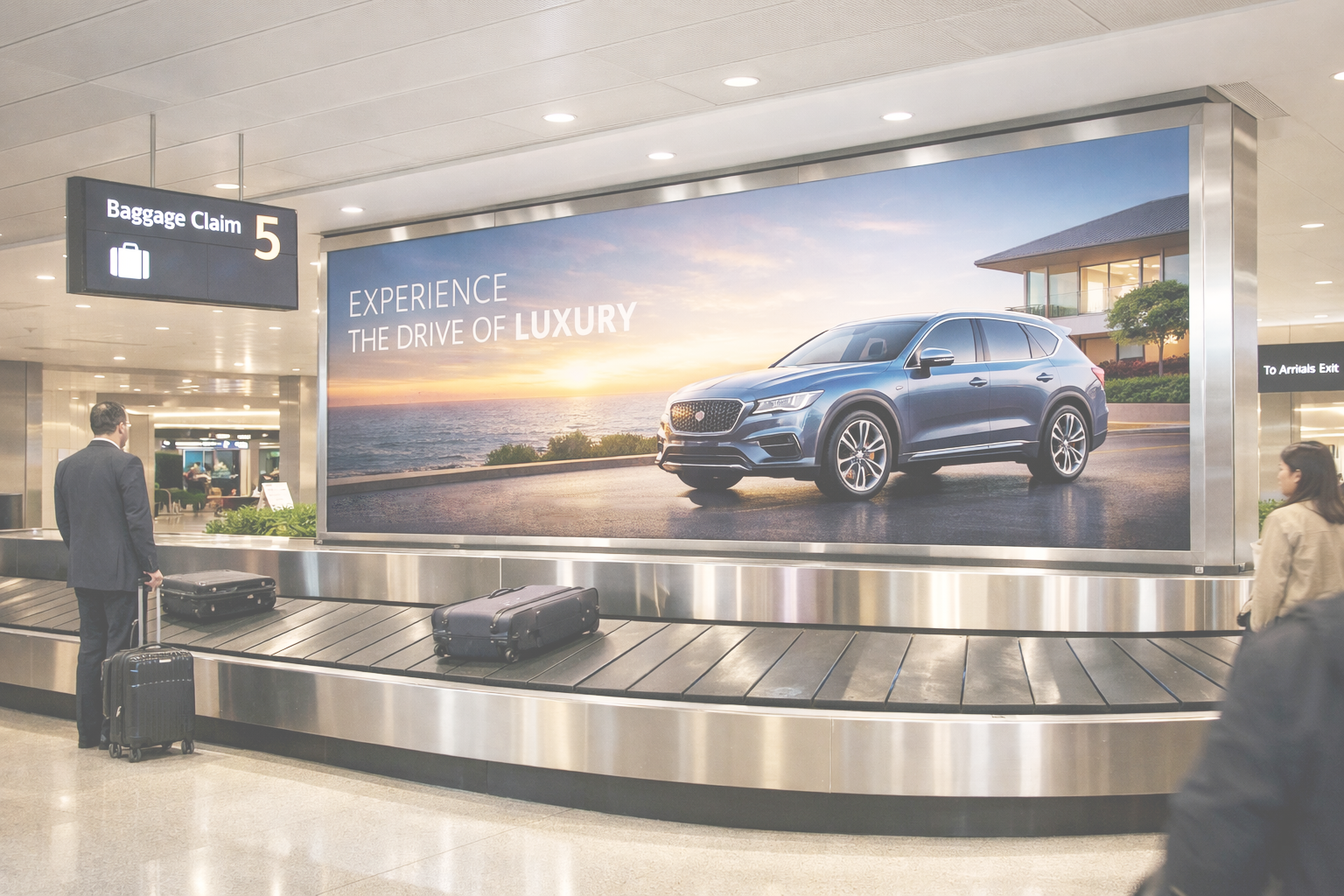
It’s Not Just Where You Advertise - It’s How Fast You Execute
We combine local insight with fast rollout to deliver results for you, now.
Talk to an ExpertAudience and Cultural Intelligence
Top 2 Languages
- Swedish: The operational language of the entire catchment. Swedish-first creative signals local commitment and materially improves trust for financial, property, and B2B categories where credibility determines conversion.
- English: Near-universal comprehension among professionals and the language of inbound Central European and international business travellers. English creative works without penalty for global luxury, automotive, and technology brands.
Major Traveller Nationalities
The passenger base is overwhelmingly Swedish, reflecting the airport's domestic route dominance. Secondary nationalities are German, Dutch, Danish, and Norwegian, arriving for High Coast nature tourism and cross-border industrial business. A smaller Finnish and Baltic business flow connects through Stockholm. For advertisers, this means creative should be built for a Swedish primary reader with English as a fully functional secondary, and should avoid the multi-language clutter appropriate to international hubs.
Religion: Advertiser Intelligence
- Church of Sweden Lutheran tradition (majority nominal affiliation): Religious observance is low but the calendar is commercially decisive. Christmas, Easter, Midsummer, and Lucia function as fixed, high-certainty spend triggers for gifting, jewellery, premium food and beverage, and family travel. Advertisers should treat these as budget-anchoring windows rather than cultural notes.
- Non-religious and secular (very large share): This audience rejects tradition-based appeals and responds to evidence, transparency, and demonstrated value. Sustainability credentials and clear pricing outperform prestige-signalling creative.
- Islam (small but established minority in Sundsvall and Härnösand): Ramadan and Eid create defined family gathering, gifting, and remittance spend windows. Halal-appropriate food and beverage and money-transfer categories benefit from timed activation, though volume through SDL specifically is limited.
Behavioral Insight
This is a high-scepticism, high-diligence audience. Purchase decisions are researched, comparison-driven, and resistant to status appeals. Financial literacy is above average because of the region's banking and pension employment base, which means investment and property advertisers must lead with yield, tax treatment, and regulatory clarity rather than lifestyle imagery. Sustainability claims are scrutinised and unsupported claims damage brands here. The winning message is specific, quantified, and understated.
Outbound Wealth and Investment Intelligence
The outbound passenger at SDL is asset-rich rather than income-flamboyant. Decades of industrial and public-sector employment, mortgage-free property, and mature pension entitlement produce households with substantial deployable capital and a strong cultural preference for hard assets over speculative instruments. Their capital moves in two directions: southward into Stockholm-managed investment vehicles, and outward into sun-belt real estate and residency structures. The airport is the physical chokepoint for both flows.
Outbound Real Estate Investment
Swedish buyers from this catchment concentrate purchases in Spain, particularly the Costa del Sol corridor around Fuengirola, Marbella, and Nerja, where established Nordic communities lower the perceived risk of purchase. Portugal's Algarve is the second destination, selected for climate, tax treatment, and lower entry pricing. France, Italy, and Cyprus attract a smaller premium segment, while Thailand's Hua Hin and Phuket corridors capture retirement-stage buyers seeking cost arbitrage. Yield expectations are modest and holding periods long, which makes this an ideal audience for developers selling stability and rental management rather than capital appreciation. International real estate developers advertising at SDL reach these buyers precisely when they are travelling to view or occupy overseas property.
Outbound Education Investment
Students from Västernorrland pursue higher education primarily within Sweden, then move internationally for postgraduate study. The dominant destinations are the United Kingdom, the Netherlands, Denmark, Germany, and the United States, with growing interest in Swiss hospitality and business programmes. Family spending profiles are strong because tuition is subsidised domestically, leaving household capital available for international study, accommodation, and living costs. International universities, business schools, and education consultancies reach a parent audience here with high funding capacity and low debt aversion.
Outbound Wealth Migration and Residency
Second-residency interest in this catchment is climate-driven and tax-aware rather than mobility-driven. Portugal's residency and tax-status pathways remain the most relevant, followed by Greek and Cypriot residency-by-investment routes and Spanish non-lucrative residency for retirement-stage households. Caribbean citizenship-by-investment programmes attract a narrow entrepreneurial segment. Advisory firms should note that this audience requires regulatory transparency and Swedish-tax-integrated advice, and responds poorly to aggressive programme marketing.
Strategic Implication for Advertisers
Brands on both sides of this corridor should treat SDL as a low-cost, high-precision entry point into Nordic outbound capital. A Portuguese or Spanish developer, a Swiss private bank, or a residency advisory reaches a concentrated, pre-qualified buyer pool here at a fraction of Stockholm pricing. Masscom Global activates both ends of the corridor simultaneously, pairing SDL placement with destination-market airport inventory so the same household is reached at intent and at arrival.
Airport Infrastructure and Premium Indicators
Terminals
- Single compact passenger terminal handling all scheduled domestic and seasonal international charter traffic. Because departure, security, and gate functions are consolidated, every passenger passes the same limited set of high-visibility positions, producing effective frequency without incremental inventory.
- Terminal scale supports approximately 4,074 annual landings as of the last verified statistical year, with capacity headroom well above current utilisation. Additional terminal breakdown: Data not available.
Premium Indicators
- Lounge provision is limited and basic in scale, consistent with a regional domestic airport. This signals that premium positioning must be delivered through creative and placement quality rather than environment prestige.
- General aviation and business aviation handling is available, and the airport is designated as an airport of entry with customs capability, which supports corporate and charter private movement into the industrial catchment.
- No integrated luxury airport hotel. Premium accommodation demand is served in Sundsvall city, roughly 21 km distant.
- The airport operates Sweden's pioneering remote air traffic control tower centre, controlling movements at multiple airports from a single digital facility, and has invested in energy-efficient operations and sustainable aviation fuel readiness. These are meaningful credibility signals for technology, energy, and sustainability advertisers seeking aligned environments.
Forward-Looking Signal
Route development is active, with recently announced connectivity toward Malmö expanding domestic reach beyond the Stockholm dependency, alongside renewed carrier collaboration and confirmed seasonal Canary Islands charter programming extending into the 2026 to 2027 winter season. The remote tower infrastructure gives the airport unusual operational scalability relative to its size, which means capacity can absorb traffic recovery without physical expansion. Advertisers should note that inventory pricing at SDL currently reflects contracted traffic rather than recovering traffic. Masscom Global advises clients to secure position and rate now, ahead of the route expansion cycle, so contracted terms carry through the recovery rather than being reset against it.
Airline and Route Intelligence
Top Airlines
Scandinavian Airlines and PopulAir operate the scheduled programme, with TUI fly Nordic delivering seasonal leisure charter and West Air Sweden operating cargo services.
Key International Routes
Seasonal charter service to Gran Canaria, with Rhodes and additional Mediterranean and Canary Islands programming operating in peak leisure windows. Weekly frequency by route: Data not available.
Domestic Connectivity
Stockholm Arlanda is the dominant route and the airport's commercial backbone, carrying the majority of business traffic. Secondary domestic service operates to Malmö and Umeå, extending north-south reach within Sweden.
Wealth Corridor Signal
The route map tells a precise story. The Stockholm axis is a pure wealth-and-decision corridor, carrying industrial executives, financial professionals, and public-sector seniority in both directions on repeat frequency. The Canary Islands and Mediterranean charters are a discretionary-spend corridor, carrying committed leisure capital and overseas-property intent. The Malmö and Umeå services are functional connectivity with limited premium signal. Advertisers should buy the Stockholm corridor for B2B and financial services, and time activation to the charter corridor for property, residency, and premium consumer categories.
Media Environment at the Airport
- Terminal scale is compact and advertising clutter is minimal compared with Stockholm gateways, which means a single well-placed execution can achieve near-exclusive visual ownership of the passenger journey. Standout potential is exceptionally high relative to spend.
- Dwell time is driven by security processing, the consolidated check-in and retail area, and the single gate hold environment. Business passengers on repeat Stockholm rotations deliver high frequency against the same positions, compounding recall across a campaign flight.
- The remote tower technology leadership, sustainability investment, and calm, uncrowded terminal atmosphere create a credible, unhurried environment that supports considered-purchase categories such as property, wealth management, and industrial B2B far better than high-pressure hub environments.
- Masscom Global provides inventory access, placement precision, and rollout across the full SDL passenger path, with the local insight to align activation to charter windows and business-travel rhythms rather than flat annual scheduling.
Strategic Advertising Fit
Best Fit
- Industrial B2B and automation: Reaches procurement and engineering decision-makers from forestry, pulp, and metals operations with genuine capital-expenditure authority.
- Banking, wealth management, and private advisory: Intercepts an unusually financially literate audience concentrated by the region's banking and pension administration employment.
- International real estate developers: Aligns directly with confirmed Spanish, Portuguese, and Southeast Asian purchase behaviour among this catchment's asset-rich households.
- Residency and citizenship-by-investment advisory: Matches climate-driven second-residency demand among retirement-stage and pre-retirement households.
- Premium automotive and commercial vehicles: Fits both high-income salaried professionals and regional business owners with fleet requirements.
- Energy, sustainability, and cleantech: Environment credentials and heavy-industry audience create rare category-context alignment.
- Higher education and international study: Reaches parents with strong funding capacity and established international study patterns.
- Outdoor, technical apparel, and equipment: Aligns with High Coast tourism inflow and winter sports seasonality.
Brand Alignment at a Glance
| Category | Fit |
|---|---|
| Industrial B2B and automation | Exceptional |
| Banking and wealth management | Exceptional |
| International real estate | Strong |
| Residency and investment migration | Strong |
| Premium automotive | Strong |
| Higher education | Moderate |
| Ultra-luxury watches and haute joaillerie | Moderate |
| Global transit-hub duty free and mass FMCG | Poor fit |
Who Should Not Advertise Here
- Ultra-luxury conspicuous-consumption brands relying on scale: The audience is culturally averse to status display and the volume is insufficient to justify flagship prestige spend.
- Mass-market FMCG and impulse retail: Passenger volume is too low to deliver the reach economics these categories require.
- Long-haul connecting-passenger and transit-oriented advertisers: SDL carries almost no international transit traffic, so airline alliance, hub-transfer, and global roaming propositions have no relevant audience.
Event and Seasonality Analysis
- Event Strength: Medium
- Seasonality Strength: High
- Traffic Pattern: Dual-Peak
Strategic Implication
Budget should not be spread evenly across the year at SDL. Business-oriented B2B and financial campaigns deliver maximum return between September and November and again from January to May, when Stockholm corridor frequency is highest. Consumer, property, and residency campaigns should be concentrated into February, late October, and December, when charter demand peaks and discretionary intent is at its highest. Masscom Global structures SDL campaigns around this dual rhythm, weighting delivery into the windows where the intended audience is physically present rather than paying for months when it is not.

Poor Placement and Delays Affect Airport Campaigns
We help you move faster, access better inventory, and get it right now.
Talk to an ExpertFinal Strategic Verdict
Sundsvall Timrå Airport is a specialist buy that rewards advertisers who understand what they are purchasing. It will never deliver hub-scale impressions, and no serious media plan should ask it to. What it does deliver is uncontested access to the industrial, financial, and administrative decision-making population of Sweden's mid-coast, at repeat frequency, inside a low-clutter terminal where a single execution owns the environment. Industrial B2B brands reach procurement authority they cannot isolate at Arlanda. International property developers and residency advisers reach asset-rich Nordic households at the exact moment those households are travelling toward the Mediterranean and Canary Islands markets they are buying into. The airport's remote tower leadership, sustainability investment, and active route development toward Malmö signal capacity and connectivity growth priced against current contracted traffic rather than future recovery. Advertisers who secure position now hold favourable terms through that recovery. Masscom Global brings the inventory access, catchment intelligence, and execution speed to make a Tier 3 airport perform like a Tier 1 audience buy.
About Masscom Global
Masscom Global is a premium international airport advertising and media buying agency operating across 140 countries. With deep expertise in airport OOH, premium publications, and high-net-worth audience targeting, Masscom helps brands reach the world's most valuable travellers at the moments that matter most. For advertising packages, media rates, and campaign planning at Sundsvall Timrå Airport and airports across the globe, contact Masscom Global today.
Frequently Asked Questions
How much does airport advertising cost at Sundsvall Timrå Airport? Cost varies by format, position within the terminal, campaign duration, and seasonal demand, with February, late October, and December commanding premium rates because of charter concentration. Because the terminal is compact and inventory is finite, high-visibility positions are limited and priced accordingly. Masscom Global provides current rates, format availability, and package options on request.
Who are the passengers at Sundsvall Timrå Airport? The passenger base is predominantly Swedish and domestic. It is led by business travellers from forestry and pulp, primary aluminium, and advanced manufacturing operations, alongside a large professional cohort from Sundsvall's banking, insurance, pension administration, and government agency clusters. Seasonal charter windows add affluent family and retirement-stage leisure travellers heading to the Canary Islands and Mediterranean. Inbound international traffic is largely German, Dutch, and Nordic nature tourism bound for the High Coast.
Is Sundsvall Timrå Airport good for luxury brand advertising? Selectively. The audience has high household wealth and strong financial literacy, but Swedish cultural norms discourage conspicuous display, and passenger volume is too low for flagship prestige campaigns. Luxury categories that perform here are understated and considered: private banking, wealth advisory, premium automotive, high-end property, and quality-led craftsmanship brands. Volume-dependent luxury retail is better placed at Stockholm Arlanda.
What is the best airport in Sweden to reach HNWI audiences? Stockholm Arlanda leads on absolute high-net-worth volume, with Gothenburg Landvetter second. Sundsvall Timrå occupies a different position: it is the most efficient route to the industrial and administrative wealth of Sweden's mid-coast, where household asset positions are strong and media competition is minimal. The correct strategy is Arlanda for scale and SDL for precision within the Norrland corridor.
What is the best time to advertise at Sundsvall Timrå Airport? For B2B and financial services, September to November and January to May, when Stockholm corridor business frequency peaks. For consumer, property, and residency categories, February during the sports holiday, late October during the autumn half-term charter surge, and December during Christmas gifting season. July delivers inbound High Coast tourism but weak business traffic.
Can international real estate developers advertise at Sundsvall Timrå Airport? Yes, and it is one of the strongest category fits at this airport. This catchment's households are active buyers in the Costa del Sol, Algarve, France, Italy, Cyprus, and Thailand's Hua Hin and Phuket markets, typically purchasing with substantial equity and long holding intent. Reaching them at the departure point of their charter journey captures intent before arrival. Creative should lead with yield, tax treatment, rental management, and regulatory clarity rather than lifestyle imagery.
Which brands should not advertise at Sundsvall Timrå Airport? Mass-market FMCG and impulse retail cannot achieve viable reach economics at this passenger volume. Transit-dependent categories such as airline alliances, hub-transfer propositions, and global roaming have effectively no audience, as international transit traffic is negligible. Scale-dependent conspicuous luxury also underperforms, both on volume and on cultural fit.
How does Masscom Global help brands advertise at Sundsvall Timrå Airport? Masscom Global delivers the full pathway: catchment and audience intelligence specific to Västernorrland, inventory access across the terminal passenger journey, creative guidance calibrated to Swedish audience scepticism and language preference, seasonal scheduling built around the dual business and charter rhythm, and end-to-end execution with performance reporting. Masscom also activates the destination side of the corridor so the same household is reached at departure and at arrival. Book a fifteen-minute planning call to review availability and rates.







