

Airport at a Glance
| Field | Detail |
|---|---|
| Airport | Frankfurt Airport |
| IATA Code | FRA |
| Country | Germany |
| City | Frankfurt |
| Annual Passengers | 60.7 million international (2023–24) |
| Primary Audience | Ultra HNWI Eurozone financial and banking executives, global trade fair and MICE delegates, German industrial and automotive sector principals, pharmaceutical and chemical industry leaders |
| Peak Advertising Season | September to November, March to June |
| Audience Tier | Tier 1 — Ultra |
| Best Fit Categories | Private banking and financial services, premium automotive, B2B industrial technology, pharmaceutical and life sciences, international real estate |
Frankfurt Airport is the primary gateway to a city that performs an extraordinary range of commercially critical functions simultaneously. Frankfurt am Main is where the European Central Bank sets monetary policy for twenty member states. It is where Deutsche Bank, Commerzbank, and DZ Bank headquarter their global operations. It is where Deutsche Börse operates the Frankfurt Stock Exchange and the Xetra trading platform that price Europe's most significant equities. It is where Messe Frankfurt — the world's largest trade fair company by revenue — organises the Frankfurt Book Fair, Automechanika, and dozens of globally definitive B2B industry events that draw the purchasing and deal-making authority of entire industries from every continent annually. And it sits within 150 kilometres of the headquarters of some of the world's most commercially consequential corporations — Merck KGaA, Boehringer Ingelheim, Fresenius, BASF, and Opel among them. For an advertiser seeking access to European corporate decision-making authority across the broadest possible industrial and financial base, FRA is not one option among several. It is the structural gateway to the commercial engine room of Europe's largest economy.
What distinguishes FRA from Amsterdam's technology-forward positioning and Paris's luxury cultural authority is the depth and diversity of German industrial wealth it serves. The executive transiting FRA is not primarily a luxury consumer — they are a capital allocator, a deal-maker, a procurement authority, or a technology commissioner operating at the intersection of finance, manufacturing, chemicals, automotive, and pharmaceutical industries that collectively define the competitive terms of European corporate activity. They travel in Lufthansa's first and business class cabins as a professional standard, hold Hon Circle and Senator tier status, and make brand decisions with the measured, evidence-based authority that characterises the German commercial culture at its most commercially productive. Advertising at FRA earns its audience through demonstrated commercial substance — and the return for earning it is access to the most institutionally powerful corporate audience in Continental Europe.


Advertising Value Snapshot
- Passenger scale: 60.7 million international passengers (2023–24), making FRA Europe's fourth-largest international airport by volume, with sustained recovery driven by Lufthansa's expanding transatlantic and Asian long-haul network, growing trade fair-driven MICE traffic, and Frankfurt's post-Brexit consolidation as the Eurozone's pre-eminent financial services hub
- Traveller type: Ultra HNWI Eurozone banking and ECB-adjacent financial principals, German automotive and chemical industry executives, global Messe Frankfurt trade fair delegates, pharmaceutical and life sciences sector leaders, post-Brexit London-relocated European banking professionals
- Airport classification: Tier 1 — Ultra. FRA holds a top-five HNWI classification in Western Europe and is the premier airport in Europe for financial services and industrial corporate audience concentration — a category distinction defined not by luxury consumption but by institutional commercial authority
- Commercial positioning: The Eurozone's foremost financial gateway and the world's trade fair capital airport, serving a catchment that concentrates the ECB, three of Germany's five largest banks, the world's largest trade fair company, and the headquarters clusters of some of the world's most commercially significant pharmaceutical and chemical companies within a 150-kilometre radius
- Wealth corridor signal: FRA sits at the intersection of the transatlantic financial corridor via Lufthansa's Star Alliance network, the Asian industrial and automotive trade corridor via extensive East Asian connectivity, the GCC banking and investment corridor via multiple Gulf carrier services, and the pharmaceutical and chemical industry corridors connecting Frankfurt's Rhine-Main region to global research and manufacturing partners
- Advertising opportunity: Masscom Global provides direct access to FRA's premium Terminal 1 and Terminal 2 inventory, enabling brands to reach Continental Europe's most institutionally authoritative commercial audience in an airport whose operational scale, Lufthansa First Class Terminal exclusivity, and Messe Frankfurt-driven MICE traffic concentration create advertising conditions that are commercially unmatched in the European industrial corporate market
Airport Advertising is Complex to Get Right
We help you execute faster, with proven results and local insight most planners lack starting now.
Talk to an ExpertCatchment Area and Economic Drivers
Top 10 Cities within 150 km — Marketer Intelligence
- Frankfurt am Main: The Eurozone's financial capital, housing the European Central Bank, Deutsche Bundesbank, Frankfurt Stock Exchange, Deutsche Bank, Commerzbank, DZ Bank, Helaba, and the European or German headquarters of every major global investment bank and financial institution operating in the EU — producing a daily FRA departure audience of financial sector principals, ECB and Bundesbank officials, and corporate deal-makers whose institutional authority is without equivalent at any other German airport
- Darmstadt: The home of Merck KGaA — one of the world's oldest and most commercially significant pharmaceutical and life sciences companies, a global leader in semiconductor materials, display technologies, and healthcare — generating a community of scientific executives, commercial leaders, and technology principals who travel internationally for research partnerships, regulatory engagement, and investor relations with a frequency and premium-class booking profile that marks them as core FRA Ultra HNWI commercial audience
- Bad Homburg: The spa city and pharmaceutical hub immediately north of Frankfurt, housing the headquarters of Fresenius Medical Care — one of the world's largest kidney dialysis companies — and significant German operations of other pharmaceutical and healthcare companies, producing a community of life sciences executives and wealthy residential professionals whose proximity to FRA makes them a natural component of the airport's Ultra HNWI catchment
- Wiesbaden: The Hessian state capital and one of Germany's most historically affluent residential cities, combining government administration with an established luxury residential community of banking executives, diplomatic personnel, and old-money Frankfurt professional families whose international travel patterns route consistently through FRA
- Mainz: The capital of Rhineland-Palatinate and a city of growing technology significance — home to BioNTech, which developed one of the world's most commercially successful mRNA vaccines and generated a concentration of biotech entrepreneurial wealth unprecedented in German medical science — generating a new generation of pharmaceutical and biotechnology founders whose international travel intensity and personal wealth profiles represent a rapidly emerging Ultra HNWI segment at FRA
- Mannheim: A major industrial and commercial hub of the Rhine-Neckar metropolitan region, housing significant operations of Daimler Truck, Roche Diagnostics, and John Deere Germany, alongside the operational centre of several major chemical and engineering firms — producing a dense community of industrial executives with regular transatlantic and Asian travel mandates and upper-HNWI compensation structures
- Heidelberg: The home of one of Germany's most globally recognised universities and a significant pharmaceutical research and biotechnology cluster, with Roche Molecular Diagnostics and Heidelberg Pharma among the anchoring life sciences companies — generating a community of academic-commercial pharmaceutical leaders whose international conference, collaboration, and regulatory travel routes through FRA with consistent frequency
- Karlsruhe: Germany's technology law and research city, hosting the Federal Constitutional Court of Germany and the Karlsruhe Institute of Technology — one of Germany's leading technical universities — alongside significant technology industry operations including KIT's spin-off ecosystem and the broader Baden-Württemberg technology manufacturing corridor, producing an audience of legal-institutional principals and technology sector executives whose FRA travel patterns are commercially active year-round
- Würzburg: The gateway to Franconia's wine and tourism economy and a significant regional commercial hub in northern Bavaria, producing a community of wine industry executives, regional manufacturing entrepreneurs, and cultural tourism professionals whose international travel uses FRA as the primary gateway and whose premium consumption behaviour is shaped by direct proximity to one of Germany's most distinguished wine-producing regions
- Koblenz: The strategic commercial and logistics gateway at the confluence of the Rhine and Moselle rivers — one of Europe's most historically significant trade corridors — generating a community of logistics, chemicals, and mid-tier industrial entrepreneurs whose Rhine Valley commercial networks maintain active international trade relationships through FRA and whose wealth profiles are rising alongside the corridor's continued industrial activity
NRI and Diaspora Intelligence
Frankfurt's diaspora profile is one of the most commercially layered of any European airport, reflecting Germany's post-war guest worker history and its subsequent emergence as Europe's most economically active immigration destination. The Turkish community — Germany's largest diaspora group at approximately 3 to 4 million nationally, with significant concentration in the Frankfurt and Rhein-Main area — uses FRA as its primary bilateral gateway to Istanbul and Ankara, maintaining family, business, and cultural connections with a travel frequency that makes the Frankfurt-Istanbul route one of the busiest bilateral corridors at FRA. The Turkish business community in Germany has produced a significant tier of entrepreneurs and industrialists — particularly in construction, logistics, retail, and food service — whose purchasing power and international commercial activity place them in the upper-income bracket of the FRA diaspora audience. The Iranian diaspora — one of the largest in Europe, with particular concentration in Frankfurt where an estimated 60,000 to 80,000 Iranian-origin residents constitute one of the most commercially significant émigré communities in Germany — uses FRA as its primary gateway for cultural, business, and family connections to Tehran and Dubai. Many Iranian HNWI families relocated to Frankfurt following the 1979 revolution, establishing themselves in real estate, medicine, engineering, and trade, and now represent a commercially active audience for luxury real estate, private banking, and premium lifestyle brand advertising. The Italian diaspora — rooted in the Gastarbeiter migration of the 1950s and 1960s — adds a Mediterranean commercial dimension to the FRA bilateral route portfolio, while the Indian pharmaceutical and IT professional community, growing rapidly in the Darmstadt-Frankfurt corridor as Merck KGaA and related companies expand their international workforce, is generating an increasingly significant HNWI segment at FRA.
Economic Importance
The Rhine-Main region — anchored by Frankfurt but extending through Wiesbaden, Mainz, Darmstadt, and the surrounding industrial corridor — is the most financially concentrated metropolitan economy in Continental Europe. Frankfurt alone generates a GDP that places it among the top five European city economies despite its relatively modest population, driven overwhelmingly by the depth and institutional weight of its financial services sector. The European Central Bank's presence in Frankfurt is not simply symbolic — the ECB and its associated regulatory, supervisory, and monetary policy functions draw hundreds of senior economists, financial regulators, and institutional banking representatives to Frankfurt on a permanent and rotating basis, creating a sustained high-compensation professional community that uses FRA as their daily work-adjacent airport. Post-Brexit, dozens of London-based financial institutions relocated their EU-licensed operations to Frankfurt — Goldman Sachs, Morgan Stanley, Citigroup, Barclays, JPMorgan, and others all established or substantially expanded Frankfurt presences — adding a layer of globally elite financial sector professionals whose London standards of premium service and brand expectation now operate from a Frankfurt base. For an advertiser, the Rhine-Main economy does not produce one commercially defined audience segment. It produces the full spectrum of institutional financial authority, industrial corporate leadership, and scientific-commercial excellence simultaneously.
Business and Industrial Ecosystem
- Financial services, ECB, and post-Brexit banking consolidation: The European Central Bank, Deutsche Bundesbank, Frankfurt Stock Exchange, Deutsche Bank, Commerzbank, and the relocated EU operations of London's major investment banks collectively generate a financial services executive community whose institutional authority, compensation structures, and international travel mandates place them at the apex of the FRA commercial audience — a tier of principals whose brand decisions reflect institutional prestige requirements rather than personal aspiration, making them ideal targets for private banking, premium corporate hospitality, international real estate, and financial technology advertising
- Pharmaceutical and life sciences: The Darmstadt-Frankfurt-Mainz corridor is one of the world's most commercially productive pharmaceutical and life sciences geographies, housing Merck KGaA, Boehringer Ingelheim (Ingelheim, 40km from FRA), BioNTech, Fresenius Medical Care, and dozens of subsidiary and supply chain pharmaceutical companies — generating a community of life sciences executives, research directors, and commercial leaders with regular transatlantic and Asian travel for clinical partnerships, regulatory meetings, and investor relations, and whose compensation and equity participation structures produce a new and rapidly growing HNWI tier within the FRA commercial audience
- Automotive and engineering: The German automotive industry's presence in the FRA catchment — anchored by Opel's headquarters in Rüsselsheim (35 kilometres from FRA), supported by the supplier and engineering networks of BMW, Mercedes-Benz, and Volkswagen's Rhine-Main operations — generates a community of automotive executives and precision engineering principals with significant international travel to Japan, South Korea, China, and the United States for technology partnerships, procurement negotiations, and market expansion, and whose personal and professional premium brand engagement mirrors the engineering excellence that defines their commercial output
- Chemical industry: BASF, headquartered in Ludwigshafen approximately 70 kilometres south of FRA, is the world's largest chemical company by revenue and generates a community of senior chemical and materials science executives whose international travel for supply chain management, research collaboration, and regulatory compliance routes primarily through FRA — an audience whose institutional commercial authority and compensation structure place them firmly in the FRA Ultra HNWI tier
Passenger Intent — Business Segment
The FRA business traveller is travelling with the authority of one of the most commercially disciplined corporate cultures in the world. They are flying to New York for a capital markets roadshow, to Tokyo for an automotive technology partnership meeting, to Mumbai for a pharmaceutical licensing discussion, or to Dubai for a banking investment review. They occupy Lufthansa First and Business Class as a contractual entitlement rather than a personal preference, carry Lufthansa Hon Circle or Senator status as a mark of their travel intensity, and make brand decisions based on demonstrated performance, institutional credibility, and product engineering quality — the three values that the German commercial tradition applies to all purchasing decisions from automobiles to asset management. Advertiser categories that intercept them most effectively at FRA include premium automotive, private banking and family office services, international commercial real estate, pharmaceutical and medtech industry platforms, corporate legal and advisory services, and premium B2B technology. The FRA business passenger does not respond to advertising that asks them to aspire — they respond to advertising that demonstrates why a specific product or service is the most capable in its category.
Strategic Insight
The B2B advertising environment at FRA is the most institutionally authoritative in Continental European aviation. The combination of ECB and Bundesbank financial weight, the post-Brexit banking consolidation that has made Frankfurt the undisputed EU financial regulatory centre, the pharmaceutical and life sciences leadership of the Darmstadt-Mainz-Frankfurt corridor, and the Messe Frankfurt MICE infrastructure that brings the world's entire B2B trade hierarchy to Frankfurt multiple times annually creates an advertising environment whose commercial audience is constituted by decision-makers rather than by the people who report to them. For B2B brands — whether in financial technology, enterprise software, premium automotive, life sciences services, or industrial B2B — there is no airport in Europe whose business audience more completely represents the hierarchy of institutional purchasing authority.
Tourism and Premium Travel Drivers
- Messe Frankfurt and global trade fair tourism: The world's largest trade fair company operates from Frankfurt, hosting over 50 international trade fairs annually that collectively draw over 2 million visitors from 180 countries — producing tourism flows that are not leisure-driven but commercially driven, and whose participants carry higher average daily business spending than almost any category of leisure tourist. Frankfurt Book Fair, Automechanika, Light + Building, ISH, and Ambiente each concentrate global industry purchasing authority in Frankfurt for four to six days at a time, making FRA's trade fair-driven MICE audience the most commercially concentrated event-driven advertising opportunity in European aviation.
- Rhine Valley and UNESCO World Heritage tourism: The Middle Rhine Valley — a UNESCO World Heritage Site approximately 50 kilometres west of FRA, stretching from Bingen to Koblenz — is one of Germany's most visited heritage landscapes, drawing culturally educated European and international tourism that uses Frankfurt as its air gateway. Rhine cruise passengers, castle tourism visitors, and the premium wine tourism market of the Rhine and Moselle valleys generate a secondary leisure audience at FRA with upper-income cultural tourism spending profiles.
- Heidelberg Castle and Baroque heritage tourism: Heidelberg's partially ruined Renaissance and Baroque castle — one of Germany's most photographed heritage landmarks — anchors a significant international cultural tourism market that uses FRA as its arrival gateway, drawing American, Japanese, and European visitors whose premium leisure profiles include luxury accommodation and cultural spending.
- Frankfurt's own cultural circuit: The Frankfurt Museum Embankment (Museumsufer) — the densest concentration of museums per kilometre of any street in the world — houses the Städel Museum (one of Europe's finest Old Master and modern art collections), the Museum of Applied Arts, the German Film Museum, and a dozen other world-class cultural institutions along the Sachsenhausen riverbank, generating a culturally motivated premium inbound tourism audience that combines with the city's business travel economy to produce a year-round commercial audience of diverse commercial intent
Passenger Intent — Tourism Segment
The international leisure tourist arriving at FRA has chosen a destination that is primarily known for business and industry rather than pure leisure — and that selection signals a commercially sophisticated traveller profile. Rhine Valley cruise passengers are typically retired or semi-retired European and American professionals with significant accumulated wealth and premium hospitality spending behaviour. Heritage tourism visitors to Heidelberg and the Romantic Road are drawn from the culturally educated HNWI leisure segment. Trade fair visitors — while technically MICE rather than leisure — represent a commercially distinct spending profile that includes significant hotel, dining, and corporate hospitality expenditure. Together, these streams produce a FRA tourism audience whose average income is substantially above the European leisure travel mean, making the airport commercially productive for premium hospitality, luxury automotive, and premium lifestyle advertising even outside its peak B2B commercial windows.
Travel Patterns and Seasonality
Peak seasons:
- September to November (trade fair season and Messe Frankfurt peak): FRA's most commercially concentrated advertising window, driven by the autumn trade fair calendar — Frankfurt Book Fair (October), Automechanika (September biennial), and a cluster of major B2B industrial and professional trade events that collectively bring the world's purchasing authority to Frankfurt for six sustained weeks. This window produces the single highest concentration of global B2B decision-makers at any airport in Europe at any time of year.
- March to June (spring trade fair season and corporate travel surge): The secondary commercial peak, combining the spring Messe Frankfurt calendar — Light + Building, ISH, and various professional trade events — with the post-Q1 corporate travel restart and the acceleration of the transatlantic and Asian business travel cycle that drives Lufthansa's long-haul network to its spring operational peak.
- January to February (ECB and financial conference season): The Eurozone financial calendar begins in January with ECB Governing Council meetings, Bundesbank policy cycles, and the broader European financial regulatory calendar driving a concentrated B2B financial services audience window that is commercially productive for private banking, fintech, and financial advisory advertising.
Event-Driven Movement
- Frankfurt Book Fair (Frankfurter Buchmesse — October): The world's largest trade book fair, drawing over 300,000 visitors from more than 100 countries — publishers, literary agents, media executives, technology and education companies, and cultural ministers — to Frankfurt for five days in mid-October. The Buchmesse generates the most internationally diverse single-event B2B audience of any fair in the Messe Frankfurt calendar, with cultural, media, technology, and education industry principals from every global source market transiting FRA in a concentrated five-day window that is commercially distinctive for media, technology, premium education, and cultural brand advertising.
- Automechanika (September, biennial): The world's largest automotive aftermarket and automotive technology trade fair, drawing over 150,000 professional visitors from 170 countries and representing the full global automotive supply chain purchasing hierarchy in a single Frankfurt venue. Automechanika years produce extraordinary automotive B2B audience density at FRA — a premium advertising window for premium automotive brands, automotive technology companies, and industrial supply chain service providers targeting the global automotive trade community.
- ISH Frankfurt (March, biennial — building technology and water): Europe's largest trade fair for water, heating, air conditioning, and renewable energy, drawing global building technology executives and sustainable energy professionals — a concentrated window for premium technical brand advertising targeting the global construction and building technology industry's decision-making tier.
- Light + Building (March, biennial): The world's leading trade fair for lighting and building technology, generating a concentrated global architecture, design, and building technology audience that is commercially relevant for premium design brands, luxury lighting manufacturers, and premium lifestyle advertising targeting the design and architecture HNWI professional community.
- ECB Governing Council Meetings (variable, six-weekly cycle): The European Central Bank's regular monetary policy meetings draw central bankers, financial economists, and investment community representatives to Frankfurt on a six-weekly cycle — producing a recurring, modestly scaled but institutionally authoritative B2B audience window for financial services advertising targeting the Eurozone monetary policy community.
- Christmas Market season (November to December): Frankfurt's Römerberg Christmas Market — one of Germany's oldest and most celebrated — draws significant domestic and European leisure tourism in November and December, generating a secondary leisure audience at FRA with premium consumer spending behaviour and a distinctive gifting and luxury goods purchasing mindset during the festive window.
It’s Not Just Where You Advertise - It’s How Fast You Execute
We combine local insight with fast rollout to deliver results for you, now.
Talk to an ExpertAudience and Cultural Intelligence
Top 2 Languages
- German: The national language of Germany and the primary commercial and professional language of the FRA domestic audience. German-language advertising at FRA signals market commitment and commercial respect for the German audience's cultural and linguistic identity — a commercially pragmatic group that responds measurably better to advertising in German than to English-language international creative that treats Germany as an extension of a pan-European generic market. For any brand with German HNWI domestic market ambitions, German-language advertising at FRA is the commercial baseline.
- English: The international commercial language of FRA's transatlantic, Asian, and GCC business audience and the operational language of Frankfurt's post-Brexit financial sector, where relocated London banking professionals have created a significantly Anglophone professional community within the Frankfurt financial district. English-language advertising at FRA reaches the full international premium cabin audience and the relocated financial sector community with equal precision, making it the mandatory second creative language for any brand targeting FRA's internationally oriented commercial audience.
Major Traveller Nationalities
FRA's passenger base reflects Lufthansa's Star Alliance hub role and Germany's position as the world's third or fourth largest exporter. German domestic business and HNWI travellers anchor the outbound corporate audience. American business travellers — among the highest volume transatlantic corridor nationalities at FRA — arrive for automotive procurement, pharmaceutical licensing, technology partnership, and financial services engagement with German and European corporates. Japanese and Korean automotive and electronics executives transit FRA for supply chain and technology partnership engagement. Chinese corporate delegations travel for infrastructure investment, automotive, and manufacturing partnership discussions. Indian pharmaceutical executives maintain regular Frankfurt-Mumbai corridor travel for Merck KGaA and Boehringer Ingelheim supply chain and licensing engagements. GCC investment and business delegations transit FRA for European asset management and infrastructure investment. Turkish diaspora and business community generate significant bilateral Istanbul-Frankfurt commercial traffic. The combined passenger base is one of the most industrially diverse of any European hub airport — reflecting the breadth of Germany's export economy and its commercial relationships across every global trade corridor.
Religion — Advertiser Intelligence
- Christianity (approximately 55% of Germany — Catholic majority in southern Hesse and Bavaria, Protestant majority in northern Hesse and Germany): The dominant cultural and practicing religious community of FRA's German domestic audience. Christmas is the most commercially intensive festive window in the German retail calendar — the Frankfurt Christmas Market season drives premium gifting, fine goods, and luxury retail spending from mid-November through December, producing a sustained consumer commercial window that is the most commercially active of the domestic German year. Easter drives secondary family leisure travel and a gifting cycle. The Christian festive calendar at FRA aligns with Messe Frankfurt's autumn and spring trade fair peaks to produce a full-year commercial structure where event-driven and festive windows alternate at high commercial intensity.
- Islam (approximately 6% of Germany, significantly higher in Frankfurt and Rhein-Main area): The Turkish and Moroccan Muslim diaspora communities at FRA generate concentrated bilateral travel windows during Ramadan and both Eid festivals. The Turkish business diaspora — one of Germany's most commercially active diaspora communities — produces elevated retail and premium goods purchasing at FRA during pre-Eid periods. The Iranian diaspora community — many of whom are culturally and nominally Muslim but commercially secular — adds a secondary dimension to the Islamic community profile at FRA that is more commercially relevant through Iranian New Year (Nowruz, March) and secular cultural occasions than through Islamic festival cycles.
- Judaism (approximately 0.1% of Germany nationally, but Frankfurt has one of Germany's most historically significant Jewish communities — approximately 20,000 to 25,000 registered members): Frankfurt's Jewish community is historically one of the oldest and most culturally significant in Europe — the Rothschild banking family originated in Frankfurt's Judengasse, and the Frankfurt Jewish community's commercial heritage in finance, publishing, and trade has left a permanent institutional imprint on the city's economic character. The contemporary Frankfurt Jewish community maintains active commercial and cultural ties to Israel, New York, and London, and generates international travel through FRA with a purchasing profile that consistently places it in the HNWI bracket — commercially relevant for premium financial services, real estate, and luxury goods brands with Israeli and international Jewish community market relevance.
- Hinduism (approximately 0.5% nationally, growing in the Frankfurt-Darmstadt pharmaceutical corridor):The Indian Hindu professional community in the Frankfurt-Darmstadt life sciences corridor — drawn to Germany by Merck KGaA, Boehringer Ingelheim, and related pharmaceutical companies — generates Diwali-period travel to India and a growing premium consumer presence at FRA whose purchasing behaviour mirrors the Indian pharmaceutical executive diaspora profile seen at BOM, DEL, and AMS in the Indian premium consumer context.
Behavioral Insight
The FRA Ultra HNWI audience operates through the lens of German commercial culture — and that culture applies standards to brand credibility that are among the most intellectually exacting in global advertising. The German executive does not make brand decisions based on social proof, peer pressure, or aspirational identity — they make them based on engineering quality, institutional track record, product performance data, and demonstrated category leadership. This is the audience that invented the concept of Qualität als Marke — quality as brand — and applies it as a purchasing filter across every category from automobiles to asset management. Advertising at FRA that leads with performance credentials, manufacturing or institutional heritage, category-defining technology, or evidence-based value propositions consistently outperforms creative that relies on visual premium signals alone. The post-Brexit financial professional community in Frankfurt adds a London-standard premium lifestyle consumption dimension that softens the purely engineering-focused commercial culture of the German domestic audience — creating a more diverse commercial response profile within the FRA executive audience than was present in the pre-Brexit era.
Outbound Wealth and Investment Intelligence
The FRA HNWI outbound passenger deploys capital with the methodical precision that characterises the German commercial tradition — diversified, evidence-based, and structurally long-term. German private wealth is among the most internationally diversified in Europe, with documented allocation across North American equities, Asian manufacturing stakes, Swiss private banking structures, and European commercial real estate. The pharmaceutical and technology wealth emerging from the Darmstadt-Mainz corridor adds an equity-rich, internationally mobile new HNWI tier whose outbound investment behaviour is accelerating rapidly.
Outbound Real Estate Investment
The German HNWI outbound real estate market is concentrated in markets that offer either lifestyle alignment, tax efficiency, or institutional investment quality. Switzerland — specifically Zurich, Geneva, and the Ticino canton — attracts German ultra-HNWI buyers seeking residential properties in a stable, low-tax, culturally adjacent European environment. Austria, particularly Vienna and the Tyrol resort market, draws German second-home buyers with cultural familiarity and EU membership. Spain — specifically Mallorca, the Costa del Sol, and the Balearic Islands — is Germany's most popular leisure real estate market, with the Mallorca property market disproportionately driven by German HNWI buyers at every price tier from premium to ultra-luxury. Portugal's Algarve attracts a growing German HNWI buyer community. Dubai's prime residential market has seen growing German financial sector and pharmaceutical executive investment, driven by zero taxation and strong rental yields. The United States — Miami, New York, and California — attracts German pharmaceutical, technology, and automotive sector ultra-HNWI buyers with active American commercial relationships. International real estate developers in Spain, Switzerland, Portugal, Dubai, and the US should treat FRA as a primary German HNWI buyer acquisition channel.
Outbound Education Investment
The German HNWI class invests in international education with a strategic focus on complementing Germany's excellent domestic university system with international credentials and language exposure. The United Kingdom remains the primary international destination — German students attending LSE, Imperial, Oxford, and Cambridge are among the most commercially active international student communities at UK institutions. Switzerland's ETH Zurich and EPFL attract the engineering and scientific elite. The United States — MIT, Stanford, Harvard Business School, and Wharton — attracts German pharmaceutical, technology, and finance sector families seeking American MBA or doctoral credentials. Switzerland and Austria attract German students for business and hospitality management education. For international universities, elite UK boarding schools targeting European enrolment, and US business schools with European student outreach, FRA is the primary German HNWI family access channel during the January to March pre-admissions and May to July pre-departure windows.
Outbound Wealth Migration and Residency
The German HNWI community's residency diversification behaviour is driven primarily by tax planning, lifestyle quality, and the increasingly international nature of the pharmaceutical and technology wealth emerging from the Frankfurt-Darmstadt corridor. Switzerland's Forfait fiscal and Geneva-canton residency structures attract German ultra-HNWI who establish Swiss tax residency while maintaining German commercial operations. Austria's Vienna attracts German executives seeking EU mobility with lower tax exposure. The UAE Golden Visa has attracted German fintech, pharmaceutical, and technology sector principals with Dubai commercial operations. Portugal's NHR programme has drawn German technology sector wealth, particularly post-startup exit and pharmaceutical equity participants. Malta and Cyprus CBI programmes attract the ultra-HNWI German tier seeking EU passport flexibility. For immigration advisory firms, international tax practices, and government investment promotion boards from Switzerland, Austria, UAE, and Portugal, FRA is the primary German HNWI market access channel.
Strategic Implication for Advertisers
FRA's outbound wealth intelligence is commercially distinctive because it operates through industrial trade corridors rather than luxury tourism corridors — the German HNWI deploys capital internationally as a consequence of business relationships rather than lifestyle aspiration. This creates a high-intent outbound investment audience whose engagement with international real estate, private banking, and residency advisory advertising is grounded in active commercial necessity rather than aspirational browsing. For brands that operate at the intersection of German industrial wealth and international capital markets — whether selling into the German premium domestic market or capturing capital flowing outbound from one of Europe's most prolific institutional investment communities — FRA is the mandatory channel. Masscom Global provides the strategic architecture to activate both directions simultaneously.
Airport Infrastructure and Premium Indicators
Terminals
- Terminal 1 (Lufthansa and Star Alliance hub): Frankfurt's primary and largest terminal, handling all Lufthansa operations and the majority of Star Alliance carrier services. T1's five concourses — A, B, C, D, and Z — process the full spectrum of Lufthansa's long-haul first and business class passengers, the Star Alliance network's intercontinental premium cabin traffic, and the domestic and European connections that feed Lufthansa's long-haul departures. T1 is the commercial core of the FRA advertising estate and the terminal zone where the Ultra HNWI commercial audience is most densely concentrated.
- Terminal 2 (non-Star Alliance and point-to-point carriers): Handles a range of non-Lufthansa international carriers and charter operations, processing a commercially diverse passenger mix that includes leisure travellers, mid-tier corporate travellers, and the specific non-Star Alliance international premium cabin audience — relevant for brands seeking broader reach beyond the Lufthansa-concentrated T1 premium audience.
- Terminal 3 (under construction): Fraport's major Terminal 3 expansion — currently under construction and anticipated to add significant passenger handling capacity — will substantially expand the FRA commercial advertising estate when operational, adding new premium passenger flow zones and inventory that will be available to advertisers from Masscom's early access network ahead of general market availability.
Premium Indicators
- Lufthansa First Class Terminal (FCT): The most important single premium indicator at any European airport — and arguably the most exclusive commercial airline terminal facility in the world. The Lufthansa First Class Terminal is a completely separate terminal building, accessible only to Lufthansa First Class ticket holders and Hon Circle status members. Passengers are collected from the main terminal by a private Porsche and driven to the FCT, where individual private suites, sommelier service, an à la carte restaurant with an on-call executive chef, a spa and relaxation suite, and a private security and immigration processing channel eliminate every shared-terminal experience. The FCT's operational existence is a definitive statement about the wealth profile of FRA's premium cabin audience — Lufthansa built an entirely separate building because the commercial value of serving this audience at an absolutely exclusive standard justified the infrastructure investment. No other airline in the world operates an equivalent facility at any scale.
- Lufthansa Senator and Business Lounges: T1's extensive premium lounge network — Senator Lounges for Lufthansa's second-tier elite frequent flyers and Business Lounges for premium cabin passengers — represents one of the largest premium lounge networks of any single carrier at any European hub airport, housing the majority of FRA's frequent business traveller community in premium environments directly adjacent to the commercial advertising estate
- DE-CIX Frankfurt — world's largest internet exchange: DE-CIX Frankfurt is the world's most powerful internet exchange point by traffic volume, routing a significant proportion of the global internet's data through Frankfurt's physical infrastructure. While not an airport amenity, DE-CIX's presence in Frankfurt is commercially significant as a signal of the city's role as Europe's digital infrastructure capital — a status that directly informs the technology sector executive community's choice of Frankfurt as a European headquarters and FRA as their primary travel gateway
- Proximity to Messe Frankfurt venues: The world's largest trade fair company's exhibition halls are located approximately 15 minutes from FRA's terminal by direct S-Bahn rail connection — making the airport the immediate gateway to a trade fair infrastructure that draws over 2 million international industry professionals annually, and creating an advertising environment where MICE delegate traffic through FRA is among the highest of any European hub airport
Forward-Looking Signal
Frankfurt Airport's Terminal 3 expansion — currently under construction by Fraport — will add capacity for up to 19 million additional passengers annually when complete, significantly expanding the FRA commercial advertising estate and adding new premium passenger flow zones that will be available for early inventory positioning ahead of the general market's rate adjustment to new terminal quality standards. The German federal government's increasing commitment to Frankfurt as the Eurozone's financial regulatory centre — reinforced by post-Brexit banking consolidation that shows no signs of reversing — will continue to deepen the financial services audience concentration at FRA through the coming decade. Lufthansa's long-haul network expansion, particularly to North American secondary cities and emerging Asian markets, will bring additional Ultra HNWI source market volumes through FRA. Masscom advises clients to establish FRA positions now and to plan for Terminal 3 inventory inclusion as a priority, recognising that new terminal openings at Ultra HNWI airports consistently drive premium rate restructuring that early-positioned advertisers avoid.
Airline and Route Intelligence
Top Airlines
Lufthansa, Condor, easyJet, Ryanair, British Airways, Air France, Singapore Airlines, Emirates, Qatar Airways, Etihad Airways, Turkish Airlines, Cathay Pacific, United Airlines, American Airlines, Delta Air Lines, Air Canada, Japan Airlines, ANA, Korean Air, China Eastern, Air China, Ethiopian Airlines, Kenya Airways, South African Airways, El Al, Air India, Flydubai
Key International Routes
- New York (JFK/EWR): Multiple daily Lufthansa and United wide-body services — the highest-revenue transatlantic route at FRA, carrying American financial, pharmaceutical, and technology sector executives alongside German-American diaspora and corporate deal-flow
- Chicago (ORD): Daily Lufthansa service — US Midwest industrial, agricultural commodities, and financial sector corridor
- Los Angeles (LAX): Daily Lufthansa service — US West Coast technology and entertainment industry corridor
- Washington (IAD): Daily Lufthansa service — US government, regulatory, and institutional sector corridor
- Tokyo (NRT/HND): Daily Lufthansa and ANA services — Japanese automotive, electronics, and manufacturing sector corridor
- Hong Kong (HKG): Daily Lufthansa and Cathay Pacific services — East Asian financial and commercial gateway
- Singapore (SIN): Daily Lufthansa and Singapore Airlines services — Southeast Asian financial and pharmaceutical sector corridor
- Shanghai (PVG) and Beijing (PEK): Daily Lufthansa and Chinese carrier services — Chinese automotive, chemical, and manufacturing sector corridor
- Seoul (ICN): Daily Lufthansa and Korean Air services — Korean automotive and electronics sector corridor
- Mumbai (BOM) and Delhi (DEL): Daily Lufthansa and Air India services — Indian pharmaceutical and IT sector corridor
- Dubai (DXB): Daily Emirates and Lufthansa services — GCC investment, banking, and luxury leisure corridor
- Riyadh (RUH) and Doha (DOH): Regular Lufthansa and Gulf carrier services — Saudi and Qatari sovereign investment corridor
- Nairobi (NBO) and Johannesburg (JNB): Daily Lufthansa and partner services — East and Southern African business corridor
- São Paulo (GRU): Lufthansa service — Brazilian chemical, agricultural, and finance sector corridor
- Istanbul (IST): Daily Lufthansa and Turkish Airlines services — Turkish diaspora and business bilateral corridor
Domestic Connectivity
Lufthansa's domestic network from FRA connects Frankfurt to Munich, Berlin, Hamburg, Düsseldorf, Stuttgart, Cologne/Bonn, and all major German commercial cities, supplemented by Eurowings and regional carrier services. The Frankfurt-Munich corridor is commercially significant — both cities carry Ultra HNWI financial and industrial audiences, and the shuttle service between Germany's financial and industrial capitals carries a daily flow of C-suite executives and senior financial principals whose combined commercial authority is without equivalent on any other European domestic route.
Wealth Corridor Signal
FRA's route network maps the German export economy onto aviation with extraordinary commercial precision. The Japanese routes carry automotive and precision engineering partnership traffic — Germany and Japan have the most commercially active bilateral automotive supply chain relationship in the world. The US routes carry pharmaceutical, chemical, and financial sector deal-flow between Germany's most commercially productive industries and their North American counterparts. The Chinese routes carry the automotive, chemical, and manufacturing procurement relationships that have become the most commercially significant bilateral trade corridor in German export history. The Indian routes carry the pharmaceutical and IT sector connections between Germany's life sciences corridor and India's pharmaceutical manufacturing base. The GCC routes carry sovereign investment and real estate capital into European assets alongside German engineering company partnerships with Gulf infrastructure programmes. Every long-haul route cluster at FRA maps a specific German industrial or financial trade relationship — and every one of those relationships generates a commercially defined Ultra HNWI audience segment.
Media Environment at the Airport
- FRA's Terminal 1 architecture — one of Europe's largest single-terminal airline hub facilities, with five concourses processing over 40 million passengers annually — creates an advertising estate of extraordinary commercial depth across Lufthansa's premium cabin network, with large-format placements in Concourse B and C directly accessing the intercontinental first and business class departure flow that constitutes FRA's highest-value advertising audience
- The Lufthansa First Class Terminal's existence is not simply a premium service indicator — it is an advertising positioning signal. Any brand that secures premium advertising adjacency to the FCT departure zone at T1 is positioning itself within the visual and commercial orbit of the world's most exclusive single-carrier terminal, achieving brand association at a prestige level that no other facility in European aviation can provide
- Messe Frankfurt's direct S-Bahn connection to FRA means that trade fair delegate flows — entering and exiting the airport during major Messe events — create concentrated, commercially specific audience windows where entire industry verticals transit the same terminal concourses within defined four to six day periods. An advertiser positioned in FRA's T1 concourse during Frankfurt Book Fair week is advertising to the global publishing industry's decision-making tier; during Automechanika, to the global automotive supply chain's purchasing authority
- Masscom Global provides comprehensive inventory access across FRA's T1 and T2 commercial estate, with full campaign management covering German-language and English-language creative execution, compliance with the Werberat der deutschen Wirtschaft (German Advertising Standards Council) requirements, optimal concourse position selection calibrated to specific route cluster and event-driven audience concentrations, and campaign performance reporting that isolates trade fair and standard traffic windows for precision ROI assessment
Strategic Advertising Fit
Best Fit
- Premium automotive — German and international brands: FRA is the world's most commercially authoritative airport for premium automotive advertising, serving the homeland audience of the brands that defined global premium automotive and the international corporate audience that purchases them most consistently. BMW, Mercedes-Benz, Porsche, Audi, and Bentley advertising at FRA reaches their highest-concentration domestic HNWI audience simultaneously with the international corporate executive audience who maintains Germany's premium automotive brands as their global professional status standard. No other airport in the world provides this dual-market automotive advertising efficiency.
- Private banking and Eurozone financial services: The ECB, Deutsche Bank, post-Brexit relocated investment banks, and the Frankfurt Stock Exchange community collectively produce the most institutionally authoritative private banking audience in Continental European aviation. For private banks, wealth management platforms, family office services, and institutional investment product brands, FRA delivers the Eurozone's most concentrated financial authority audience year-round with specific intensity peaks during ECB governance cycles and the autumn financial conference season.
- Pharmaceutical and life sciences: The Darmstadt-Frankfurt-Mainz pharmaceutical corridor and the international pharmaceutical executive community transiting FRA for trade, regulatory, and commercial engagement make this airport the most productive Continental European advertising channel for pharmaceutical services, clinical research organisations, medical technology, and life sciences investment platforms.
- Enterprise and B2B technology: Messe Frankfurt's trade fair calendar creates windows of extraordinary B2B technology audience concentration at FRA — the Frankfurt Book Fair brings media technology buyers, Automechanika brings automotive technology buyers, and Light + Building brings building technology buyers through the same terminal in concentrated event windows that are commercially precise advertising moments for enterprise software, industrial IoT, and B2B technology infrastructure brands.
- International real estate — Spain, Switzerland, Portugal, UAE: German HNWI buyers are among the most active international property purchasing communities in Europe — dominant in the Mallorca and Costa del Sol markets, among the top five buying nationalities in Portugal and Switzerland, and a growing UAE residential investor community. Developers across all these markets have a pre-qualified, actively investing German buyer audience at FRA year-round.
- Premium corporate hospitality and MICE venues: Frankfurt's trade fair delegate community requires premium hospitality infrastructure at a scale and frequency that makes FRA advertising commercially productive for luxury hotel groups, premium conference venue operators, and corporate hospitality brands year-round — not just during peak leisure travel periods
- Financial technology and payments: The convergence of Deutsche Börse's technology ecosystem, the ECB's digital euro infrastructure programme, and the relocated London fintech community makes FRA specifically productive for fintech, payments technology, and financial infrastructure brand advertising targeting the European financial technology decision-making community
Brand Alignment at a Glance
| Category | Fit |
|---|---|
| Premium automotive | Exceptional |
| Private banking and financial services | Exceptional |
| Pharmaceutical and life sciences | Exceptional |
| B2B technology and enterprise platforms | Exceptional |
| International real estate | Strong |
| Premium corporate hospitality | Strong |
| Financial technology and payments | Strong |
| Mass-market FMCG | Poor fit |
Who Should Not Advertise Here
- Purely aspirational luxury brands without performance credentials: The German commercial culture's fundamental preference for demonstrated quality over status signalling means that luxury brands whose primary value proposition is exclusivity or social prestige — rather than engineering excellence, material quality, or institutional heritage — will find the FRA audience's commercial pragmatism a meaningful barrier to engagement. Aspirational brand advertising without substantive product authority claims consistently underperforms at FRA relative to comparable placements at LHR or CDG.
- Mass-market FMCG and value retail: FRA's Ultra HNWI premium cabin-concentrated audience has no commercial overlap with budget retail, value FMCG, or entry-level product categories — the investment in FRA's premium inventory cannot be recovered by commercial returns from categories the audience has definitively graduated beyond.
- Lifestyle-only brands without functional excellence narrative: Brands whose advertising relies exclusively on lifestyle imagery without functional or quality credentials will find the German audience's demand for substance over style a persistent engagement barrier — the FRA HNWI wants to know why a product is the best in its category before they consider whether it is also beautiful.
Event and Seasonality Analysis
- Event Strength: Exceptional
- Seasonality Strength: High
- Traffic Pattern: Sustained institutional B2B baseline with Messe Frankfurt event spikes and dual seasonal trade fair peaks
Strategic Implication
FRA's commercial calendar is structured around the Messe Frankfurt trade fair cycle in a way that is unique in European aviation — and that structure creates advertising opportunities of extraordinary commercial precision that no other European hub airport provides. The September to November autumn trade fair peak — anchored by Frankfurt Book Fair in October and the broad range of Messe events across the season — delivers the year's single most concentrated B2B commercial audience at FRA, and brands in every relevant category should allocate their highest campaign budgets to this window. The March to June spring trade fair and corporate travel peak delivers the complementary B2B window for brands whose specific trade fair alignment is with spring rather than autumn events. The year-round transatlantic and Asian corporate travel baseline maintains commercial productive constant for financial services, pharmaceutical, and automotive brands throughout January to March. Masscom structures FRA campaigns with Messe Frankfurt event calendars embedded in the media plan — identifying the specific trade fair weeks that most precisely target each brand's commercial audience and deploying premium positions to coincide with those windows for maximum audience specificity and commercial return.
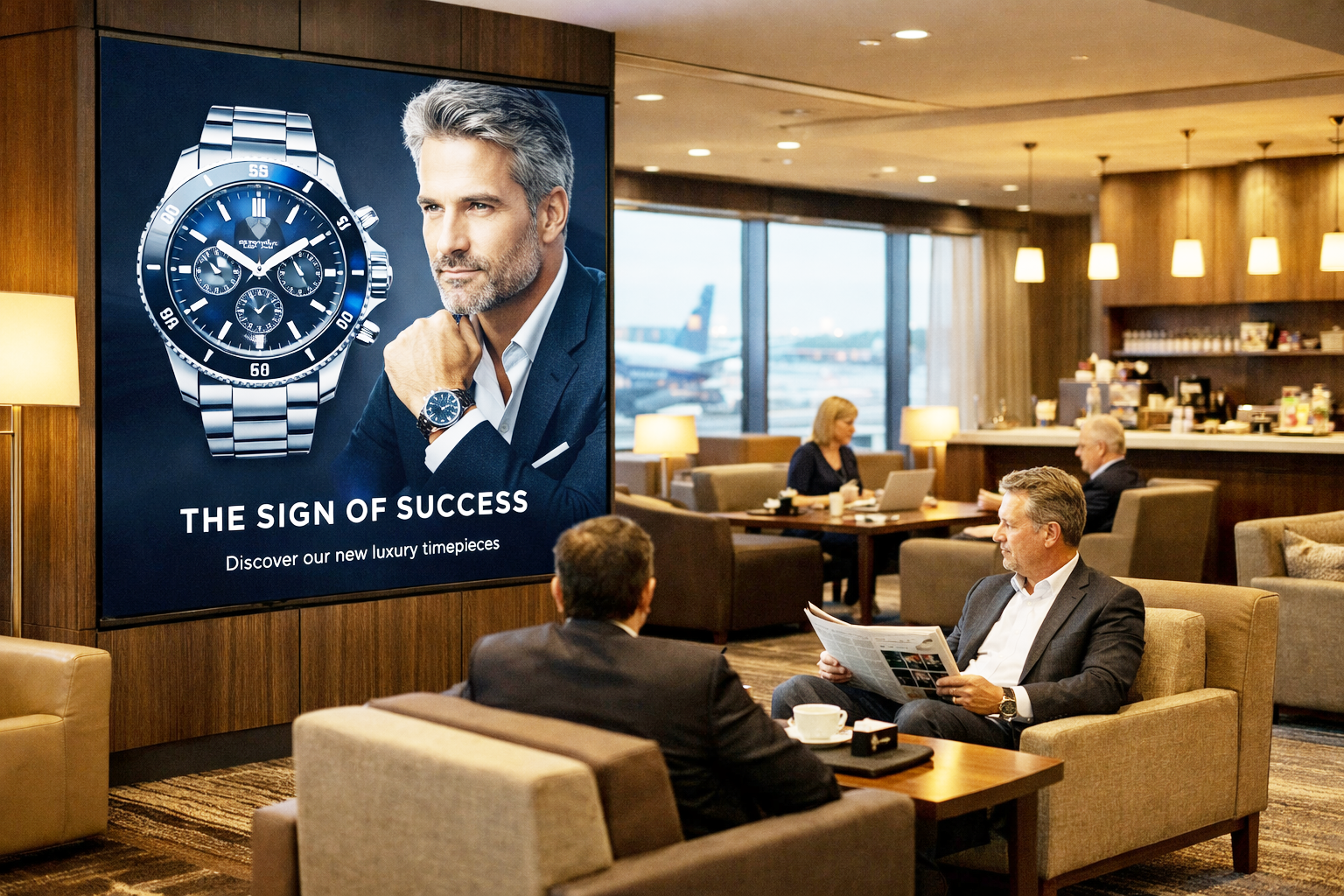
Poor Placement and Delays Affect Airport Campaigns
We help you move faster, access better inventory, and get it right now.
Talk to an ExpertFinal Strategic Verdict
Frankfurt Airport delivers a commercial proposition that is structurally irreplaceable in European aviation for the specific and commercially critical category of institutional B2B advertising. The Eurozone's financial capital, the world's trade fair capital, the homeland of the global premium automotive industry, the centre of one of Europe's most commercially active pharmaceutical corridors, and the only airport in the world served by a completely separate first class terminal for its ultra-premium cabin audience — FRA is where European corporate authority concentrates, where global industry decision-makers arrive to do business, and where the purchasing power of the world's most export-successful large economy is in transit at all hours of every operating day. For private banks targeting the Eurozone's financial elite, for pharmaceutical and medical technology companies targeting the life sciences corridor, for premium automotive brands advertising in the homeland of the category's global benchmark, for B2B technology platforms targeting Messe Frankfurt's trade fair audience, and for international real estate developers targeting Germany's most active outbound property buying community, FRA is not a secondary buy in a broader European portfolio. It is the primary Continental European channel whose audience authority no other airport on the continent replicates. Masscom Global delivers the inventory access, the Messe Frankfurt event calendar intelligence, and the institutional German market credibility to ensure that every brand investing at FRA reaches the right executive, in the right trade fair or corporate travel window, with the commercial precision and cultural authority that Germany's most demanding business audience demands.
About Masscom Global
Masscom Global is a premium international airport advertising and media buying agency operating across 140 countries. With deep expertise in airport OOH, premium publications, and high-net-worth audience targeting, Masscom helps brands reach the world's most valuable travellers at the moments that matter most. For advertising packages, media rates, and campaign planning at Frankfurt Airport and airports across the globe, contact Masscom Global today.
Frequently Asked Questions
How much does airport advertising cost at Frankfurt Airport?
Advertising costs at FRA vary significantly by terminal, concourse zone, format type, position within the passenger flow, campaign duration, and seasonal demand. Terminal 1 concourse positions serving Lufthansa's long-haul first and business class departures command the highest rates in the FRA estate, reflecting the Lufthansa First Class Terminal-adjacent audience concentration and the Ultra HNWI transatlantic and intercontinental premium cabin passenger profile. Messe Frankfurt major trade fair weeks — Frankfurt Book Fair, Automechanika, Light + Building — carry event-driven premium rate uplifts reflecting the concentrated global industry audience those weeks deliver. Masscom Global provides current rate structures, concourse-by-concourse guidance, Messe event calendar integration, and full campaign proposals. Contact Masscom for a tailored FRA proposal.
Who are the passengers at Frankfurt Airport?
FRA serves an Ultra HNWI-rated international audience led by Eurozone financial services executives from the ECB, Deutsche Bank, Commerzbank, and post-Brexit relocated London investment banks, alongside German pharmaceutical and life sciences principals from the Darmstadt-Mainz corridor, automotive and chemical industry executives from the Rhine-Main manufacturing base, global Messe Frankfurt trade fair delegates from over 180 countries, and international corporate travellers using Lufthansa's Star Alliance hub for transatlantic, Asian, and GCC connectivity. The defining commercial characteristic of the FRA audience is institutional corporate authority — this is an airport of decision-makers rather than consumers.
Is Frankfurt Airport good for luxury brand advertising?
FRA is highly productive for luxury brands that lead with engineering excellence, manufacturing heritage, material quality, or institutional provenance — particularly premium automotive, luxury watches with horological heritage narratives, fine jewellery with craftsmanship credentials, and ultra-luxury hospitality with property or service quality stories. The German HNWI commercial culture responds to luxury advertising that demonstrates why a product is the best in its category before it demonstrates why it is expensive. Pure status luxury advertising without substantive quality claims consistently underperforms at FRA relative to LHR and CDG. Brands that earn the German audience's respect through demonstrated excellence achieve exceptional brand loyalty and commercial return.
What is the best airport in Europe for B2B advertising?
FRA is the premier European airport for B2B advertising across the broadest range of industries, combining the Eurozone's financial authority, the world's largest trade fair company, the German industrial sector's corporate leadership community, and the pharmaceutical and automotive industry executive concentration of the Rhine-Main corridor in a single airport environment. For financial services technology, automotive industry supply chain, pharmaceutical services, industrial B2B technology, and corporate advisory brands, FRA delivers an institutional audience authority that no other European airport matches. Masscom Global can structure FRA as the anchor of a coordinated European B2B campaign across Frankfurt, Amsterdam, and London targeting the full European corporate decision-making hierarchy.
What is the best time to advertise at Frankfurt Airport?
The September to November autumn Messe Frankfurt season is FRA's primary commercial peak — Frankfurt Book Fair in October delivers the global media and publishing industry, Automechanika years deliver the global automotive trade, and the broader autumn conference and trade fair calendar concentrates global B2B purchasing authority through FRA in a sustained 10-week window. March to June is the secondary peak for spring trade fair and corporate travel campaigns. ECB governance cycle dates create recurring financial services audience windows throughout the year. For luxury consumer categories, November to December's festive season is the highest domestic premium retail spending period. Campaigns should be structured around the Messe Frankfurt event calendar for maximum precision.
Can international real estate developers advertise at Frankfurt Airport?
FRA is commercially productive for international real estate developers targeting multiple German HNWI buyer communities. German buyers are the dominant international nationality in the Mallorca and Costa del Sol markets, a top-five buyer community in Portugal and Switzerland, and a growing Dubai residential investor segment. Spanish, Swiss, Portuguese, and UAE developers all have a pre-qualified, actively buying German HNWI audience at FRA year-round. The Mainz BioNTech pharmaceutical wealth community and the post-Brexit Frankfurt financial sector have both added new HNWI real estate buyer tiers to the FRA audience. Masscom Global has specific campaign structures for international real estate developers targeting the German HNWI outbound market. Contact the team for details.
Which brands should not advertise at Frankfurt Airport?
Budget retail brands, mass-market FMCG, and entry-level financial products are commercially misaligned with FRA's institutionally authoritative Ultra HNWI audience. Additionally, luxury brands that rely exclusively on aspirational status positioning without substantive performance or quality credentials will find the German commercial audience's evidence-based purchasing culture a persistent engagement barrier at FRA — a dynamic that distinguishes the Frankfurt market from the more status-receptive audiences at LHR and CDG and that requires creative adaptation rather than standard pan-European luxury campaign repurposing.
How does Masscom Global help brands advertise at Frankfurt Airport?
Masscom Global provides full-service airport advertising execution at FRA — covering audience and Messe Frankfurt event calendar intelligence, German-language and English-language creative strategy, optimal concourse and zone position selection across T1 and T2, German Advertising Standards Council compliance management, trade fair-aligned campaign burst planning, and live campaign performance reporting. With operations across 140 countries, Masscom is positioned to activate FRA as the Continental European anchor of a coordinated global B2B or corporate premium campaign — running concurrent placements across FRA, AMS, LHR, CDG, and source market airports in New York, Tokyo, Dubai, and Mumbai to intercept the institutional corporate audience at every stage of their transatlantic and intercontinental travel circuit through the world's most commercially authoritative European hub.