

Airport at a Glance
| Field | Detail |
|---|---|
| Airport | Bishkek Manas International Airport |
| IATA Code | FRU |
| Country | Kyrgyzstan |
| City | Bishkek |
| Annual Passengers | Approximately 3 million (2023, recovering and growing year-on-year) |
| Primary Audience | Diaspora returnees, Silk Road investors, adventure and heritage tourists, re-export trade executives |
| Peak Advertising Season | May to September, December to January |
| Audience Tier | Tier 2 |
| Best Fit Categories | Financial services, real estate, premium automotive, education, adventure and luxury tourism |
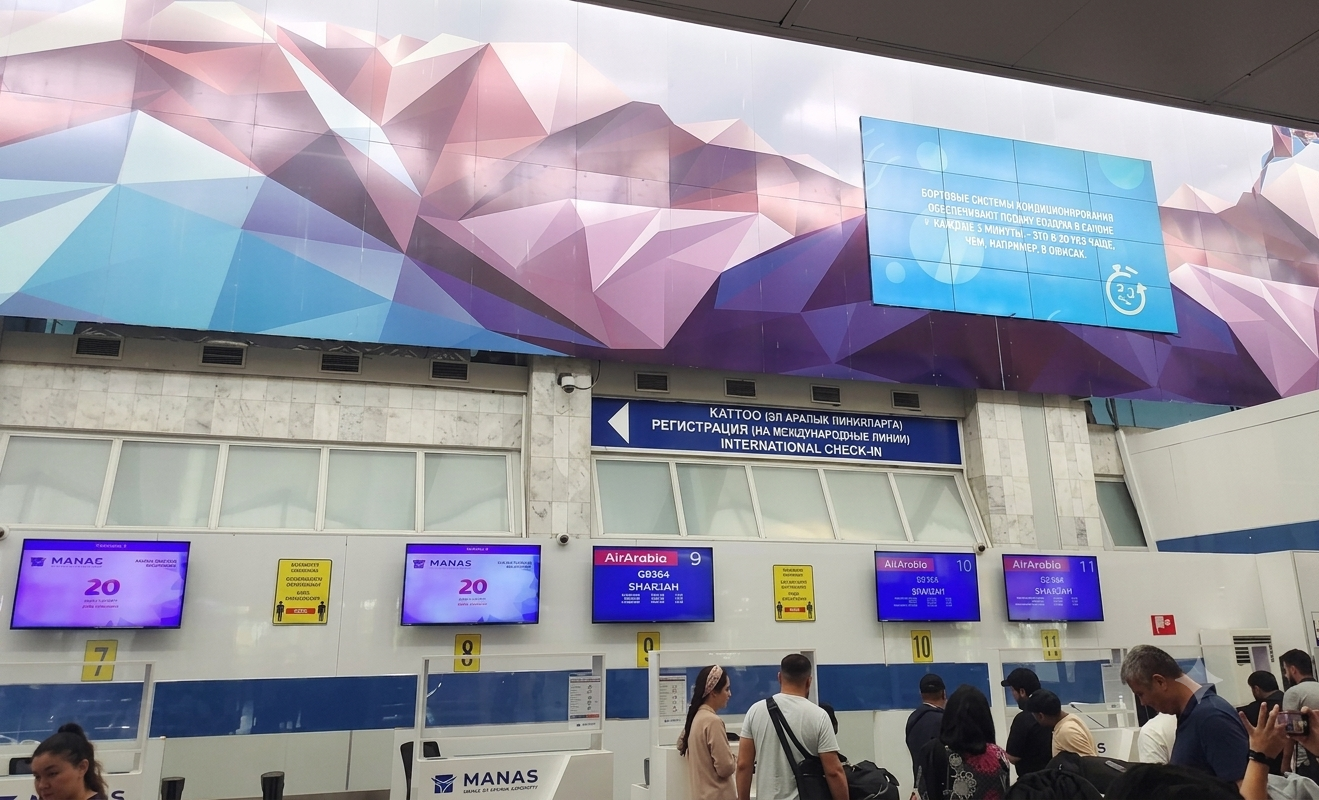
Bishkek Manas International Airport is the sole international gateway for Kyrgyzstan and the primary aviation hub for one of Central Asia's most strategically positioned economies. As the capital airport of a country that functions as a critical re-export corridor between China, Russia, and the broader CIS, FRU handles a commercially concentrated audience that spans returning diaspora with significant foreign-earned capital, inbound investors evaluating one of the region's most rapidly opening economies, and a growing premium tourism flow drawn to the country's spectacular mountain landscapes and Silk Road heritage. For advertisers, FRU is not simply a low-volume regional airport — it is the singular chokepoint through which every commercially valuable traveller entering or leaving Kyrgyzstan must pass.
The commercial case for FRU rests on an audience paradox that makes this airport genuinely unique in the Central Asian context. Kyrgyzstan's economy is structurally shaped by remittance flows from a diaspora of approximately one million overseas workers, the majority based in Russia, who return seasonally carrying foreign currency and globally shaped consumer expectations. Layered over this diaspora economy is a growing class of Bishkek-based entrepreneurs who have built significant wealth through the country's re-export trade, gold mining supply chain, and fintech corridor activity — and who are now beginning to deploy that wealth internationally for the first time. This dual-audience profile, combining aspiring mass-consumption behaviour and genuine HNWI outbound investment intent, creates advertiser opportunities across a wider category range than most airports of comparable volume can support.


Advertising Value Snapshot
- Passenger scale: Approximately 3 million annually, with consistent post-pandemic recovery growth driven by expanding route network and rising outbound Kyrgyz travel demand
- Traveller type: Russia-based Kyrgyz diaspora returnees, inbound Silk Road adventure and heritage tourists, re-export trade and investment executives, outbound Kyrgyz HNWIs
- Airport classification: Tier 2 — the sole international gateway for a strategically positioned Central Asian capital, with audience commercial density exceeding what volume metrics alone suggest
- Commercial positioning: Kyrgyzstan's only international air gateway, handling the country's entire foreign-earned remittance re-entry flow and all inbound investment and premium tourism traffic simultaneously
- Wealth corridor signal: FRU sits on the China-Russia re-export corridor and the emerging Bishkek-Istanbul-Dubai investment triangle, making it one of Central Asia's most active commercial transit environments relative to its size
- Advertising opportunity: Masscom Global provides strategic inventory access and full campaign execution at Bishkek Manas International Airport, enabling brands to intercept the Kyrgyz diaspora, investor class, and premium tourism audience in a media environment that remains significantly less contested than equivalent-tier airports in neighbouring Kazakhstan and Uzbekistan. Masscom's cross-corridor capability allows advertisers to coordinate FRU placements with campaigns at Moscow, Istanbul, and Dubai — the three origin points that define the airport's highest-value audience flows.
Airport Advertising is Complex to Get Right
We help you execute faster, with proven results and local insight most planners lack starting now.
Talk to an ExpertCatchment Area and Economic Drivers
Top 10 Cities within 150 km — Marketer Intelligence
- Bishkek: The political, commercial, and financial capital of Kyrgyzstan, producing the country's highest concentration of business executives, government officials, and internationally mobile professionals; the fastest-growing consumer class in the country is concentrated here and is actively acquiring international brand awareness through digital exposure and cross-border travel
- Tokmok: A secondary industrial city in the Chui Valley approximately 70 km east of Bishkek with a strong manufacturing and agricultural processing base; produces a commercial business owner audience relevant to financial services, B2B technology, and trade finance advertisers
- Kant: Home to one of the few remaining Russian military air bases in Central Asia; generates a significant Russian military and civilian contractor community whose consumption patterns reflect Russian premium brand preferences and whose cross-border financial behaviour is commercially relevant for banking and remittance advertisers
- Kara-Balta: Hosts the Kara-Balta Oil Refinery and uranium processing facilities; the industrial executive and technical management audience here carries above-average income and is among the most brand-exposed professional segments in the Chui province outside Bishkek itself
- Kemin: A scenic mountain district on the edge of the Tian Shan foothills that is emerging as an eco-tourism and adventure tourism staging point; relevant for outdoor, travel insurance, premium gear, and adventure lifestyle advertisers targeting the inbound tourism segment
- Sokuluk: One of the Chui Valley's most productive agricultural districts with a significant greenhouse and horticultural export economy; contributes agri-business owners and export operators to the airport's commercial traveller audience
- Belovodskoe: A rural district capital with a strong livestock and dairy economy; commercially relevant as part of the broader Chui Valley agricultural business owner profile, a segment with growing financial services and input supply advertising receptivity
- Alamudun: An immediate suburban district of Bishkek with a rapidly growing residential development profile driven by the capital's expanding middle and upper-middle class; new residential buyers in this corridor are an active audience for banking, insurance, and home improvement brands
- Ysyk-Ata: A district known for its thermal springs and sanatorium tourism; attracts domestic health and wellness tourists, relevant for premium health, lifestyle, and medical tourism advertisers targeting the domestic Kyrgyz consumer
- Balykchy: The gateway city to Issyk-Kul Lake — Central Asia's most important leisure tourism destination — approximately 150 km from Bishkek; travellers passing through FRU en route to Issyk-Kul represent a concentrated summer leisure and adventure tourism segment with strong hospitality, lifestyle, and premium outdoor brand receptivity
NRI and Diaspora Intelligence: Kyrgyzstan has one of the most economically significant diaspora communities in the post-Soviet space relative to its national population. An estimated 700,000 to one million Kyrgyz nationals are based primarily in Russia, with smaller but commercially relevant concentrations in Kazakhstan, Turkey, South Korea, and the Gulf states. Remittances from this diaspora consistently represent 25 to 35 percent of Kyrgyzstan's GDP — one of the highest remittance-to-GDP ratios in the world — and a significant proportion of this foreign-earned capital enters the country physically through FRU in the form of returning travellers carrying cash, electronics, clothing, and consumer goods. This returning diaspora segment is not a low-income labour migration audience in a conventional sense — it includes skilled workers, small business owners, and a growing tier of successful entrepreneurs who have accumulated meaningful capital in Russia and are now actively looking to deploy it in Bishkek real estate, domestic business investment, and international financial products. For advertisers, the FRU departures and arrivals environment offers access to this returning capital flow at the moment when it is most liquid and most actively seeking investment and consumption direction.
Economic Importance: Kyrgyzstan's catchment economy is structured around five commercially significant drivers that produce distinct and addressable advertiser audience segments. The Kumtor gold mine — one of the world's highest-altitude gold operations and historically one of the country's single largest GDP contributors — generates a senior engineering, executive, and government relations audience that travels internationally on a regular basis. The Bishkek re-export economy, which channels Chinese manufactured goods northward into Russia and the CIS, produces a merchant and logistics entrepreneur class with significant disposable income and growing international brand exposure. A rapidly expanding fintech and digital economy, partly driven by the country's relatively liberal digital regulations, is producing a young, internationally connected entrepreneurial tier in Bishkek. Tourism infrastructure investment, led by international interest in Issyk-Kul and mountain adventure experiences, is bringing hospitality investment capital into the country from Turkish and Gulf developers. And the remittance economy, described above, creates a structural inflow of foreign currency that sustains retail and consumer spending well above what domestic income statistics alone would suggest.
Business and Industrial Ecosystem
- Kumtor Gold Mine and Kyrgyz mining sector: Produces a senior engineering, executive, and government affairs audience with strong international travel frequency; relevant for premium financial services, B2B technology, aviation, and high-end personal goods advertisers targeting the country's wealthiest professional class
- Bishkek Re-Export and Trade Economy: The China-to-CIS goods corridor through Bishkek produces a merchant entrepreneur and logistics owner class with high commercial travel frequency to China, Russia, Kazakhstan, and Turkey; one of the most consistent business traveller segments at FRU and highly receptive to trade finance, banking, and premium business travel advertising
- Bishkek Free Economic Zone: One of Central Asia's operational free zones attracting manufacturing and assembly investment; generates inbound investor and executive traffic from China, Turkey, and Russia that is receptive to B2B professional services, real estate, and financial product advertising
- Fintech, Digital, and IT Services Sector: Bishkek has emerged as one of Central Asia's most active technology startup and IT outsourcing hubs, with a young, internationally oriented professional class that is brand-aware, digitally sophisticated, and actively seeking premium financial, travel, and lifestyle products
Passenger Intent — Business Segment: Business travellers at FRU are concentrated in three commercially high-value categories: trade and logistics entrepreneurs managing the China-Russia re-export corridor, mining and energy sector executives travelling to operational sites and international financing meetings, and a growing technology and fintech professional class maintaining connections with venture capital, development partner, and client networks in Istanbul, Dubai, Moscow, and increasingly London. All three segments carry above-average financial product sophistication and strong receptivity to wealth management, premium banking, real estate investment, and premium automotive messaging. The airport's status as Kyrgyzstan's sole international gateway means there is no alternative routing for this audience — every commercially valuable traveller in the country passes through FRU.
Strategic Insight: The business audience at Bishkek Manas International Airport is characterised by a commercial confidence rooted in operating in an undercompeted, high-growth market where early movers consistently generate outsized returns. Kyrgyz entrepreneurs and executives who have built wealth in re-export trade, mining supply chains, or digital services carry a deal-maker mentality and a genuine openness to international financial, real estate, and investment products — precisely because they are in the earliest stages of deploying newly accumulated capital internationally. Masscom-positioned campaigns at FRU that speak to international returns, portfolio diversification, and premium lifestyle achievement will consistently outperform generic brand awareness campaigns in this environment.
Tourism and Premium Travel Drivers
- Issyk-Kul Lake: One of the world's largest alpine lakes and Central Asia's premier leisure destination, drawing over 1 million domestic and international visitors annually; inbound tourists arriving at FRU for Issyk-Kul have pre-committed to a premium outdoor and resort experience, creating strong receptivity for luxury hospitality, premium outdoor brands, adventure travel insurance, and lifestyle advertising at the airport
- Tian Shan Mountain Range and Epic Trek Routes: Kyrgyzstan is internationally recognised as one of the world's premier adventure trekking destinations, drawing European, American, and East Asian adventure tourists who represent some of the highest per-day spending visitors in Central Asia; this audience is educated, internationally mobile, premium-brand literate, and receptive to outdoor lifestyle, travel services, and premium gear advertising
- Silk Road Heritage Circuit — Burana Tower, Uzgen, Osh: The historic Silk Road trail through Kyrgyzstan connects a series of archaeological and cultural heritage sites that draw the same European and Asian cultural tourism audience that visits Samarkand and Bukhara in Uzbekistan; these travellers carry premium cultural tourism budgets and above-average hospitality and lifestyle spending profiles
- Ala Archa National Park and Alpine Skiing: A spectacular gorge and alpine recreation zone immediately south of Bishkek that attracts both domestic and international visitors year-round; the proximity to the capital means that a significant proportion of its visitors pass through FRU within hours of their park experience, creating a compressed but commercially relevant outdoor and wellness brand audience window
Passenger Intent — Tourism Segment: Tourists arriving at FRU for Kyrgyzstan's mountain and heritage experiences have made a highly deliberate destination choice — this is not an impulse or package holiday audience. International visitors to Kyrgyzstan have typically researched the destination extensively and arrived with adventure, authenticity, and high-quality outdoor experience as their primary motivation. They carry significant discretionary budgets, premium outdoor equipment preferences, and above-average receptivity to experiential lifestyle brands, travel insurance, specialist financial products, and international real estate messaging. The domestic tourism segment driving Issyk-Kul summer travel is a separate but large and commercially valuable audience — Bishkek's middle and upper class who represent the country's fastest-growing consumer tier and are actively upgrading their spending across hospitality, automotive, fashion, and financial services.
Travel Patterns and Seasonality
Peak seasons:
- May to September: The primary summer season driven by Issyk-Kul lake tourism, mountain trekking arrivals, and the peak domestic leisure travel period; international adventure tourism arrivals peak in July and August, while domestic resort travel peaks from June through August
- December to January: New Year holiday travel surge driven by returning diaspora from Russia, Kazakhstan, and Turkey; one of the highest-spend consumer windows of the year as returning workers arrive with foreign-earned savings and seasonal gift purchasing intent
- March: Navruz — the Central Asian New Year — creates a strong domestic travel mobilisation and gifting spending surge; a commercially valuable window for retail, consumer goods, and hospitality brands
Event-Driven Movement:
- Navruz — Central Asian New Year (March 21): The largest domestic travel and consumer spending mobilisation event of the Kyrgyz calendar; retail, gifting, food and beverage, and family consumer brands should treat this as the year's highest-priority campaign window for reaching domestic Kyrgyz audiences in the departures and arrivals environment
- World Nomad Games (September, biennial — Issyk-Kul): One of Central Asia's most distinctive and internationally covered cultural events, drawing athletes, government delegations, journalists, and cultural tourists from over 70 countries; creates a short but commercially exceptional traffic window with disproportionate international brand exposure value
- Eid al-Fitr (variable — March/April): The end of Ramadan drives one of the highest-spend gifting and travel periods in the Muslim calendar; the Kyrgyz Muslim population observes Eid with strong family travel and gifting behaviour, creating a peak window for consumer lifestyle, food, fashion, and hospitality brands
- Eid al-Adha (variable — June/July): A second major Islamic holiday travel mobilisation; reinforces the summer peak with additional family and community travel activity and consumer spending intent across gifting and hospitality categories
- Russian New Year and Orthodox Christmas (December 31 to January 7): The largest single diaspora return travel window of the year; Kyrgyz workers based in Russia return home in force, carrying a year's worth of accumulated foreign currency and consumer purchasing intent; financial services, real estate, electronics, and premium consumer goods brands achieve peak advertiser relevance in this window
It’s Not Just Where You Advertise - It’s How Fast You Execute
We combine local insight with fast rollout to deliver results for you, now.
Talk to an ExpertAudience and Cultural Intelligence
Top 2 Languages:
- Kyrgyz: The official state language and the first language of the overwhelming majority of the domestic and diaspora audience; essential for campaigns targeting returning diaspora, domestic consumers, and government and institutional audiences; Kyrgyz-language creative signals cultural respect and brand authenticity in a market where foreign brands are still establishing trust
- Russian: The dominant business language of Bishkek and the primary communication language of the commercial, academic, and professional class; Russian-language creative is essential for reaching the business executive tier, the Russian-Kyrgyz mixed community, inbound CIS investors, and the large segment of the diaspora audience who conduct their financial and commercial affairs in Russian regardless of ethnicity
Major Traveller Nationalities: The international audience at FRU is led by Russian nationals who represent both a tourism and a business investor segment with long-established ties to Kyrgyzstan through the post-Soviet institutional and commercial network. Turkish nationals are the second most commercially significant international group, connected to Bishkek through both a large Turkish business investment community and the deep cultural and linguistic affinity between Turkish and Kyrgyz that has made Turkey the primary destination for Kyrgyz students pursuing international higher education. Chinese nationals represent a growing inbound commercial traveller segment driven by the re-export trade corridor and manufacturing investment activity in the Bishkek FEZ. Gulf Arab visitors are a smaller but growing tourism segment drawn by Kyrgyzstan's Muslim-majority identity and its adventure tourism offering. Returning Kyrgyz diaspora from Russia and Kazakhstan constitute the highest-volume single traveller segment at FRU and are the primary driver of the airport's commercial spending environment at peak diaspora return windows.
Religion — Advertiser Intelligence:
- Islam — Sunni (approximately 90% of population): Kyrgyzstan is a majority Sunni Muslim country with a moderate and culturally integrated Islamic practice; Ramadan and both Eid holidays create three significant commercial windows annually for gifting, hospitality, fashion, personal care, and family consumer brands; the Islamic fintech and halal finance sector is growing rapidly in Kyrgyzstan as the country develops sharia-compliant banking infrastructure, creating a specific and commercially relevant audience for Islamic financial product advertising at FRU
- Orthodox Christianity (approximately 7%, predominantly Russian ethnic community): The Russian-Kyrgyz Orthodox Christian community observes Russian New Year and Orthodox Christmas with strong travel and gifting behaviour; the December to January window is shaped almost equally by Islamic New Year observance and Orthodox holiday practice, creating a dual-audience commercial opportunity that few other airports in the region can offer
- Tengrism and Nomadic Cultural Heritage (culturally significant): Kyrgyzstan's pre-Islamic nomadic spiritual heritage is not a practised religion for most but is a powerful cultural identity marker that shapes national pride, consumer brand resonance, and the country's positioning as a World Nomad Games host; brands that acknowledge and respect this heritage in creative strategy build significantly stronger trust and recall in the domestic Kyrgyz market than brands that ignore it
Behavioral Insight: The Bishkek Manas airport audience combines two behaviorally complementary but commercially distinct decision-making profiles. The returning diaspora traveller arrives with accumulated savings, deferred purchasing intent, and a determination to convert foreign-earned capital into tangible assets — real estate, vehicles, electronics, and financial products — in the shortest possible window after landing. The outbound Kyrgyz entrepreneur and professional carries an ambition-forward orientation shaped by operating in one of the region's most dynamic and undercompeted commercial environments, where first-mover confidence and tolerance for calculated risk are higher than in more mature markets. Both profiles share a strong orientation toward trust, reputation, and word-of-mouth validation — meaning that campaigns which demonstrate credibility and peer endorsement consistently outperform abstract brand promise messaging in this market.
Outbound Wealth and Investment Intelligence
The outbound traveller at Bishkek Manas International Airport represents a commercially underserved but rapidly maturing wealth deployment audience. A generation of Kyrgyz entrepreneurs and diaspora returnees who have accumulated meaningful capital through trade, remittances, and domestic business success are now looking outward for the first time — evaluating international real estate, education migration, second residency, and global financial products with an appetite that international brands have been slow to recognise and address.
Outbound Real Estate Investment: Kyrgyz HNWIs and diaspora investors are most actively acquiring property in Istanbul and coastal Turkey, driven by cultural affinity, linguistic proximity, Kyrgyz community networks already established in Turkish cities, and the accessibility of Turkey's citizenship-by-investment and residency programmes. Dubai is the second-most-active investment destination, fuelled by the UAE's visa-free policy for Kyrgyz passport holders, USD-denominated returns, and the aspirational lifestyle positioning of the Dubai property market among Central Asian investors. Russia — despite geopolitical complexity — remains a property acquisition market for Bishkek's Russian-Kyrgyz business community with existing Moscow and St. Petersburg assets. Georgia, particularly Tbilisi and Batumi, is emerging as a third market driven by the visa-free corridor, low entry price points, and strong short-term rental yields that Kyrgyz investors find commercially familiar.
Outbound Education Investment: Kyrgyzstan has one of the youngest age profiles in Central Asia and one of the region's most educationally ambitious middle and upper classes. The primary international university destinations for Kyrgyz families are Turkey — by significant margin, driven by scholarship availability, linguistic affinity, and established community networks — Russia for legacy institutional relationships and cost accessibility, and increasingly South Korea, Germany, and the Czech Republic for families with the financial capacity to target European-standard higher education. The family education investment cycle at FRU produces a strong and repeatable annual spending window, particularly in the August to September departure period when students and accompanying parents represent some of the highest per-trip spenders moving through the airport.
Outbound Wealth Migration and Residency: The Kyrgyz HNWI class is showing growing interest in second-residency and investment migration programmes, with Turkey's citizenship-by-investment pathway the most widely pursued option given cultural proximity and relatively low capital threshold. The UAE long-term residency Golden Visa is the second most actively pursued programme, primarily among Bishkek's business executive class with UAE business interests. European residency programmes — Portugal, Greece, Hungary, and Malta — are beginning to attract the most internationally oriented and financially capable segment of the Kyrgyz investor class, particularly families motivated by European education access for children. Immigration advisory firms, citizenship programme operators, and wealth management platforms targeting the Central Asian market will find FRU one of the most cost-efficient access points in the region for this audience.
Strategic Implication for Advertisers: International brands on both sides of the wealth corridor — property developers in Dubai and Istanbul, universities in Turkey and Germany, immigration advisory services, and Islamic and conventional wealth management platforms — should treat Bishkek Manas International Airport as a priority activation environment rather than a secondary or supplementary buy. The audience is financially ready, internationally motivated, and operating in a media environment with significantly less competing brand noise than equivalent audiences in Kazakhstan or Uzbekistan. Masscom Global offers the capability to coordinate simultaneous campaigns at FRU and at the destination airports where this audience arrives — Istanbul, Dubai, Moscow, Seoul — creating a corridor-wide sequential brand narrative that is more persuasive and more measurable than any single-market activation.
Airport Infrastructure and Premium Indicators
Terminals:
- Bishkek Manas International Airport operates a primary international terminal that has undergone phased modernisation, with a functional layout that routes all international travellers through a contained corridor from check-in through security to departure gates, giving advertisers consistent and high-capture audience exposure across the full journey through the terminal
- A domestic terminal handles internal Kyrgyz routes and provides a secondary advertising environment relevant to campaigns targeting the domestic business and consumer audience connecting from regional cities to international flights
Premium Indicators:
- Business lounge provision at FRU serves the growing premium traveller tier — senior executives, government officials, and frequent international business travellers whose income and brand awareness levels make them the most commercially valuable individual audience segment in the terminal
- The airport's geographic position adjacent to the Tian Shan mountain system means that a significant proportion of arriving passengers are adventure and premium nature tourists arriving with above-average travel spend profiles — a context that reflexively elevates the premium brand relevance of advertising placed within the arrivals and departures environment
- International hotel brands adjacent to Bishkek — including the Hyatt Regency and Sheraton properties in the capital — signal the destination's growing premium hospitality credentials and provide an ambient luxury context that supports premium brand advertising at the airport
- The airport's role as a historical transit point on Central Asian air routes and its proximity to major NATO and CIS military infrastructure creates a consistent background of internationally mobile, high-status travellers moving through the terminal alongside the commercial and tourism audience
Forward-Looking Signal: Kyrgyzstan's government has committed to a national tourism development programme targeting five million annual visitors by 2030 — a more than doubling of current levels — with significant infrastructure investment allocated to road access to Issyk-Kul, luxury resort development on the lake's northern shore, and international route expansion from FRU. New direct routes from Gulf carriers and expanded Turkish Airlines frequencies are anticipated as the country's inbound tourism profile rises. The World Nomad Games, held biennially at Issyk-Kul, continues to build international media coverage that directly drives inbound interest. Masscom Global advises clients to activate campaigns at FRU now, while the airport's commercial inventory remains competitively priced ahead of the route expansion and passenger volume growth that the government's tourism investment pipeline will generate.
Airline and Route Intelligence
Top Airlines:
- Uzbekistan Airways (regional Central Asian connectivity)
- Turkish Airlines
- FlyDubai
- Air Arabia
- Pegasus Airlines
- Aeroflot / Ural Airlines / Pobeda (Russia corridor)
- Air Astana (Kazakhstan)
- China Southern (Urumqi corridor)
- Avia Traffic Company (Kyrgyz national carrier, domestic and regional)
- S7 Airlines (Russia, seasonal)
Key International Routes:
- Moscow and Russian cities (multiple carriers, multiple weekly frequencies — the highest-volume international corridor driven by diaspora travel)
- Istanbul (Turkish Airlines and Pegasus — the primary investment, education, and cultural corridor)
- Dubai and Sharjah (FlyDubai and Air Arabia — the Gulf wealth and labour corridor growing in frequency)
- Almaty, Kazakhstan (daily, the primary Central Asian business connectivity route)
- Urumqi, China (China Southern — the re-export trade corridor)
- Frankfurt, Vienna, and European seasonal routes (charter and scheduled services serving the growing European adventure tourism segment)
Domestic Connectivity:
- Osh (multiple daily frequencies — the second city and primary southern connectivity route, connecting Kyrgyzstan's Fergana Valley population to international departures)
- Jalal-Abad, Batken, Karakol (regional domestic network)
Wealth Corridor Signal: The Moscow and Istanbul route dominance at FRU tells a precise commercial story about this airport's audience. The Moscow corridor carries the largest single segment by volume — the returning diaspora whose foreign-earned capital is the structural backbone of Kyrgyzstan's consumer economy — and whose arrival at FRU represents one of the most concentrated foreign-currency-carrying consumer audiences in Central Asia at peak diaspora return windows. The Istanbul corridor carries the highest-potential outbound investment and education audience — Kyrgyz HNWIs actively deploying capital into Turkish real estate and citizenship programmes and families sending children to Turkish universities. Advertisers who understand these two corridor narratives and build campaigns calibrated to the specific intent state of each audience will achieve returns at FRU that broad market approaches cannot replicate.
Media Environment at the Airport
- Bishkek Manas International Airport's single-terminal international structure creates a natural advertising capture funnel where the entire international traveller audience passes through a limited number of high-visibility zones, giving strategically placed campaigns near-complete audience coverage without the format dilution typical of multi-terminal hub airports
- Dwell time at FRU is extended by the airport's position as a destination airport rather than a transit hub — international travellers are not rushing to connections but settling into a pre-travel window that consistently runs 60 to 90 minutes in international departures, generating meaningful creative exposure for both static and digital formats
- The combination of returning diaspora with deferred purchasing intent and outbound HNW investors in an active capital deployment mindset creates a dual-audience environment where financial services, real estate, automotive, and premium consumer goods campaigns simultaneously intercept both a buyer-ready and a decision-primed audience within the same physical space
- Masscom Global holds strategic inventory access at Bishkek Manas International Airport and executes campaigns with the regional coordination and speed that this market's compressed peak windows require, ensuring creative placements are live at the exact moments when diaspora return, Navruz, and Eid traffic surges maximise audience concentration
Strategic Advertising Fit
Best Fit:
- International real estate developers: The returning diaspora and outbound Kyrgyz HNWI audience at FRU is actively deploying capital into Turkish, UAE, and Georgian property markets; the airport is the single most efficient access point to this buyer segment in Kyrgyzstan, and the relative absence of competing property developer advertising makes well-executed campaigns exceptionally visible
- Financial services, Islamic banking, and remittance platforms: The remittance-driven economic structure of Kyrgyzstan and the growing demand for sharia-compliant financial products create a highly receptive audience for banking, investment, and Islamic finance advertising at every peak diaspora travel window
- Premium and mid-premium automotive brands: Returning diaspora and domestic business owners consistently allocate a significant share of accumulated capital to vehicle purchases; German, Korean, and Japanese premium marques have strong brand recognition and aspirational status in the Bishkek market
- International universities and education consultancies: The Kyrgyz outbound student corridor to Turkey, Russia, South Korea, and Germany is one of Central Asia's most active; parents and students travelling together through FRU in August and September represent a highly motivated and financially prepared education decision audience
- Adventure tourism, outdoor lifestyle, and travel insurance brands: The inbound adventure tourism audience at FRU is internationally mobile, premium-brand literate, and highly receptive to specialist outdoor equipment, travel services, and adventure lifestyle brands at point of arrival
- Turkish and Gulf real estate and residency programmes: Cultural affinity with Turkey and established community networks make the Kyrgyz audience at FRU one of the most receptive catchments for Turkish citizenship-by-investment and UAE Golden Visa advertising outside those two countries themselves
- Premium consumer electronics and mobile technology: Returning diaspora travellers have historically been significant buyers of electronics and mobile technology following international travel; the FRU arrivals environment captures this purchasing intent at peak intensity
Brand Alignment at a Glance:
| Category | Fit |
|---|---|
| International real estate and residency | Exceptional |
| Financial services and Islamic banking | Exceptional |
| International education | Exceptional |
| Premium automotive | Strong |
| Adventure tourism and outdoor lifestyle | Strong |
| Consumer electronics and mobile technology | Strong |
| Luxury goods and premium fashion | Moderate |
| Mass-market FMCG | Poor fit |
Who Should Not Advertise Here:
- Mass-market FMCG brands dependent on high reach and frequency: The annual passenger volume at FRU does not support the coverage and frequency requirements of high-volume consumer goods campaigns; brands in this category should consider FRU only as a supplementary buy within a broader Central Asian market strategy
- Ultra-luxury heritage brands with strict HNWI-only targeting parameters: While FRU has a genuine HNWI tier, the majority of the airport's passenger volume is composed of diaspora and mid-market travellers; brands requiring a consistently ultra-high-net-worth audience environment should treat FRU as one element of a corridor strategy rather than a standalone ultra-luxury buy
- Domestically anchored Kyrgyz brands with no cross-border relevance: The most commercially valuable audience segments at FRU are either international arrivals or outbound Kyrgyz travellers whose consumption frame has been shaped by international market exposure; brands without an international or aspirational positioning will underperform relative to the investment required
Event and Seasonality Analysis
- Event Strength: Medium-High
- Seasonality Strength: High
- Traffic Pattern: Dual-Peak (Summer tourism and diaspora season May to September; Winter diaspora return and New Year window December to January)
Strategic Implication: Advertisers at Bishkek Manas International Airport should structure annual investment around two primary deployment windows: the summer peak from May through August, when international adventure tourism arrivals, Issyk-Kul domestic leisure travel, and the biennial World Nomad Games combine to create the year's highest-volume and most audience-diverse traffic concentration, and the December to January diaspora return window, when the year's highest per-passenger foreign-currency density passes through the terminal and consumer purchasing intent is at its most immediate and actionable. The Navruz window in late March provides a strong supplementary deployment opportunity for consumer, retail, and hospitality brands targeting the domestic Kyrgyz audience. Masscom Global structures FRU campaigns to exploit these three windows with calibrated creative rotation, ensuring that messaging is precisely matched to the distinct intent state of each audience segment at each seasonal moment.

Poor Placement and Delays Affect Airport Campaigns
We help you move faster, access better inventory, and get it right now.
Talk to an ExpertFinal Strategic Verdict
Bishkek Manas International Airport is one of the most commercially underestimated advertising environments in the entire Central Asian corridor. As Kyrgyzstan's sole international gateway, it holds a structural monopoly on access to every commercially valuable traveller entering or leaving the country — a concentration of audience that no other media channel in the market can replicate. The convergence of a remittance-powered diaspora returning with foreign-earned capital and deferred consumption intent, an outbound HNWI class beginning to deploy internationally for the first time, and a rapidly growing premium tourism flow from Europe and the Gulf creates a tri-audience commercial environment of genuine rarity at a volume tier where most international brands have not yet looked. Brands in financial services, real estate, education, premium automotive, and adventure lifestyle who partner with Masscom Global to activate at FRU today are securing access to a fast-rising market audience at a commercial efficiency that Bishkek's growing regional profile will not sustain for long. Masscom Global brings the inventory access, regional corridor intelligence, and execution capability to make that advantage real, measurable, and deployable now.
About Masscom Global
Masscom Global is a premium international airport advertising and media buying agency operating across 140 countries. With deep expertise in airport OOH, premium publications, and high-net-worth audience targeting, Masscom helps brands reach the world's most valuable travellers at the moments that matter most. For advertising packages, media rates, and campaign planning at Bishkek Manas International Airport and airports across the globe, contact Masscom Global today.
Frequently Asked Questions
How much does airport advertising cost at Bishkek Manas International Airport? Advertising costs at Bishkek Manas International Airport vary depending on format type, placement zone within the terminal, campaign duration, and the seasonal demand window selected. Summer peak and the December to January diaspora return window command premium rates due to the concentration of high-intent, high-spend travellers in those periods. Contact Masscom Global for a tailored rate card and media plan aligned to your specific campaign objectives, target audience, and budget parameters.
Who are the passengers at Bishkek Manas International Airport? The passenger base at FRU spans four commercially distinct segments: returning Kyrgyz diaspora from Russia and Kazakhstan carrying foreign-earned capital and strong consumer purchasing intent; outbound Kyrgyz HNWIs and entrepreneurs actively investing in real estate, education, and financial products internationally; inbound adventure and heritage tourists from Europe, Turkey, and the Gulf with premium outdoor and cultural experience budgets; and inbound business investors evaluating Kyrgyzstan's re-export, mining, and free economic zone opportunities.
Is Bishkek Manas International Airport good for luxury brand advertising? FRU offers genuine luxury brand advertising value within a specific category framework. The airport's HNWI tier — concentrated in mining executives, re-export trade entrepreneurs, and returning diaspora with accumulated foreign capital — is receptive to premium financial services, real estate investment, premium automotive, and aspirational lifestyle brands. Ultra-luxury heritage goods brands requiring a consistently ultra-high-net-worth audience should treat FRU as part of a corridor strategy coordinated with Istanbul and Dubai rather than a standalone ultra-luxury environment.
What is the best airport in Kyrgyzstan and Central Asia to reach diaspora audiences? Bishkek Manas International Airport is the only international gateway in Kyrgyzstan, making it the definitive access point for the country's entire diaspora audience — there is no alternative routing. Within the broader Central Asian context, FRU delivers a diaspora audience with one of the highest remittance-to-GDP ratios in the world, making the returning traveller segment at this airport financially more significant per head than equivalent diaspora audiences at higher-volume regional airports in Kazakhstan or Uzbekistan.
What is the best time to advertise at Bishkek Manas International Airport? The two highest-value advertising windows are the summer season from May through August — when adventure tourism arrivals, Issyk-Kul domestic leisure travel, and the World Nomad Games biennial event align to create peak audience density — and the December to January diaspora return window, when Kyrgyz workers returning from Russia arrive with a year's worth of accumulated savings and peak consumer purchasing intent. The Navruz period in late March is the strongest supplementary window for consumer, retail, and hospitality brands. Masscom Global recommends booking peak season inventory at least three months in advance.
Can international real estate developers advertise at Bishkek Manas International Airport? Absolutely. FRU is one of the most commercially efficient access points in Central Asia for the international property buyer segment. The outbound Kyrgyz HNWI audience at this airport is actively acquiring real estate in Istanbul, Dubai, Tbilisi, and Batumi — often for the first time — and is operating in a media environment where competing property developer advertising is significantly less dense than at equivalent audience airports in the Gulf or Turkey. International developers who position campaigns at FRU intercept this buyer audience at the precise moment when investment intent is active and purchase decisions are forming.
Which brands should not advertise at Bishkek Manas International Airport? Mass-market FMCG brands dependent on high reach and frequency will not achieve viable commercial returns given the airport's current passenger volume. Ultra-luxury brands with strict HNWI-minimum audience requirements should treat FRU as a corridor buy rather than a standalone placement. Domestic Kyrgyz brands with no cross-border relevance or aspirational positioning will underperform, as the most commercially valuable audience at FRU is shaped by international market exposure and has consumption expectations that domestically anchored brands without international credibility cannot effectively address.
How does Masscom Global help brands advertise at Bishkek Manas International Airport? Masscom Global provides end-to-end campaign management at Bishkek Manas International Airport, from strategic audience intelligence and format selection through to inventory booking, creative placement guidance, and in-market execution. With operational coverage across 140 countries and deep expertise in the Central Asian, Russian, Turkish, and Gulf corridors that define FRU's audience flows, Masscom ensures campaigns are timed to the airport's compressed but commercially intense peak windows and coordinated with complementary placements at Moscow, Istanbul, and Dubai where the same audience originates. To discuss current advertising availability and media packages at Bishkek Manas International Airport, contact Masscom Global today.