

Airport at a Glance
| Field | Detail |
|---|---|
| Airport | Tan Son Nhat International Airport |
| IATA Code | SGN |
| Country | Vietnam |
| City | Ho Chi Minh City (Saigon) |
| Annual Passengers | ~30.2 million |
| Primary Audience | Vietnamese HNWI emerging luxury consumers, Viet Kieu (overseas Vietnamese) returnees, Korean and Japanese manufacturing executives, Chinese business and tourism visitors |
| Peak Advertising Season | Tet (Vietnamese Lunar New Year), summer, year-end holiday season |
| Audience Tier | Tier 1 (Southeast Asia fastest-growing HNWI market and Viet Kieu diaspora return combined) |
| Best Fit Categories | Luxury real estate, premium automotive, international education, financial services, luxury lifestyle brands, Korean and Japanese bilateral B2B |
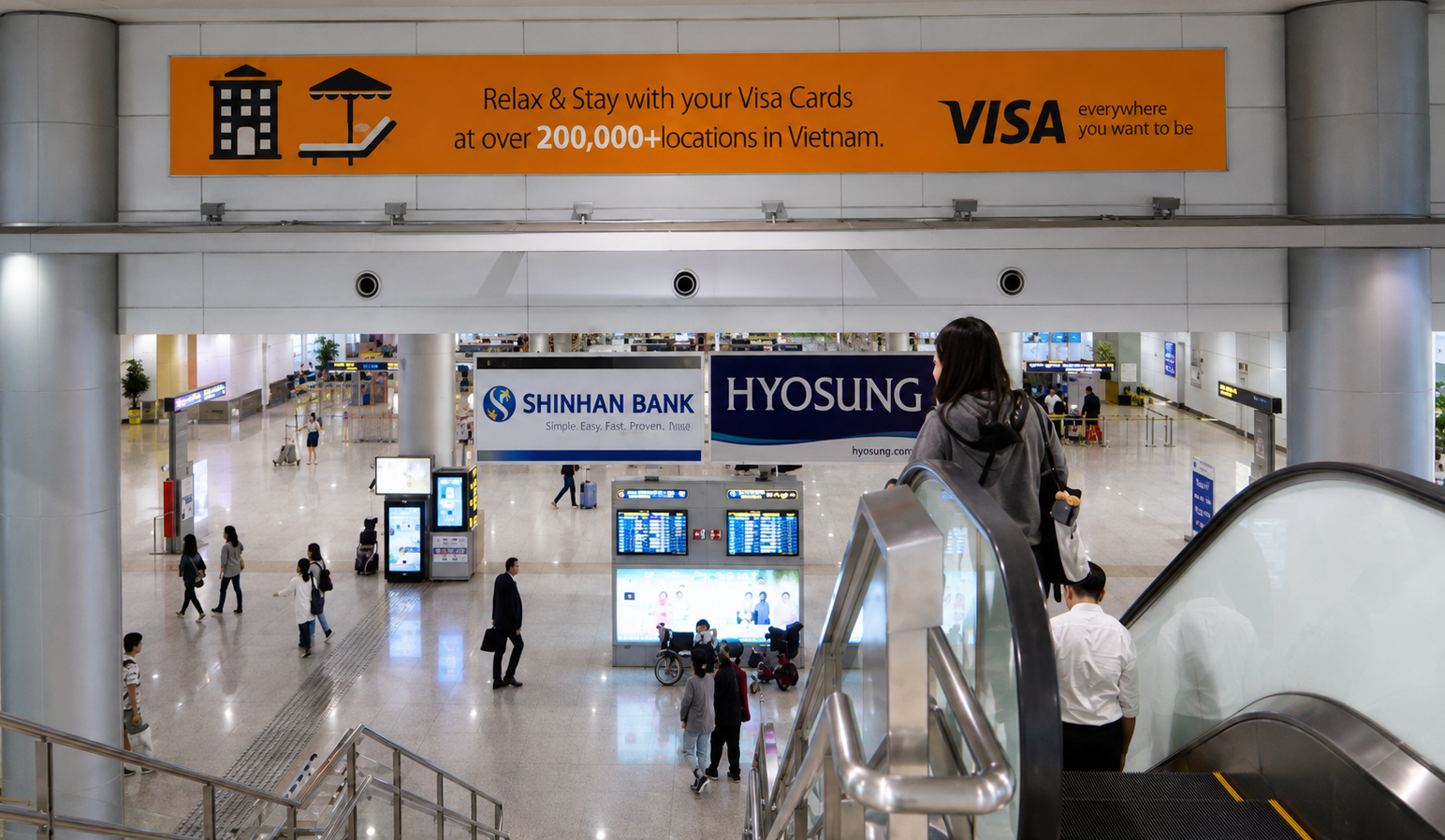
Tan Son Nhat International Airport is the most commercially consequential airport in Southeast Asia that the global advertising industry has not yet fully mobilised around. With 30.2 million passengers annually, SGN is the busiest airport in Vietnam and one of the busiest in Southeast Asia — a gateway serving a city of 9 million official residents whose real metropolitan population exceeds 13 million and whose economic output makes Ho Chi Minh City the engine of the fastest-growing major economy in the developing world. Vietnam's GDP has grown from approximately USD 35 billion in 2000 to over USD 430 billion in 2024 — a twelvefold expansion in a single generation — and Ho Chi Minh City has been the primary geographic source of that wealth creation. The HNWI class that has emerged from this growth is not a marginal premium consumer segment. It is the beneficiary of the most rapid legitimate wealth creation of any country in Southeast Asia over the past quarter century, and it is arriving at — and departing from — this terminal every day.
The commercial significance of SGN is amplified by three distinct audience layers that converge here simultaneously. The Vietnamese domestic HNWI — entrepreneurs in real estate, consumer goods, manufacturing, and technology whose wealth accumulation is still in its exponential growth phase — travels through SGN for international leisure, education investment, and business expansion with a spending ambition that is barely constrained by the premium product and service infrastructure that Vietnam itself has yet to fully develop. The Viet Kieu overseas Vietnamese diaspora — approximately 5.3 million strong globally, concentrated in the United States, Australia, France, Canada, and Germany — returns through SGN for Tet, family visits, and the increasingly serious homeland real estate and business investment that the diaspora's accumulated foreign earnings make possible. And the Korean, Japanese, and Taiwanese manufacturing investment community — whose USD 70-plus billion in cumulative foreign direct investment in Vietnam makes it the most Korea-and-Japan-invested economy in Southeast Asia — generates a continuously cycling bilateral business travel audience whose professional commercial profile mirrors the industrial management class described at Qingdao, Shenyang, and Taichung airports, but in a Vietnamese economic context whose growth trajectory makes every bilateral relationship more commercially valuable each year.


Advertising Value Snapshot
- Passenger scale: Approximately 30.2 million annual passengers, recovering toward and approaching the airport's practical capacity ceiling of approximately 28-30 million — a congestion signal that confirms both the commercial vitality of HCMC's aviation market and the urgency of the Long Thanh International Airport development whose completion will provide the overflow capacity the SGN corridor structurally requires
- Traveller type: Vietnamese domestic HNWI and emerging premium consumers, Viet Kieu overseas Vietnamese diaspora returnees, Korean and Japanese manufacturing investment bilateral community, Chinese business and tourism visitors, Western expatriate and business community, Southeast Asian regional tourism visitors
- Airport classification: Tier 1 — Vietnam's busiest international airport and the primary aviation gateway for Southeast Asia's fastest-growing major economy, serving a city whose commercial sophistication, consumption aspiration, and per-capita income growth are accelerating faster than any comparable Southeast Asian metropolitan market outside Singapore
- Commercial positioning: Southeast Asia's fastest-growing luxury market gateway — the primary air access point for a Vietnamese HNWI class whose wealth creation trajectory is the steepest of any comparable emerging market consumer segment in the region, combined with the Viet Kieu diaspora's return capital and the bilateral manufacturing investment of Korea and Japan
- Wealth corridor signal: SGN sits at the convergence of Vietnam's domestic HNWI wealth creation corridor — where real estate, consumer goods, fintech, and manufacturing entrepreneurship has generated the most rapid legitimate private wealth accumulation in Southeast Asia — and the bilateral Korea-Japan-Taiwan manufacturing investment corridor that has made Ho Chi Minh City the most strategically important manufacturing relocation destination in the post-China-plus-one global supply chain reorientation
- Advertising opportunity: Masscom Global activates the full advertising environment at Tan Son Nhat International Airport, positioning brands at the most commercially dynamic major airport in Southeast Asia — the gateway of a luxury market whose growth trajectory, diaspora return capital, and bilateral manufacturing investment make it the highest-potential major airport advertising environment in the region for any brand category from luxury real estate and premium automotive to international education and Korean-Japanese bilateral consumer goods
Airport Advertising is Complex to Get Right
We help you execute faster, with proven results and local insight most planners lack starting now.
Talk to an ExpertCatchment Area and Economic Drivers
Top 10 Cities within 150 km — Marketer Intelligence:
- Binh Duong Province: Located 30 kilometres north, Binh Duong is Vietnam's most industrially productive province per square kilometre — home to over 4,000 foreign-invested enterprises in textile, electronics, and consumer goods manufacturing, including major operations from Samsung, Lego, and hundreds of Korean, Japanese, and Taiwanese companies. Its industrial management class represents one of the most Korea-and-Japan-invested business communities in Southeast Asia, generating a high-frequency bilateral business travel audience through SGN whose purchasing profile reflects both Vietnamese growing income and Korean/Japanese consumer brand standards simultaneously.
- Dong Nai Province: Located 40 kilometres northeast, Dong Nai is Vietnam's second-most-industrialised province, housing the Amata and Long Binh industrial zones whose combined foreign investment — including major operations from Ajinomoto, Bosch, and Honda — generates an industrial management community of national commercial significance. Dong Nai's Long Thanh district is the site of Vietnam's new Long Thanh International Airport, whose construction and eventual operation will redefine the region's aviation capacity and commercial geography.
- Ba Ria-Vung Tau Province: Located 100 kilometres southeast, Ba Ria-Vung Tau is Vietnam's most significant oil and gas producing province — home to Vietsovpetro's joint venture operations and the PetroVietnam management community whose natural resource revenues have generated some of Vietnam's most substantial state enterprise management wealth. Vung Tau's beach resort economy, anchored by the growing luxury villa and resort development market on its Long Hai coastline, adds a premium domestic leisure tourism dimension whose inbound travel through SGN represents one of the most commercially active Vietnamese domestic HNWI leisure markets.
- Tay Ninh Province: Located 100 kilometres northwest adjacent to the Cambodian border, Tay Ninh is the spiritual heartland of the Cao Dai religion — Vietnam's uniquely syncretic indigenous faith whose magnificent Great Temple at Tay Ninh City draws domestic and international religious and cultural tourism. Its agricultural and light manufacturing economy connects to the HCMC metropolitan corridor's economic expansion.
- Long An Province: Located 40 kilometres southwest, Long An is a rapidly industrialising province adjacent to HCMC whose proximity to the city has attracted significant logistics, warehousing, and light manufacturing investment driven by land price advantages over the saturated HCMC industrial zones. Its growing industrial management class and the agricultural wealth of the Mekong Delta corridor create a commercial audience relevant for financial services, automotive, and consumer goods brands entering the outer HCMC metropolitan market.
- Tien Giang Province: Located 70 kilometres southwest at the entrance to the Mekong Delta, Tien Giang is Vietnam's most commercially significant tropical fruit producing province — home to the Ben Tre coconut economy, the Tien Giang longan and citrus production that supplies HCMC's premium food market, and the growing Mekong Delta eco-tourism circuit. Its agricultural entrepreneur class represents a rural wealth tier whose premium food and consumer goods spending is growing rapidly with Vietnam's rising agricultural export prices.
- Binh Phuoc Province: Located 100 kilometres north at the Cambodian border, Binh Phuoc is Vietnam's most significant rubber and cashew producing province — two of Vietnam's most commercially valuable agricultural export commodities — whose plantation and processing entrepreneur class represents an emerging but commercially active agricultural wealth tier.
- Can Tho City: Located 150 kilometres southwest, Can Tho is the Mekong Delta's capital city and Vietnam's fourth-largest urban centre — a rapidly growing commercial and logistics hub whose river economy, pharmaceutical manufacturing, and educational services generate a professional class with above-average Mekong Delta income levels who use SGN as their primary international air gateway.
- Phan Thiet and Binh Thuan Province: Located 200 kilometres northeast along Vietnam's coastline (at the outer edge of the catchment), Phan Thiet is the gateway to Mui Ne Beach — Vietnam's most established kite surfing and beach resort destination — and the Binh Thuan coastline's rapidly developing luxury villa and resort market. Its premium coastal tourism economy generates an inbound HNWI leisure audience from HCMC and internationally whose accommodation and experience investment is among Vietnam's highest outside Phu Quoc.
- Cu Chi District: Located 40 kilometres northwest of central HCMC, Cu Chi is the site of the Cu Chi Tunnels — one of the most visited historical sites in Vietnam and a major international tourism attraction for visitors from the United States, Australia, Korea, and Europe with Vietnamese War historical interest. Its growing residential and industrial development as HCMC expands northward makes it commercially relevant for real estate, financial planning, and premium FMCG brands targeting the expanding HCMC suburban professional market.
NRI and Diaspora Intelligence:
The Viet Kieu overseas Vietnamese diaspora is one of the most commercially significant diaspora communities in Southeast Asia, and its relationship with SGN is structurally comparable to the Lebanese diaspora's relationship with Beirut — an emotionally intense homeland return flow whose commercial behaviour is shaped by the specific combination of diaspora-accumulated foreign earnings, the emotional investment in Vietnam's economic success, and the social performance dynamics of returning home with international credentials and purchasing power. An estimated 5.3 million Vietnamese live overseas, with the United States hosting the largest community of approximately 2.3 million (concentrated in California's Orange County, San Jose, and Texas), Australia the second-largest at approximately 300,000, France with approximately 350,000, Canada with approximately 300,000, and Germany, Japan, and Taiwan hosting significant communities. These communities' remittances to Vietnam — estimated at USD 14 to 17 billion annually — represent one of the largest remittance flows in Southeast Asia and one of the highest remittance-to-GDP ratios of any country in the region. The Viet Kieu return through SGN for Tet is the single most commercially charged annual travel event in Vietnamese aviation — millions of overseas Vietnamese arriving in a two-week window before Lunar New Year carrying foreign currency earnings, premium foreign goods as gifts, and a homeland investment intent that ranges from Saigon luxury apartment purchases to family business capitalisation.
Economic Importance:
Ho Chi Minh City's economy is Vietnam's most commercially consequential and its most structurally diverse. The real estate sector — whose boom-and-bust cycles have nonetheless generated substantial developer and investor wealth — is the primary source of Vietnam's most rapid HNWI creation, with Saigon real estate developers including Vingroup, Novaland, and hundreds of smaller developers having created billionaire and ultra-HNWI wealth at a pace that mirrors the early Shenzhen development story of the 1990s. The manufacturing and export economy — anchored by foreign direct investment from Samsung (whose Vietnam operations generate approximately USD 65 billion in annual exports), LG, Intel, and hundreds of Korean, Japanese, Taiwanese, and Chinese manufacturers — generates both direct Vietnamese manufacturing management employment and an enormous indirect supplier and service economy. The consumer goods, retail, and hospitality economy — whose premium tier has expanded from near-zero to a genuinely competitive luxury ecosystem over two decades, with Louis Vuitton, Cartier, Rolex, Porsche, and BMW all maintaining HCMC operations — reflects an HNWI consumer class whose purchasing ambition was formed watching Singapore and Shanghai develop and whose spending urgency reflects the desire to reach that standard within a single generation.
Business and Industrial Ecosystem
- Samsung Vietnam's two major manufacturing complexes in Binh Duong and Hanoi (the latter accessible through HAN) collectively represent over USD 20 billion in cumulative investment and produce a Korean-Vietnamese manufacturing management community whose bilateral commercial relationships and professional compensation packages create a sustained high-income Korean-speaking business travel audience through SGN whose consumer behaviour bridges Korean premium brand culture and Vietnamese aspirational luxury simultaneously
- The Korea Trade-Investment Promotion Agency (KOTRA) HCMC office and the broader Korean business community — estimated at over 100,000 Korean residents in Vietnam, with the largest concentration in HCMC and Binh Duong — represents one of the most commercially active Korean overseas business communities in Southeast Asia, generating a bilateral Seoul-Saigon business travel pattern whose purchasing profile at Korean beauty, food, and consumer goods categories creates a commercially productive Korean audience at SGN whose brand engagement mirrors the Fukuoka-Busan pattern in its bilateral cultural consumption intensity
- Vietnam's growing technology and fintech economy — anchored by VNG Corporation (Vietnam's most valuable technology company), MoMo (Vietnam's leading digital payment platform), and a rapidly expanding startup ecosystem whose venture capital funding from Singapore, Korean, and Japanese investors creates a young tech entrepreneur class — generates a domestically-wealthy, internationally-networked, and premium brand-aware professional audience whose consumption trajectory is the steepest of any Vietnamese economic sector
- The Japanese manufacturing investment community — anchored by Toyota, Honda, Canon, Panasonic, and hundreds of Japanese component and consumer goods manufacturers who have made Vietnam their primary Southeast Asian production base — generates a Japanese expatriate professional community in HCMC whose consumer behaviour mirrors the Taichung Japanese bilateral community's brand preferences, creating a commercially significant Japanese-language audience at SGN whose duty-free and airport retail purchasing reflects both Japanese premium brand loyalty and the Vietnamese luxury market's growing offer quality
Passenger Intent — Business Segment:
The business travellers at Ho Chi Minh City Airport operate across a commercially extraordinary range from Samsung Vietnam executives managing USD 20-billion manufacturing operations through young Vietnamese tech founders flying to Singapore for venture capital meetings, to Viet Kieu real estate investors returning from California to close a Phu My Hung district apartment deal. What defines the SGN business audience is not a single commercial profile but a shared commercial trajectory — every significant business traveller moving through this terminal is participating, in some dimension, in the story of Vietnam's transformation from one of the world's poorest economies to a middle-income country with genuine premium market depth in under thirty years. That story, and the emotional investment every participant has in its continued success, creates a commercial receptivity at SGN that goes beyond normal B2B or consumer brand engagement — it is the receptivity of people who are actively building something and who are open to every tool, partnership, and brand that can help them build it faster and better.
Strategic Insight:
The commercial environment at SGN is defined by the most important structural insight in Southeast Asian airport advertising: Vietnam's HNWI class is the youngest and fastest-growing of any comparable cohort in the region, and the brands that establish premium advertising presence at SGN now are investing in a market whose luxury consumption trajectory is at the equivalent stage of Singapore in the 1990s or Shanghai in the 2000s. The Vietnamese entrepreneur who is flying business class for the first time has already decided to never fly economy again. The Viet Kieu returning from Orange County is arriving with forty years of accumulated Californian premium brand exposure and a homeland whose supply of those brands has finally caught up with the demand. The Korean manufacturing executive managing Binh Duong's Samsung complex is making personal consumption decisions calibrated to Korean premium standards in a Vietnamese market where Korean brands have unmatched cultural equity. All three audiences are at inflection points — moments of brand adoption and brand loyalty formation that, in more mature markets, happened decades ago and can no longer be influenced. At SGN, those moments are happening now.
Tourism and Premium Travel Drivers
- Vietnam's rapidly expanding luxury tourism infrastructure — anchored by Four Seasons The Nam Hai (Hoi An), Park Hyatt Saigon, Sofitel Legend Metropole Hanoi, and the Capella, Amanoi, and Six Senses resort properties along Vietnam's Central Coast — positions the country as one of Southeast Asia's most ambitious premium hospitality destinations, drawing international HNWI leisure tourists from Singapore, Korea, Japan, Australia, and Europe whose per-night accommodation investment confirms Vietnam's arrival as a genuine luxury tourism market rather than a budget backpacker destination
- Phu Quoc Island — Vietnam's premium island tourism jewel whose 2021 opening to international tourists and the establishment of Sun Premier Village Kem Beach resort cluster, JW Marriott Phu Quoc Emerald Bay, and the InterContinental Phu Quoc Long Beach Resort has rapidly positioned it as one of Southeast Asia's most competitive luxury island destinations — generates significant inbound and domestic HNWI leisure travel through SGN whose resort spending per visit rivals comparable Maldivian and Bali properties
- Da Lat — the highland flower city and former French colonial retreat 300 kilometres northeast, now Vietnam's most rapidly growing premium agri-tourism and boutique boutique hotel market — generates a domestic Vietnamese HNWI weekend and short-break leisure travel audience through SGN whose premium accommodation, specialty coffee, and mountain cuisine spending reflects the accelerating Vietnamese premium domestic tourism culture
- The Cu Chi Tunnels, the War Remnants Museum, and HCMC's French colonial architectural heritage — the Reunification Palace, Notre-Dame Cathedral, Central Post Office — generate a sustained international cultural heritage tourism audience from the United States, Australia, France, and Korea whose Vietnam War historical interest, French colonial architecture appreciation, and emerging Vietnamese luxury tourism culture creates a commercially premium inbound tourism layer whose per-visit accommodation and experience spend is above average for Southeast Asian cultural tourism
Passenger Intent — Tourism Segment:
The tourists arriving at Ho Chi Minh City Airport divide between the international premium leisure visitor whose Vietnam trip represents a luxury Southeast Asian discovery, and the Viet Kieu homeland returnee whose arrival at SGN is simultaneously a family reunion, a cultural homecoming, and a commercial inspection tour of the country they left and to which they are now considering returning capital. Both audiences are pre-committed spenders. The international luxury tourist has pre-booked premium accommodation and is arriving to spend generously on experiences, food, and cultural immersion. The Viet Kieu returnee is arriving with foreign currency, a gift-giving obligation, and a real estate or business investment review agenda that will generate significant premium commercial activity during their stay. Both are in the most commercially receptive states of mind available to an advertiser, and both are intercepted at this terminal.
Travel Patterns and Seasonality
Peak seasons:
- Tet (Vietnamese Lunar New Year — January to February): The single most commercially consequential travel event in Vietnamese aviation. The Viet Kieu diaspora's mass homecoming convergence creates a two to three-week window before Tet whose inbound passenger surge, gifting behaviour, and homeland investment spending is without precedent in Vietnamese commercial history. The departures surge before Tet — Vietnamese residents leaving for international leisure and family visits — adds an outbound premium commercial layer. This is SGN's highest-volume and most emotionally charged commercial window.
- Summer (June to September): Vietnam's summer school holidays drive both domestic leisure travel and the peak international tourism season for South Korea, Japan, and Australia, whose summer break travellers make Vietnam one of Southeast Asia's most visited destinations. The summer peak is SGN's highest-sustained-volume international inbound window.
- Year-end holiday season (December): Christmas and New Year celebrations in Vietnam — increasingly observed across the non-Buddhist educated professional class — generate a domestic premium hospitality and retail spending surge alongside the Viet Kieu year-end return wave whose diaspora members whose American and Australian employers grant December vacation travel back to Vietnam for Christmas and New Year family gatherings.
- Korean and Japanese Golden Week equivalents (May, September): Korea's Children's Day week in May and Japan's Golden Week in April-May generate concentrated Korean and Japanese tourist inbound surges whose Vietnam destination choice reflects the bilateral manufacturing community's personal travel preference and the growing Korean Wave-influenced Vietnamese cultural tourism appeal in the Japanese and Korean mass market.
Event-Driven Movement:
- Tet Viet Kieu Homecoming (January to February): The most commercially defining event in SGN's annual calendar — the mass return of the overseas Vietnamese diaspora for Lunar New Year. This event generates the terminal's highest annual passenger concentration in a two-week window, the most emotionally charged brand advertising context in Vietnamese aviation, and the most commercially productive gifting, real estate inquiry, and premium consumer purchase window of the year for every brand category from luxury real estate to premium food and beverage.
- Vietnam International Motor Show (October/November — biennial): Vietnam's most commercially significant automotive event, held in HCMC and drawing both domestic Vietnamese HNWI car buyers and international automotive brand executives whose HCMC visits generate a concentrated premium automotive audience through SGN that is directly relevant for luxury and premium vehicle brands targeting Vietnam's rapidly expanding luxury car market.
- Ho Chi Minh City Marathon (October): A growing international running event whose health-conscious, internationally mobile, and premium lifestyle-oriented participant and spectator audience represents the Vietnamese professional and entrepreneurial class's most commercially active sports and wellness consumer segment.
- APEC, ASEAN, and Major International Diplomatic Events: HCMC's growing status as a venue for international business forums, ASEAN economic meetings, and bilateral diplomatic events — including the 2017 APEC Summit held in Da Nang with delegations travelling through SGN — generates concentrated international government, diplomatic, and business audiences whose premium hospitality and protocol-standard service spending is commercially relevant for five-star hotel, luxury ground transport, and premium catering brands.
- Vingroup and Major Developer Launches (year-round): Vietnam's most commercially significant real estate developer events — Vinhomes project launches, Novaland project openings, and international developer Vietnam market entry announcements — generate concentrated HCMC HNWI and Viet Kieu investor audiences whose commercial concentration at SGN before and after these events makes the airport the most effective single point of real estate brand advertising access in Vietnam.
It’s Not Just Where You Advertise - It’s How Fast You Execute
We combine local insight with fast rollout to deliver results for you, now.
Talk to an ExpertAudience and Cultural Intelligence
Top 2 Languages:
- Vietnamese: The primary language of the overwhelming majority of SGN's domestic and diaspora passenger base. Vietnamese-language creative at Ho Chi Minh City must reflect the specific cultural character of southern Vietnamese identity — warmer, more commercially direct, more socially expressive, and more receptive to international cultural influence than the more formal northern Vietnamese commercial register. Saigon's commercial culture has historically been the most internationally open in Vietnam, shaped by French colonial influence, American presence, and the pragmatic entrepreneurial spirit that survived decades of post-war economic reconstruction to produce Southeast Asia's most dynamic business-building culture. Brand communications that acknowledge this specific Saigon identity — its warmth, its ambition, its international openness — will earn significantly deeper engagement than generic Vietnamese national advertising templates.
- Korean: The most commercially critical non-Vietnamese language at SGN, serving a Korean business and resident community whose combined commercial investment, consumer brand influence, and K-culture soft power makes Korean cultural penetration of the Vietnamese consumer market deeper and more commercially consequential than in any other Southeast Asian country. Korean beauty brands dominate Vietnamese cosmetics retail. Korean food culture — Korean BBQ, Korean fried chicken, Korean instant noodles — has been fully integrated into Vietnamese urban food culture. BTS and K-drama dominate Vietnamese youth entertainment consumption. Korean language advertising at SGN reaches both the Korean resident business community and the much larger Vietnamese consumer audience whose K-culture affinity creates pre-existing brand warmth for Korean brands that no other international cultural origin can match.
Major Traveller Nationalities:
The dominant nationality at Ho Chi Minh City Airport is Vietnamese, with both the domestic Vietnamese professional class and the Viet Kieu diaspora returnees representing the commercial core of SGN's passenger base. South Korean nationals represent the most commercially significant international nationality, reflecting both the scale of Korean manufacturing FDI in Vietnam and the Korean community's bilateral travel volume — Korea is consistently Vietnam's largest source of international tourist arrivals at approximately 3 to 4 million visitors annually, making it the single most commercially important bilateral tourism nationality at SGN. Japanese nationals represent the second-largest Asian international community, reflecting both the Japanese manufacturing investment and the growing Japanese leisure tourism to Vietnam's UNESCO heritage sites and coastal resorts. Chinese nationals — from Mainland China, Hong Kong, and Taiwan — represent a significant combined East Asian tourism and business visitor layer. Western visitors from the United States, Australia, France, and Germany — many with personal Vietnam War history connections, French colonial heritage interest, or business development objectives — add an internationally diverse premium tourist layer.
Religion — Advertiser Intelligence:
- Buddhism (~45%): The dominant formal religious practice in Vietnam, whose Mahayana Buddhist tradition creates a distinct consumer culture around temple visits, ancestor veneration, and the major Buddhist calendar events — Vesak (Buddha's Birthday), Vu Lan (Ghost Festival), and the major lunar calendar dates — that generate gifting, incense purchasing, and premium food cultural spending windows commercially relevant for premium FMCG, cultural heritage, and artisan food brands. The Buddhist cultural calendar's alignment with Vietnamese family values creates strong commercial overlap with the Tet and harvest season premium food purchase windows.
- Vietnamese folk religion and ancestor veneration (widely practised): The most commercially significant religious-cultural practice in Vietnam for advertisers is not formally Buddhist or Taoist practice but the near-universal ancestor veneration and fate-conscious spiritual practice embedded in Vietnamese daily commercial decision-making. The ritual burning of votive offerings, the consultation of astrology and feng shui for major purchase decisions including real estate and automotive, and the cultural premium placed on auspicious numbers and dates for business and personal milestones create commercially distinctive consumer behaviour patterns — particularly in real estate, automotive, and luxury gifting categories — whose understanding is commercially essential for brands marketing at SGN.
- Catholic (~7%): A historically significant Catholic community concentrated in the former South Vietnamese educated professional class and parts of the Mekong Delta — Vietnam has the second-largest Catholic community in Southeast Asia after the Philippines. The Christmas and Easter calendar creates premium gifting, hospitality, and family celebration spending windows commercially relevant for food, beverage, and lifestyle brands whose December and spring campaign timing aligns with the Catholic community's above-average premium consumer engagement.
- Cao Dai (~3%): Vietnam's uniquely indigenous syncretic religion, whose Great Temple at Tay Ninh and organised religious hierarchy create a culturally distinctive community of significant artisan craft, traditional textile, and cultural heritage commercial relevance.
Behavioral Insight:
The Vietnamese HNWI consumer at Ho Chi Minh City Airport is operating at the most commercially consequential inflection point of their wealth accumulation journey — the transition from aspirational to luxury consumption. This transition is happening with extraordinary speed in Vietnam's entrepreneurial class, whose individual journeys from poverty to premium spending in a single generation have created a luxury consumer whose emotional relationship with premium brands is not the casual engagement of the established wealthy but the intensely charged identification of someone who has earned every purchase. The Viet Kieu returnee adds a distinct layer: they have spent years in America, Australia, or France consuming premium brands at market price and returning to Vietnam with those consumption standards fully formed and a homeland that can now partially supply them. Both audiences reward brands that take the Vietnamese market seriously, invest in Vietnamese-language communication with genuine cultural respect, and demonstrate commitment to the country's commercial future rather than treating it as a temporary luxury market opportunity. The Korean cultural overlay — K-beauty, K-drama, K-food — means that Korean brands enjoy a structural brand warmth advantage in Vietnam that no other international cultural origin currently matches, and that advantage is most efficiently converted into purchase intent at the airport advertising context where the brand encounter is distraction-free and emotionally heightened.
Outbound Wealth and Investment Intelligence
The outbound passenger at Ho Chi Minh City Airport is the most commercially dynamic emerging HNWI in Southeast Asian aviation. The Vietnamese real estate developer flying to Singapore for a capital markets meeting, the Viet Kieu technology entrepreneur from San Jose returning to launch a startup in the country of their parents' birth, the Samsung Vietnam management executive flying to Seoul for quarterly strategy reviews, and the HCMC young professional flying to Tokyo for the first time on a premium leisure trip funded by their first year of startup equity — all move through SGN with investment intent, commercial sophistication, and brand receptivity that is growing faster than any comparable audience in Southeast Asian airport advertising.
Outbound Real Estate Investment:
Vietnamese HNWI outbound real estate investment is growing rapidly but is still at an early stage of geographic diversification relative to Chinese, Korean, or Taiwanese equivalents. The primary outbound real estate market is domestic within Vietnam — HCMC's own luxury residential market and the coastal resort real estate of Da Nang, Phu Quoc, and Nha Trang represent the first investment destination for most Vietnamese HNWI. Internationally, Singapore is the most actively pursued foreign real estate market for Vietnamese HNWI — the combination of geographic proximity, Chinese-language familiarity, and Singapore's status as the regional HNWI's aspirational financial and lifestyle benchmark makes Singapore condominium investment the dominant international property choice for Vietnam's wealthiest entrepreneurs. Australia — particularly Sydney and Melbourne — is the second most active international market, driven by the Australian Viet Kieu community's real estate familiarity and the education-adjacent property purchase dynamic. Japan's Tokyo residential investment is growing among the Vietnamese HNWI whose Japanese commercial relationships create market familiarity. The United States — California specifically — attracts the Viet Kieu-connected segment whose family members in the US create real estate investment comfort in markets like Los Angeles and San Jose. International real estate developers in Singapore, Australia, Japan, and the US should treat SGN as a primary acquisition channel for the Vietnamese HNWI buyer whose international property investment appetite is at an early but rapidly accelerating stage.
Outbound Education Investment:
Vietnam's education-investment-driven family culture — whose "tiger mom" parenting intensity rivals South Korea and China — creates extraordinary per-student international education spending at every income level above the middle class. The United States is the dominant international education destination for Vietnamese HNWI families, with Boston-area, New York, and California universities being the most targeted institutions for the Viet Kieu-connected segment who choose American education for both quality and diaspora community infrastructure. Australia is the most popular international study destination for the broader Vietnamese student market by volume, driven by geographic proximity, Australian government scholarship programmes, and the large Vietnamese community in Melbourne, Sydney, and Brisbane. Singapore's NUS and NTU attract the premium academic track whose Southeast Asian regional aspiration is aligned with the city-state's educational prestige. The United Kingdom's Russell Group attracts the prestige-oriented segment. Japan's universities — increasingly targeting Southeast Asian student recruitment — attract the growing Vietnamese segment with Japanese commercial and cultural connections. International boarding schools in the US, UK, Australia, and Singapore are the apex education investment for Vietnam's billionaire and ultra-HNWI class.
Outbound Wealth Migration and Residency:
Vietnamese HNWI interest in international residency is growing, driven primarily by the desire for educational pathway security, business mobility, and as a hedge against Vietnam's domestic political environment's uncertainty for private wealth. Singapore's Entrepass, Global Investor Programme, and permanent residency pathways are the most actively pursued options for Vietnamese entrepreneurs and corporate executives — Singapore's proximity, Chinese cultural alignment, and regional business hub status make it the natural primary international residency option for the Saigon commercial class. Australia's significant investor visa and business owner visa attract the Melbourne and Sydney diaspora-connected segment. Canada's Express Entry and investor programmes attract the Viet Kieu-connected segment whose family is already in Canada. The United States' EB-5 investor visa remains the most aspirationally pursued North American pathway. Portugal's Golden Visa fund investment route is gaining awareness among the most internationally informed Vietnamese HNWI. Residency advisory firms with Singapore, Australia, and US pathway expertise will find at SGN one of Southeast Asia's most commercially motivated and fastest-growing international mobility planning audiences.
Strategic Implication for Advertisers:
International luxury real estate developers in Singapore, Australia, Japan, and the US, private banking institutions entering the Vietnamese HNWI market, international education providers from the US, UK, Australia, and Singapore, and residency advisory firms offering Singapore and Australian pathways should treat Tan Son Nhat Airport as the primary and most efficient access channel for Vietnam's fastest-growing luxury consumer market. The combination of domestic Vietnamese HNWI brand adoption willingness, Viet Kieu diaspora return capital deployment, and Korean-Japanese bilateral manufacturing community's daily commercial presence creates at SGN a commercially diverse but commercially ambitious convergence of Southeast Asia's most commercially dynamic audiences.
Airport Infrastructure and Premium Indicators
Terminals:
Tan Son Nhat International Airport operates two terminal buildings — Terminal 1 (T1) primarily handling domestic operations and Terminal 2 (T2) serving international flights — within an airport complex located just 7 kilometres from central Ho Chi Minh City, making SGN one of the most city-proximate major international airports in Southeast Asia. The terminal infrastructure reflects both the extraordinary passenger volume growth Vietnam's aviation market has experienced and the capacity constraints that come with an airport operating consistently above its design capacity. The international Terminal 2 processes all overseas arrivals and departures including the Viet Kieu diaspora return flow, the Korean and Japanese business community, and the international leisure tourism market, within a facility whose commercial retail, duty-free, and food and beverage operations have been progressively upgraded to meet the rising consumption standards of Vietnam's HNWI passenger base. The Long Thanh International Airport — under construction 40 kilometres northeast of HCMC and designed for initial capacity of 25 million passengers annually upon its first-phase opening, planned for 2025-2026 — will progressively absorb overflow capacity and eventually replace SGN as HCMC's primary international gateway, a transition whose commercial implications for airport advertising will be significant.
Premium Indicators:
- Vietnam's luxury hotel ecosystem in HCMC — anchored by the Park Hyatt Saigon, the Caravelle Hotel (historic wartime press headquarters), the InterContinental Saigon, the Sheraton Grand Saigon, and the newer Capella Saigon — establishes a five-star accommodation tier that confirms the presence of premium hospitality guests cycling through SGN whose nightly room rate investment signals the top tier of Vietnam's rapidly expanding HNWI leisure market
- The Korean community's commercial infrastructure in HCMC — including Lotte Mall, Korean supermarkets, Korean beauty retail chains, and the Phu My Hung township's Korean residential community — creates a bilateral Korea-Vietnam consumer ecosystem whose commercial depth amplifies the Korean-language brand advertising value at SGN beyond the Korean resident community to encompass the much larger Vietnamese K-culture consumer market
- Vietnam's growing luxury automotive market — whose Porsche, BMW, Mercedes-Benz, Lexus, and Land Rover dealer network has expanded rapidly in HCMC since 2015 — signals the arrival of a premium vehicle purchasing cohort whose wealth and consumption aspiration confirms the presence of genuine HNWI passenger segments at SGN whose automotive brand engagement is commercially productive
- The Long Thanh International Airport construction — a government infrastructure investment of approximately USD 16 billion representing one of Vietnam's largest ever infrastructure projects — confirms the Vietnamese government's sustained commitment to aviation capacity expansion commensurate with an economy the government is targeting for USD 1 trillion GDP by 2045, providing the long-term commercial trajectory signal that justifies international brand investment in Vietnam's aviation advertising environment
Forward-Looking Signal:
The Long Thanh Airport's planned opening — Phase 1 targeting 25 million passengers annually — will create a new premium advertising environment adjacent to the Dong Nai and Long An industrial corridors that serve Vietnam's most Korea-and-Japan-invested manufacturing zones, amplifying the bilateral business travel advertising opportunity beyond SGN's current catchment. Until Long Thanh opens, SGN's capacity constraint creates an advertising environment of unusual commercial concentration — every passenger passing through an airport at maximum capacity is a confirmed priority traveller whose trip significance amplifies their engagement with terminal advertising. The continued acceleration of Vietnam's luxury market development — whose trajectory is consistently beating analyst expectations — means that the HNWI audience quality at SGN is improving faster than its passenger volume metrics alone suggest, as the fastest-growing segment of Vietnamese consumers is precisely the premium and luxury tier whose growth rate exceeds GDP by a significant multiple. Masscom advises clients to establish SGN presence now and to plan for Long Thanh campaign extension as the new airport opens — ensuring continuous brand presence across Vietnam's aviation advertising transition as the commercial geography of HCMC's air gateway shifts eastward.
Airline and Route Intelligence
Top Airlines:
- Vietnam Airlines — national flag carrier, primary domestic and international operator
- VietJet Air — Vietnam's largest LCC, primary domestic and regional international routes
- Bamboo Airways — Vietnam's premium LCC, growing domestic and international network
- Pacific Airlines (formerly Jetstar Pacific) — secondary LCC
- Korean Air — primary Seoul hub connection, highest bilateral commercial value
- Asiana Airlines — Seoul connections
- Jin Air, T'way Air, Jeju Air — Korean LCCs serving the mass Korean tourist corridor
- ANA, JAL — primary Japanese bilateral connections
- Cathay Pacific — Hong Kong hub, global onward connectivity
- Singapore Airlines — Singapore hub, Southeast Asian and global onward
- China Eastern, China Southern — Mainland China connections
- China Airlines, EVA Air — Taiwan bilateral connections
- Thai Airways, Bangkok Airways — Bangkok hub connections
- Qantas, Jetstar Australia — Australian diaspora and leisure corridor
- Air France — Paris connection, French diaspora and luxury European tourism
- Lufthansa — Frankfurt connection, German business and European onward
Key International Routes:
- HCMC (SGN) to Seoul Incheon (ICN): The most commercially valuable bilateral route at SGN — the Korean manufacturing investment community's daily commercial artery and the Korean tourist market's primary Vietnam destination connection, generating SGN's highest bilateral commercial value per route
- HCMC (SGN) to Tokyo Narita (NRT) and Haneda (HND): Japan bilateral connection serving the Japanese manufacturing investment community and growing Japanese leisure tourism to Vietnam
- HCMC (SGN) to Osaka Kansai (KIX): Secondary Japanese connection and Kansai bilateral manufacturing relationship gateway
- HCMC (SGN) to Singapore (SIN): The Viet Kieu Singapore community's primary connection and the Vietnamese HNWI's most important international financial hub route
- HCMC (SGN) to Sydney (SYD) and Melbourne (MEL): The Australian Viet Kieu diaspora's primary homeland return corridor, generating SGN's most emotionally charged Western diaspora return audience
- HCMC (SGN) to Los Angeles (LAX) and San Francisco (SFO): The North American Viet Kieu diaspora's primary connection, carrying the largest foreign-currency-accumulating overseas Vietnamese community through SGN
- HCMC (SGN) to Paris (CDG): The French Viet Kieu diaspora connection and the French colonial cultural heritage tourism corridor
- HCMC (SGN) to Taipei (TPE): Taiwan bilateral business and cultural tourism connection
- HCMC (SGN) to Hong Kong (HKG): Cantonese diaspora and global onward hub connection
Domestic Connectivity:
SGN operates as Vietnam's primary domestic aviation hub, with high-frequency services to Hanoi, Da Nang, Phu Quoc Island, Nha Trang (Cam Ranh), Da Lat, Hue, Quy Nhon, and all major Vietnamese provincial capitals. The domestic route network serves both the Vietnamese HNWI leisure tourism circuit — Phu Quoc and Nha Trang's luxury resort properties, Da Nang's beach and golf resort corridor, Da Lat's highland spa culture — and the Vietnamese professional class's domestic business travel between HCMC and Vietnam's other major commercial and governmental centres.
Wealth Corridor Signal:
The SGN route network is the commercial map of Vietnam's bilateral manufacturing relationships and diaspora geography simultaneously. The Seoul routes — operating at multiple daily departures with both full-service and LCC carriers — are the commercial expression of Korea's USD 70-plus billion cumulative Vietnam investment, the most commercially consequential bilateral manufacturing relationship in Southeast Asia. The Tokyo and Osaka routes confirm Japan's equally significant manufacturing investment. The Sydney, Melbourne, Los Angeles, and Paris routes are the arteries of the Viet Kieu homecoming — the annual convergence of diaspora capital, emotional homeland investment, and foreign-currency consumer spending that makes the pre-Tet return window the most commercially charged travel event in Southeast Asian aviation. The Singapore route confirms Vietnam's most important HNWI investment and residency gateway. Taken together, the network tells the story of a country that has become the manufacturing workshop of Korea and Japan while simultaneously receiving back the diaspora capital that its most commercially driven citizens have been building overseas for thirty years.
Media Environment at the Airport
- Tan Son Nhat Airport's two-terminal configuration — with Terminal 2 handling all international operations and Terminal 1 managing domestic — provides a structured advertising environment where strategic placement across the international arrivals, duty-free, departure lounges, and the high-traffic domestic terminal zones achieves comprehensive coverage of SGN's commercially diverse passenger base, from the Viet Kieu returnee arriving in T2 with a suitcase of American goods and a homeland investment agenda to the HCMC professional departing from T1 for a Phu Quoc luxury resort weekend
- Dwell time at SGN is elevated by the airport's notorious congestion and check-in complexity — while a commercial challenge for airport operations, this creates advertising dwell windows of 60 to 90-plus minutes in the departure terminal that are among the longest of any major Southeast Asian gateway and whose involuntary extended presence translates into brand advertising exposure that is both sustained and — for the emotionally invested Viet Kieu homecoming audience — uniquely receptive
- The terminal's identity as the physical threshold of Vietnam — the first and last point of contact with the country for every Viet Kieu returnee — creates a brand association environment whose emotional resonance is directly comparable to the homecoming contexts described at Beirut, Xiamen, and Busan airports, and whose commercial implications for brands that engage authentically with the Vietnamese diaspora homecoming experience are equally extraordinary
- Masscom Global delivers full-service inventory access across Tan Son Nhat Airport's Terminal 1 and Terminal 2 commercial zones, with Vietnamese and Korean bilingual creative capability, Vietnam HNWI and Viet Kieu diaspora market intelligence, and the cultural knowledge to ensure every campaign reflects the authentic ambition, warmth, and commercial sophistication of Southeast Asia's most dynamically growing luxury consumer market
Strategic Advertising Fit
Best Fit:
- Luxury real estate — domestic Vietnamese and international: The Vietnamese HNWI real estate investor and the Viet Kieu homeland property buyer represent two distinct but commercially complementary luxury property acquisition audiences at SGN. Vietnamese domestic developers with premium HCMC projects, international developers in Singapore, Australia, and Japan, and resort property developers at Phu Quoc and Da Nang will all find at SGN a captive, financially motivated, and purchase-intent-driven audience whose real estate investment decisions are among the most commercially active of any Southeast Asian airport catchment.
- Premium automotive — European luxury and Korean premium: Vietnam's luxury car market is one of Asia's fastest-growing, and the HCMC HNWI's first premium vehicle purchase is one of the most commercially charged transactions in the Vietnamese luxury consumption journey. European luxury marques — Porsche, Mercedes-Benz, BMW, Audi, Land Rover — will find at SGN an audience at the exact inflection point of aspirational to achievable luxury automotive purchase. Korean premium brands — Genesis, Kia premium — benefit from the K-culture brand warmth that makes Korean automotive aspirational in the Vietnamese market in ways unavailable to competing Japanese or European brands at equivalent price points.
- Korean beauty, cosmetics, and K-beauty brands: Vietnam is Korea's most commercially responsive K-beauty market in Southeast Asia, and SGN's Korean bilateral business and tourist flow creates a constant renewal of Korean brand introduction and brand reinforcement for the Vietnamese consumer audience whose K-beauty adoption rate is among the highest in the region. Korean cosmetics brands advertising at SGN reach both the Korean resident community and the much larger Vietnamese audience whose K-culture affinity creates pre-existing brand openness.
- International education — US, UK, Australia, Singapore: Vietnam's per-student international education investment is among the highest in Southeast Asia, and the HCMC HNWI parent's education decision is one of the most commercially consequential purchase decisions in the Vietnamese premium family lifecycle. US universities, UK boarding schools, Australian Group of Eight institutions, and Singapore's NUS and NTU all find at SGN a parent audience whose educational investment commitment and international brand recognition rival the most education-investment-intensive audiences at airports in Korea or China.
- Private banking and financial services: Vietnam's HNWI financial services market is in its earliest stages of premiumisation — the transition from domestic Vietnamese bank savings and informal wealth management to international private banking, portfolio management, and family office services is happening rapidly but incompletely. Singapore-based private banks, international wealth management platforms, and insurance companies targeting the Vietnamese HNWI segment should treat SGN as their primary Vietnam acquisition channel for the wealth management conversation whose urgency is growing with every year of Vietnamese HNWI wealth accumulation.
- Premium food, beverage, and lifestyle brands entering Vietnam: The Vietnamese premium consumer's brand discovery phase is at maximum openness, and the airport retail and advertising environment intercepts this discovery intent at its highest receptivity. Premium imported food brands, international spirits, luxury skincare, and lifestyle goods brands entering the Vietnamese market will find SGN's departure retail zone one of the most commercially productive brand introduction environments in Southeast Asian airport advertising.
- Viet Kieu-targeted premium gifting and cultural brands: The Viet Kieu returnee's gift-purchasing behaviour — bringing premium Vietnamese cultural products back to diaspora community members abroad — creates a specific Vietnamese cultural heritage, premium food, and artisan craft brand commercial window whose peak in the pre-Tet departure window is commercially extraordinary. Vietnamese premium tea, artisan pottery, high-quality lacquerware, and Vietnamese premium FMCG brands should treat the pre-Tet SGN departures environment as their highest-ROI annual export brand promotion channel.
Brand Alignment at a Glance:
| Category | Fit |
|---|---|
| Luxury real estate — domestic and international | Exceptional |
| Korean beauty and K-culture consumer brands | Exceptional |
| Premium automotive — European and Korean | Exceptional |
| International education — US, UK, Australia, Singapore | Exceptional |
| Private banking and financial services | Strong |
| Premium lifestyle and imported consumer brands | Strong |
| Viet Kieu gifting and Vietnamese cultural products | Strong |
| Korean-Japanese B2B manufacturing services | Strong |
| Mass-market budget consumer brands | Moderate |
Who Should Not Advertise Here:
- Brands with no Vietnam distribution or Vietnamese digital commerce infrastructure: International brands whose Vietnam entry has not progressed beyond awareness generation — without Lazada, Shopee, Tiki, or physical retail Vietnamese presence — will find that SGN airport advertising creates awareness without any commercial conversion pathway. Vietnam's e-commerce infrastructure is sophisticated and growing, and brands must have a Vietnamese purchase pathway before airport advertising investment can generate commercial return.
- Brands referencing Vietnam War history without specific cultural sensitivity: Any advertising content that engages with Vietnam War imagery, narratives, or symbolism — even obliquely or in what might seem like a positive historical framing — risks creating negative brand associations with an audience whose relationship with that history is complex, personal, and generationally specific. The Viet Kieu audience in particular has family narratives connected to the war's aftermath that make commercial references to that period commercially dangerous without deep cultural understanding.
- Brands treating Vietnam as a generic Southeast Asian market without specific cultural calibration: Vietnam's commercial culture, language, and consumer values are distinct from Thailand, the Philippines, Indonesia, or Malaysia in commercially important ways. Brands that deploy generic Southeast Asian advertising without Vietnamese-language adaptation, Vietnamese cultural acknowledgment, or Vietnamese-specific market intelligence will significantly underperform relative to brands that make the cultural investment the market rewards.
Event and Seasonality Analysis
- Event Strength: Very High (Tet Viet Kieu homecoming — Southeast Asia's most emotionally charged diaspora return)
- Seasonality Strength: Very High
- Traffic Pattern: Dominant Tet peak with sustained Korean-Japanese bilateral year-round baseline and summer leisure peak
Strategic Implication:
Advertisers at Ho Chi Minh City Airport must treat the Tet window — beginning approximately three weeks before Lunar New Year and peaking in the final week — as their primary annual SGN campaign investment. The Viet Kieu homecoming creates a commercial opportunity at SGN that mirrors the Lebanese diaspora's return at Beirut in its emotional intensity and purchasing generosity, and no other window in SGN's calendar concentrates gifting, real estate inquiry, luxury consumer purchase, and homeland investment intent simultaneously to the same commercial magnitude. The Korean bilateral business community's year-round daily commercial presence creates a sustained K-beauty, K-food, and Korean consumer brand advertising baseline that rewards full-year presence rather than purely seasonal investment. The summer leisure peak from June through August generates the highest-volume international inbound tourism concentration, maximising exposure to Korean, Japanese, and Australian leisure tourists whose Vietnam destination choice reflects the bilateral cultural relationship that SGN's advertising environment can most effectively deepen. Masscom Global structures SGN campaigns to capture all three commercial rhythms — the Tet diaspora peak, the Korean bilateral year-round baseline, and the summer leisure international inbound surge — simultaneously, ensuring Vietnam's most commercially dynamic airport delivers maximum brand value across every dimension of its uniquely layered commercial calendar.
Poor Placement and Delays Affect Airport Campaigns
We help you move faster, access better inventory, and get it right now.
Talk to an ExpertFinal Strategic Verdict
Tan Son Nhat International Airport is Southeast Asia's most commercially consequential airport advertising environment for any brand whose growth strategy includes the fastest-rising luxury consumer market in the region. Vietnam's GDP has grown twelvefold in a generation; its HNWI class is at the earliest and most commercially receptive stage of luxury brand adoption; its Viet Kieu diaspora is returning billions of dollars annually to a homeland whose investment climate improves every year; and its Korean and Japanese manufacturing bilateral community is the most commercially active bilateral business investor in Southeast Asia. All of these audiences converge at a single terminal whose advertising environment has historically received international brand investment calibrated to a developing-market airport rather than the gateway of the fastest-growing luxury consumption story in Asia. For luxury real estate developers whose next decade of Southeast Asian growth will be driven by Vietnamese HNWI buyers, for Korean beauty and consumer brands whose Vietnamese K-culture equity is their most commercially productive brand warmth asset in any Southeast Asian market, for international education providers whose Vietnamese per-student investment commitment and educational ambition rival any Asian market, for private banking institutions whose Vietnamese HNWI client acquisition window is open now and narrowing with every year of wealth maturation, and for European luxury automotive brands whose Vietnamese luxury car market adoption curve is following the Singapore-of-the-1990s trajectory with twenty years of compressed adoption — SGN is the most commercially important airport in Southeast Asia for your brand's next decade of growth, and Masscom Global has the Vietnamese-Korean bilingual intelligence, the Viet Kieu diaspora cultural expertise, and the SGN inventory access to make that growth happen.
About Masscom Global
Masscom Global is a premium international airport advertising and media buying agency operating across 140 countries. With deep expertise in airport OOH, premium publications, and high-net-worth audience targeting, Masscom helps brands reach the world's most valuable travellers at the moments that matter most. For advertising packages, media rates, and campaign planning at Tan Son Nhat International Airport and airports across the globe, contact Masscom Global today.
Frequently Asked Questions
How much does airport advertising cost at Tan Son Nhat International Airport?
Advertising costs at Ho Chi Minh City Airport vary based on terminal zone, format type, Vietnamese and Korean language specifications, campaign duration, and seasonal demand. The Tet window — beginning approximately three weeks before Lunar New Year — attracts the highest inventory demand across all category types and should be planned and booked well in advance. The summer Korean and Japanese tourist peak from June through August represents the second-highest international inbound audience concentration. Masscom Global provides current rate cards across Terminal 1 and Terminal 2 placements, bilingual Vietnamese and Korean creative specifications, and bespoke media packages tailored to domestic Vietnamese HNWI, Viet Kieu diaspora, and Korean-Japanese bilateral campaign objectives. Contact Masscom Global directly for current pricing and a detailed proposal.
Who are the passengers at Tan Son Nhat International Airport?
SGN serves a commercially extraordinary passenger profile across four primary segments. The domestic Vietnamese HNWI and emerging premium consumer class — entrepreneurs in real estate, technology, manufacturing, and consumer goods whose wealth accumulation is the fastest in Southeast Asia — represents the most commercially dynamic domestic audience. The Viet Kieu overseas Vietnamese diaspora — returning from the United States, Australia, France, Canada, and Germany for Tet, family visits, and homeland investment — represents the most emotionally charged and commercially generous inbound audience. The Korean and Japanese manufacturing and business investment bilateral community — whose combined USD 70-plus billion in Vietnam FDI generates the most commercially active bilateral business travel in Southeast Asia — represents the most sustained year-round high-income international business audience. International leisure tourists from Korea, Japan, Australia, and Western markets complete the profile.
Is Tan Son Nhat Airport good for luxury brand advertising?
Ho Chi Minh City Airport is excellent for luxury brand advertising, but its value is specifically calibrated to the Vietnamese market's current stage of luxury consumption development. The Vietnamese HNWI is at the earliest and most brand-receptive stage of luxury adoption — the inflection point where aspiration becomes purchase. Brands that establish premium presence at SGN now will benefit from brand equity formation at the most commercially consequential moment in Vietnam's luxury market development. The most effective categories are those where Vietnamese purchase intent is already formed — luxury real estate, premium automotive, international education, Korean beauty, and premium lifestyle — rather than categories requiring luxury brand education that the Vietnamese market has not yet reached.
What is the best airport in Vietnam to reach HNWI audiences?
Tan Son Nhat International Airport is Vietnam's primary HNWI access point, serving the country's most commercially significant metropolitan economy and the largest concentration of Vietnamese entrepreneurs, real estate developers, and technology sector wealth. Noi Bai International Airport in Hanoi serves the Vietnamese political capital and its government-connected wealth base, relevant for state enterprise management and northern Vietnamese industrial wealth. For brands targeting the fastest-rising domestic Vietnamese HNWI, the Viet Kieu diaspora return, the Korean bilateral manufacturing community, or the international luxury tourism market, SGN is the primary and most commercially consequential channel.
What is the best time to advertise at Ho Chi Minh City Airport?
The Tet window — beginning three weeks before Lunar New Year and peaking in the final week before the holiday — is SGN's most commercially defining and highest-return advertising period. The convergence of Viet Kieu homecoming, Vietnamese domestic gifting culture, luxury consumer purchase behaviour, and homeland real estate and business investment inquiry creates a commercial concentration at SGN that is without parallel in Southeast Asian airport advertising. The summer peak from June through August delivers the highest Korean and Japanese inbound tourist concentration. The year-end December window delivers a secondary diaspora and domestic premium spending surge. Korean bilateral business advertising rewards year-round presence rather than seasonal bursts.
Can international real estate developers advertise at Ho Chi Minh City Airport?
Ho Chi Minh City Airport is one of the most commercially productive real estate advertising channels in Southeast Asia for both domestic Vietnamese premium projects and international property developments targeting Vietnamese HNWI buyers. The domestic Vietnamese real estate investor and the Viet Kieu homeland property buyer represent two distinct but financially qualified buyer audiences whose combined transaction value at SGN's pre-Tet and year-round advertising environment is commercially substantial. International developers in Singapore, Australia, Japan, and the US — whose Vietnamese buyer pipelines are growing with Vietnam's outbound investment maturity — should treat SGN as their primary Vietnam HNWI acquisition channel, particularly in the pre-Tet and post-Tet windows when homeland investment decisions are most actively made.
Which brands should not advertise at Ho Chi Minh City Airport?
Brands without Vietnamese distribution infrastructure or e-commerce purchase pathways, content that engages with Vietnam War history without deep cultural sensitivity, brands deploying generic Southeast Asian creative without Vietnamese language and cultural adaptation, and brands positioned exclusively at an ultra-luxury price point without accessible premium tier offerings are structurally misaligned with the SGN advertising environment's current development stage. The Vietnamese luxury market is growing rapidly but has not yet reached the individual wealth concentration of Singapore or Hong Kong — the most effective SGN campaigns are those targeting the premium-to-accessible-luxury tier whose Vietnamese adoption curve is steepest, rather than the ultra-luxury tier whose Vietnamese market depth is still developing.
How does Masscom Global help brands advertise at Tan Son Nhat International Airport?
Masscom Global provides complete end-to-end advertising capability at Ho Chi Minh City Airport — from Vietnamese HNWI and Viet Kieu diaspora audience intelligence through Vietnamese and Korean bilingual campaign strategy, inventory access across Terminal 1 and Terminal 2 commercial zones, creative specification, placement execution, and campaign performance reporting. Our team brings deep knowledge of Vietnam's luxury market development trajectory, the Viet Kieu homecoming commercial calendar, the Korean bilateral business community's brand consumption profile, the Tet seasonal advertising dynamics, and the culturally specific communication register that earns genuine engagement from an audience defined by commercial ambition, diaspora pride, and the extraordinary story of a nation that has built one of Asia's most dynamic economies in a single generation. Contact Masscom Global today to build your brand's presence at Southeast Asia's most commercially consequential airport advertising environment.