

Airport at a Glance
| Field | Detail |
|---|---|
| Airport | Bandaranaike International Airport |
| IATA Code | CMB |
| Country | Sri Lanka |
| City | Colombo (Katunayake), Western Province |
| Annual Passengers | ~10.2 million |
| Primary Audience | Sri Lankan diaspora returnees from Western countries and the Gulf, South Asian transit passengers, Indian Ocean tourism hub visitors, BPO and IT sector professionals |
| Peak Advertising Season | December to January, Vesak (May), summer, Sinhala and Tamil New Year (April) |
| Audience Tier | Tier 1 (diaspora return capital and South Asian transit HNWI combined) |
| Best Fit Categories | Real estate, financial services, tourism hospitality, international education, remittance and NRI banking, premium lifestyle brands, South Asian transit bilateral brands |
Bandaranaike International Airport is Sri Lanka's sole international airport and the single gateway through which every internationally-travelling Sri Lankan — whether departing for work in the Gulf, returning from Canada for a family visit, or flying to Australia for a daughter's university orientation — must pass. That structural monopoly on international air access creates a commercial advertising environment of unusual concentration: unlike India or China where multiple gateway airports divide the national air travel market, CMB captures 100 percent of Sri Lanka's international passenger movement through a single terminal. For advertisers seeking to reach the Sri Lankan HNWI, the Gulf Sri Lankan diaspora, the returning Australian and British Sri Lankan professional, or the South Asian transit passenger connecting between the Indian subcontinent and Southeast Asia through SriLankan Airlines' Colombo hub — there is one airport, one terminal, and one advertising environment whose commercial reach across the entire Sri Lankan international travel market is absolute.
Sri Lanka's commercial story at CMB is defined by three overlapping dynamics whose combined commercial amplitude creates an advertising environment significantly richer than the island nation's modest economic size might suggest. The Sri Lankan diaspora — estimated at 3 million globally, concentrated in the Gulf (UAE, Saudi Arabia, Qatar, Kuwait), the United Kingdom, Australia, Canada, Italy, and South Korea — generates remittances estimated at USD 3 to 4 billion annually, making remittance one of Sri Lanka's top-three foreign exchange earners. This diaspora's return visits — for Vesak, Sinhala and Tamil New Year, Christmas, and the December school holiday season — create homecoming commercial surges of the type described at Beirut, Ho Chi Minh City, and Chandigarh airports, whose per-passenger foreign currency purchasing power and homeland investment intent creates premium commercial activity whose intensity is disproportionate to the airport's volume ranking.
The tourism sector — whose pre-crisis peak of 2.3 million annual visitors represented the highest per-capita tourism density of any South Asian nation — is in active recovery and progressive new high achievement, whose returning international visitor base from India (the largest source market), China, the UK, Germany, and Australia creates an inbound tourism commercial layer of genuine premium quality. And the South Asian transit hub ambition — whose SriLankan Airlines' Colombo routing as a stop-over connection between South Asia and Southeast Asia positions CMB as a potential regional aviation hub of genuine strategic significance — adds a transit passenger commercial dimension whose premium business travel profile creates B2B and premium consumer brand advertising opportunities beyond the purely Sri Lankan domestic market.


Advertising Value Snapshot
- Passenger scale: Approximately 10.2 million annual passengers, reflecting the ongoing recovery of Sri Lanka's international aviation from the combined impact of the 2019 Easter Sunday attacks, the 2021-2022 economic crisis, and the COVID-19 pandemic disruption — representing a recovery trajectory toward and beyond pre-crisis peaks whose achievement is commercially positive for every brand advertising at CMB
- Traveller type: Sri Lankan Gulf diaspora returnees, Western country (UK, Australia, Canada, Italy) Sri Lankan diaspora homecomers, Indian and South Asian business visitors, inbound tourism from India, China, and Western Europe, SriLankan Airlines transit passengers between South Asia and Southeast Asia, BPO and IT sector professionals
- Airport classification: Tier 1 — Sri Lanka's only international airport, through whose single terminal passes 100 percent of the nation's international air travel, creating an advertising monopoly on the Sri Lankan international commercial passenger audience that no comparable South Asian country's primary airport can match
- Commercial positioning: Sri Lanka's sole international aviation gateway and South Asia's most strategically positioned Indian Ocean transit hub — the only airport in Sri Lanka through which all international diaspora return, all inbound tourism, and all outbound travel must pass, creating a commercial concentration of advertising reach across the full Sri Lankan international economic community that is structurally unique in South Asian aviation
- Wealth corridor signal: CMB sits at the convergence of the Sri Lankan diaspora's return capital corridor — whose Gulf, UK, Australian, and Canadian-accumulated earnings represent one of Sri Lanka's most significant foreign exchange-generating economic relationships — and the South Asian transit commercial corridor whose connecting passengers represent a cross-section of the Indian subcontinent's most mobile and commercially sophisticated professional class
- Advertising opportunity: Masscom Global activates the full advertising environment at Bandaranaike International Airport, positioning brands at the world's most monopolistically concentrated gateway to the Sri Lankan diaspora return economy, the island's most commercially sensitive tourism recovery, and the South Asian transit hub whose strategic positioning in the Indian Ocean creates bilateral commercial opportunities available at no other airport in the region
Airport Advertising is Complex to Get Right
We help you execute faster, with proven results and local insight most planners lack starting now.
Talk to an ExpertCatchment Area and Economic Drivers
Top 10 Cities within 150 km — Marketer Intelligence:
- Colombo City (all districts): The capital city's 752,000 official residents — expanded to over 2 million in the greater metropolitan area — represent Sri Lanka's primary commercial, administrative, and professional concentration. The Colombo Fort commercial district, the Beira Lake financial corridor, and the growing Rajagiriya IT and Battaramulla government administrative zones generate Sri Lanka's most commercially sophisticated professional and entrepreneurial class whose premium brand consumption and international commercial exposure creates the highest per-household consumer spending in the country.
- Negombo: Located 5 kilometres north of the airport, Negombo is both CMB's immediate host city and Sri Lanka's second-most important tourism destination — whose beach resort circuit, Catholic church heritage (reflecting Portuguese colonial influence), and fishing culture create a premium tourism and hospitality economy whose management and service professional class uses the airport as a daily commercial gateway. The Negombo beach resort ecosystem's growing luxury hotel development is commercially relevant for premium hospitality and tourism brand advertisers.
- Colombo North (Kelaniya, Ja-Ela, Wattala): The corridor between Colombo city and the airport generates Sri Lanka's densest concentration of export processing zone (EPZ) manufacturing — the Katunayake EPZ and Biyagama EPZ whose garment, electronics, and light manufacturing industries employ hundreds of thousands of workers and whose management class generates consistent professional travel through CMB. The EPZ corridor's manufacturing management class creates a B2B professional audience relevant for industrial services and financial planning brands.
- Sri Jayawardenepura Kotte: Sri Lanka's capital city and the seat of parliament, located 7 kilometres from Colombo city, generates a government and diplomatic professional class whose international connectivity through CMB creates a consistent official and institutional travel audience relevant for premium B2B hospitality, government services, and professional services brands.
- Gampaha District (broader): The entire Gampaha District hosting the airport — whose growing residential, industrial, and commercial development makes it Sri Lanka's fastest-developing administrative district by FDI and population growth — represents the primary economic hinterland of CMB. Its diverse mix of EPZ manufacturing, pharmaceutical production, and expanding suburban residential development creates a commercially active middle and upper-middle professional class.
- Kandy: Located 115 kilometres northeast, Kandy is Sri Lanka's second city and the cultural capital of the Kandyan kingdom — home to the Temple of the Tooth Relic (Sri Dalada Maligawa), one of Buddhism's most sacred sites, whose annual Perahera festival is one of Asia's most spectacular religious processions. Kandy's tourism economy, university and educational institution cluster, and highland agricultural wealth (tea, spices) create a commercially active professional and heritage tourism audience whose CMB connectivity is primary.
- Galle and Southern Province: Located 120 kilometres south, Galle's Dutch fort (UNESCO World Heritage Site), premium boutique hotel circuit, and growing international real estate market — whose colonial fort-area villa prices have attracted significant British, Australian, and European investment — create a premium international tourism and expatriate property investment audience commercially relevant for luxury real estate and premium hospitality brands.
- Nuwara Eliya and Hill Country: Located 155 kilometres east in the Central Highlands, Nuwara Eliya's tea estate colonial heritage, the world-famous Sri Lanka hill country cycling and trekking circuit, and the premium tea planter bungalow accommodation economy create an international eco-luxury tourism audience whose CMB connectivity generates premium nature and heritage tourism commercial alignment.
- Hambantota and South Coast Development Corridor: The Chinese-invested Hambantota Port development and the surrounding Southern Province infrastructure investment — whose commercial significance for Sri Lanka's emerging deep-water logistics economy positions the south coast as a growing industrial and commercial development zone — creates a government, infrastructure, and Chinese business community travel audience through CMB whose B2B commercial profile reflects the most significant single bilateral infrastructure investment in Sri Lanka's recent history.
- Jaffna (Northern Province): Located 400 kilometres north — beyond the strict catchment but commercially significant through its airport connectivity — Jaffna is the cultural and commercial capital of Sri Lanka's Tamil community whose post-war reconstruction, diaspora return investment, and growing tourism economy creates a specific Tamil diaspora return and development community whose commercial connection to CMB's international routes is commercially significant for Tamil NRI brands and northern Sri Lanka development investment.
NRI and Diaspora Intelligence:
The Sri Lankan diaspora of approximately 3 million people is disproportionately commercial relative to the island's 22 million population, creating a remittance-to-GDP ratio that ranks among South Asia's highest and a diaspora return commercial intensity that is among the most economically significant of any South Asian country. The Gulf Sri Lankan community — estimated at over 1.5 million workers and professionals in the UAE, Saudi Arabia, Qatar, Kuwait, and Bahrain — generates the largest single remittance corridor, whose workers' monthly savings are a primary economic lifeline for Sri Lankan households and whose annual Sinhala New Year, Vesak, and Avurudu homecomings create the most concentrated diaspora return commercial surges at CMB. The Western country Sri Lankan diaspora — concentrated in the UK (whose Sri Lankan community of approximately 100,000 is predominantly Tamil from the post-1983 migration wave and subsequent professional and student migration), Australia (whose Sri Lankan community of over 100,000 spans both Sinhala and Tamil communities), Canada (whose Sri Lankan Tamil community particularly in Toronto's Scarborough district is one of Canada's most commercially active South Asian communities), Italy (whose Sri Lankan domestic worker community of over 90,000 is one of the largest per-capita Sri Lankan overseas communities), and South Korea — represents a diverse but commercially significant diaspora whose Western-calibrated consumption standards create above-average per-visit spending during homeland returns. The Tamil diaspora's specific commercial relationship with northern Sri Lanka — whose reconstruction investment, Jaffna property acquisition, and post-war community development creates a distinct diaspora-homeland commercial dynamic — adds a commercially important second dimension to CMB's diaspora return commercial profile.
Economic Importance:
Sri Lanka's economy has historically been driven by tourism, garment exports, tea and spice exports, and remittances — four commercial pillars whose combined resilience through the country's challenging 2021-2022 economic crisis demonstrates the structural depth of the Sri Lankan commercial economy despite its small scale. The tourism sector — whose recovery toward and beyond pre-crisis peaks of 2.3 million annual visitors is the most important single commercial indicator for CMB's advertising market trajectory — represents the primary growth driver for the premium commercial audience that enters and exits through the airport. The garment export industry — whose USD 5 billion annual revenues make Sri Lanka one of South Asia's most significant apparel exporters per capita — generates a factory management and export entrepreneur class whose commercial profile, while not HNWI by Indian or Chinese standards, is above the South Asian average. The emerging IT and BPO sector — whose Colombo-based companies including Dialog Axiata, MillenniumIT, and international BPO operations create a technology professional class whose consumption standards are progressively aligning with regional South Asian IT city norms — adds a forward-looking premium consumer income segment to a commercial ecosystem historically dominated by agriculture and manufacturing.
Business and Industrial Ecosystem
- The garment and textile export manufacturing industry — whose EPZ-based factories in the Katunayake and Biyagama zones generate Sri Lanka's largest manufacturing export revenues — creates a factory management, quality control, and export logistics professional class whose international commercial exposure through buyer relationships with global fashion brands (H&M, Marks and Spencer, Victoria's Secret) creates internationally calibrated consumption standards above the Sri Lankan regional average
- The tourism and hospitality industry — whose Colombo's Galle Face Hotel, Shangri-La Colombo, Cinnamon Grand, and growing boutique luxury hotel market creates a hospitality management class whose international service training and above-average professional income generates premium consumer brand consumption in financial services, automotive, and lifestyle categories
- The BPO and IT sector — whose Dialog Axiata's technology subsidiary, IronOne Technologies, and growing international BPO company client base create a technology professional class whose Colombo-based income levels and digital literacy create Sri Lanka's most rapidly growing premium consumer market segment — a population whose salary trajectory, social media engagement, and premium brand aspiration mirrors the trajectory of Bengaluru's BPO workforce in the 2000s
- SriLankan Airlines' commercial hub operation — whose Colombo routing as a transit hub between South Asia and Southeast Asia generates consistent professional business traveller transit traffic — creates an aviation industry professional class and a transit passenger commercial audience whose premium business travel profile contributes international commercial sophistication to CMB's advertising environment above what purely Sri Lankan domestic travel would generate
Passenger Intent — Business Segment:
The business travellers at Colombo Airport are commercially diverse in their intent — the garment export entrepreneur flying to London to visit a major retail buyer, the IT professional connecting to Singapore for a technology company meeting, the tourism industry executive flying to China for a travel fair, and the Gulf-returned Sri Lankan professional whose Colombo visit combines family reunion with real estate review. What unites this commercially diverse business audience is the shared characteristic of operating in a small, open, trade-dependent economy whose business professionals develop internationally calibrated commercial sophistication above what the country's modest GDP size suggests. Sri Lankan business professionals have consistently punched above their weight in international commercial settings — creating a corporate culture of genuine global commercial engagement whose consumer brand sophistication reflects international rather than South Asian regional market norms.
Strategic Insight:
The commercial case for advertising at Colombo Airport is built on the monopoly argument that no comparable airport in South Asia can make: CMB is the only airport through which every internationally-mobile Sri Lankan must pass, creating an advertising audience that encompasses 100 percent of the Sri Lankan international commercial community in a single terminal. The NRI banking platform that wants to reach every Gulf Sri Lankan returnee, the UK university that wants to reach every Sri Lankan family considering international education, the Dubai property developer targeting the Sri Lankan diaspora buyer, and the premium automotive brand seeking the 5,000 highest-income Sri Lankan families who import luxury vehicles annually — all must come to CMB to reach their Sri Lankan target audience. No other advertising channel in Sri Lanka provides this structural completeness of reach for the international commercial audience, and no other South Asian country of comparable size offers this single-gateway advertising monopoly for the full spectrum of its diaspora and international travel community.
Tourism and Premium Travel Drivers
- The Sri Lanka tourism circuit — whose integrated combination of Sigiriya Rock Fortress (UNESCO World Heritage), Dambulla Cave Temple, Galle Dutch Fort (UNESCO), the Yala National Park leopard safari, the Ella mountain railway journey, and the pristine southern coast beaches creates one of the most commercially comprehensive and internationally competitive compact tourism circuits in South Asia — generates inbound tourism from over 90 countries whose premium package tour and independent luxury travel spending per visitor is among South Asia's highest per-capita tourism revenue generators
- Colombo City's emerging premium dining, nightlife, and lifestyle tourism identity — whose Galle Face Green waterfront, the rapidly developing Beira Lake marina district, the Pettah spice market culture, and the premium restaurant scene centred on the Colombo Fort's boutique hotel circuit create an urban tourism destination of growing international relevance — generates an inbound city tourism audience whose per-visit premium accommodation and dining investment confirms Colombo's progressive repositioning from a transit city toward a genuine urban luxury destination
- The southern Sri Lanka luxury beach and wellness circuit — whose Unawatuna, Mirissa, Weligama, and Tangalle beaches are anchored by premium boutique resorts whose international recognition in luxury travel media has attracted a European and Australian HNWI beach tourism audience whose Colombo gateway transit creates premium inbound commercial presence at CMB — generates a high-spending international leisure tourism audience whose per-visit accommodation investment at Sri Lanka's southern coast luxury properties confirms genuine premium market participation
- The Sri Lanka Eco-tourism and Wildlife Circuit — whose Yala National Park leopard sightings, Sinharaja Rainforest Biosphere Reserve birding, and whale watching off Mirissa create one of Asia's most commercially underrecognised premium wildlife tourism experiences — generates an international conservation tourism audience whose passion-driven destination commitment mirrors the Labuan Bajo diving and Chiang Mai wellness audiences in its premium per-visit spending intensity
Passenger Intent — Tourism Segment:
The tourists arriving at Colombo Airport are overwhelmingly destination-committed premium leisure travellers whose Sri Lanka tourism decision reflects genuine engagement with the destination's extraordinary combination of cultural heritage, wildlife, beaches, and wellness — a combination that packages uniquely into a compact, accessible, and genuinely premium tourism experience whose international recognition is growing faster than its commercial advertising investment suggests. Indian tourists — Sri Lanka's largest inbound nationality — arrive primarily for beach leisure, cultural heritage visits, and the specific Colombo-to-Kandy cultural circuit. Western tourists — British, German, Australian, and increasingly American — arrive for the premium wildlife, heritage, and beach combination whose Condé Nast and Lonely Planet recognition has progressively elevated Sri Lanka's international luxury tourism profile. Chinese tourists — recovering from the pandemic-era suppression — arrive for heritage, beach, and leisure tourism whose pre-pandemic growth trajectory positions them as Sri Lanka's most commercially significant inbound tourism growth segment.
Travel Patterns and Seasonality
Peak seasons:
- December to January (Western diaspora Christmas homecoming and peak tourism season): Sri Lanka's most commercially intense combined tourism and diaspora return window — the December school holiday season drives both the peak international tourism inbound surge (Sri Lanka's best beach weather coincides with Western winter) and the Western country Sri Lankan diaspora's Christmas homecoming. This window generates CMB's highest annual passenger concentration and its most commercially diverse premium audience simultaneously.
- Sinhala and Tamil New Year (April): Sri Lanka's most culturally significant national celebration — the Sinhala and Tamil New Year (Avurudu) on April 13-14 — whose homecoming travel surge from the Gulf diaspora and domestic family reunions across the island creates CMB's most culturally charged annual diaspora return event, whose traditional new year games, milk-boiling ceremonies, and kin gift-giving create commercial peaks for premium food, gifting, and consumer goods brands.
- Vesak (May — full moon): The most sacred Buddhist holiday in Sri Lanka's calendar — whose Vesak lantern festivals, dana (charity) giving, and family reunion culture create a cultural homecoming whose spiritually charged commercial environment rewards premium cultural, food, and lifestyle brand advertising with above-average community engagement.
- Summer tourism season (June to September): Sri Lanka's western coast beach season coincides with the European summer holiday, generating the highest-quality European inbound leisure tourism concentration of the year — whose premium resort bookings and whale watching and wildlife safari investment creates CMB's most internationally diverse and most individually high-spending international tourism audience window.
Event-Driven Movement:
- Avurudu (Sinhala and Tamil New Year, April 13-14): The most emotionally charged annual homecoming event in Sri Lanka's cultural calendar — generating the year's most concentrated Gulf diaspora return surge as Sri Lankan workers save specifically for the Avurudu holiday visit home. The commercial intensity of the Avurudu homecoming — whose traditional gift exchange (dawasalaya), new clothes (aluth awurudu ape), and family feast investment creates a commercial concentration of gifting, fashion, and premium food brand purchasing — creates CMB's most specifically Sri Lankan cultural commercial peak.
- December Tourism and Christmas Homecoming (December): The year's highest combined inbound tourism and Western diaspora return window — whose European and Australian beach tourists, Western Sri Lankan diaspora homecomers, and domestic Sri Lankan family celebrations create the most commercially diverse and most individually premium-spending month of CMB's annual calendar.
- Visit Lanka Tourism Promotion Campaigns: The Sri Lanka Tourism Promotion Bureau's year-round international marketing campaigns — whose increasing investment in the Indian, Chinese, and Western markets is progressively rebuilding tourism arrivals toward new peak levels — creates sustained inbound tourism commercial audience growth whose commercial implications for CMB's advertising environment are progressively positive across all seasons.
- Kandy Esala Perahera (July to August): Sri Lanka's most spectacular Buddhist cultural festival — whose ten-day procession of ceremonially decorated elephants, Kandyan dancers, and temple officials culminates in the sacred Tooth Relic's display — generates the year's most concentrated inbound cultural and Buddhist pilgrimage tourism at CMB, drawing Sri Lankan diaspora and international Buddhist pilgrimage audiences from Japan, South Korea, Thailand, and across Asia.
- Colombo Fashion Week and Cultural Events (variable): Sri Lanka's growing fashion and creative industry calendar — whose Colombo Fashion Week has attracted international media coverage and positioned local designers within the South Asian luxury fashion ecosystem — generates a culturally sophisticated domestic and diaspora creative class audience whose brand engagement reflects the aspirations of Sri Lanka's emerging premium lifestyle economy.
It’s Not Just Where You Advertise - It’s How Fast You Execute
We combine local insight with fast rollout to deliver results for you, now.
Talk to an ExpertAudience and Cultural Intelligence
Top 2 Languages:
- Sinhala: The primary language of Sri Lanka's Sinhalese majority — approximately 75 percent of the population — whose commercial cultural register reflects the warmth, community solidarity, and Buddhist values orientation of the Sinhalese social tradition. Sinhala-language creative at CMB is commercially essential for brands targeting the domestic Sri Lankan professional and the Gulf returnee, whose homeland cultural identity is anchored in the Sinhala Buddhist tradition and whose brand engagement rewards genuine cultural respect for the Sri Lankan social values of community solidarity, religious reverence, and family primacy. The Sinhala script's unique and beautiful character creates a visual brand identity opportunity at CMB that is both culturally specific and commercially distinctive relative to the English or Hindi-dominant advertising of neighboring South Asian airports.
- Tamil: The second commercially essential language at CMB, serving Sri Lanka's Tamil minority — approximately 11 percent of the population, significantly augmented by the diaspora-amplified Tamil international travel community — and the large Indian Tamil tourist community whose Sri Lanka visits create the highest-volume single-nationality inbound tourism flow. Tamil-language advertising at CMB reaches the Sri Lankan Tamil diaspora returnee — particularly the Canadian, UK, and Australian Tamil communities whose Western-calibrated consumption standards create high per-visit spending intensity — and the Indian Tamil tourist whose comfort with Tamil-language communication creates brand engagement above what English-only advertising achieves.
Major Traveller Nationalities:
The dominant nationality at Colombo Airport is Sri Lankan, with the domestic professional class and Gulf returnee community representing the commercial core of CMB's year-round passenger base. Within the international spectrum, Indian tourists represent the largest single inbound nationality — whose proximity, affordability of Sri Lanka for the Indian middle class, and specific cultural heritage and beach tourism motivation creates a high-volume but moderate-average-spend international tourism layer whose total commercial impact is significant. UK Sri Lankan diaspora returnees represent the most individually high-spending international inbound nationality per visit — whose British-calibrated consumption standards create premium homecoming commercial activity of disproportionate intensity relative to volume. Australian and Canadian Sri Lankan diaspora returnees add their Western-calibrated spending profiles. German, French, Chinese, and other international tourists whose leisure tourism choice of Sri Lanka reflects genuine premium destination selection complete the international profile.
Religion — Advertiser Intelligence:
- Buddhism (~70% — Sinhalese Buddhist majority): The Theravada Buddhist tradition is the foundational identity of Sri Lanka's majority community, whose religious calendar — Vesak, Poson, Esala, and Unduvap Poya (Full Moon) days — creates specific commercial behaviour patterns. Dana (charitable giving), religious offering purchasing at temples, and the cultural expectation of gifting during Buddhist festival periods create commercially significant premium food, artisan product, and cultural heritage brand purchase windows throughout the Buddhist lunar calendar. Vesak — whose lantern making, white clothing purchasing, and temple participation creates a communal commercial celebration of extraordinary cultural richness — is the most commercially specific purely Sri Lankan Buddhist cultural advertising window available at any South Asian airport.
- Hinduism (~12.6% — Sri Lankan Tamil community): The Sri Lankan Tamil community's Hindu religious calendar — whose Deepavali, Thai Pongal, and Navaratri celebrations mirror the South Indian Tamil religious commercial culture — creates festival commercial windows whose gifting, gold, and fashion purchasing behaviour mirrors the Coimbatore Tamil pattern described at CJB Airport. Tamil New Year (Puthandu) in April creates a specific Tamil community homecoming commercial window that aligns with the Sinhala Avurudu celebration to create a unified Sinhala-Tamil New Year commercial peak at CMB.
- Islam (~7.6% — Sri Lankan Moor and Malay communities): The Sri Lankan Muslim community's Eid al-Fitr and Eid al-Adha celebrations create Islamic commercial windows whose gifting, fashion, and halal food purchasing reflects the Gulf diaspora's combined Islamic and Sri Lankan cultural identity. The Gulf returnee community's disproportionate Muslim composition — reflecting the Gulf labour market's strong demand for Sri Lankan Muslim workers — amplifies the Eid commercial window's commercial significance at CMB above what the 7.6 percent domestic Muslim population alone would suggest.
- Christianity (~6.1% — Catholic and Protestant communities): Sri Lanka's Catholic community — concentrated in the Negombo, Colombo, and Mannar areas — generates Christmas commercial peaks whose premium gifting, hospitality, and decorative spending reflects the Western-cultural overlay of Sri Lanka's Portuguese and Dutch colonial Christian heritage. The UK, Italian, and Australian diaspora communities' Christmas homecoming amplifies the December commercial window beyond the domestic Christian calendar's own contribution.
Behavioral Insight:
The Sri Lankan consumer carries a commercial identity shaped by the specific combination of Buddhist values and colonial commercial legacy that defines the island's unique cultural character. The Buddhist ethic of right livelihood, contentment, and communal generosity creates a consumer who is less ostentatiously aspirational than the Punjabi NRI, less intellectually competitive than the Bengali professional, and less technically evaluation-focused than the Tamil manufacturer — but whose warmth, social loyalty, and genuine appreciation of quality and authenticity creates a commercial audience whose brand engagement is both genuine and communal in its amplification. The diaspora overlay adds a Western-calibrated quality standard whose returning Sri Lankan — having spent years in London, Melbourne, or Toronto — arrives at CMB with consumption standards that the domestic Sri Lankan market is only beginning to develop the supply capacity to meet. This gap between the diaspora's international consumption standard and the domestic Sri Lankan market's offering quality creates a specific commercial opportunity for international and premium local brands whose quality standard genuinely bridges the diaspora expectation gap.
Outbound Wealth and Investment Intelligence
The outbound passenger at Colombo Airport is a Sri Lankan professional or HNWI whose outbound investment priorities reflect the specific characteristics of a small, open economy recovering from a severe crisis and whose most commercially dynamic wealth generation has historically been concentrated in remittance-funded real estate, tourism investment, and the IT and BPO sector's emerging professional wealth. Their international investment decisions are shaped by both opportunity and necessity — the desire for educational pathway security, real estate diversification, and the practical requirement of managing Gulf-accumulated savings that the domestic banking system's recent crisis has made less reliable as a sole store of value.
Outbound Real Estate Investment:
Sri Lankan HNWI outbound real estate investment is modest in scale relative to the Indian or Chinese equivalents but commercially growing with the recovery of Sri Lanka's economy and the stabilisation of its financial system post-crisis. Australia — particularly Melbourne and Sydney — is the dominant international real estate market for the most internationally mobile Sri Lankan professional and diaspora family whose Australian community provides social and investment infrastructure. The UK's London and Birmingham markets attract the UK-connected Sri Lankan diaspora's property investment. Dubai's established South Asian community infrastructure attracts the Gulf-connected Sri Lankan professional's UAE residential investment. Domestically, Colombo's Rajagiriya, Mount Lavinia, and Battaramulla premium residential corridors represent the primary real estate investment focus for the Sri Lankan HNWI whose domestic property market has shown remarkable resilience through the 2021-2022 crisis. International developers in Melbourne, Sydney, and London should treat CMB as their primary Sri Lankan HNWI and diaspora buyer acquisition channel — an audience that is commercially active, internationally aware, and financially rebuilding after a challenging crisis period whose portfolio diversification motivation is now stronger than ever.
Outbound Education Investment:
Sri Lanka's education-driven professional aspiration creates significant per-student international education investment from families above the middle-income threshold. The United Kingdom — whose historically close Sri Lanka-British relationship, established Sri Lankan academic diaspora in UK universities, and the specific cultural familiarity that British-legacy education in Sri Lanka creates — is the dominant international education destination for the Sri Lankan HNWI family. Australia's Pacific proximity and established Sri Lankan community infrastructure attract the practical-minded segment. Canada's immigration pathway option value appeals to the family seeking combined education quality and permanent residency access. The United States attracts the most academically ambitious. Local international universities — including the Sri Lanka Institute of Information Technology (SLIIT) and the growing campus of international university franchises — supplement the outbound international education market with a domestic premium education alternative whose quality is progressively improving.
Outbound Wealth Migration and Residency:
The Sri Lankan HNWI's interest in international residency has accelerated significantly following the 2021-2022 economic crisis, whose combination of sovereign debt default, currency depreciation, and banking sector stress drove the most commercially sophisticated Sri Lankan professionals toward international mobility planning at rates unprecedented in the country's post-independence history. Australia's skilled worker and investor visa programmes are the most actively pursued primary pathways — reflecting Australia's Pacific proximity, established Sri Lankan community infrastructure, and the IT sector's skills-qualified immigration pathway. Canada's Express Entry attracts the technology professional segment. The UK's skilled worker visa attracts the UK-connected professional community. The UAE's investor residency attracts the Gulf-experienced Sri Lankan whose Middle Eastern commercial relationships create existing Dubai infrastructure familiarity. Portugal's Golden Visa attracts the most internationally sophisticated segment. Residency advisory firms with Australia and Canada expertise will find at CMB one of South Asia's most commercially motivated international mobility planning audiences whose urgency is relatively recent but whose financial qualification is genuine and growing.
Strategic Implication for Advertisers:
Australian and UK real estate developers targeting the Sri Lankan diaspora buyer, international universities and education advisors with UK and Australia expertise, private banking institutions managing Sri Lankan HNWI wealth post-crisis, Australian and Canadian residency advisory firms, and premium tourism hospitality brands whose Sri Lanka presence represents the island's tourism recovery story should all treat CMB as their primary Sri Lankan international commercial acquisition channel. The structural monopoly of CMB's single-gateway status means that these brands can achieve near-complete Sri Lankan international audience reach through a single terminal — a commercial efficiency of geographic concentration unavailable at any other South Asian country of comparable population size.
Airport Infrastructure and Premium Indicators
Terminals:
Bandaranaike International Airport operates a single integrated international terminal building — whose post-independence era construction and subsequent expansion phases have created a functional if increasingly capacity-constrained facility whose upgrade and expansion is a consistent priority of Sri Lanka's aviation development policy. The terminal handles all international arrivals and departures alongside limited domestic connectivity, creating the complete audience concentration in a single facility that is the structural commercial advantage described throughout this blog. A second international terminal — Mattala Rajapaksa International Airport in the southern Hambantota district — exists but handles negligible commercial traffic, confirming CMB's effective monopoly on Sri Lanka's international air travel. Terminal expansion and modernisation investment is planned as part of Sri Lanka's post-crisis economic recovery programme, with the airport authority's upgrade commitments signalling a long-term infrastructure investment whose commercial implications for advertiser access to upgraded premium inventory are progressively positive.
Premium Indicators:
- Sri Lanka's luxury hotel ecosystem — anchored by the Shangri-La Colombo, Cinnamon Grand, Galle Face Hotel (the most historically significant grand hotel in South Asia outside India), Taj Samudra, and the growing boutique luxury resort market on the southern and east coasts — establishes a premium hospitality tier whose international brand presence confirms the existence of a genuine premium travel market audience cycling through CMB
- SriLankan Airlines' status as a Star Alliance member — whose Colombo hub routing connects South Asia to Southeast Asia via the Indian Ocean — creates a transit passenger commercial audience of Pan-Asian professional travel sophistication that elevates CMB's commercial brand association above a purely domestic South Asian airport designation
- The Galle Fort luxury villa market's international property buyer community — whose British, Australian, and European ownership of premium Galle Dutch Fort properties confirms the existence of an internationally wealthy residential investment community in the Sri Lanka tourism economy — signals a premium inbound investment tourism audience whose individual transaction values are among Sri Lanka's highest
- Sri Lanka's growing recognition as an international cricket tourism destination — whose Test Match audience from England, Australia, and South Africa generates a concentrated, high-income sports tourism commercial audience that is commercially relevant for sports lifestyle, premium hospitality, and travel brands targeting the international cricket touring community
Forward-Looking Signal:
Sri Lanka's post-crisis tourism recovery trajectory is the most commercially important forward signal for CMB's advertising environment. The island's tourism sector is recovering from crisis to what most international observers believe will be new historical peaks — driven by the combination of its internationally competitive natural and cultural tourism offer, the growing India and China outbound tourism markets whose proximity makes Sri Lanka uniquely accessible, and the structural removal of competitive constraints (post-crisis currency depreciation has made Sri Lanka dramatically more price-competitive for international tourism than at any point in the previous decade). Every percentage point of tourism recovery translates directly into premium inbound advertising audience growth at CMB. The Sri Lankan diaspora's post-crisis homeland investment — whose property and business investment is driven by both lower acquisition costs and diaspora pride in supporting the national recovery — is creating a specific post-crisis investment motivation at CMB whose commercial intensity mirrors the post-conflict reconstruction investment dynamics of Lebanon and northern Sri Lanka. Masscom advises clients to establish CMB presence now — the combination of tourism recovery momentum, diaspora investment motivation, and the airport's structural commercial monopoly creates a commercial growth trajectory whose upside is substantially larger than the current passenger volume implies.
Airline and Route Intelligence
Top Airlines:
- SriLankan Airlines — national flag carrier, primary international hub operator and South Asian transit network
- IndiGo — India bilateral connection (largest single-nationality tourist source)
- Air India — India bilateral connections
- Emirates — Dubai hub, primary Gulf corridor
- Qatar Airways — Doha hub connection
- Etihad Airways — Abu Dhabi connection
- Air Arabia — Sharjah LCC connection
- FlyDubai — Dubai LCC connections
- Singapore Airlines / SilkAir — Singapore hub connection
- Malaysia Airlines / AirAsia — Kuala Lumpur connections
- Thai Airways — Bangkok hub connection
- Cathay Pacific — Hong Kong hub connection
- British Airways — London Heathrow connection
- Air India Express — Gulf point-to-point connections
Key International Routes:
- Colombo (CMB) to Dubai (DXB): The most commercially valuable international route at CMB — the primary Gulf diaspora return corridor whose Avurudu and seasonal homecoming waves generate the most concentrated foreign-currency premium consumer spending at any Sri Lankan airport window
- Colombo (CMB) to Chennai (MAA) and other South Indian cities: The most commercially significant tourism bilateral — connecting Sri Lanka to its largest single inbound tourism source market and reflecting the deep cultural and geographic proximity of Tamil Nadu and Sri Lanka
- Colombo (CMB) to Delhi (DEL) and Mumbai (BOM): Indian bilateral connections serving the premium Indian tourism and business travel market
- Colombo (CMB) to Singapore (SIN): Southeast Asian hub connection serving both the IT sector's Singapore commercial relationships and SriLankan Airlines' South Asian transit routing
- Colombo (CMB) to London (LHR): UK diaspora homecoming corridor — the most individual-spending-intensive NRI return route at CMB given the British Sri Lankan community's London-calibrated consumption standards
- Colombo (CMB) to Frankfurt (FRA): European hub connection serving the German tourism market whose Sri Lanka destination preference is commercially significant
- Colombo (CMB) to Sydney (SYD) and Melbourne (MEL): Australian diaspora connections whose Sri Lankan community return travel creates specific premium homecoming commercial windows
Domestic Connectivity:
CMB operates alongside a minor domestic aviation network — FitsAir connecting Colombo to Jaffna, Trincomalee, and Mattala — whose limited domestic capacity reflects the island nation's compact geography where surface transport serves most domestic travel. The absence of significant domestic aviation competition confirms CMB's absolute commercial monopoly on the internationally-mobile Sri Lankan's airport commercial exposure.
Wealth Corridor Signal:
The CMB route network tells the commercial story of Sri Lanka's dual identity as a diaspora-dependent economy and a tourism-dependent recovery story simultaneously. The Dubai, Doha, and Gulf routes are the arteries of the remittance economy — the channels through which Gulf-accumulated Sri Lankan earnings flow home as foreign currency consumer spending and real estate investment during the homecoming windows. The London route is the most individually premium diaspora return corridor. The Indian bilateral routes confirm the most commercially significant single-nationality tourism market. The Singapore and Southeast Asian connections confirm SriLankan Airlines' transit hub ambition. Together, the network maps both Sri Lanka's economic dependencies and its commercial opportunities — a small island nation whose global commercial reach through its diaspora and tourism economy is disproportionate to its geographic size.
Media Environment at the Airport
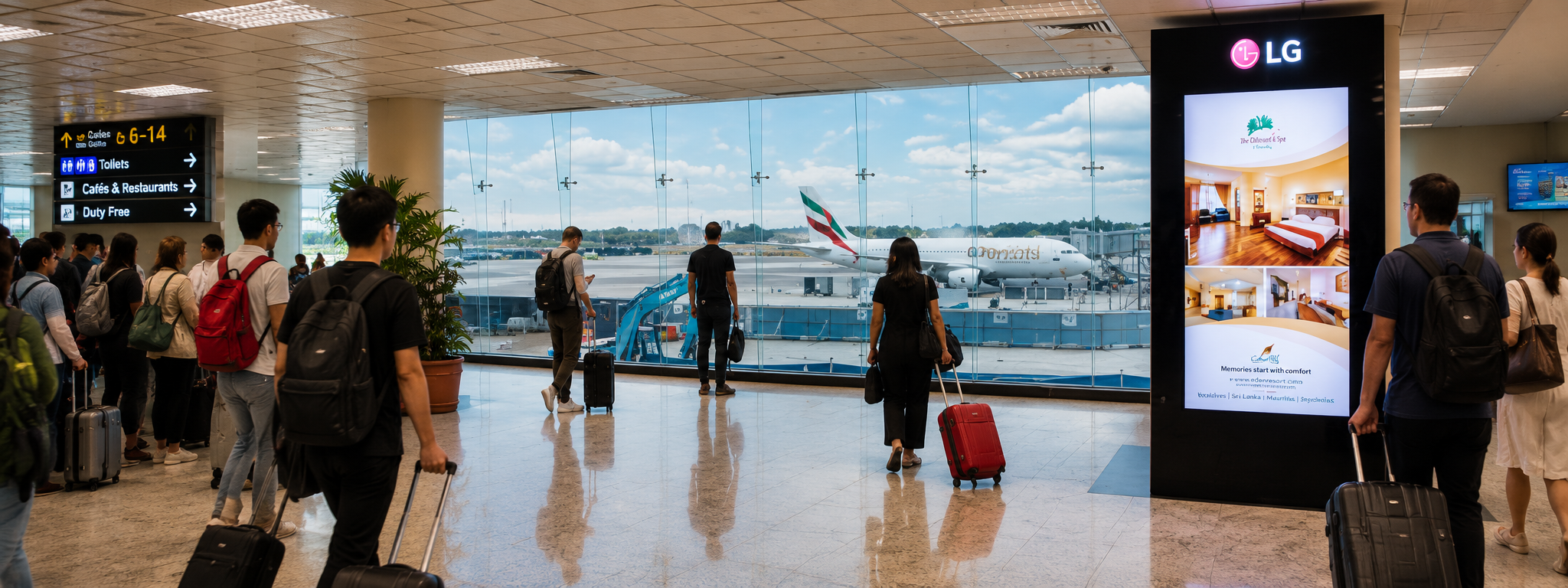
- Bandaranaike International Airport's single integrated terminal creates the most structurally comprehensive advertising audience concentration of any South Asian airport — 100 percent of Sri Lanka's internationally-mobile commercial audience passes through a single terminal whose unified commercial environment eliminates audience fragmentation and ensures that every brand placement achieves complete Sri Lankan international audience coverage with a single, manageable placement footprint
- Dwell time at CMB is elevated by international departure processing requirements and the cultural tendency of Sri Lankan travellers to arrive with extended family accompaniment for both departures and arrivals — creating terminal dwell windows of 60 to 90-plus minutes in both domestic arrivals and international departures whose brand exposure concentration is sustained and commercially productive
- The terminal's commercial identity as both Sri Lanka's sole international gateway and the physical threshold of the island's diaspora homecoming experience creates a brand association environment of cultural emotional weight that mirrors — in smaller scale but comparable intensity — the diaspora homecoming dynamics described at Beirut, Xiamen, and Ho Chi Minh City airports. A brand present at CMB participates in the Sri Lankan diaspora's most emotionally significant annual event — the island homecoming — whose brand loyalty implications for advertisers that engage authentically with this moment are commercially substantial.
- Masscom Global delivers full-service inventory access across Bandaranaike International Airport's international and domestic terminal zones, with Sinhala and Tamil bilingual creative capability, Sri Lankan diaspora and tourism recovery market intelligence, and the cultural expertise to ensure every campaign reflects the authentic warmth of Sri Lankan Buddhist cultural identity, the Gulf diaspora's homecoming commercial dynamics, and the tourism renaissance story whose global recognition is creating new premium inbound audiences at CMB with every passing season
Strategic Advertising Fit
Best Fit:
- Real estate — Colombo premium residential and southern coast villa market: The Sri Lankan diaspora's homeland property investment — concentrated in Colombo's premium residential corridor and the southern coast villa market — creates a commercially active property buyer audience whose decision timing peaks during homecoming visits at CMB. Australian, UK, and Dubai developers marketing to the Sri Lankan diaspora will find at CMB the most concentrated Sri Lankan international property buyer audience available.
- NRI and diaspora banking — Gulf and Western Sri Lankan community: The Gulf Sri Lankan worker's remittance banking, the UK and Australian Sri Lankan's NRI account and India investment management, and the domestic Sri Lankan's post-crisis financial recovery planning create a commercially active but underserved financial services audience at CMB. NRI banking platforms, remittance services, and investment advisory firms targeting the Sri Lankan diaspora should treat CMB as their primary Sri Lankan international financial services acquisition channel.
- International education — UK and Australia: The Sri Lankan HNWI family's UK and Australian education aspiration creates a parent audience at CMB whose per-student investment commitment and international quality demand rewards UK and Australian institution advertising at the terminal. IELTS preparation, UK boarding schools, Australian university placement services, and Canada immigration-adjacent education programmes will find at CMB a commercially motivated and financially capable South Asian parent audience.
- Sri Lanka inbound tourism brands — resorts, wildlife, heritage: International tour operators, premium Galle Fort villa rental companies, Yala National Park luxury safari camps, whale watching operators, and boutique Sri Lanka tourism experience platforms will find at CMB an arriving international tourism audience whose destination commitment confirms premium experience investment readiness and whose British, German, and Australian origin creates internationally calibrated quality expectation for the accommodation and experience products being advertised.
- Premium consumer goods and lifestyle brands entering the Sri Lankan market: The recovering Sri Lankan HNWI consumer's post-crisis aspiration to restore internationally-calibrated consumption standards creates a commercially receptive premium brand introduction audience at CMB. Luxury automotive brands, premium FMCG companies, premium fashion and lifestyle brands, and technology companies entering the Sri Lankan premium consumer market will find at CMB the most concentrated Sri Lankan HNWI consumer discovery moment available.
- Avurudu and cultural gifting brands: Sri Lankan premium food brands, artisan products, traditional gifting items, and quality FMCG brands targeting the Avurudu homecoming commercial peak will find at CMB the most concentrated and most culturally motivated Sri Lankan diaspora gifting purchase audience of any window in the annual calendar.
- Australian and Canadian residency advisory: The post-crisis acceleration of Sri Lankan professional international mobility creates a commercially active and financially qualified audience at CMB for Australia and Canada residency advisory services — a market whose urgency is recent and whose conversion potential is among South Asia's most commercially responsive per capita for the targeted mobility planning advisory category.
Brand Alignment at a Glance:
| Category | Fit |
|---|---|
| Real estate — Colombo and southern coast | Exceptional |
| NRI and diaspora banking | Exceptional |
| Sri Lanka inbound tourism brands | Exceptional |
| International education — UK and Australia | Strong |
| Premium consumer goods entering Sri Lankan market | Strong |
| Avurudu and cultural gifting brands | Strong |
| Australian and Canadian residency advisory | Strong |
| Ultra-luxury brands without Sri Lankan market entry | Moderate |
Who Should Not Advertise Here:
- Brands with no Sri Lanka distribution, digital presence, or market entry plan: International brands whose awareness advertising at CMB cannot be converted into Sri Lankan purchase pathways — either through local retail distribution, e-commerce, or hospitality channel — will find the CMB audience commercially unreachable through awareness alone. Sri Lanka's commercial ecosystem is developing but requires genuine market presence before airport advertising generates commercial return.
- Brands referencing or implying sensitivity around the 2019 Easter attacks or 2021-2022 crisis: Any advertising content that engages with Sri Lanka's recent security or economic challenges — however carefully framed — risks creating negative commercial associations with an audience whose resilience and national pride after these crises is both genuine and commercially significant. Sri Lanka's tourism and commercial recovery story is one of the most inspiring in South Asian recent history, and brands that acknowledge the positive trajectory rather than the historical difficulty will earn commercial respect from an audience that has genuinely earned its optimism.
- Brands without Sinhala or Tamil language capability: English-only advertising at CMB will reach a fraction of the terminal's most commercially valuable audience. The Sri Lankan professional and diaspora returnee's strong preference for their native language creates specific brand engagement requirements that English-only campaigns cannot address — and the investment in Sinhala-language creative is both commercially productive and culturally respectful in ways that earn brand loyalty disproportionate to the creative investment.
Event and Seasonality Analysis
- Event Strength: High (Avurudu Gulf homecoming and December tourism/diaspora peak — South Asia's most structurally concentrated diaspora return windows)
- Seasonality Strength: High
- Traffic Pattern: Dual-Peak (December Western diaspora and tourism + April Avurudu Gulf homecoming) with summer western tourism baseline
Strategic Implication:
Advertisers at Colombo Airport should structure their investment around two primary commercial windows. The December to January window delivers CMB's highest combined international tourism inbound and Western diaspora Christmas homecoming — creating the year's most commercially diverse premium audience concentration at the airport and rewarding brands in premium hospitality, diaspora real estate, gifting, and NRI financial services simultaneously. The Avurudu April window delivers the most specifically Sri Lankan cultural homecoming event — whose Gulf diaspora return and domestic Sinhala-Tamil New Year celebration creates the most emotionally charged diaspora commercial window in the Sri Lankan aviation calendar and the most culturally specific brand advertising opportunity for Sri Lankan cultural heritage, food, and gifting brands. The summer June-September window sustains the western tourism inbound commercial baseline. Masscom Global structures CMB campaigns to capture both peak windows with bilingual Sinhala and Tamil creative calibrated to each season's specific cultural and diaspora commercial character.

Poor Placement and Delays Affect Airport Campaigns
We help you move faster, access better inventory, and get it right now.
Talk to an ExpertFinal Strategic Verdict
Bandaranaike International Airport is South Asia's most structurally distinctive airport advertising environment — the world's only major national gateway whose monopoly on 100 percent of a nation's international commercial air travel creates complete national international audience reach through a single terminal, whose diaspora homecoming commercial dynamics mirror the Lebanese Beirut and Vietnamese Ho Chi Minh City patterns in emotional intensity and per-passenger spending generosity, and whose tourism recovery story is one of South Asia's most commercially promising narratives for the decade ahead. Every Gulf Sri Lankan worker returning for Avurudu with monthly savings accumulated in Abu Dhabi and spent in Colombo's real estate market, every British Sri Lankan professional returning from London for Christmas with their children's UK schoolbooks and a Galle Fort villa inspection on the agenda, every German tourist arriving for a Yala leopard safari and a southern coast week at Amanwella, and every Australian Sri Lankan family arriving for the July school holiday with investment advisory appointments booked for the Rajagiriya premium apartment — all pass through the single terminal whose advertising inventory is the most structurally complete access channel to the Sri Lankan international commercial community available anywhere on earth. For NRI banking platforms whose Sri Lankan diaspora customer acquisition needs the only channel that reaches 100 percent of the target audience, for UK and Australian property developers whose Sri Lankan buyer pipeline requires the emotional homecoming moment of arrival, for international tourism hospitality brands whose Sri Lanka destination marketing most efficiently converts at the moment of first touchdown, and for premium consumer brands whose Sri Lankan market entry needs the most concentrated single-terminal HNWI introduction channel available in South Asia — Colombo Airport is the only place where these audiences are structurally guaranteed to be. Masscom Global provides the Sinhala and Tamil bilingual intelligence, the Sri Lankan diaspora and tourism market expertise, and the CMB inventory access to ensure every campaign captures the full commercial potential of South Asia's most commercially misunderstood monopoly airport gateway.
About Masscom Global
Masscom Global is a premium international airport advertising and media buying agency operating across 140 countries. With deep expertise in airport OOH, premium publications, and high-net-worth audience targeting, Masscom helps brands reach the world's most valuable travellers at the moments that matter most. For advertising packages, media rates, and campaign planning at Bandaranaike International Airport and airports across the globe, contact Masscom Global today.
Frequently Asked Questions
How much does airport advertising cost at Colombo Bandaranaike International Airport?
Advertising costs at Colombo Airport vary based on terminal zone, format type, Sinhala and Tamil language specifications, campaign duration, and seasonal demand. The December to January window and the Avurudu April window attract the highest inventory demand and should be planned well in advance. The summer June-September western tourism peak represents a sustained secondary demand period. Masscom Global provides current rate cards, bilingual Sinhala and Tamil creative specifications, and bespoke media packages tailored to diaspora return, tourism hospitality, and NRI financial services campaign objectives. Contact Masscom Global directly for current pricing and a detailed proposal.
Who are the passengers at Colombo Bandaranaike International Airport?
CMB serves a commercially diverse passenger profile whose defining characteristic is structural completeness — 100 percent of Sri Lanka's internationally-mobile commercial audience. The Gulf Sri Lankan diaspora — returning from UAE, Saudi Arabia, Qatar, and Kuwait for Avurudu, Vesak, and seasonal homecomings — represents the most commercially charged seasonal inbound audience whose Gulf-accumulated earnings create above-average homecoming purchasing intensity. Western country Sri Lankan diaspora — from the UK, Australia, and Canada — represent the most individually high-spending diaspora return nationality. International inbound tourists — primarily Indian, British, German, Australian, and Chinese — represent the growing tourism recovery audience whose premium destination commitment creates above-average per-visit spending. South Asian transit passengers completing SriLankan Airlines hub connections between South Asia and Southeast Asia add a professional business travel commercial dimension.
Is Colombo Airport good for luxury brand advertising?
Colombo Airport performs well for premium brand advertising in categories aligned with Sri Lanka's recovering premium consumer economy, the diaspora's Western-calibrated quality expectations, and the island's premium tourism positioning. Real estate, NRI banking, international education, premium tourism hospitality, and luxury lifestyle brands entering the Sri Lankan market all find genuine audience alignment at CMB. The most important condition for performance is brand quality authenticity — the returning Sri Lankan diaspora's Western consumption standards create quality expectations that require genuine premium delivery rather than aspirational positioning without substance.
What is the best airport in South Asia to reach Sri Lankan HNWI audiences?
Bandaranaike International Airport is the only airport in South Asia through which 100 percent of the Sri Lankan international commercial audience must pass — making it structurally the complete Sri Lankan HNWI access channel by definition. No other South Asian country's primary airport offers this single-gateway coverage of a national international commercial audience. For any brand whose Sri Lankan HNWI, diaspora, or international tourist audience requires comprehensive national coverage, CMB is not one option among several — it is the only option.
What is the best time to advertise at Colombo Airport?
The December to January window is CMB's most commercially diverse and highest-volume advertising period — combining the year's highest inbound international tourism concentration with the Western diaspora Christmas homecoming for the most commercially premium simultaneous audience at any window. The Avurudu April window is the most specifically Sri Lankan cultural homecoming event, generating the Gulf diaspora's most emotionally charged return surge and the domestic family reunion's most concentrated premium gifting and consumer spending. The summer June-September window sustains western inbound tourism commercial quality across a three-month period.
Can international real estate developers advertise at Colombo Airport?
Colombo Airport is a viable and commercially productive acquisition channel for international real estate developers targeting the Sri Lankan diaspora buyer. The structural monopoly of CMB's single-gateway status means that a property developer advertising at this terminal reaches 100 percent of the Sri Lankan international property buyer audience in a single placement — a commercial efficiency unavailable at any other South Asian country of comparable size. Australian and UK developers marketing to the Sri Lankan diaspora community, and Colombo and Galle Fort domestic developers targeting NRI investment buyers, will find at CMB the most precisely concentrated Sri Lankan international property buyer acquisition opportunity available.
Which brands should not advertise at Colombo Airport?
Brands without Sri Lanka distribution or market entry infrastructure, content referencing Sri Lanka's recent security or economic challenges without acknowledging the recovery narrative, brands deploying English-only creative without Sinhala or Tamil language adaptation, and brands whose ultra-luxury positioning targets a wealth tier that Sri Lanka's current consumer economy has not yet fully developed will find CMB structurally limiting for their specific commercial objectives. The Sri Lankan market is recovering and growing — brands whose positioning is calibrated to the recovery trajectory rather than the pre-crisis peak will find more commercially responsive audiences than those whose premium positioning assumes a market maturity that remains aspirational rather than current.
How does Masscom Global help brands advertise at Colombo Bandaranaike International Airport?
Masscom Global provides complete end-to-end advertising capability at Colombo Airport — from Sri Lankan diaspora and tourism recovery audience intelligence through Sinhala and Tamil bilingual campaign strategy, inventory access across international and domestic terminal zones, creative specification, placement execution, and performance reporting. Our team brings deep knowledge of the Sri Lankan diaspora's Gulf and Western homecoming commercial dynamics, the Avurudu and Vesak cultural commercial calendar, the tourism recovery's inbound premium audience trajectory, and the specific Sinhala Buddhist and Tamil Hindu cultural communication standards that earn genuine brand engagement from an audience whose warmth, community solidarity, and genuine quality appreciation reward authentic cultural respect with commercial loyalty of extraordinary durability. Contact Masscom Global today to build your brand's presence at South Asia's most structurally complete national international commercial gateway.