

Executive Summary: Timing Over Volume
In 2026, airport advertising effectiveness in the United Arab Emirates is no longer determined by passenger volume alone. It is defined by when travelers move through airports and who those travelers are.
Between mid-February and late March, UAE aviation hubs experience a convergence of seasonal elite mobility, religious travel patterns, and premium passenger flows. This period creates a high-density audience window, where a disproportionately high concentration of high-net-worth individuals (HNWIs) passes through key airports in Dubai and Abu Dhabi. For advertisers, this is not an awareness play — it is a precision moment.
Airport Infrastructure as an Exposure Multiplier
Recent infrastructure upgrades across UAE airports have amplified the value of this window.
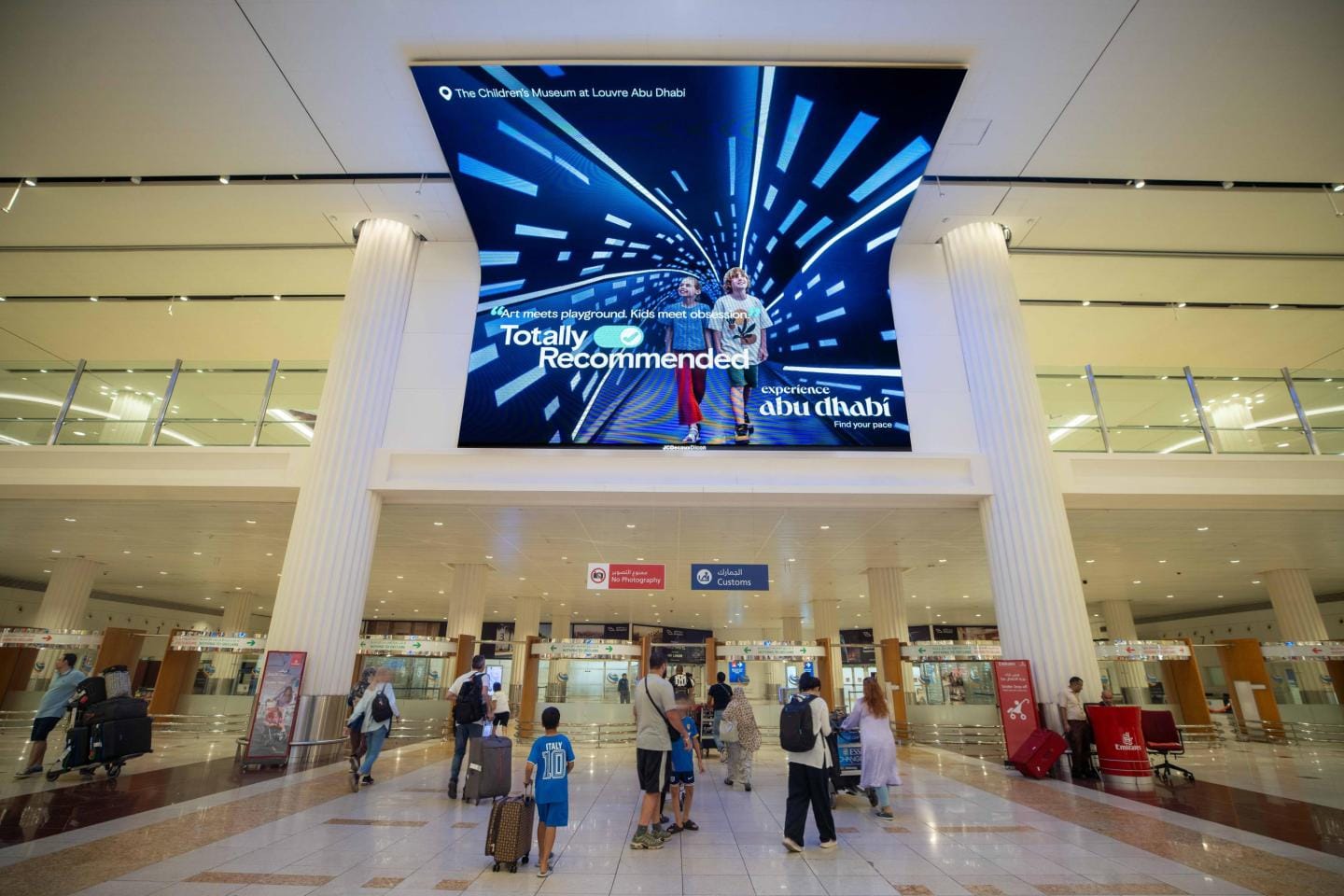
At Dubai International Airport (DXB), the rollout of advanced biometric processing has reduced passenger clearance times by approximately 40%. From an advertising perspective, this shift is critical. Faster processing does not reduce exposure — it reallocates it. Travelers spend less time in queues and more time in post-security retail corridors, premium lounges, and dwell-heavy circulation zones, where attention is higher and distraction is lower.
In parallel, Zayed International Airport (AUH) has emerged as a high-quality alternative gateway. The airport is projected to record a 15% year-on-year increase in premium cabin occupancy in Q1 2026, signaling a growing concentration of executive and elite travelers. Compared to DXB, AUH offers a quieter, less cluttered environment, making it particularly effective for brands seeking high-impact visibility among decision-makers.
Passenger Composition: The HNWI Concentration Effect
From February through March, UAE aviation hubs are expected to experience a 22% higher concentration of high-net-worth individuals compared to annual averages. This increase is driven by seasonal inbound travel from Europe and CIS markets, combined with regional mobility ahead of Ramadan.
Crucially, this is not a generalized traffic spike. It is a composition shift — fewer low-intent travelers and a higher share of affluent, internationally mobile passengers. For airport advertisers, this concentration significantly improves message relevance and recall.
The Ramadan–Eid Mobility Shift
The most important behavioral transition occurs from mid-February to March 20, as the Ramadan–Eid cycle reshapes airport usage patterns.
Historical data supports this shift. Ramadan 2025 travel to the UAE increased by 6% year-on-year, confirming that Ramadan is no longer a low-mobility period. Instead, travel redistributes across the day. Daytime business movement softens, while evening, late-night, and pre-Eid travel accelerates, particularly among family groups and high-value leisure travelers.
For airport advertising, this creates predictable engagement windows — especially in departure halls, arrivals corridors, and premium retail zones during evening peaks.
Strategic Implications for Airport Advertising
This environment rewards advertisers who plan around real passenger behavior, not static schedules. Brands that align messaging with:
- seasonal elite mobility,
- premium cabin flows,
- evening travel peaks,
- and airport-specific dwell zones
achieve stronger relevance than those relying on flat, always-on exposure.
The effectiveness of airport advertising in 2026 is therefore less about saturation and more about synchronization.
Conclusion: Advertising That Moves With the Passenger
In 2026, airport advertising in the UAE works best when brands align with real travel cycles and elite movement patterns, rather than assuming uniform passenger behavior throughout the year.
The February–March window illustrates this clearly: infrastructure efficiency, premium passenger growth, and seasonal mobility converge to create a uniquely valuable environment. Brands that recognize and plan for these shifts position themselves where attention, intent, and influence intersect.