

Airport at a Glance
| Field | Detail |
|---|---|
| Airport | Xi'an Xianyang International Airport |
| IATA Code | XIY |
| Country | China |
| City | Xi'an, Shaanxi Province |
| Annual Passengers | ~26.3 million |
| Primary Audience | Domestic Chinese cultural heritage tourists, Xi'an technology and aerospace professionals, Shaanxi energy sector wealth, Belt and Road business community, international cultural and heritage visitors |
| Peak Advertising Season | April to October (heritage tourism peak), Chinese New Year (January to February), National Golden Weeks |
| Audience Tier | Tier 1 (heritage tourism premium and technology-industrial HNWI combined) |
| Best Fit Categories | Heritage luxury, premium hospitality, domestic Chinese consumer brands, technology and B2B, real estate, international education, premium food and beverage |
Xi'an Xianyang International Airport is the gateway to one of the most commercially and culturally extraordinary cities in human history. Xi'an — known as Chang'an throughout its millennia as China's imperial capital and as the eastern terminus of the ancient Silk Road — is both a UNESCO World Heritage landscape of incomparable depth and one of China's most rapidly modernising technology and industrial economies. The passengers moving through XIY are arriving to stand before the Terracotta Warriors of Emperor Qin Shi Huang, to walk the Han Dynasty walls of China's most intact ancient city, and to experience the Muslim Quarter's thousand-year culinary culture — and they are doing so in a city simultaneously housing aerospace factories producing commercial aircraft, semiconductor fabrication plants, university research institutes of national strategic importance, and the Chinese central government's most ambitious western development zone. That combination of ancient cultural gravity and contemporary commercial ambition creates an airport advertising environment whose audience spans the full breadth of China's premium consumer economy, from the domestic heritage tourist who has saved for years to see the Terracotta Army to the Shaanxi energy magnate whose fortune was built on the coal fields of the Loess Plateau.
XIY is not merely a major Chinese regional airport. It is the commercial gateway to China's Belt and Road Initiative story — the city where the ancient Silk Road began, where modern China-Europe freight trains now depart weekly for Hamburg and London, and where the Chinese government has invested most directly in the narrative of China as a civilisational bridge between East and West. For international brands seeking to position themselves within China's most powerful soft power story, and for advertisers whose audiences include China's surging domestic cultural tourism market, Shaanxi's industrial and energy wealth, and the western China professional class that has built one of the country's most dynamic innovation economies, Xi'an Xianyang Airport is one of the most strategically positioned advertising environments in Chinese aviation.


Advertising Value Snapshot
- Passenger scale: Approximately 26.3 million annual passengers, reflecting the ongoing recovery of Chinese domestic and international aviation from the extended COVID-19 disruption period. Pre-pandemic, XIY handled approximately 47 million passengers annually — one of China's top ten airports — making the current figure a trajectory indicator rather than a ceiling
- Traveller type: Domestic Chinese cultural heritage and tourism visitors, Xi'an and Shaanxi technology, aerospace, and energy sector professionals, Belt and Road international business community, international cultural tourists arriving for the Terracotta Warriors and Silk Road heritage, Chinese domestic HNWI leisure and investment travellers
- Airport classification: Tier 1 — one of China's strategically designated aviation hubs for western China, serving a catchment that combines China's most visited UNESCO heritage landscape with one of the country's most significant technology and energy industrial bases
- Commercial positioning: China's ancient capital gateway and the modern Silk Road's eastern anchor — a dual commercial identity as both the country's most historically resonant premium tourism destination and as western China's most ambitious technology, aerospace, and innovation economy hub
- Wealth corridor signal: XIY sits at the convergence of China's domestic heritage tourism wealth corridor — where Beijing, Shanghai, Guangzhou, and Shenzhen HNWI families travel to access China's most profound historical experiences — and Shaanxi's indigenous technology, energy, and industrial wealth base whose accumulated capital is among the most significant in western China
- Advertising opportunity: Masscom Global activates the full advertising environment at Xi'an Xianyang International Airport, positioning brands at the arrival and departure points of China's most commercially and culturally resonant domestic tourism corridor, combined with access to the technology and energy executive class that drives Shaanxi's rapidly expanding premium consumer economy
Airport Advertising is Complex to Get Right
We help you execute faster, with proven results and local insight most planners lack starting now.
Talk to an ExpertCatchment Area and Economic Drivers
Top 10 Cities within 150 km — Marketer Intelligence:
- Xi'an city (core): China's fourth great ancient capital and the primary commercial, cultural, and administrative centre of Shaanxi Province, Xi'an's 13 million residents include one of China's most rapidly growing technology and aerospace professional classes alongside a deeply embedded heritage culture economy. The city's consumer market spans the full premium tier from established real estate and energy wealth through emerging startup and technology entrepreneur wealth, and its domestic tourism economy generates billions of RMB annually in hospitality, dining, and retail spend from visitors arriving from every province of China.
- Xianyang: The airport's immediate host city and itself a former imperial capital — Qin Dynasty Emperor Qin Shi Huang ruled from Xianyang before Xi'an's Han and Tang Dynasty prominence — Xianyang is a rapidly growing commercial and logistics hub directly adjacent to the airport, housing significant industrial and manufacturing operations whose professional workforce is a primary air travel consumer with strong demand for financial services, automotive, and premium FMCG brands.
- Lintong District (Lishan area): The administrative district 60 kilometres east housing the Museum of Emperor Qin Shi Huang's Mausoleum — home of the Terracotta Warriors — and the Lishan Mountain imperial hot springs. Lintong's entire commercial economy is oriented around servicing the tourism flow to the most visited UNESCO site in western China, generating a concentrated, high-spend tourist commerce ecosystem relevant for premium hospitality, heritage retail, and food and beverage brands.
- Weinan: A city of over 5 million people 100 kilometres east of the airport, Weinan is Shaanxi's most agriculturally productive corridor alongside a growing industrial and chemical manufacturing base. Its agricultural wealth — including China's largest apple production region and premium fruit orchards — generates a farming landowner and agribusiness entrepreneur class whose commercial profile is relevant for financial planning, premium FMCG, and consumer goods brands entering western China's rural prosperity market.
- Tongchuan: A former coal mining city 80 kilometres north undergoing industrial transformation, Tongchuan is transitioning from coal dependency toward pharmaceutical manufacturing, ceramics heritage tourism (it was China's most significant Song Dynasty kiln site), and light industry. Its professional and managerial class generates a travel audience relevant for healthcare, professional services, and B2B financial brands active in western China's industrial transition economy.
- Yanliang District: Xi'an's aerospace industrial district 50 kilometres east, Yanliang houses China's most significant military and commercial aviation manufacturing cluster including AVIC Xi'an Aircraft Industry (XAC) — the primary production facility for the Y-20 military transport aircraft and the MA60 regional commercial aircraft. Its aerospace engineering and technical management workforce represents a highly educated, above-average-income professional audience with strong demand for technology, premium automotive, and financial services brands.
- Yangling (Yangling Agricultural High-Tech Industrial Demonstration Zone): A nationally designated agricultural science and technology demonstration zone 100 kilometres west, Yangling houses Northwest Agriculture and Forestry University and a growing agricultural innovation economy. Its academic and innovation professional community generates an educated, internationally connected travel audience relevant for technology, premium food, and education brand advertisers.
- Zhouzhi County: A mountainous Shaanxi county southwest of Xi'an known for its Chinese giant panda protection zones, ecological forest reserves, and premium kiwifruit production — one of the most commercially branded agricultural products in Shaanxi. The Zhouzhi area's growing eco-tourism and premium agricultural brand economy connects to the broader Shaanxi premium food provenance story that is commercially relevant at XIY's departures retail environment.
- Huayin (Mount Hua area): A county city 150 kilometres east at the base of Huashan — one of China's Five Great Mountains and a Taoist sacred peak famous for its vertiginous cliff-face plank walks that have made it a global extreme adventure tourism attraction — Huayin's rapidly growing adventure and cultural tourism economy generates a premium leisure audience relevant for outdoor, adventure, insurance, and premium hospitality brands aligned with China's booming national park and natural heritage tourism market.
- Baoji: A major industrial city 150 kilometres west at the western edge of the catchment, Baoji is China's most significant titanium and special metals production centre and the origin city of the Zhou Dynasty that preceded the Qin Empire. Its industrial and metallurgical wealth class uses XIY as its primary air gateway, and its historical significance as the site of the founding of Chinese civilisational culture adds a cultural tourism dimension increasingly relevant for heritage tourism and premium cultural experience brands.
NRI and Diaspora Intelligence:
Xi'an does not serve a significant outbound overseas diaspora in the traditional sense, but it hosts one of China's most commercially important inbound diaspora dynamics — the return of overseas Chinese students and professionals who studied or worked internationally and have returned to Xi'an to contribute to the city's technology and innovation economy. Xi'an's universities — including Xi'an Jiaotong University, ranked among China's top ten — produce significant annual outbound student flows to the United States, the United Kingdom, Australia, and Canada, and the return movement of these internationally educated professionals carrying both technical expertise and foreign market knowledge is a commercially distinct audience segment at XIY whose consumption patterns reflect internationally calibrated standards in technology, premium consumer goods, and financial services. Separately, Xi'an's Hui Muslim community — one of China's most historically significant Islamic communities, maintaining a continuous presence in the Muslim Quarter since Tang Dynasty Central Asian trade — generates a distinctive international travel pattern to Islamic world destinations including Saudi Arabia (Hajj and Umrah), the UAE, and Southeast Asian Muslim countries, creating a niche but commercially active diaspora travel segment through XIY with specific halal and Islamic lifestyle brand relevance.
Economic Importance:
Shaanxi Province's economy is anchored by three structural pillars of significant commercial scale. The energy sector — particularly coal and natural gas extraction from Shaanxi's Ordos Basin and Loess Plateau reserves — has generated extraordinary private and institutional wealth concentration in the province, with Shaanxi ranking among China's top coal and natural gas producing regions and its energy entrepreneurs representing some of the wealthiest private individuals in western China. The technology and aerospace industrial complex — centred on Xi'an's nationally designated High-Tech Industries Development Zone and the Yanliang aerospace manufacturing corridor — employs hundreds of thousands of engineers, scientists, and technical managers whose professional income profile significantly exceeds the western China average and who travel frequently through XIY for domestic and international business connections. Tourism, anchored by the Terracotta Warriors as China's single most visited UNESCO site outside the Great Wall circuit, generates billions of RMB annually in accommodation, dining, cultural experience, and retail spend from the largest sustained inbound domestic and international cultural tourism flow of any western Chinese city. For advertisers, the commercial implication of these three pillars is a catchment that produces premium audience segments across leisure, business, and industrial categories simultaneously — an unusual commercial diversity for a regional gateway airport.
Business and Industrial Ecosystem
- Xi'an's National High-Tech Industries Development Zone — one of China's first nationally designated technology development zones, housing over 20,000 enterprises including Samsung, Huawei, ZTE, Shaanxi Blower, and hundreds of domestically originated technology companies — generates a professional and entrepreneurial technology class whose travel through XIY for domestic and international business connections represents one of western China's most commercially valuable B2B and premium consumer airport audiences
- The aerospace and defence manufacturing complex centred on AVIC Xi'an Aircraft Industry in Yanliang generates a technically elite engineering and management workforce with significant government-backed compensation packages, career stability, and strong purchasing power in automotive, real estate, and premium consumer electronics categories — a professional class whose commercial profile is consistently underestimated by advertisers who associate Shaanxi primarily with heritage tourism
- Shaanxi's energy sector — encompassing coal, natural gas, and oil extraction operations across the province's northern plateau — has created a class of energy company executives, private mining entrepreneurs, and natural resource traders whose accumulated wealth is substantial by any national standard and who travel internationally through XIY for investment management, luxury leisure, and international education planning for their children
- The logistics and trade corridor economy anchored by Xi'an International Port — the largest inland container port in China and the primary terminus for the China-Europe freight train network connecting Xi'an to Hamburg, Rotterdam, London, and Central Asian cities — generates a cross-border trading company executive and logistics entrepreneur class with strong demand for international financial services, trade insurance, and premium business travel products
Passenger Intent — Business Segment:
Business travellers at Xi'an Xianyang Airport divide between domestic and international intent in commercially distinct ways. Domestic business travellers — connecting Xi'an to Beijing, Shanghai, Guangzhou, Shenzhen, and Chengdu — are predominantly the Xi'an High-Tech Zone professional class, energy sector executives, and aerospace industry managers whose business travel patterns reflect a city in the process of rapid economic integration with China's coastal commercial centres. International business travellers — connecting Xi'an to Seoul, Tokyo, Dubai, London, Frankfurt, and Central Asian capitals — reflect the Belt and Road commercial network that has made Xi'an one of China's most internationally connected western cities. Both segments carry premium consumption profiles significantly above the Shaanxi provincial average, and both are responsive to brand communications that acknowledge Xi'an's ambition as a national technology and heritage capital rather than positioning it merely as a secondary Chinese city.
Strategic Insight:
The commercial environment at XIY is defined by a structural opportunity that most international advertisers have not yet fully recognised: Xi'an is simultaneously one of China's most visited tourist destinations and one of its most rapidly growing premium consumer markets, but it is served by a terminal that has historically received international brand attention far below what either of those commercial facts would justify. The Terracotta Warriors alone draw over 1.8 million visitors annually to the museum complex — the majority of whom are premium domestic Chinese tourists from the coastal wealth cities whose disposable income, brand sophistication, and premium consumer spending capacity rival the audiences at Shanghai Pudong or Beijing Capital. For brands seeking to reach China's most commercially motivated domestic leisure traveller at a moment of extraordinary cultural engagement, and for technology and B2B brands seeking western China's most qualified professional audience, XIY represents a cost and competition environment that is structurally more attractive than any comparable premium airport in eastern China.
Tourism and Premium Travel Drivers
- The Museum of Emperor Qin Shi Huang's Mausoleum — home to the Terracotta Warriors, designated a UNESCO World Heritage Site and described by former French President Jacques Chirac as the eighth wonder of the world — is China's single most internationally recognised archaeological site and the primary driver of Xi'an's status as a top-five domestic Chinese tourism destination, drawing over 2 million visitors annually to the museum complex and generating the most sustained cultural tourism passenger flow of any western Chinese city
- The Xi'an Ancient City Wall — one of the largest and most completely preserved city walls on earth, encircling the historic inner city of Xi'an in a 14-kilometre perimeter of Ming Dynasty fortification that can be walked, cycled, or experienced from a horseback tour — anchors the city's heritage tourism identity as a living museum of Chinese imperial history and generates sustained inbound tourism from domestic and international visitors whose per-visit spend on cultural experiences and heritage retail is among the highest in China's domestic tourism market
- Huashan Mountain, one of China's Five Great Mountains and a Taoist sacred peak whose cliff-face plank walk at 2,100 metres elevation has become globally viral as an extreme adventure tourism experience, draws both Chinese domestic adventure tourists and international travellers who combine a Huashan ascent with Xi'an's heritage circuit, representing a younger, physically active, internationally connected audience segment whose spending on premium outdoor, adventure, and insurance brand categories is directly relevant at XIY
- The Tang West Market and Tang Paradise cultural theme park — large-scale immersive recreations of Tang Dynasty architecture, performance, and lifestyle — represent Xi'an's investment in premium domestic cultural tourism experience infrastructure beyond the ancient archaeological sites, drawing younger domestic Chinese tourists whose cultural consumption is shaped by national pride and whose premium experience spending in dining, accommodation, and cultural retail is growing rapidly with Chinese household income expansion
Passenger Intent — Tourism Segment:
The tourists arriving at Xi'an Airport are among China's most culturally motivated and purchase-committed domestic leisure travellers. They have typically planned their Xi'an trip around specific heritage experiences — the Terracotta Warriors, the City Wall, the Muslim Quarter — and they arrive with accommodation pre-booked at Xi'an's premium hotels and dining reservations at the city's most celebrated restaurants. This pre-commitment profile means the arrival terminal intercepts an audience in a state of maximum cultural anticipation whose spending agenda is expansive and emotionally charged. Premium cultural experience upgrades, luxury hotel brand communications, fine dining and cuisine experiences, regional specialty food products, and cultural craft brands all find their ideal Chinese domestic consumer audience concentrated in the arrivals hall of XIY at the moment of maximum receptivity.
Travel Patterns and Seasonality
Peak seasons:
- Qingming Festival and spring (April): China's traditional tomb-sweeping holiday combined with spring travel season creates a surge of heritage tourism to Xi'an, where the connection between ancestral veneration and the Terracotta Warriors' imperial burial site gives Qingming particular cultural resonance. April and early May represent one of XIY's highest-quality domestic tourism inbound windows.
- Labour Day Golden Week (late April to early May): China's seven-day holiday generates one of the two peak domestic tourism surges of the year through XIY, as families from Beijing, Shanghai, Guangzhou, and Shenzhen travel to Xi'an for cultural heritage experiences. Premium hotel occupancy reaches annual peaks, and per-visitor spend on accommodation, dining, and cultural experience is at its highest.
- Summer (July to August): School summer holidays drive the highest-volume domestic family tourism window, generating the largest single-month inbound passenger totals of the year. The summer audience includes the broadest income range of any season — from budget backpackers to luxury family groups staying at the Sofitel Xi'an on Renmin Square or the Hyatt Regency Xi'an.
- National Day Golden Week (October): China's most commercially intense holiday week, generating massive domestic travel surges across all major tourist destinations. Xi'an's autumn climate — comfortable and clear — combined with the cultural resonance of National Day for heritage sites creates XIY's second-largest annual peak, with domestic luxury leisure travellers representing a significant proportion of the National Day audience.
- Chinese New Year (January to February): The Lunar New Year generates the largest single family travel event of the Chinese calendar. Xi'an's distinctive local New Year celebrations — including the Tang West Market lantern festival, traditional performances, and temple fair culture — draw premium domestic tourists seeking an authentic ancient capital Chinese New Year experience as an alternative to urban New Year entertainment.
Event-Driven Movement:
- Xi'an Silk Road International Tourism Festival (various): An annual government-supported international cultural tourism event celebrating Xi'an's Silk Road heritage, drawing international delegations, cultural tourism operators, and media from Belt and Road partner countries. The festival generates a short but commercially valuable international professional and diplomatic audience through XIY with strong premium hospitality, cultural brand, and B2B service brand relevance.
- National Day Golden Week (October 1 to 7): The single highest-volume tourism week in China's annual calendar, generating peak inbound tourist concentration at Xi'an that fills every premium hotel room in the city simultaneously. Brands in luxury accommodation, premium dining, cultural experience, and retail should treat the pre-National Day advertising window as their highest-priority annual campaign placement at XIY.
- Chinese New Year (Lunar calendar — January to February): The most emotionally charged family travel event of the Chinese year. Xi'an's Tang Paradise and Muslim Quarter New Year celebrations are nationally promoted as premium heritage New Year experiences, drawing a family luxury leisure audience from coastal cities whose per-night accommodation and dining spend during this week is among the highest of any Chinese tourism window.
- Labour Day Golden Week (late April to early May): China's spring holiday week generates the second-largest inbound domestic tourism surge of the year. The spring weather and cherry blossom season in Xi'an's parks add a natural beauty dimension that makes this window particularly attractive for the young Chinese premium traveller whose social media documentation of the trip begins the moment they land at XIY.
- Belt and Road Forum and Related Business Events (variable): Xi'an's designation as a key Belt and Road Initiative node generates high-profile international business forums, trade delegations, and investment conferences that bring senior government officials, international business leaders, and Central Asian commercial delegations through XIY — a concentrated, high-protocol, institutionally supported B2B audience with premium hospitality and financial services brand relevance.
It’s Not Just Where You Advertise - It’s How Fast You Execute
We combine local insight with fast rollout to deliver results for you, now.
Talk to an ExpertAudience and Cultural Intelligence
Top 2 Languages:
- Mandarin Chinese (Putonghua): The universal primary language of the entire passenger base at XIY — domestic Chinese tourists, Shaanxi provincial residents, and Chinese diaspora returnees all communicate in standard Mandarin, which is the only language that achieves complete coverage across the airport's full commercial audience. Chinese-language creative at XIY must reflect the specific cultural codes of an audience whose relationship with Xi'an is defined by national pride, historical depth, and the emotional resonance of standing at the origin point of Chinese civilisation — a cultural register that rewards heritage language, classical Chinese references, and the vocabulary of dynastic grandeur rather than the contemporary urban commercial Chinese of Shanghai or Beijing airport advertising.
- English: The most commercially relevant secondary language at XIY, serving the international cultural tourism audience — primarily Western European, North American, Japanese, Korean, and Southeast Asian — arriving for the Terracotta Warriors and Silk Road heritage circuit. English-language creative positions brands in front of the highest individual per-visit spending nationality group in Xi'an's inbound tourism market — foreign passport tourists whose accommodation and experience spend at Xi'an's premium hotel tier is among the highest of any Chinese domestic destination outside Shanghai, Beijing, and Chengdu.
Major Traveller Nationalities:
The dominant passenger nationality at Xi'an Xianyang Airport is Chinese domestic — with inbound tourist flows from Beijing, Shanghai, Guangzhou, Shenzhen, Chengdu, Hangzhou, and Nanjing representing the commercial backbone of the airport's leisure traffic. Within this domestic Chinese audience, the most commercially significant segments are the coastal city HNWI family leisure tourists whose cultural tourism investment in Xi'an is among the highest per trip of any domestic Chinese destination, and the Shaanxi provincial business and professional class whose outbound travel connects Xi'an's economy to China's national commercial centres and to international partners across the Belt and Road network. International nationals — South Korean tourists (significant, driven by direct Seoul flights), Japanese visitors (drawn by the Silk Road cultural connection and the deep historical relationship between Chang'an and Nara), Southeast Asian tourists from Thailand, Singapore, and Vietnam, and Western European and North American cultural tourists — add a commercially valuable inbound foreign currency tourism layer whose individual spending intensity significantly exceeds the domestic Chinese average.
Religion — Advertiser Intelligence:
- Buddhism and Taoism (culturally practiced — majority): The overwhelming majority of Xi'an's domestic Chinese visitors maintain the syncretic Buddhist-Taoist practice that defines Chinese popular religion, expressed most commercially through temple visits, incense purchasing, and the heritage tourism circuit that includes Xi'an's Big Wild Goose Pagoda (one of the most important Tang Dynasty Buddhist monuments in China), Famen Temple (housing the finger relic of the historical Buddha), and Huashan Mountain's Taoist shrines. These religious cultural tourism sites generate sustained domestic visitor traffic whose per-visit purchasing on cultural products, religious offerings, and heritage artisan goods is directly relevant for premium cultural retail brands advertising at XIY. Chinese New Year, Qingming, and the mid-autumn festival are the three most commercially significant cultural-religious calendar windows, driving the largest domestic travel surges through the airport.
- Islam (~4% — Xi'an Muslim community): Xi'an's Hui Muslim community — one of China's most historically significant, tracing its origins to Silk Road-era Arab and Persian merchants who settled in Chang'an — maintains a living Islamic culture centred on the Great Mosque of Xi'an and the Muslim Quarter's halal food economy. This community's international travel through XIY — including Hajj and Umrah pilgrimages to Saudi Arabia and leisure travel to the UAE and Southeast Asian Muslim destinations — generates a niche but commercially distinctive travel segment. The Muslim Quarter's halal food culture is also Xi'an's most visited non-archaeological tourism attraction, drawing domestic Chinese tourists whose interest in the Hui culinary heritage creates commercial alignment for premium halal food, traditional craft, and Muslim lifestyle brands.
- Christianity (~3% — primarily urban professional): A small but growing Christian community concentrated among Xi'an's educated urban professional and international-educated returnee class. Christmas functions as China's most commercially active retail gift-giving season for the secular consumer market, and the Christian professional segment adds a secondary consumer dimension for international luxury and lifestyle brands whose Christmas gifting campaign timing aligns with Xi'an's pre-Lunar New Year retail surge.
Behavioral Insight:
The Chinese domestic tourist at Xi'an Airport is operating in what Chinese consumer research consistently identifies as the most emotionally engaged form of domestic travel — the cultural heritage pilgrimage to one of China's founding civilisational sites. This is not casual leisure travel. It is a journey that carries the weight of national identity, ancestral connection, and the deeply Chinese concept of knowing one's historical roots. The consumer behaviour that follows from this emotional register is characterised by a willingness to invest at the premium tier for accommodation and dining, by strong receptivity to culturally resonant brand storytelling that connects to Xi'an's specific heritage narrative, and by a social media documentation impulse that amplifies premium brand encounters into networks of hundreds of connections across WeChat, Weibo, Douyin, and Xiaohongshu. A brand that earns genuine engagement at XIY is not paying for an impression — it is entering a conversation that the Chinese cultural tourist will actively share, and the amplification value of that sharing in China's domestic social commerce ecosystem is commercially extraordinary.
Outbound Wealth and Investment Intelligence
The outbound passenger at Xi'an Xianyang Airport is a western China wealth holder whose international investment patterns reflect both the coastal Chinese HNWI behaviour that has defined global luxury real estate and education markets and the specific characteristics of Shaanxi's indigenous energy and technology wealth — more conservative in investment style, more focused on domestic China opportunity alongside international diversification, and more motivated by family security and educational advancement for children than by lifestyle diversification alone.
Outbound Real Estate Investment:
Shaanxi HNWI outbound real estate investment flows follow the established Chinese HNWI corridor with some western China-specific characteristics. Australia remains the dominant international destination — Queensland and New South Wales coastal properties are the most actively purchased by Chinese investors nationally, and Xi'an's technology professional class is a consistent participant in this flow. Canada's British Columbia and Ontario markets attract the largest Chinese student-family investment correlation, with Xi'an families purchasing Vancouver and Toronto residential properties to anchor their children's Canadian university experience with an asset. The United Kingdom — particularly London and Manchester — is the premium education-adjacent property market for the most internationally oriented Xi'an HNWI family. Singapore, whose regulatory stability and Chinese cultural alignment make it China's most trusted offshore financial and real estate hub, attracts significant Shaanxi energy and technology sector investment through its private banking and condominium market. Within China, Xi'an's domestic real estate market has shown consistent appreciation driven by inbound investment from coastal cities, and outbound Xi'an investors are simultaneously active buyers in Beijing, Hainan Island resort properties, and Shenzhen technology corridor apartments.
Outbound Education Investment:
Xi'an's status as one of China's leading university cities — home to 63 universities and colleges including Xi'an Jiaotong University, Northwest University, and Shaanxi Normal University — creates both a local education premium and a strong outbound aspiration for the next credential level beyond domestic elite. Xi'an HNWI families direct their international education investment toward the United States for science, technology, engineering, and mathematics programmes (MIT, Stanford, Caltech, and Ivy League universities attract the largest share of Xi'an's technology sector family outbound student investment), the United Kingdom for business, law, and humanities at Russell Group universities, and Australia and Canada for more accessible pathways that combine quality education with immigration option value. The technology and aerospace professional community's international education investment is particularly concentrated in STEM disciplines at the world's top technical universities — a purchasing profile that makes XIY a high-value acquisition channel for the world's leading engineering, computer science, and applied science university programmes seeking Chinese western city student enrolment.
Outbound Wealth Migration and Residency:
Chinese HNWI interest in international residency has been one of the most significant global wealth migration trends of the past decade, and Shaanxi's energy and technology wealth class participates in this trend with specific characteristics. Canada's investor immigration programme remains the most actively pursued pathway for Xi'an's HNWI family segment seeking North American residency, driven by the quality of Canadian university pathways for their children and the perception of political and economic stability. Australia's significant investor visa programme attracts energy and technology wealth seeking Pacific Rim lifestyle access alongside investment returns. Portugal's Golden Visa fund investment pathway has attracted Chinese investor interest, though the regulatory evolution of this programme has reduced its certainty as a primary option. The UAE's zero-tax residency structure is growing in relevance for the Xi'an trading and logistics business community whose Belt and Road commercial relationships give them existing Dubai and UAE business connections. Singapore's Global Investor Programme is the most actively pursued Asian-Pacific residency option, offering a Chinese cultural environment, tax efficiency, and financial system stability that addresses the specific risk management priorities of Shaanxi's energy sector wealth.
Strategic Implication for Advertisers:
International real estate developers active in Australia, Canada, the UK, and Singapore should treat Xi'an Xianyang Airport as a primary western China HNWI buyer acquisition channel — an audience that is commercially active, investment-motivated, and underserved relative to the Shanghai and Beijing-focused China marketing investment of most international property developers. International education providers at the world's leading STEM universities will find at XIY a parent audience whose per-student investment commitment and STEM educational aspiration reflects the specific professional values of a technology and aerospace workforce community. Masscom Global coordinates these outbound investment campaigns with inbound cultural tourism brand campaigns operating simultaneously at XIY, ensuring the full commercial value of the terminal is activated across both directions of the Silk Road wealth corridor.
Airport Infrastructure and Premium Indicators
Terminals:
Xi'an Xianyang International Airport operates three terminal buildings — Terminal 2, Terminal 3, and the newly operational Terminal 5 — that together form one of western China's largest airport complexes. Terminal 3 is the primary international and major domestic operations terminal, offering an international-standard passenger experience with premium retail, duty-free, and lounge facilities calibrated for the premium domestic Chinese tourist and international inbound audience. Terminal 5 represents the airport's most significant recent infrastructure investment, a state-of-the-art facility designed to handle the return to and expansion beyond pre-pandemic capacity and featuring commercial and retail spaces designed for the post-COVID premium Chinese consumer experience. The multi-terminal configuration means that campaign planning requires strategic placement across key terminals, with Masscom Global's inventory access and Xi'an market knowledge ensuring optimal placement in the zones carrying the highest commercial audience concentration.
Premium Indicators:
- Xi'an's five-star hotel ecosystem — including the Sofitel Xi'an on Renmin Square, Hyatt Regency Xi'an, Hilton Xi'an, Westin Xi'an, and Grand Hyatt Xi'an — establishes a luxury accommodation tier competitive with China's tier-two city best properties, confirming the presence of premium hotel guests whose room rate commitment signals discretionary spending power across all premium consumer categories in the city's commercial environment
- The airport's direct rail and expressway connectivity to Xi'an city centre — and by extension to the Terracotta Warriors, the Ancient City Wall, and the Muslim Quarter — positions XIY as the direct entry point to China's most visited UNESCO heritage circuit, giving every premium brand placement at the airport a cultural authority halo derived from the destination's extraordinary civilisational significance
- Xi'an International Port — the largest inland container port in China, directly adjacent to the airport's logistics corridor — signals the commercial intensity of the Belt and Road freight economy that Xi'an anchors, confirming the presence of a trading company and logistics executive professional class whose international commercial activity generates consistent premium business travel through XIY
- The Xi'an High-Tech Industries Development Zone's global company roster — including Samsung Semiconductor, Huawei, Shaanxi Blower, and dozens of nationally listed technology companies — confirms the presence of an internationally calibrated technology executive class whose consumer standards and brand expectations reflect global rather than western China regional norms
Forward-Looking Signal:
Xi'an's aviation infrastructure investment trajectory is one of the most ambitious in China's western development programme. The new Terminal 5 expansion is designed to restore and exceed the pre-pandemic annual capacity of 83 million passengers by 2030 — a target that, if achieved, would make XIY one of China's five largest airports by passenger volume. New direct international route development under the Belt and Road framework is progressively adding Central Asian capitals (Almaty, Tashkent, Nur-Sultan), Middle Eastern cities (Dubai, Riyadh, Doha), and European destinations (London, Paris, Amsterdam via direct charter-to-scheduled upgrades) to XIY's international network. The TSMC-adjacent semiconductor supply chain investment drawing international component manufacturers to the greater Xi'an and Shaanxi region is generating new international technology sector travel flows whose commercial profile is among the highest per individual of any business travel category in Chinese aviation. Masscom advises clients to establish presence at XIY now — the combination of terminal expansion, route network growth, and domestic tourism recovery toward pre-pandemic peaks means that inventory competition will intensify significantly as the airport approaches its 83 million passenger target, and current placement rates reflect a market that will not persist as capacity and commercial competition grow.
Airline and Route Intelligence
Top Airlines:
- Air China — primary domestic hub connector and international long-haul operator
- China Eastern — major domestic and international operator
- China Southern — domestic hub connectivity and international routes
- Hainan Airlines — domestic connections and international long-haul routes
- Xiamen Air — domestic feeder connections
- Sichuan Airlines — southwest China connections
- Shenzhen Airlines — Pearl River Delta connections
- Lucky Air and Chengdu Airlines — secondary domestic LCC operations
Key International Routes:
- Xi'an (XIY) to Seoul Incheon (ICN): Primary Northeast Asian connection serving Korean and Chinese tourism exchange
- Xi'an (XIY) to Tokyo Narita (NRT) and Haneda (HND): Japanese cultural tourism and business connection
- Xi'an (XIY) to Bangkok (BKK): Southeast Asian leisure and Buddhist pilgrimage connection
- Xi'an (XIY) to Singapore (SIN): Southeast Asian financial hub connection, Chinese diaspora gateway
- Xi'an (XIY) to Dubai (DXB): Belt and Road Gulf corridor, Chinese-Middle Eastern business and tourism connection
- Xi'an (XIY) to London Heathrow (LHR): European flagship route, education and heritage tourism gateway
- Xi'an (XIY) to Frankfurt (FRA): European business and diaspora connection, China-Europe Belt and Road air corridor
- Xi'an (XIY) to Los Angeles (LAX): North American connection serving overseas Chinese student and tourism flows
- Xi'an (XIY) to Sydney (SYD): Australian connection serving the most active Chinese property investment destination market
Domestic Connectivity:
XIY operates as one of western China's primary domestic aviation hubs, with high-frequency services to Beijing Capital and Beijing Daxing, Shanghai Pudong and Hongqiao, Guangzhou Baiyun, Shenzhen Bao'an, Chengdu Tianfu, Kunming Changshui, Chongqing Jiangbei, Hangzhou Xiaoshan, Wuhan Tianhe, and all major Chinese provincial capitals. Domestic route density confirms XIY's role as the primary air connectivity node for all of Shaanxi Province and as a significant transit hub for travellers from northwestern China provinces accessing the domestic network through Xi'an.
Wealth Corridor Signal:
The XIY route network tells the commercial story of Xi'an's dual identity as heritage tourism gateway and Belt and Road node simultaneously. The Seoul and Tokyo routes confirm Northeast Asia's strong cultural tourism interest in Silk Road heritage. The Dubai, Singapore, and Middle Eastern routes confirm Xi'an's Belt and Road commercial relationships with the Islamic world that mirror the Tang Dynasty's original Silk Road trade flows. The London, Frankfurt, and Los Angeles routes confirm the western education and luxury tourism corridor that connects Xi'an's HNWI family outbound investment to the world's most prestigious educational institutions and property markets. The dense domestic network confirms that XIY is the point through which all of Shaanxi and northwest China's commercial and leisure air travel is concentrated — a catchment amplification effect that makes the terminal's commercial audience even larger than the city's own population would suggest.
Media Environment at the Airport
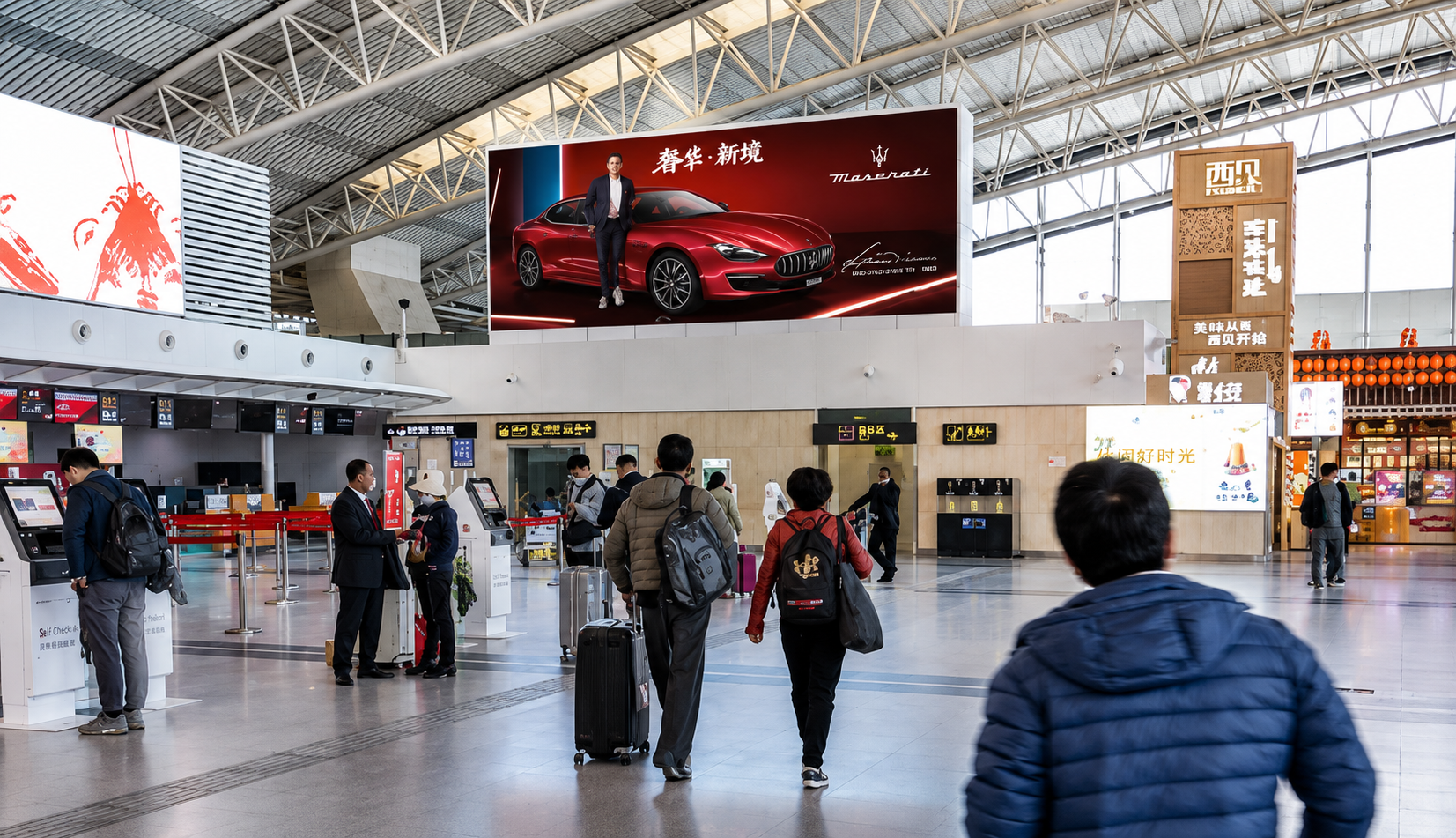
- Xi'an Xianyang Airport's multi-terminal configuration — with Terminal 3 and the new Terminal 5 as the primary commercial zones — provides a structured advertising environment where placement strategy across key domestic arrival, international arrival, departures, and duty-free zones allows brands to achieve comprehensive coverage of the premium tourist, technology professional, and international business audience segments that define XIY's commercial value
- Dwell time at XIY is elevated by the premium domestic leisure tourist profile of the dominant audience segment — Chinese domestic cultural heritage tourists who have invested significantly in their Xi'an trip are less hurried and more attentive than the average business traveller, creating extended dwell windows in arrivals and departures zones where brand advertising receives sustained, quality engagement
- The airport's cultural positioning as the entry point to China's ancient capital creates a brand association environment of extraordinary civilisational weight — being present at XIY positions a brand within the visual vocabulary of Chinese imperial history, Silk Road heritage, and national cultural pride, an associative elevation that no other Chinese regional airport can replicate and that rewards premium brand creative with cultural resonance depth
- Masscom Global delivers full-service inventory access across Xi'an Xianyang Airport's key commercial zones in both Terminal 3 and Terminal 5, with Mandarin-language creative capability, Chinese consumer market intelligence, and the Xi'an-specific cultural knowledge to ensure that every campaign reflects the specific character of China's ancient capital rather than applying generic Chinese market advertising templates
Strategic Advertising Fit
Best Fit:
- Premium Chinese cultural and heritage experience brands: Museums, cultural theme parks, luxury ryokan-equivalent heritage accommodation, traditional craft and artisan brands, and Chinese cultural experience platforms will find at XIY an arriving audience in a state of maximum Chinese cultural heritage receptivity — a commercial context available at no other Chinese airport of comparable scale.
- Luxury hospitality and premium accommodation: Xi'an's five-star hotel ecosystem competes for the same domestic Chinese HNWI leisure tourist whose per-night accommodation spend is among the highest of any Chinese domestic destination. International luxury hotel brands, boutique heritage properties, and premium accommodation platforms should treat XIY as their primary western China brand communication channel.
- Premium Chinese food, beverage, and regional specialty products: Xi'an's departures terminal is one of China's most commercially productive premium food retail environments — a captive audience of domestic cultural tourists whose food souvenir purchasing behaviour is culturally embedded and high-volume. Shaanxi specialty food brands, premium Chinese tea and wine producers, and regional craft food companies will find a concentrated, purchase-intent audience in the departures hall whose food retail engagement rate rivals any Chinese tier-one airport.
- Technology and B2B services: The Xi'an High-Tech Zone executive and the Shaanxi energy sector professional class represent a consistently underserved B2B advertising audience at XIY. Enterprise software, cloud computing, financial technology, and professional services brands targeting western China's technology economy will find at XIY a qualified decision-maker audience whose daily proximity to Xi'an's national technology champions makes them among the most commercially receptive technology B2B audiences in Chinese regional aviation.
- International real estate — Australia, Canada, UK, Singapore: Shaanxi HNWI outbound property investment is active and growing, and the education-adjacent property purchase decision that drives Australia, Canada, and UK property buying is directly accessible through the parent audience at XIY whose children are in the Xi'an university preparation pipeline for international study.
- Premium automotive: China's western city luxury and premium automotive market has grown dramatically with the expansion of the technology and energy sector professional class. German marques, Japanese premium brands, and Chinese national champions in the premium and new energy vehicle segment all find strong audience alignment with the Xi'an HNWI professional whose automotive purchasing decision reflects status, quality, and technology values simultaneously.
- International education — STEM universities and premium boarding schools: The Xi'an technology and aerospace professional community is China's most STEM-educated provincial parent audience outside Shenzhen and Hangzhou. International STEM universities, engineering programmes, and boarding schools with strong science and technology curricula will find at XIY a parent audience whose educational investment intensity and subject area preferences are among the most precisely defined of any Chinese regional airport catchment.
- Luxury fashion and accessories: China's domestic luxury fashion market has absorbed Xi'an's technology and energy wealth as a major consumer segment, and premium departures retail at XIY captures the full-trip celebration spending of domestic HNWI tourists who mark their Xi'an heritage experience with luxury fashion purchases before returning to coastal cities. International luxury fashion and accessories brands with Chinese market distribution should treat XIY as a western China brand communication priority.
Brand Alignment at a Glance:
| Category | Fit |
|---|---|
| Heritage luxury and cultural experiences | Exceptional |
| Premium hospitality and accommodation | Exceptional |
| International real estate — Australia, Canada, UK | Exceptional |
| Premium Chinese food, tea, and specialty products | Exceptional |
| Premium automotive | Strong |
| Technology B2B and enterprise services | Strong |
| International education — STEM focus | Strong |
| Luxury fashion and accessories | Strong |
| Budget consumer goods | Poor fit |
Who Should Not Advertise Here:
- Brands with no China market relevance or distribution: International brands without Chinese distribution, WeChat presence, or established Chinese consumer relationships will find the domestic Chinese tourism audience at XIY commercially inaccessible — brand awareness without market accessibility generates no commercial return in China's walled digital and retail ecosystem.
- Politically sensitive content or brands associated with China-sensitive issues: The airport's location within a Chinese government strategic development zone means that any advertising content that touches on sensitive political, territorial, or sovereignty issues — including Taiwan, Tibet, Xinjiang, or historical diplomatic sensitivities — will be non-approvable for display and will create legal and reputational risk for the brand attempting to place it.
- Pure Western lifestyle brands without Asia-market adaptation: Western luxury lifestyle brands whose China-market creative has not been adapted for the specific cultural register of Chinese heritage tourism identity — treating Xi'an as a generic second-tier Chinese city — will significantly underperform compared to brands that acknowledge and honour the extraordinary civilisational significance of the destination their audience is visiting.
Event and Seasonality Analysis
- Event Strength: High
- Seasonality Strength: Very High
- Traffic Pattern: Multi-Peak (spring Qingming, Labour Day Golden Week, summer, National Day Golden Week)
Strategic Implication:
Advertisers at Xi'an Airport should structure their investment around China's four primary holiday travel windows — Qingming in April, Labour Day Golden Week in late April and early May, summer school holidays in July and August, and National Day Golden Week in October — while maintaining sustained presence across the full calendar year to capture the Shaanxi provincial business audience whose travel patterns are less seasonally concentrated than domestic tourism flows. The National Day Golden Week is the single most commercially intense window at XIY, generating the highest-quality domestic HNWI tourism audience concentration of the year simultaneously with the strongest Belt and Road business event calendar. Masscom Global structures XIY campaigns to capture all four Golden Week peaks with elevated investment while maintaining a sustained year-round baseline that ensures brand visibility to the Xi'an technology and energy professional community across the full business calendar.

Poor Placement and Delays Affect Airport Campaigns
We help you move faster, access better inventory, and get it right now.
Talk to an ExpertFinal Strategic Verdict
Xi'an Xianyang International Airport is one of China's most commercially underactivated major airports — a gateway serving 26.3 million passengers at the intersection of China's most visited UNESCO heritage destination, one of western China's most rapidly growing technology and energy economies, and the ancient Silk Road terminus that the Chinese government has strategically repositioned as the narrative anchor of its Belt and Road global infrastructure vision. The domestic Chinese HNWI cultural tourist arriving at XIY is the most emotionally engaged, culturally motivated, and premium-spend-committed audience in Chinese domestic leisure aviation. The Shaanxi technology executive and energy sector principal travelling through XIY is western China's most commercially underserved HNWI professional airport audience. The international cultural and Belt and Road business visitor arriving at XIY is engaging with China's most powerful civilisational soft power story. For heritage luxury brands whose Chinese market strategy needs the cultural authority only Xi'an can provide, for international real estate developers whose Australian, Canadian, and UK property pipelines need western China acquisition, for STEM universities whose Chinese student recruitment is concentrated in exactly the technology-professional family demographic that the Xi'an High-Tech Zone produces, and for premium Chinese food and hospitality brands whose domestic marketing needs the cultural endorsement of China's ancient capital — Xi'an Xianyang Airport is not a secondary Chinese market consideration. It is a primary strategic brand communication environment whose commercial value is proportional to the civilisational weight of the destination it serves. Masscom Global delivers the Mandarin-language intelligence, the Chinese cultural market expertise, and the XIY inventory access to ensure that every campaign at this terminal performs at the level that China's ancient capital demands.
About Masscom Global
Masscom Global is a premium international airport advertising and media buying agency operating across 140 countries. With deep expertise in airport OOH, premium publications, and high-net-worth audience targeting, Masscom helps brands reach the world's most valuable travellers at the moments that matter most. For advertising packages, media rates, and campaign planning at Xi'an Xianyang International Airport and airports across the globe, contact Masscom Global today.
Frequently Asked Questions
How much does airport advertising cost at Xi'an Xianyang International Airport?
Advertising costs at Xi'an Xianyang Airport vary based on terminal zone, format type, creative language specifications, campaign duration, and seasonal demand. The four major Chinese holiday Golden Weeks — Labour Day in late April and early May, National Day in October, Chinese New Year in January and February, and Qingming in April — attract the highest inventory demand and should be planned and booked well in advance. Masscom Global provides current rate cards across Terminal 3 and Terminal 5 placements, Mandarin-language creative specification guidance, and bespoke media packages tailored to both domestic Chinese cultural tourism brand objectives and international inbound market campaigns. Contact Masscom Global directly for current pricing and a detailed campaign proposal.
Who are the passengers at Xi'an Xianyang International Airport?
XIY serves a commercially layered passenger profile combining three primary segments. Domestic Chinese cultural heritage tourists — arriving primarily from Beijing, Shanghai, Guangzhou, Shenzhen, and Chengdu — represent the highest-volume and most commercially motivated leisure audience, travelling specifically to experience the Terracotta Warriors, Ancient City Wall, and Xi'an's imperial heritage circuit. The Shaanxi provincial business community — encompassing Xi'an High-Tech Zone technology executives, Shaanxi energy sector professionals, aerospace industry management, and Belt and Road logistics entrepreneurs — represents the year-round business travel audience. International cultural tourism visitors — primarily from South Korea, Japan, Southeast Asia, Europe, and North America — represent the highest per-individual-visit spending segment, arriving for the Silk Road heritage experience that Xi'an uniquely provides.
Is Xi'an Xianyang Airport good for luxury brand advertising?
Xi'an Xianyang Airport is an excellent channel for luxury brand advertising in categories aligned with Chinese cultural heritage values, domestic premium tourism, and the specific consumption preferences of western China's technology and energy HNWI class. Heritage luxury, premium hospitality, luxury fashion, fine dining experiences, and premium automotive brands will find at XIY an audience whose emotional engagement with the destination context creates unusually high brand receptivity. The cultural authority that Xi'an's civilisational identity confers on brands present in its airport environment is commercially valuable in a way that no generic Chinese regional airport can replicate.
What is the best airport in western China to reach HNWI audiences?
Xi'an Xianyang Airport is the primary HNWI access point in western China for the domestic Chinese cultural tourism market, the Shaanxi technology and energy professional class, and the Belt and Road international business community. Chengdu Tianfu and Chongqing Jiangbei serve the southwestern China HNWI market with comparable scale. For brands whose strategy is specifically focused on China's ancient capital heritage identity, Silk Road cultural tourism, or the Shaanxi-specific energy and aerospace wealth base, XIY is the only viable primary channel — its cultural specificity is both its differentiating strength and its commercial irreplaceability.
What is the best time to advertise at Xi'an Airport?
National Day Golden Week in October is the single highest-quality domestic Chinese HNWI tourism concentration window at XIY, combining peak passenger volume with the most culturally engaged and premium-spend-committed leisure audience of the year. Labour Day Golden Week in late April and early May is the second-highest-quality domestic tourism window with notably favourable spring weather. Chinese New Year in January and February delivers the most emotionally charged family travel surge. The summer school holiday period from July through August generates the highest total volume. For international brand campaigns targeting inbound foreign tourists, the spring and autumn seasons deliver the highest-quality European, Japanese, and Korean heritage tourism audience concentration.
Can international real estate developers advertise at Xi'an Xianyang Airport?
Xi'an Airport is a viable and underutilised acquisition channel for international real estate developers targeting Chinese HNWI buyers from western China. The Shaanxi technology and energy sector HNWI is an active outbound property investor — concentrated in Australian Queensland and New South Wales coastal properties, Canadian British Columbia residential, UK London investment apartments, and Singapore private condominium market acquisitions. Developers active in any of these corridors will find at XIY a qualified buyer audience from China's western HNWI market that is significantly underrepresented in the Shanghai and Beijing-focused China marketing investment of most international property developers — offering genuine first-mover positioning in a commercially active and growing buyer segment.
Which brands should not advertise at Xi'an Xianyang Airport?
Brands without Chinese market distribution or established WeChat presence, brands whose creative applies generic urban Chinese advertising language without acknowledging Xi'an's specific ancient capital cultural identity, and any content touching Chinese political sensitivities are all structurally misaligned with the XIY advertising environment. Mass-market budget consumer goods requiring metropolitan scale for ROI viability will find western China regional airport passenger volumes below their threshold. Western lifestyle brands without any China cultural adaptation will generate negligible engagement from an audience whose cultural pride in Xi'an's civilisational significance is the primary emotional driver of their trip.
How does Masscom Global help brands advertise at Xi'an Xianyang International Airport?
Masscom Global provides end-to-end advertising capability at Xi'an Xianyang Airport — from Chinese domestic cultural tourism audience intelligence and Mandarin-language campaign strategy through inventory access across Terminal 3 and Terminal 5, Chinese creative specification, placement execution, and performance reporting. Our team brings deep knowledge of Chinese domestic heritage tourism consumer behaviour, the Shaanxi technology and energy professional market, the four Golden Week commercial windows that define XIY's annual performance calendar, and the culturally specific brand communication standards that the Xi'an audience rewards with genuine engagement. We move faster, with deeper Chinese market calibration and more precise placement strategy than any planning team approaching XIY without dedicated Chinese western city airport expertise. Contact Masscom Global today to build your brand's presence at one of China's most culturally powerful and commercially underactivated airport advertising environments.