


Airport at a Glance
| Field | Detail |
|---|---|
| Airport | Tripoli Mitiga International Airport |
| IATA Code | MJI |
| Country | Libya |
| City | Tripoli (8 km east of city centre) |
| Annual Passengers | Data not available; approximately 154 arrivals per week, 22 commercial flights per day; passenger traffic growing +5.2% year-on-year as stability improves |
| Primary Audience | Oil and energy sector professionals, government officials and contractors, Libyan business travellers to Turkey and Tunisia, Hajj and Umrah pilgrims |
| Peak Advertising Season | Ramadan and Eid windows; July to August (summer leisure); September to October (post-summer return) |
| Audience Tier | Tier 2 |
| Best Fit Categories | Oil and gas B2B, Construction and reconstruction, Islamic finance and banking, Halal consumer goods, Turkish and Italian real estate, Healthcare and medical services, Automotive, Telecom |
Tripoli Mitiga International Airport is Libya's largest and most active airport, serving as the sole international gateway to Tripoli since 2018 following the closure of Tripoli International Airport due to civil war damage. MJI operates from a site with a history as extraordinary as Libya itself — a 1923 Italian Air Force base, a World War II German airfield, a post-war American base known as Wheelus for over two decades, and a Soviet-era Libyan military installation before conversion to civilian use in 1995. Today it processes approximately 22 commercial flights per day across 15 destinations in 11 countries, connecting Libya's capital to Istanbul, Tunis, Cairo, Dubai, Rome, Milan, Malta, Amman, Jeddah, and Casablanca. For advertisers, MJI's commercial significance is not measured against conventional airport traffic benchmarks but against the extraordinary economic context it serves: Libya holds 48 billion barrels of proven oil reserves — the largest in Africa — produces 1.3 million barrels per day, holds $78.3 billion in foreign reserves covering 34.6 months of imports, and the World Bank projected its GDP to grow 13.3% in 2025. Every passenger through MJI's terminal is moving through the only commercial air gateway for a population of 7.5 million people sitting on an oil economy of exceptional scale.
What makes MJI commercially compelling for a specific and well-defined category of advertiser is precisely what makes it unusual. The terminal serves a small number of wealthy and institutionally powerful travellers — oil executives, government officials, tribal business leaders, energy sector contractors, and a growing merchant class — whose purchasing authority and accumulated oil wealth place them among the highest per-capita spending travellers in North Africa, operating in a market with almost no other formal advertising infrastructure. The absence of billboards, shopping malls, and digital out-of-home networks at the scale found elsewhere in the region means the airport terminal is not one of many advertising environments competing for this audience's attention. It is, for many categories, the only one.
Advertising Value Snapshot
- Passenger scale: Approximately 154 commercial arrivals per week and 119 departures per week; exact annual passenger count not publicly available; Tunis and Istanbul together account for 60% of all monthly arrivals; passenger traffic growing at approximately 5.2% year-on-year as stability improves
- Traveller type: Oil and energy sector professionals, government officials and state contractors, Libyan business travellers on Turkey and Tunisia corridors, Hajj and Umrah pilgrims, medical tourism travellers to Tunisia and Turkey
- Airport classification: Tier 2 — Libya's primary and sole functioning international gateway for Tripoli; Libya holds the largest proven oil reserves in Africa and $78.3 billion in foreign reserves; airport audience is disproportionately high-income relative to passenger volume
- Commercial positioning: MJI is the exclusive commercial air gateway for over 1.2 million Tripoli metro residents and the primary routing point for western Libya's government, energy, and business professional class
- Wealth corridor signal: Libya's oil sector generated 97% of the country's exports and 90%+ of fiscal revenues in 2023; oil production averaged 1.3 million barrels per day in 2025 at approximately $80 per barrel; the Government of National Unity posted a fiscal surplus of 3.6% of GDP in the first nine months of 2025; the professionals and officials who manage this economy transit MJI to Tunis, Istanbul, Dubai, Rome, and Jeddah
- Advertising opportunity: Masscom Global provides access to MJI's advertising environment with the local intelligence and execution capability that operating in Libya's distinctive market context requires; for oil and gas B2B, construction, Islamic finance, automotive, and halal consumer brands targeting the North African oil economy, MJI is a high-precision, low-competition channel that most international advertising planners have never activated
Airport Advertising is Complex to Get Right
We help you execute faster, with proven results and local insight most planners lack starting now.
Talk to an ExpertCatchment Area and Economic Drivers
Top 10 Cities and Districts within 150 km — Marketer Intelligence
- Tripoli city centre (~8 km west): Libya's capital and commercial hub, population approximately 1.2 million in the metro area; home to the government ministries, the National Oil Corporation, the central bank, major trading houses, and the primary concentration of Libya's professional and merchant class; virtually every MJI passenger originates from or terminates their journey in Tripoli's commercial and residential districts
- Janzur (~15 km west): An affluent western suburb of Tripoli housing some of Libya's wealthiest families and senior government officials; property values in Janzur reflect the capital's most premium residential market and the commercial community here represents a high-spending audience whose travel patterns include Istanbul, Tunis, and Dubai
- Zawiya (~45 km west): A significant industrial city housing Libya's Zawiya Oil Refinery, one of the country's most strategically important petroleum processing facilities; refinery executives, petroleum engineers, and the oil sector workforce in Zawiya represent a commercially active professional audience with strong institutional connections to MJI
- Sabratah (~65 km west): A historic coastal city housing one of Libya's most significant UNESCO World Heritage Sites — the spectacular Roman theatre — and an active fishing and light industrial economy; Sabratah's business community and its emerging heritage tourism operators use MJI as their primary air connection
- Tarhuna (~65 km southeast): A historically significant tribal and agricultural town whose business and political leadership maintain active travel patterns through MJI for governmental and commercial affairs in Tripoli and beyond
- Gharyan (~90 km south): The capital of Jabal al-Gharbi district, famous for its Berber underground houses and traditional pottery industry; a mountainous administrative centre whose district leadership and commercial operators use MJI for connections to Tunis and Istanbul
- Sorman (~55 km west): A coastal city between Tripoli and Zawiya with a growing residential and commercial economy; its business community is closely connected to Tripoli's merchant and oil sector networks
- Zuwara (~115 km northwest): A Berber (Amazigh) city on the Mediterranean coast near the Tunisian border; Zuwara's commercial community has particularly strong traditional connections to Tunisia, making the MJI-Tunis route commercially relevant for both business and family travel audiences here
- Khums (~115 km east): The nearest major city to the UNESCO World Heritage Site of Leptis Magna — one of the best-preserved Roman cities in the world; Khums serves as the commercial and administrative hub for the Murqub district and connects MJI to the eastern Tripolitanian business community
- Zliten (~120 km east): An eastern Tripolitanian city known for its religious heritage and Sufi traditions; its commercial operators and religious community generate travel through MJI for both commercial connections and Umrah pilgrimage travel via the Jeddah route
NRI and Diaspora Intelligence
Libya's diaspora profile is commercially significant and unusually concentrated. The Libyan community in Italy — particularly in Rome, Milan, and Sicily — is historically rooted in the colonial and post-colonial relationship between the two countries and generates consistent inbound travel on the Rome and Milan routes. The Libya-Malta connection reflects both geographic proximity and a historic business relationship in maritime commerce and trade finance that continues to generate regular professional travel. The Egyptian and Tunisian communities within Libya — estimated at 1-2 million Egyptians and over 211,000 Tunisians working primarily in construction, oil services, and agriculture — generate substantial outbound return travel on the Cairo and Tunis routes, creating a returning worker audience alongside the professional Libyan traveller. For brands in remittance services, mobile top-up, and worker financial products, the Egyptian and Tunisian worker community at MJI is a commercially distinct and volume-significant audience segment.
Economic Importance
Libya's economy is, by a wide margin, the most oil-dependent in North Africa. Oil and gas account for approximately 97% of exports, over 90% of fiscal revenues, and roughly 68% of GDP. With 48 billion barrels of proven reserves — the largest in Africa — and production averaging 1.3 million barrels per day in 2025, Libya's hydrocarbon wealth generates a volume of national income that, even with significant political fragmentation and spending inefficiency, creates a consumer economy of extraordinary liquidity. Libya's foreign reserves stand at $78.3 billion — 34.6 months of import coverage — reflecting decades of accumulated oil wealth that has not been fully absorbed by public expenditure. Approximately 75% of Libyan employment is in the public sector, funded by oil revenues that pay wages and subsidies accounting for approximately 85% of total government expenditure. This structure creates a large consumer class with disposable income derived from government salaries, a wealthy elite of oil sector and private business leaders, and an active construction and reconstruction economy fuelled by post-conflict rebuilding contracts now accelerating as the security situation stabilises.
Business and Industrial Ecosystem
- Oil and gas — National Oil Corporation and international partners: The NOC and its subsidiaries, alongside international operators including ENI, TotalEnergies, BP, ConocoPhillips, and Repsol YPF, manage the production and export of Libya's oil wealth; the executives, engineers, and government liaison officials from this sector travel through MJI on the Istanbul, Dubai, Rome, and Tunis routes and represent MJI's highest-value individual B2B advertising audience
- Reconstruction and infrastructure contracting: Libya's post-conflict reconstruction economy is generating significant contract activity for both Libyan and international construction firms; the construction executives, project managers, and procurement officials involved in rebuilding Tripoli International Airport, upgrading urban infrastructure, and restoring damaged facilities are a high-spending B2B audience at MJI with strong demand for construction equipment, materials technology, and project management services
- Government administration and institutional sector: Libya's Government of National Unity in Tripoli employs the majority of the capital's professional workforce; ministers, senior civil servants, and institutional officials form a year-round business travel base at MJI connecting primarily to Istanbul, Tunis, and Rome for diplomatic, institutional, and personal commercial purposes
- Trade and import commerce: Libya imports the overwhelming majority of its consumer goods — food, vehicles, electronics, clothing, machinery — through a merchant class that uses MJI for commercial travel to suppliers in Turkey, Tunisia, Italy, and Egypt; these traders represent a commercially active, import-oriented audience whose purchasing decisions directly shape the Libyan consumer market
Passenger Intent — Business Segment
Business travellers at MJI are primarily oil sector professionals connecting to international partners via Istanbul and Dubai, government officials routing to Tunis and Rome for institutional meetings and personal affairs, and traders routing to Istanbul for import sourcing, real estate evaluation, and financial transactions. Advertiser categories that intercept this audience most effectively include oil and gas technology and services, construction equipment and materials, Islamic banking and trade finance, Turkish and Mediterranean real estate, premium automotive, and business travel services.
Strategic Insight
The business audience at MJI is commercially exceptional because it combines two rare qualities simultaneously: very high per-capita spending power derived from oil wealth, and almost no competing brand messaging in the surrounding market environment. Libya's media and advertising infrastructure is severely underdeveloped — the country has no functioning outdoor advertising network of Western scale, limited print circulation, and constrained digital platform reach. MJI's terminal is one of the only formal commercial advertising environments that this audience encounters in a setting calibrated to purchase intent. For brands willing to navigate this market with expert local guidance, the cost-per-attention opportunity at MJI has no comparable benchmark in North Africa.
Tourism and Premium Travel Drivers
- Leptis Magna UNESCO World Heritage Site (~100 km east near Khums): One of the best-preserved Roman cities in the world, founded by the Phoenicians and later home to the Emperor Septimius Severus who was himself from this city; Leptis Magna's extraordinary scale and preservation draw heritage tourism researchers, classicists, and Roman history enthusiasts from Europe and the Arab world who route through MJI; as security conditions improve this audience will grow substantially
- Sabratha UNESCO World Heritage Site (~65 km west): A spectacular Roman and Phoenician coastal site whose second-century theatre, built directly on the Mediterranean shore, is among the finest Roman performance venues anywhere in the world; the Italian academic and heritage tourism community maintains particular interest in this site given the Italian colonial-era excavations, generating inbound travel on the Rome and Milan routes
- Tripoli Old Medina: The historic heart of Tripoli, with its Ottoman-era mosques, covered markets, and the Arch of Marcus Aurelius — one of the few Roman monuments remaining in the city; the medina's restoration is part of the post-conflict reconstruction agenda and generates domestic and diaspora tourism
- Sahara and desert tourism potential: Libya holds some of the most remote and pristine Saharan desert landscapes on earth, including the Ubari Sand Sea, the Akakus Mountains rock art (also a UNESCO World Heritage Site in Fezzan), and prehistoric Saharan sites; adventure tourism operators are beginning to resume desert expeditions as security in southern regions improves, creating inbound tourism traffic through MJI for specialist operators
Passenger Intent — Tourism Segment
Tourism passengers at MJI are currently a limited but commercially engaged segment — primarily returning Libyan residents from diaspora visits, European heritage tourism researchers, and Arab heritage tourists. The departure mindset of a Libyan traveller heading to Tunisia or Turkey for leisure includes significant retail and hospitality spend intent for both destination experiences and imported goods purchases; the arrival mindset of a heritage tourism visitor arriving from Rome or Malta includes pre-committed high-spend heritage tourism itinerary and accommodation spend. As Libya's security environment continues to improve, the inbound tourism audience at MJI will grow significantly, making early brand presence in the terminal increasingly valuable as tourism infrastructure develops.
Travel Patterns and Seasonality
Peak seasons:
- Ramadan and Eid al-Fitr (annually shifting date, spring/summer window): The most commercially concentrated period at MJI; Libyan families visiting Tunisia and Turkey for Eid celebrations, consumer spending at its annual peak, gifting and hospitality spend exceptionally high; the Tunis route reaches its maximum frequency in the pre-Eid window as Libyans cross the border for shopping, dining, and family visits; Ramadan creates a distinct pre-Iftar airport dwell time with high brand receptivity
- Eid al-Adha and Hajj season (annually shifting date, summer window): The Jeddah route carries Hajj pilgrims and Umrah travellers whose travel intent is entirely faith-motivated; the commercial spending triggers around the Hajj and Umrah travel window include religious goods, modest fashion, gift purchasing, and family celebration products
- July to August (summer leisure): Libyan families travelling to Tunisia, Turkey, and European Mediterranean destinations for summer leisure; the Turkish and Italian routes carry peak leisure traffic; consumer retail, hospitality, and lifestyle brands benefit from this window
- October to November (post-summer return and year-end business): Return travel from summer destinations and year-end institutional travel for government budget coordination and contractor settlements; a commercially active window for both consumer and B2B categories
Event-Driven Movement
- Eid al-Fitr (annually, following Ramadan): The single most commercially intense travel window at MJI; outbound family travel to Tunisia and Turkey peaks sharply in the week before Eid; consumer brands with halal positioning, gifting, and premium food categories achieve maximum audience receptivity; the post-Eid return travel generates another concentrated window approximately two weeks later
- Eid al-Adha and Hajj season (annually, approximately 10 weeks after Eid al-Fitr): Hajj pilgrimage travel on the Jeddah route; Umrah travel year-round but peaks in the weeks surrounding Eid al-Adha; Islamic finance, travel insurance, modest fashion, and faith lifestyle brands find their most motivated audience in this window
- Oil sector project milestones (year-round): NOC production ramp-ups, new international oil company contract activations, and refinery maintenance cycles generate discrete waves of high-income professional travel through MJI on the Istanbul, Dubai, and Rome routes; B2B advertisers in oilfield services, industrial equipment, and energy technology should track NOC's publicly communicated investment programme for timing signals
- Government budget and contracting cycle (November to January): Libya's annual budget negotiations and government contract award processes drive concentrated official travel between Tripoli and Tunis, Istanbul, and Rome; institutional service providers and government-adjacent B2B brands should increase presence during this institutional cycle
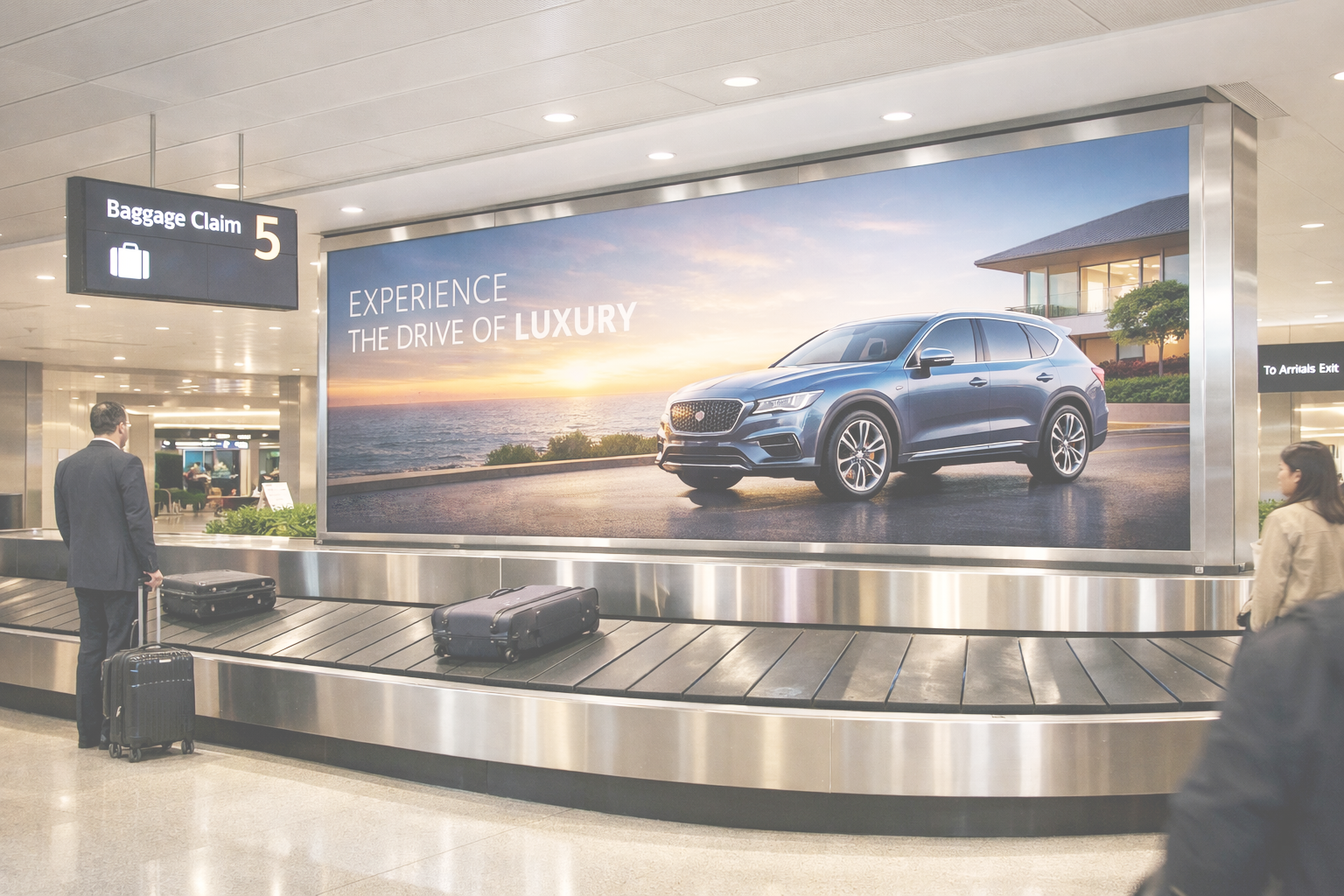
It’s Not Just Where You Advertise - It’s How Fast You Execute
We combine local insight with fast rollout to deliver results for you, now.
Talk to an ExpertAudience and Cultural Intelligence
Top 2 Languages
- Arabic (Libyan dialect): The official language of Libya and the mother tongue of virtually all Libyan passengers at MJI; all commercial advertising at the airport must operate in Arabic script as its baseline and any brand that invests in culturally resonant Libyan Arabic — rather than generic Modern Standard Arabic — will signal the market respect that generates disproportionate brand trust among an audience that is very aware of whether a brand is actually present in their market or merely translating a generic campaign
- English: The working language of Libya's international oil sector and the professional language of NOC's international partnerships with European and Gulf oil companies; English-language B2B advertising targeting oil sector professionals is commercially appropriate alongside Arabic for campaigns in the energy, construction, and professional services categories
Major Traveller Nationalities
The dominant nationality at MJI is Libyan, with the passenger base overwhelmingly composed of Libyan Arab citizens travelling on the airport's international corridors to Tunisia, Turkey, Egypt, Jordan, Saudi Arabia, Italy, Malta, and the UAE. A secondary international audience includes Egyptian and Tunisian construction and service workers on return travel to their home countries, European oil company employees and business visitors arriving from Rome and Milan, and Turkish businessmen arriving from Istanbul to pursue the substantial Turkey-Libya commercial relationship in construction, trade, and real estate. For advertisers, campaign creative must default to Arabic as the primary language of communication, with the cultural register calibrated to Libya's Muslim-majority, Arabic-speaking, tribal-structure audience.
Religion — Advertiser Intelligence
- Sunni Islam (approximately 97%): Islam is the defining social, cultural, and commercial framework for virtually the entire MJI passenger base; Ramadan, Eid al-Fitr, Eid al-Adha, Hajj, and Mawlid al-Nabi are the primary calendar anchors driving consumer behaviour, travel patterns, and commercial spending; halal certification is a baseline expectation for every food and beverage product advertising at MJI, not a differentiating premium; modest fashion, Islamic finance, and faith-aligned lifestyle brands have natural and effortless audience alignment at this airport; brands that understand and respect Islamic commercial ethics — no riba, halal sourcing, community orientation — generate durable trust that outperforms category-led brand switching
- Sufi and traditional Islamic practices (overlapping majority): Libya's Islamic practice incorporates significant Sufi traditions alongside mainstream Sunni observance; Sufi shrines, Zawiyas (Sufi lodges), and the veneration of local religious figures are part of the cultural landscape; this heritage creates a population whose faith is both devout and culturally embedded, making religious calendar advertising particularly resonant and worth genuine investment in execution quality
Behavioral Insight
Libya's MJI audience makes commercial decisions through a framework of tribal loyalty, family network validation, and personal trust relationships built over time — a structure common to economies where formal institutional frameworks remain incomplete and personal reputation and family affiliation substitute for regulatory and contractual certainty. For advertisers, this means brand presence must be consistent and patient; a single seasonal campaign generates minimal return, while a sustained presence that the audience recognises over multiple encounters builds the familiarity that triggers commercial response. The oil sector professional class at MJI has been exposed to international brands through their industry relationships with European and Gulf oil companies and approaches advertising messages with a commercially sophisticated filter — they recognise quality and respond to authority signals. The government and merchant class responds to social proof, peer endorsement, and the confirmation that a brand is actively present in their market rather than testing it from a distance.
Outbound Wealth and Investment Intelligence
The outbound passenger at MJI is among the most financially distinctive in North Africa. Libya's oil economy generates a per-capita income that, measured against purchasing power parity and adjusted for extensive government subsidies — which effectively subsidise fuel, food staples, utilities, and housing for the majority of the population — creates substantial disposable income for the consumer class. The government salary base that employs 75% of the workforce is funded entirely from oil revenues and is supplemented by the near-total subsidisation of basic living costs; the result is that the Libyan consumer's discretionary spending capacity on premium goods, real estate, leisure, and healthcare is larger than nominal income figures suggest.
Outbound Real Estate Investment
Turkey is the single largest destination for Libyan outbound real estate investment, driven by cultural proximity, a visa-free travel arrangement, relative ease of transaction, and the very active Turkish-Libyan commercial relationship that has deepened since 2020. Istanbul property has been actively purchased by Libyan HNIs as both second homes and investment assets, particularly in districts such as Beylikdüzü, Esenyurt, and Başakşehir. The Istanbul route's extraordinary frequency at MJI — served by five separate airlines — is the commercial infrastructure that supports this property market relationship. Tunisian real estate, particularly in Tunis, Hammamet, and Sousse, represents a secondary Libyan property investment market where proximity, affordability, and cultural familiarity drive purchases for both retirement and investment purposes. Maltese and Italian Mediterranean coastal properties attract Libya's highest-earning HNI class as European residency assets.
Outbound Education Investment
Libya sends students primarily to Tunisia, Turkey, and Jordan for higher education, with the Tunis and Istanbul routes directly supporting this student and parent travel flow. The University of Tunis and the many private Tunisian universities attract large numbers of Libyan students whose families make multiple annual visits through MJI on the Tunis route. Turkish universities have become increasingly attractive for Libyan students, particularly given the Turkey-Libya bilateral relationship and the presence of the Libyan community in Istanbul. Jordan's university sector in Amman also draws Libyan medical students and their families on the Amman route. For international universities marketing to the Libyan student market, MJI is the primary advertising access point — Libyan families actively researching overseas education options pass through this terminal before and after visits to their enrolled children.
Outbound Wealth Migration and Residency
Libyan HNIs have shown sustained interest in Turkish residency — both residential property-based residency and business registration in Turkey for accessing European financial systems — given the Turkey-Libya political alignment and the practical accessibility of Istanbul from Tripoli. Malta and Italy attract Libyan HNIs seeking EU residency pathways through investment, property purchase, and the various European residency-by-investment programmes that offer access to the Schengen zone. The UAE remains a destination for Libyan commercial wealth held in foreign accounts and real estate, reflecting Dubai's role as the Arab world's preferred offshore financial and lifestyle destination, reached from MJI via the Dubai route.
Strategic Implication for Advertisers
Libya's oil wealth is real, concentrated, and moving through MJI in the hands of a small but commercially powerful traveller class whose purchasing intent on Turkish property, Islamic finance, luxury vehicles, and premium consumer goods is among the highest in North Africa. International brands in real estate, banking, automotive, and premium construction that invest in MJI's advertising environment are accessing a market whose formal advertising infrastructure is almost entirely absent, whose audience is calibrated by high oil-sector incomes, and whose commercial decisions are being made before boarding — precisely in the terminal environment where Masscom Global operates. The cost of entry is low. The competitive noise is minimal. The commercial returns for the right categories are exceptional.
Airport Infrastructure and Premium Indicators
Terminals
- MJI operates a single terminal building approximately 8 kilometres east of Tripoli's city centre, built on the footprint of the former US Wheelus Air Base and subsequently expanded for civilian operations from 1995; the terminal processes all international and domestic commercial traffic for Tripoli and serves as Libya's sole functioning main international airport following the closure of Tripoli International Airport (TIP) after civil war damage in 2018
- Terminal upgrades are planned, targeting expanded passenger and cargo handling capacity commensurate with MJI's growing role as Libya's permanent primary international airport pending the reconstruction of TIP; the airport also shares its site with continued Libyan Air Force operations, reflecting the mixed civilian-military heritage of the facility
Premium Indicators
- The presence of Turkish Airlines (Star Alliance), Royal Jordanian (Oneworld), bmi Regional (connecting to Rome, Milan, and Malta), and ITA Airways at MJI confirms the airport's status as a commercially viable international gateway whose route quality attracts alliance-member carriers; these airlines serve the professional and affluent traveller segment at MJI rather than price-sensitive mass market routes
- Private aviation is active at MJI — a reviewer on Flightradar24 notes seeing a Maybach in the airport showroom in 2024, confirming the presence of premium automotive as an active commercial category in the terminal; private jet operations through the co-located military base add a HNWI dimension to the airport's daily traffic that is not reflected in commercial flight data
- Libya's $78.3 billion in foreign reserves — equivalent to nearly three years of import coverage — and the Government of National Unity's fiscal surplus of 3.6% of GDP in the first nine months of 2025 confirm that the oil-funded economy generating MJI's passenger base is financially sound at the macro level, even if political fragmentation and governance challenges constrain optimal deployment
- The Turkish Airlines Boeing 777 operations on the Istanbul route signal capacity confidence from one of the world's leading carriers in a market where airline investment is a direct measure of commercial viability assessment; the Boeing 777 on the Tripoli-Istanbul route carries a premium product cabin and a load factor that justifies a wide-body aircraft
Forward-Looking Signal
Libya's trajectory in 2025 points firmly toward commercial expansion. Oil production averaging 1.3 million barrels per day after the resolution of the Central Bank leadership dispute, a fiscal surplus building in the government's accounts, World Bank GDP growth projections of 13.3% for 2025, and the beginning of Tripoli International Airport's reconstruction all signal an improving commercial environment at MJI. The airport's own passenger traffic has shown moderate year-on-year growth as stability improves, and the addition of routes — including the new Jeddah service from April 2026 — confirms continued airline confidence in MJI's market. When Tripoli International Airport eventually reopens with its updated capacity, the commercial aviation market in Tripoli will expand significantly, potentially accommodating new international carriers and direct long-haul routes that currently route through Istanbul and Cairo. Masscom Global advises brands targeting the Libyan market — particularly in oil and gas B2B, construction, Islamic finance, automotive, and halal consumer categories — to establish advertising presence at MJI now, at current rates reflecting Libya's frontier market positioning, before airport expansion and normalisation elevate competitive pressure and inventory costs.
Airline and Route Intelligence
Top Airlines
Libyan Wings (largest by departures), Buraq Air, Libyan Airlines, Afriqiyah Airways, Turkish Airlines (Star Alliance, year-round Istanbul), bmi Regional (Rome, Milan, Malta, Istanbul year-round), EgyptAir, Royal Jordanian (Oneworld), Royal Air Maroc, Fly OYA (Istanbul, Jeddah, Dubai), Air Cairo, Medsky Airways, Berniq Airways, ITA Airways (seasonal Rome)
Key International Routes
- Tunis (TUN): Five airlines; approximately 58 flights per week; 35% of all MJI departures — the airport's dominant corridor connecting Libya's capital to its nearest, most accessible international destination
- Istanbul (IST): Five airlines (Turkish Airlines, Libyan Airlines, Buraq Air, bmi Regional, Fly OYA); the primary corridor for Turkish goods, real estate, medical services, and the enormous Turkey-Libya commercial relationship
- Cairo (CAI): EgyptAir, Air Cairo; connecting MJI to the Arab world's largest city and a primary destination for education, commerce, and Egyptian worker return travel
- Rome (FCO): bmi Regional year-round, ITA Airways seasonal; the primary European corridor reflecting the deep Italy-Libya relationship and the medical and business tourism between the two countries
- Jeddah (JED): Fly OYA, bmi Regional (announced April 2026); Hajj and Umrah pilgrimage route
- Dubai (DXB): Fly OYA, Boeing 777; the Gulf wealth corridor; longest MJI route at 5 hours 30 minutes
- Amman (AMM): Afriqiyah, Royal Jordanian; medical and education corridor to Jordan's hospital network
- Milan (MXP): bmi Regional year-round; Italian business and diaspora connection
- Malta (MLA): bmi Regional, Universal Air; Mediterranean business and European gateway connection
- Casablanca (CMN): Royal Air Maroc; Maghreb regional connection
- Port Sudan: Afriqiyah; sub-Saharan African corridor
- Niamey, Niger: Libyan Airlines; trans-Saharan connection
Domestic Connectivity
- Benghazi (BEN): The most important domestic route, connecting Libya's eastern capital to Tripoli; Afriqiyah, bmi Regional, Libyan Airlines
- Sebha (SEB): Southern Libya's main hub, gateway to the Fezzan desert and the Sahara; Afriqiyah, Fly OYA
- Tobruk (TOB): Eastern Libya's second city; Afriqiyah
Wealth Corridor Signal
MJI's route network is an exceptionally precise map of Libya's commercial and political power structure. The Tunis dominance reflects Tunisia's role as Libya's functional economic extension — the country where Libyan consumers shop, receive medical treatment, hold bank accounts, and access EU goods that are unavailable or overpriced in Libya. The Istanbul dominance reflects the Turkey-Libya political and commercial alliance and the enormous property and import trade that flows along this corridor. The Dubai route represents the Gulf wealth management corridor where Libya's HNI class maintains financial assets and real estate. Rome reflects the European oil company and Italian commercial relationship going back to ENI's first Libyan oil concession in 1959. Every route at MJI is a corridor of commercial necessity rather than leisure convenience, and every passenger is moving along it with a defined commercial or personal purpose that shapes their receptivity to brand messaging throughout their terminal dwell time.
Media Environment at the Airport
- MJI's single-terminal layout concentrates all international and domestic passengers in a unified environment where advertising placements achieve full audience coverage without site fragmentation; the terminal's relatively compact footprint means dwell time is concentrated in a small number of zones where brand presence has maximum impact per square metre
- Libya's near-complete absence of formal out-of-home advertising infrastructure — functioning billboards, shopping malls with retail advertising, digital signage networks — means MJI's terminal is one of the only environments where Libyan consumers encounter formal brand messaging before they board; the context novelty this creates generates attention values that would be impossible to achieve in a more media-saturated market
- The dwell time at MJI is extended by Libya's security-conscious check-in requirements, the arrival and departure patterns of multiple daily routes, and the absence of the competing retail and entertainment distractions that shorten effective dwell time at more developed airport environments; passengers at MJI spend meaningful time in a state of commercial receptivity with limited competing content
- Masscom Global provides access to MJI's advertising inventory with the local market intelligence, Arabic-language creative guidance, and on-ground execution capability required to activate campaigns in Libya's distinctive media environment; our expertise in North African oil economy markets and our network of in-country relationships give brands the confidence and capability to enter the Libyan advertising market without the delays and compliance risks that characterise independent market entry
Strategic Advertising Fit
Best Fit
- Oil and gas B2B technology and services: MJI's primary audience of NOC officials, international oil company personnel, and oilfield service contractors moving on the Istanbul, Dubai, and Rome routes represents the decision-making tier of an oil industry producing 1.3 million barrels per day; industrial equipment suppliers, drilling technology brands, oilfield chemicals, and energy project management services find their most senior Libyan energy sector audience concentrated at this airport
- Construction and infrastructure equipment: Libya's reconstruction economy is generating contract activity for billions of dollars in infrastructure rebuilding; the project managers, procurement officials, and construction executives managing these contracts travel through MJI and represent a commercially active audience for heavy equipment, materials technology, and construction services brands
- Islamic finance and Sharia-compliant banking: Libya's banking sector is operating under Islamic finance principles — private sector credit growth in 2024 was primarily through Murabaha financing — and the Libyan professional class actively seeks Islamic finance products for property purchases, trade finance, and savings; brands offering Sharia-compliant financial products find a pre-qualified audience at MJI whose cultural and regulatory framework already mandates the product type
- Turkish and Mediterranean real estate: The Istanbul and Rome routes carry Libyan HNIs who are actively researching, visiting, and purchasing properties in Turkey and Italy; Turkish property developers and Mediterranean lifestyle estate agents should treat MJI as their primary channel for the Libyan buyer market
- Premium automotive — trucks, SUVs, luxury vehicles: Libya's road conditions, security context, and cultural preference for high-capability vehicles make premium SUVs and luxury trucks the dominant vehicle category in the Libyan HNI market; the Maybach showroom noted at MJI confirms that premium automotive is already an active commercial presence; global SUV brands, luxury vehicle dealers, and automotive technology brands find strong audience alignment
- Healthcare and medical services: Tunisia and Turkey are Libya's primary medical tourism destinations; Libyan patients travel to Tunis and Istanbul for procedures ranging from cardiac surgery and oncology to dental work and cosmetic procedures; hospitals, clinics, and medical service brands in both destinations should treat MJI as their primary Libyan patient acquisition channel
Brand Alignment at a Glance
| Category | Fit |
|---|---|
| Oil and gas B2B | Exceptional |
| Construction and infrastructure | Exceptional |
| Islamic finance and banking | Exceptional |
| Turkish and Mediterranean real estate | Strong |
| Premium automotive | Strong |
| Healthcare and medical tourism | Strong |
| Halal food and consumer goods | Strong |
| Telecom and digital services | Moderate |
| Mass-market consumer retail | Moderate |
Who Should Not Advertise Here
- Alcohol brands: Libya is a strict Muslim-majority country where alcohol is completely prohibited; any brand associated with alcohol has no audience alignment whatsoever at MJI and would create severe cultural offence with every passenger
- Non-halal food brands: Libya's Muslim-majority consumer base requires halal certification as an absolute baseline; food and beverage brands without verifiable halal credentials will find their messaging actively counterproductive rather than merely ineffective
- Brands dependent on digital infrastructure Libya lacks: E-commerce, digital banking, and technology platforms whose value proposition requires consistent broadband connectivity, functioning card payment infrastructure, or stable regulatory environments will find Libya's current digital development stage a structural barrier to conversion regardless of how well the advertising is executed
Event and Seasonality Analysis
- Event Strength: Very High (Islamic calendar-driven)
- Seasonality Strength: High
- Traffic Pattern: Event-driven with Islamic calendar peaks dominant; summer leisure secondary; year-round stable institutional and oil sector base
Strategic Implication
MJI's traffic is more event-driven than seasonally smooth, with the Islamic calendar — Ramadan, Eid al-Fitr, Eid al-Adha, and Hajj season — providing the most commercially concentrated windows of the year. The two Eid periods generate the largest single-week spikes in outbound leisure and family travel, with the Tunis and Istanbul routes at absolute capacity in the days before each Eid. Brands in halal food, gifting, consumer goods, and travel services should concentrate their budget aggressively in the pre-Eid windows — particularly the fortnight before Eid al-Fitr at the end of Ramadan, which is Libya's equivalent of the pre-Christmas consumer peak in terms of spending intent and emotional engagement. Masscom Global structures MJI campaigns around the Islamic calendar as the primary planning framework, supplemented by the summer leisure window and the oil sector institutional travel cycle. Brands that align their creative messaging with the cultural meaning of these periods — rather than applying generic seasonal advertising formats — will generate the recall and loyalty that converts at this airport's unique commercial environment.

Poor Placement and Delays Affect Airport Campaigns
We help you move faster, access better inventory, and get it right now.
Talk to an ExpertFinal Strategic Verdict
Tripoli Mitiga International Airport is not the largest airport in Africa, nor the most comfortable, nor the most commercially developed. What it is, is the only air gateway to a nation of 7.5 million people sitting on 48 billion barrels of oil reserves, $78.3 billion in foreign reserves, and a GDP projected to grow 13.3% in 2025 — a nation where the formal advertising infrastructure that brands rely upon in every other North African market is almost entirely absent, and where the airport terminal is therefore the single most commercially concentrated brand environment accessible to a high-income, high-spending-intent audience in the entire country. The passengers moving through MJI's terminal are oil executives and government officials travelling on Boeing 777s to Istanbul and Dubai, Libyan families spending their oil-subsidised disposable income on Eid travel to Tunis, Hajj pilgrims connecting to Jeddah on routes of profound personal significance, and medical travellers heading to Tunis and Rome with the purchasing power that Libya's oil wealth provides. For oil and gas B2B brands, Islamic finance providers, Turkish real estate developers, construction equipment suppliers, premium automotive brands, and Halal consumer goods companies, MJI is not an optional add-on to a North Africa media plan. It is the most precisely targeted, lowest-competition, and highest per-capita-impact advertising channel on the entire continent for their specific commercial categories. Masscom Global has the local execution capability, Arabic-language creative expertise, and North African oil economy intelligence to make this channel work for brands that are ready to commit to Libya's commercial reality with the strategic patience it rewards.
About Masscom Global
Masscom Global is a premium international airport advertising and media buying agency operating across 140 countries. With deep expertise in airport OOH, premium publications, and high-net-worth audience targeting, Masscom helps brands reach the world's most valuable travellers at the moments that matter most. For advertising packages, media rates, and campaign planning at Tripoli Mitiga International Airport and airports across the globe, contact Masscom Global today.
Frequently Asked Questions
How much does airport advertising cost at Tripoli Mitiga International Airport? Advertising costs at MJI vary by format, placement zone, campaign duration, and seasonal timing relative to the Ramadan and Eid peak windows. MJI's frontier market positioning means rates are significantly lower than comparable placements in Casablanca, Cairo, or Istanbul, while reaching an audience whose individual spending power reflects Libya's oil economy. Given the unique market dynamics at MJI, Masscom Global handles all logistics, regulatory compliance, and creative execution requirements in-country. Contact us directly for current rate cards and tailored proposals.
Who are the passengers at Tripoli Mitiga International Airport? MJI serves approximately 22 commercial flights per day to 15 destinations in 11 countries. The dominant audience is Libyan nationals travelling to Tunis (the most-served route at 35% of all departures), Istanbul (served by five airlines), Cairo, Jeddah, Dubai, Rome, Milan, and Malta. The secondary audience includes Egyptian and Tunisian workers on return travel, Turkish and Italian business visitors, and oil sector international professionals. The passenger base skews heavily toward professional, government, and merchant-class Libyans with above-average disposable income derived from Libya's oil economy and government salary structure.
Is Tripoli Mitiga International Airport good for luxury brand advertising? MJI is appropriate for luxury brands in specific categories: premium automotive (SUVs and trucks are extremely sought after in Libya), high-quality watches and personal luxury items, and luxury real estate in Turkey and the Mediterranean. European fashion luxury brands without Arabic-market cultural adaptation will find less alignment. The airport's strongest luxury advertising categories are those directly connected to the practical and aspirational needs of Libya's oil-wealthy professional and merchant class — vehicles, real estate, financial services, and premium consumer technology.
What is the best airport in North Africa to reach the Libyan oil sector audience? Tripoli Mitiga Airport (MJI) is the most precise channel for reaching the Libyan oil sector audience in-country. For complementary coverage of Libyan professionals when they are abroad, Istanbul Airport (IST) in Turkey, Tunis Carthage International Airport (TUN), and Cairo International Airport (CAI) are the three airports through which the largest numbers of Libyan business travellers pass. Masscom Global can coordinate a multi-airport strategy across MJI, IST, TUN, and CAI to intercept the Libyan oil and business audience at multiple points along their most-travelled corridors.
What is the best time to advertise at Tripoli Mitiga International Airport? The pre-Eid al-Fitr fortnight at the end of Ramadan is MJI's single most commercially intense window; this is when Libyan families are travelling in the highest numbers and spending most freely on food, gifts, and leisure. The Eid al-Adha and Hajj season generates the highest faith-motivated spending receptivity for Islamic finance, travel, and halal lifestyle brands. The summer window from July to August is the secondary peak for leisure and family travel on the Tunis, Istanbul, and Rome routes. Year-round presence is recommended for oil and gas B2B and construction categories given the stable professional travel base.
Can international real estate developers advertise at Tripoli Mitiga International Airport? MJI is among the most commercially effective airports in the Arab world for Turkish and Mediterranean real estate advertising targeted at Libyan buyers. The Istanbul route's five-airline frequency and the Rome-Malta corridor both carry audiences whose primary commercial motivation on departure is Turkish property purchasing or Italian/Maltese residency investment. Turkish property developers with Istanbul and Istanbul-adjacent projects, Maltese residency investment programmes, and Italian coastal property developers should treat MJI as their primary Libyan market channel. Masscom Global coordinates campaigns that intercept these buyers at MJI and follow them to Istanbul and Rome airports on the return leg.
Which brands should not advertise at Tripoli Mitiga International Airport? Alcohol brands, non-halal food products, and gambling-related services have zero cultural alignment with MJI's Muslim-majority Libyan audience and would cause active brand damage. Brands whose commercial model requires functioning e-commerce, digital payment infrastructure, or stable regulatory frameworks will find Libya's current developmental stage a structural barrier to conversion. Mass-market discount brands whose proposition is price-only will find the audience's oil-income-funded spending confidence works against price-sensitivity messaging.
How does Masscom Global help brands advertise at Tripoli Mitiga International Airport? Masscom Global provides the complete advertising activation service that MJI's unique market context requires: local market intelligence on Libya's oil economy dynamics, in-country contacts for regulatory compliance and inventory access, Arabic-language creative specification and cultural calibration, placement execution within MJI's terminal environment, and campaign performance monitoring adjusted for Libya's frontier market reporting infrastructure. Our experience in North African oil economies, our understanding of the Islamic calendar's commercial implications, and our relationships with Libya's airport and media stakeholders give brands the access, confidence, and execution quality to enter the Libyan advertising market without the risks and delays that characterise self-directed market entry. Contact us to begin planning.