


Airport at a Glance
| Field | Detail |
|---|---|
| Airport | Sharjah International Airport |
| IATA Code | SHJ |
| Country | UAE |
| City | Sharjah |
| Annual Passengers | ~9.2 million |
| Primary Audience | South Asian expat professionals and business owners, MENA regional travellers, UAE-based SME entrepreneurs, real estate investors |
| Peak Advertising Season | April to June, September to November, Ramadan and Eid windows |
| Audience Tier | Tier 2 (volume-led with concentrated SME and diaspora wealth segments) |
| Best Fit Categories | Real estate, financial services and remittance, premium FMCG, automotive, telecommunications, education, healthcare |
Sharjah International Airport is the most commercially misunderstood major airport in the UAE. Positioned in the shadow of Dubai International's global prestige, SHJ is routinely underestimated by media planners who mistake volume for simplicity and mistake the South Asian character of the audience for a lack of purchasing power. Both assumptions are wrong, and they represent significant missed opportunity for every advertiser whose target audience includes UAE-based expat professionals, South Asian SME owners, MENA regional business travellers, and the most commercially active remittance and real estate investment community in the Arab world. Sharjah Airport handles 9.2 million passengers annually as the hub of Air Arabia — the Middle East's first and most successful low-cost carrier — connecting the UAE to Pakistan, India, Bangladesh, Sri Lanka, Egypt, Morocco, Jordan, and Central Asia through the most route-diverse network of any airport in the northern UAE. The passengers moving through SHJ are not wealthy by Dubai Marina standards. They are wealthy by the standards of every country they are travelling to and every family whose financial futures they are managing from a UAE salary, and that distinction is commercially critical for every advertiser who understands what South Asian diaspora economics actually look like.
The emirate of Sharjah is the UAE's manufacturing, education, and cultural powerhouse — designated the Cultural Capital of the Arab World by UNESCO, home to the American University of Sharjah and six other universities in its University City, and the site of one of the most diversified free zone and industrial economy clusters in the Gulf. The business community that travels through SHJ includes some of the most commercially sophisticated SME owners, trading house principals, and manufacturing entrepreneurs in the UAE economy — individuals whose modest international travel profile conceals significant accumulated wealth in UAE real estate, South Asian property, business equity, and foreign currency savings. For brands in financial services, real estate, automotive, premium FMCG, and education, this is not a secondary audience. It is the primary commercial audience of the UAE's productive middle economy, and it is almost entirely overlooked at the airport level by the brands competing ferociously for a fraction of this market's attention at Dubai International.
Advertising Value Snapshot
- Passenger scale: 9.2 million annual passengers. Air Arabia's primary hub, connecting the UAE to 150-plus routes across South Asia, MENA, Central Asia, East Africa, and Southern Europe. Consistent year-on-year growth driven by Air Arabia's network expansion and increasing UAE-South Asia travel demand
- Traveller type: UAE-based South Asian expat professionals and business owners, MENA regional commercial travellers, Pakistani and Indian SME entrepreneurs, Egyptian and Levantine workers and professionals, real estate and investment visitors to the Sharjah and UAE property market
- Airport classification: Tier 2 by individual wealth profile but Tier 1 by volume and aggregate commercial audience value — the UAE's most productive mass-market expat aviation hub, serving a population that collectively manages billions of dollars in annual remittance, investment, and consumer spending
- Commercial positioning: Air Arabia's strategic hub and the UAE's primary gateway for South Asian and MENA expat communities — a high-volume, commercially productive, and advertiser-accessible audience that is structurally underserved by premium brand communications relative to its actual purchasing power
- Wealth corridor signal: SHJ sits at the nexus of the UAE-South Asia and UAE-MENA remittance and investment corridors — the two most economically significant diaspora capital flows in the Arab world — intercepting the community that manages the largest collective transfer of wealth from the Gulf to South Asia and Africa of any airport in the northern UAE
- Advertising opportunity: Masscom Global activates the Sharjah Airport advertising environment to reach a high-volume, commercially underserved audience of UAE-based expat professionals and South Asian business owners at the moment of their most significant financial and emotional engagement — travel to and from the countries where their families live and their savings are deployed
Airport Advertising is Complex to Get Right
We help you execute faster, with proven results and local insight most planners lack starting now.
Talk to an ExpertCatchment Area and Economic Drivers
Top 10 Cities within 150 km — Marketer Intelligence:
- Dubai: Located 15 kilometres south of Sharjah Airport and home to the UAE's most concentrated wealth ecosystem, Dubai contributes a significant secondary commercial and leisure audience to SHJ — particularly cost-conscious business travellers, Air Arabia frequent flyers, and the large Sharjah-resident-Dubai-worker commuter class whose daily economic activity spans both emirates and who travel internationally through whichever UAE airport offers the most efficient route.
- Ajman: The UAE's smallest emirate and one of its most densely populated residential zones, Ajman houses a large South Asian and MENA expat working population that uses SHJ as its primary air gateway. The Ajman resident audience is commercially significant for financial services, telecommunications, FMCG, and real estate brands targeting the UAE's working and lower-middle professional class.
- Umm Al Quwain: A smaller, industrially and agriculturally oriented emirate 50 kilometres north of Sharjah, Umm Al Quwain generates a mix of Emirati landowner wealth, industrial business operators, and expat working-class travel through SHJ. Its free zone and light industrial economy contributes a B2B audience relevant for logistics, industrial equipment, and financial services brands.
- Ras Al Khaimah: The UAE's northernmost emirate, 65 kilometres from SHJ, RAK is one of the UAE's fastest-growing manufacturing and luxury tourism markets. Its expanding cement, ceramics, and industrial export economy generates a professionally active B2B travel audience, while its growing Mina Al Arab and Al Hamra luxury real estate and hospitality development signals an emerging premium consumer segment that is beginning to access SHJ for international connectivity.
- Fujairah: On the UAE's east coast 125 kilometres from Sharjah, Fujairah is home to the UAE's second-largest port, a significant oil storage and bunkering industry, and the UAE's east coast leisure tourism economy. Its industrial and maritime business community uses SHJ as its primary western gateway, generating a technically educated, commercially active, and above-average-income B2B travel segment.
- Dhaid: Sharjah's inland enclave in the Hajar Mountain foothills, Dhaid is a growing agricultural, residential, and retail hub for Sharjah's emirate territory beyond the coastal strip. Its population is predominantly UAE national and South Asian agricultural workers, with a modest but stable consumer base relevant for FMCG, telecommunications, and financial planning brands.
- Al Ain: Abu Dhabi's inland oasis city 130 kilometres from SHJ is one of the UAE's most historically significant cities and a growing medical, educational, and agricultural hub. Its predominantly Emirati population and Abu Dhabi-aligned wealth profile adds a secondary premium layer to SHJ's otherwise South Asian-dominant catchment, particularly for real estate and automotive brands seeking UAE national consumer exposure.
- Abu Dhabi city: Located at the southern boundary of the 150-kilometre catchment, Abu Dhabi's 1.5 million-person capital and its concentrated government, energy, and financial services wealth occasionally feeds SHJ through Air Arabia's lower-cost routes, though DXB and AUH remain the primary gateways for Abu Dhabi's premium audience.
- Khor Fakkan: Sharjah's east coast enclave and one of the UAE's primary container ports, Khor Fakkan contributes a maritime logistics and port trade professional audience to SHJ's commercial catchment — a B2B segment highly relevant for financial services, logistics technology, and commercial banking brands active in the UAE's shipping and trade economy.
- Kalba and Khor Fakkan east coast corridor: Sharjah's east coast territory generates a leisure and nature tourism audience using SHJ for access to the UAE's east coast beaches, dive sites, and mountain terrain — a secondary leisure travel segment with growing domestic and regional significance as UAE residents increasingly explore their own country for weekend and short-break tourism.
NRI and Diaspora Intelligence:
Sharjah Airport serves the most commercially significant NRI and South Asian diaspora corridor in the UAE outside of Dubai International. The Pakistani community in the UAE — estimated at over 1.5 million residents, with the majority concentrated in Sharjah, Ajman, and the northern emirates — represents the largest single national group using SHJ, and their economic footprint is extraordinary by any regional standard. Pakistani UAE residents remit approximately USD 5 to 6 billion annually to Pakistan — one of the largest remittance corridors in the world — while simultaneously accumulating UAE real estate equity, business ownership stakes, and savings in a tax-free environment that amplifies their wealth-building capacity far beyond what their nominal salary levels suggest. The Indian community — particularly Kerala, Tamil Nadu, Andhra Pradesh, and Telangana origin groups — forms the second-largest bloc, with a commercial profile that ranges from mid-level professionals to successful trading house and manufacturing SME owners who have built significant wealth across decades of Gulf employment. The Egyptian, Bangladeshi, Sri Lankan, and Moroccan communities add further layers of commercial diversity, each with their own remittance corridors, real estate investment behaviours, and consumer spending profiles that collectively make SHJ's diaspora commercial ecosystem one of the most complex and valuable in the Arab world.
Economic Importance:
Sharjah's economy is built on a manufacturing, logistics, education, and services base that is deliberately distinct from Dubai's finance and luxury tourism model. The emirate's industrial zones — including the Sharjah Airport International Free Zone, Hamriyah Free Zone, and the Al Sajaa industrial area — house over 10,000 companies ranging from small family-owned trading operations to major manufacturing businesses producing goods for export across the MENA region. This industrial economy generates a professional and entrepreneurial class whose spending profile is not luxury-dominant but is consistently above regional middle-market levels, with strong demand for automotive, real estate, financial services, and premium consumer goods. Sharjah's University City — the most concentrated higher education cluster in the UAE outside Abu Dhabi — generates 30,000-plus students and an academic professional community with distinct spending patterns in education, technology, and professional development services. For advertisers, the commercial implication is clear: SHJ's catchment produces a high-volume, commercially active audience whose aggregate spending power exceeds its individual wealth profile — and whose brand loyalty, once earned, is among the most durable in the Gulf consumer market.
Business and Industrial Ecosystem
- The Sharjah Airport International Free Zone, one of the most established and competitively priced free zones in the UAE, houses over 7,000 companies across logistics, trading, manufacturing, and professional services — generating a dense SME owner and commercial director audience whose business travel through SHJ connects them to South Asia, MENA, and East Africa and whose purchasing profile includes premium business services, financial advisory, and technology investment
- Sharjah's manufacturing sector — producing plastics, metals, pharmaceuticals, food processing, and construction materials — generates an industrial executive and engineering professional class that travels to supplier, partner, and customer bases across Asia and MENA, with strong demand for B2B financial services, logistics technology, and business class travel products
- The UAE's largest university cluster, centred on Sharjah's University City and including the American University of Sharjah, University of Sharjah, and five additional institutions, generates a 30,000-plus student and faculty community whose travel patterns connect the UAE to education corridors in South Asia, the Arab world, and increasingly Europe and North America
- Sharjah Media City, one of the UAE's most cost-effective media and creative industry free zones, houses hundreds of media companies, digital agencies, and content production operations whose young professional and creative director workforce generates a tech-forward, brand-aware, aspirational consumer segment highly relevant for digital, lifestyle, and premium brand advertisers
Passenger Intent — Business Segment:
The business travellers at Sharjah Airport are overwhelmingly SME owners, trading company directors, factory managers, and commercial agents whose business relationships span the UAE, South Asia, and MENA simultaneously. They are not Fortune 500 executives on corporate travel programmes — they are the entrepreneurs and business principals who built the UAE's manufacturing, trading, and distribution economy from the ground up, often across multiple decades of Gulf residence. Their commercial intent is intensely practical — supplier visits, contract signings, family business management, and financial repatriation — and their brand receptivity at the airport reflects the decision-maker rather than the employee mindset. B2B financial services, premium business banking, commercial real estate, and enterprise technology brands will find at SHJ a decision-maker audience whose access is structurally easier and less contested than at Dubai International's premium business corridors.
Strategic Insight:
The strategic case for advertising at Sharjah Airport rests on a single, powerful insight that most UAE media planners miss: the South Asian SME owner and professional resident of the northern UAE is one of the most commercially underserved high-value audiences in Gulf advertising. They are not captured by the luxury Dubai airport campaigns aimed at international visitors and Emirati elite. They are not reached by the mass-market Dubai outdoor campaigns that speak to a generic resident audience. They travel through SHJ multiple times per year to destinations where their most significant financial decisions — property purchases, business investments, family financial planning — are made. And almost no major international brand is speaking to them at the moment they are most financially engaged. That gap is Masscom Global's activation opportunity at SHJ.
Tourism and Premium Travel Drivers
- Sharjah's UNESCO-recognised Heritage District — centred on Al Hisn Fort, the Heritage Area, and the Heart of Sharjah restoration project — is the Arab world's most ambitious heritage preservation initiative, drawing culturally engaged domestic UAE visitors and international tourists who specifically seek an authentic Emirati cultural experience unavailable in Dubai's commercial environment
- The Sharjah Museum of Islamic Civilization, the Sharjah Art Museum, and the Sharjah Art Foundation together form the most significant Islamic cultural and contemporary arts cluster in the Gulf, attracting curators, collectors, and cultural tourists from Europe, the Americas, and the Arab world who use SHJ as their primary UAE gateway
- Mleiha Archaeological and Ecotourism Project — a Sharjah government-backed heritage and adventure tourism destination in the emirate's desert interior — is one of the UAE's fastest-growing domestic tourism attractions, offering glamping, falconry, 4x4 desert safaris, and some of the most significant pre-Islamic archaeological sites in the Arabian Peninsula
- Khor Fakkan and Sharjah's east coast resorts, accessible in under two hours from the airport, offer the UAE's most accessible mountain, wadi, and Red Sea-adjacent diving tourism — drawing a domestic UAE resident leisure audience from across the northern emirates whose spending on accommodation, outdoor adventure, and food and beverage is consistent and growing year-on-year
Passenger Intent — Tourism Segment:
The tourism audience at Sharjah Airport divides into two commercially distinct segments. The domestic UAE leisure traveller — departing SHJ for South Asian, MENA, or European holiday destinations — is a cost-conscious but experience-hungry consumer whose Air Arabia booking reflects a rational price decision rather than a quality preference. Once at the destination, this audience spends generously on accommodation, dining, and retail. The inbound international tourist arriving at SHJ for Sharjah's cultural and heritage attractions is a different profile entirely — more educated, culturally motivated, and drawn from European and Arab world premium cultural tourism circuits. The arrival hall creative environment for this inbound cultural audience should reflect Sharjah's extraordinary heritage identity, positioning brands that align with cultural sophistication and authenticity.
Travel Patterns and Seasonality
Peak seasons:
- September to November (post-summer return): The highest-volume commercial season at SHJ, driven by the return of South Asian expat workers and families from summer home visits and the resumption of full UAE economic activity after the summer slowdown. September and October generate the most consistent and commercially productive passenger volumes of the year.
- April to June (pre-summer departure): The outbound summer peak, when UAE-based South Asian residents depart for extended home visits coinciding with school holidays and the end of the UAE business year. This outbound window is commercially critical for financial services, remittance, and real estate brands intercepting travellers at the moment of maximum family financial decision-making.
- Ramadan and Eid al-Fitr (lunar calendar — variable): Sharjah's strongly Muslim identity and the dominant Muslim profile of its South Asian and Arab audience makes Ramadan one of the most commercially intense periods in the airport advertising calendar. Eid al-Fitr generates the single highest outbound travel surge of the year as the entire Muslim expatriate community in the UAE travels home simultaneously for Eid family gatherings. Brands in gifting, premium FMCG, fashion, jewellery, and financial services generate their highest single advertising exposure of the year in this window.
- Eid al-Adha (lunar calendar — variable): The second Eid generates a smaller but still commercially significant outbound travel surge, overlapping with the Hajj pilgrimage season that creates a distinct audience of Hajj and Umrah pilgrims travelling through SHJ to Saudi Arabia — a deeply observant, community-oriented audience highly receptive to Islamic lifestyle, financial planning, and premium heritage brand communications.
- December to January: A secondary leisure and family travel peak, driven by UAE winter school holidays and the most comfortable outdoor weather season in the Gulf. Outbound family leisure travel to South Asian, East African, and European destinations peaks in this window, with strong retail and gifting spend at the departure terminal.
Event-Driven Movement:
- Sharjah International Book Fair (November): The world's largest book fair by exhibitor count and one of the Arab world's most significant intellectual and cultural events, drawing publishers, authors, educators, and book lovers from 100-plus countries through SHJ. The Book Fair audience is the most educated and culturally engaged in Sharjah's annual calendar — ideal for education, technology, premium media, and cultural brand advertising in the November window.
- Sharjah Light Festival (February): An annual public art and light installation event transforming Sharjah's heritage architecture and public spaces, drawing a family and arts audience from across the UAE and Gulf region. The Light Festival positions Sharjah's cultural identity to a domestic and regional premium leisure audience and generates increased inbound tourism through SHJ during the February window.
- Eid al-Fitr Travel Surge (variable): The most commercially intense travel event in SHJ's annual calendar, generating the highest single-week outbound passenger volume of the year. Brands in gifting, fashion, jewellery, gold, financial services, and premium FMCG achieve their maximum annual audience at this moment — and it is a moment that requires advertising to be in place well in advance, as last-minute placements are both harder to secure and less effective than sustained pre-Eid presence.
- Hajj and Umrah Season (variable): Sharjah's proximity to major Pakistani, Indian, and Arab Muslim communities makes the airport a primary departure point for Hajj and Umrah pilgrims throughout the year. Islamic finance, insurance, and pilgrimage service brands find a uniquely motivated and receptive audience in SHJ's departures hall during this window.
- UAE National Day (December): The UAE's most significant national celebration generates a domestic travel and social engagement peak across all UAE emirates. For brands targeting the UAE national and long-term resident audience, National Day represents a moment of peak patriotic and communal brand receptivity.

It’s Not Just Where You Advertise - It’s How Fast You Execute
We combine local insight with fast rollout to deliver results for you, now.
Talk to an ExpertAudience and Cultural Intelligence
Top 2 Languages:
- Arabic: The official language of the UAE and the primary language of the Emirati, Egyptian, Jordanian, Syrian, and broader Arab world audience at SHJ. Arabic-language creative is non-negotiable for campaigns targeting the Arab community at this airport, and Sharjah's identity as the UAE's designated Cultural Capital of the Arab World — where Arabic language and culture are more formally respected than in Dubai's multicultural commercial environment — means that Arabic creative at SHJ is received with a particular cultural weight and authenticity expectation that rewards genuine linguistic investment.
- Urdu and Hindi: The most commercially critical non-Arabic language at SHJ, serving the combined Pakistani and North Indian audience that represents the dominant passenger segment. Urdu is the language of commercial and personal communication for Pakistan's educated and business class, and Hindi-script or Devanagari-capable creative significantly expands reach into the North Indian community. South Indian languages — particularly Malayalam for the Kerala-origin community and Tamil for Tamil Nadu and Sri Lankan Tamil audiences — represent important tertiary language capabilities for brands seeking the deepest penetration into the South Asian audience at SHJ.
Major Traveller Nationalities:
The dominant nationality group at Sharjah Airport is Pakistani, reflecting both the size of the Pakistani community in the northern UAE and Air Arabia's extensive Karachi, Lahore, Islamabad, Peshawar, and Multan route network. The Indian community — particularly South Indian from Kerala, Tamil Nadu, and Andhra Pradesh — represents the second-largest bloc, with a commercial profile spanning semi-skilled workers through established trading house owners. The Egyptian community is the largest Arab nationality at SHJ outside the UAE, with Air Arabia's Cairo, Alexandria, and Aswan routes serving one of the largest Egyptian communities in the Gulf. Bangladeshi and Sri Lankan communities represent significant secondary nationalities, followed by Moroccan, Jordanian, Filipino, and Central Asian passengers. UAE nationals represent a small but commercially important segment, particularly on international leisure and education routes. The striking multi-nationality of SHJ's audience is its defining commercial complexity — and it is the reason that single-language, single-culture campaign executions consistently underperform here relative to their reach potential.
Religion — Advertiser Intelligence:
- Sunni Muslim (~72%): The overwhelmingly dominant faith at SHJ, encompassing Pakistani, Bangladeshi, Egyptian, Moroccan, Jordanian, and Emirati passengers. The Muslim calendar drives the most commercially significant advertising windows at this airport. Ramadan is the single most important campaign period — a month of spiritual reflection, family connection, and gifting spend that makes the airport departure hall a premium brand communication environment for food and beverage, fashion, gold and jewellery, electronics, and financial services. The pre-Eid al-Fitr window — typically the final ten days of Ramadan — is the most concentrated single gifting and retail purchase window in the Muslim world's commercial calendar, and any brand absent from SHJ's advertising environment during this period is missing the most commercially productive audience moment the airport generates.
- Hindu (~20%): Concentrated among the South and North Indian expat community, the Hindu audience at SHJ follows its own high-spend festival calendar — Diwali, Dussehra, Navratri, and Onam — that overlaps significantly with the September to November peak travel season. Diwali in particular generates a major gifting, gold, jewellery, and electronics purchase surge among Indian expat families, and brands that align their SHJ campaign with Diwali timing will access a concentrated, purchase-intent-driven audience. Gold jewellery brands specifically find their peak Indian diaspora demand window in the pre-Diwali period.
- Christian (~6%): Concentrated among the Filipino, South Indian Christian, and Western expat communities. Christmas and Easter drive secondary spend windows, with Filipino Christian workers generating the most predictable travel pattern around the Christmas and Holy Week periods.
Behavioral Insight:
The UAE-based South Asian professional or SME owner travelling through Sharjah Airport is making a journey that is almost always simultaneously personal and financial. They are visiting family, but they are also carrying remittance cash, managing a property investment decision, reviewing a business situation, or planning a financial transaction that will shape their family's economic future. This dual personal-financial travel intent creates a specific brand receptivity profile: practical, value-conscious, information-seeking, and deeply brand-aware in the categories that matter to their life goals — real estate, banking, insurance, automotive, gold, and education. They do not respond to aspirational lifestyle advertising that positions itself beyond their economic reality. They respond powerfully to brands that respect their intelligence, understand their goals, and offer genuine relevance to the financial and family decisions they are making at the moment of travel. Trust is the single most important brand value at SHJ — and it is earned over time through consistent, culturally appropriate, multilingual communication that meets this audience where they actually are.
Outbound Wealth and Investment Intelligence
The outbound passenger at Sharjah Airport is among the most financially consequential diaspora travellers in the Arab world by aggregate impact, even if not by individual wealth level. The UAE-based South Asian and Arab expat community collectively transfers tens of billions of dollars annually to home countries through remittance, property investment, business equity, and savings repatriation. The decision-making that drives these transfers — which bank to use, which property to buy, which insurance to take, which brand to trust — is made in a window of maximum financial engagement that begins at the airport terminal. For financial services, real estate, and insurance brands operating across the South Asia and MENA corridor, the departures hall at SHJ is not an advertising channel. It is the most important commercial conversation in their customers' year.
Outbound Real Estate Investment:
South Asian expat real estate investment from the UAE is one of the largest foreign direct investment flows in both the Pakistani and Indian real estate markets. Pakistani UAE residents are among the most active buyers in Karachi's Defence Housing Authority and Bahria Town developments, as well as in Lahore's premium gated communities — with UAE salary-backed purchasing power making them among the most creditworthy buyers in Pakistan's property market. Indian expat investment flows from the UAE concentrate in Kerala residential real estate (particularly Kochi, Thrissur, and Calicut premium apartments), Hyderabad's IT corridor properties, and increasingly Mumbai and Bengaluru premium segments. The Egyptian community's outbound real estate investment targets Cairo's New Cairo and Sheikh Zayed City developments. Beyond home-country investment, an increasing segment of the SHJ audience is investing in UAE real estate itself — specifically Sharjah's dramatically more affordable apartment market, which has attracted significant South Asian and Arab expat buyer activity as a lower-entry-point alternative to Dubai. Real estate developers and agents operating in all of these markets — Pakistan, India, UAE, and Egypt — should treat SHJ as a primary and underutilised acquisition channel for diaspora buyer leads.
Outbound Education Investment:
The South Asian expat community in the UAE is among the most education-investment-oriented diaspora groups in the world, and the school and university decision for their children is one of the most financially consequential choices they make during their Gulf residency. Pakistani families with UAE earnings direct their education investment toward elite Pakistani universities in Lahore and Karachi, Canadian universities for secondary migration pathway seekers, UK universities for prestige and proximity, and UAE-based institutions for proximity and cost efficiency. Indian expat families target IIT and IIM track preparation alongside UK, US, and Australian university pathways. The American University of Sharjah and the University of Sharjah draw significant domestic UAE expat enrolment from SHJ's catchment community. International boarding schools offering Gulf-accessible campuses in the UK, Canada, and Australia should treat SHJ as a high-converting acquisition channel for per-student enrolment revenue among the UAE's most education-committed diaspora segment.
Outbound Wealth Migration and Residency:
The UAE-based South Asian professional and SME owner community is increasingly exploring international residency as a complement to Gulf residency — driven by the desire for a second home country for children's education, a hedge against political uncertainty in home countries, and a pathway to expanded global mobility. Canada's Express Entry and provincial nominee programmes attract the largest segment — particularly Pakistani and Indian professionals with university education and skilled occupation backgrounds whose Gulf earnings give them exceptional settlement fund capacity. Portugal's Golden Visa fund investment route is gaining traction among higher-net-worth UAE-based Pakistani and Indian SME owners. The UK's skilled worker visa pathway is relevant for the UAE professional community seeking London-accessible secondary residency. Australia's skilled and investor migration pathways attract South Asian families with children entering secondary education age. Residency advisory firms and immigration legal services offering specialised South Asian diaspora migration pathways will find at SHJ a consistently motivated, financially qualified, and action-oriented audience whose decision timeline aligns with the summer home-visit travel peak that defines the airport's most commercially productive season.
Strategic Implication for Advertisers:
International real estate developers, financial services institutions, remittance platforms, insurance providers, and immigration advisory firms whose customer base includes UAE-based South Asian and Arab expat communities should treat SHJ as their primary UAE airport advertising channel. The audience at SHJ is not being marketed to at a level commensurate with its aggregate commercial value — Dubai International's premium positioning leaves the SHJ corridor structurally underserved by major brand investment. Masscom Global activates the full Sharjah Airport commercial environment with the multilingual creative capability, South Asian cultural intelligence, and placement precision to ensure that every campaign generates maximum reach and relevance across the airport's complex, multi-nationality, multi-faith audience.
Airport Infrastructure and Premium Indicators
Terminals:
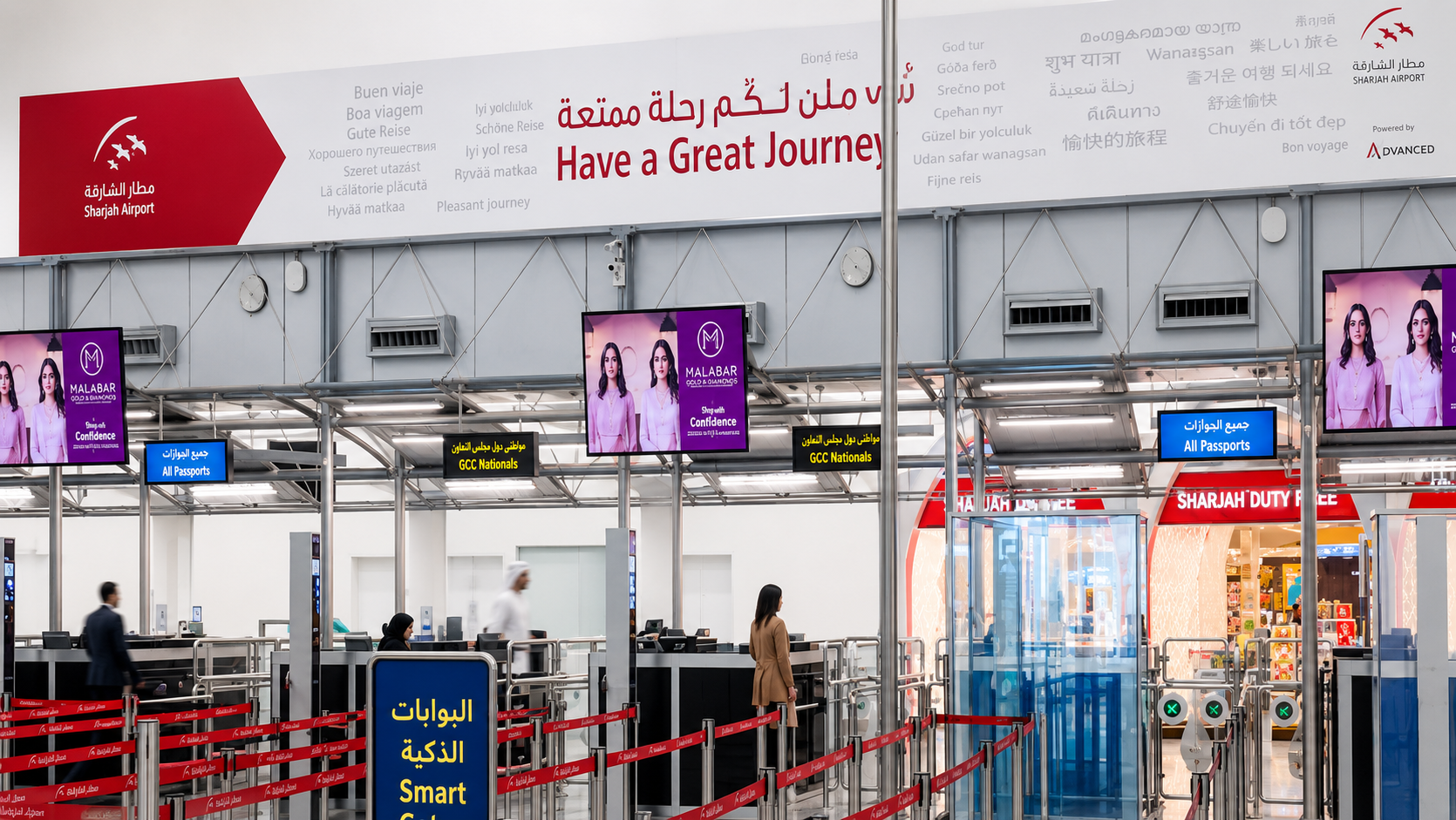
Sharjah International Airport operates a primary international terminal and an adjacent domestic and regional terminal, handling the full spectrum of Air Arabia's route network alongside a secondary community of international carriers serving regional and long-haul routes. The terminal infrastructure is functional, high-traffic, and oriented toward efficient passenger processing rather than luxury dwell — a characteristic that rewards advertising placements positioned at high-traffic choke points where dwell is structural rather than voluntary. The departures hall, security queue areas, boarding gate corridors, and arrivals meeting hall are the highest-attention environments in the terminal, and these are precisely the zones where Masscom Global focuses placement strategy for maximum commercial impact across a fast-moving, purposeful passenger base.
Premium Indicators:
- Air Arabia's hub operation at SHJ confirms the airport's status as the primary commercial aviation gateway for the UAE's most economically productive expat communities — a volume-and-frequency premium that compensates for the lower individual wealth profile relative to Dubai International
- Sharjah's free zone ecosystem — SAIF Zone directly adjacent to the airport and Hamriyah and Sharjah Media City within the broader catchment — generates thousands of B2B travellers whose business activity is directly linked to the airport corridor and who represent high-frequency, commercially sophisticated advertising targets for financial, logistics, and professional services brands
- The airport's proximity to Dubai International — 15 kilometres — means that the SHJ audience overlaps significantly with the Dubai economy but accesses it through a lower-cost aviation gateway, confirming that the audience's economic engagement with the UAE's premium commercial environment is real even if their airport choice reflects rational cost optimisation
- Sharjah's status as the UAE's designated Cultural Capital creates a distinctive brand association environment that elevates the airport beyond its functional Air Arabia hub identity — campaigns that acknowledge and engage with Sharjah's cultural and heritage positioning will benefit from an authenticity premium unavailable at Dubai's commercially saturated airport advertising environment
Forward-Looking Signal:
Air Arabia's continued network expansion — including new routes across Sub-Saharan Africa, Central Asia, and Southern Europe — is adding new audience layers to SHJ's already diverse passenger base and driving sustained passenger volume growth above the regional aviation average. Sharjah's government-led infrastructure investment in the Heritage Area, the University City expansion, and the Mleiha eco-tourism project is progressively repositioning the emirate as a premium cultural destination within the UAE, which will attract higher-income domestic and international visitor flows through SHJ in coming years. The maturation of Sharjah Media City as a tech and creative industry hub is adding a young professional and digital entrepreneur demographic to an airport that has historically skewed older and more traditional. Masscom advises clients to establish presence at SHJ now — the rate environment reflects the airport's current volume-not-luxury positioning, but the commercial trajectory of both the airport and the emirate is toward a higher-value audience profile that will make current placements significantly more competitive to secure within a three to five-year horizon.
Airline and Route Intelligence
Top Airlines:
- Air Arabia — primary hub operator, MENA's first and largest LCC, operating 150-plus routes from SHJ
- Pakistan International Airlines (PIA) — Pakistan national carrier supplementing Air Arabia's extensive Pakistan network
- Iraqi Airways — Baghdad and Basra connections
- Jazeera Airways — Kuwait connections
- Multiple charter and supplemental operators serving seasonal demand on South Asian routes
Key International Routes:
- Sharjah (SHJ) to Karachi (KHI), Lahore (LHE), Islamabad (ISB): Air Arabia's highest-frequency Pakistan corridors — the most commercially productive routes in the SHJ network for South Asian diaspora advertising
- Sharjah (SHJ) to Kochi (COK), Chennai (MAA), Trivandrum (TRV), Hyderabad (HYD): South Indian connection routes serving the UAE's largest Indian expat communities
- Sharjah (SHJ) to Cairo (CAI), Alexandria (HBE): Egypt's primary UAE connection, serving the Gulf's largest Arab expatriate community
- Sharjah (SHJ) to Amman (AMM), Beirut (BEY): Levant connections serving Jordanian and Lebanese expat communities
- Sharjah (SHJ) to Casablanca (CMN), Rabat (RBA): North African connections serving Morocco's growing UAE expat community
- Sharjah (SHJ) to Kathmandu (KTM): Nepal connection serving the construction and hospitality worker community
- Sharjah (SHJ) to Baku (GYD), Tbilisi (TBS), Almaty (ALA): Central Asian connections serving the growing Azerbaijani, Georgian, and Kazakh business community in Sharjah's free zones
Domestic Connectivity:
Data not available for formal UAE domestic route structure — SHJ primarily serves international routes, with UAE domestic movement handled through ground transportation to the Dubai metro area.
Wealth Corridor Signal:
The SHJ route network is a precise map of the UAE's expat economic geography. Every high-frequency Pakistan route confirms the scale and financial productivity of Pakistan's largest overseas worker and business community. Every South Indian connection reflects the Kerala, Tamil Nadu, and Andhra Pradesh communities whose remittances are among the highest per capita of any Indian state diaspora. The Egypt and Levant routes confirm Sharjah's role as the northern UAE's primary Arab expat gateway. The Central Asian network signals the free zone and construction sector's growing Central Asian workforce component. Taken together, the SHJ route network is not a leisure map — it is a commercial atlas of the Gulf's most productive diaspora economies, and it is one of the most efficient advertising vehicles available for reaching those economies at the moment of maximum financial engagement.
Media Environment at the Airport
- Sharjah Airport's high passenger volume through a functionally streamlined terminal creates an advertising environment where placement frequency and position relative to passenger flow are the primary performance drivers — brands positioned at choke points in the departures process achieve significantly higher average impressions-per-placement than comparable Dubai International positions at a fraction of the cost
- Dwell time at SHJ is elevated in the departures hall by the Air Arabia check-in and security processing rhythm — passengers arrive early for budget carrier requirements, creating 45 to 90-minute captive windows in the pre-security and post-security zones that provide sustained brand exposure opportunities for placements across multiple advertising formats
- The terminal's multilingual audience complexity rewards advertisers who invest in language-diverse creative executions — Arabic, Urdu, Hindi, and Malayalam-capable campaigns achieve dramatically higher engagement rates than English-only international creative, and the relatively low competition for multilingual placements at SHJ versus Dubai International means that language-invested campaigns can achieve near-market-exclusive positioning in their target language audience
- Masscom Global delivers precision inventory access across all key terminal zones at Sharjah Airport — departures hall, security corridor, boarding gates, arrivals hall, and ground transportation area — with the multilingual creative capability and South Asian market intelligence to ensure every campaign is calibrated for the audience that actually moves through this terminal, not the generic Gulf airport audience that most campaigns are built for
Strategic Advertising Fit
Best Fit:
- Real estate developers — UAE, Pakistani, and Indian markets: The UAE-based South Asian professional's most significant financial decision is real estate investment — in their home country and increasingly in Sharjah's affordable UAE property market. Developers operating in any of these corridors will find at SHJ a pre-qualified, financially motivated, and captive audience whose property investment intent is at maximum engagement during the travel window.
- Financial services, banking, and remittance platforms: Western Union, money transfer operators, UAE retail banks, Pakistani and Indian banks targeting NRI accounts, and international financial planning services will find at SHJ the Arab world's most productive single point of access for the South Asian diaspora financial services market.
- Telecommunications: Mobile and data services brands targeting UAE expat communities — particularly prepaid and international calling plan operators — will find an audience at SHJ whose communication needs are acute at the moment of departure and arrival and whose brand loyalty in telecom is both high-value and price-sensitive in ways that reward smart, timely advertising.
- Premium FMCG and packaged goods: South Asian and Arab diaspora consumers carry strong brand loyalty to premium FMCG categories — food, personal care, household products — and the airport is a commercially proven environment for driving brand reinforcement and trial among this audience. Halal-certified premium food and beverage brands, premium personal care brands with South Asian or Arab market positioning, and consumer goods companies launching in the UAE market will all find efficient audience access at SHJ.
- Gold, jewellery, and luxury accessories: The South Asian diaspora's cultural relationship with gold — as investment, gifting, and status signalling — makes jewellery and gold retail one of the most consistent high-performing categories at SHJ. UAE gold retailers, Indian jewellery brands expanding in the Gulf, and international fine jewellery companies should treat the pre-Eid and pre-Diwali windows at SHJ as priority campaign investments.
- Automotive — Japanese, Korean, and accessible premium European: The UAE's zero-tax car purchase environment makes automotive one of the most actively considered categories for UAE-based expat professionals, whose car purchase decisions are made against the backdrop of lower prices than in any comparable market. Japanese, Korean, and accessible European marques will find a motivated, comparison-shopping automotive buyer audience at SHJ.
- Education — UAE and international: South Asian expat families with children in UAE schools represent one of the most active international education consumer segments in the Gulf. UAE private schools, university preparation programmes, and international higher education institutions offering South Asian entry pathways will find a structurally receptive parent audience at SHJ throughout the academic calendar.
- Healthcare and medical tourism: Sharjah and Dubai's private healthcare sector is the primary healthcare provider for the UAE's expat community, and medical tourism inbound to Beirut, Bangkok, India, and Turkey flows through SHJ. Healthcare insurance providers, UAE private hospital groups, and international medical tourism facilitators will find a consistently health-investment-conscious audience at this airport.
Brand Alignment at a Glance:
| Category | Fit |
|---|---|
| Real estate — UAE, Pakistani, Indian markets | Exceptional |
| Financial services and remittance | Exceptional |
| Gold, jewellery, and gifting | Exceptional |
| Telecommunications | Strong |
| Premium FMCG and halal-certified brands | Strong |
| Automotive — Japanese and Korean | Strong |
| Education | Strong |
| Ultra-luxury fashion and watches | Moderate |
| Urban nightlife and entertainment brands | Poor fit |
Who Should Not Advertise Here:
- Alcohol, nightlife, and adult entertainment brands: Sharjah is the UAE's most conservative emirate, with a legal prohibition on alcohol sales and a regulatory environment that actively enforces Islamic values in public spaces. Any brand associated with alcohol, nightlife, or adult entertainment is not only commercially misaligned at SHJ but actively contraindicated by the cultural and regulatory context of the emirate.
- Ultra-luxury brands without volume justification: Brands positioned exclusively at the top one percent of individual wealth — Rolls-Royce, Patek Philippe, Hermes — will find insufficient audience overlap at SHJ's predominantly mid-market professional and SME passenger base to justify the investment relative to Dubai International. Ultra-luxury campaigns should be deployed at DXB first, with SHJ considered only for categories where the SME owner and established professional segments represent a viable secondary audience.
- Brands without Arabic, Urdu, or South Asian language capability: Campaigns deployed at SHJ exclusively in English will achieve only a fraction of their potential reach. The absence of non-English language creative in this terminal signals cultural indifference that actively reduces brand affinity among an audience whose language identity is a point of pride and a meaningful filter for brand trustworthiness.
Event and Seasonality Analysis
- Event Strength: High (Ramadan and Eid)
- Seasonality Strength: High
- Traffic Pattern: Dual-Peak with Ramadan-Eid Overlay
Strategic Implication:
Advertisers at Sharjah Airport should structure their investment around three overlapping commercial rhythms — the Ramadan and Eid al-Fitr window as the single highest-impact burst opportunity, the September to November post-summer return season as the highest-volume sustained window, and the April to June pre-summer departure season as the most financially engaged outbound window. Within the Ramadan window, presence must begin at the start of the month — the first week of Ramadan establishes brand preference that drives purchase decisions in the final Eid spending surge. Masscom Global structures SHJ campaigns around all three rhythms simultaneously, ensuring that the brand is present during the Muslim calendar's most commercially productive advertising window, the South Asian financial decision-making window, and the sustained post-summer commercial recovery period that defines the second half of the UAE's business year.

Poor Placement and Delays Affect Airport Campaigns
We help you move faster, access better inventory, and get it right now.
Talk to an ExpertFinal Strategic Verdict
Sharjah International Airport is the most commercially underserved major airport in the UAE — a 9.2 million passenger hub serving the Arab world's most economically productive diaspora communities at a brand investment level that is a fraction of what Dubai International attracts. The gap between the aggregate commercial value of SHJ's audience and the brand investment it receives is the largest structural advertising arbitrage opportunity in Gulf airport media. South Asian SME owners, Pakistani and Indian real estate investors, Egyptian and Levantine professionals, and the South Asian expat financial decision-makers who collectively manage tens of billions of dollars in annual remittance, property, and business investment flow are accessible at SHJ at rates and with a competitive clarity that Dubai International cannot offer any advertiser at any budget level. The brands that recognise this — and that invest in the multilingual, culturally calibrated, South Asian-intelligent campaigns that this audience demands and rewards — will find at Sharjah Airport one of the most efficient customer acquisition channels available in the entire Gulf out-of-home market. Masscom Global has the cultural intelligence, inventory access, and execution capability to turn that opportunity into measurable commercial returns, starting now.
About Masscom Global
Masscom Global is a premium international airport advertising and media buying agency operating across 140 countries. With deep expertise in airport OOH, premium publications, and high-net-worth audience targeting, Masscom helps brands reach the world's most valuable travellers at the moments that matter most. For advertising packages, media rates, and campaign planning at Sharjah International Airport and airports across the globe, contact Masscom Global today.
Frequently Asked Questions
How much does airport advertising cost at Sharjah International Airport?
Advertising costs at Sharjah Airport vary based on format, terminal placement zone, creative language specifications, campaign duration, and seasonal demand. The Ramadan and Eid al-Fitr window, the September to November post-summer peak, and the pre-summer departure season in April to June carry the highest inventory demand and should be planned well in advance. Masscom Global provides current rate cards, multilingual format recommendations, and bespoke media packages structured for both South Asian diaspora and MENA regional brand objectives. Contact Masscom Global directly for current pricing and a tailored media proposal.
Who are the passengers at Sharjah International Airport?
Sharjah Airport serves primarily the UAE's South Asian and Arab expat communities. The largest single nationality group is Pakistani, followed by Indian — particularly South Indian from Kerala, Tamil Nadu, and Andhra Pradesh — and Egyptian. Secondary nationalities include Bangladeshi, Sri Lankan, Moroccan, Jordanian, Filipino, and Central Asian communities. UAE nationals represent a smaller but commercially significant segment. The passenger profile at SHJ spans semi-skilled construction and hospitality workers through established SME owners, trading house directors, and free zone business principals — a wide wealth range within which the upper segments carry significant accumulated Gulf earnings and active investment intent across real estate, financial services, and business categories.
Is Sharjah International Airport good for luxury brand advertising?
Sharjah Airport is well-suited for brands in the accessible luxury and aspirational premium tier whose price point and product positioning align with the UAE's South Asian professional and SME owner audience. Gold jewellery, premium Japanese and Korean automotive, premium FMCG, UAE real estate, and financial services brands perform strongly at SHJ. Ultra-luxury brands positioned at the highest individual wealth tier — fine Swiss watchmaking, superyacht brands, private jet services — will find the audience overlap too narrow for volume-justified ROI. The category-by-category fit assessment by Masscom Global's media planning team will determine precise brand suitability for SHJ placement.
What is the best airport in the UAE to reach South Asian diaspora audiences?
Dubai International handles the UAE's largest total South Asian passenger volume. However, Sharjah Airport offers South Asian diaspora-focused brands a more concentrated, less commercially cluttered, and more cost-efficient access point to the northern UAE's Pakistani, Indian, and Bangladeshi communities. SHJ's audience is less diluted by international transit traffic and luxury tourism segments than DXB, meaning the South Asian diaspora share of total SHJ passengers is higher, and the per-impression relevance for South Asian-targeted campaigns is structurally better. Masscom Global recommends a combined SHJ-DXB strategy for brands seeking full UAE South Asian diaspora coverage, with SHJ as the efficiency driver and DXB as the scale driver.
What is the best time to advertise at Sharjah Airport?
The single most important advertising window at SHJ is the Ramadan and Eid al-Fitr period, whose specific calendar dates shift annually with the Islamic lunar calendar. The final ten days of Ramadan and the immediate pre-Eid departure surge represent the highest-concentration gifting, retail, and travel spend window in the airport's year. September to November is the highest-volume sustained advertising season, driven by the return of South Asian expat workers from summer home visits. April to June provides the pre-summer outbound peak, when financial decision-making for home-country investment is at maximum engagement. The Diwali window in October to November is a secondary burst opportunity for brands targeting the Hindu Indian community specifically.
Can international real estate developers advertise at Sharjah Airport?
Sharjah Airport is a high-converting channel for real estate developers operating in the UAE, Pakistan, and India — the three most active property markets for the SHJ audience. Pakistani developers marketing Defence Housing Authority, Bahria Town, and premium Lahore residential projects will find at SHJ their largest single point of access to UAE-based Pakistani buyers outside Pakistan itself. Indian developers targeting the Kerala, Hyderabad, and Bengaluru premium apartment markets will reach the UAE's largest South Indian expat community at the moment of maximum home-investment engagement — the pre-summer departure window when property visit and purchase decisions are made. UAE developers marketing Sharjah's affordable apartment and townhouse sector will access a motivated local buyer audience whose UAE earnings make them among the most creditworthy property purchasers in the emirate.
Which brands should not advertise at Sharjah Airport?
Alcohol brands, nightlife and entertainment brands, and any brand associated with adult content are prohibited from advertising at Sharjah Airport by both regulatory requirement and the cultural values of the emirate. Ultra-luxury brands without accessible premium tier extensions — positioned exclusively at the top fraction of individual wealth — will find insufficient qualified audience density at SHJ to justify investment relative to Dubai International's premium terminals. English-only campaigns without Arabic, Urdu, or South Asian language components will significantly underperform relative to their potential at this airport and are not recommended without multilingual creative supplementation.
How does Masscom Global help brands advertise at Sharjah International Airport?
Masscom Global provides complete end-to-end airport advertising capability at Sharjah Airport — from South Asian diaspora audience intelligence and multilingual campaign strategy through inventory access, Arabic, Urdu, and Hindi creative specification, placement execution, and performance reporting. Our team brings deep knowledge of the UAE's South Asian expat commercial culture, the Ramadan and Eid advertising rhythm, the financial decision-making patterns of South Asian diaspora travellers, and the specific placement zones within SHJ's terminal that deliver maximum attention and engagement across a fast-moving, multilingual passenger base. We execute faster, with deeper cultural calibration and more precise placement strategy than any planning team approaching SHJ without dedicated Gulf-South Asian market expertise. Contact Masscom Global today to begin building your brand's presence in the UAE's most commercially underutilised major airport.