

Airport at a Glance
| Field | Detail |
|---|---|
| Airport | Václav Havel Airport Prague |
| IATA Code | PRG |
| Country | Czech Republic (Czechia) |
| City | Prague (12 km west of city centre, Prague-Ruzyně) |
| Annual Passengers | 17,750,528 (2025, +8.5% YoY); 16,353,522 (2024, +18% YoY, 3rd highest in history); 18.4 million targeted as all-time record |
| Primary Audience | British and European premium leisure and city-break travellers, MICE and corporate professionals, Middle Eastern HNW spa tourists, growing Asian leisure market, Czech diaspora in UK and Germany |
| Peak Advertising Season | April to October (summer season); December (Christmas tourism, ranked 3rd globally); March (Easter and MICE spring conferences) |
| Audience Tier | Tier 1 |
| Best Fit Categories | Premium tourism and hospitality, MICE and corporate events, Luxury consumer brands, Financial services and banking, Automotive, Real estate, Airlines and travel, Tech and professional services |
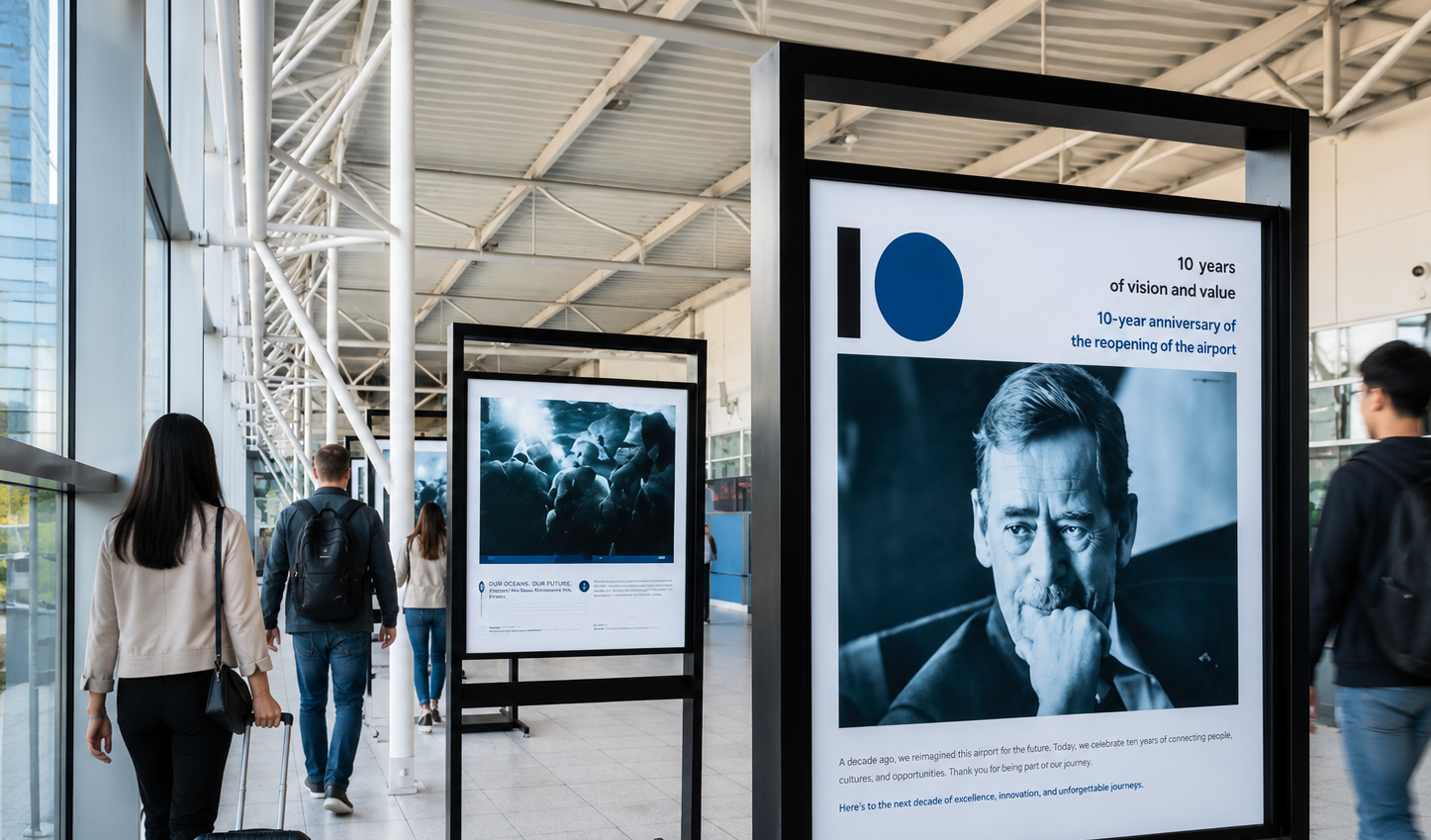
Václav Havel Airport Prague is the Czech Republic's sole major international airport and Central Europe's most commercially dynamic aviation gateway, handling 17,750,528 passengers in 2025 — an 8.5% increase over 2024's already record-breaking 16.35 million, which was itself an 18% surge over 2023. The airport has won the Routes World Award two consecutive years running, most recently in 2025, reflecting its exceptional performance in route development: 41 new routes launched in 2024 alone, 181 direct destinations by end of 2024, and a 2025 summer network of 165 destinations served by 75 airlines. Expansion plans approved will increase capacity to 21.2 million passengers through new terminal construction and, separately, a new parallel runway — a programme whose scale confirms the long-term commercial trajectory that already places PRG among the Continent's fastest-recovering post-pandemic hubs. Named after the playwright and statesman Václav Havel — the last president of Czechoslovakia and first president of the Czech Republic — the airport is a fitting gateway to a capital that has been remade, since the Velvet Revolution of 1989, into one of Europe's most sophisticated, culturally rich, and commercially compelling destinations.
What makes PRG commercially exceptional is the rare convergence of three audience profiles that rarely appear together at the same scale in the same terminal. The British short-break and city-break traveller — 2.1 million of them in 2024 alone, routed on the London connection's 100 weekly summer flights — arrives carrying European premium leisure standards and a willingness to pay for quality that Prague's maturing luxury hotel market is actively cultivating, with 66% of visitors choosing four- or five-star accommodation and luxury hotel occupancy up 12% in 2024. The corporate and MICE professional community — Prague is ranked 7th globally in the ICCA destination performance index — books into the city's world-class congress infrastructure for incentive events, international conferences, and corporate gatherings whose delegate spend per head is among Europe's highest. And the emerging long-haul premium market — Middle Eastern visitors already numbering 379,000 annually (concentrated in Prague and Karlovy Vary's spa resorts), South Korean tourists growing to 170,709, Chinese tourists nearly doubling to 92,000, and new direct connections to Toronto, Abu Dhabi, and Philadelphia all live or confirmed — is deepening the airport's audience commercial richness well beyond its European regional base. Prague is not recovering toward its pre-pandemic form. It has surpassed it, and is now building the infrastructure for the next decade of growth.


Advertising Value Snapshot
- Passenger scale: 17,750,528 (2025); 16,353,522 (2024, +18% YoY, 3rd highest ever); historic record of 18.4 million targeted; 83%+ average load factor in 2024; 134,609 aircraft movements in 2024
- Traveller type: British and European premium short-break tourists, MICE delegates and corporate professionals, Middle Eastern HNW spa and leisure visitors, growing South Korean, Chinese, and Japanese leisure markets, Czech diaspora returnees from UK and Germany, North American transatlantic travellers (Toronto and Philadelphia connections)
- Airport classification: Tier 1 — Czech Republic's sole major airport; Central European aviation hub; Routes World Award winner 2024 and 2025; 3rd highest passenger year in airport history in 2024
- Commercial positioning: PRG is the exclusive commercial gateway for a capital city whose economy generates 25% of Czech GDP, whose GDP per capita (€58,216) is the 3rd highest in the EU at 203% of the EU-27 average, and whose $9.13 billion in 2024 tourism revenue already exceeded 2019 levels by 25%
- Wealth corridor signal: London's 1.4 million PRG passengers in 2024 (+26% YoY) on up to 100 weekly summer flights represent British premium leisure at its most Prague-focused; Abu Dhabi and Toronto direct connections launched 2025 confirm Middle Eastern, Indian subcontinent, and North American long-haul premium demand; 379,000 Middle Eastern visitors to Czech Republic in 2024 heading primarily to Prague and Karlovy Vary spa resorts signal a high-spending Gulf corridor
- Advertising opportunity: PRG approaching its all-time passenger record at the same moment its luxury market is demonstrably upgrading creates a premium advertising environment with exceptional commercial conditions; Masscom Global provides the inventory access, positioning strategy, and market intelligence to activate campaigns that intercept Europe's most commercially diverse Central European gateway audience
Airport Advertising is Complex to Get Right
We help you execute faster, with proven results and local insight most planners lack starting now.
Talk to an ExpertCatchment Area and Economic Drivers
Top 10 Cities within 150 km — Marketer Intelligence
- Prague (city, adjacent): The capital and economic engine of the Czech Republic, population 1.5 million with the broader metropolitan area exceeding 2.7 million; Prague's economy generates approximately 25% of Czech GDP and its GDP per capita in purchasing power terms places it as the third most productive regional economy in the entire European Union at 203% of the EU-27 average; the city hosts the headquarters of every major Czech and Central European business, the full diplomatic infrastructure of an EU and NATO capital, and a creative and tech economy that has attracted thousands of international professionals and remote workers from across Europe and North America
- Kladno (~15 km north): A former steel and mining industrial city that has significantly diversified toward manufacturing, logistics, and commercial real estate; Kladno's professional community uses PRG for both business connections to Western Europe and leisure travel, and its proximity to the airport makes it a natural secondary catchment for the capital's aviation infrastructure
- Beroun (~25 km southwest): A historic Bohemian town on the Berounka River, growing as a commuter community for Prague's professional class seeking suburban quality of life while retaining access to the capital's commercial opportunities and PRG's international connections; its residential premium is rising steadily as Prague's urban footprint expands
- Mladá Boleslav (~55 km northeast): The headquarters of Škoda Auto — the Czech Republic's most globally recognised industrial brand and one of the cornerstones of the Volkswagen Group's Central European manufacturing strategy; Škoda employs tens of thousands in Mladá Boleslav and generates a sustained business travel base of automotive engineers, executives, VW Group managers from Wolfsburg, and global automotive supply chain professionals who route their Central European travel through PRG; the automotive wealth generated here radiates into consumer purchasing power across the region
- Příbram (~55 km south): A mid-sized city with a mining heritage in silver and uranium and a growing industrial diversification into manufacturing and precision engineering; its professional community represents the Bohemian industrial economy at mid-scale and connects to PRG for Western European business travel
- Kutná Hora (~70 km east): A UNESCO World Heritage City — the former silver mining capital of medieval Bohemia and home to the extraordinary Sedlec Ossuary and the Cathedral of St. Barbara, one of Central Europe's finest Gothic structures; Kutná Hora has become a significant day-trip destination for heritage tourists arriving through PRG and a growing weekend destination for premium domestic and inbound cultural tourism whose profile aligns with Prague's luxury shift
- Plzeň (~90 km southwest): The Czech Republic's fourth-largest city and an industrial and cultural heavyweight; home to Pilsner Urquell — the brewery whose 1842 lager revolutionised global beer culture and remains one of the world's most recognised premium food and beverage brands — and to Škoda Engineering, a heavy industrial and defence manufacturer; Plzeň's business community generates substantial PRG travel for connections to Germany, its primary commercial partner, and to the UK and Benelux; the city's European Capital of Culture designation in 2015 has sustained a cultural tourism premium that continues to attract European heritage visitors
- Karlovy Vary (~135 km northwest): The Czech Republic's premium spa resort city, historically frequented by European royalty, aristocracy, and the global creative class — Goethe, Beethoven, Schiller, Karl Marx, Peter the Great, and Tsar Alexander I all visited — and today the preferred Czech destination for Middle Eastern HNW visitors seeking therapeutic spa treatments, luxury boutique shopping, and family wellness travel; the region's Karlovy Vary Vary International Film Festival (KVIFF) is one of Europe's premier cultural events; the 379,000 Middle Eastern tourists who visited Czech Republic in 2024 disproportionately concentrated in Prague and Karlovy Vary, making this corridor one of the most commercially powerful HNW travel pipelines in Central Europe
- Pardubice (~110 km east): An important industrial and chemical city — the origin of Semtex explosive and today a diversified chemical and engineering economy — and the host of the Velká Pardubická steeplechase, one of the world's oldest and most technically demanding horse races; its industrial and equestrian professional communities use PRG for European business and leisure connections
- Liberec (~100 km north): The historical centre of the Czech textile industry, located close to the German border in the Jizera Mountains; Liberec's growing tourism economy, built on skiing and mountain sports infrastructure, generates a leisure travel audience that routes through PRG for connections to UK, Germany, and the Scandinavian markets where Czech mountain tourism is actively marketed
NRI and Diaspora Intelligence
The Czech diaspora in the United Kingdom — the legacy of Czech and Slovak labour migration that accelerated after EU accession in 2004 — generates one of the most commercially active diaspora return corridors in Central Europe on the London route. The UK is PRG's single largest international market at 2.1 million passengers in 2024, a 29% year-on-year increase, and the multiple daily London connections (up to 100 flights per week in the summer schedule) carry a two-way flow of British visitors arriving to Prague and Czech diaspora returning home that collectively constitute the airport's commercial backbone. The Czech community in Germany — the other major destination for Czech labour migration and the Czech Republic's dominant trade partner — generates the secondary diaspora return corridor. A growing community of Czech tech and creative professionals in Amsterdam, Stockholm, and Dublin further diversifies the diaspora return geography. For brands in financial products, real estate, and premium consumer goods, the returning Czech professional who has earned UK or German wages and is visiting Prague to invest in property, visit family, or assess return migration is a commercially active audience whose purchasing power differentials work strongly in Czech market favour.
Economic Importance
The Czech Republic's economy is a sophisticated, highly industrialised, export-oriented EU member state with a GDP of $344 billion, a GDP per capita at purchasing power parity of $50,961, and unemployment among the lowest in the EU. The automotive sector — anchored by Škoda Auto in Mladá Boleslav, together with Volkswagen, Toyota, Hyundai, and dozens of Tier 1 and Tier 2 suppliers across Bohemia and Moravia — contributes approximately 10% of the entire national economy and makes the Czech Republic one of the most vehicle-intensive manufacturing economies per capita on Earth. The country hosts over 2,100 active foreign direct investment projects with a total FDI stock exceeding $200 billion. Prague's own economy operates at 203% of the EU-27 average GDP per capita, placing it firmly in the same commercial bracket as Vienna, Brussels, and Munich — European cities where premium brand standards are not aspirational but expected. The Czech Republic's decision to remain outside the eurozone (using the Czech Crown, CZK) while maintaining full EU single market integration creates a persistent currency dynamic where visiting Europeans experience relative pricing advantages that contribute to Prague's premium tourist spend growth — visitors with euros spend more in CZK-denominated Prague than equivalent cities within the eurozone.
Business and Industrial Ecosystem
- Automotive and manufacturing: The Škoda-VW Group industrial ecosystem connecting Mladá Boleslav to Wolfsburg is the Czech Republic's largest single commercial relationship and generates thousands of executive, engineering, and logistics professional flights annually through PRG on the Frankfurt, Hamburg, and Düsseldorf routes; the supporting network of automotive suppliers, engineering consultancies, and Tier 1 parts manufacturers across Bohemia adds a second layer of industrial business travel that routes through PRG to Germany, the UK, and South Korea
- Financial services, banking, and fintech: Prague hosts the Czech headquarters of all major Central European banking groups including Česká spořitelna (Erste Group), Komerční banka (Société Générale), and MONETA Money Bank, alongside international private banking, investment management, and a growing fintech ecosystem; the city's financial professional community travels frequently through PRG on the London, Frankfurt, Paris, and Amsterdam routes for client and regulatory meetings
- MICE, congress, and corporate events: Prague is ranked 7th globally in the ICCA Destination Performance Index for conference tourism; the Prague Congress Centre, O2 Arena, Forum Karlín, and dozens of premium hotel conference facilities host thousands of international corporate events annually; MICE delegates represent PRG's highest per-diem spend category — corporate rates on flights, premium accommodation, gala dinners, and specialist social programmes generate average delegate spends far exceeding leisure tourist equivalents
- Technology, IT, and startup ecosystem: Prague's tech ecosystem has grown substantially since 2010; the city hosts the Central European headquarters of numerous US, UK, and German tech companies who use Prague's lower labour costs, English-language professional environment, and EU jurisdiction for EMEA operational centres; their tech professionals travel regularly through PRG on routes to London, Amsterdam, and the US via the new transatlantic connections
- Tourism and hospitality industry: Prague's $9.13 billion tourism economy in 2024 — 25% above 2019 levels — is itself a major commercial ecosystem employing over 58,500 people in the capital directly, with a further significant multiplier across accommodation, F&B, transport, and cultural sectors; the tourism industry's buyers and operators, from hotel chains to tour operators to inbound ground handlers, generate substantial business travel through PRG
Passenger Intent — Business Segment
Business travellers at PRG divide clearly between three intent profiles. Corporate and MICE delegates routing primarily on the London, Frankfurt, Amsterdam, and Paris corridors are in an institutional spending mode with high brand receptivity for professional tools, premium corporate hospitality, and business services. The automotive and industrial professional community on the German routes is in a procurement and partnership mode, responsive to engineering excellence, technology advancement, and industrial services brands. The emerging long-haul business traveller on the Toronto, Abu Dhabi, and Seoul routes represents the most internationally mobile and commercially sophisticated segment, whose expectations are calibrated to global hub standards. Masscom Global's strategic approach structures PRG campaigns to address all three profiles with differentiated creative executions rather than a single generic campaign.
Strategic Insight
PRG's commercial environment is shaped by a fundamental premium shift that Prague's own tourism data confirms: the city's visitors are upgrading from its budget-city-break legacy toward a quality-first city experience, with 66% of all 2024 visitors choosing four- and five-star accommodation and luxury hotel occupancy growing 12%. This shift has deep implications for advertisers. The audience at PRG is no longer the stag-party and budget-airline market that defined Prague's post-1989 tourism brand for many international planners. It is increasingly the same audience — by nationality, income level, and quality expectation — that premium advertisers target in Vienna, Amsterdam, and Copenhagen. The cost of advertising at PRG, however, still reflects Central European pricing — not Western European pricing — creating an exceptional cost-per-qualified-impression opportunity for brands willing to update their market assessment.
Tourism and Premium Travel Drivers
- Historic Centre of Prague — UNESCO World Heritage Site: Prague's medieval Old Town, Malá Strana, Hradčany, and Josefov (Jewish Quarter) constitute one of the most intact and architecturally extraordinary historic city centres on earth; the city presents an unbroken visual narrative from Romanesque through Gothic, Renaissance, Baroque, and Art Nouveau that draws heritage, cultural, and architectural tourism from Germany, the UK, the USA, South Korea, and Japan at scale; the UNESCO designation reinforces PRG's position as a destination airport for serious cultural tourism willing to pay premium prices for premium experiences
- Christmas market — 3rd globally ranked: Prague's Old Town Square Christmas market was ranked the third best in the world in December 2024; the festive December window consistently generates PRG's strongest winter tourism spike, with the UK, German, and Scandinavian markets providing the majority of inbound Christmas visitors; the luxury gifting, premium food, and experiential retail categories achieve exceptional conversion in this window
- KVIFF — Karlovy Vary International Film Festival: One of Europe's premier film festivals, held annually in late June at the spa resort 135 km from PRG; KVIFF draws international film industry, media, and creative professionals from across Europe, the US, and Asia whose travel routes through PRG; the festival generates a concentrated HNW audience of creatives, media executives, and cultural influencers whose brand alignment skews toward premium lifestyle, fashion, and cultural categories
- Spa and wellness tourism — Karlovy Vary (Carlsbad) and West Bohemian Triangle: The spa tradition of Karlovy Vary, Mariánské Lázně (Marienbad), and Františkovy Lázně — the Western Bohemian Spa Triangle — has been a magnet for European HNW leisure since the 18th century and is today experiencing significant reinvestment driven by Middle Eastern visitors seeking thermal and therapeutic wellness in a European cultural setting; the Gulf market's 379,000 2024 visitors to Czech Republic concentrate heavily in this corridor, arriving through PRG, and represent one of the highest per-stay spend audiences at the airport
- Beer culture and gastronomy tourism: Czech brewing tradition — Pilsner Urquell from Plzeň (1842), Budvar from České Budějovice, Kozel from Velké Popovice — is among the most globally recognised food culture propositions in Central Europe; the growing international gastronomy and craft beer tourism audience arrives at PRG for both Prague's exceptional food scene and for brewery tours in the Bohemian countryside
- Classical music and arts: Prague's musical heritage — the city where Mozart premiered Don Giovanni, home to the Prague Spring International Music Festival, and stage for world-class orchestral and opera performances at the National Theatre and Rudolfinum — draws a premium, culturally motivated European audience whose spending patterns on accommodation, dining, and cultural products align with the luxury shift that Prague's tourism data confirms
Travel Patterns and Seasonality
Peak seasons:
- April to October (summer season and European city-break peak): PRG's dominant commercial window; the summer schedule operates 165 destinations with 75 airlines; London's 100-flight weekly frequency represents the single most-served route of any European airport serving Prague during this window; the graduation, school holiday, and business incentive conference cycles of the British and German markets generate their strongest Prague travel in April-June and September-October
- December (Christmas tourism peak): Prague's world-class Christmas market draws European visitors in concentrations that rival the summer peak; the December window has the highest luxury hotel occupancy of the year; consumer, gifting, and lifestyle brands achieve exceptional conversion; the 3rd global ranking for Christmas destination in 2024 confirms sustained marketing potency
- March (Easter and spring conference season): Easter weekend generates a concentrated British and German inbound leisure spike; the spring conference and congress season — March to May — generates the first major MICE travel surge of the year through PRG's convention infrastructure
Event-Driven Movement
- Prague Spring International Music Festival (May): One of Europe's oldest and most prestigious classical music festivals, attracting tens of thousands of classical music enthusiasts from Germany, Austria, the UK, the USA, and Japan; festival delegates represent PRG's most culturally engaged and premium-accommodation-selecting annual audience concentration
- IIHF Ice Hockey World Championship (biennial, May): Czech Republic hosts this event regularly; the 2024 championship generated enormous inbound traffic from Canada, the US, Sweden, Finland, and other hockey nations through PRG; the next hosting cycle will create another major inbound sports tourism spike of significant commercial scale
- Karlovy Vary International Film Festival (late June/July): International film industry professionals, media executives, and cultural travellers routing through PRG for the festival; high-end hospitality, luxury fashion, and creative industry brands align naturally with this audience
- Prague Food Festival (May/June): One of Central Europe's most successful premium gastronomy festivals; attended by culinary professionals, premium food buyers, and food-focused leisure tourists from across Europe; food, lifestyle, and premium beverage brands benefit from the activated consumer mindset this event generates at PRG
- European tour concert season (spring and autumn): Prague has become one of Europe's most sought-after concert venues for major international artists; Rammstein, Travis Scott, and international performers generated significant inbound and domestic tourism in 2024; large-scale entertainment events at O2 Arena create discrete spikes in leisure travel through PRG
- Christmas Market season (late November to December): European tourism boards consistently rank Prague among the top three Christmas destinations globally; the six-week Christmas market season generates one of PRG's most commercially concentrated annual audience windows, particularly relevant for gifting, luxury retail, and premium food brands
It’s Not Just Where You Advertise - It’s How Fast You Execute
We combine local insight with fast rollout to deliver results for you, now.
Talk to an ExpertAudience and Cultural Intelligence
Top 2 Languages
- Czech: The official language of the Czech Republic, spoken by virtually all 1.5 million Prague residents as their mother tongue and understood across the country; Czech shares significant lexical and grammatical similarities with Slovak, Polish, and other Slavic languages, making Prague a natural commercial hub for the broader Central European market; advertising at PRG in Czech signals genuine market commitment and builds the brand trust that Czech consumers — pragmatic, quality-conscious, and deeply sceptical of superficial marketing — reward with durable loyalty
- English: The working language of Prague's international business community, the language of instruction in most Czech universities' international programmes, and the dominant language of the city's large expat and digital nomad population; English functions effectively as a second language for the entire professional class in Prague and is the natural default for international brand advertising at PRG's international terminal
Major Traveller Nationalities
PRG's 2024 passenger base of 16.35 million divides across a genuinely pan-European and increasingly global nationality mix. British passengers at 2.1 million are the dominant international nationality, reflecting both the strong Prague short-break tradition in the UK market and the active Czech diaspora return corridor. Italian passengers at 1.9 million, Spanish at 1.6 million, and German at over 1 million reflect Prague's deep appeal across Southern and Central Europe. The growing long-haul cohort — South Korean visitors at 170,709 (the dominant Asian nationality), Chinese at 92,000 (nearly doubled year-on-year), Japanese at 53,295 (+29%), and American at 492,748 — is reshaping the airport's audience diversity in commercially significant ways. Middle Eastern visitors at 379,000 nationally represent a concentrated HNW segment at both PRG and Karlovy Vary. For advertisers, PRG's nationality breadth means campaigns must balance Czech-language domestic targeting with multilingual international reach — a balance that Masscom Global manages through culturally calibrated multi-audience creative strategies.
Religion — Advertiser Intelligence
- Secular majority (approximately 75%): The Czech Republic is one of the most secular societies in Europe; approximately 75% of the population identifies as non-religious; religion plays almost no role in the commercial calendar for the domestic Czech audience, whose purchasing behaviour is driven by pragmatic quality assessment, value for money, and aspirational lifestyle positioning rather than faith-based calendar anchors; brands should not design Czech domestic campaigns around religious triggers but instead calibrate to the country's strong secular cultural identity — civic pride, intellectual sophistication, cultural richness, and the national self-image as Central Europe's most culturally independent nation
- Roman Catholic (approximately 10%): A significant minority, concentrated more heavily in Moravia than in Bohemia; Catholic feast days — Christmas, Easter — are culturally relevant to Czech commercial timing as national holidays regardless of personal faith affiliation; the Catholic visitor from Germany, Italy, Poland, and the Middle East brings faith-relevant cultural context that intersects with Prague's architectural heritage (Baroque churches, the St. Vitus Cathedral) as a tourism draw rather than a commercial messaging strategy
- Muslim (incoming international visitors from Middle East and South Asia): The 379,000 Middle Eastern visitors to Czech Republic in 2024, alongside the South Asian audience being built by the Etihad Abu Dhabi connection, create a commercially significant inbound Muslim audience for whom halal food availability, modest fashion, and culturally respectful hospitality are commercial expectations; brands and hotels seeking to capture this audience should note that Karlovy Vary and central Prague are actively developing halal-certified hospitality infrastructure in response to this market's growth
Behavioral Insight
Czech consumers are pragmatic, research-driven, and powerfully sceptical of advertising overstatement — a cultural disposition shaped by decades of communist-era propaganda whose legacy is a population that applies forensic consumer intelligence to every brand claim. Czech professionals do not respond to superlatives, celebrity endorsement, or emotional pressure as readily as their Western European counterparts; they respond to evidence, specificity, and functional quality demonstration. The international visitor audience at PRG — British, German, American, Korean, and Middle Eastern — brings their own culturally specific consumer frameworks, but they share with the Czech domestic audience a premium travel context that elevates receptivity; every traveller at PRG is in a mood of positive anticipation or satisfied recall, both states proven to enhance brand memory encoding. Masscom Global's campaign strategy at PRG is designed to exploit this dual domestic-international audience dynamic with messaging that meets both the Czech consumer's evidence preference and the international visitor's aspiration engagement.
Outbound Wealth and Investment Intelligence
The outbound passenger at PRG represents the Czech Republic's professionally mobile and internationally connected class — a population whose GDP per capita at purchasing power parity ($50,961) already places them ahead of Spain and within reaching distance of France, and whose Prague-specific income premium (Prague wages are approximately 20% above the Czech national average) gives the capital's professional class discretionary purchasing power that is genuinely comparable to Western European peers.
Outbound Real Estate Investment
Czech outbound real estate investment is driven primarily by two markets. The professional class with UK connections — the 100,000-plus Czech nationals working in the UK who return through PRG — is the primary buyer group for Prague's upscale residential market, investing the sterling savings differential in apartments and houses in Prague's premium districts of Vinohrady, Žižkov, and the wider metropolitan area. A secondary flow of Czech entrepreneurs and high-earning tech professionals targets Southern European leisure and retirement property — Spain's Costa del Sol, Portugal's Algarve, and Croatia's Adriatic coast — on outbound routes through PRG. For international real estate developers targeting Central European buyers, PRG is the channel.
Outbound Education Investment
The UK remains the primary destination for Czech students pursuing higher education abroad, with the LSE, UCL, King's College London, and the major UK provincial universities all actively recruiting from Czech high schools; British university brands marketing to Czech families should treat PRG's departures environment as their most concentrated awareness channel ahead of the January-March UCAS application cycle. Germany's universities are the secondary destination for Czech students given the proximity and the German language proficiency of a significant portion of Czech secondary school graduates. The USA, the Netherlands, and Austria attract a smaller but commercially significant Czech student flow whose routing through PRG is concentrated in August and September.
Outbound Wealth Migration and Residency
Czech HNIs show limited interest in formal wealth migration or golden visa programmes given the country's EU citizenship, high quality of life, and political stability — factors that substantially reduce the motivation for offshore residency planning. The relevant outbound commercial intelligence is that Czech affluent professionals with business exposure to Germany, the UK, and the US hold consumer standards calibrated by those markets and bring those standards back to their Prague purchasing decisions. Brands that present at PRG with the quality execution they would deploy in Frankfurt or Amsterdam will find a Czech professional audience that recognises and respects that signal.
Strategic Implication for Advertisers
The commercial case for PRG is straightforward: a 17.75 million passenger airport approaching its all-time historical record, serving Central Europe's wealthiest regional economy, with a luxury tourism transformation already confirmed by occupancy data, a long-haul network that has in two years added Toronto, Abu Dhabi, Philadelphia (2026), and multiple new Asian routes, and a MICE sector ranked 7th in the world whose corporate delegates represent the highest per-diem spend category in the airport's commercial profile. For brands in premium tourism, MICE services, luxury consumer goods, financial products, and automotive — and for any international brand targeting the British, German, South Korean, Middle Eastern, and North American visitors who constitute PRG's most commercially active inbound nationalities — this airport at this moment is a rare convergence of scale, quality, and commercial momentum that Masscom Global is positioned to activate immediately.
Airport Infrastructure and Premium Indicators
Terminals
- PRG operates two main terminal buildings: Terminal 1 handles non-Schengen traffic (connections to the UK, USA, Middle East, Asia, and other non-EU destinations) and Terminal 2 handles Schengen-zone European traffic; this structural separation creates two distinct audience zones that allow advertisers to target UK, US, Middle Eastern, and Asian international travellers in Terminal 1 and European Schengen-zone business and leisure travellers in Terminal 2 with entirely distinct campaigns if desired — a precision capability that few two-terminal European airports offer at PRG's passenger scale
- Infrastructure expansion is actively underway: capacity is being increased to 21.2 million passengers through Terminal 2 expansion and a new central check-in point adjacent to Terminal 1; a new Parking House B is scheduled for completion in 2029; a new parallel runway is planned for medium-term capacity assurance; carbon neutrality is targeted by 2030 with CT X-ray security screening already deployed in Terminal 2
Premium Indicators
- The five consecutive fastest-growing years in PRG's route development history — confirmed by the Routes World Award for 2024 and 2025 — are the most commercially credible signal an airport can provide that its audience scale is growing rather than static; brands that advertise at PRG today are building recognition with an audience that will be 2-3 million larger within three years
- Etihad Airways' launch of Abu Dhabi service in June 2025 on Boeing 787 wide-body aircraft at four weekly frequencies, and Air Canada's Toronto service on Airbus A330 at three weekly frequencies from the same month, elevate PRG's premium cabin product offer from a European regional category to a genuine global long-haul gateway; both airlines' presence confirms institutional airline investment in PRG's premium market potential
- American Airlines' Philadelphia daily service launching in summer 2026 represents the first direct USA-Prague scheduled connection, confirming that PRG's transatlantic potential is now recognised by a US legacy carrier whose route investment decisions are among the most commercially rigorous in global aviation
- The 83%+ average load factor across all routes in 2024 — the highest efficiency metric of any European airport at this scale — confirms that PRG's growth is demand-driven rather than capacity-forced, and that every additional route launched is commercially justified by actual passenger behaviour
- Smartwings and Ryanair as the two dominant carriers create a complementary high-volume, high-connectivity base that sustains the airport's network breadth while the premium long-haul expansion adds the commercial quality dimension; 76 airlines operating simultaneously is a network depth that rivals airports twice PRG's size
Forward-Looking Signal
PRG's trajectory from 16.35 million in 2024 to 17.75 million in 2025 and toward the planned 21.2 million capacity is backed by confirmed airline commitments, approved infrastructure investment, and a tourism market that is actively upgrading toward premium spend. The Philadelphia announcement for 2026 is the most commercially significant single route development in the airport's recent history — it confirms that PRG has now broken through to the tier of Central European airports that command direct US legacy carrier service, a threshold previously held only by Warsaw, Vienna, and Zurich in the broader region. When the rail link is eventually built (procurement underway, construction delayed but committed), the airport will gain the city-centre connectivity that currently constrains some premium business travellers. Masscom Global advises brands to establish PRG presence now, at current Central European advertising cost levels that do not yet reflect the airport's Western European audience quality profile, before the airport's traffic record breaks and competitive pressure on premium inventory intensifies.
Airline and Route Intelligence
Top Airlines
Smartwings (hub, largest by passengers), Ryanair (fastest growing, second year running 2024), easyJet, Wizz Air, Lufthansa (top five by 2024 passengers); also British Airways, Air France, KLM, Turkish Airlines, Emirates, Korean Air, Asiana Airlines (from April 2025), China Airlines, Hainan Airlines, Etihad Airways (from June 2025), Air Canada (from June 2025), American Airlines (daily Philadelphia from summer 2026), EgyptAir, SCAT Airlines, Condor, Air Baltic, Croatia Airlines, and 60+ others
Key International Routes
- London (LHR/STN/LGW/LTN): Multiple daily services by British Airways, easyJet, Ryanair, Wizz Air, Jet2 — 1.4 million passengers in 2024 (+26% YoY); up to 100 flights per week in summer 2025; the airport's single most-served corridor and the dominant commercial relationship of PRG's entire route network
- Paris (CDG/ORY): Air France, easyJet, Transavia — approximately 700,000 passengers annually; the second busiest international corridor and the primary French and Francophone market connection
- Milan (MXP/LIN/BGY): Multiple Italian carriers — 545,000 passengers annually; Italy second largest national market at 1.9 million total in 2024
- Amsterdam (AMS): KLM, Ryanair — 538,000 passengers annually; primary connection to the Netherlands and North Sea business community; also a key hub-feed route for long-haul connections to Asia-Pacific
- Istanbul (IST): Turkish Airlines — 440,000 passengers annually; connecting PRG to the Turkish market and to Turkish Airlines' extensive Middle East, Africa, and Asia network
- Seoul (ICN): Korean Air year-round; Asiana Airlines from April 2025 (Airbus A350, 3x weekly) — reflecting the South Korean market's exceptional growth (170,709 visitors to Prague in 2024)
- Beijing (PEK): Hainan Airlines — resumed 2024; first direct China service since pandemic; key for the Chinese tourist market whose visitors nearly doubled to 92,000 in 2024
- Taipei (TPE): China Airlines — launched 2023; connecting PRG to Taiwan and the broader East Asian premium travel market
- Abu Dhabi (AUH): Etihad Airways — launched June 2025 (Boeing 787, 4x weekly); opening the Gulf and Indian subcontinent corridor for both outbound Czech leisure and inbound Middle Eastern premium visitors
- Toronto (YYZ): Air Canada — launched June 2025 (Airbus A330, 3x weekly); first direct Canadian service; North American market access for both Czech diaspora and Canadian premium tourism
- Philadelphia (PHL): American Airlines — daily from summer 2026; first direct US legacy carrier service; confirming PRG's transatlantic premium market potential
Domestic Connectivity
No domestic scheduled services within the Czech Republic; Prague's central European location means domestic air travel is commercially non-viable against high-speed rail and road infrastructure.
Wealth Corridor Signal
PRG's route network is one of the most commercially diversified in Central Europe. The London mega-corridor carries British premium leisure and Czech diaspora. The German triangle (Frankfurt, Munich, Düsseldorf) carries automotive and manufacturing business wealth. The Gulf corridor (Abu Dhabi, Istanbul) carries Middle Eastern HNW leisure and Indian subcontinent connectivity. The Asian long-haul (Seoul, Beijing, Taipei) carries the fastest-growing international tourism segment. The transatlantic corridors (Toronto, Philadelphia) carry North American corporate and leisure spend at the highest individual ticket values in the network. Each corridor warrants a distinct advertiser category — and each converges through PRG's two terminals in a commercial environment where Masscom Global's inventory access and strategic positioning deliver precisely differentiated brand presence across every segment simultaneously.
Media Environment at the Airport
- PRG's Terminal 1 / Terminal 2 architecture creates an immediately practical targeting structure: Terminal 1's non-Schengen environment concentrates the UK, US, Middle Eastern, and Asian premium audiences whose spending profiles justify premium advertising investment; Terminal 2's Schengen environment concentrates the German, Italian, Spanish, and broader European commercial volume whose numerical dominance justifies high-frequency reach campaigns
- Dwell time at PRG is extended by the airport's multiple security checkpoints and the increasing deployment of biometric and EES (Entry/Exit System) processing for non-EU nationals, which has extended non-Schengen terminal dwell time meaningfully since October 2025; longer dwell times increase total brand exposure per placement without additional cost
- PRG's rapid passenger growth from 13.8 million in 2023 to 17.75 million in 2025 means the audience size per advertising placement has effectively increased by 28% in two years without any corresponding adjustment in advertising pricing — an extraordinary value trajectory that Masscom Global monitors and communicates transparently to clients evaluating investment timing
- The airport's position as a MICE destination of global significance means a meaningfully higher-than-average proportion of PRG's passengers are corporate delegates whose company-funded travel context creates premium brand receptivity and above-average secondary audience recall (corporate travellers discuss brand encounters in airport environments with colleagues at their destination events)
Strategic Advertising Fit
Best Fit
- Premium tourism and hospitality brands: Prague's 66% four- and five-star hotel selection rate and 12% luxury occupancy growth confirm that PRG's tourism audience is actively upgrading; international luxury hotel brands, premium tour operators, exclusive experience platforms, and aspirational destination brands targeting European, American, and Asian premium leisure travellers find an audience at PRG whose quality expectations and brand engagement level are among the highest in Central Europe
- MICE, corporate events, and professional services: PRG's 7th global ICCA ranking and the concentration of corporate decision-makers on business routes to London, Frankfurt, Amsterdam, and the growing long-haul destinations create an exceptional B2B advertising environment; event management platforms, premium corporate hospitality brands, financial advisory services, and professional conference technology find their highest-value Central European audience concentrated at this airport
- Luxury automotive: The automotive sector's deep structural connection to Central Europe — Škoda-VW in Mladá Boleslav, the German automotive supply chain, and the affluent Czech professional class's strong preference for premium German vehicles — makes PRG one of the most commercially receptive Central European airports for luxury automotive advertising; South Korean automotive brands (Hyundai, Genesis, Kia) also benefit from the Korean Air/Asiana audience alignment
- Financial services, private banking, and investment products: Prague's GDP per capita at 203% of EU average and the city's growing tech and startup wealth class create genuine demand for private banking, wealth management, and investment products at PRG; the Czech professional who has sold a startup, earned equity in a US tech company, or accumulated professional savings across a UK or German career uses PRG as their primary air platform and responds to premium financial brand messaging
- Premium consumer brands and fashion: The British, German, American, South Korean, and Middle Eastern visitors arriving at PRG carry consumer brand expectations from their home markets; international luxury and premium consumer brands that position themselves at the arrival moment in Terminal 1 intercept visitors already in a positive anticipation mindset and create the first Prague brand memory that shapes their commercial behaviour throughout their stay
- Real estate — Prague residential and Central European development: The returning Czech diaspora from the UK and Germany, combined with the international investor community that European low-interest environments and Prague's relative affordability have attracted, creates a concentrated real estate advertising audience at PRG; residential developers, Czech property consultancies, and European lifestyle real estate brands all find their most relevant Central European buyer concentration at this airport
Brand Alignment at a Glance
| Category | Fit |
|---|---|
| Premium tourism and hospitality | Exceptional |
| MICE and corporate events | Exceptional |
| Luxury and premium automotive | Strong |
| Financial services and private banking | Strong |
| Premium consumer brands and fashion | Strong |
| Real estate — Prague and European | Strong |
| Airlines and travel | Strong |
| Technology and SaaS (B2B) | Strong |
| Mass-market discount retail | Poor fit |
Who Should Not Advertise Here
- Budget or discount-positioning brands: PRG's audience is actively upgrading toward premium — 66% four- and five-star hotel selection is not a temporary anomaly but a structural market shift confirmed across multiple data points; budget brands whose entire value proposition is price leadership will find the audience temperament and the advertising context work against their positioning; PRG is not the correct platform for lowest-price acquisition campaigns
- Brands with no Czech or Central European distribution or service presence: International brands that advertise awareness at PRG without the in-market capability to convert that awareness — distribution networks, customer service infrastructure, Czech-language support — will generate expensive recognition without commercial return; Masscom Global always advises brands to confirm their Czech market readiness before launching PRG campaigns
- Brands inconsistent with the Václav Havel cultural legacy: The airport's name honours one of the 20th century's most principled advocates for human dignity, freedom, and cultural integrity; brands that carry significant controversy around transparency, corporate ethics, or political association that conflicts with these values may find the airport's cultural associations create unintended brand dissonance in the Czech market context
Event and Seasonality Analysis
- Event Strength: Very High
- Seasonality Strength: High (with strong shoulder seasons)
- Traffic Pattern: Summer dominant (April–October) with strong Christmas peak (December) and active spring MICE shoulder (March–May)
Strategic Implication
PRG's seasonality is more evenly distributed than most Central European airports because Prague's tourism proposition operates across multiple distinct audience motivations — summer cultural tourism, Christmas market tourism, spring MICE conferencing, and year-round business travel — none of which is uniquely dependent on school holiday timing. The airport's deliberate route expansion strategy has been focused on increasing winter and shoulder season frequencies, and the success of this approach is confirmed by the year-round load factors exceeding 83%. For advertisers, this means a year-round campaign strategy outperforms seasonal-only concentration in terms of total audience reach and brand recall accumulation, while targeted budget intensification around the London peak summer window (June–August), the Christmas market window (late November–December), and the spring MICE conference season (March–May) maximises conversion at the moments of highest commercial audience engagement. Masscom Global builds PRG campaigns with this four-window structure as the default planning framework: summer leisure, Christmas, spring MICE, and year-round business.

Poor Placement and Delays Affect Airport Campaigns
We help you move faster, access better inventory, and get it right now.
Talk to an ExpertFinal Strategic Verdict
Václav Havel Airport Prague is Central Europe's most commercially compelling major airport at the exact moment its long-term growth thesis is being validated by the data that sceptics once said would take decades to materialise. 17.75 million passengers in 2025, approaching an all-time historical record. Long-haul connections to Toronto and Abu Dhabi live in June 2025, Philadelphia confirmed for 2026, Seoul at double-carrier frequency. A luxury tourism transformation already confirmed by 66% four- and five-star hotel selection rates and 12% luxury occupancy growth. A MICE sector ranked 7th in the world. A city economy generating 203% of the EU-27 average GDP per capita. An Asian tourist market growing at 28% year-on-year. Middle Eastern HNW visitors at 379,000 annually choosing Karlovy Vary for spa, and Prague for everything else. Two consecutive Routes World Awards. Infrastructure expanding to 21.2 million capacity. And all of this served by two well-differentiated terminals whose Schengen and non-Schengen separation gives advertisers the targeting precision to speak distinctly to the British city-break traveller, the German business executive, the South Korean cultural tourist, the Middle Eastern spa visitor, and the North American MICE delegate — simultaneously, from a single airport. For international brands in premium tourism, MICE, luxury consumer goods, financial services, and automotive that are building their Central European market presence or amplifying an existing position, PRG is not a secondary market with secondary aspirations. It is a Tier 1 European gateway at a Tier 1 moment in its commercial development — with, for the time being, Tier 2 advertising cost economics. That window will not stay open indefinitely. Masscom Global is the partner to activate it now.
About Masscom Global
Masscom Global is a premium international airport advertising and media buying agency operating across 140 countries. With deep expertise in airport OOH, premium publications, and high-net-worth audience targeting, Masscom helps brands reach the world's most valuable travellers at the moments that matter most. For advertising packages, media rates, and campaign planning at Václav Havel Airport Prague and airports across the globe, contact Masscom Global today.
Frequently Asked Questions
How much does airport advertising cost at Václav Havel Airport Prague? Advertising costs at PRG vary by terminal zone (Schengen Terminal 2 versus non-Schengen Terminal 1), format type, placement position, campaign duration, and seasonal window relative to the summer peak, Christmas market window, and spring MICE conference season. PRG's Central European cost base means rates are significantly lower than comparable placements at Frankfurt, Amsterdam, or Heathrow, while the airport's audience quality — 17.75 million passengers, 203%-of-EU-average-GDP capital city, 66% luxury hotel selection rate — delivers commercial returns commensurate with Western European platforms. Masscom Global provides current rate cards and tailored proposals; contact us directly for pricing specific to your campaign objectives and target audience.
Who are the passengers at Václav Havel Airport Prague? PRG handled 17.75 million passengers in 2025 across 190+ direct destinations served by approximately 80 airlines. The largest national segment is British, at 2.1 million in 2024 (+29% YoY), concentrated on the London mega-corridor. Italian, Spanish, and German visitors collectively contribute over 4 million passengers. The fastest-growing segments in 2024 were Asian tourists (+28% YoY, led by South Korea at 170,709 and China at 92,000 nearly doubled) and the emerging Middle Eastern corridor (379,000 visitors to Czech Republic). Corporate and MICE travellers on the London, Frankfurt, and Abu Dhabi routes represent the highest individual spend category. Czech outbound travellers contribute approximately 44.5% of total passengers.
Is Václav Havel Airport Prague good for luxury brand advertising? PRG is exceptionally well suited for luxury and premium brand advertising given its confirmed luxury market shift: 66% of all 2024 Prague visitors chose four- and five-star hotels (up 12% in luxury occupancy), average hotel pricing is comparable to Berlin and Vienna, and the city's tourism strategy is explicitly targeting higher-spending visitors. The Middle Eastern HNW segment visiting for Karlovy Vary spa treatment, the South Korean premium leisure market, the British premium city-break audience, and the North American corporate traveller on Toronto and Philadelphia connections are all luxury-receptive profiles concentrated at PRG's Terminal 1. Masscom Global positions luxury campaigns in Terminal 1's non-Schengen environment for maximum HNW international audience precision.
What is the best Central European airport to reach MICE audiences? Václav Havel Airport Prague is the primary Central European MICE gateway for international corporate event delegates, ranked 7th globally in the ICCA Destination Performance Index. Vienna International Airport (VIE) is the secondary Central European MICE airport, with strong heritage and a larger route network; Warsaw Chopin Airport (WAW) serves Central Europe's fastest-growing economy with a growing MICE sector. For pan-Central European MICE campaigns, Masscom Global recommends a coordinated PRG-VIE-WAW strategy; for single-airport MICE market prioritisation in Central Europe, PRG's 7th global ranking and its premium convention infrastructure make it the first choice.
What is the best time to advertise at Václav Havel Airport Prague? Four windows deliver the highest commercial return at PRG. The summer peak of June to August captures the largest British leisure audience, the South Korean and Chinese tourist volume, and the corporate business incentive travel market at maximum frequency. The Christmas market window of late November to December captures the 3rd-globally-ranked Christmas tourism audience at its most concentrated and commercially engaged. The spring MICE season of March to May intercepts the corporate conference delegate market before and after the summer peak. Year-round placement is recommended for automotive, financial services, and B2B brands whose audience is not seasonally concentrated. The new long-haul corridor windows — Abu Dhabi (June 2025), Toronto (June 2025), and Philadelphia (2026) — additionally warrant targeted placement investment for brands specifically seeking Middle Eastern, Canadian, or American audience reach through the non-Schengen Terminal 1 zone.
Can international hotel and hospitality brands advertise at Václav Havel Airport Prague? PRG is one of the most commercially relevant European airports for international luxury hotel and hospitality brand advertising. The confirmed luxury shift in Prague's hotel market — 66% four- and five-star selection, 12% luxury occupancy growth — confirms genuine demand expansion for premium accommodation; a brand present at PRG's arrival halls is intercepting visitors at the precise moment they are forming their Prague hospitality impression and confirming their accommodation choices. Hotels and resorts in Prague, Karlovy Vary, and the broader Czech tourism landscape should prioritise PRG Terminal 1 arrivals placements. International resort brands marketing to Czech outbound leisure travellers should prioritise Terminal 2 departures placements on the Spanish, Portuguese, and Mediterranean resort corridors.
Which brands should not advertise at Václav Havel Airport Prague? Budget and discount-first brands whose positioning is exclusively price-based will find PRG's actively premiumising audience temperament and environment misaligned with conversion; the airport's passenger profile is upgrading away from the budget city-break market that once defined Prague's tourism identity. Brands without Czech Republic or Central European distribution, service capability, or customer support infrastructure will generate costly awareness without conversion. Brands that carry significant ethical, environmental, or corporate governance controversy risk negative brand associations in a market where Václav Havel's personal legacy of principled integrity continues to influence Czech commercial culture.
How does Masscom Global help brands advertise at Václav Havel Airport Prague? Masscom Global provides full-service airport advertising at PRG covering audience intelligence on Prague's luxury market transition, the MICE professional segment, and the growing Asian and Middle Eastern long-haul corridors; complete inventory access across Terminal 1 and Terminal 2 zone environments; bilingual Czech-English creative adaptation; placement execution timed to the summer peak, Christmas market, spring MICE, and year-round business windows; and campaign performance monitoring calibrated to PRG's growth trajectory. Our strategic assessment of PRG as Central Europe's highest-commercial-momentum major airport gives brands the market intelligence and execution confidence to build presence now — before the airport's all-time passenger record brings competitive advertising pressure that will narrow both availability and pricing advantage. Contact us to begin planning.