

Airport at a Glance
| Field | Detail |
|---|---|
| Airport | Tribhuvan International Airport |
| IATA Code | KTM |
| Country | Nepal |
| City | Kathmandu, Bagmati Province |
| Annual Passengers | 5 million+ international (2025, all-time record); 4.96 million international (2024, +9.3% YoY) |
| Primary Audience | International adventure and trekking tourists, Gulf-bound migrant workers and their families, Nepali students departing abroad, spiritual and pilgrimage tourists, business travellers |
| Peak Advertising Season | September to November (trekking peak), March to May (spring trekking), December to January (holiday travel) |
| Audience Tier | Tier 2 |
| Best Fit Categories | Adventure and trekking equipment, remittance and financial services, international education, travel and hospitality, spiritual and wellness tourism, premium gear brands |
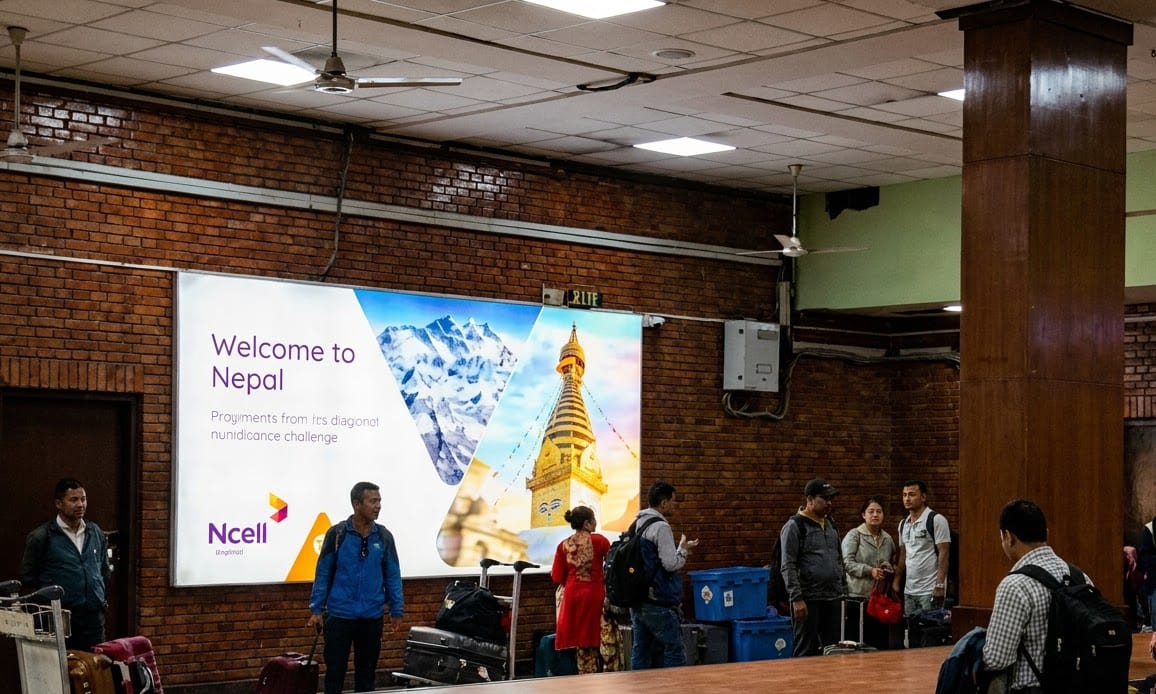
Kathmandu's Tribhuvan International Airport is one of the most commercially distinct airport environments in Asia. It serves two fundamentally different audience streams simultaneously — and both are commercially extraordinary in different ways. The first is the inbound stream: adventure tourists, mountaineers, trekkers, spiritual pilgrims, and cultural travellers who have spent months planning journeys to one of the world's most aspirationally unique destinations, arriving at KTM with pre-committed premium spending and deep emotional investment in their experience. The second is the outbound stream: Nepali migrant workers departing to Qatar, the UAE, Saudi Arabia, Kuwait, Malaysia, and beyond — and students leaving for Australia, the United Kingdom, and Europe — who carry the most financially motivated travel intent of any departure audience in South Asia.
In 2024, the airport recorded a historic 4.96 million international passengers — nearly five times the one million it handled in 2000 — with growth driven equally by tourism recovery, an accelerating wave of outbound migration, and surging student travel. International passenger traffic grew 9.3% year-on-year, averaging 13,598 international travellers per day. In 2025, KTM crossed five million international passengers for the first time, setting another all-time record. This is Nepal's sole international airport, and there is no alternative gateway for any passenger entering or leaving the country by air. Every dollar of Nepal's $11 billion annual remittance economy — representing 26.6% of GDP and making Nepal one of the world's top ten remittance-receiving nations — flows through the human channel that passes through this terminal.
The airport's significance extends far beyond its passenger volume. KTM is the starting point for all Everest Base Camp treks, all Annapurna circuit expeditions, all Himalayan mountaineering permits, and all approaches to eight of the world's fourteen peaks above 8,000 metres — all of which are located in Nepal. Every serious mountaineer on earth arrives and departs through a single terminal with a single tabletop runway on the edge of the Kathmandu Valley.


Advertising Value Snapshot
- Passenger scale: 5 million+ international passengers (2025, all-time record); 4.96 million in 2024, growing at 9.3% year-on-year, nearly five times the airport's 2000 passenger count
- Traveller type: Premium-spending international trekkers and mountaineers, Gulf and Malaysian-bound migrant workers and their families, Nepali student travellers, spiritual and pilgrimage tourists, South Asian business travellers, and Himalayan adventure tourism operators
- Airport classification: Tier 2 — Nepal's sole international gateway with a bifurcated audience of extremely high-spending inbound tourists and one of the world's most financially motivated outbound migration and diaspora communities
- Commercial positioning: The only commercial entry point for the world's premier adventure tourism destination, the birthplace of Buddha, and the Himalayan spiritual heartland — combining extraordinary inbound tourism spending potential with a massive outbound remittance and financial services market
- Wealth corridor signal: KTM sits at the intersection of the Gulf-South Asia labour migration corridor — the world's highest-volume remittance flow from a developing nation — and the global adventure tourism premium spending pipeline that delivers high-income travellers from North America, Europe, Australia, and East Asia to the Himalayas
- Advertising opportunity: Masscom Global provides brands with access to a unique dual-audience environment where inbound travellers carry pre-committed adventure, wellness, and cultural spending, and outbound Nepali passengers carry active financial services, telecommunications, and consumer goods purchasing intent. Neither audience is adequately served by current advertising in the terminal — making KTM one of South Asia's most commercially underutilised airport advertising environments.
Airport Advertising is Complex to Get Right
We help you execute faster, with proven results and local insight most planners lack starting now.
Talk to an ExpertCatchment Area and Economic Drivers
Top 10 Cities within 150 km — Marketer Intelligence
- Kathmandu (city proper): Nepal's capital with approximately 1.5 million city residents and 3.5 million in the broader valley — the centre of government, banking, tourism, education, and the Nepali diaspora's financial management. The highest-income urban consumer market in Nepal, home to the premium retail, hospitality, and service sector that caters to the international tourism economy.
- Lalitpur (Patan): Immediately adjacent to Kathmandu — home to the famous Patan Durbar Square and one of Nepal's finest concentrations of medieval Newari architecture and cultural heritage. A major destination for cultural and heritage tourists using KTM as their gateway and a significant artisan and craft economy that produces goods consumed by international visitors.
- Bhaktapur: A remarkably intact medieval city approximately 16 km east of Kathmandu, recognised as one of the best-preserved ancient cities in Asia — a UNESCO World Heritage Site that draws significant cultural tourism and generates premium heritage travel spending from international visitors.
- Kirtipur: An ancient Newar hilltop city adjacent to Kathmandu — home to Tribhuvan University, Nepal's largest educational institution, which generates significant outbound student travel demand through KTM.
- Dhulikhel/Kavrepalanchok: A scenic hilltop town approximately 30 km east of Kathmandu, increasingly popular for luxury eco-resorts, Himalayan view retreats, and wellness tourism that draws premium domestic and international travellers.
- Sindhuli: A scenic mid-hills district approximately 100 km southeast of Kathmandu, known for the increasingly popular cycling and adventure tourism corridor along the BP Highway — contributing a growing adventure recreation audience connecting through KTM.
- Hetauda: A provincial city approximately 80 km south of Kathmandu in Bagmati Province — a significant transit and industrial hub for southern Nepal, generating business and government professional travel through KTM.
- Dhading District (Gorkha corridor gateway): The western Kathmandu Valley approach district connecting the capital to the Gorkha and Manaslu trekking regions — a rural and agricultural corridor whose population relies on KTM for remittance travel and government connections.
- Nuwakot: A historic hill district approximately 75 km northwest of Kathmandu — a significant source of migrant labour to India and the Gulf, contributing to the outbound worker departure audience at KTM.
- Makwanpur (Hetauda corridor): An industrialising district to the southwest of Kathmandu connecting the Kathmandu Valley to the Terai plains — producing a dual audience of industrial workers seeking Gulf employment and domestic business professionals.
NRI and Diaspora Intelligence
Nepal's diaspora and migrant worker community is one of the most economically consequential in Asia relative to the home country's size. Over 3.5 million Nepalis — approximately 14% of the entire population — work abroad, primarily in the GCC states (Qatar, UAE, Saudi Arabia, Kuwait, and Oman), Malaysia, and India. In 2024, Nepal issued over 741,000 labour permits for overseas employment. The financial flows generated by this workforce — USD $11 billion in annual remittances, representing 26.6% of GDP — make Nepal one of the world's most remittance-dependent economies. Every migrant worker, student abroad, and their immediate family members conducting financial transactions, purchasing insurance, renewing communications contracts, or making remittance decisions does so at some intersection with the KTM terminal. The departing Gulf worker represents the single most financially motivated passenger in the airport — making a consequential personal and family investment decision about their own employment abroad. The returning worker arrives with savings, purchasing power, and active consumer intent to invest in home improvement, land, business, or family welfare.
Economic Importance
Nepal's economy is structurally unusual in ways that directly shape the KTM advertising environment. Tourism is the formal headline sector, contributing approximately 7-8% of GDP and sustaining hundreds of thousands of jobs in trekking, hospitality, transport, and services. But remittances at 26.6% of GDP completely dwarf tourism's formal contribution — and both of these flows pass through a single airport terminal. The interplay between these two economic engines at KTM creates an advertising environment unlike any other in South Asia: inbound tourists carrying premium discretionary spending, and outbound workers carrying the accumulated aspirations of entire family units for economic mobility.
Business and Industrial Ecosystem
- Tourism and hospitality (trekking agencies, expedition companies, hotels): Nepal's tourism economy employs an estimated 1.5 million people directly and indirectly — producing a substantial professional travel audience of tourism operators, trekking guides, hotel managers, and adventure company executives who connect to global trade fairs, training programmes, and supplier networks through KTM
- Remittance and financial services sector: Nepal's $11 billion annual remittance economy supports a dense ecosystem of money transfer operators, commercial banks, insurance companies, and financial advisory services — whose primary client acquisition moment is the KTM departure hall where migrant workers are making financial management decisions before departure
- Government and diplomatic services: Kathmandu is Nepal's capital and the seat of all federal government activity — generating a sustained flow of senior civil servants, diplomatic personnel, international NGO professionals, and development organisation staff connecting through KTM
- Education services (private schools, universities, coaching centres): Nepal's rapidly growing student outmigration — primarily to Australia, the United Kingdom, USA, and Canada — has created a large commercial ecosystem of IELTS and TOEFL coaching centres, visa consultancies, and international education agents whose clients are concentrated in the KTM departure audience
Passenger Intent — Business Segment: The business traveller at KTM operates across two distinct categories. The first is the international corporate and NGO professional — from development organisations (World Bank, UNDP, ADB), multinational companies, and the diplomatic community — who travels between Kathmandu and regional hubs including Delhi, Doha, Singapore, and Bangkok for institutional operations. The second, far more numerous, is the Nepali entrepreneur and commercial professional managing import businesses, trekking operations, or hospitality enterprises with international supplier relationships. Advertiser categories most relevant to these segments include banking and financial services, telecommunications, premium travel, and business technology solutions.
Strategic Insight: What makes the KTM business environment commercially distinctive is the convergence of three globally significant economic forces in a single terminal: the world's premier adventure tourism economy, one of the world's largest per-capita remittance flows, and a rapidly growing student emigration wave that is reshaping Nepal's demographic structure. For advertisers who understand that Nepal's economic psychology is oriented toward investment, mobility, and aspiration — rather than consumption for its own sake — KTM delivers an audience whose purchasing decisions carry extraordinary family and life consequence, and who are therefore receptive to brands that address fundamental needs for security, opportunity, and quality.
Tourism and Premium Travel Drivers
- Mount Everest and the Khumbu region: The world's most aspirationally charged trekking destination — drawing tens of thousands of trekkers annually to the Everest Base Camp route, with additional thousands pursuing technical climbing permits on Everest itself. Every single visitor to the Khumbu arrives and departs through KTM, having committed to multi-thousand-dollar expeditions, guiding fees, and premium equipment before departure
- Annapurna Circuit and Base Camp: The world's most celebrated trekking circuit, with the Annapurna Base Camp trek second only to Everest Base Camp in global recognition — drawing premium adventure travellers from North America, Europe, Australia, and East Asia who use Kathmandu as their base
- Pashupatinath Temple and Hindu pilgrimage circuit: Directly adjacent to Tribhuvan Airport — one of Hinduism's most sacred shrines, drawing hundreds of thousands of Hindu pilgrims annually from India, Southeast Asia, and the global Hindu diaspora. Pilgrims from India, Nepal, and the Indian diaspora consider Pashupatinath among their most significant lifetime religious obligations
- Boudhanath Stupa and Tibetan Buddhist circuit: One of the largest stupas in the world and the global centre of Tibetan Buddhist culture outside Tibet — drawing spiritual tourism from across East Asia, Europe, and North America, with a growing wellness retreat and Buddhist meditation tourism market centred on the Kathmandu Valley
- Lumbini — birthplace of the Buddha: Although 300 km west of Kathmandu, Lumbini's world significance as the birthplace of the Buddha makes it accessible through KTM with domestic connections — drawing Buddhist pilgrims from across East and Southeast Asia whose journey begins and ends at Tribhuvan
Passenger Intent — Tourism Segment: The inbound tourist at KTM has made one of the most deliberate travel commitments available in international tourism. Everest Base Camp trekkers typically budget $3,000-$10,000 for their Nepal experience. Technical mountaineering permit holders pay $11,000 per person for an Everest climbing permit alone. Annapurna Circuit trekkers arrive having booked guides, porters, accommodation, and equipment months in advance. By the time they collect their baggage at KTM, their spending commitment to Nepal is already made. What the departures hall advertising environment captures is the equally significant outbound purchase intent: trekking gear purchases, expedition insurance, travel retail, and the premium departure experience that these high-spending travellers expect.
Travel Patterns and Seasonality
Peak seasons:
- September to November (Autumn Trekking Peak): The single busiest period in Nepal's tourism calendar — post-monsoon skies are clear, temperatures are ideal, and the Himalayan peaks are at their most visually dramatic. Everest Base Camp and Annapurna treks are booked to full capacity. September marks the Dashain festival season — the most important Hindu festival in Nepal — generating peak domestic and diaspora family travel. October is Nepal's single busiest tourism month.
- March to May (Spring Trekking Season): The second peak for Himalayan tourism — rhododendron forests in bloom, pre-monsoon clear conditions, and the primary mountaineering expedition season when Everest and the major peaks accept climbers. The spring mountaineering season generates the highest per-person spending of any tourism window in Nepal.
- December to January (Holiday Travel and Tibetan New Year): Christmas and New Year generate significant leisure travel from Western markets. Tibetan Losar celebrations draw Buddhist pilgrims to the Kathmandu Valley's monasteries. The Gulf Nepali diaspora begins its annual return visits for the winter holiday window.
- June to August (Monsoon Season): The lowest tourism traffic period due to heavy rains and restricted mountain visibility — however, outbound migrant worker departures remain consistent year-round, and domestic cultural and religious travel continues through the monsoon.
Event-Driven Movement
- Dashain Festival (September/October): Nepal's most important festival — a 15-day Hindu celebration of Durga's victory over evil that drives the year's largest single domestic travel surge as Nepalis across the world return home. Diaspora members from Qatar, Dubai, Malaysia, and further afield book KTM flights months in advance for Dashain, creating the year's highest-concentration returning migrant and diaspora audience at the airport
- Tihar / Deepawali (October/November): Nepal's festival of lights, immediately following Dashain — a five-day celebration that sustains the diaspora return travel wave and generates significant consumer goods and gifting expenditure
- Buddha Jayanti (May): The globally celebrated birthday of the Buddha, drawing Buddhist pilgrims from across East and Southeast Asia to Lumbini, Boudhanath, and the Kathmandu Valley monasteries — creating a concentrated inbound Asian Buddhist pilgrimage audience at KTM
- Indra Jatra (September, Kathmandu): The spectacular festival of the living goddess Kumari, with chariot processions through Kathmandu's ancient squares — drawing domestic and international cultural tourism in the pre-Dashain window
- Everest Spring Expedition Season (April-May): The annual window when mountaineering teams from across the world converge on Kathmandu before helicopter transfers and trekking approaches to Everest Base Camp — producing a concentrated premium adventure and expedition audience

It’s Not Just Where You Advertise - It’s How Fast You Execute
We combine local insight with fast rollout to deliver results for you, now.
Talk to an ExpertAudience and Cultural Intelligence
Top 2 Languages
- Nepali: The official national language and the first language of the majority of Nepali nationals transiting through KTM — essential for all advertising targeting the outbound migrant worker, student, and domestic traveller audience. Nepali-language advertising carries authenticity and cultural credibility that English alone cannot achieve with the working-class migration audience.
- English: The language of international tourism, NGO operations, diplomatic activity, and the educated professional class — essential for all advertising targeting the inbound tourism audience, the international business and NGO professional segment, and the younger educated Nepali professional population.
Major Traveller Nationalities
KTM's international traffic is a genuinely global mix reflecting Nepal's position at the intersection of multiple global economic and spiritual currents. Indian nationals represent the largest single foreign traveller group, with IndiGo and Air India collectively dominating the Delhi and Mumbai routes. Qatari and Gulf-routed travellers — both Nepali migrant workers and international tourists connecting through Doha and Dubai — form the second major group. Chinese visitors, connecting through Air China, China Eastern, Sichuan Airlines, and other carriers, represent a rapidly growing segment connected to both Buddhist pilgrimage tourism and trekking interest. Western European, North American, and Australian tourists — arriving via Doha, Dubai, Istanbul, Bangkok, and Singapore — form the premium adventure tourism core. Korean and Japanese visitors are among the highest-spending Asian tourism groups at KTM, with strong mountaineering and cultural tourism traditions connecting them to Nepal.
Religion — Advertiser Intelligence
- Hinduism (approx. 81%): Nepal is the world's only nation with Hinduism as a historical state religion — and its Hindu cultural identity shapes the Nepali traveller's entire commercial calendar. Dashain and Tihar are the two most commercially significant festivals, creating the year's peak in travel, gifting, consumer goods purchasing, and family financial transfers. Pashupatinath Temple, adjacent to the airport, is one of Hinduism's most sacred sites — making religious pilgrimage a structurally significant component of KTM's inbound tourism. Brands connected to festival, gifting, family welfare, and prosperity resonate deeply with the Hindu majority.
- Buddhism (approx. 9%): Nepal's Buddhist community, concentrated in the Kathmandu Valley among the Newar and Tamang communities, and reinforced by the massive Tibetan Buddhist cultural presence centred on Boudhanath, creates a significant pilgrimage tourism segment drawing visitors from across East and Southeast Asia. The Buddhist pilgrimage circuit — Lumbini, Boudhanath, Swayambhunath — generates a concentrated, spiritually motivated inbound audience with active spending on religious items, guided tours, meditation retreats, and cultural experiences.
- Islam (approx. 5%): A growing community, partly connected to Nepal's increasing migration to Gulf states, whose Eid celebrations and Ramadan observance create secondary seasonal travel peaks and whose financial needs — particularly for halal-compliant financial products and transfer services — represent a commercially relevant niche at KTM.
Behavioral Insight
The KTM audience operates at two emotional frequencies that are commercially opposite but equally powerful. The inbound adventure tourist is in a state of elevated aspiration and experiential openness — they have crossed the world to pursue a dream, and their spending behaviour reflects a "once in a lifetime" psychological framing that makes them receptive to premium positioning and emotional brand storytelling. The outbound migrant worker is in a state of deep family responsibility — departing to sacrifice years of proximity to family in exchange for financial security. Their purchasing decisions at the airport reflect duty, love, and pragmatic investment rather than aspiration. Both audiences respond to brands that take their purpose seriously. Neither responds to frivolity. Advertising at KTM that speaks to the weight of the journey — in either direction — achieves recall rates that casual brand awareness campaigns cannot match.
Outbound Wealth and Investment Intelligence
The outbound passenger at Kathmandu Airport carries one of the most consequential financial profiles of any departing passenger in South Asia. A Nepali worker departing to Qatar or Dubai is not leaving for a holiday — they are executing a multi-year economic plan for their family. A student departing for Melbourne or London has committed their family's life savings to an international education. A returning worker arriving at KTM after two years in Riyadh carries savings that will define the trajectory of their family's next decade. The financial intensity of these journeys creates one of the most commercially receptive audiences for financial services, telecommunications, insurance, and investment products of any airport in Asia.
Outbound Real Estate Investment:
Nepal's remittance economy directly funds one of the most active domestic real estate investment patterns in South Asia. Kathmandu's real estate market has been fundamentally shaped by remittance capital — with land and property purchases in Kathmandu, Pokhara, and provincial towns being the primary investment destination for returning Gulf and Malaysian workers. International real estate investment remains nascent but is growing among Nepal's increasingly globally exposed professional class — particularly among students returning from Australia and the UK with professional incomes and international investment awareness.
Outbound Education Investment:
Nepal's student emigration has accelerated dramatically — with Australia, the United Kingdom, the United States, Canada, Germany, and Japan being the primary destinations. In 2024, the acceleration of student departures was a primary driver of KTM's passenger growth. Families committing children to international education at KTM's departures hall have already spent years saving for tuition deposits and initial living costs — they represent a captured audience for the full ecosystem of international education services, forex, insurance, and student banking.
Outbound Wealth Migration and Residency:
Nepal's rapidly growing professional class, particularly those returning from international education and employment, is increasingly exploring permanent residency options in Australia, Canada, and Europe. The outbound KTM audience from this segment carries active interest in immigration consultancy services, international banking products, and residency pathway programmes. This is not a high-volume category at KTM but it is one of the highest-value per-passenger categories in the departures hall — educated, aspirational Nepalis in their 20s and 30s making consequential long-term decisions about where to build their lives.
Strategic Implication for Advertisers:
For financial services brands serving the Nepal-Gulf remittance corridor, international education service providers, insurance companies covering overseas workers and students, telecommunications companies offering international SIM and roaming packages, and adventure and outdoor equipment brands targeting the inbound trekking audience, KTM represents one of South Asia's highest-concentration, highest-intent captive audiences. Masscom Global's access to the KTM advertising environment allows brands to activate with the audience intelligence and creative precision that this uniquely bifurcated market demands — reaching both the departing worker and the arriving adventurer with messaging that respects the gravity of their respective journeys.
Airport Infrastructure and Premium Indicators
Terminals
- Tribhuvan International Airport operates a single international terminal and a separate domestic terminal connected by a shuttle service — with the international terminal serving all 32 international airlines and the domestic terminal handling Nepal's extensive internal network to Lukla, Pokhara, Biratnagar, Nepalgunj, and 40+ regional airstrips.
- The airport's single runway (02/20) was extended to 3,350 metres in 2020 and the departure hall was expanded to accommodate 1,500 additional passengers. A parallel taxiway construction project commenced in November 2024, with completion expected by end-2026 — which, upon completion, will substantially increase aircraft movements and passenger handling capacity.
- The airport sits at 4,390 feet above sea level, with a tabletop runway approach that requires special pilot certification — a distinctive operational characteristic that contributes to the airport's atmospheric character and limits its maximum aircraft category.
Premium Indicators
- Radisson Hotel Executive Lounge: The Radisson Hotel Kathmandu operates an executive lounge serving first and business class passengers of multiple airlines — a premium environment signal for the high-value inbound tourism audience
- Thai Airways Royal Thai Silk Lounge: A dedicated premium lounge for Thai Airways business class passengers and Star Alliance Gold card holders — a clear indicator of the premium carrier audience transiting through KTM
- Duty-free and commercial retail: The international terminal has duty-free shops, cafes, and banking services in the departures area — a commercial ecosystem serving the mixed tourist and migrant worker audience
- Proximity to Pashupatinath Temple (1 km): The airport's direct adjacency to one of Hinduism's most sacred sites is both a cultural context signal and a practical tourism asset — many inbound visitors visit the temple on their final morning before departure, creating a concentrated devotional and emotional state among departing international tourists
- Gateway to 10 UNESCO World Heritage Sites: Nepal hosts ten UNESCO World Heritage Sites — seven of which are within the Kathmandu Valley, all accessible through this airport. No other airport of comparable passenger scale sits at the centre of such a concentration of world heritage tourism demand.
Forward-Looking Signal
Tribhuvan Airport is approaching a capacity inflection point that will substantially change its commercial character. The parallel taxiway project completing in 2026 will increase daily flight movements, enabling more airlines and more frequency on existing routes. The Civil Aviation Authority of Nepal has plans for terminal expansion to accommodate the airport's trajectory toward 7+ million annual international passengers. The broader Nepal aviation context — Gautam Buddha International Airport in Lumbini and Pokhara International Airport having opened, but both serving limited routes — means that KTM will remain the dominant international gateway for all practical purposes for the foreseeable future. For advertisers, the period ahead of the capacity expansion is the optimal window to establish brand presence at the existing cost and competitive clutter levels — before increased route additions, terminal improvements, and audience growth create a more contested advertising environment.
Airline and Route Intelligence
Top Airlines at KTM (2024 passenger volumes)
- Qatar Airways — 596,060 passengers (top carrier, connecting Kathmandu to global network via Doha)
- Nepal Airlines — 560,108 passengers (flag carrier)
- IndiGo — 461,167 passengers (India's largest low-cost carrier)
- Air India — 411,125 passengers (India's full-service national carrier)
- FlyDubai — 351,670 passengers (low-cost Gulf connection)
- Air Arabia — 226,317 passengers (35.2% YoY growth)
- Thai Airways — 200,996 passengers (resumed November 2023)
- Jazeera Airways (Kuwait) — 137,352 passengers
- Turkish Airlines, Emirates, Singapore Airlines, Korean Air, Cathay Pacific, Malaysia Airlines, Kuwait Airways, SriLankan Airlines, Himalaya Airlines, Sichuan Airlines, China Eastern, China Southern, Bhutan Airlines, Drukair, Biman Bangladesh
Key International Routes
- KTM — Doha (Qatar Airways, multiple daily — top carrier, connects to global network)
- KTM — Delhi, Mumbai (IndiGo, Air India, multiple daily — highest frequency corridor)
- KTM — Dubai (FlyDubai, Emirates — Gulf migrant and tourism corridor)
- KTM — Sharjah, Kuwait, Muscat, Riyadh, Bahrain (Air Arabia, Jazeera, Oman Air, Saudia — Gulf migrant worker primary routes)
- KTM — Bangkok, Kuala Lumpur (Thai Airways, Thai AirAsia, Batik Air, Malaysia Airlines — Southeast Asia leisure and migration)
- KTM — Istanbul (Turkish Airlines — Europe connection hub)
- KTM — Singapore (Singapore Airlines, Scoot — Southeast Asia premium leisure)
- KTM — Hong Kong, Seoul, Beijing, Guangzhou, Chengdu (Cathay Pacific, Korean Air, Air China, China Eastern, Sichuan Airlines — East Asia tourism and Chinese pilgrim/trekking market)
Wealth Corridor Signal
The route network at KTM tells the complete story of Nepal's dual economic identity. The Gulf routes — Doha, Dubai, Sharjah, Kuwait, Muscat, Riyadh, Bahrain — collectively constitute the remittance economy in physical form. Every departure on these routes carries outbound workers; every arrival brings returnees with savings. The Delhi corridor is the highest-frequency route and serves the full spectrum from business and diplomatic travel to low-cost tourism. The Bangkok, Kuala Lumpur, and Singapore routes carry both Southeast Asian trekking tourists and the outbound Malaysian migrant corridor. The Istanbul route provides Nepal's connection to European leisure travellers who transit through the Gulf's global hub networks. The East Asian routes — Seoul, Tokyo, Hong Kong, Beijing — carry premium adventure tourists, Buddhist pilgrims, and the growing Chinese trekking market.
Media Environment at the Airport
- KTM's single-terminal international building creates absolute audience concentration — every international passenger from check-in through immigration to the departures hall and boarding gate shares a common environment. There is no terminal fragmentation, no alternative circulation path, and no secondary passenger zone that diverts audience attention from advertising placements
- The airport's operational character — with morning fog delays, seasonal weather disruptions, and the concentrated activity of a high-volume single-runway facility — creates structurally extended dwell times that significantly elevate advertising exposure duration. Passengers at KTM wait, and they engage with the terminal environment while waiting
- The adjacent Pashupatinath Temple creates a distinctive pre-departure emotional context for many outbound international tourists — who have visited the temple on their final morning in Nepal — making them receptive to travel retail, adventure brand, and experiential product advertising that resonates with the spiritual intensity of their Nepal experience
- Masscom Global's regional South Asia inventory access and execution capability enables brands to activate at KTM with the operational precision and cultural intelligence that most international media planners cannot achieve independently in Nepal's distinctive commercial environment
Strategic Advertising Fit
Best Fit
- Adventure and trekking equipment brands: The inbound adventurer at KTM has arrived with specific equipment needs for high-altitude conditions — and the departures audience is reviewing their experience and considering upgrades for future expeditions. Outdoor and trekking brands including apparel, footwear, backpacks, navigation, and safety equipment find a globally self-selected premium adventure audience
- Remittance and international financial services: The single most commercially motivated audience in the terminal is the outbound migrant worker making financial management decisions. Banks offering remittance services, digital money transfer platforms, insurance products, and financial planning services for overseas workers find a captive, needs-driven audience with immediate purchasing intent
- International education and student services: IELTS preparation services, university recruitment, student banking, and visa consultancy brands find a student travel audience that is simultaneously the largest-growth demographic at KTM and the highest-spending education investment household in Nepal
- Telecommunications and international SIM/roaming: Every departing worker, student, and family member faces an immediate and high-priority need for international connectivity — making telecommunications brands one of the highest-purchase-intent categories in the departures hall
- Premium travel insurance and health services: Both outbound migrant workers and inbound adventure tourists require comprehensive travel insurance — the migrant for overseas employment coverage, the trekker for altitude evacuation coverage. KTM's pre-departure environment is where these purchasing decisions are finalised
- Spiritual and wellness tourism brands: The concentrated Buddhist and Hindu pilgrimage audience at KTM — particularly visible in the arrivals hall as inbound pilgrims from India, East Asia, and the global diaspora arrive — creates a captive market for meditation, wellness retreat, and spiritual tourism products
Brand Alignment at a Glance
| Category | Fit |
|---|---|
| Adventure and trekking equipment | Exceptional |
| Remittance and financial services | Exceptional |
| International education and student services | Exceptional |
| Telecommunications | Strong |
| Travel insurance and health | Strong |
| Spiritual and wellness tourism | Strong |
| Luxury consumer goods | Moderate |
Who Should Not Advertise Here
- Mass market domestic consumer brands without Nepal distribution: Consumer brands that have no physical retail presence in Nepal will not achieve meaningful conversion from airport advertising, as the audience has no access pathway to purchase
- Highly urbanised Western lifestyle brands without Asian market relevance: Premium Western lifestyle brands that have no resonance with Nepal's cultural context or the aspirations of the migrant worker and student audiences will not achieve conversion among the majority of the terminal's passenger base
- Categories dependent on high passenger volume at low cost-per-impression economics: KTM's passenger volumes, while significant by South Asian standards, do not support mass-reach campaign economics for categories that require millions of impressions to generate commercial return
Event and Seasonality Analysis
- Event Strength: Exceptional
- Seasonality Strength: High
- Traffic Pattern: Dual-Peak with year-round migration baseline (autumn trekking and Dashain peak; spring climbing and trekking season; stable outbound migration year-round)
Strategic Implication: The October-November window — combining the autumn trekking peak with Dashain/Tihar festival diaspora return travel — is the single highest commercial yield period at KTM. This window delivers inbound premium adventure tourists, returning Gulf diaspora members with savings and consumer intent, and the maximum cultural and emotional engagement of the Nepali calendar simultaneously. The March-May spring window is the second-highest-value period for adventure and expedition brands, when mountaineering expedition participants — carrying some of the highest per-person spending of any tourism category in Nepal — transit through the terminal. For financial services and student education brands, September is the critical window when the academic year departure surge creates the year's highest concentration of outbound student travellers. Masscom structures KTM campaigns to capture each of these distinct audience peaks with appropriate creative executions — ensuring that the adventure brand, the remittance service, and the student visa consultancy each reach their most commercially motivated audience at their moment of maximum intent.

Poor Placement and Delays Affect Airport Campaigns
We help you move faster, access better inventory, and get it right now.
Talk to an ExpertFinal Strategic Verdict
Kathmandu Tribhuvan International Airport is the most commercially distinctive Tier 2 airport in South Asia — the only gateway to the world's Himalayan heartland, the sole exit point for one of the world's highest-remittance economies, and the terminal through which more aspiration per passenger flows than almost any other airport of its scale on earth. The inbound adventure tourist arriving at KTM has committed their life savings to a dream. The outbound migrant worker has staked their family's future on a departure. The student leaving for Australia or the UK has made the most consequential educational investment of their household. None of these passengers pass through the terminal casually. For adventure equipment brands, financial services providers, international education platforms, telecommunications companies, insurance products, and spiritual tourism brands, KTM delivers a commercially engaged, purpose-driven, emotionally activated audience in a single-terminal environment where every advertising placement achieves complete exposure. Masscom Global provides the regional access, cultural intelligence, and execution capability to activate this extraordinary commercial environment with the precision and speed it deserves.
About Masscom Global
Masscom Global is a premium international airport advertising and media buying agency operating across 140 countries. With deep expertise in airport OOH, premium publications, and high-net-worth audience targeting, Masscom helps brands reach the world's most valuable travellers at the moments that matter most. For advertising packages, media rates, and campaign planning at Tribhuvan International Airport and airports across the globe, contact Masscom Global today.
Frequently Asked Questions
How much does airport advertising cost at Tribhuvan International Airport? Advertising costs at KTM vary based on format, placement zone within the terminal, campaign duration, and seasonal demand — with the October-November Dashain-trekking peak and the March-May spring expedition season commanding premium rates. As Nepal's sole international airport with a growing private commercial investment profile, KTM's advertising inventory covers formats from static display to digital screens. Contact Masscom Global for current availability, format recommendations, and a cost proposal tailored to your brand objectives and target audience segment.
Who are the passengers at Tribhuvan International Airport? KTM serves a genuinely bifurcated international audience. Inbound passengers are predominantly international adventure and trekking tourists from North America, Europe, Australia, and East Asia — plus Buddhist and Hindu pilgrims, NGO and development sector professionals, and South Asian business travellers. Outbound passengers are predominantly Nepali migrant workers departing to Gulf states and Malaysia, students leaving for international education, and Nepali professionals travelling for business. Qatar Airways (596,060 passengers) leads the international carriers, followed by Nepal Airlines, IndiGo, Air India, FlyDubai, and Air Arabia — a carrier profile that reflects the full range of tourist, business, and migrant worker travel across South Asia, the Middle East, and global hub connections.
Is Tribhuvan International Airport good for luxury brand advertising? KTM offers selective luxury brand opportunities in specific categories. Standard international luxury fashion and European premium lifestyle brands find limited audience alignment among the terminal's predominantly adventure, migration, and student travel audience profile. However, premium adventure categories — expedition-grade outdoor equipment, luxury eco-lodge and retreat brands, and high-end mountaineering gear — find a globally self-selected premium audience at KTM that outspends comparable luxury brand consumers in any other regional airport context. For luxury brands whose category intersects with adventure, nature, or spiritual experience, KTM delivers an aspirationally engaged premium audience that no other South Asian airport can replicate.
What is the best airport in Nepal to reach international trekking and adventure tourists? Tribhuvan International Airport KTM is the only commercially viable answer. Every international trekker, mountaineer, and adventure tourist entering Nepal arrives through KTM — there is no alternative commercial international gateway. Pokhara International Airport, while open since 2023, currently offers limited international routes and handles a fraction of KTM's volume. For adventure and trekking brands seeking access to the global Himalayan adventure tourism market, KTM is structurally the exclusive access point.
What is the best time to advertise at Tribhuvan International Airport? October and November deliver the highest combined commercial value — merging the autumn trekking peak with Dashain and Tihar diaspora return travel and post-monsoon optimal weather conditions. March to May delivers the spring expedition season's premium mountaineering audience alongside the Annapurna trekking surge. For financial services and student education brands, September is the critical outbound student departure window. For Gulf remittance brands, year-round presence is advisable given the consistent monthly rhythm of migrant worker departures. Masscom recommends investing across October-November as the primary window and March-May as the secondary window for most advertising categories at KTM.
Can international real estate developers advertise at Tribhuvan International Airport? Yes — with important nuance about audience calibration. Domestic Nepal real estate developers find the most commercially relevant audience at KTM among returning Gulf workers arriving with savings earmarked for property investment in Kathmandu, Pokhara, and their home districts. International real estate developers targeting the Nepali professional diaspora in Australia, UK, and North America will find a smaller but growing outbound audience of educated professionals considering investment property in their destination countries. For developers in Nepal's own hospitality and eco-resort sector targeting inbound adventure tourists, KTM's arrivals hall provides access to the highest-spending real estate experiential consumer in Nepal's tourism economy.
Which brands should not advertise at Tribhuvan International Airport? Mass market Western consumer goods without Nepal distribution, highly urbanised European lifestyle brands with no South Asian market relevance, and volume-dependent awareness campaigns that require millions of impressions for commercial return are poor matches for KTM's current audience scale and profile. Consumer brands without retail distribution in Nepal will not convert airport advertising awareness into purchase behaviour regardless of creative quality. Masscom can advise on the right South Asian and global airport portfolio configuration for any campaign objective.
How does Masscom Global help brands advertise at Tribhuvan International Airport? Masscom Global provides complete campaign management at KTM — from audience intelligence and cultural context analysis through to media buying, format selection, creative compliance for Nepal's regulatory environment, local coordination, and performance reporting. Our understanding of the airport's bifurcated audience — inbound adventure tourists and outbound migrant worker and student travellers — allows us to structure campaigns that speak meaningfully to both segments simultaneously or to target specific audience windows with precision. We manage every element from brief to live placement, ensuring your brand appears in the environments where it achieves maximum engagement with the audiences most commercially valuable to your category. Contact Masscom Global today to begin planning your campaign at Tribhuvan International Airport.