


Airport at a Glance
| Field | Detail |
|---|---|
| Airport | Kotoka International Airport |
| IATA Code | ACC |
| Country | Ghana |
| City | Accra |
| Annual Passengers | 3.6 million international (2023–24) |
| Primary Audience | Oil and mining executives, pan-African financial services professionals, Ghanaian diaspora returnees, African American heritage investors |
| Peak Advertising Season | June–August, November–January |
| Audience Tier | Tier 1 |
| Best Fit Categories | International real estate, financial services, luxury consumer brands, international education, pan-African B2B platforms |
Accra Kotoka International Airport is the commercial entry point to West Africa's most consistently reliable economy. While the wider region has been periodically disrupted by political instability, currency crises, and security concerns, Ghana has maintained democratic governance, rule of law, and a business environment that consistently ranks among the best in sub-Saharan Africa. This stability is not incidental to the airport's advertiser value — it is the core of it. The traveller at ACC is not simply a Ghanaian passenger. They are the executive class of a region that has designated Accra as its most trusted operational base, the diaspora community that has chosen Ghana as its preferred African home, and the international investor who has made West Africa's most predictable economy their first destination on the continent.
Ghana's economy is built on three pillars of genuine wealth generation: gold — Ghana is Africa's largest gold producer — offshore oil from the Jubilee, TEN, and Sankofa fields, and a rapidly maturing financial services and technology sector anchored in Accra. The individuals who own, manage, and invest in these sectors are the dominant audience at ACC. They travel to London, New York, Amsterdam, and Dubai to manage assets, close deals, and deploy capital — and they return through this terminal carrying investment decisions and spending intent that advertisers in multiple premium categories can intercept at the most commercially receptive moment.
Advertising Value Snapshot
- Passenger scale: 3.6 million international passengers annually, with growth driven by expanding Gulf route frequency, growing African American heritage tourism, and Ghana's increasing role as the preferred West Africa regional hub for multinational corporations
- Traveller type: Oil and gas industry executives, gold and mining sector principals, pan-African banking and financial services professionals, Ghanaian diaspora returnees from the UK and USA, and African American heritage and investment tourists
- Airport classification: Tier 1 — West Africa's premier stable gateway and the preferred regional base for international corporations managing multi-country West Africa operations from a single Accra headquarters
- Commercial positioning: The operational hub of West Africa's wealthiest natural resource economy, the diaspora magnet of the continent's most successful homeland reconnection campaign, and the B2B centre of gravity for the region's most internationally credentialed financial services sector
- Wealth corridor signal: ACC sits at the intersection of the West Africa–UK wealth corridor — the most established diaspora remittance and investment route in the region — and the rapidly deepening West Africa–Gulf investment corridor driven by Emirati and Saudi sovereign fund interest in Ghanaian infrastructure and real estate
- Advertising opportunity: Masscom Global provides premium placement access across ACC's Terminal 3 international facility, with campaign strategy calibrated to diaspora summer return peaks, oil industry travel cycles, and the pan-African financial services conference calendar that concentrates West Africa's business elite at this terminal
Airport Advertising is Complex to Get Right
We help you execute faster, with proven results and local insight most planners lack starting now.
Talk to an ExpertCatchment Area and Economic Drivers
Top 10 Cities within 150 km — Marketer Intelligence
- Accra: Ghana's capital and economic engine — home to the Ghana Stock Exchange, the headquarters of every major Ghanaian and international bank operating in West Africa, the regional Africa offices of multinational oil companies, and a rapidly expanding fintech and professional services sector whose combined output generates a resident HNWI class with documented cross-border investment and luxury spending behaviour
- Tema: Ghana's primary industrial port city 25 km from Accra, processing the vast majority of the country's seaborne trade — its shipping agents, customs brokers, cold-chain logistics operators, and port-adjacent manufacturing executives represent a first-generation business wealth segment whose international trade activity routes through ACC for London, Amsterdam, and Dubai connections
- Kasoa: A rapidly growing satellite city of Accra whose real estate development boom has created a new class of property developers, construction entrepreneurs, and middle-market business owners whose aspirational spending behaviour and growing disposable income make them an emerging premium consumer audience at ACC
- Koforidua: The capital of Ghana's Eastern Region and a significant gold trading hub, whose jewellery merchants, small-scale mining operators, and commodity traders transit ACC for connections to Dubai's gold souk and Antwerp's diamond market — a niche but commercially concentrated wealth segment with strong luxury goods and financial product appetite
- Nsawam: A peri-urban processing town north of Accra hosting canning and food processing industries — its business owners and factory managers represent a catchment audience for B2B financial and technology products increasingly integrated into Accra's commercial ecosystem
- Cape Coast: Ghana's historical capital and a UNESCO World Heritage slave fort city, whose cultural heritage generates a sustained inbound flow of African American diaspora and heritage tourists — the outbound tourism operators, hospitality business owners, and cultural economy professionals of Cape Coast use ACC as their international gateway for tour operator networks in the USA and UK
- Winneba: A coastal university and fishing town with a growing hospitality economy — its university professionals and coastal tourism operators represent a secondary catchment audience for educational and financial brand advertising at ACC
- Swedru: A commercial market town in the Central Region with strong trading community ties to Accra's Makola Market ecosystem — its traders represent the upwardly mobile Ghanaian merchant class whose purchasing behaviour is driven by aspirational brand exposure accumulated through Accra
- Suhum: An agricultural town in Ghana's Eastern Region with cocoa and oil palm processing — its commodity business owners represent a landed agricultural wealth segment whose international exposure is growing through commodity export relationships in Europe and Asia
- Saltpond: A coastal Central Region town with fishing, salt production, and growing real estate development — its business community represents a peri-coastal HNWI emerging segment whose property and investment activity increasingly routes through Accra's financial services infrastructure
NRI and Diaspora Intelligence
Ghana's diaspora community of approximately 4 to 5 million people is distributed across the United Kingdom — where the Ghanaian community is the third-largest African national group — the United States, Canada, Germany, the Netherlands, and Italy. The UK-Ghana corridor is the dominant remittance and return investment pipeline, with Ghanaian-British professionals and business owners sending over USD 4 billion home annually and investing actively in Accra's real estate, hospitality, and agricultural sectors. The African American engagement with Ghana is commercially distinct from conventional diaspora patterns — driven by the government's Year of Return initiative in 2019 and the ongoing Beyond the Return programme, tens of thousands of African Americans have visited, invested in property, started businesses, and in some cases obtained Ghanaian citizenship by descent. At ACC, both the UK diaspora returnee and the African American heritage investor arrive with substantial purchasing intent — shaped by years of premium market exposure in Western cities — making them a high-conversion audience for real estate, financial services, luxury consumer, and lifestyle brand advertising.
Economic Importance
Ghana's economy is structurally unique in West Africa because its wealth generation rests on three independently robust pillars that do not rise and fall together. Gold mining contributes approximately 6 percent of GDP and generates consistent export revenue through a commodity cycle that has remained strong. Offshore oil production from the Jubilee, TEN, and Sankofa fields generates a petroleum revenue stream that has funded infrastructure development and attracted a permanent community of international oil company executives to Accra. The financial services sector — anchored by a well-regulated banking system, a functioning stock exchange, and a growing insurance and pension fund industry — creates a professional wealth class whose international connectivity and cross-border investment behaviour is more comparable to a Southern African financial centre than a conventional West African economy. For advertisers, this three-pillar economy produces three distinct HNWI audience types at a single airport — commodity wealth, petroleum executive wealth, and professional financial services wealth — each with different spending triggers but all routing their international travel through ACC.
Business and Industrial Ecosystem
- Oil and gas sector: International petroleum companies — including BP, ENI, Tullow Oil, and Aker Energy — operate their Ghana offshore field management from Accra headquarters, generating a permanent community of expatriate and Ghanaian senior executives whose international travel through ACC connects to Aberdeen, Houston, Stavanger, and London — a high-frequency, high-income business travel segment with strong financial product, premium hospitality, and technology brand appetite
- Gold and mining industry: Ghana's gold mining sector — anchored by Newmont, Gold Fields, AngloGold Ashanti, and a large formal and informal artisanal sector — produces senior mine management, commodity trading, and financial structuring professionals who travel through ACC to London, New York, Zurich, and Dubai for capital markets activity, equipment sourcing, and investor relations — a specialist HNWI travel segment whose route patterns precisely map the global gold finance ecosystem
- Banking and financial services: Ghana's banking sector has consolidated significantly, producing a small number of large, well-capitalised institutions — including Ecobank, Absa Ghana, Standard Chartered Ghana, and Fidelity Bank — whose senior management teams travel internationally for correspondent banking, capital raising, and regulatory engagement, generating a financial sector executive audience at ACC with above-average brand sophistication
- Technology and fintech: Accra's technology ecosystem — home to mPharma, Zeepay, Hubtel, and a growing cohort of pan-African fintech startups — has positioned Ghana as the preferred tech hub for foreign venture capital entering West Africa, generating a sustained flow of Silicon Valley, London, and Israeli investors through ACC whose dwell time represents a premium B2B technology brand engagement window
Passenger Intent — Business Segment
The business traveller at ACC is executing one of three commercially distinct missions: managing Ghana's natural resource sector from an Accra operating base, building pan-African financial service networks from West Africa's most internationally credentialed banking hub, or deploying international capital into Ghana's real estate, technology, and agricultural sectors. All three profiles produce a traveller with above-average income, a clear international commercial purpose, and dwell time sufficient for substantive brand engagement. Premium financial technology, international real estate, business travel platforms, corporate banking products, and luxury goods advertising intercept this audience at the precise moment when their commercial intent is most activated.
Strategic Insight
ACC's business audience has a characteristic that is rarely matched in West African airports: it includes the regional headquarters class of multinational corporations that have deliberately chosen Ghana over Nigeria as their West Africa operational base. For companies managing operations across Côte d'Ivoire, Senegal, Cameroon, and Nigeria from a single regional hub, Accra's stability, English-language environment, rule of law, and quality of life for expatriate staff make it the preferred choice. This means the business traveller at ACC is not just managing a Ghanaian operation — they are managing West Africa from Ghana. The advertiser who reaches them at ACC is reaching the regional decision-maker for a geography of 400 million people, not just 33 million.
Tourism and Premium Travel Drivers
- Cape Coast Castle and Elmina Castle — UNESCO World Heritage slave forts: Ghana's Atlantic slave trade heritage sites are the primary driver of African American heritage tourism to the continent — generating an inbound traveller segment from the United States whose pre-committed trip spending is among the highest of any heritage tourism product in sub-Saharan Africa, and whose emotional receptiveness to identity-affirming brand messaging at ACC arrivals is distinctly high
- Mole National Park and wildlife tourism: Ghana's premier safari destination in the north draws premium wildlife tourists from Europe and North America who combine game viewing with coastal heritage experiences — an inbound leisure tourist whose ACC transit is the beginning of a high-spending Ghanaian itinerary
- Labadi Beach and Accra's luxury hospitality corridor: The Five-Star hotel corridor along Accra's Atlantic Coast — anchored by the Kempinski Gold Coast City, Movenpick Ambassador, and La Palm Royal Beach — serves both business and leisure travellers whose spending behaviour at the airport reflects pre-committed premium accommodation and entertainment expenditure
- Volta Region eco-tourism and Wli Waterfalls: A growing domestic and inbound eco-tourism segment whose operators use ACC for international tour operator relationships in Germany, the Netherlands, and the UK — a niche but growing premium leisure corridor generating inbound high-income European travellers through the airport
Passenger Intent — Tourism Segment
The inbound tourist arriving at ACC through the lens of Ghana's heritage and diaspora positioning is commercially distinct from conventional leisure tourists. The African American traveller coming for heritage engagement, citizenship consultation, or property investment has pre-committed to a high-spending itinerary and is emotionally primed for brand messages that speak to identity, belonging, and investment in Ghana. The European eco-tourist and premium safari traveller arrives with luxury accommodation and experience spend already committed. Both segments are receptive to premium retail, financial services, real estate, and lifestyle brand advertising at arrivals — making ACC's arrivals zone a commercially underutilised asset for categories that target these traveller types with genuine cultural intelligence.
Travel Patterns and Seasonality
Peak seasons:
- June–August (summer diaspora return): The UK and North American Ghanaian diaspora returns home en masse during school summer holidays — the single highest-volume diaspora travel window of the year at ACC, producing a concentrated, high-purchasing-intent audience that combines emotional homecoming receptiveness with spending power accumulated in Western premium markets
- November–January (Christmas and New Year diaspora peak): Ghana's most celebrated festive season draws the largest annual diaspora return across all communities — Ghanaian-British, Ghanaian-American, and Ghanaian-Dutch families return for Christmas, weddings, funerals, and the New Year's social calendar, producing the year's most brand-receptive family consumer audience window
- March–April (Easter and trade event season): Easter drives a secondary diaspora return peak alongside the Ghana-based corporate event calendar — a combined commercial and faith-motivated travel window with strong household, fashion, and consumer goods brand relevance
- October–November (investment and conference season): The Accra-based pan-African business conference calendar peaks in this period — Ghana Economic Forum, FinTech Festival, and a cluster of investment and property forums bring international capital allocators through ACC in concentration
Event-Driven Movement
- Ghana Economic Forum (October–November): Ghana's premier national investment forum attracts international business leaders, sovereign fund representatives, and bilateral development finance delegations — a concentrated B2B and institutional audience window at ACC whose delegate profile includes some of the highest-net-worth individuals to pass through the terminal in any given month
- Africa Fintech Festival and Ghana FinTech Forum (October): West Africa's leading financial technology conferences draw venture capital investors, central bank officials, and fintech founders from across the continent and internationally — a pure B2B premium technology audience at ACC whose dwell window is a priority placement for enterprise technology, financial services, and investment brand advertising
- Pan-African Heritage Tourism Events — Beyond the Return (year-round, peaks in December): Ghana's government-backed Beyond the Return programme drives year-round African American and diaspora engagement with structured investment forums, citizenship workshops, and heritage tourism packages — each event generates a premium, investment-intent inbound traveller cohort at ACC arrivals
- Afrochella and Detty December (December): Accra's pan-African cultural festival season — anchored by the Afrochella music and cultural event and a cluster of diaspora-targeted entertainment experiences — has positioned Accra as West Africa's December cultural capital, drawing thousands of affluent African diaspora and African American visitors whose entertainment and lifestyle spending during this window makes December one of ACC's highest consumer brand impact periods
- Easter Festivals — Homowo and Akwasidae (variable): Ghana's traditional Akan festivals, including the Akwasidae of the Ashanti and the Homowo of the Ga people, drive diaspora return travel and cultural tourism from the UK, USA, and the Netherlands — faith and tradition-motivated travel windows with strong community gifting and lifestyle brand relevance
It’s Not Just Where You Advertise - It’s How Fast You Execute
We combine local insight with fast rollout to deliver results for you, now.
Talk to an ExpertAudience and Cultural Intelligence
Top 2 Languages
- Twi (Akan): The most widely spoken indigenous language in Ghana and the primary language of the Ashanti and Akan business community — the Ashanti trading culture is one of the most commercially influential in West Africa, and advertising that speaks Twi signals community membership and earns a level of trust with this audience that English-only creative cannot replicate; financial services, real estate, and consumer brand campaigns with Twi creative significantly outperform English-only approaches among Ghana's resident HNWI merchant class
- English: Ghana's official language and the operational language of its entire formal business, banking, legal, and government sector — the international conference delegate, oil industry executive, and diaspora returnee audience at ACC is exclusively English-operating, and English is the universal language for reaching all international and cross-demographic audiences within the terminal
Major Traveller Nationalities
Ghanaian nationals are the dominant nationality at ACC, split between the resident business and professional class and the large returning diaspora from the UK, USA, Canada, the Netherlands, and Germany. British nationals represent the largest non-African inbound group — a combination of UK corporate executives managing West Africa operations, Ghanaian-British diaspora travelling home, and UK leisure tourists visiting Cape Coast and Accra's cultural attractions. American travellers — both African American heritage tourists and US corporate executives managing oil, mining, and technology investments — form a growing and commercially significant second group. Expatriate professionals from Europe, the Middle East, and East Asia stationed in Accra for oil, construction, and technology sectors represent a smaller but high-spending resident audience that uses ACC frequently.
Religion — Advertiser Intelligence
- Christianity (approximately 71%, predominantly Pentecostal, Evangelical, and Catholic): Ghana's Christian majority is among the most demonstrably faith-active in Africa — the Pentecostal and Charismatic church culture in Accra has direct commercial implications: prosperity gospel theology has created a consumer class that actively links faith expression to premium brand ownership, aspirational homeownership, and investment success. Christmas, Easter, and major revival events drive the year's most significant travel and consumer spending peaks. Brands that speak to aspiration, family wellbeing, and financial security within a values-consistent framework achieve strongest recall with this audience. The Accra-based megachurch community — including the congregations of the International Central Gospel Church, the Church of Pentecost, and Lighthouse Chapel — has produced a commercially sophisticated, brand-conscious, and wealth-aspiring professional class that represents the core premium consumer segment at ACC.
- Islam (approximately 18%): Ghana's Muslim community is concentrated in the north and among the Hausa and Zongo trading communities of Accra and Kumasi — a commercially active trading diaspora whose cross-border relationships extend to Senegal, Côte d'Ivoire, and the Gulf. Eid ul Fitr and Eid ul Adha drive secondary travel peaks, and the Hajj pilgrim departure from ACC creates a faith-motivated audience window with strong household and financial brand relevance for halal-positioned products.
Behavioral Insight
The Accra premium traveller operates within a commercial culture that combines the aspirational individualism of a democratic consumer economy with the community accountability of an extended family wealth system. Wealth in Ghana is rarely purely personal — it is publicly demonstrated, family-shared, and community-validated. Brand decisions carry social weight that amplifies both the reward of a positive brand experience and the consequence of a misaligned one. Advertising at ACC that positions premium brands as tools for family advancement, community leadership, and generational wealth-building will consistently outperform messaging that targets individual aspiration alone. The Ghanaian HNWI traveller does not just buy for themselves — they buy to signal, to give, and to invest in the people around them.
Outbound Wealth and Investment Intelligence
The outbound HNWI traveller at ACC is deploying capital with a specifically West African commercial logic — seeking stable assets in markets that provide the portfolio diversification, property rights security, and currency protection that Ghana's cedis-denominated domestic asset base does not fully deliver. Their investment choices are shaped by the UK diaspora relationship, the Gulf's increasing engagement with Ghana, and the North American education pathway that Ghana's middle and upper class has prioritised across two generations. For international brands positioning on either side of these wealth flows, ACC is the most commercially concentrated single access point to Ghana's outbound investment class.
Outbound Real Estate Investment
The United Kingdom — particularly London's outer boroughs and Midlands cities — is the primary outbound real estate market for Accra's HNWI class, driven by the UK diaspora community's established buy-to-let investment culture and the sterling-denominated asset stability it provides. East London, Croydon, Birmingham, and Manchester have active Ghanaian property investor communities whose acquisition activity flows directly from Accra business income. Dubai has grown rapidly as a second real estate destination, with Ghanaian oil executives and financial professionals drawn by zero-tax structuring, rental yield advantages, and the UAE's Golden Visa accessibility at property investment thresholds that are manageable for Ghana's upper wealth tier. Canada — particularly Toronto and Calgary — attracts Ghanaian property investors whose real estate purchases are strategically linked to immigration pathway planning for their children's education. Portugal's residential market, particularly Lisbon and the Algarve, has attracted a growing cohort of Accra-based professionals seeking EU entry point assets at accessible price points. International real estate developers active across all four of these markets should treat ACC as a primary acquisition advertising channel.
Outbound Education Investment
The United Kingdom is overwhelmingly the preferred international education destination for Ghana's HNWI families — reinforced by Ghana's British colonial education heritage, the English-language advantage, and the social prestige of UK university credentials within Ghana's professional class. Universities of London, Nottingham, Manchester, and Leeds absorb the largest share of Ghanaian outbound students, and the September departure window at ACC is one of the terminal's most concentrated family spending moments of the year. Canada has grown strongly as a secondary destination — combining high educational quality with immigration pathway benefits that make the tuition commitment strategically layered. The USA draws a smaller but high-profile Ghanaian student segment, concentrated in universities with strong African American community connections that overlap with Ghana's diaspora relationships — Howard University, Morehouse, and major state universities in Georgia and Texas. International universities, student accommodation operators, and education consultancies will find ACC's September departure corridor a high-conversion advertising window.
Outbound Wealth Migration and Residency
Second-residency and citizenship-by-investment demand among Accra's HNWI class is accelerating, driven primarily by the desire for passport mobility, children's education access, and portfolio currency diversification. The UAE Golden Visa is the most actively pursued programme — accessible through Dubai property investment, with a Ghanaian business community in Dubai already large enough to provide peer validation. Portugal's Golden Visa fund route continues to draw Accra applicants seeking EU mobility alongside real estate investment. Canada's immigration programmes — including the Express Entry and Provincial Nominee streams — are the aspirational ceiling for Ghana's professional class with international qualifications and investable assets. The UK's Innovator Founder Visa draws Ghana's technology entrepreneur segment whose startup ventures qualify for the programme's endorsement pathway. Immigration advisory firms, international law practices, and cross-border wealth management firms will find ACC's departures hall a commercially receptive audience for second-residency proposition advertising.
Strategic Implication for Advertisers
Ghana's outbound HNWI traveller is simultaneously an investor in the UK, UAE, Canada, and Portugal — and a returning diaspora capital repatriator who is actively buying Accra real estate, funding Ghanaian technology startups, and building premium hospitality assets in the Greater Accra region. This bidirectional capital flow means the same individual departing ACC is a prospect for a London property developer, a UAE Golden Visa advisory, a Canadian university, and a Ghanaian real estate developer — within a single travel cycle. Masscom Global's ability to activate ACC campaigns in coordination with placements in London, Dubai, Toronto, and Lisbon allows brands to intercept Ghana's HNWI traveller at every stage of their investment decision journey, not just at the point of departure.
Airport Infrastructure and Premium Indicators
Terminals
Kotoka International Airport operates Terminal 3 as its primary international facility — a purpose-built modern terminal opened in 2018, designed to handle up to 5 million passengers annually. Terminal 3's wide concourses, multi-level retail environment, and extended pre-security and post-security dwell zones provide multiple sustained brand touchpoints across the passenger journey. The older Terminal 2 handles some domestic and regional traffic. Terminal 3's design represents a significant upgrade from the facility it partially replaced and delivers an advertising environment consistent with modern West African commercial airports, with a clutter level meaningfully lower than Lagos Murtala Muhammed, making category exclusivity achievable at competitive rates.
Premium Indicators
- Terminal 3 hosts dedicated airline lounges for Business Class passengers on British Airways, KLM, Delta, Turkish Airlines, and Africa World Airlines — confirming a well-served, consistently present premium traveller segment whose lounge access patterns create defined high-dwell, high-receptivity advertising windows in adjacent premium zones
- Accra's five-star hotel corridor — anchored by the Kempinski Gold Coast City, Marriott, and Movenpick Ambassador — provides a pre- and post-airport brand environment consistent with the HNWI audience profile, extending the commercial reach of an ACC campaign into the city's premium hospitality ecosystem
- The airport's VIP executive lounge and protocol suite serves a regular diplomatic and government official passenger segment — reflecting Ghana's role as a regional diplomatic hub and creating a distinct institutional audience with high-status brand association value for advertisers in its proximity
- ACC's ongoing infrastructure investment programme, including expanded cargo facilities supporting Ghana's growing non-oil export sector, signals accelerating commercial traffic that will increase premium passenger volumes and brand exposure opportunity within the existing terminal footprint
Forward-Looking Signal
Ghana's aviation authority has outlined a terminal expansion programme for Kotoka International Airport designed to increase total capacity in line with projected passenger growth driven by Beyond the Return diaspora flows, Gulf route expansion, and the increasing consolidation of West Africa regional headquarters in Accra. RwandAir, Ethiopian Airlines, and Gulf carriers have all added or increased frequency on the ACC route in recent years, reflecting the airport's growing strategic importance in the continent's aviation network. Ghana's government has also signalled long-term plans for a potential new greenfield airport to serve the greater Accra region as Terminal 3 approaches capacity. Masscom Global is advising clients to establish ACC presence now — while category competition remains lower than comparable West African hubs and while current placement rates reflect a market still priced below its commercial trajectory.
Airline and Route Intelligence
Top Airlines
British Airways, KLM, Delta Air Lines, Turkish Airlines, Emirates, Kenya Airways, Ethiopian Airlines, Brussels Airlines, Egypt Air, Africa World Airlines, PassionAir, ASKY Airlines, Air Côte d'Ivoire, RwandAir, United Airlines (seasonal)
Key International Routes
- London Heathrow (British Airways, multiple weekly — highest-value and most commercially important corridor)
- Amsterdam (KLM, multiple weekly — significant Dutch Ghanaian diaspora corridor)
- New York JFK (Delta, multiple weekly — African American heritage and diaspora corridor)
- Istanbul (Turkish Airlines, daily — Eurasian connectivity and Gulf staging corridor)
- Dubai (Emirates and connecting, daily — Gulf investment and diaspora remittance corridor)
- Washington Dulles (United, seasonal — US government and development sector corridor)
- Brussels (Brussels Airlines, multiple weekly — European diaspora corridor)
- Nairobi (Kenya Airways and Ethiopian Airlines, multiple weekly — East Africa business connection)
- Addis Ababa (Ethiopian Airlines, multiple weekly — pan-African hub connection)
- Lagos (multiple carriers, multiple daily — highest-frequency intra-West-Africa route)
- Abidjan (Air Côte d'Ivoire, multiple weekly — francophone West Africa commercial corridor)
Domestic Connectivity
Kumasi, Tamale, Sunyani, Wa, and Takoradi form the primary domestic network, connecting ACC to Ghana's regional capitals, the oil industry base in the western region, and the Ashanti commercial heartland — particularly the Kumasi route, whose frequency reflects the commercial importance of Ghana's second city as the centre of Ashanti business wealth.
Wealth Corridor Signal
ACC's route map is a direct encoding of Ghana's wealth architecture. The London and Amsterdam corridors carry the largest and most established diaspora remittance and investment repatriation pipelines in the country. The New York route carries the African American heritage and investment flow that Ghana's government has strategically cultivated through the Year of Return and Beyond the Return programmes. The Dubai route carries the Gulf real estate and cross-border investment corridor whose Ghanaian buyer activity has been growing since oil revenues created a new class of internationally mobile wealth. The Lagos route carries the intra-regional business traffic between West Africa's two most commercially significant economies — and the frequency of that connection reflects the economic interdependence that makes Accra and Lagos complementary rather than competing hubs for the West African executive class.
Media Environment at the Airport
- Terminal 3's modern design delivers a significantly lower advertising clutter environment than the older facilities at Lagos and Abidjan — making category exclusivity achievable for multiple brand categories simultaneously and creating standout potential that comparable budgets cannot buy at larger, more saturated West African airports
- Average international departure dwell time at ACC is approximately 2 to 2.5 hours, driven by check-in processing timelines and pre-boarding procedures — creating a sustained, multi-touchpoint brand exposure window across departures hall, security corridor, and gate concourse zones that rewards strategic placement planning over single-format buys
- The premium lounge corridor and Business Class check-in zones within Terminal 3 concentrate Ghana's oil executives, mining sector principals, and senior banking professionals in a physically defined environment where advertising reaches the highest-net-worth segment of the terminal population with minimal waste audience
- Masscom Global holds inventory access across Terminal 3's key placement zones — including digital large-format, static concourse, and gate-zone formats — with campaign execution capability aligned to diaspora return peaks, the Detty December cultural tourism window, and the pan-African business conference calendar that defines ACC's premium audience concentration moments
Strategic Advertising Fit
Best Fit
- International real estate developers (UK, UAE, Canada, Portugal): ACC's HNWI and diaspora audience is among West Africa's most active cross-border property investor base — developers in London, Dubai, Toronto, and Lisbon will find the departures hall a consistently high-intent acquisition channel
- Private banking and wealth management: Ghana's oil, gold, and financial services wealth class holds investable assets across multiple currencies and is actively seeking portfolio diversification products — international private banking propositions from UK, UAE, and South African institutions will find a commercially ready and financially sophisticated audience at ACC
- International universities and education consultancies (UK, Canada, USA): Ghanaian families investing in overseas education are a high-commitment audience at ACC every September — with the UK being the dominant destination and Canada growing rapidly as a secondary market, September and January are the terminal's highest-conversion windows for education brand advertising
- Luxury consumer goods — fashion, watches, and jewellery: Ghana's HNWI and returning diaspora travellers are documented premium retail buyers — Accra's luxury retail market has grown significantly, and diaspora returnees arriving from London and New York carry brand relationships shaped by premium Western retail environments; airport advertising bridges their international brand experience to home market purchase intent
- Immigration and residency advisory firms (UAE, UK, Canada, Portugal): Second-residency demand is accelerating among Accra's professional class — immigration advisories and international legal practices will find ACC's departures hall a high-conversion, decision-motivated advertising environment
- Pan-African B2B technology and fintech platforms: Ghana's fintech ecosystem and its role as the preferred West Africa tech hub for international venture capital makes ACC's corporate traveller audience among West Africa's most enterprise-technology-literate — SaaS platforms, B2B fintech, and enterprise software brands seeking pan-African reach will find a well-qualified audience at this terminal
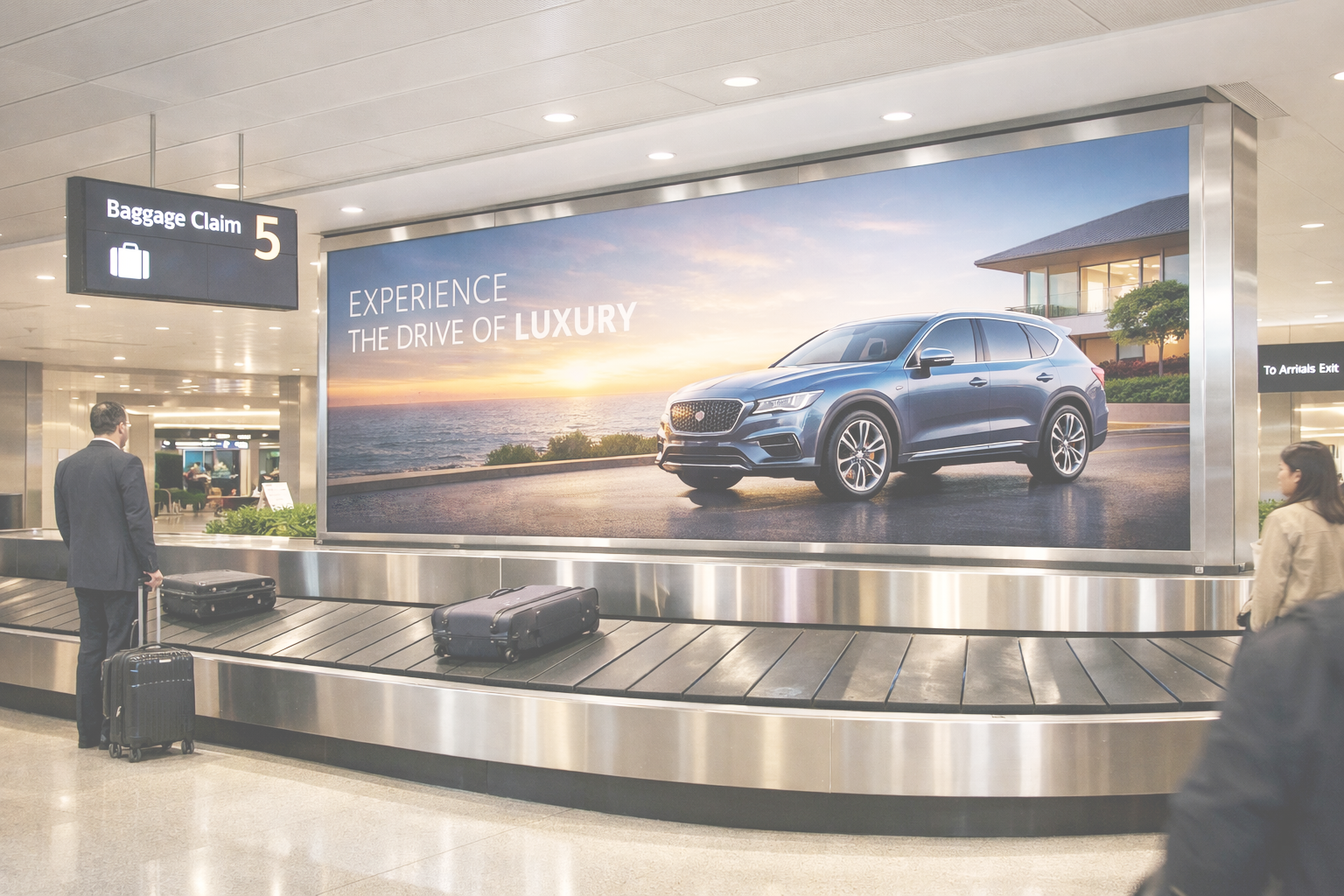
- Premium automotive brands: Ghana's luxury vehicle market is Accra-concentrated — diaspora returnees arriving from the UAE and UK carry showroom exposure to premium European marques that airport advertising at ACC can convert into domestic purchase intent
- Heritage and cultural tourism brands: The African American heritage traveller at ACC arrivals is a uniquely emotionally receptive audience — brands in premium travel, experience, and cultural identity categories will find a high-engagement audience at the arrivals zone whose emotional state at arrival is among the most brand-receptive of any traveller type at any African airport
Brand Alignment at a Glance
| Category | Fit |
|---|---|
| International Real Estate | Exceptional |
| Private Banking and Wealth Management | Exceptional |
| International Education | Exceptional |
| Pan-African Fintech and B2B Technology | Strong |
| Luxury Consumer Goods | Strong |
| Immigration and Residency Advisory | Strong |
| Premium Automotive | Strong |
| Heritage and Cultural Tourism Brands | Exceptional |
| Mass FMCG | Moderate |
| Budget Retail | Poor fit |
Who Should Not Advertise Here
- Budget travel platforms and low-cost accommodation brands: ACC's dominant traveller profiles — oil executives, diaspora returnees, and premium conference delegates — have pre-committed to premium or business-class travel decisions before entering the terminal; discount travel propositions find minimal conversion against a wealth-stratified audience whose travel decisions are driven by status and comfort, not price
- Purely domestic Ghanaian service brands: The ACC terminal audience is directionally outward — advertising services and products with no cross-border relevance or international dimension reaches travellers whose commercial attention is focused on international destinations, investment markets, and global brand relationships
- Industrial and manufacturing B2B categories without Africa investment angles: Heavy industrial procurement and manufacturing supplier brands without a direct African market development narrative are poor fits for an audience whose travel purpose is commercial deal-making and investment, not procurement sourcing
Event and Seasonality Analysis
| Metric | Rating |
|---|---|
| Event Strength | High |
| Seasonality Strength | High |
| Traffic Pattern | Dual-Peak |
Strategic Implication
ACC operates on two dominant cycles — a diaspora return cycle concentrated in the June–August summer window and the November–January festive and Detty December cultural season, and a pan-African business and investment conference cycle concentrated in October–November. These two cycles create four commercially distinct high-value advertising windows per year, with no genuine low season for premium audience concentration. Masscom Global structures ACC campaigns to activate across both cycles simultaneously — aligning spend peaks with the summer diaspora window for consumer and real estate categories and the October–November conference season for B2B and institutional categories. Advertisers who synchronise their ACC investment with the Detty December window — when diaspora returnees, African American visitors, and pan-African cultural tourists converge on Accra in the highest concentration of the year — will achieve the broadest audience quality combination this terminal can deliver, reaching HNWI consumers, diaspora investors, and international cultural travellers within a single campaign window.

Poor Placement and Delays Affect Airport Campaigns
We help you move faster, access better inventory, and get it right now.
Talk to an ExpertFinal Strategic Verdict
Accra Kotoka International Airport is West Africa's most commercially reliable advertising environment — a terminal that delivers what Lagos cannot consistently guarantee and what smaller regional airports cannot deliver at scale: a stable, professionally managed gateway whose audience is dominated by oil and mining wealth, pan-African financial services executives, a diaspora community among the most investment-active in sub-Saharan Africa, and a uniquely Ghanaian phenomenon — the African American heritage and investment traveller whose commercial engagement with this country has no equivalent at any other West African airport. Ghana's stability is not just a political credential — it is a commercial multiplier that makes the advertiser's investment in ACC predictable, executable, and measurable in a way that the wider West African market cannot always guarantee. For international real estate developers, private banks, international universities, luxury brands, and fintech platforms building West African presence, ACC is the first airport to buy, the most consistent airport to hold, and the gateway through which every serious commitment to the region ultimately passes. Masscom Global delivers the access, the cultural intelligence, and the corridor synchronisation to make that investment work at both ends of Ghana's most commercially consequential travel routes.
About Masscom Global
Masscom Global is a premium international airport advertising and media buying agency operating across 140 countries. With deep expertise in airport OOH, premium publications, and high-net-worth audience targeting, Masscom helps brands reach the world's most valuable travellers at the moments that matter most. For advertising packages, media rates, and campaign planning at Kotoka International Airport and airports across the globe, contact Masscom Global today.
Frequently Asked Questions
How much does airport advertising cost at Kotoka International Airport? Advertising costs at Accra ACC vary by format type, placement zone, campaign duration, and seasonal demand — with the June–August summer diaspora window, the November–January Detty December and Christmas peak, and the October–November investment conference season commanding premium rates due to sustained high-value audience concentration. Static large-format, digital screens, concourse, and gate-zone formats each carry separate pricing structures tied to dwell-zone position and audience flow. Contact Masscom Global for current rate cards and available inventory across all formats at ACC.
Who are the passengers at Kotoka International Airport? ACC's passenger base is led by four commercially distinct segments: Ghana's resident oil, mining, banking, and technology executive class travelling on international business; Ghanaian diaspora returnees from the UK, USA, Netherlands, and Canada visiting for holidays, family events, and investment activity; African American heritage and investment tourists participating in Ghana's Beyond the Return programme; and international corporate and diplomatic professionals based in Accra who manage regional West Africa operations from the country's preferred multinational headquarters city.
Is Kotoka International Airport good for luxury brand advertising? ACC is a strong luxury brand environment, particularly for categories aligned with the diaspora returnee and oil industry audience profiles. Returning Ghanaian diaspora from the UK and USA carry brand relationships shaped by Western premium retail markets and arrive with purchasing intent for fashion, electronics, vehicles, and lifestyle brands. The oil and mining executive segment represents a resident HNWI class with documented premium goods consumption. Terminal 3's modern, well-maintained environment supports premium brand positioning with a physical context consistent with international luxury advertising standards.
What is the best airport in West Africa to reach HNWI audiences? ACC and Lagos Murtala Muhammed are West Africa's two primary HNWI access airports, but they serve different commercial purposes. Lagos is larger by passenger volume and accesses Nigeria's significantly bigger economy — but at the cost of a more operationally complex advertising environment. ACC delivers a smaller but more stable and consistently premium audience, with a higher proportion of diaspora returnees, heritage investors, and multinational regional HQ executives per traveller. For brands where audience quality, campaign execution reliability, and the Ghana-UK-USA diaspora corridor are priorities, ACC is the cleaner, higher-yield buy. Masscom Global can advise on combined ACC and Lagos strategies for brands requiring pan-West Africa reach.
What is the best time to advertise at Kotoka International Airport? ACC offers four high-value advertising windows: the June–August summer diaspora return peak, the October–November investment conference and Ghana FinTech Forum season, the Kwaw Kese and Afrochella Detty December cultural tourism window, and the Christmas and New Year diaspora return peak in December–January. The November–January combined window — spanning the investment conference season through to the Detty December cultural peak and the Christmas diaspora return — delivers the broadest premium audience quality combination of the year and represents the strongest single-season advertising investment for most brand categories.
Can international real estate developers advertise at Kotoka International Airport? ACC is one of West Africa's most viable international real estate advertising channels. Ghanaian buyers are active in London, Dubai, Toronto, and Lisbon, and the departing traveller at ACC frequently travels to these markets specifically for property viewing, investment management, or purchase completion. The summer and Christmas diaspora windows are the highest-intent periods for real estate messaging, and the oil executive segment represents a resident high-liquid buyer class for international property in the UAE and UK. Masscom Global has structured corridor campaigns for real estate developers at ACC in coordination with receiving-end placements in London, Dubai, and Lisbon.
Which brands should not advertise at Kotoka International Airport? Budget travel platforms, mass-market value FMCG brands, and domestic-only service providers are poor fits for ACC. The terminal's dominant audience is outward-facing, internationally calibrated, and driven by quality and status in their purchasing decisions rather than price. Industrial B2B categories without direct African investment or development narratives face audience misalignment, as the dominant traveller is a commercial and investment decision-maker, not a procurement or supply chain professional.
How does Masscom Global help brands advertise at Kotoka International Airport? Masscom Global provides full-service airport advertising execution at ACC — from audience intelligence and campaign planning through to inventory access across Terminal 3's key placement zones, creative adaptation for English and Twi-speaking audiences, and performance reporting aligned to ACC's diaspora-cycle and conference-season traffic patterns. Masscom's ability to activate ACC campaigns in coordination with placements in London, Dubai, Toronto, and Lisbon allows brands to intercept Ghana's HNWI traveller at every point of their investment corridor — from departure in Accra to arrival at their destination market. Contact Masscom Global to discuss media rates, format availability, and campaign strategy at Accra Kotoka International Airport.