

King Khalid International Airport is the primary gateway to Riyadh, the political, financial, and administrative capital of the world's largest oil-producing nation, and the command centre of Saudi Vision 2030 — the $3 trillion economic diversification programme reshaping every sector of the Saudi economy. In 2024, RUH served 37.6 million passengers, up 18% year-on-year and representing a 46% increase in international passengers compared to pre-pandemic levels. The airport added 15 new airline partners and 29 new retail and food and beverage outlets in a single year, reflecting the pace at which Riyadh is integrating into global aviation and commercial networks. Riyadh had 65% more millionaires in 2024 than it did in 2014, with over 20,000 individuals holding at least $1 million in liquid investable wealth — including 77 centi-millionaires and 11 billionaires. The Public Investment Fund, headquartered in Riyadh, manages assets exceeding $700 billion and is the primary driver of Saudi Arabia's giga-projects, Riyadh Air, and the new King Salman International Airport currently under construction on the RUH site.
No other airport in the world sits at the intersection of sovereign capital, government power, and urban transformation at the scale of RUH. Riyadh is simultaneously the seat of the Saudi royal family, the headquarters of Saudi Aramco, SABIC, and every major Saudi government ministry, the registered address of over 600 global companies that have opened regional headquarters under Vision 2030's incentive programme, and the host city of World Expo 2030 and the 2034 FIFA World Cup. Every senior decision-maker passing through RUH is embedded in this transformation — either as a principal directing it, an investor benefiting from it, or an international partner facilitating it. For advertisers targeting the world's most commercially consequential sovereign and corporate audience, RUH is a non-negotiable media buy.
Advertising Value Snapshot
- Passenger scale: 37.6 million in 2024, up 18% year-on-year; 46% increase in international passengers versus pre-pandemic levels; busiest single day on 1 August 2024 with 131,000 passengers; 165 international routes across 50+ airlines
- Traveller type: Saudi HNWI principals and senior government officials, PIF investment executives, international corporate decision-makers connecting to Saudi Vision 2030, regional business travellers, and a growing Vision 2030 inbound leisure and events audience
- Airport classification: Tier 1 — the capital airport of the Arab world's largest economy, operating as the primary hub for Saudi Arabia's second flag carrier Riyadh Air (launched October 2025) and the national carrier Saudia, with the new King Salman International Airport being built on the current site to accommodate 120 million passengers by 2030
- Commercial positioning: Riyadh is among the fastest-growing millionaire cities in the world with 65% HNWI growth over the past decade; the city is host to World Expo 2030, the FIFA World Cup 2034, the King Abdullah Financial District (KAFD), and over 600 multinational regional headquarters
- Wealth corridor signal: RUH anchors the Riyadh-to-London, Riyadh-to-New York, and Riyadh-to-Asia sovereign investment corridor — the routes through which PIF and Saudi royal family capital deploys globally and through which international capital flows into Saudi Arabia's giga-projects
- Advertising opportunity: Masscom Global provides brands with access to RUH's commercially extraordinary sovereign and corporate audience — the decision-makers behind the world's most funded urban transformation — with the local market intelligence required to position brands correctly in a culturally specific and rapidly evolving environment
Airport Advertising is Complex to Get Right
We help you execute faster, with proven results and local insight most planners lack starting now.
Talk to an ExpertCatchment Area and Economic Drivers
Top 10 Cities within 150 km — Marketer Intelligence
- Riyadh (King Abdullah Financial District and Diplomatic Quarter): The capital's central business districts are the operational headquarters of PIF, Saudi Aramco, SABIC, the Saudi Central Bank, and every major government ministry; the senior officials, investment managers, and corporate executives working in these institutions represent the most commercially concentrated sovereign and institutional decision-making audience at any Gulf airport — a population that deploys capital at a scale and with an authority that has no equivalent in regional aviation
- Al Kharj: An agricultural and military city approximately 80 km south of Riyadh, home to the Royal Saudi Air Force base and a growing residential community connected to the capital; the professional government and defence sector workforce contributes regular domestic and occasional international travel through RUH
- Al Diriyah: Physically within Greater Riyadh's expansion and the site of one of Saudi Arabia's most ambitious Vision 2030 giga-projects; the Diriyah Gate Development Authority is transforming the birthplace of the Saudi state and UNESCO At-Turaif World Heritage Site into a $20 billion mixed-use cultural, hospitality, and luxury retail destination; the construction and investment professionals managing this project represent a productive B2B audience at RUH
- Qiddiya: Also within the greater Riyadh development corridor, approximately 50 km from the city centre, Qiddiya is being developed as Saudi Arabia's entertainment capital — a $10 billion giga-project encompassing theme parks, racing circuits, esports venues, and a Six Flags park; the executives of PIF's entertainment sector portfolio and their international partners transit through RUH regularly
- Al Majmaah: A university city in the northern Riyadh region that contributes academic and educational traffic through RUH; proximity to the Riyadh catchment and academic institution presence make this a modest but consistent domestic travel audience
- Dawadmi: A regional city in the western Riyadh province that contributes domestic travel through RUH; primarily a small-business owner and local government professional audience relevant for domestic financial services and insurance advertising
- Al Aflaj: A southern governorate community whose residents access Riyadh for commercial and government services, contributing domestic family and business travel through RUH
- Shaqra: A regional centre in the Riyadh province approximately 110 km north-west of the capital; predominantly agricultural and SME business community whose travel through RUH aligns with domestic banking, education, and government services
- Rumah: A smaller community in the Riyadh province reflecting the broad domestic catchment that the Saudi capital serves as an administrative and commercial hub; its audience represents the domestic mid-market Saudi consumer who travels for education, healthcare, and family purposes
- New Murabba (Under Development): Not yet a standalone city but one of the most consequential development zones in Riyadh's transformation — the New Murabba mega-project, centred on The Mukaab (one of the world's largest proposed built structures), is creating a new downtown district that will house luxury residences, a 46,000-capacity football stadium, offices, and retail adjacent to the existing RUH airport site; the investors and developers associated with this project are a premium B2B audience at RUH today and an emerging premium consumer audience as the development matures
NRI and Diaspora Intelligence
Riyadh's expatriate community is commercially distinct from the Gulf's typical South Asian labour diaspora. While the South Asian professional and technical community remains significant — drawn to the capital by Vision 2030 construction, healthcare, and technology projects — the defining diaspora characteristic of RUH is the concentration of Western corporate professionals who have relocated to Riyadh as part of the Regional Headquarters Programme. Over 600 global companies have established regional headquarters in Riyadh, including McKinsey, PwC, EY, Goldman Sachs, HSBC, Citigroup, and Amazon. The senior executives of these firms — typically British, American, French, and German — travel through RUH regularly on London, New York, Paris, and Frankfurt connections and represent a premium B2B advertising audience with corporate expense accounts, international investment mandates, and high personal discretionary spend. Indian, Pakistani, and Egyptian professionals in healthcare, education, and construction also contribute substantial volume, particularly on South Asian and Arab regional routes.
Economic Importance
Riyadh is the economic engine of the Arab world's largest economy. Saudi Arabia accounts for approximately half of the Gulf Cooperation Council's nominal GDP. The PIF, headquartered in Riyadh, has assets under management exceeding $700 billion and has committed to growing this to $1 trillion, investing across Saudi giga-projects, global technology companies, sports franchises, hotel groups, and infrastructure assets on six continents. Saudi Aramco — the world's most profitable company by net income — is headquartered in Dhahran but its government and institutional shareholder relationships are managed entirely from Riyadh. The King Abdullah Financial District (KAFD) — 95 buildings designed by 25 world-leading architectural firms, achieving LEED Platinum certification across its entire 1.6 million square metre footprint — is the physical expression of Riyadh's ambition to become a top-10 global city by economic output. For advertisers, the practical implication is that RUH's catchment produces more autonomous institutional capital deployment decisions per square kilometre than almost any other city on earth — and the executives making those decisions pass through this airport every day.
Business and Industrial Ecosystem
- Public Investment Fund (PIF) and its portfolio companies: The PIF and its 100+ portfolio companies — spanning Neom, Qiddiya, Diriyah Gate, Riyadh Air, ROSHN, Red Sea Global, SABIC, and international investments — generate a constant flow of senior investment executives, project managers, and international partners through RUH; these individuals are among the most commercially valuable B2B advertising targets in the Gulf for professional services, technology, and premium business product categories
- Saudi Aramco and the energy sector: While Aramco is headquartered in Dhahran, its government relations, investor communications, and senior management all operate through Riyadh; the Kingdom's Ministry of Energy and the executives managing Saudi Arabia's LNG expansion, oil production strategy, and energy transition investments are all Riyadh-based and RUH-transiting, representing a premium B2B audience for financial advisory, premium automotive, and professional services brands
- Regional Headquarters Programme — 600+ global companies: Under Vision 2030, over 600 multinational companies have established regional headquarters in Riyadh with incentives including 30-year tax relief, fast-track licensing, and dedicated government account managers; the senior executives of these companies — from Goldman Sachs to Amazon to McKinsey — travel regularly through RUH on long-haul international routes, creating one of the most concentrated international corporate executive audiences in Middle Eastern aviation
- King Abdullah Financial District (KAFD): One of the world's most ambitious purpose-built financial districts, home to the Capital Market Authority, the Saudi Exchange, major banks, and the regional headquarters of global financial institutions; KAFD's resident financial sector professionals generate regular high-value travel through RUH and represent a premium audience for wealth management, private banking, and premium technology platforms
Passenger Intent — Business Segment
RUH's business traveller cohort is structurally different from any other Gulf airport's because Riyadh is a political and institutional capital rather than primarily a commercial hub in the Dubai or Doha model. The senior Saudi official or royal family member travelling through RUH is not attending a business conference — they are directing sovereign capital, negotiating bilateral investment treaties, managing national security, or overseeing a giga-project portfolio worth hundreds of billions of dollars. This is the tier of decision-making authority that no other Gulf airport concentrates at the same density. For B2B advertisers, this means the audience at RUH is not simply wealthy — it is institutionally powerful in ways that determine commercial outcomes at the country and sector level.
Strategic Insight
Riyadh is undergoing the fastest transformation of any capital city of its size in the world. The city's millionaire population grew 65% in a decade, 600 global companies have opened regional offices in five years, and the event calendar for the next decade — World Expo 2030, FIFA World Cup 2034, AFC Asian Cup 2027 — guarantees a sustained inflow of international corporate, diplomatic, and tourism audience through RUH. Brands that establish advertising presence at RUH now are positioning themselves at the entry point of what will be, by 2030, one of the world's five most commercially significant airport catchments. Masscom advises clients to treat RUH not as a regional play but as a tier-one global capital airport buy.
Tourism and Premium Travel Drivers
- Riyadh Season: Saudi Arabia's flagship entertainment programme and arguably the world's most ambitious annual entertainment festival platform; Riyadh Season 2024 attracted millions of domestic and international visitors with international boxing (Fury vs. Usyk), the WTA Finals, international concerts, the Esports World Cup, and top-tier sports events; this programming drives sustained inbound leisure travel through RUH across the full October-to-March window and is directly responsible for a large share of the 18% passenger growth RUH recorded in 2024
- Diriyah Gate Development: The $20 billion UNESCO-anchored giga-project transforming the birthplace of the Saudi state into a luxury cultural, hospitality, and retail destination; Diriyah's At-Turaif UNESCO World Heritage Site, luxury hotels, fine dining, and cultural programming attract premium international visitors and cultural tourists through RUH who are among the highest-spending inbound audiences in the Saudi leisure market
- Qiddiya Entertainment City: Saudi Arabia's $10 billion entertainment capital under construction south-west of Riyadh, encompassing a Six Flags theme park, the world's tallest water coaster, Formula 1 and esports circuits, and entertainment venues designed to attract millions of annual visitors; Qiddiya is expected to open in phases from 2025 and will rapidly become a major driver of international tourism through RUH
- King Salman Park: Described as one of the world's largest urban parks and a centrepiece of Riyadh's urban beautification programme, King Salman Park integrates cultural venues, a royal arts complex, and green public spaces that are part of the city's Vision 2030 liveability push; the park's cultural infrastructure is creating a new domestic leisure and international cultural tourist audience at RUH
- World Expo 2030 Riyadh (October 2030 to March 2031): Riyadh won the right to host World Expo 2030 in the first round of voting, becoming the first Arab city to host a World Expo; the event is projected to draw over 40 million visits, contribute $64 billion to GDP, and create 171,000 jobs; it will generate the largest concentrated international visitor surge through RUH in the airport's history and is the single most commercially transformative event in RUH's near-term advertising future
Passenger Intent — Tourism Segment
Inbound leisure tourism at RUH is in its earliest phase of scale growth — the airport has historically been primarily a government and business travel hub, and the pivot to premium leisure tourism is being driven entirely by Vision 2030's event programming and giga-project development. The Riyadh Season visitor arriving for WTA Finals, international boxing, or esports has a premium leisure spending profile and significant dwell time in the capital before and after events. As Qiddiya and Diriyah mature and World Expo 2030 approaches, RUH's inbound tourism audience will transform from a modest secondary segment into a primary commercial driver. Advertisers who establish brand presence at RUH now are investing ahead of the most significant leisure tourism inflection point in the airport's history.
Travel Patterns and Seasonality
Peak seasons:
- October to March (Riyadh Season and business event peak): The primary advertising window at RUH, aligning with Saudi Arabia's winter climate, Riyadh Season's international programming calendar, the regional corporate event season, and the highest volume of inbound international business and leisure travel; this window delivers maximum audience volume and commercial quality simultaneously
- Ramadan and Eid Al Fitr (variable — March to April in current years): The most important Islamic calendar advertising window; gifting, premium food, fashion, Islamic banking, and outbound leisure travel all peak; Saudi families travel internationally to Europe, Turkey, and South-East Asia for Eid holidays, and the pre-Ramadan gifting economy creates exceptional retail advertising conditions at RUH
- Summer (June to August): A significant outbound leisure spike as Saudi families travel to Europe and North America to escape Riyadh's extreme summer heat; the Saudi family travelling internationally in summer has a substantial discretionary spending budget — this window is particularly productive for European hospitality, real estate, and luxury goods advertising
- Year-round government and corporate travel: Unlike leisure-driven airports, RUH's government and corporate audience generates consistent premium travel across all months of the year, ensuring that B2B advertising campaigns deliver sustained audience quality even outside peak leisure windows
Event-Driven Movement
- Riyadh Season (October to January, annual): Saudi Arabia's most commercially significant domestic tourism event, generating millions of visits and driving international arrivals from across the Gulf, Arab world, and increasingly from Europe and Asia; the full international entertainment portfolio — boxing, tennis, concerts, motorsport, esports — brings a globally diverse premium audience through RUH in concentrated waves that advertisers should target with event-specific campaigns
- Esports World Cup (July to August, Riyadh): One of the world's largest and most valuable esports events, held in Riyadh and attracting elite gaming professionals, global brands, and millions of fans domestically and internationally; the event's €70 million+ prize pool and global broadcast reach make it a commercially significant audience window for technology, premium gaming, and youth-oriented lifestyle brands at RUH
- WTA Finals (Riyadh, annual November): The season-ending women's tennis championship, bringing the world's top eight players and a premium global sports audience to Riyadh; the WTA Finals audience includes high-spending European, American, and Gulf tennis fans whose profile aligns strongly with luxury lifestyle, premium hospitality, and prestige brand advertising at RUH
- FIFA World Cup 2034 (Riyadh host city — from 2034): Saudi Arabia was confirmed as the sole host of the 2034 FIFA World Cup in December 2024; Riyadh will host eight of the 15 tournament stadiums including the 92,000-capacity King Salman Stadium; the commercial and infrastructure preparation for this event is already generating massive international business travel through RUH and will intensify annually through the decade
- World Expo 2030 Riyadh (October 2030 to March 2031): The most significant single event in RUH's near-term commercial future; 40 million projected visits, 174 participating nations, and a $64 billion GDP contribution will transform RUH's inbound audience composition for six months into one of the most internationally diverse high-value traveller concentrations in Middle Eastern aviation history
It’s Not Just Where You Advertise - It’s How Fast You Execute
We combine local insight with fast rollout to deliver results for you, now.
Talk to an ExpertAudience and Cultural Intelligence
Top 2 Languages
- Arabic: The language of Saudi state power, Islamic scholarship, and the Kingdom's cultural identity; campaign creative in Arabic at RUH signals respect for the Saudi national audience whose sovereign and institutional decisions define the airport's commercial premium; Standard Arabic reaches both Najdi Saudis and the pan-Arab expatriate professional community simultaneously
- English: The operational language of Riyadh's 600+ regional headquarters community, the international corporate and consulting professional tier, and the growing inbound tourism audience from Europe, America, and Asia; English is the primary communication medium for the international business traveller at RUH, and bilingual Arabic-English creative captures the full spectrum of commercial opportunity at this airport
Major Traveller Nationalities
RUH's international nationality profile reflects Riyadh's dual role as a sovereign capital and Vision 2030 investment hub. Saudi nationals — the highest-spending domestic segment — dominate outbound leisure travel to London, Paris, Geneva, and New York, and incoming domestic traffic from every major Saudi city. British, American, and Western European corporate professionals represent the largest inbound international segment, driven by the Regional Headquarters Programme and Vision 2030 investment activities. Arab nationals from Egypt, Jordan, Lebanon, and the Gulf contribute significant business and professional travel. South Asian professionals in healthcare, construction, and technology add volume across the subcontinental routes. Chinese travel grew substantially in 2024, reflecting increasing Sino-Saudi investment ties and the Belt and Road connectivity of Saudi Arabia's Vision 2030 partnerships.
Religion — Advertiser Intelligence
- Islam (approximately 97%): The all-encompassing cultural reality at RUH; every advertising decision at this airport must begin from an understanding of Islamic values and their commercial expression in the Saudi context; Ramadan is the year's most important advertising window — premium gifting, luxury food, fashion, Islamic banking products, and charitable giving all accelerate simultaneously; Eid Al Fitr drives outbound leisure travel with Saudi families spending generously on international experiences; Eid Al Adha is the secondary Eid travel peak with its own gifting and hospitality spend profile; the Islamic business week (Saturday to Wednesday) and prayer-time patterns influence the daily flow of premium business travellers through RUH in ways that are commercially relevant for B2B campaign timing
- Other faiths (approximately 3%): The Western corporate and South Asian Christian and Hindu expatriate community; this group's spending behaviour aligns with the Christmas and New Year international travel window, contributing to December's historically strong passenger volumes at RUH
Behavioral Insight
The Saudi government and corporate principal at RUH operates from a framework of tribal, institutional, and Islamic loyalty that is commercially distinct from individual consumer HNWI behaviour elsewhere. Decision-making at the senior Saudi official level is consensus-based within family and institutional networks, brand relationships are typically long-term and resistant to disruption, and advertising's role is to reinforce trust rather than create preference from scratch. The Western corporate executive transiting through RUH is in active deal flow — arriving or departing from a meeting with a government ministry, a PIF portfolio company, or a Vision 2030 project partner — and is in a state of high commercial attention that makes airport advertising a natural extension of the business environment they are already operating in. Masscom builds campaigns for RUH that speak to both audiences simultaneously, with creative calibrated to the sovereign institutional framework that governs commercial relationships in this market.
Outbound Wealth and Investment Intelligence
Saudi HNWI outbound capital deployment from Riyadh follows the institutional pattern of the PIF on a smaller scale. The PIF has committed $45 billion in direct US investment, acquired a 15% stake in Heathrow Airport, owns 49% of Rocco Forte Hotels, and has taken positions in global technology, sports, and infrastructure across every major market. Individual Saudi royal family members and HNWI principals mirror this at the family level — London prime property, Swiss wealth management, Paris real estate, and US private equity are the dominant capital deployment categories for the Riyadh HNWI tier. Saudi Arabia projected to attract 2,400 new millionaires in 2025 — the fastest inbound wealth migration growth globally — with Riyadh at the centre of this transformation, attracting both returning Saudi nationals and international HNWI investors drawn by Vision 2030 residency incentives and giga-project investment access.
Outbound Real Estate Investment
London is the primary destination for Saudi HNWI real estate investment, with decades of royal family and merchant class property ownership in Mayfair, Belgravia, and Knightsbridge creating an established market. The PIF's acquisition of a 15% stake in Heathrow Airport and significant Manhattan property holdings signal the institutional preference for UK and US real estate at the sovereign level. Switzerland — Geneva and Zurich — attracts Saudi wealth management real estate. Paris, particularly the 8th and 16th arrondissements, maintains strong appeal for Saudi royals and senior officials. Domestically, Vision 2030's real estate sector transformation — particularly KAFD apartments, ROSHN communities, and the New Murabba luxury residential development — is creating a new generation of Saudi domestic real estate investment that channels through RUH's audience.
Outbound Education Investment
The Saudi government's scholarship programme has historically funded tens of thousands of students at US and UK universities, and private Saudi family investment in international education follows the same geographic preference. Georgetown, MIT, Harvard, and Oxford are the elite tier; the Russell Group and US top-50 universities receive the mass market of Saudi students. UK boarding schools — particularly in Surrey, Oxfordshire, and Berkshire — host a significant population of Saudi royal family and HNWI children. This creates a structural outbound education travel flow through RUH year-round, concentrated around school term starts in September, January, and April. International universities, UK boarding school admissions consultants, and student accommodation providers will find RUH one of the most commercially concentrated parent audiences in global aviation.
Outbound Wealth Migration and Residency
Second residency demand among Riyadh's HNWI community focuses on two distinct objectives. The first is lifestyle optionality — UK Tier 1 investor and Global Talent routes, Portuguese Golden Visa, and Swiss residency programmes attract Saudi HNWIs who spend significant time in Europe for education and leisure and want formal residency to simplify their access. The second is asset diversification — Caribbean citizenship-by-investment programmes and UAE Golden Visa residency are used as mobility insurance and capital protection instruments by Riyadh's institutional and professional HNWI community. Saudi Arabia's own premium residency programme, expanded in January 2024, is simultaneously attracting international HNWI investors into the Kingdom through real estate acquisition and business establishment, creating a bidirectional residency market that RUH's advertising environment can reach on both flows.
Strategic Implication for Advertisers
Riyadh is the seat of the decisions that govern how one of the world's largest pools of sovereign capital is deployed globally. Brands targeting Saudi institutional investment flows — whether as UK real estate developers, European private banks, US technology platforms, or Asian infrastructure partners — should regard RUH as the single most important airport in the Arab world for establishing brand authority with the decision-makers who determine those flows. Masscom structures campaigns at RUH to intercept both the outbound Saudi HNWI deploying capital internationally and the inbound international corporate and investor seeking partnership access to Saudi Arabia's transformation, simultaneously.
Airport Infrastructure and Premium Indicators
Terminals
RUH operates across five passenger terminals spread across one of the world's largest airport sites by area. Terminal 1 — renovated and reopened in December 2024 with new check-in counters, automated gates, and modernised passport control — serves Flynas and is designated for Riyadh Air. Terminal 2 is currently closed for renovation. Terminal 3 hosts most international airlines other than those in Terminal 1. Terminal 4 serves Saudia and Flyadeal. Terminal 5, opened in 2016, handles additional operations. The airport is directly connected to the Riyadh Metro via Line 4, which opened on 1 December 2024 — providing direct city-centre connectivity for the first time in the airport's history and substantially increasing the accessible audience for terminal advertising.
Premium Indicators
- Riyadh Air hub designation: Riyadh Air — a PIF-owned airline with Boeing 787-9 aircraft, codeshare agreements with Delta, Air France-KLM, Singapore Airlines, Turkish Airlines, and Virgin Atlantic — launched commercial operations in October 2025 with initial services to London Heathrow and Dubai; as Riyadh Air expands to 100 destinations by 2030, it will introduce a new premium international audience tier to RUH that currently travels predominantly through DXB or DOH
- Royal Terminal: RUH operates a dedicated Royal Terminal for Saudi royal family members, heads of state, and government officials — the most concentrated sovereign audience environment of any commercial airport in the Arab world
- King Salman International Airport — under construction on the RUH site: The $30 billion new airport being built on the expanded current RUH site, with six runways, six terminals, and 120 million passenger capacity by 2030; construction commenced September 2025 with Bechtel managing passenger terminal development and Parsons overseeing airside infrastructure; the transition from RUH to KSIA is the single most transformative aviation infrastructure event in Saudi Arabia's history and is creating a structural advertising environment where brands that establish presence now will be positioned as legacy partners in the world's newest mega-airport
- Riyadh Metro Line 4 connection: The December 2024 opening of Line 4 directly connecting RUH to Riyadh's city centre transforms the airport's catchment accessibility; corporate travellers, event attendees, and urban residents can now access RUH without private transport, substantially expanding the daily audience pool
Forward-Looking Signal
RUH's forward trajectory is defined by three concurrent and funded transformations. The first is Riyadh Air's rapid network expansion to 100 destinations by 2030, which will introduce premium international long-haul passengers to this airport at volumes it has never before experienced. The second is the King Salman International Airport construction programme — currently in active build phase, with a third runway under construction as of December 2025 and the first new terminal designed to handle 40 million passengers scheduled to begin construction in 2026. The third is the World Expo 2030 and FIFA World Cup 2034 infrastructure build, which is already generating massive international business travel through RUH as contractors, sponsors, and government partners move through Riyadh at increasing frequency. Masscom advises clients to treat RUH as the most important early-mover advertising opportunity among Saudi airports — the window to establish brand presence at current rates, before Riyadh Air's network maturity and World Expo 2030's visitor surge transforms the airport's commercial profile completely, is a defined and closing one.
Airline and Route Intelligence
Top Airlines
Saudia (primary hub carrier), Flyadeal, Flynas, Riyadh Air (launched October 2025), Emirates, Qatar Airways, Turkish Airlines, Lufthansa, British Airways, Air France, Cathay Pacific (launched October 2024), Virgin Atlantic (daily London Heathrow from 2025), ITA Airways (Rome), LOT Polish Airlines (Warsaw), Delta Air Lines (Atlanta from October 2025), Singapore Airlines, Malaysia Airlines, EgyptAir, Royal Jordanian, Pakistan International Airlines, IndiGo, Air India
Key International Routes
- London Heathrow (Saudia, Riyadh Air, Virgin Atlantic; anticipates 24% UK-Saudi air travel increase from 2019 to 2035)
- Dubai International (highest frequency; multiple daily services)
- Cairo, Amman, Beirut (dense Arab world connectivity)
- Istanbul (Turkish Airlines hub connection)
- Frankfurt, Paris, Rome (European business and leisure routes)
- Atlanta (Delta, launched October 2025)
- Hong Kong (Cathay Pacific, launched October 2024)
- Warsaw (LOT Polish Airlines, launched June 2024)
- Karachi, Lahore, Islamabad, Mumbai, Delhi
- Singapore (Singapore Airlines)
Domestic Connectivity
Dense domestic network connecting Riyadh to Jeddah (highest frequency domestic route), Dammam, Madinah, Abha, Taif, Al Qassim, Yanbu, and all major Saudi cities; the domestic routes reflect both the business needs of corporate decision-makers spread across the Kingdom and the personal travel of Saudi families managing properties, businesses, and family relationships across multiple cities.
Wealth Corridor Signal
RUH's route network is the institutional map of Saudi Arabia's global capital deployment. The London routes carry Saudi sovereign and family capital into UK real estate, financial services, and education. The Atlanta and US routes carry PIF investment executives to Wall Street, Silicon Valley, and the US private equity ecosystem where $45 billion in Saudi investment is currently deployed. The Cathay Pacific Hong Kong and Singapore Airlines routes reflect the growing Asia-Pacific orientation of Saudi capital, where QIA and PIF are both increasing their portfolio allocations. The European routes — particularly Frankfurt and Paris — carry the bilateral business relationships that underpin Saudi Arabia's LNG contracts, defence purchases, and luxury consumer flows. Every route at RUH is a sovereign capital movement route, and the executives managing those movements are the airport's primary advertiser audience.
Media Environment at the Airport
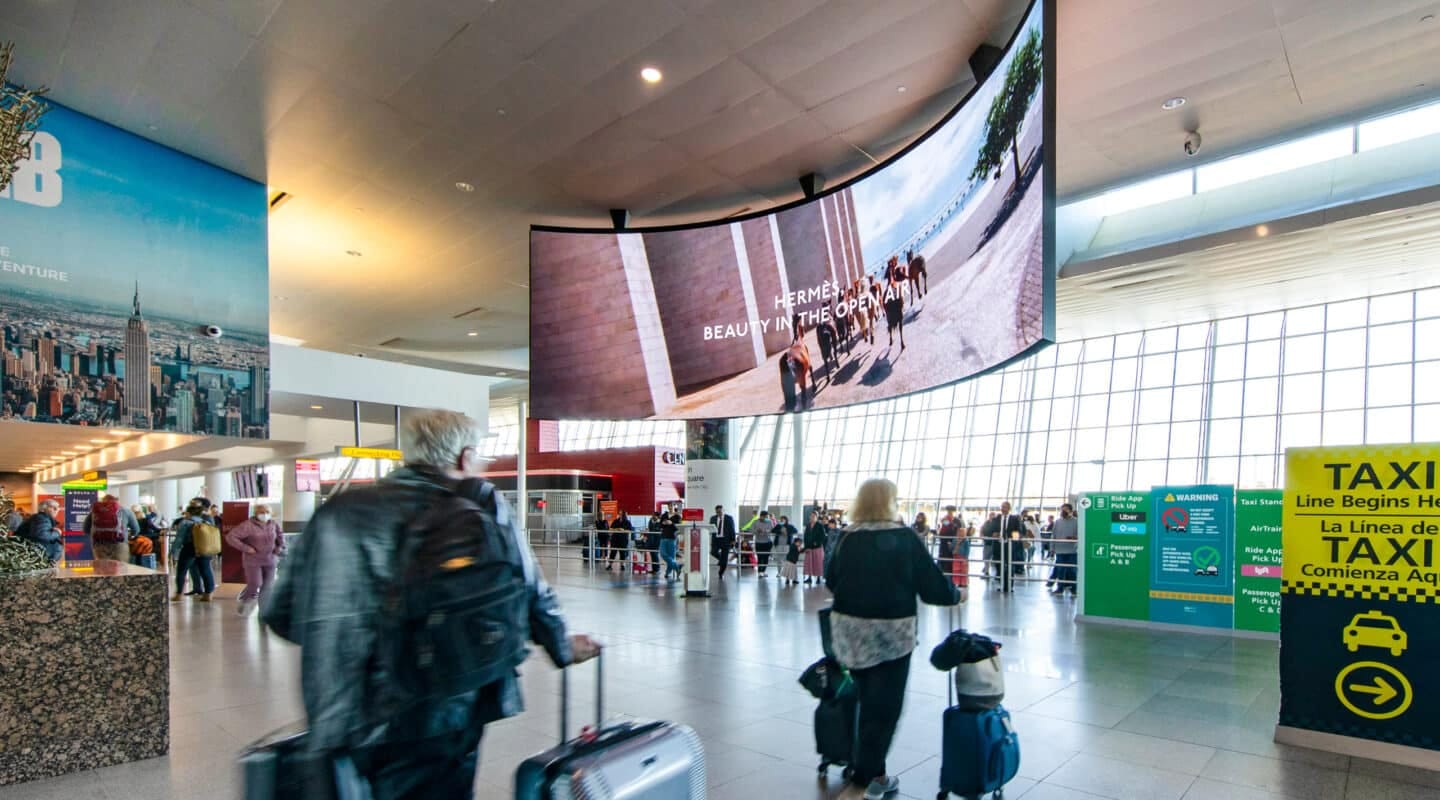
- RUH's five-terminal layout across an expansive 225 square kilometre site creates distinct advertising zones that serve fundamentally different audience segments; Terminal 3's international airline environment, Terminal 1's post-renovation Flynas and Riyadh Air hub, and the Royal Terminal zone each require separate placement intelligence to reach the specific commercial cohort that uses them
- The December 2024 opening of Riyadh Metro Line 4 — directly connecting RUH to the city centre — has transformed the airport's landside environment into a daily commuter and transit zone for the first time, creating new advertising reach opportunities beyond the traditional departure and arrival passenger flow
- RUH's 2024 addition of 29 new retail and food and beverage outlets signals the airport's accelerating commercial development ahead of King Salman International Airport; brands that establish retail adjacency and advertising presence now are building familiarity with an audience that will transition into the world's newest mega-airport terminal environment within this decade
- Masscom Global structures RUH campaigns with terminal-specific placement intelligence — ensuring sovereign and institutional B2B messaging reaches the international terminal environment while Ramadan, gifting, and lifestyle campaigns are positioned across the broader terminal network to intercept the full commercial audience
Strategic Advertising Fit
Best Fit
- Private banking and wealth management: Riyadh's 20,000 millionaires, its 77 centi-millionaires, and 11 billionaires represent a uniquely concentrated domestic HNWI audience; JP Morgan, HSBC Private Banking, UBS, Goldman Sachs, and Citigroup have all expanded their Riyadh presence specifically to serve this audience — advertising at RUH allows international and local private banks to intercept this audience at the moment of international travel, when private banking conversations are most naturally initiated
- Premium Islamic finance: Saudi Arabia has the world's most sophisticated Islamic finance ecosystem; Al Rajhi Bank, Alinma, SNB Capital, and international Islamic finance platforms compete for the same audience that passes through RUH; Ramadan and the corporate travel season are the primary windows for this category
- B2B professional services — consulting, technology, legal, audit: The 600+ multinational regional headquarters in Riyadh generate a constant flow of senior consulting, legal, technology, and audit professionals through RUH; McKinsey, PwC, EY, BCG, Baker McKenzie, and Deloitte all have expanding Riyadh offices specifically because this is where their clients — PIF portfolio companies and government ministries — are based; advertising adjacent to this audience has exceptional B2B conversion potential
- Ultra-luxury goods and watches: Riyadh's 20,000 millionaires and the senior Saudi official community are active luxury goods consumers; the WTA Finals, international boxing, and Riyadh Season drive concentrated ultra-HNWI audience windows where prestige brands targeting the Saudi domestic consumer achieve their highest impression quality of the year
- International luxury real estate: Saudi HNWI families are active buyers of London prime property, Swiss real estate, and UAE freehold assets; domestic real estate — particularly KAFD residential, New Murabba, and ROSHN premium communities — is also a productive advertising category as Vision 2030's real estate transformation creates new investment opportunities for the Riyadh millionaire community
- Premium automotive: Saudi Arabia has one of the world's highest luxury vehicle penetration rates per capita; senior officials, business owners, and HNWI families in Riyadh are among the most consistent premium automotive buyers in the Gulf; Rolls-Royce, Bentley, Porsche, and Mercedes-Benz are all relevant advertising categories at RUH
- International education: The structural commitment of Saudi HNWI and government families to UK and US education creates year-round demand at RUH for education consultancies, boarding schools, universities, and student accommodation providers; the September and January term-start peaks are the most concentrated advertising windows for this category
- Technology and enterprise software: The 600+ multinationals establishing regional headquarters in Riyadh — combined with Vision 2030's digital transformation agenda — create a concentrated enterprise technology buying audience at RUH; cloud platforms, ERP systems, cybersecurity, and AI solutions are highly relevant advertising categories for the corporate decision-maker segment
Brand Alignment at a Glance
| Category | Fit |
|---|---|
| Private banking and wealth management | Exceptional |
| Premium Islamic finance | Exceptional |
| B2B professional services and technology | Exceptional |
| Ultra-luxury goods and watches | Strong |
| International luxury real estate | Strong |
| Premium automotive | Strong |
| International education | Strong |
| Mass-market consumer goods | Poor fit |
| Alcohol and entertainment brands | Poor fit |
Who Should Not Advertise Here
- Alcohol brands: Legally impermissible and culturally incompatible with the Saudi context; as at KAIA, alcohol advertising is not an option at RUH in any format or creative execution
- Mass-market FMCG and value retail: RUH's audience profile is too commercially elevated for brands whose value proposition is built on price accessibility; the investment in premium placements at RUH would not be recovered by mass-market consumer goods campaign objectives
- Entertainment brands incompatible with Islamic values: Content categories that conflict with Saudi cultural and religious norms will generate reputational damage rather than commercial return; Masscom advises on cultural compliance before any entertainment category campaign is built for the Saudi market
Event and Seasonality Analysis
- Event Strength: Very High (Riyadh Season, WTA Finals, Esports World Cup, Expo 2030, FIFA World Cup 2034)
- Seasonality Strength: High (Ramadan-Eid peak, summer outbound, October-March winter business and event season)
- Traffic Pattern: Multi-Peak (October to March event and business season; Ramadan-Eid; summer outbound; year-round government and corporate stability)
Strategic Implication
RUH's commercial calendar is being written by Vision 2030's event programme and will intensify every year through the decade until World Expo 2030 and the FIFA World Cup 2034 dominate the event landscape completely. Advertisers should structure campaigns around four commercial windows: the October-to-March Riyadh Season and business peak; the Ramadan-Eid window for gifting, Islamic finance, and outbound leisure; the summer outbound peak for European hospitality, education, and luxury real estate; and the year-round government and corporate layer that maintains audience quality across all months. Masscom phases campaign investment to maximise the event-driven peaks while maintaining continuous brand presence for B2B categories whose audience flows steadily regardless of seasonal patterns.
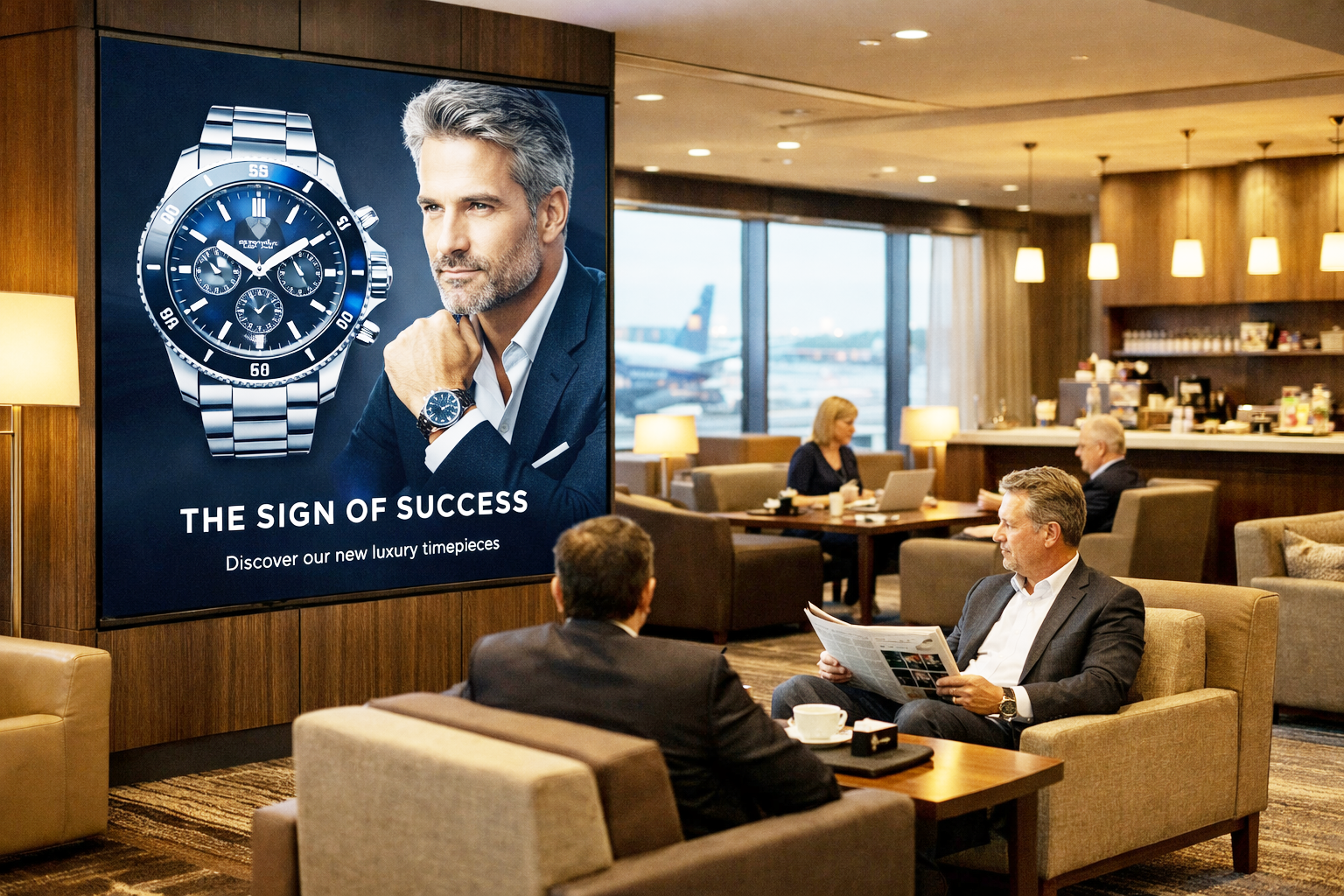
Poor Placement and Delays Affect Airport Campaigns
We help you move faster, access better inventory, and get it right now.
Talk to an ExpertFinal Strategic Verdict
King Khalid International Airport is the advertising gateway to the most consequential capital city transformation in the Arab world, and one of the most commercially extraordinary sovereign and institutional audience concentrations in global aviation. Riyadh's 20,000 millionaires, its 77 centi-millionaires and 11 billionaires, the $700 billion PIF headquartered in the city, over 600 global companies that have opened regional offices under the Regional Headquarters Programme, and an event calendar that includes World Expo 2030 and the FIFA World Cup 2034 — these are not background commercial facts. They are the defining commercial realities of an airport that is already operating at 18% year-on-year passenger growth while its successor airport is being built around it. The brands that advertise at RUH today are reaching the decision-makers who govern Saudi Arabia's sovereign investment flows, manage the giga-project portfolios that are transforming the region's economy, and lead the international companies whose presence in Riyadh signals the transformation's global credibility. The commercial window at current rates, before Riyadh Air's 100-destination network and World Expo 2030's 40 million visitors fully reprice the media environment at this airport, is defined and available now. Masscom Global provides the intelligence, placement access, and execution capability to convert that window into measurable commercial results.
About Masscom Global
Masscom Global is a premium international airport advertising and media buying agency operating across 140 countries. With deep expertise in airport OOH, premium publications, and high-net-worth audience targeting, Masscom helps brands reach the world's most valuable travellers at the moments that matter most. For advertising packages, media rates, and campaign planning at King Khalid International Airport and airports across the globe, contact Masscom Global today.
Frequently Asked Questions
How much does airport advertising cost at King Khalid International Airport?
Advertising costs at RUH vary by terminal, format, placement zone, campaign duration, and timing. Terminal 3's international airline environment commands premium pricing for its corporate and HNWI audience concentration. Event-window pricing — particularly during Riyadh Season, WTA Finals, and international boxing events — reflects the exceptional audience concentration these periods deliver. Riyadh Air's launch and the ongoing renovation of Terminals 1 and 2 are creating new premium placement opportunities as the airport's commercial infrastructure modernises ahead of King Salman International Airport. Masscom Global provides current rate intelligence and placement recommendations tailored to campaign objectives. Contact Masscom for a specific rate card and campaign proposal.
Who are the passengers at King Khalid International Airport?
RUH's passenger profile is defined by three commercially distinct segments. The first and highest-value is the domestic Saudi HNWI, government official, and senior corporate executive — including the decision-makers of PIF portfolio companies, Saudi Aramco, and the 600+ global multinational regional headquarters based in Riyadh. The second is the international corporate professional — the McKinsey partner flying in from London, the Goldman Sachs banker connecting from New York, the construction executive arriving from Frankfurt for a giga-project meeting. The third is the growing domestic leisure and event audience driven by Riyadh Season's international programming and the city's expanding entertainment calendar.
Is King Khalid International Airport good for luxury brand advertising?
RUH is an excellent environment for ultra-luxury brand advertising when campaigns are correctly timed and placed. Riyadh's 20,000 millionaires — including 77 centi-millionaires and 11 billionaires — constitute one of the most concentrated domestic luxury consumer populations in Gulf aviation. The Riyadh Season event windows, particularly WTA Finals, international boxing, and major concerts, deliver the highest concentration of ultra-HNWI audience available at RUH in any single period. Cultural calibration is essential — luxury creative must respect Islamic values and Saudi cultural norms to perform at the level that the audience quality warrants.
What is the best airport in Saudi Arabia to reach the Vision 2030 corporate and government audience?
RUH is the unambiguous choice for this audience. All major Saudi government ministries, the PIF, and the regional headquarters of 600+ multinational companies are based in Riyadh. This concentration of institutional decision-making authority — combined with Riyadh's growing HNWI population and its status as host of World Expo 2030 and the FIFA World Cup 2034 — makes RUH the most commercially important airport in Saudi Arabia for B2B corporate and government audience advertising.