




Airport at a Glance
| Field | Detail |
|---|---|
| Airport | Dushanbe International Airport |
| IATA Code | DYU |
| Country | Tajikistan |
| City | Dushanbe |
| Annual Passengers | Approximately 2.3 million (2024) |
| Primary Audience | Returning labour migrants from Russia, CIS, and Gulf; Hajj and Umrah pilgrims; government and business travellers; inbound cultural and adventure tourists |
| Peak Advertising Season | March to April (Navruz and Ramadan), June to September (summer migrant return), October to November (Eid al-Adha and pre-winter return) |
| Audience Tier | Tier 2 |
| Best Fit Categories | Mobile financial and remittance services, telecom, halal consumer goods, construction materials, Islamic finance, mobile devices, education |
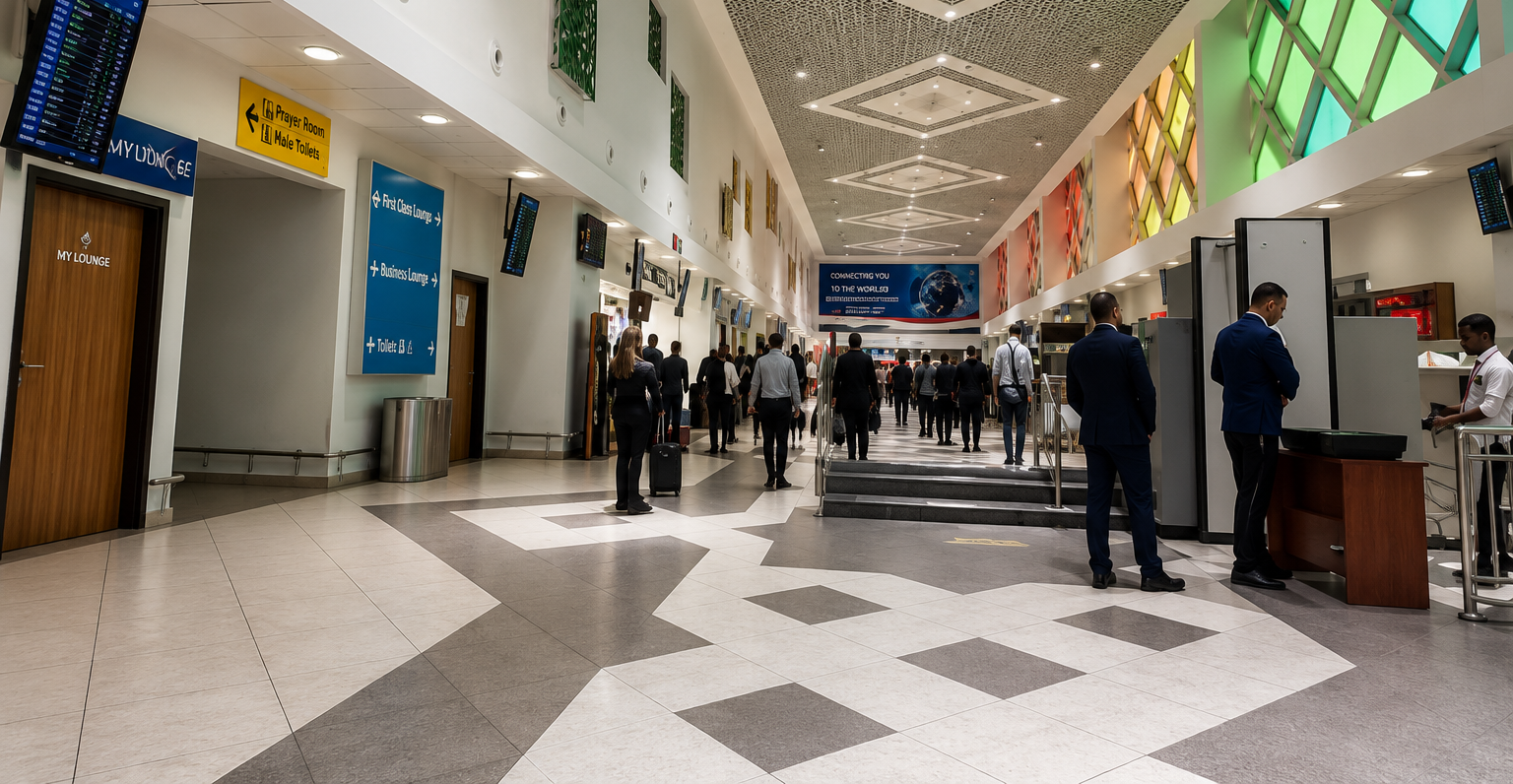
The sole international gateway of the world's most remittance-dependent economy — where every flight carries the weight of $5.8 billion in annual household financial decisions.
Dushanbe International Airport is not simply Tajikistan's largest airport — it is the country's only commercially significant international aviation hub, handling virtually every inbound and outbound international journey for a landlocked, mountainous nation of approximately 10 million people. In 2024, the airport handled approximately 2.3 million passengers, reflecting steady 5 percent year-on-year growth from a post-pandemic recovery base that was already substantially above pre-2020 levels. Every government delegation, every returning migrant, every inbound investor, and every departing pilgrim passes through DYU's single terminal, creating a concentrated, captive audience exposure environment with no meaningful competitive dilution across alternative airports in the capital catchment. For advertisers, Tajikistan's aviation geography is a structural gift: there is only one airport that matters, and it is this one.
What elevates Dushanbe International Airport beyond a simple regional gateway is the economic context it operates within. Tajikistan recorded remittances equivalent to approximately 45 percent of GDP in 2024 — the highest ratio of any country in the world according to World Bank data — with total inflows reaching $5.8 billion. The passengers at DYU are the human carriers of this capital. They depart as workers seeking income and return as household investors deploying accumulated savings into construction, consumer goods, family assets, and small business investment. No other category of advertiser-audience alignment in Central Asian aviation is as structurally reliable as the remittance-return moment at DYU.
Advertising Value Snapshot
- Passenger scale: Approximately 2.3 million passengers in 2024, representing 5 percent year-on-year growth. A new terminal is under active construction with completion expected by 2026 to 2027, signalling government confidence in continued traffic growth and a materially expanded commercial environment ahead.
- Traveller type: Outbound and returning labour migrants concentrated on the Russia corridor; Hajj and Umrah pilgrims via Jeddah and Gulf transit points; government, mining, and industrial business travellers; and a growing inbound tourism segment from Russia, China, Turkey, and the Arab world drawn by adventure and cultural heritage programming.
- Airport classification: Tier 2 — Tajikistan's sole dominant international hub, serving the entire country's international air traffic with no viable competing airport in the capital region. Within its national context, DYU punches at effective Tier 1 status given its monopoly position.
- Commercial positioning: The definitive and exclusive air access point for a 10 million-person Muslim-majority nation whose economy is structurally built around outbound labour migration, remittance returns, and growing hydropower and mining export revenue.
- Wealth corridor signal: DYU sits on the Dushanbe-to-Moscow labour corridor and the Dushanbe-to-Dubai-to-Jeddah pilgrimage and trade corridor — two of the highest-transaction-volume human movement channels in the former Soviet and Islamic world respectively.
- Advertising opportunity: Masscom Global activates brands at DYU with intelligence calibrated to the specific financial and cultural profile of Tajikistan's outbound and returning audience. With Open Skies legislation enacted in June 2025 and new terminal construction underway, the commercial environment at DYU is accelerating and Masscom is positioned to move ahead of that inflection.
Airport Advertising is Complex to Get Right
We help you execute faster, with proven results and local insight most planners lack starting now.
Talk to an ExpertCatchment Area and Economic Drivers
Top 10 Cities within 150 km — Marketer Intelligence
- Dushanbe (capital, approx. 1.04 to 1.56 million): Tajikistan's sole major city and the economic, political, and financial nerve centre of the entire country. Over 20 percent of national GDP is concentrated here through industry, finance, and services. The capital generates the country's highest-spending consumer segment — government employees, banking professionals, NGO and international agency workers, and the upper tier of the migrant-return household — making it the most commercially active address in Tajikistan's advertising landscape.
- Vahdat (approx. 25 km east, approx. 60,000): A satellite industrial and residential city immediately east of Dushanbe along the Varzob River corridor. Vahdat produces a working-class and lower-middle-income consumer audience whose household finances are significantly bolstered by remittance income. Construction materials, mobile financial services, and affordable consumer electronics brands have strong audience resonance here.
- Hissar / Hisor (approx. 25 km west, approx. 30,000): Home to the historic Hissar Fortress, one of Tajikistan's premier archaeological and tourism sites, and a growing residential suburb of Dushanbe. The fortress site generates a stream of cultural tourists who transit DYU, while the residential population adds a remittance-funded middle-income consumer layer to the catchment.
- Tursunzoda (approx. 60 km west, approx. 60,000): The location of TALCO, Tajikistan's aluminium processing plant and the country's single largest industrial employer and export earner. TALCO generates the most significant industrial management and procurement travel segment at DYU — executives, engineers, and international buyers transiting to and from the plant. B2B industrial, financial services, and premium business brands benefit from this commercially distinct audience.
- Nurek (approx. 70 km east, approx. 25,000): Site of the Nurek Hydropower Dam, one of the world's tallest dams and the source of the majority of Tajikistan's electricity. The dam powers TALCO and exports electricity to Afghanistan and Uzbekistan. The technical and engineering workforce here generates a specialist business travel segment at DYU with above-average income and procurement-oriented spending patterns.
- Roghun (approx. 100 km east): Site of the Rogun Hydropower Dam, a project that when completed will be the world's tallest dam at 335 metres. Construction is ongoing with World Bank support, and the project employs thousands of workers and international engineers who transit DYU regularly. The Rogun development represents Tajikistan's most strategically significant infrastructure investment of the decade and produces a sustained B2B and engineering travel segment.
- Bokhtar / Qurghonteppa (approx. 77 km south, approx. 65,000): The capital of Khatlon Region and a significant agricultural and cotton processing hub. Bokhtar is served by a small domestic airport but for international travel it relies on DYU. The region's commercial farming and agri-processing economy generates a procurement and family travel audience with strong Hajj travel ties given the conservative religious character of the Khatlon population.
- Varzob (approx. 30 km north): A mountain gorge resort area immediately north of Dushanbe that serves as the primary domestic leisure destination for the capital's middle and upper classes. Varzob attracts both domestic leisure travellers and inbound tourists using DYU as the entry point for mountain and adventure activities. Premium hospitality, outdoor equipment, and personal care brands find audience relevance in this segment.
- Shahrinav (approx. 40 km northwest): A district centre within Dushanbe's western hinterland with agricultural and light industrial activity. The population here is predominantly remittance-dependent, making it a strong catchment for financial services, mobile payment platforms, and consumer goods brands that target returning migrant households.
- Faizabad (approx. 110 km northeast): The capital of Rasht Valley and a gateway to eastern Tajikistan's mountainous regions. Faizabad generates a flow of local officials, traders, and agricultural workers transiting DYU for Tashkent, Moscow, or Gulf connections. The surrounding Rasht Valley is known for its traditional communities and significant gold extraction activity, producing a niche but commercially relevant extractive industry audience at DYU.
NRI and Diaspora Intelligence
Tajikistan's outbound migration dynamic is among the most extreme of any country in the world and is the single most commercially structuring fact about DYU's audience. Approximately 1.2 million Tajik citizens work in Russia alone, representing 16 percent of all foreign workers in the Russian Federation — a number that for a country of only 10 million represents a structural dependence on external labour income that permeates every household in the catchment. Total remittances in 2024 reached $5.8 billion, equivalent to 45 to 49 percent of GDP — the highest proportion anywhere in the world according to World Bank data. For DYU, this means that every passenger arriving from Moscow, St. Petersburg, Yekaterinburg, or the Gulf cities is arriving with accumulated savings in a state of immediate deployment readiness. The arrivals hall at DYU is, in practical commercial terms, the country's single most important financial services and consumer goods activation zone: it is the physical location at which remittance capital first touches the domestic economy in human form.
Economic Importance
Tajikistan's economy is built around four commercially relevant pillars for advertisers. Labour migration and remittances, at close to half of GDP, are the defining economic reality. Aluminium processing at TALCO in Tursunzoda generates the country's primary industrial export and produces a management and procurement travel segment at DYU that is distinct from the migrant base. Hydropower, anchored by the Nurek Dam and the in-construction Rogun Dam, is the strategic growth engine of the Tajik economy and generates a sustained flow of international engineers, World Bank and ADB officials, and government stakeholders through DYU. And agriculture — cotton, fruits, and vegetables — creates a trade and procurement audience in the Khatlon Region south of Dushanbe. For advertisers, the most commercially activated audience at DYU is the remittance-return segment, but the hydropower and aluminium business travel segment represents the upper tier of the airport's commercial spending profile.
Business and Industrial Ecosystem
- Aluminium processing and metallurgy: TALCO at Tursunzoda is Tajikistan's largest employer and export earner, powered by the Nurek Dam. International buyers, logistics operators, and corporate management transit DYU regularly, creating a B2B commercial travel segment for financial services, premium hospitality, and corporate product brands.
- Hydropower construction and engineering: The Rogun Dam project, backed by the World Bank and international donors, employs thousands of workers and generates a sustained flow of engineers, consultants, and government officials through DYU. B2B technology, industrial equipment, and financial services brands find a specialised and commercially distinct audience in this segment.
- Government and international organisations: Dushanbe is the seat of Tajikistan's government and hosts significant presences from the United Nations, World Bank, ADB, European Union, and bilateral aid agencies. This institutional presence generates a well-resourced, internationally experienced business traveller segment at DYU who travel to Tashkent, Moscow, Istanbul, and Geneva for meetings and conferences.
- Mining and natural resources: Gold, silver, and antimony extraction in Tajikistan's mountain districts generates a business and technical travel segment from district administrators, mining company managers, and export logistics professionals who concentrate their international connections through DYU.
Passenger Intent — Business Segment: The business traveller at DYU falls into two distinct categories. The institutional and industrial traveller — TALCO management, Rogun Dam engineers, UN and World Bank staff — is internationally oriented, travels to Moscow, Geneva, Beijing, and Dubai, and represents the airport's highest per-trip spending audience. The second category is the SME owner and trader — buyers of goods from Turkey and China, exporters of agricultural products and minerals — whose travel is transactional and whose financial services needs are concentrated around cross-border payment and currency management products.
Strategic Insight: The DYU business environment is commercially differentiated by its government-adjacent character. A significant share of Tajikistan's formal-sector business operates in proximity to state institutions, international aid machinery, and the TALCO-Rogun industrial complex. Brands targeting B2B decision-makers who move between Dushanbe, Moscow, Istanbul, and Beijing — and who are accompanied by international institutional travellers with European spending standards — will find DYU a surprisingly productive channel for premium B2B advertising given the concentration of that audience in a single small terminal.
Tourism and Premium Travel Drivers
- Pamir Mountains and Pamir Highway: Tajikistan's defining tourism proposition, the Pamir Highway is one of the world's highest road journeys, connecting Dushanbe to Khorog and Osh through dramatic high-altitude terrain. DYU is the entry point for adventure tourists from Russia, Europe, China, and the Arab world who arrive specifically for Pamir trekking, cycling, and mountain tourism. This growing segment brings above-average per-trip spending and is expanding rapidly as Tajikistan's tourism profile rises internationally.
- Hissar Fortress (approx. 25 km from DYU): One of Central Asia's most significant medieval fortresses, a UNESCO-nominated site, and the most visited archaeological attraction near Dushanbe. The fortress anchors the Silk Road cultural tourism circuit and attracts diaspora-adjacent visitors and international cultural tourists who transit DYU. Tourism brands, premium hospitality, and cultural experience products find strong audience resonance here.
- Varzob Gorge and mountain resort corridor: The immediate mountain recreation zone north of Dushanbe generates domestic leisure tourism from Dushanbe's professional class as well as inbound tourism seeking mountain retreat experiences. Radisson and Hyatt have established presences in Dushanbe for this growing hospitality demand.
- National Museum of Tajikistan and Rudaki Park: Dushanbe's cultural core, including one of Central Asia's largest national museums and the city's most important public park. These anchor the capital's city tourism offering for international visitors using DYU. Food and beverage, cultural experience, and personal care brands benefit from the inbound cultural tourist segment centred on these attractions.
Passenger Intent — Tourism Segment: The inbound tourist at DYU arrives through Istanbul, Moscow, Dubai, or Beijing having pre-committed to an adventure or cultural itinerary with above-average hospitality spending. The Russian and Chinese tourist segments are the largest in volume and bring mid-tier spending profiles. The European and Arab tourist segments, though smaller in volume, arrive with significantly higher per-day budgets and a premium hospitality expectation. Outbound leisure travellers from DYU are predominantly using Istanbul and Dubai as transit hubs for European and further Gulf destinations, creating a transit spending audience with duty-free, personal care, and travel accessory relevance at the terminal.
Travel Patterns and Seasonality
Peak seasons:
- Navruz season (March 15 to April 5): Navruz on March 21 is the most significant travel and spending trigger of the year for Tajikistan. Workers abroad return from Russia and Kazakhstan for the spring holiday, families reunite, and consumer spending on food, clothing, household goods, and home improvement peaks simultaneously. This is DYU's highest commercial intensity window and the most critical planning period for any advertiser entering the Tajik market.
- Ramadan and Eid al-Fitr (variable): The Islamic holy month and its Eid celebration create a concentrated domestic consumer spending surge. Household food, clothing, personal care, and gifting budgets peak in the days surrounding Eid. The Umrah pilgrimage in Ramadan adds an outbound travel spike on the Jeddah route, creating a devotional audience moment at the departure gate.
- Summer migrant return (June to September): The Northern Hemisphere summer triggers the largest volume of returning workers from Russia and the Gulf. July and August see peak remittance-funded household spending deployments across construction, consumer electronics, and retail. Families separated since the previous Navruz reunion are at maximum emotional and financial activation during this window.
- Eid al-Adha and Hajj season (variable, typically May to July): Hajj is the single highest-spending per-trip event in Tajikistan's travel calendar. Departing pilgrims are emotionally committed, financially pre-deployed, and receptive to brands aligned with Islamic values, quality, and family wellbeing. The Jeddah route from DYU specifically serves this audience, and the pre-departure gate zone is the highest-intent advertising environment at the airport.
Event-Driven Movement
- Navruz National Holiday (March 21): The defining annual commercial trigger. Every advertiser category with relevance to returning migrant households should plan activation around the two-week window surrounding Navruz.
- Eid al-Fitr (variable, April or May): Peak household gifting, apparel, and food spending. Financial services, FMCG, and personal care brands achieve maximum receptivity during this window.
- Eid al-Adha (variable, June or July): Pilgrim departures on the Jeddah route, livestock and food spending domestically, and a general household celebration trigger combining religious and consumer commercial activity.
- Independence Day of Tajikistan (September 9): A national holiday coinciding with the tail of the summer migrant return season and extending the household spending window into early September.
- Opening of ski and winter resort season (November to March): Varzob and the mountain resort corridor north of Dushanbe generate a domestic and regional leisure travel audience at DYU during the winter months, adding a leisure hospitality segment to the airport's predominantly labour-migration-driven traffic base.

It’s Not Just Where You Advertise - It’s How Fast You Execute
We combine local insight with fast rollout to deliver results for you, now.
Talk to an ExpertAudience and Cultural Intelligence
Top 2 Languages
- Tajik (Tajik Persian): The primary language of the Tajik population and the official language of the state. Campaigns in Tajik carry the highest authenticity signal for consumer goods, financial services, Islamic lifestyle, and personal care brands targeting the domestic and diaspora-return audience. The Tajik script and the Persian-origin vocabulary carry specific cultural resonance for the returning migrant audience who most strongly associate the mother tongue with home, family, and personal identity.
- Russian: The working language of Tajikistan's labour migrants during their time in Russia, and widely used in government, education, and urban professional contexts in Dushanbe. Russian-language creative is the practical default for financial services brands serving the remittance corridor, telecoms brands addressing cross-border worker communication, and B2B brands targeting the international institutional and industrial audience that transits DYU.
Major Traveller Nationalities
The dominant nationality at DYU is Tajik, comprising the overwhelming majority of both outbound and inbound passengers. Russian nationals represent the largest inbound foreign segment, arriving for business meetings related to energy projects, bilateral government engagement, and a small but growing leisure tourism category. Chinese nationals are a growing presence at DYU driven by infrastructure investment activity and direct flight connectivity, representing a B2B procurement and project management audience. Turkish passengers reflect the strong bilateral trade, education, and cultural ties between Tajikistan and Turkey. Iranian nationals use the Tehran route for business and cross-border trade, contributing a Persian-language audience with commercial ties to Dushanbe's trading economy.
Religion — Advertiser Intelligence
- Sunni Islam (approx. 95%): Islam is the foundational cultural and commercial context at DYU. The Tajik Muslim population observes the full Islamic calendar, and the annual rhythm of Ramadan, Eid al-Fitr, Eid al-Adha, and the Hajj pilgrimage creates a structured, predictable series of high-intensity commercial activation windows. For FMCG brands, the pre-Eid gifting window is the single highest-ROI period. For financial services brands, the pre-departure Hajj window at the departure gate captures a devotionally committed audience making some of the most significant financial commitments of their lives. For personal care and apparel brands, Ramadan represents peak category spending. Advertisers who structure their DYU campaigns around the Islamic calendar rather than the Gregorian commercial year will consistently outperform those who apply generic planning logic.
- Ismaili Islam (approx. 3 to 5%, concentrated in Badakhshan and Pamirs): A smaller but distinctive Muslim community in eastern Tajikistan, followers of the Aga Khan. The Ismaili population has historically benefited from Aga Khan Development Network investment in education and infrastructure, producing a relatively higher-income and better-educated rural audience. Ismaili travellers using DYU to connect to international Aga Khan Foundation activities and diaspora communities in Europe and Canada represent a niche but commercially distinct upper-income segment.
Behavioral Insight
The Tajik passenger at DYU operates within a financial psychology shaped by years of delayed gratification. A returning migrant arrives having spent months in a low-expenditure, high-saving work environment in Russia or the Gulf, and the moment of return is simultaneously the moment of financial deployment. Decisions on home renovation, consumer electronics, family celebrations, land or property purchase, and children's education are compressed into the first weeks following return. Advertisers who understand this concentrated deployment cycle — and who position their brand at the DYU arrivals interface as the first commercial impression after months away — intercept an audience at maximum financial and emotional activation. This is not a passive browsing audience; it is a committed spending audience arriving with a plan.
Outbound Wealth and Investment Intelligence
The outbound passenger at Dushanbe International Airport is primarily a labour migrant, a pilgrim, or a business traveller, rather than an HNI capital allocator in the conventional sense. But within this structural reality lies a commercially important and often underestimated opportunity: Tajikistan's economy is growing at 8.4 percent real GDP growth in 2024, remittance income has created a growing middle-income household segment with rising aspirational consumption, and the government's infrastructure investment programme — anchored by Rogun Dam and a $140 million airport upgrade — signals an economy beginning its transition from pure labour export to domestic investment accumulation.
Outbound Real Estate Investment: The primary real estate investment orientation for Tajik returnees and migrant workers is domestic. Dushanbe's property market is absorbing remittance capital at a rapid pace, with new residential construction visible across the capital. Brands serving the domestic construction and home improvement market are the most commercially relevant real estate-adjacent advertisers at DYU. Internationally, a small but growing segment of higher-earning Tajik professionals is beginning to explore UAE and Turkish property options, particularly families of workers already based in Dubai or Istanbul. International property brands targeting the Gulf and Turkey markets will find a nascent but growing audience within DYU's business-class traveller segment.
Outbound Education Investment: Russia remains the primary destination for Tajik students pursuing higher education, driven by language access, bilateral agreements, and cost. Turkey is a fast-growing secondary destination, with Turkish universities actively recruiting in Tajikistan. A smaller premium segment is beginning to explore European and Gulf universities, particularly for postgraduate and professional education. The June to September departure window at DYU is the primary student outbound season, and this audience — often accompanied by parents making significant financial commitments — is highly receptive to education brand advertising, student banking services, and communication products at the terminal.
Outbound Wealth Migration and Residency: Formal Golden Visa or residency-by-investment programmes are not yet mass-market products for the DYU audience given the catchment's medium-high HNWI profile. However, the post-Crocus City Hall attack environment in Russia — where over 20,000 Tajik migrants were deported in 2024 and Russia's migration policy has become increasingly restrictive — is accelerating interest in alternative work and residency destinations. UAE, Turkey, South Korea, and European countries are all growing in relevance as Tajikistan's government diversifies outbound migration targets. Brands offering cross-border financial products, international banking, and alternative migration pathway services are entering a window of rising audience receptivity.
Strategic Implication for Advertisers: DYU is best approached as a mass-volume, remittance-cycle-driven commercial channel with a specific business traveller premium layer. The commercial return comes from aligning brand presence with the return-migrant spending cycle, the Islamic calendar's commercial triggers, and the B2B corridor of industrial, energy, and institutional travel. Masscom Global structures DYU campaigns to capture all three simultaneously, ensuring that brands with the right category fit are present at the precise moments when audience intent peaks.
Airport Infrastructure and Premium Indicators
Terminals
- Current terminal (French-built, opened September 2014): An 11,000 square metre facility designed and constructed by VINCI Construction with French government financing. Built to accommodate 1.5 million passengers per year, it is currently operating above nameplate capacity at 2.3 million, creating structural pressure that has driven the decision to build a second terminal. The terminal features duty-free retail, VIP and CIP lounges, a business lounge, currency exchange, ATMs, cafes and restaurants, and Wi-Fi throughout.
- New terminal under construction (2025 to 2026): Construction of a second passenger terminal began in 2025 with Turkish and Chinese specialists engaged for design and delivery. The new terminal is expected to be operational within one to two years of groundbreaking and will substantially expand DYU's capacity, passenger processing speed, and commercial retail environment. Meeting areas for arriving and departing passengers are also under construction as an immediate comfort upgrade.
- Government and military facility: DYU operates as a joint civil and military airport, with the runway and apron infrastructure sized to accommodate wide-body aircraft including the Boeing 747 and Ilyushin Il-76.
Premium Indicators
- VIP and CIP lounges: The 2014 terminal includes dedicated VIP and CIP lounge facilities with personalised service — a meaningful premium signal for Tajikistan's government, industrial, and diplomatic traveller segment.
- Business lounge: A separate business lounge offering a quieter work and rest environment reflects the airport's growing institutional and corporate travel base.
- International hotel brands in the catchment: Radisson and Hyatt both operate properties in Dushanbe, signalling a premium hospitality environment for the B2B and institutional audience that transits DYU. These brands' presence confirms the commercial viability of the airport's upper-tier traveller segment for premium advertisers.
- Open Skies policy (June 2025): In June 2025, Tajikistan enacted a landmark Open Skies policy that abolishes the flight parity rule restricting foreign carrier frequencies, eliminates limits on aircraft types and carrier numbers, and tasks the Civil Aviation Agency with expedited route approvals. This is the single most commercially significant recent development at DYU: it signals that the number of airlines, routes, and passengers using Dushanbe is set to increase materially in 2026 and beyond as new international carriers enter the market.
Forward-Looking Signal: The convergence of three developments at DYU makes the next two to three years the most commercially dynamic in the airport's history: a new terminal entering service by 2026 to 2027, an Open Skies policy that will attract new international carriers and routes, and a domestic economy growing at over 8 percent annually on the back of remittance inflows and hydropower investment. When Rogun Dam is completed, Tajikistan will transition from a remittance-dependent economy to a regional energy exporter — a structural economic shift that will elevate both the spending power and the commercial ambition of the DYU passenger base. Masscom Global advises brands to establish their DYU presence ahead of this inflection, accessing current inventory conditions before the expanded terminal and incoming airline network materially increase both competition and placement costs.
Airline and Route Intelligence
Top Airlines: Somon Air, Ural Airlines, S7 Airlines, UTair, Nordwind Airlines, Turkish Airlines, flydubai, Air Astana, Uzbekistan Airways, AZAL (Azerbaijan Airlines), Jazeera Airways, Varesh Airlines (Iran), China Southern, Tajik Air
Key International Routes:
- Moscow Vnukovo, Moscow Domodedovo, Moscow Sheremetyevo (dominant, accounting for over half of total capacity)
- Saint Petersburg, Yekaterinburg, Novosibirsk, Krasnoyarsk, Samara, Sochi, and other Russian regional cities
- Istanbul (Turkish Airlines, Somon Air — year-round)
- Dubai (flydubai — year-round)
- Jeddah (Somon Air — Hajj and Umrah season)
- Baku (AZAL — year-round)
- Almaty (Air Astana — year-round)
- Tashkent (Uzbekistan Airways, Somon Air)
- Tehran (Varesh Airlines — seasonal)
- Beijing and Chinese cities (China Southern — seasonal)
- Kuwait City (Jazeera Airways)
- New Delhi (seasonal)
Domestic Connectivity:
- Khujand (Somon Air, 4x weekly — northern Tajikistan)
- Kulob, Penjikent (Tajik Air, limited frequency)
Wealth Corridor Signal: The route map at DYU tells Tajikistan's economic story with complete clarity. The Moscow-dominant network — accounting for over 50 percent of all seats — is the remittance corridor: workers departing for construction and service employment and returning with accumulated wages. Istanbul is the trade and transit corridor: goods sourced in Turkey, educational connections, and onward European access for the institutional and government segment. Dubai is the Gulf corridor: workers in UAE, family visits, and the transit route for Hajj pilgrims connecting to Jeddah. The Beijing routes reflect China's growing infrastructure investment presence in Tajikistan. Each corridor maps to a specific audience segment with a specific financial profile, and effective advertising at DYU means targeting the right brand message to each gate's departure profile.
Media Environment at the Airport
- Single terminal, total passenger capture: The 2014 terminal's compact 11,000 square metre footprint means every passenger passes through the same commercial zones on the way to and from their flight. There is no terminal fragmentation, no audience dilution, and no missed segments. Every placement at DYU reaches the full passenger load, making share-of-voice calculations unusually favourable for early-entry advertisers.
- Elevated dwell times from processing bottlenecks: DYU's current infrastructure is handling 2.3 million passengers through a terminal built for 1.5 million, creating systematically extended dwell times in the departure hall, arrivals zone, and airside commercial areas. This operational pressure on the terminal is a commercial advantage for advertisers: passengers spend more time in front of placements than at comparably sized airports with adequate infrastructure.
- High-intensity arrivals zone: The arrivals corridor at DYU is among the most commercially valuable advertising environments in Central Asian aviation. Returning labour migrants arriving from Moscow, Dubai, or Istanbul have been absent from the domestic economy for months. They are arriving into a family, retail, and social environment they have been mentally preparing for throughout their working period abroad. The arrivals zone intercepts this audience at maximum emotional and financial activation — a commercial opportunity that is structurally unique to remittance-economy airports.
- Masscom Global's access and execution at DYU: Masscom Global activates brands at Dushanbe International Airport with the precision of a partner who understands the specific audience zones, the Islamic calendar's commercial triggers, and the strategic importance of arrivals-side versus departures-side placement for different advertiser categories. Brands entering DYU with Masscom are not buying blanket coverage — they are deploying audience-calibrated intelligence across 140 countries into the specific commercial geometry of Tajikistan's sole international gateway.
Strategic Advertising Fit
Best Fit
- Mobile financial services and remittance transfer platforms: The highest-ROI advertiser category at DYU without exception. Returning migrants arrive with cash or incoming transfer confirmations. Outbound workers need the most cost-effective, reliable international money transfer solutions available. DYU is the physical meeting point of Tajikistan's most important financial product category and its primary user group.
- Telecom and mobile data providers: Tajik workers abroad need affordable international communication, SIM solutions, and data roaming. Domestic operators and international telecoms brands targeting the Russia-Tajikistan corridor will find this audience at maximum decision-readiness at the DYU departure and arrivals interface.
- Halal consumer goods, personal care, and FMCG: The Muslim consumer market at DYU is structurally aligned with Eid gifting, Ramadan household spending, and the pre-pilgrimage personal preparation window. Halal-certified food, cosmetics, and household goods brands achieve their highest audience receptivity in this environment.
- Consumer electronics and mobile devices: Returning migrants invest early in smartphones and home electronics after months of savings accumulation. The arrivals hall at DYU is the most commercially direct intercept available for electronics brands targeting the first-week-of-return spending window.
- Construction materials and home improvement: Tajikistan's remittance-funded residential construction market is active and growing. Arriving workers routinely deploy a portion of savings into housing improvement in the months following return. Building materials, paints, tiles, sanitary ware, and home furnishing brands face a high-intent B2C audience at the arrivals interface.
- Islamic finance and banking products: The Tajik population is receptive to Sharia-compliant financial products, and the growing profile of Islamic banking in Tajikistan — combined with the Hajj traveller segment — creates strong audience alignment for Islamic finance brands at DYU.
- Education and student services: Russia and Turkey-bound students departing DYU in summer represent a high-aspiration, family-supported audience making significant financial education commitments. International universities, language schools, and student financial services brands find a concentrated, decision-stage audience at the June to September departure window.
Brand Alignment at a Glance
| Category | Fit |
|---|---|
| Mobile financial services and remittance | Exceptional |
| Telecom and mobile data | Exceptional |
| Halal consumer goods and FMCG | Exceptional |
| Consumer electronics and mobile devices | Strong |
| Construction materials and home goods | Strong |
| Islamic finance | Strong |
| Education and student services | Strong |
| Premium luxury goods | Poor fit |
| International premium real estate | Poor fit |
Who Should Not Advertise Here
- Ultra-premium luxury brands (high jewellery, private aviation, ultra-luxury automotive): The DYU audience's Medium-High HNWI score reflects a market whose commercial energy is in remittance-funded household and consumer spending rather than aspirational luxury purchasing. Brands requiring a true ultra-HNI audience will not achieve viable return at this airport.
- Premium European Golden Visa and residency investment products: The capital and aspiration threshold for Greek, Maltese, or Portuguese residency-by-investment programmes is not yet present at mass-market scale in Tajikistan's current consumer base.
- Mass-market brands without Islamic calendar awareness: Generic consumer brands that advertise year-round without adapting to the Navruz, Ramadan, and Eid windows will systematically underperform relative to the audience's actual commercial calendar.
Event and Seasonality Analysis
| Event Strength | High |
| Seasonality Strength | High |
| Traffic Pattern | Dual-Peak with Religious Overlay |
Strategic Implication: DYU operates on a seasonality calendar that is simultaneously shaped by Russia's labour market cycle and the Islamic liturgical year, creating a commercial environment where the highest-value windows are determined by two independent but overlapping systems. The Navruz-to-summer arc from mid-March through August is the primary volume and spending peak, driven by returning migrants and pilgrimage traffic. The Eid al-Adha window in the second quarter adds a secondary religious commercial intensity peak. Masscom structures DYU campaigns to capture the full value of this dual-calendar dynamic, ensuring brands are in market at every peak rather than just the most visible one. Year-round presence at DYU, budgeted around four key windows — Navruz, Eid al-Fitr, summer return, and Eid al-Adha — consistently outperforms single-window activation strategies.

Poor Placement and Delays Affect Airport Campaigns
We help you move faster, access better inventory, and get it right now.
Talk to an ExpertFinal Strategic Verdict
Dushanbe International Airport is one of the most structurally compelling remittance-economy advertising environments in the post-Soviet world. It is the sole international gateway of a country where nearly half of GDP flows through the hands of returning migrants, where every arrivals-hall moment carries a deployment decision, and where Islamic calendar triggers create four distinct high-intensity commercial windows per year. The Open Skies policy enacted in June 2025, the new terminal under construction for 2026 delivery, and an economy growing at 8-plus percent annually on the back of hydropower investment and continued remittance inflows all point in the same direction: DYU is a commercially ascending environment, and the brands that enter now access inventory conditions that will not survive the terminal expansion. Masscom Global provides the access, the audience intelligence, and the execution precision to turn Tajikistan's remittance economy into a sustainable advertising return. The commercial case for DYU is not a question of if — it is a question of when, and that answer is now.
About Masscom Global
Masscom Global is a premium international airport advertising and media buying agency operating across 140 countries. With deep expertise in airport OOH, premium publications, and high-net-worth audience targeting, Masscom helps brands reach the world's most valuable travellers at the moments that matter most. For advertising packages, media rates, and campaign planning at Dushanbe International Airport and airports across the globe, contact Masscom Global today.
Frequently Asked Questions
How much does airport advertising cost at Dushanbe International Airport? Advertising costs at Dushanbe International Airport vary based on placement format, zone within the terminal, campaign duration, and seasonal period. The current terminal, operating above its original design capacity, offers concentrated audience exposure at entry-level rates relative to comparable CIS airports. With a new terminal entering service by 2026 to 2027 and Open Skies legislation expected to bring new airlines and passengers, current pricing represents a structurally advantaged entry point. Contact Masscom Global directly for a bespoke rate card and campaign proposal for DYU.
Who are the passengers at Dushanbe International Airport? DYU's passenger base is primarily composed of outbound and returning labour migrants on the Russia and Gulf corridors, Hajj and Umrah pilgrims on the Jeddah route, domestic Tajik travellers connecting via Tashkent or Istanbul to further destinations, and a growing inbound tourist segment from Russia, Turkey, China, and the Arab world. The airport also serves a B2B audience of industrial management, energy sector engineers, government officials, and international organisation staff associated with Tajikistan's aluminium, hydropower, and development finance sectors.
Is Dushanbe International Airport good for luxury brand advertising? DYU carries a Medium-High HNWI score, reflecting a market with strong commercial activity and rising consumer spending power but not the ultra-premium audience profile of Tier 1 regional hubs. Mid-tier aspirational brands in personal care, electronics, and home goods will find strong audience resonance given the remittance-funded spending capacity of the returning migrant base. Luxury brands requiring an ultra-HNI, globally mobile audience will achieve stronger returns at Tashkent, Dubai, or Istanbul rather than at DYU as a standalone buy.
What is the best airport in Central Asia to reach remittance-economy audiences? Dushanbe International Airport is unrivalled in the post-Soviet space for reaching the specific profile of a remittance-funded, Muslim-majority, Russia-corridor labour migration audience. Tajikistan's remittance dependence at 45 percent of GDP is the highest of any country in the world, making DYU the definitive channel for brands whose commercial proposition connects with returning migrant households, cross-border financial services, and Islamic calendar-driven consumer spending. For broader Central Asian reach, DYU should be considered alongside Tashkent and Namangan airports in a coordinated multi-airport strategy.
What is the best time to advertise at Dushanbe International Airport? The four highest-ROI windows at DYU are: the Navruz period around March 21, when returning migrants and maximum consumer spending coincide; the Ramadan and Eid al-Fitr window in spring, when Islamic calendar spending peaks across all categories; the summer migrant return period from June through August, when the largest volume of savings-carrying returnees arrive; and the Eid al-Adha and Hajj departure window when pilgrims at maximum devotional and financial commitment pass through the departure gate. Year-round presence, structured around these four anchors, delivers the highest aggregate return for brands with DYU audience alignment.
Can international real estate developers advertise at Dushanbe International Airport? International real estate developers targeting domestic Tajik buyers — particularly Dushanbe residential property developers responding to the remittance-funded construction boom — will find strong audience alignment at DYU. For overseas property markets, UAE-based developers serving the Gulf worker community will find some relevance given the Dubai route's audience profile. Premium European markets are not yet well-aligned with the current DYU audience profile, but Turkey-based developers and those in the UAE premium segment will find growing receptivity as the economy transitions and outbound wealth migration interest develops.
Which brands should not advertise at Dushanbe International Airport? Ultra-premium luxury brands, European residency-by-investment programmes, premium financial news and advisory services, and brands without Islamic calendar awareness or remittance-economy relevance will not achieve commercially viable returns at DYU in its current configuration. Brands requiring a globally mobile, ultra-HNI executive audience should prioritise Tashkent, Istanbul, or Dubai over DYU as a primary placement.
How does Masscom Global help brands advertise at Dushanbe International Airport? Masscom Global provides end-to-end advertising capability at Dushanbe International Airport, from audience intelligence and campaign timing strategy through to inventory access, creative guidance, and performance reporting. Our team understands the specific commercial dynamics of the DYU environment — the remittance arrival windows, the Islamic calendar triggers, the B2B industrial and institutional segments — and translates that understanding into placement decisions that maximise return for each advertiser category. With operations across 140 countries and deep experience in CIS and Central Asian airport markets, Masscom is uniquely positioned to activate DYU effectively for brands that understand its commercial logic. Contact us to start planning your Dushanbe campaign today.







