

Airport at a Glance
| Field | Detail |
|---|---|
| Airport | Detroit Metropolitan Wayne County Airport |
| IATA Code | DTW |
| Country | United States of America |
| City | Detroit, Michigan (Romulus) |
| Annual Passengers | 32.97 million (2024); 33.37 million (2025) |
| Primary Audience | Automotive industry executives, B2B corporate professionals, Arab-American diaspora, Delta premium cabin business travellers, Midwest HNWI leisure travellers |
| Peak Advertising Season | January (NAIAS Auto Show), June to August, November to December |
| Audience Tier | Tier 1 |
| Best Fit Categories | Automotive and Mobility, Financial Services, B2B Technology, International Real Estate, Premium Consumer Goods |
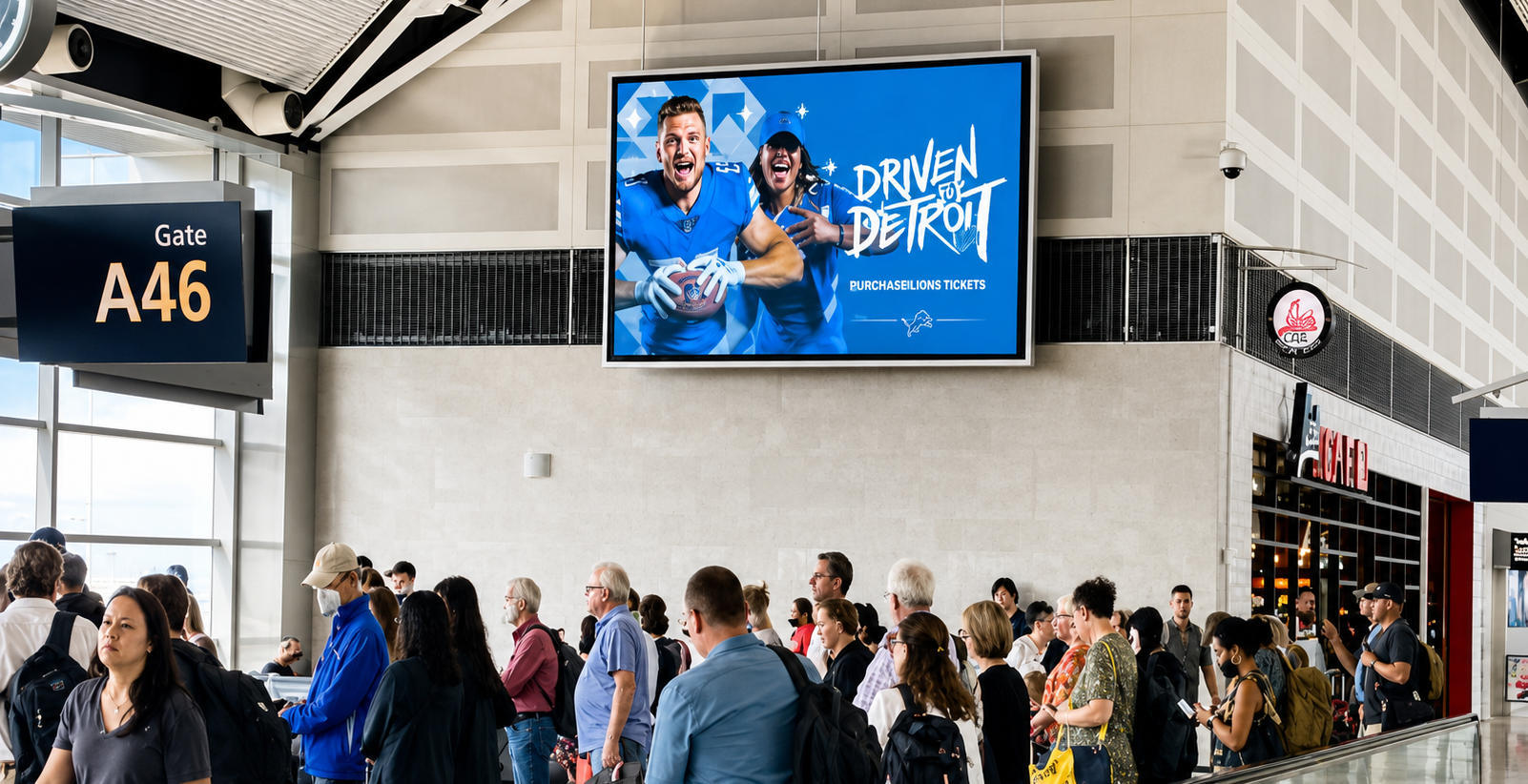
Detroit Metropolitan Wayne County Airport handled 32.97 million passengers in 2024, growing to 33.37 million in 2025, and sits within a Combined Statistical Area of 5.4 million people that ranks as the 12th most populous in the nation. Delta Air Lines dominates 74% of all flights from DTW — making it Delta's second-largest hub and the only airport in Michigan with direct Pacific and extensive transatlantic connections. The airport's Air Service Area hosts 19 Fortune 1000 company headquarters with combined annual revenue of USD 544.6 billion and over 839,000 employees worldwide. Two of those companies — General Motors and Ford Motor Company — rank among the 20 largest corporations in the United States by revenue, and every senior executive decision made within those organisations flows through this airport.
What makes DTW commercially distinctive in the US aviation landscape is the intersection of three audience streams that are rarely found under one roof. The first is the global automotive industry's brain trust — Ford, GM, Stellantis, and 65 of the top 100 North American automotive suppliers are headquartered in the catchment, generating a constant flow of senior technical, commercial, and executive talent on international routes to Frankfurt, Amsterdam, Tokyo, Seoul, and Shanghai. The second is the largest Arab-American community in the United States, concentrated in Dearborn adjacent to the airport, whose diaspora travel generates demand on Royal Jordanian's Amman service and Turkish Airlines' Istanbul flights in volumes that make DTW one of the most commercially significant Middle Eastern diaspora airports in the country. The third is the broader Midwest B2B professional community that treats DTW as its international departure hub for a 5.4-million-person catchment whose per-capita income and Fortune 1000 density rival any comparable regional gateway in the nation.


Advertising Value Snapshot
- Passenger scale: 32.97 million in 2024 (+4.83% YoY), 33.37 million in 2025; 19th largest US airport, recovering toward pre-pandemic peak of 36.77 million
- Traveller type: Automotive and mobility industry senior executives, Delta SkyTeam premium cabin business travellers, Arab-American diaspora on Middle Eastern and Turkish routes, B2B corporate professionals from the Midwest Fortune 1000 ecosystem, Japan and Korea-bound technology and trade executives
- Airport classification: Tier 1 — Delta's second-largest global hub, the only US airport outside the coasts with direct nonstop service to Tokyo, Seoul, and Shanghai; home to the second-longest airport concourse in the world
- Commercial positioning: The World Automotive Capital's international gateway and the Midwest's premier B2B aviation hub, connecting Detroit's USD 304 billion automotive economy to the global markets it serves
- Wealth corridor signal: DTW sits at the intersection of the US-Europe automotive trade corridor, the US-Japan and US-Korea technology and manufacturing partnership corridor, and the US-Middle East Arab-American diaspora remittance and investment corridor
- Advertising opportunity: Masscom Global provides brands with precision access to DTW's dual-terminal advertising ecosystem — from the world's second-longest airport concourse in the McNamara Terminal, home to five Delta Sky Clubs, to the Evans Terminal's international premium environment housing Lufthansa, Turkish Airlines, and Royal Jordanian — reaching the automotive industry's decision-making elite and the broader Midwest premium professional audience at maximum dwell time.
Airport Advertising is Complex to Get Right
We help you execute faster, with proven results and local insight most planners lack starting now.
Talk to an ExpertCatchment Area and Economic Drivers
Top 10 Cities within 150 km — Marketer Intelligence
- Detroit (city proper, ~640,000): The global headquarters of General Motors, the operational home of Ally Financial and Rocket Companies, and the urban renaissance city whose USD 15 billion in investment since 2010 has produced a growing technology and financial services sector layered directly over its automotive heritage — its C-suite and executive professional base drives DTW's most frequent, highest-value business travel on the European and Asia-Pacific corridors
- Dearborn (~100,000, ~20 km east): The global headquarters of Ford Motor Company and the largest Arab-American community in the United States — a city whose dual commercial identity as automotive capital and Arab-American cultural centre creates the most commercially distinct catchment community at any comparable US airport, generating both premium automotive executive travel and a high-volume diaspora travel base that sustains DTW's Royal Jordanian and Turkish Airlines services
- Auburn Hills (~25,000, ~40 km north): The North American operational headquarters of Stellantis, home to BorgWarner's global headquarters, and a cluster of tier-one automotive supplier R&D centres — whose senior technical and commercial leadership constitutes one of the most frequent business travel audiences on DTW's Frankfurt and Amsterdam corridors, travelling to European parent companies and supplier partners
- Southfield (~75,000, ~30 km northeast): Metro Detroit's largest suburban office market, housing national and international corporate offices for Lear Corporation, Lawrence Technological University, and dozens of financial services, consulting, and technology firms — its professional services executive community generates consistent premium business travel through DTW on domestic and international routes
- Ann Arbor (~125,000, ~55 km west): Home to the University of Michigan — one of the top three research universities in the United States — and Toyota's largest Research and Development centre outside Japan (a USD 1.5 billion, 50-year commitment housing over 2,000 engineers), Ann Arbor produces a continuously mobile, globally connected academic, research, and automotive technology executive audience that uses DTW daily for international travel to Japan, Germany, and beyond
- Windsor, Ontario (~250,000, ~5 km across the Detroit River): Canada's only border city directly adjacent to a major US metro, connected to Detroit via the Ambassador Bridge and the Detroit-Windsor Tunnel — its automotive manufacturing workforce (Stellantis Windsor Assembly Plant), casino resort community, and cross-border professional class create a unique binational catchment that adds a Canadian commercial dimension to DTW's originating audience
- Toledo, OH (~280,000, ~115 km south): Home to the Jeep Grand Cherokee assembly plant, Owens Corning headquarters, and a manufacturing corridor that supplies the automotive industry — its executive and technical professional class uses DTW as the closest major international hub for travel to European automotive supplier networks and Asian manufacturing partners
- Lansing (~120,000, ~130 km north): Michigan's state capital and home to General Motors' Lansing operations, Auto-Owners Insurance, and Jackson National Life — its government, financial services, and manufacturing professional community generates regular DTW-routed domestic and international business travel
- Flint (~100,000, ~90 km north): The original birthplace of General Motors and an active manufacturing corridor for GM's truck production, hosting Kettering University (one of the US's most cooperative engineering schools) — its automotive manufacturing management class and engineering talent pipeline generates consistent DTW-routed travel to Detroit corporate headquarters and international supplier meetings
- Port Huron (~30,000, ~100 km northeast): The gateway to Lake Huron and the Blue Water Bridge Canada crossing, generating both recreational tourism and cross-border trade professional travel through DTW — its logistics and trade management professional class uses DTW for all non-direct international travel
NRI and Diaspora Intelligence
Detroit's most commercially significant diaspora community is the Arab-American population — the largest in the United States, estimated at 300,000 to 400,000 people concentrated in Dearborn, Dearborn Heights, and greater Metro Detroit. This community encompasses Lebanese, Yemeni, Iraqi, Syrian, and Palestinian communities across multiple generations, many of whom maintain family, business, and investment ties to their countries of origin. Royal Jordanian's thrice-weekly Amman service is the primary direct gateway for the Jordanian, Palestinian, and wider Levant diaspora; Turkish Airlines' daily Istanbul service enables connections to Lebanon, Iraq, and the broader Arab world. The Arab-American professional community at DTW is commercially significant not just for its volume but for its profile — many are second and third-generation Americans with high professional achievement, significant household income, and active cross-border investment and remittance activity. The Polish-American community — one of the largest in the US, concentrated in Hamtramck and the Detroit metro — generates European travel on DTW's Amsterdam and Frankfurt corridors. The South Asian technology and research professional community in Ann Arbor and throughout Metro Detroit generates growing demand on DTW's Asia-Pacific routes.
Economic Importance
No US metropolitan economy is more defined by a single industry than Detroit — and no industry affects the global economy more directly than the one headquartered here. The Detroit automotive industry contributes USD 304 billion annually to Michigan's economy, employs 1.1 million people in automotive and mobility roles representing 20% of the state's workforce, and maintains the presence of 26 original equipment manufacturers, 65 of the top 100 North American automotive suppliers, and the global engineering R&D operations of virtually every major automaker and technology firm investing in the future of mobility. But the modern Detroit economy is not only automotive. Dan Gilbert's Rocket Companies has committed USD 500 million to downtown Detroit revitalization, generating a fintech and financial services sector that has produced one of the fastest-growing startup ecosystems in North America. The University of Michigan and Wayne State University anchor a research economy that ranks Michigan third or fourth nationally in R&D expenditure. For advertisers, this means DTW's catchment is simultaneously a sector-dominant industrial economy and an emerging technology hub whose professional class is internationally mobile, financially sophisticated, and commercially responsive.
Business and Industrial Ecosystem
- Automotive and mobility manufacturing: Ford, GM, Stellantis, and their 65 headquartered tier-one suppliers generate the world's most concentrated automotive executive and engineering travel audience — these professionals travel to Frankfurt, Amsterdam, Tokyo, Seoul, and Shanghai to manage supply chains, R&D partnerships, regulatory engagements, and investment reviews that shape the global vehicle fleet
- Automotive technology and EV transition: The shift to electric vehicles has layered a new wave of technology firms, battery chemistry researchers, and software engineers onto Detroit's traditional automotive base — their global partnerships with Japanese, Korean, and German technology partners are activated through DTW's Asia-Pacific and European routes in a new, growing category of cross-sector B2B travel
- Financial services and fintech: Ally Financial, Rocket Companies, and a growing financial technology ecosystem centred on Detroit's revitalised downtown generate a digitally sophisticated, internationally mobile financial professional class whose business travel skews toward New York, San Francisco, and international financial centres via DTW's domestic and international hub connections
- Healthcare and life sciences: Metro Detroit hosts one of the largest healthcare systems in the Midwest — Henry Ford Health System, Beaumont Health, and Wayne State University School of Medicine — generating medical research and pharmaceutical professional travel on DTW's European and Asia-Pacific routes for clinical trials, research conferences, and international healthcare investment
Passenger Intent — Business Segment: The DTW business traveller is the most technically credentialed regular flyer in Midwest aviation. They are not generalist corporate executives — they are automotive engineers flying to Stuttgart to review platform architectures, supplier directors flying to Tokyo to audit battery supply chains, venture capitalists flying to Frankfurt to evaluate EV technology startups, and regulatory professionals flying to Brussels for EU automotive emissions compliance meetings. The depth of technical and commercial expertise at DTW's premium cabin departure gates is unmatched at any comparable US regional hub, making the airport a uniquely specific and commercially potent environment for B2B advertisers serving the global mobility and technology sectors.
Strategic Insight: DTW's business advertising value is defined by the automotive industry's global reach combined with the scale of its local catchment. Every strategic direction taken by Ford, GM, and Stellantis in the next decade — electrification, software-defined vehicles, autonomous technology — requires intensive international travel between Detroit and Frankfurt, Amsterdam, Tokyo, Seoul, and Shanghai. The volume of senior executives, engineers, and commercial professionals travelling these routes through DTW is not shrinking — it is growing as the industry's transformation accelerates the need for global partnership and cross-border R&D collaboration. For brands serving this professional class, DTW is the point of maximum concentration.
Tourism and Premium Travel Drivers
- North American International Auto Show (NAIAS, January, Detroit): The world's premier automotive trade exhibition, returning to Detroit's Huntington Place convention centre annually and drawing over 100,000 automotive industry professionals, journalists, investors, and enthusiasts from across the United States, Germany, Japan, South Korea, France, and Italy — the single highest concentration of global automotive authority arriving through DTW in any calendar week, creating the airport's most commercially targeted B2B advertising window of the year
- Detroit's urban renaissance tourism: Dan Gilbert's USD 2.5 billion Downtown Detroit redevelopment, including the Bedrock portfolio of renovated historic buildings, Little Caesars Arena, and the expanded Detroit Riverfront, has produced a genuine urban tourism infrastructure — drawing convention delegates, sports fans, and cultural visitors to a city increasingly recognised as one of America's most remarkable civic transformation stories
- Lake Michigan and Northern Michigan luxury resort belt: Michigan's Gold Coast along Lake Michigan — anchored by Traverse City, Petoskey, and Charlevoix's premium resort communities — generates consistent premium outbound leisure travel through DTW on domestic routes, while the Cherry Blossom wine country of Traverse City draws premium inbound leisure visitors from across the Midwest and from Europe
- Great Lakes outdoor and water sports tourism: Michigan's extraordinary freshwater geography — bordered by four of the five Great Lakes — generates inbound tourism from Europe, Japan, and South Korea whose travellers use DTW as their arrival gateway for fishing, sailing, and outdoor premium experiences unavailable anywhere else in the continental United States
Passenger Intent — Tourism Segment: DTW's leisure travellers are overwhelmingly Midwest origin travellers departing for Florida (the most popular domestic route pair), Caribbean winter sun, European cultural destinations, and Japan and Korea for culinary and cultural tourism. International leisure arrivals are primarily European and Asian visitors combining automotive industry corporate travel with Michigan leisure extensions. Both segments share a characteristic that makes DTW commercially valuable for leisure brand advertising: they are high-disposable-income Midwest professionals whose leisure travel represents a deliberate investment in premium experience after a working year built around one of the world's most commercially serious industries.
Travel Patterns and Seasonality
Peak seasons:
- Summer (June to August): DTW's highest-volume leisure travel period, driven by Michigan's Great Lakes summer season, outbound Florida and Caribbean traffic, and European leisure season demand on the transatlantic routes — July is historically the busiest single month, with over 3.2 million passengers
- Winter holiday season (November to January): The second major peak, driven by holiday family travel, end-of-year automotive industry business travel cycles, and the January concentration of NAIAS traffic which extends the post-Christmas B2B peak well into the new year
- Spring business season (March to May): A consistent B2B peak driven by automotive show season, supplier conferences, and the automotive industry's first-quarter strategy and investment cycle generating concentrated European and Asia-Pacific executive travel
Event-Driven Movement
- North American International Auto Show (January, Detroit): The world's most commercially significant automotive gathering, drawing global automotive press, industry executives, supplier representatives, and investors through DTW in a concentrated 10-day window — every major automaker and supplier uses this event as a global executive gathering point, producing a uniquely concentrated audience of automotive industry HNWI and C-suite professionals at DTW simultaneously
- Detroit Grand Prix (June, Belle Isle / downtown Detroit): An IndyCar street circuit race returning annually to Detroit, generating a premium motorsports audience through DTW in early June — automotive executives, IndyCar sponsors, and racing industry professionals converge on the Motor City for a premium event that reinforces Detroit's connection to the global motorsports industry
- Ford World Headquarters product launches and major supplier summits: Ford's Dearborn headquarters, immediately adjacent to DTW, hosts regular global product launches, investor days, and executive summits that generate concentrated inbound business travel from Europe, Asia, and across North America — producing defined advertising windows aligned with Ford's annual communications calendar
- University of Michigan commencement and academic calendar (May and August): One of the world's largest and most prestigious university graduation ceremonies, drawing tens of thousands of families from across the US, Asia, and Europe through DTW in May — a high-income, education-premium audience whose brand engagement in this window is characterised by celebration, gifting, and aspirational consumption
- Detroit Lions and Tigers sports seasons (September to January, April to October): The return of the Detroit Lions to NFL playoff relevance and the cultural significance of Tigers baseball generate consistent sports travel through DTW — premium suite-holding corporate executives, sponsor guests, and out-of-state fans using DTW for same-day or overnight sports events
It’s Not Just Where You Advertise - It’s How Fast You Execute
We combine local insight with fast rollout to deliver results for you, now.
Talk to an ExpertAudience and Cultural Intelligence
Top 2 Languages
- English: The dominant language of DTW's primarily American automotive and corporate professional audience — a technically sophisticated, analytically driven consumer base whose brand preferences are shaped by an industry that has spent a century defining the relationship between product engineering and aspirational lifestyle, making them unusually receptive to brands that communicate quality, innovation, and engineering credibility
- Arabic: The language of Metro Detroit's 300,000-to-400,000-strong Arab-American community — the largest such community in the United States — whose cultural heritage, ongoing family ties to the Levant, and economic participation in both Detroit's automotive sector and Dearborn's thriving small business economy make Arabic-language advertising commercially relevant and highly effective at DTW's Evans Terminal where the Royal Jordanian and Turkish Airlines departure corridors concentrate this audience
Major Traveller Nationalities
American nationals are the dominant passenger group, with the automotive industry professional class forming a uniquely distinct sub-profile — technically credentialed, internationally experienced, and frequent international travellers on the European and Asia-Pacific routes. German nationals are the most commercially significant inbound foreign audience, arriving daily on Lufthansa's Frankfurt service and Delta's Germany connections for automotive industry partnership meetings, R&D collaborations at Ford, GM, and supplier tech centres, and investment and regulatory engagements. Japanese nationals represent the second most significant international inbound group — Toyota's 2,000-engineer Ann Arbor R&D centre, Honda's manufacturing partnerships, and the deep US-Japan automotive supply chain generate a consistent, high-income, technically senior Japanese professional community transiting through DTW. South Korean nationals are a growing segment on Korean Air/Delta's Seoul service, driven by Hyundai and Kia's growing US manufacturing presence and their supplier networks. French nationals travel on Air France's Paris service, connected to PSA/Stellantis's French parent company relationship and the substantial French automotive design community. Arab-American and Middle Eastern nationals constitute the most distinctive diaspora group at DTW, concentrated on the Royal Jordanian and Turkish Airlines corridors.
Religion — Advertiser Intelligence
- Christianity (approximately 62%): The dominant faith across DTW's Michigan catchment, encompassing Catholic communities — heavily represented in Metro Detroit's Polish-American, Lebanese Christian, and Italian-American populations — and Protestant communities across Michigan's manufacturing towns. Christmas and Easter generate DTW's two most significant leisure travel peaks, with premium family travel to Florida, the Caribbean, and European cultural destinations at their respective high points. The Polish-American community adds an Easter peak of particular cultural significance for Detroit, with family travel to Poland and Central Europe generating demand on Amsterdam and Frankfurt connections in the spring.
- Islam (approximately 10% in Metro Detroit catchment): Metro Detroit's Muslim community — primarily Arab-American, with significant South Asian and African-American Muslim populations — makes the Detroit metropolitan area one of the highest-per-capita Muslim concentration markets in the United States. Ramadan and Eid al-Fitr travel windows on the Royal Jordanian and Turkish Airlines corridors generate concentrated outbound religious and family travel, with associated consumer spending peaks on gifting, food, and premium goods. Halal food and beverage brands, Islamic financial products, and Gulf real estate advertisers find a directly relevant audience at DTW that is concentrated in the Evans Terminal's international departure corridors.
- Eastern Orthodox and Arab Christian traditions (approximately 5%): The Lebanese Christian community — Maronite, Greek Orthodox, and Melkite Catholic — is a significant component of Dearborn's Arab-American population, generating Middle Eastern travel with a distinctly different cultural and consumption profile from the Muslim Arab-American community. Their festivals and family reunion travel windows add further commercial texture to DTW's international departure calendar.
Behavioral Insight: The DTW traveller is defined by an engineering mindset applied to consumption decisions. Metro Detroit has spent a century refining the process of moving from concept to production — and the professional culture that has developed here is systematic, quality-focused, evidence-driven, and resistant to superficial brand promises. Automotive executives, supplier engineers, and technology professionals at DTW respond most powerfully to brands that communicate technical merit, build quality, and performance credentials. The Arab-American community adds a distinct layer of warm hospitality culture, family-first decision-making, and loyalty to brands that demonstrate cultural respect and community investment. Together, these behavioural profiles create an airport audience that rewards substantive brand positioning over aspirational vagueness.
Outbound Wealth and Investment Intelligence
DTW's outbound HNWI audience represents two distinct wealth creation stories. The first is the traditional automotive industry executive class — senior leaders at Ford, GM, and Stellantis who have accumulated significant wealth through decades of corporate advancement, stock-based compensation, and the cyclical profit peaks of the American automotive market. The second is the emerging tech-in-auto wealth class — software engineers, battery technology specialists, and mobility startup founders whose equity and compensation packages reflect the global technology industry's arrival in Detroit rather than the traditional manufacturing economy.
Outbound Real Estate Investment: Michigan's automotive executive class directs outbound real estate investment primarily toward Florida — particularly Sarasota, Naples, Estero, and the Fort Myers Gulf Coast, accessible via DTW's multiple Florida routes — as primary retirement and second-home destinations. Germany and the Netherlands attract a smaller but financially significant cohort of international real estate buyers from the Ford and GM executive community who have lived in Germany or the Netherlands during international assignments and maintained property relationships. The Arab-American community's outbound real estate investment flows heavily toward Jordan, Lebanon, and Dubai — markets directly accessible on Royal Jordanian and Turkish Airlines connections from DTW.
Outbound Education Investment: The University of Michigan's presence in the catchment creates a domestic education premium culture — families throughout Southeast Michigan invest heavily in university education. Internationally, German universities and technical institutes attract the children of automotive executives who have lived in Germany or whose children speak German. Japanese and Korean engineering programmes attract second-generation Asian-American professionals connected to Toyota, Honda, Hyundai, and Kia operations in the area. UK universities — particularly engineering, business, and law programmes — attract the broader professional class on DTW's London Heathrow corridor.
Outbound Wealth Migration and Residency: Florida continues to be the primary domestic wealth migration destination for Michigan's retiree professional class — and DTW's Florida connectivity makes it the natural gateway for this movement. Internationally, the Arab-American community has active second-citizenship and investment residency interest in Jordan, Lebanon, and the UAE, driven by family heritage and asset diversification motivations. The growing tech-in-automotive class is increasingly exploring Portuguese Golden Visa and Spanish residency programmes as European mobility options.
Strategic Implication for Advertisers: DTW offers a precision corridor between the global automotive industry's North American headquarters and its European, Japanese, and Korean counterparts. Brands serving automotive executives, automotive technology decision-makers, and the supplier ecosystem should treat DTW as their highest-concentration North American access point for this audience. Simultaneously, the Arab-American community's commercial activity — remittances, real estate investment, business ties to the Levant — makes DTW a directly relevant activation point for financial services, Gulf real estate, and Middle Eastern lifestyle brands that seek US diaspora reach. Masscom Global structures campaigns to activate both dimensions simultaneously within DTW's dual-terminal advertising environment.
Airport Infrastructure and Premium Indicators
Terminals and Concourses:
- McNamara Terminal (Delta and SkyTeam): The most technologically advanced terminal at DTW, housing Delta's exclusive operation across three concourses — A, B, and C — with Concourse A stretching nearly one mile in length (the second longest airport concourse in the world) and the ExpressTram system accelerating passengers between its extremities. Five Delta Sky Club lounges operate across the terminal — the most of any US airport — concentrating Delta's premium cabin and SkyMiles Medallion audience in a series of defined, extended dwell-time environments across the full concourse length. Delta's proprietary PARALLEL REALITY technology — an industry-first personalised flight information display, exclusive to DTW — signals the airport's status as Delta's technology showcase hub.
- Evans Terminal (all other carriers): Houses United, Southwest, Spirit, Frontier, Turkish Airlines, Royal Jordanian, Aeromexico, WestJet, and Air Canada — the terminal is home to the Lufthansa Business and Senator Lounge, the only non-Delta premium lounge at DTW, providing a premium international environment for Lufthansa and Star Alliance business class passengers.
- On-site Westin Hotel (AAA Four-Diamond): DTW is one of the only US airports with an on-site AAA Four-Diamond hotel — the Westin Detroit Metropolitan Airport, connected to Concourse A via walkway — a premium indicator of DTW's business travel profile and a direct signal that the airport's corporate audience demands and supports hotel-grade hospitality within the terminal complex.
Premium Indicators:
- Delta's A350-900 operates the daily Tokyo Haneda service — one of the most operationally intensive aircraft deployments in Delta's network, justified by the business class demand of automotive and technology executives connecting Detroit to Japan's manufacturing and R&D ecosystem
- Lufthansa's Frankfurt service operated with the A380 (seasonal upgrade) puts DTW in a small category of US airports hosting A380 service — a direct statement about the German carrier's confidence in the premium business travel demand between Detroit and Frankfurt, the two cities whose automotive industries are most deeply intertwined
- Royal Jordanian's Boeing 787-8 Dreamliner service to Amman — making DTW one of the only US regional airports with a 787 direct service to the Middle East — confirms the commercial viability of the Arab-American diaspora travel market on DTW's Evans Terminal international corridor
- Turkish Airlines' daily Boeing 787-9 service to Istanbul positions DTW as a Turkish Airlines secondary US hub, reflecting the airline's recognition of Metro Detroit's Turkish and broader Middle Eastern community as a commercially sufficient base for premium daily widebody operation
Forward-Looking Signal: DTW's planned USD 1.2 billion Capital Improvement Programme through 2029 confirms sustained infrastructure investment at a level that signals the airport authority's confidence in long-term passenger growth. Delta's ongoing McNamara Terminal investment — including a new Sky Club near gate A43 opened in December 2021 and continued technology deployment including PARALLEL REALITY — confirms Delta's intention to maintain DTW as a premier showcase hub rather than a secondary operation. The addition of Dublin service from Delta in May 2025 and the expansion of Munich to daily frequency signals that transatlantic capacity at DTW is expanding, adding new European audience dimensions to the airport's international advertising environment. Masscom Global advises brands to establish premium DTW inventory positions now — the combination of infrastructure investment, new route additions, and the automotive industry's continued engagement with European and Asian partners ensures that the premium business travel audience at DTW will continue to grow in volume and commercial value through this decade.
Airline and Route Intelligence
Top Airlines: Delta Air Lines (hub, ~74% of flights), Spirit Airlines (operating base), Southwest Airlines, United Airlines, Frontier Airlines, American Airlines, Air Canada, WestJet, Turkish Airlines, Air France, Lufthansa, Royal Jordanian, Aeromexico, Volaris, Icelandair — 18 airlines serving 125-plus nonstop destinations.
Key International Routes: Amsterdam (Delta and Air France — top international route by passenger volume, 525,024 passengers in 2024), Paris CDG (Delta and Air France — 388,366 passengers, second highest), Frankfurt (Delta and Lufthansa — 254,788 passengers, fourth highest), London Heathrow (Delta, daily A330), Munich (Delta, daily from May 2025), Dublin (Delta, 4x weekly from May 2025 — new), Rome (Delta, seasonal), Istanbul (Turkish Airlines, daily Boeing 787-9), Tokyo Haneda (Delta, daily A350-900 — the only nonstop Michigan-Japan service), Seoul Incheon (Delta, year-round — the only nonstop Michigan-Korea service), Shanghai Pudong (Delta, seasonal A350 — the longest DTW route at 15.5 hours, the only nonstop US-China option from Michigan), Amman (Royal Jordanian, 3x weekly Boeing 787-8), Toronto (Delta and Air Canada year-round, 243,298 passengers — 5th highest), Montreal (Air Canada and Delta), Cancun (Delta, Frontier, Spirit), Mexico City (Delta and Aeromexico), Punta Cana (Delta seasonal), Montego Bay (Delta seasonal).
Domestic Connectivity: Atlanta leads with 825,070 annual passengers (Delta's primary hub-to-hub route), followed by Orlando (662,360), New York LaGuardia (531,840), Dallas-Fort Worth (511,310), and Las Vegas (500,430) — making DTW an effective origination and connection hub for all 50 US states.
Wealth Corridor Signal: DTW's international route map is the clearest commercial expression of where the global automotive industry's money and expertise flows. The Amsterdam and Frankfurt corridors carry the US-Netherlands and US-Germany automotive trade — the world's most commercially intense bilateral automotive relationships. The Tokyo and Seoul corridors carry the US-Japan and US-Korea automotive and battery technology partnerships that will define the next generation of mobility. The Shanghai corridor carries the increasingly complex US-China EV technology relationship. The Istanbul and Amman corridors carry the Arab-American diaspora's commercial and family ties to the Middle East. Each corridor maps directly to a commercial sector whose decision-makers sit in DTW's departure lounges multiple times per year — and whose brand preferences are shaped by engineering, quality, and global cultural intelligence.
Media Environment at the Airport
- McNamara Terminal's Concourse A — nearly one mile long and the second-longest airport concourse in the world — creates an advertising environment of extraordinary linear reach, with passengers traversing its length multiple times per journey and encountering brand messages at gates, lounge entries, retail spaces, and ExpressTram boarding points across every gate zone
- DTW's five Delta Sky Clubs — more than any other US airport — concentrate the premium cabin and SkyMiles Medallion elite audience in a network of extended dwell-time environments distributed throughout the terminal, providing consistent premium brand exposure to the automotive executive and corporate frequent flyer class that defines DTW's highest-income traveller segment
- The Evans Terminal's international concourse, housing the Lufthansa, Turkish Airlines, and Royal Jordanian departure gates, creates a concentrated international audience environment where German automotive professionals, Turkish community passengers, and Arab-American diaspora travellers dwell for 60-to-90 minutes before long-haul departures — with minimal competing commercial distraction and maximum brand message absorption
- Masscom Global provides strategic access to DTW's full advertising inventory across both terminals — from high-frequency Concourse A formats reaching Delta's premium corporate audience to Evans Terminal international corridor placements reaching the airport's distinctive European and Middle Eastern traveller segments — with the planning intelligence to optimise campaigns around the NAIAS auto show peak, the European summer business travel season, and the Arab-American diaspora's concentrated Eid and Ramadan travel windows
Strategic Advertising Fit
Best Fit:
- Automotive and mobility technology brands: No airport in the world concentrates automotive industry executive and technical decision-making authority at the density of DTW — brands supplying, serving, or partnering with Ford, GM, Stellantis, and the 65 headquartered tier-one suppliers find their highest-concentration North American B2B audience at this airport's premium departure lounges and international concourse environments
- Premium automotive (car brands): Detroit is the World Automotive Capital — its executive class has the most direct relationship with automotive brands of any US metro, combining deep industry knowledge with high household income and above-average vehicle purchase frequency; premium automotive brands from Germany, Japan, and the US find their most technically engaged and commercially capable buyer audience at DTW
- Financial services and fintech: The combination of Ally Financial, Rocket Companies, and the automotive industry's extensive financial services ecosystem generates a digitally sophisticated, high-income financial professional class at DTW; private banking, investment platforms, and B2B fintech brands find a directly receptive audience whose professional lives are deeply intertwined with large-scale financial decision-making
- B2B enterprise technology (EV transition focus): Battery technology, software-defined vehicle platforms, autonomous systems, and mobility-as-a-service — the technology categories in which Detroit's automotive industry is actively investing billions — are directly relevant to the corporate and engineering professional audience at DTW; enterprise software, cloud computing, and technology infrastructure brands find a technically credentialed, purchasing-authority audience at DTW's premium environments
- Arab-American and Middle Eastern lifestyle brands: No US airport outside New York offers comparable access to the Arab-American diaspora community — Dearborn's 300,000-to-400,000-strong Arab-American population generates a concentrated, commercially active, culturally distinct audience at DTW's Evans Terminal whose brand loyalties extend to halal products, Gulf real estate, Middle Eastern financial services, and Arabic media brands
- International real estate (Gulf and Europe focus): The Arab-American community's investment ties to Jordan, Lebanon, and Dubai, combined with the automotive executive class's Florida and European second-home purchasing patterns, make DTW a directly commercial environment for both Gulf real estate developers and Florida/European property advertisers
Brand Alignment at a Glance:
| Category | Fit |
|---|---|
| Automotive and Mobility Technology | Exceptional |
| Premium Automotive Brands | Exceptional |
| Arab-American and Gulf Lifestyle Brands | Exceptional |
| Financial Services and Fintech | Strong |
| B2B Enterprise Technology | Strong |
| International Real Estate | Strong |
| Luxury Consumer Goods | Moderate |
| Mass-Market Consumer Brands | Poor fit |
Who Should Not Advertise Here:
- Mass-market consumer brands without premium positioning or automotive/tech sector relevance: DTW's highly specific professional and diaspora audience profile creates a structural misalignment for brands whose messaging is designed for broad demographic reach rather than the technically sophisticated, industry-specific consumer DTW delivers
- B2B brands outside the automotive, mobility, and technology supply chain: DTW's business audience is deeply sector-specific — brands targeting healthcare administration, legal services, or retail sectors without an automotive industry connection will find insufficient audience density to justify the investment at DTW's premium placements
- Brands targeting young families with children: DTW's audience skews significantly toward adult professionals and automotive industry workers — family-with-children brand categories find structurally stronger performance at Orlando, Atlanta, or Chicago O'Hare where family leisure travel is a larger share of total traffic
Event and Seasonality Analysis
- Event Strength: High
- Seasonality Strength: High
- Traffic Pattern: Dual-Peak with structured event-driven B2B concentrations
Strategic Implication: DTW's advertising calendar has a structural feature that distinguishes it from other major US hubs: the January NAIAS Auto Show creates the most commercially concentrated single-event B2B advertising window available at any US regional airport. For automotive brands, supplier brands, and B2B technology firms targeting the automotive sector, the NAIAS window produces an audience concentration that no amount of year-round spend can replicate. Masscom Global advises automotive, B2B technology, and financial services brands to anchor their DTW campaigns in the January NAIAS window and the June-August summer business travel peak when European and Asia-Pacific executive travel is at its highest frequency. For Arab-American and Middle Eastern community brands, the Ramadan-Eid window on the Evans Terminal corridors is the most commercially activated period of the year, producing peak travel volume with maximum cultural spending intent. Year-round premium lounge presence in the McNamara Terminal captures the consistent Delta Medallion elite audience whose automotive and corporate executive travel flows through DTW 52 weeks annually without seasonal variation.
Poor Placement and Delays Affect Airport Campaigns
We help you move faster, access better inventory, and get it right now.
Talk to an ExpertFinal Strategic Verdict
Detroit Metropolitan Wayne County Airport is the most commercially specific major hub in American aviation — an airport whose audience is shaped not by geographic accident but by the deliberate concentration of one of the world's most commercially consequential industries in its immediate catchment. Ford, GM, Stellantis, and 65 headquartered tier-one suppliers generate an automotive executive and engineering professional audience at DTW's premium departures that cannot be reached at this density at any other US airport. Delta's Asia-Pacific commitment — daily nonstops to Tokyo, Seoul, and Shanghai that no other Midwest airport offers — creates a gateway for the US automotive industry's most strategically important bilateral relationships. The Arab-American community of Dearborn and Metro Detroit generates a diaspora travel base through DTW whose commercial profile — 300,000-to-400,000 strong, economically active, culturally loyal, and deeply connected to the Levant — is unmatched at any comparable US regional hub. The USD 1.2 billion Capital Improvement Programme, new Dublin and Munich route additions in 2025, and Detroit's ongoing economic renaissance under Dan Gilbert's USD 2.5 billion downtown investment programme all signal that DTW's commercial trajectory is upward. For automotive and mobility brands, B2B technology companies, Arab-American community brands, Gulf real estate developers, and financial services firms targeting the Midwest's most commercially credentialed professional audience, DTW is not just a viable advertising environment — it is the definitively correct one. Masscom Global delivers the intelligence, inventory access, and campaign execution to convert that precision into performance.
About Masscom Global
Masscom Global is a premium international airport advertising and media buying agency operating across 140 countries. With deep expertise in airport OOH, premium publications, and high-net-worth audience targeting, Masscom helps brands reach the world's most valuable travellers at the moments that matter most. For advertising packages, media rates, and campaign planning at Detroit Metropolitan Wayne County Airport and airports across the globe, contact Masscom Global today.
Frequently Asked Questions
How much does airport advertising cost at Detroit Metropolitan Wayne County Airport? Advertising costs at DTW vary based on format type, terminal location, lounge adjacency positioning, campaign duration, and event-driven seasonal demand. The NAIAS Auto Show window in January commands premium rates for automotive and B2B technology brands; the summer European business travel peak and the Eid travel window both carry measurable demand uplifts. Delta Sky Club and McNamara Concourse A placements reflect the concentrated premium audience of Delta's Medallion elite travellers. Masscom Global provides current rate cards and full campaign cost proposals tailored to your brand category, target audience, and optimal seasonal windows. Contact us for a detailed package.
Who are the passengers at Detroit Metropolitan Wayne County Airport? DTW serves three commercially distinct audience streams. The core group is the automotive and mobility industry's professional and executive class — Ford, GM, Stellantis, and their supplier ecosystem generate a technically credentialed, internationally mobile, high-income professional audience concentrated primarily in the McNamara Terminal's Delta Sky Club environments and Concourse A departure lounges. The Arab-American diaspora community — 300,000 to 400,000 strong in Dearborn and Metro Detroit — constitutes DTW's most distinctive international passenger group, concentrated on the Evans Terminal's Royal Jordanian and Turkish Airlines corridors. The broader Midwest corporate and professional community from DTW's 5.4-million-person catchment completes the audience with a Fortune 1000-dense, consistently business-oriented travel base.
Is Detroit Metropolitan Wayne County Airport good for luxury brand advertising? DTW is effective for aspirational premium and professional luxury brands with automotive sector, technology, or B2B relevance. The airport's automotive executive base — compensated at levels consistent with Fortune 20 corporate leadership — represents a genuine luxury goods purchasing audience, particularly for premium watches, German automotive brands, high-end financial products, and premium business travel services. For pure ultra-luxury consumer brands requiring exclusively ultra-HNWI environments, supplemental lounge-specific placements in the Delta Sky Club and Lufthansa Lounge environments are recommended to isolate the highest income tier.
What is the best airport in the Midwest to reach automotive industry decision-makers? DTW is definitively the answer. Ford's global headquarters is 20 minutes from the airport. GM's Detroit headquarters is 25 minutes away. Stellantis North America is 40 minutes in Auburn Hills. The 65 headquartered tier-one suppliers and 26 OEM technical centres all generate daily automotive executive travel through DTW. No other Midwest airport — not Chicago O'Hare, not Cleveland, not Minneapolis — concentrates automotive industry authority at DTW's density or provides the direct international connectivity to Frankfurt, Amsterdam, Tokyo, Seoul, and Shanghai that the global automotive supply chain requires.
What is the best time to advertise at Detroit Metropolitan Wayne County Airport? For automotive and B2B technology brands, the January NAIAS Auto Show window delivers the highest concentration of global automotive industry authority at any US airport in any calendar window. For general corporate and professional audiences, the June-August European and Asia-Pacific business travel peak is the highest-volume period for premium cabin departures. For Arab-American and Middle Eastern community brands, the Ramadan-Eid window on the Evans Terminal international corridors produces peak travel volume with maximum cultural spending activation. Year-round Delta Sky Club and Concourse A presence captures the consistent elite frequent flyer audience.
Can international real estate developers advertise at Detroit Metropolitan Wayne County Airport? Yes — DTW offers targeted access to two distinct international real estate buyer audiences. The Arab-American community's investment ties to Jordan, Lebanon, and the UAE make DTW's Evans Terminal the most commercially direct US airport access point for Gulf and Levant real estate developers targeting the American diaspora buyer. Michigan's automotive executive class is an active Florida second-home buyer market, and European property developers find a financially capable, internationally experienced audience among the Ford and GM executive community who have lived abroad and maintain property interests in Germany, the Netherlands, and France.
Which brands should not advertise at Detroit Metropolitan Wayne County Airport? Mass-market consumer brands designed for broad demographic reach will find DTW's highly specific professional and diaspora audience profile creates structural misalignment. Entertainment-focused leisure brands targeting young families will find Orlando, Atlanta, or Chicago O'Hare more appropriate platforms. B2B brands outside the automotive, mobility, and technology supply chain will not find sufficient sector audience density to justify premium DTW placements.
How does Masscom Global help brands advertise at Detroit Metropolitan Wayne County Airport? Masscom Global provides complete airport advertising services at DTW — from audience intelligence and terminal-by-terminal format strategy through placement booking, creative guidance, and campaign performance review. We understand the unique dual nature of DTW's audience — the automotive executive B2B environment of the McNamara Terminal and the Arab-American diaspora environment of the Evans Terminal — and we structure campaigns to activate the appropriate environment for each client's specific audience and commercial objective. For multi-market campaigns, we coordinate DTW with complementary buys at Frankfurt, Amsterdam, Tokyo, Seoul, and Amman to reach the same automotive executive and diaspora professional audience at both ends of DTW's most commercially valuable international corridors. Contact us to begin.