

Airport at a Glance
| Field | Detail |
|---|---|
| Airport | Aurangabad Chikkalthana Airport |
| IATA Code | IXU |
| Country | India |
| City | Aurangabad (Chhatrapati Sambhajinagar), Maharashtra |
| Annual Passengers | 0.9 million international (FY2022-23); domestic data not separately verified |
| Primary Audience | Gulf diaspora returnees, UNESCO heritage tourists, Marathwada industrial and pharma business travellers |
| Peak Advertising Season | October to March (heritage tourism); Eid al-Fitr; Diwali |
| Audience Tier | Tier 2 |
| Best Fit Categories | Gulf travel brands, NRI banking, UAE real estate, education consultancies |
Aurangabad Chikkalthana Airport, designated IXU, serves one of India's most commercially distinct regional catchments. The airport sits at the intersection of three commercially powerful forces: a large Gulf-based migrant workforce returning home with remittance wealth, a high-volume UNESCO heritage tourism corridor anchored by Ajanta and Ellora Caves, and a growing industrial economy powered by automotive and pharmaceutical manufacturing. For advertisers, this combination produces an audience that is simultaneously emotionally engaged, financially activated, and culturally receptive to premium brand messaging. The catchment city, now officially renamed Chhatrapati Sambhajinagar by the Maharashtra government, carries a distinct regional identity that reinforces community loyalty as a marketing signal.
The Marathwada belt, which Aurangabad anchors, is home to one of India's highest concentrations of Gulf-migrant households. For decades, workers from Aurangabad, Jalna, Parbhani, Osmanabad, and Hingoli have built wealth through employment in the UAE, Qatar, Oman, and Bahrain. A significant proportion of these Gulf-based travellers now represent a second-generation audience with rising disposable incomes, active investment interests, and consistent purchasing behaviour during home visits. This makes IXU one of India's most underpriced airport advertising opportunities in the Medium-High HNWI tier, where audience purchasing power consistently exceeds what the airport's regional classification suggests.
Advertising Value Snapshot
- Passenger scale: 0.9 million international passengers annually (FY2022-23); Gulf routes dominate with sustained year-on-year demand from Marathwada diaspora
- Traveller type: Gulf diaspora returnees (UAE, Qatar, Oman, Bahrain), UNESCO heritage tourists, domestic pilgrimage travellers, Marathwada industrial and agribusiness professionals
- Airport classification: Tier 2 regional hub with Tier 1 audience characteristics on Gulf routes, driven by the remittance-wealthy Marathwada diaspora
- Commercial positioning: India's primary air gateway for Ajanta-Ellora UNESCO heritage tourism and the Marathwada-Gulf bilateral corridor
- Wealth corridor signal: IXU sits on the India-Gulf remittance corridor, one of the world's largest bilateral financial flows, where inbound passengers carry UAE-scale purchasing power into a regional economy hungry for premium brand exposure
- Advertising opportunity: Masscom Global provides full-service media buying and campaign activation at IXU, with access to premium airport inventory that captures Gulf diaspora and heritage tourists at their peak commercial engagement moments
Airport Advertising is Complex to Get Right
We help you execute faster, with proven results and local insight most planners lack starting now.
Talk to an ExpertCatchment Area and Economic Drivers
Top 10 Cities within 150 km — Marketer Intelligence
Jalna (~32 km): A rapidly expanding pharmaceutical and industrial hub producing a high concentration of factory-owner entrepreneurs, senior management professionals, and chemical traders who travel regularly for business; strong base for financial services, B2B technology, and premium vehicle advertisers.
Beed (~95 km): Marathwada's sugar economy capital with a dominant agribusiness ownership class and one of the region's highest concentrations of cooperative sector wealth; seasonal high-value transactions align commercial spending with travel windows in October through March.
Parbhani (~105 km): An agricultural and education centre with high outbound student travel, growing aspiration for international university placement, and a significant Gulf diaspora community whose remittances fuel local real estate investment and consumer upgrades.
Hingoli (~120 km): A smallholder agriculture district with strong Gulf migration links and a rising first-generation traveller base; returning Gulf workers bring UAE dirham-denominated purchasing power into a market with minimal existing premium brand penetration.
Buldhana (~130 km): A cotton-processing and agricultural economy producing wealthy commodity traders and a growing Gulf-connected household base; its traveller profile includes both heritage-curious domestic tourists and remittance-activated consumer buyers.
Washim (~145 km): A tier-3 economy with significant Gulf out-migration whose travellers carry disproportionate remittance wealth relative to the district's nominal GDP; financially activated and brand-aspiring, this audience has high receptivity to real estate, insurance, and consumer durables messaging.
Osmanabad (Dharashiv, ~130 km): A historically under-served district experiencing commercial revival through infrastructure investment and Gulf connection; outbound travellers are predominantly Gulf-connected families with concentrated spending intent during visits home.
Ahmednagar (~110 km): A militarised cantonment city with a significant defence, government services, and industrial workforce; produces premium audience segments for banking, insurance, education services, and FMCG premium tiers.
Shirdi (~100 km): India's highest-revenue pilgrimage destination, drawing 25,000 or more devotees daily from across the country and the diaspora; pilgrims travelling via IXU are predominantly mid-to-high income, travel-confident, and spending on hospitality, gold, and spiritual retail.
Nashik (~170 km): Maharashtra's industrial and viticultural capital, home to major manufacturing, Kumbh Mela pilgrimage infrastructure, and an export-industry business class; though slightly beyond the 150 km boundary, Nashik travellers using IXU bring premium characteristics including wine tourism, pharma exports, and pan-India corporate travel.
NRI and Diaspora Intelligence:
The Marathwada region represents one of India's most concentrated Gulf migration corridors. Aurangabad district alone has an estimated 200,000 or more residents employed across the UAE, Qatar, Oman, Bahrain, and Kuwait. These are not low-income migrant workers in the traditional sense: the second and third generation of this diaspora has moved into business ownership, hospitality management, contracting, and skilled professions, accumulating investable surplus over two and three decades. They travel home an average of twice per year, arrive with UAE dirham purchasing power, and spend significantly on real estate, gold, vehicles, consumer electronics, and family occasions during each visit. IXU's Gulf route network captures this audience at their peak commercial intent moment.
Economic Importance:
Aurangabad's economy is one of Maharashtra's most diversified regional economies outside the Mumbai-Pune corridor. Bajaj Auto's flagship manufacturing facility, one of the world's largest two-wheeler production plants, anchors the industrial economy alongside pharmaceutical manufacturers, agribusiness processors, and traditional textile producers. These industries create three commercially valuable audience layers: factory owners and senior management at the upper tier, skilled engineers and professionals in the mid tier, and a growing services economy at the aspiring consumer tier. For advertisers, this means a catchment that is brand-literate, salary-driven, and commercially active across a wide product spectrum.
Business and Industrial Ecosystem
- Automotive manufacturing: Bajaj Auto's Aurangabad facility is a global export hub for two-wheelers and three-wheelers, creating a large community of senior engineers, supply chain managers, component manufacturers, and automotive dealers who are frequent business travellers and premium vehicle buyers.
- Pharmaceutical and biotech manufacturing: Companies including Wockhardt, Emcure, and multiple API and generics producers operate manufacturing units in and around Aurangabad; their workforce travels regularly for regulatory approvals, clinical partnerships, and international business development, producing a high-education, high-income business traveller segment.
- Traditional luxury textiles: Himroo silk and silver-thread weaving and Paithani saree production sustain a craft-luxury export economy with an international buyer base; these industries attract cultural tourism alongside domestic premium retail audiences.
- Agribusiness and cooperative sector: The Marathwada belt's sugar, cotton, and soybean economy creates a wealthy landowner and cooperative-sector trader class that uses IXU for domestic business travel and, increasingly, international pilgrimages and Gulf-linked family visits.
Passenger Intent — Business Segment:
Business travellers at IXU are primarily in automotive supply chain, pharmaceutical exports, agribusiness processing, and government administration. They travel to Mumbai, Hyderabad, Bengaluru, and Delhi for procurement and regulatory meetings, and to Gulf cities for trade relationships and workforce oversight. These travellers are highly receptive to premium banking, business insurance, travel hospitality, and professional technology services during their airport dwell window.
Strategic Insight:
IXU's business audience is distinctive because it includes a class of first-generation industrialists and factory owners who have built significant wealth in the last 30 years within a regional economy that is structurally underserved by premium advertisers. These decision-makers have purchasing power and commercial aspiration comparable to metro-city business travellers, but the media environment at IXU is proportionally far less competitive. For B2B and premium B2C advertisers, this asymmetry delivers higher share of voice at substantially lower cost than equivalent placements at Pune or Hyderabad.
Tourism and Premium Travel Drivers
- Ajanta Caves (UNESCO World Heritage, ~105 km): Second-century Buddhist cave temples featuring extraordinary painted murals; they attract international art historians, heritage travellers, and cultural tourists from Europe, Japan, and North America, who represent premium audience segments for luxury hospitality, travel insurance, and financial services advertisers.
- Ellora Caves (UNESCO World Heritage, ~30 km): A multi-faith rock-cut temple complex spanning Buddhist, Hindu, and Jain traditions across 34 caves; draws a domestic pilgrimage and heritage audience with high brand engagement during the extended dwell time at IXU before and after visits.
- Bibi Ka Maqbara (~3 km from city centre): Known as the Taj of the Deccan, this 17th-century Mughal monument drives significant international Muslim heritage tourism and high volumes of domestic cultural excursion traffic, particularly from educational institutions across Maharashtra and beyond.
- Grishneshwar Jyotirlinga (~30 km, near Ellora): One of India's 12 sacred Jyotirlinga shrines, this major Shiva temple generates year-round pilgrimage traffic from across Maharashtra, producing a spiritually motivated, community-funded travel segment with consistent gold, textiles, and devotional retail spending.
Passenger Intent — Tourism Segment:
Tourists arriving at IXU have pre-committed significant spend on heritage hotels, guided tours, local artisan products, and religious retail. International tourists following UNESCO itineraries carry high per-day budgets and are receptive to premium hospitality, insurance, and cultural experience brands at the airport. Domestic pilgrimage travellers are brand-aware, community-validated in their choices, and actively spending on gold jewellery, traditional textiles, and religious merchandise. Both segments create high-conversion dwell-time advertising windows during both arrival and departure.
Travel Patterns and Seasonality
Peak seasons:
- October to March (Heritage Tourism Peak): The primary season for Ajanta and Ellora tourism, coinciding with India's cool and dry months; international and domestic tourist traffic peaks sharply, with IXU's inbound international volumes at their annual high.
- Ramadan and Eid al-Fitr (variable March-April): Gulf returnees travel home in concentrated numbers with high purchasing intent for real estate, gold, consumer goods, and family gatherings; this is the highest single-window commercial peak for the Gulf diaspora segment.
- Eid al-Adha (variable June-July): Second major Gulf diaspora return window; strong consumer and real estate activation, with vehicle purchases and jewellery buying at elevated levels.
- Diwali (October-November): Domestic travel and retail spike; families visiting, premium gifts purchased, and automotive and consumer durables activation at peak.
- Summer (April-June): Student travel for Gulf-connected families visiting relatives and rising outbound education travel for students departing to Canada, UK, and Australia.
Event-Driven Movement:
- Eid al-Fitr (variable March-April): The single highest-traffic window for Gulf diaspora returnees; concentrated purchasing intent for gold, real estate, vehicles, and consumer goods makes this the most commercially valuable Masscom activation window at IXU.
- Ajanta-Ellora International Arts Festival (January): A state-promoted cultural festival with classical music, dance, and heritage programming at the cave sites; draws premium domestic and international cultural tourists with above-average per-day spending.
- Kailasa Mahotsav (February, Ellora): A state-organised classical arts event at the Kailasa Temple site; attracts a culturally engaged, premium domestic and international audience.
- Diwali (October-November): Domestic travel peak with strong activation potential for real estate, automotive, gold, and financial services advertisers targeting the IXU business and agribusiness audience.
- Ram Navami and Navratri (March-April, September-October): Pilgrimage seasons for the Grishneshwar Jyotirlinga and Shirdi Sai Baba temple, drawing significant devotional travel with associated retail and hospitality spending.
It’s Not Just Where You Advertise - It’s How Fast You Execute
We combine local insight with fast rollout to deliver results for you, now.
Talk to an ExpertAudience and Cultural Intelligence
Top 2 Languages:
Marathi: The dominant language of the catchment and the primary language of the business, agricultural, pilgrimage, and political class across the Marathwada region; essential for campaigns targeting the Bajaj Auto industrial ecosystem, agribusiness owners, and domestic pilgrimage audience. Marathi-language creative drives significantly higher engagement and trust across this market.
Urdu: Aurangabad carries one of Maharashtra's largest Urdu-speaking populations, a direct legacy of its historical role as the Mughal Deccan capital and later Nizam-era city. Urdu is commercially critical for Gulf diaspora campaigns, remittance services, real estate messaging, and gold and jewellery advertising targeting the substantial Muslim community across the Marathwada region.
Major Traveller Nationalities:
Domestic Indian travellers, primarily from Maharashtra and the Marathwada region, form the dominant passenger base. International traffic divides between Gulf-based Indian diaspora from the UAE, Qatar, Oman, Bahrain, and Kuwait, and inbound heritage tourists from Japan, France, Germany, the United Kingdom, and the United States drawn by Ajanta and Ellora's global UNESCO recognition. The Japanese tourist presence at IXU is commercially noteworthy: Japan has maintained deep academic and cultural interest in the Ajanta murals for over a century, producing a niche inbound audience with high per-diem spending and elevated brand receptivity.
Religion — Advertiser Intelligence:
Hindu (~62%): The dominant community with high commercial engagement during Diwali, Navratri, Gudi Padwa, and pilgrimage periods around Grishneshwar Jyotirlinga and Shirdi Sai Baba temple. Spending triggers include gold jewellery, real estate, automobiles, premium consumer goods, and devotional retail. Pilgrimage travel is a recurring and high-ticket purchase decision that activates multiple categories simultaneously.
Muslim (~28%): A substantial and commercially significant community across the Marathwada region with direct Gulf employment and Gulf-based wealth links. Key spending windows include Eid al-Fitr, Eid al-Adha, and Ramadan. Categories with the highest conversion include real estate, gold and jewellery, remittance and banking services, Gulf airline and travel brands, and consumer durables. This community's Gulf connection makes it highly responsive to UAE-positioned brand messaging.
Buddhist (~6%): A culturally and historically resonant community in the Aurangabad context, given Ajanta and Ellora's centrality to Buddhist heritage and Dr. Ambedkar's legacy as a Nagpur-Marathwada icon. Buddhist pilgrimage and cultural tourism creates a distinct travel segment with engagement for heritage hospitality, cultural tourism operators, and community-oriented financial services.
Behavioral Insight:
The Aurangabad traveller blends deep community loyalty with strong commercial aspiration. Gulf-returned travellers are highly brand-aware from their exposure to premium retail in Dubai and Doha, yet family-first and value-conscious in their financial decision-making. Business travellers from the industrial and pharmaceutical sector respond well to credibility and authority signals rather than aspirational lifestyle messaging alone. The pilgrimage traveller is brand-loyal to established names, responsive to community-validated recommendations, and willing to commit to large purchases — gold, real estate, vehicles — during the concentrated window of a home visit. Campaigns that acknowledge community, family, and cultural identity alongside commercial aspiration consistently outperform generic premium messaging at IXU.
Outbound Wealth and Investment Intelligence
The outbound passenger at IXU represents one of India's most commercially interesting asymmetric wealth profiles. On the surface, Aurangabad is a regional city in one of Maharashtra's less-developed economic belts. In practice, its outbound travellers include factory owners, pharmaceutical exporters, Gulf-based business owners, and a substantial class of second-generation NRIs who have accumulated investable surplus from Gulf employment over two and three decades. Their capital deployment is active, directional, and increasingly sophisticated in both domestic and international markets.
Outbound Real Estate Investment:
Dubai remains the primary destination for outbound real estate investment from the Aurangabad-Marathwada corridor. UAE property's yield advantage over Indian real estate, combined with the UAE Golden Visa pathway for purchases above AED 2 million, resonates strongly with Gulf-connected Marathwada families who already hold UAE banking relationships, residency histories, and family members on the ground. Areas including Jumeirah Village Circle, Dubai South, and Business Bay are the most cited investment zones for this audience. Manchester and Birmingham in the United Kingdom attract investment from the Muslim community with established UK diaspora connections through family and community networks. Domestically, Pune remains the dominant secondary real estate destination for the Aurangabad business class, with Nashik gaining ground among agribusiness wealth holders.
Outbound Education Investment:
Canada, Australia, and the United Kingdom are the primary international destinations for students from the Aurangabad catchment. Engineering, pharmacy, business management, and hospitality are the most sought-after programmes, directly reflecting the catchment's industrial and Gulf-service economy. Families funding international education typically have Gulf-income parents or industrial business-owner parents, with household education budgets ranging from INR 25 to 50 lakh per student across a three to four-year programme. International universities, IELTS and language preparatory services, and education loan providers have a clear, underserved advertising opportunity at IXU that no competitor in the market is currently activating effectively.
Outbound Wealth Migration and Residency:
The UAE Golden Visa programme has strong uptake among Marathwada's Gulf-connected business community. Long-term UAE residency is being actively pursued by pharmaceutical exporters, automotive component manufacturers, and hospitality entrepreneurs who have established commercial ties to the UAE over decades. Portugal's D8 Digital Nomad Visa and newer European investment residency schemes are gaining traction among the pharmaceutical and export business class seeking educational access for their children in Europe. For brands operating in the residency advisory, wealth management, and international legal services space, IXU is an underserved and high-value channel.
Strategic Implication for Advertisers:
International real estate developers, wealth management institutions, and education service providers targeting the India-Gulf corridor should treat IXU as a priority channel with disproportionate cost efficiency relative to audience quality. Masscom Global operates across both the Indian and Gulf airport networks, giving clients the unique capability to engage the Marathwada diaspora audience at the point of departure in Aurangabad and again at the point of arrival in Dubai, Doha, or Muscat, delivering a complete corridor campaign strategy that single-market media buyers cannot replicate.
Airport Infrastructure and Premium Indicators
Terminals:
Aurangabad Chikkalthana Airport operates an integrated single-terminal facility handling both domestic and international passenger flows. The terminal includes a dedicated international arrivals and departures hall and has undergone progressive infrastructure improvements as part of Airports Authority of India regional development investment cycles. Terminal capacity is aligned with the airport's current international throughput, with the commercial space environment reflecting a low-clutter, high-visibility media inventory opportunity.
The single-terminal format, while modest in absolute scale relative to India's metro airports, concentrates all passenger movement through defined touchpoints across check-in, departures, lounges, and arrivals, giving advertisers predictable audience flow patterns and high format visibility for formats positioned at key movement nodes.
Premium Indicators:
Business lounge facilities are available at IXU, serving both domestic and international passengers; the lounge audience is disproportionately Gulf diaspora business owners and returning senior professionals, making lounge-adjacent inventory a high-value zone for financial services, real estate, and travel brand advertisers.
IXU's proximity to Aurangabad's heritage hotel corridor, including premium properties serving the Ajanta-Ellora tourist circuit, signals an airport where arriving passengers have pre-committed to above-average hospitality spending before their flight ends.
The airport's designation as the nearest major commercial airport to two UNESCO World Heritage Sites is a premium signal in itself: it attracts a globally funded, culturally premium inbound audience not typically found at comparable Tier 2 Indian regional airports.
Forward-Looking Signal:
Aurangabad's development trajectory as Chhatrapati Sambhajinagar, the anchor city for Maharashtra's Marathwada regional growth programme, is accelerating markedly. The Shendra-Bidkin AURIC industrial zone, developed as part of the Delhi-Mumbai Industrial Corridor, is attracting multinational manufacturing investment with a combined projected investment of INR 8,000 crore or more. IndiGo and Air India Express have been expanding Gulf route frequencies at IXU in response to sustained demand, and the state government has committed to airport infrastructure investment as part of the city's smart city development plan. Masscom advises clients to commit to IXU inventory now, while advertising rates still reflect the airport's current Tier 2 classification rather than the accelerating Tier 1 audience trajectory that AURIC investment and route expansion will deliver within this planning horizon.
Airline and Route Intelligence
Top Airlines:
- IndiGo
- Air India and Air India Express
- SpiceJet
- Air Arabia
- FlyDubai
Key International Routes:
- Dubai (DXB): Multiple weekly frequencies; the airport's highest-volume international route and the primary corridor for the Marathwada-Gulf diaspora wealth transfer
- Sharjah (SHJ): Air Arabia service; a key route for budget-oriented Gulf diaspora travellers from the Marathwada community with UAE residency
- Muscat (MCT): Serving the significant Omani-Indian workforce community from the Marathwada belt
- Doha (DOH): Connecting Qatar-bound workers and business travellers from across the Aurangabad catchment
- Abu Dhabi (AUH): Periodic Gulf connectivity completing the UAE route footprint for the NRI audience
Domestic Connectivity:
- Mumbai (BOM): Primary domestic route with multiple daily frequencies; the commercial and financial capital connection
- Delhi (DEL): Government administration and corporate headquarters travel
- Hyderabad (HYD): Pharmaceutical industry and tech-sector business connectivity
- Bengaluru (BLR): IT sector and life sciences business travel
- Pune (PNQ): Maharashtra's commercial capital and dominant real estate investment destination for Aurangabad's business class
Wealth Corridor Signal:
The route network at IXU tells an unambiguous commercial story. Gulf routes, collectively representing the dominant share of international traffic, are not leisure corridors: they are active wealth transfer routes where inbound passengers carry UAE dirhams, Qatari riyals, and Omani rials converted into purchasing decisions during home visits. Domestic routes to Mumbai, Hyderabad, and Bengaluru serve an aspirational business class that is economically punching above the catchment's nominal income tier. Advertisers who understand the remittance-to-consumption dynamic embedded in IXU's route network have a precision targeting opportunity that few Tier 2 Indian airports can match.
Media Environment at the Airport
- IXU's single-terminal format creates a concentrated, low-clutter media environment that delivers standout at a fraction of the cost of Mumbai or Delhi placements, with equivalent or superior dwell time among high-intent Gulf diaspora and heritage tourist passengers.
- Gulf route passengers have average dwell times of 90 to 120 minutes at departure, driven by international check-in requirements and security processing; this extended engagement window significantly enhances brand recall for formats positioned in the international departures zone.
- The airport's unique audience blend of Gulf diaspora returnees, UNESCO heritage tourists, and Jyotirlinga pilgrimage travellers creates a premium brand-safety environment where culturally resonant and aspirational messaging performs with minimal mass-market noise interference.
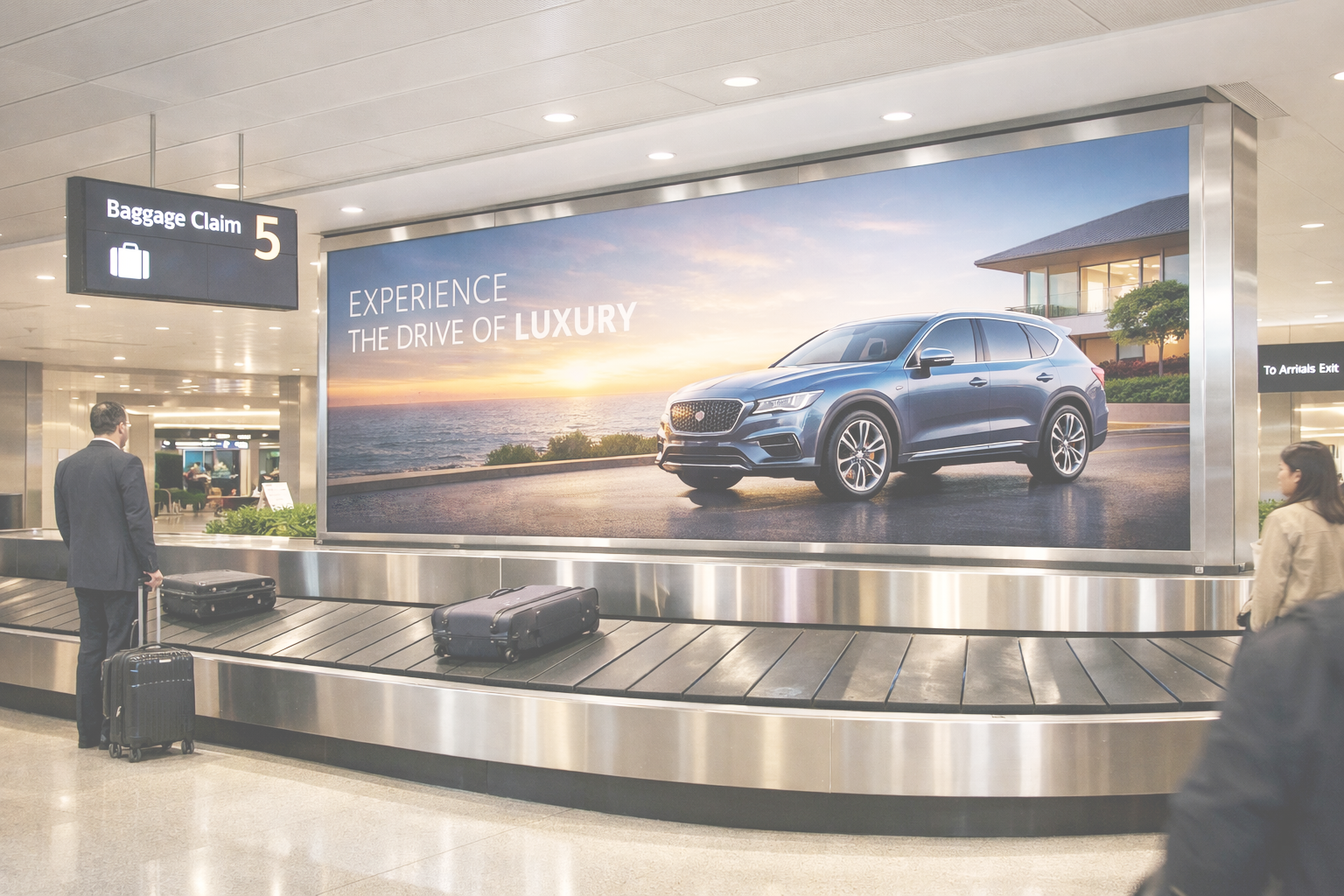
- Masscom Global provides precision inventory access at IXU covering departures hall, international check-in, arrivals corridor, baggage reclaim, and airside dwell zones, with full campaign execution support, creative compliance management, and performance reporting structured around the airport's dual seasonal peaks.
Strategic Advertising Fit
Best Fit:
- Gulf airlines, travel, and hospitality brands: The core audience of Gulf-bound passengers and returning NRIs makes IXU one of India's most concentrated placements for UAE, Qatar, and Oman-linked travel brands and destination advertising campaigns.
- International real estate developers (UAE, UK): Dubai and UK property developers with India-targeted investment programmes have a captive audience of pre-qualified, relationship-established HNI prospects at IXU who understand the product and actively seek the opportunity.
- NRI banking and remittance services: Banks with Gulf NRI products and remittance platforms have a mass-reach opportunity to engage the Marathwada diaspora audience at the precise moment of highest financial intent.
- Gold and jewellery brands: Gulf returnees are among India's highest per-capita gold purchasers during home visits; jewellery brands positioned in the arrivals corridor intercept this audience at peak conversion.
- Automotive brands — SUV and premium two-wheelers: The Bajaj Auto heartland catchment creates a natural home market for two-wheeler premium launches and SUV brand campaigns targeting Gulf NRIs who prioritise vehicle upgrades as a primary home-visit spend.
- Education consultancies and international universities: Canadian, Australian, and UK institutions targeting Marathwada's student-sending families have a high-relevance, undercovered channel at IXU with direct access to parents who are the primary financial decision-makers for international education.
- Heritage tourism, hotels, and luxury resorts: Brands serving the Ajanta-Ellora tourism circuit and Maharashtra's heritage hospitality sector have a natural fit with both inbound international tourists and domestic premium travellers transiting IXU.
- Insurance and wealth management: Gulf-income families with growing assets but a structural gap in formal financial planning represent a high-uptake audience for life insurance, health cover, mutual funds, and structured investment products.
Brand Alignment at a Glance:
| Category | Fit |
|---|---|
| Gulf airlines and UAE travel brands | Exceptional |
| NRI banking and remittance services | Exceptional |
| International real estate — UAE and UK | Exceptional |
| Gold and jewellery brands | Strong |
| Automotive — SUV and premium two-wheelers | Strong |
| Education consultancies and international universities | Strong |
| Heritage tourism and premium hospitality | Strong |
| Mass FMCG and commodity brands | Poor fit |
Who Should Not Advertise Here:
- Ultra-luxury fashion and couture (Hermès, Chanel tier): IXU's Medium-High HNWI classification lacks the ultra-HNI concentration these brands require; Mumbai, Delhi, and Bengaluru airports deliver significantly higher densities of the relevant audience.
- Mass-market FMCG with low price points: The aspirational, Gulf-exposed airport audience creates a contextual mismatch for commodity brands seeking high-impression-volume strategies at low cost; TV and rural print deliver superior economics for those categories.
- Enterprise B2B technology (global SaaS, ERP, cloud infrastructure): The business audience at IXU, while commercially valuable, lacks the CXO-level IT decision-maker concentration found at Hyderabad or Bengaluru airports; enterprise software campaigns are better routed to airports with higher corporate tech leadership density.
Event and Seasonality Analysis
- Event Strength: High
- Seasonality Strength: High
- Traffic Pattern: Dual-Peak (Heritage Tourism Season October-March; Gulf Diaspora Eid Windows March-April and June-July)
Strategic Implication:
IXU rewards advertisers who plan around its two distinct and commercially powerful seasonal rhythms: October to March for inbound UNESCO heritage tourism, domestic pilgrimage, and Diwali spending activation; and Eid windows in March-April and June-July for Gulf diaspora returnee commercial conversion. Campaigns structured across both peaks can achieve near-continuous premium audience presence for the cooler six months of the year. Masscom structures IXU campaigns around this dual rhythm, ensuring brands capture both the inbound heritage tourist and outbound diaspora segments during their respective peak commercial engagement moments. Brands that book for September — immediately before both the Diwali and Ajanta tourist peaks converge — capture the best available inventory at pre-peak rates.

Poor Placement and Delays Affect Airport Campaigns
We help you move faster, access better inventory, and get it right now.
Talk to an ExpertFinal Strategic Verdict
Aurangabad Chikkalthana Airport is India's most commercially underestimated regional airport, and the data makes the case without qualification. Its 0.9 million international passengers are not leisure flyers seeking beach holidays: they are Gulf diaspora with UAE-scale purchasing power returning to a Marathwada market where they are the dominant economic force, spending on real estate, gold, vehicles, and consumer goods in a concentrated two-to-three week window every visit. Layered onto this diaspora wealth dynamic is an internationally recognised UNESCO heritage corridor that brings high-spending European and Japanese tourists through a terminal where advertising competition is minimal and brand standout is proportionally outsized. The AURIC industrial zone investment, Bajaj Auto's global export manufacturing presence, the Grishneshwar Jyotirlinga pilgrimage economy, and the Shirdi Sai Baba devotee network further deepen a catchment that rewards precision advertisers willing to look beyond nominal city tier classifications. Brands that treat IXU as a budget Tier 2 placement miss the strategic point entirely: this is a wealth-corridor airport where cost-to-audience-quality ratio is among the most favourable in Maharashtra, and where Masscom Global provides the intelligence, inventory access, and campaign execution capability to activate the full opportunity before the market catches up.
About Masscom Global
Masscom Global is a premium international airport advertising and media buying agency operating across 140 countries. With deep expertise in airport OOH, premium publications, and high-net-worth audience targeting, Masscom helps brands reach the world's most valuable travellers at the moments that matter most. For advertising packages, media rates, and campaign planning at Aurangabad Chikkalthana Airport and airports across the globe, contact Masscom Global today.
Frequently Asked Questions
How much does airport advertising cost at Aurangabad Chikkalthana Airport?
Advertising costs at IXU vary based on format type (digital screens, static illuminated displays, experiential activations), placement zone (international departures hall, domestic arrivals, baggage reclaim, airside dwell areas), campaign duration, and seasonal demand during the October-March heritage peak and Eid diaspora windows. Peak season inventory commands a premium due to concentrated high-value audience traffic, particularly on Gulf routes during Eid al-Fitr. For current media rates, format availability, and campaign packages at IXU, contact Masscom Global directly for a customised proposal aligned to your campaign objectives and timing.
Who are the passengers at Aurangabad Chikkalthana Airport?
IXU's passenger mix is anchored by Gulf-based Indian diaspora from the Marathwada region, primarily travelling to and from the UAE, Qatar, Oman, and Bahrain. International inbound traffic includes heritage tourists from Japan, Europe, and North America visiting Ajanta and Ellora UNESCO World Heritage Sites, one of the most globally recognised archaeological destinations in Asia. Domestic pilgrimage travellers visiting Grishneshwar Jyotirlinga and Shirdi represent a consistent year-round volume, and business travellers from Aurangabad's automotive, pharmaceutical, and agribusiness economy complete a commercially layered passenger profile that covers aspiration, devotion, wealth transfer, and commercial intent simultaneously.
Is Aurangabad Chikkalthana Airport good for luxury brand advertising?
IXU is well-suited for aspirational and lifestyle-premium brands targeting Gulf-exposed NRIs and returning diaspora with UAE-scale spending patterns. The airport scores Medium-High on the HNWI index, making it an appropriate channel for gold and jewellery, premium automotive, international real estate, NRI banking, and heritage travel brands. Ultra-luxury fashion at the Hermès or Chanel tier will find limited critical mass here; those brands perform better at Mumbai, Delhi, or Bengaluru. For brands in the aspirational premium tier, including Dubai property, premium vehicles, structured investment products, and international education services, IXU offers strong audience fit combined with cost efficiency that metro airports cannot match.
What is the best airport in Maharashtra to reach Gulf diaspora NRI audiences?
Aurangabad IXU is the most targeted channel for Maharashtra's Gulf diaspora from the Marathwada belt. Mumbai's airport handles a higher absolute NRI volume across all regions, but IXU provides concentrated, catchment-specific access to the Marathwada-Gulf corridor, a community with high remittance inflows, active real estate investment intent, and strong on-visit consumer spending, at a fraction of Mumbai's media cost. For brands whose primary objective is cost-per-qualified-contact among returning Gulf NRIs rather than total impression volume, IXU is the more efficient buy in Maharashtra.
What is the best time to advertise at Aurangabad Chikkalthana Airport?
Two windows deliver peak ROI at IXU. October to March captures the UNESCO heritage tourism season, Diwali consumer activation, and the arrival of high-spending international tourists during India's optimal travel months. The Eid al-Fitr window in March-April captures Gulf diaspora returnees at their highest single annual spend moment, when gold, real estate, consumer goods, and vehicle purchases are made in concentrated bursts. September is the optimal booking window for brands wanting confirmed premium inventory before both peaks arrive simultaneously, at pre-peak rate levels.
Can international real estate developers advertise at Aurangabad Chikkalthana Airport?
Yes, and IXU is one of India's most targeted placements for UAE real estate developers with Indian investor programmes. The airport serves a passenger base that has established UAE banking relationships, existing residency experience, and active interest in Dubai property for yield, capital appreciation, and Golden Visa eligibility. Developers marketing AED 2 million-plus properties in Dubai South, Jumeirah Village Circle, or Business Bay will find a pre-qualified, relationship-ready audience at IXU who understand the UAE property market from lived experience. UK developers targeting the Muslim community with investment-grade residential property in Birmingham or Manchester also have a directly relevant and commercially receptive audience here.
Which brands should not advertise at Aurangabad Chikkalthana Airport?
Ultra-luxury fashion houses at the Hermès or Chanel tier will find insufficient ultra-HNI audience concentration at IXU's Medium-High HNWI classification; those campaigns are better placed at India's metro hub airports. Mass-market FMCG brands seeking high-volume impression reach at low CPM will achieve superior economics through television and rural print, which are structurally better suited to commodity brand strategies. Enterprise B2B technology brands targeting IT infrastructure and ERP decision-makers will find higher concentrations of the relevant corporate leadership audience at Hyderabad or Bengaluru airports than at IXU.
How does Masscom Global help brands advertise at Aurangabad Chikkalthana Airport?
Masscom Global delivers end-to-end airport advertising at IXU, from audience intelligence and strategic campaign planning to media buying, creative placement, execution management, and performance reporting. With operations across 140 countries, Masscom extends IXU campaigns across the full India-Gulf corridor, engaging the Marathwada diaspora audience at Dubai, Sharjah, Muscat, and Doha airports in the same campaign cycle for a complete bilateral strategy that no single-market media buyer can replicate.